VICE: From ISIS to The Islamic State

Flag_of_the_Islamic_State_in_Iraq_and_the_Levant.svgVICE – The Islamic State, a hardline Sunni jihadist group that formerly had ties to al Qaeda, has conquered large swathes of Iraq and Syria. Previously known as the Islamic State of Iraq and Syria (ISIS), the group has announced their intention to reestablish the caliphate and declared their leader, the shadowy Abu Bakr al-Baghdadi, as the caliph.

Flush with cash and US weapons seized during recent advances in Iraq, the Islamic State’s expansion shows no sign of slowing down. In the first week of August alone, Islamic State fighters have taken over new areas in northern Iraq, encroaching on Kurdish territory and sending Christians and other minorities fleeing as reports of massacres emerged.

Elsewhere in territory it has held for some time, the Islamic State has gone about consolidating power and setting up a government dictated by Sharia law. While the world may not recognize the Islamic State, in the Syrian city of Raqqa, the group is already in the process of building a functioning regime.

VICE News reporter Medyan Dairieh spent three weeks embedded with the Islamic State, gaining unprecedented access to the group in Iraq and Syria as the first and only journalist to document its inner workings. In part one, Dairieh heads to the frontline in Raqqa, where Islamic State fighters are laying siege to the Syrian Army’s division 17 base.


VICE: From ISIS to The Islamic State

**

Phyllis Bennis, Director at the Institute for Policy Studies, discusses ISIS’ roots, tactics, goals and how the group can be stopped without blowing up more of Iraq on Breaking the Set.

Segment starts at 2:40:

Breaking the Set on ISIS End Game

***

Follow @VICE@AbbyMartin

Abby Martin on The Joe Rogan Experience & Larry King’s Politicking

JoeRoganJoe Rogan defines new media. He’s a comedian, MMA fighter and former Fear Factor host who also pioneered The Joe Rogan Experience (JRE), a wildly popular podcast featuring an eclectic variety of fascinating and unfiltered guests. Because he runs the project, there are absolutely no constraints, censorship nor shady corporate sponsorship.

I was honored to join Joe recently for an in-depth discussion about a range of issues including the Gaza massacre, Gitmo, NSA spying, Fukushima, Big Pharma & much more. Many fucks are said, so if you’re offended by swearing please skip the broadcast.


The Joe Rogan Experience with Abby Martin

**

Larry King and I have had strong differences in the past about what defines a journalist, so I was lucky to be invited on his show to share my perspective on the two-party dictatorship, stop-and-frisk and new media.

Abby Martin Faces Off with Larry King on Dinosaur Media

**

I also recently joined Kevin Pereira, hilarious host of the Pointless Podcast, to talk about a whole host of craziness.

Follow me at @AbbyMartin

‘Human Shield’ Propaganda Used to Justify State-Sponsored Massacres for Decades

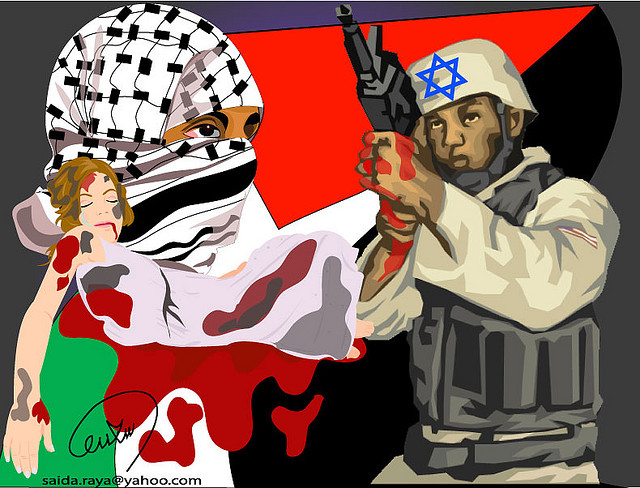
gazaflickrzoom_artbrushIt’s been three weeks since Israel launched its bombing campaign and subsequent invasion of the Gaza strip. According to the Palestinian Health Ministry, over 1,500 Palestinians have been killed and over 6,500 have been wounded in what has become one of the bloodiest offensives ever launched in the region.

The overwhelming majority of casualties are civilians. On the contrary, three Israeli civilians have died due to Hamas launched rockets and 56 IDF soldiers have lost their lives. Over the last four days Israel has bombed more than 70 sites, including Gaza’s  power plant, the only provider of electricity to the 45 mile territory’s 1.8 million citizens. Additionally, Israel has targeted and shelled dozens of medical facilities, refugee centers and is wiping out entire families every day.

Yet despite the extreme disproportionality of this ongoing massacre, there are still thousands of people vehemently defending Israel’s right to self-defense. According to Israel and its defenders, the skyrocketing Gaza death toll should be blamed on the Palestinians for committing “self-genocide” by putting themselves in the line of fire. And the crux of this perversion of reality all stems back to one single, extremely loaded talking point: human shields.


Abby Martin Dissects the ‘Human Shield’ Propaganda Talking Point

**
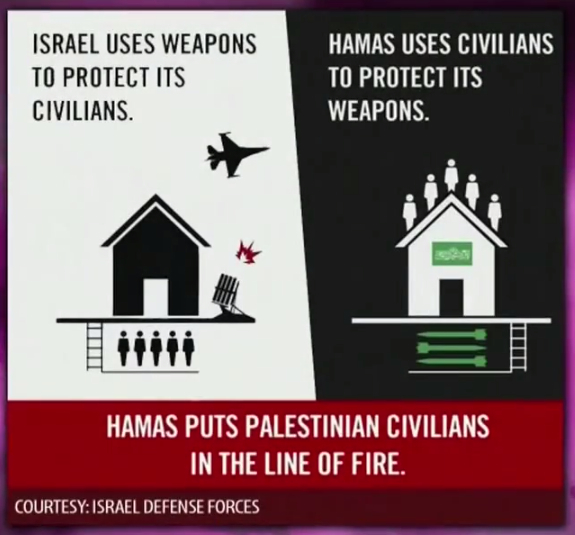
IDF infographicFrom speeches and media appearances to incessant info-graphics, the human shield claim has been used as the crux of Israeli propaganda to absolve its government of any accountability.

There’s only one problem. Besides rockets found in an abandoned school, there’s been no evidence to back up the claim that is regurgitated without question across the media establishment. The pro-Israel talking point has been so repetitive that some critics, like Max Blumenthal have sarcastically suggested that “Hamas must be hiding rockets inside Palestinian children.”

On the ground journalists have corroborated the baseless nature of this claim. According to an article titled the ‘Myth of Hamas Human Shields,’

“Some Gazans have admitted they were afraid of criticizing Hamas, but none have said they have been forced by the organization to stay in places of danger and become unwilling human shields…”

The unsettling reality is that for many Palestinians there is simply nowhere to go. The strip of land they live on is about 45 miles long and is one of the most densely populated places on earth. It’s borders are closed (immediately following the siege, Egypt closed it’s Rafah border crossing into the Gaza strip) and many people have made the decision to stay inside their own homes instead of trying to evade death on the streets.

Amazingly, despite the loaded term being parroted to absolve Israel of its blatant war crimes, one entity that has systematically used human beings as shields is Israel, and here are just three examples documented in the past five years:

Israeli soldiers use civilians as human shields in Beit Hanun
Israeli soldiers who used Palestinian boy, 9, as a human shield avoid jail
Palestinian Children Tortured, Used As Shields By Israel, UN Says

Using human beings as shields or conducting military operations from civilian areas is an undeniably cruel and inhumane tactic that stands in violation of the Geneva Conventions, which is exactly why it’s consistently projected to demonize the enemy.

Other countless propaganda points have aimed to do the same from ‘these people cut people’s heads off’ in reaction to the Nick Berg beheading to ‘they throw acid in women’s faces’ in response to the acid attacks in the Muslim world.

The establishment wants you to look at these people, and think they want to die, they encourage death; they have such little value for life they actually shield themselves with other civilians, including children. It’s the oldest trick in the book to make people feel the massacre they’re sponsoring is justified. This is exactly what’s unfolding in Gaza, and as a result the indiscriminate bloodshed is not seen as horrendous or even deliberate by the majority of people. Instead it’s shrugged off as “what are coalition forces supposed to do when enemies are firing at them hiding behind civilians?”

Israeli society even has a word for this technique, Hasbara. In Hebrew it literally translates to “an explanation” but 972 Mag gives us the modern definition:

“A form of propaganda aimed at an international audience, primarily, but not exclusively, in western countries. It is meant to influence the conversation in a way that positively portrays Israeli political moves and policies, including actions undertaken by Israel in the past. Often Hasbara efforts includes a negative portrayal of the Arabs and especially of Palestinians.”


How Israel Uses Hasbara on Social Media to Legitimize Murder 

**

This framework is used to build cases against nation states the US and Israeli government wants to topple. And the magical talking point is the enemy’s use of human shields.

One has to look no further than the infamous Bin Laden compound raid by Seal Team Six, where US officials claimed he was using his wives as human shields when he was shot. But when all was lied and done, officials were forced to admit that there was no use of human shields. In fact, according to the official narrative, the world’s most wanted man wasn’t even armed when he was allegedly executed.

Shortly after the Bin Laden raid, Pakistani Assistant Political Agent Javid Khan told the Inter Press Service “The [Taliban] militants [in Pakistan] have been using civilians as human shields.” Three years later, Khan would be accused of leading an armed militia into a Pakistani neighborhood which threatened an elderly woman at gunpoint.

But it’s not just Bin Laden and Pakistan. Nearly every major world conflict or war involving the US in the last 60 years has included this argument. In Libya, despite Gaddafi being boys with US politicians just the year prior to the NATO bombing campaign, the human shield talking point was used ad nauseum. Yet the only uncorroborated citation of this was through the same NATO supported rebel fighters that ultimately ousted Gaddafi, killing and sodomizing him with a metal pole.
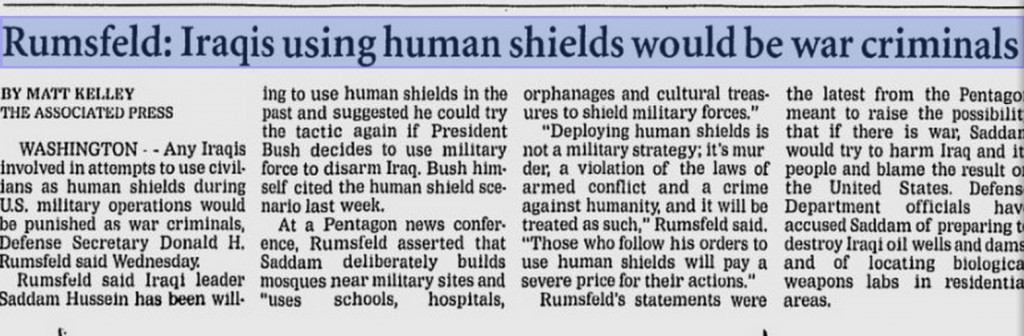
RumsfeldIraqHumanShields

Bangor Daily News: Feb 20, 2003

Leading up to the Iraq war, Bush also included the human shield talking point as a main tenant of his campaign to oust Saddam. There is evidence of Saddam holding people hostage near military targets during the invasion of Kuwait. However, like much of the Bush era propaganda which inflated kernels of truth into a hysterical echo-chamber, little evidence exists of a systematic use of human shields during his reign. Of course, a lack of evidence didn’t stop Bush’s cabinet from fear-mongering the world about Saddam’s allegedly long history of devaluing human life through the use of human shields or gassing his own people by weapons provided to him by the US government.
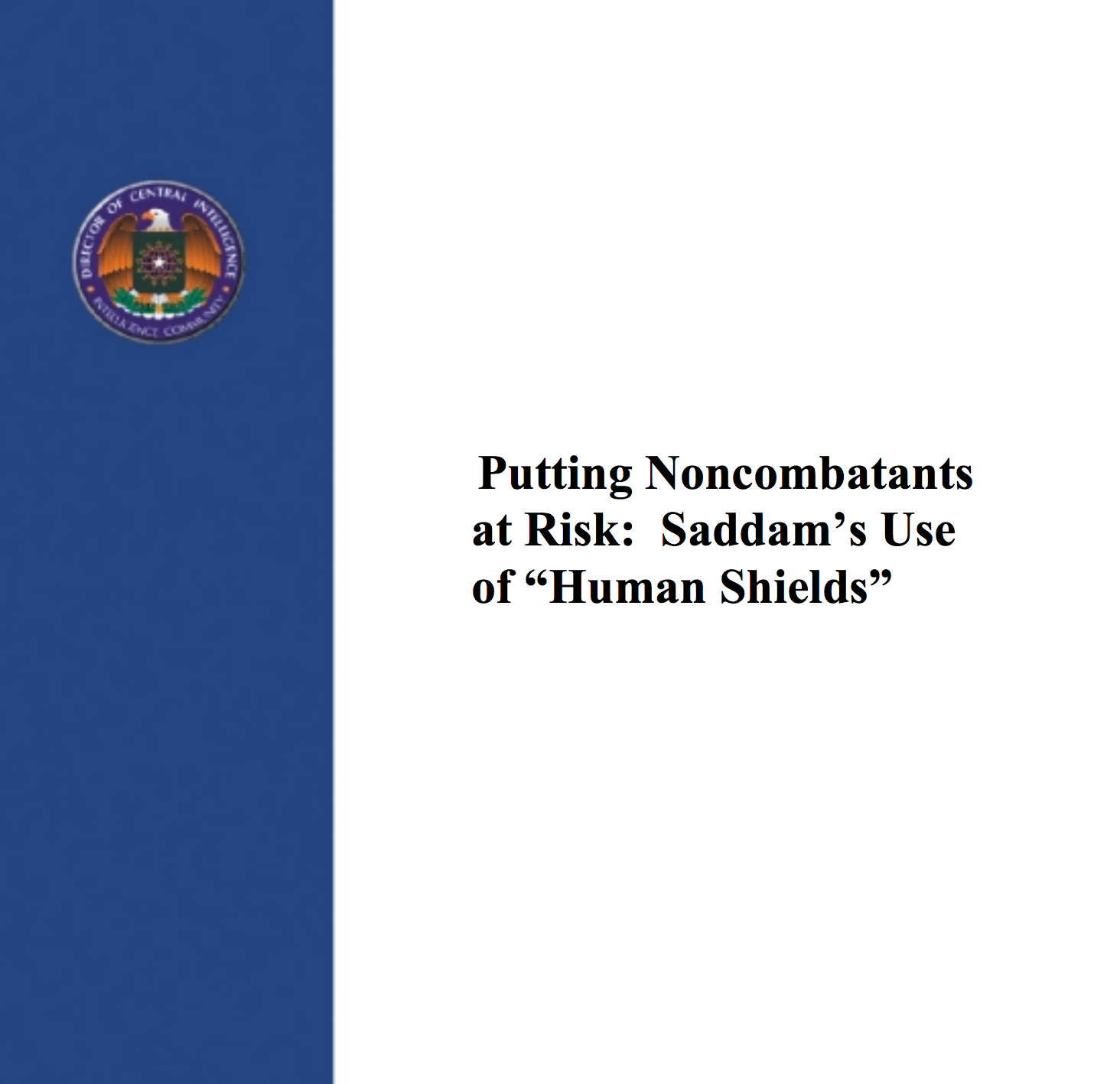
CIASaddamHumanShieldDuring the height of the US propaganda push for a second unjustified war, a lengthy CIA document was dedicated to Saddam’s use of human shields. In the document, the Bush administration tried to preemptively justify the mass civilian death toll they knew was certain to come by saying the Iraqi dictator plans to shield his military and blame coalition forces for civilian casualties that Saddam has caused.

After Paul Bremer, Iraq’s Civil Occupation Governor, announced Saddam’s capture, his spokesperson, Dan Senor, conveniently transferred the human shields talking point to the independent insurgents that took the place of Saddam’s army.
Kentucky New Era:  Dec 1, 2006

Kentucky New Era: Dec 1, 2006

The propaganda was modified so that the human shield claim could be used to justify hitting civilian targets. If an American soldier bombed or shot at a Mosque resulting in the deaths of civilians, the immediate retort from Senor was a variant of “they are using places of worship to stockpile weapons.”


Moving on to Afghanistan, where Taliban militants were accused of using civilians as human shields, according to government officials. Yet again, another narrative spun by the military with little evidence used as a cover for mass civilian casualties.

Despite the frequency of this term being applied in a post-9/11 world, it has been long practiced before the so-called War on Terror. Searching through print newspaper archives you can find the use of human shields applied to virtually every enemy involved in a military conflict with the US.

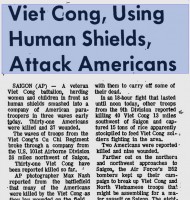
During the Vietnam war, the Viet Cong was accused of using defenseless civilians as human shields.
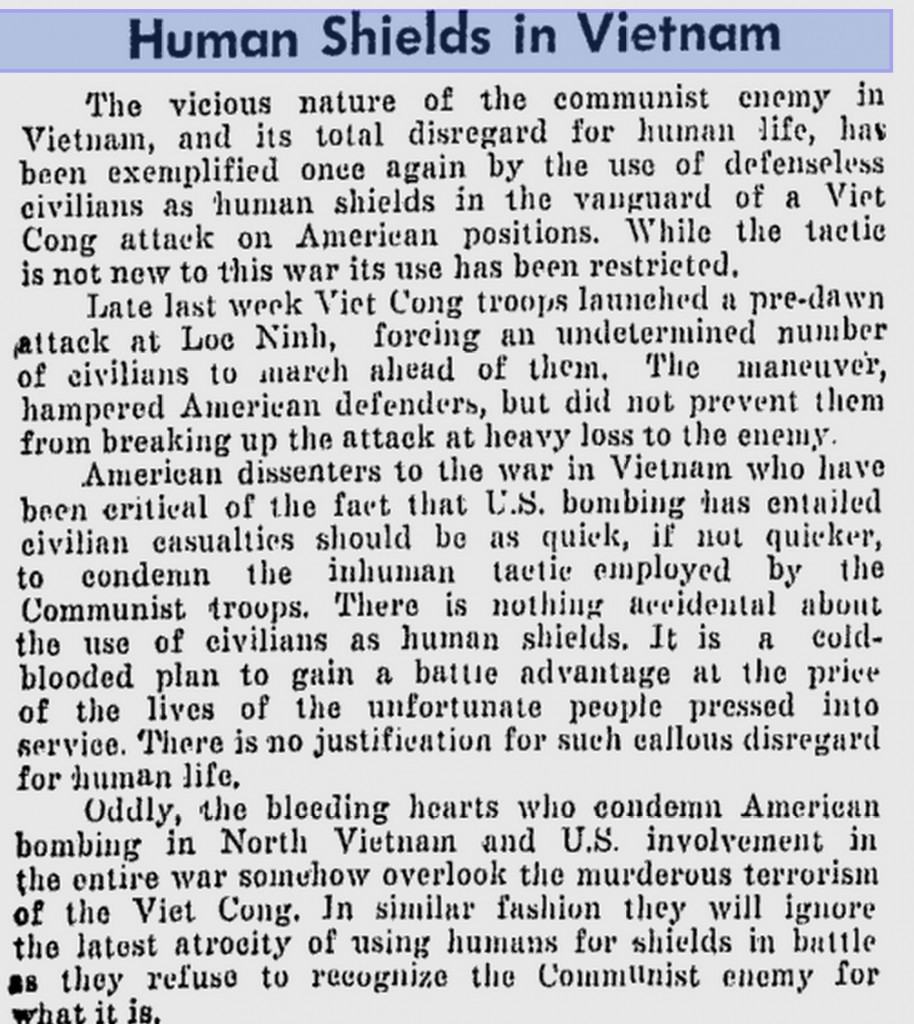
VietnamHumanShield

Lewiston Daily Sun Nov 6, 1967

Vietconghumanshield

The Free Lance-Star: Sep 6, 1968

During the Korean war, the North Koreans were described similarly, but with even cruder 1950’s slang.
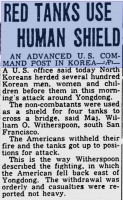
Koreahumanshields

Sarasota Herald-Tribune: Jul 26, 1950

Koreahumanshields2

The Milwaukee Journal: Jul 26, 1950

Even during World War II, the Nazis and Japanese army were accused of doing the same. 
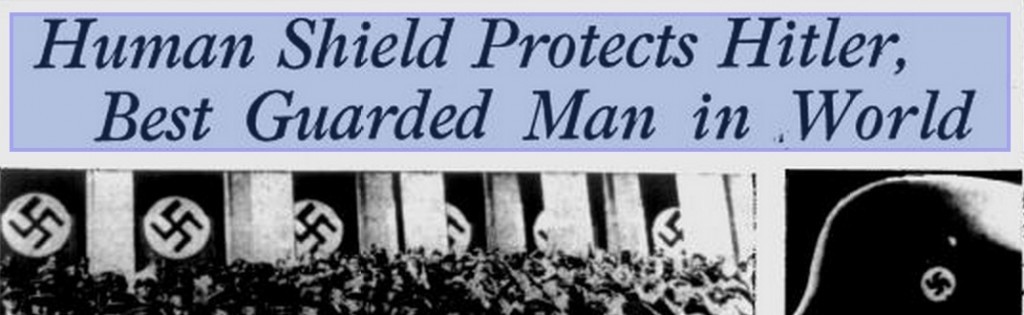
HitlerHumanShield

The Evening Independent: Nov 17, 1939

The further one goes back in the historical record, the more difficult it is to verify or debunk the veracity of these claims. But the propaganda has served the same purpose – to dehumanize entire populations. In almost every instance, the enemy was painted as having zero regard for human life, making it easier for nations like the US to blow up countries, desecrate culture, torture, slaughter, and hold thousands of people indefinitely without charges.

Francis Fukuyama, influential DC neoconservative and co-sponsor of PNAC’s ‘Rebuilding America’s Defenses’ displayed a rare moment of candor when he admitted that modern American foreign policy is even inspired by Israeli Hasbara: 

“Many Neoconservatives have adopted the point of view, the strategic prism of many hardliners on the Israeli right, including their interpretation of Arab motives and behavior, this idea that the Arabs don’t understand any principles of legitimacy, its only force that they respect.”

Every society, culture and country has extreme aspects to it, and Muslims are no different. But taking the most severe scenario that exists and exploiting it to generalize an entire demographic is extremely disingenuous and frankly, racist. When these terms are used, it paints Muslims, Arabs or Palestinians as monsters, ignoring that we’re all human beings, bleeding the same blood, feeling the same pain and suffering the loss of our loved ones just the same.

Written by Abby and Robbie Martin

Follow @AbbyMartin & @fluorescentgrey

Photo by flickr user Zoom_Airbrush

Posted in Uncategorized | 1 Reply

American Drug War Creator on Addiction, Prohibition & the “Green Rush”

MarijuanaPhotobyKayVee.INC_.jpgAs costly as it is ineffective, America’s prohibition on illegal drugs is a contentious subject the corporate media keeps at arm’s length.
Documentarian Kevin Booth is the director of several films that scrutinise America’s dubious relationship with drugs and suggest that illegal trafficking is embedded in the US economy.

As arrests are hastily made for the possession of marijuana – which is proven to have countless medical benefits, people are bombarded with advertisements for alcohol and cigarettes. Booth’s films bring attention to the profit holding priority over public health with big pharma and private prisons reaping substantial benefits to the detriment of patients whose lives could be vastly improved by medical marijuana.


American Drug War: The Last White Hope

**

Booth has lost close friends and family members to legal drug addiction amongst whom include Bill Hicks, legendary comic whose outrage with the establishment’s hypocrisy on drugs paralleled Booth’s. Their shared worldview fueled them to create Sacred Cow Productions which has since produced a host of eye-opening documentaries including American Drug War 2: Cannabis Destiny and How Weed Won the West.

With Colorado recently legalising cannabis and Washington close to follow, it’s due time for the US to review its classification of marijuana. Filmmakers like Kevin Booth deserve worldwide recognition, and we were lucky to sit down with him for an interview with Media Roots.

**

MR: I recently saw a video where you and Bill Hicks are on site covering the Waco massacre in 1993. Is that where your filmmaking career kicked off?

KB: That was in 92. I started shooting in 84. I sold cocaine in order to buy my first video camera all the way back in 1984. In Austin, Texas, they a public access channel which would allow first time filmmakers or people that made videos to able to put videos out that they made up on Austin access which was channel ten on the regular cable vision. If you had basic cable in Austin you would actually get Austin access channel ten. I became a producer for that and that was all the way back in the mid-eighties. Around the same time my band got a record contract with Chrysalis records was actually out of England, they did Jethro Tull who was one of the first bands out of Chrysalis records. I helped do a music video that was on MTV and that’s what really kind got me pushed through into this more seriously. Up until then I thought I was going to be a musician and I just did video as a hobby, and then once I did this help on the music video for MTV I got the bug. I started getting more interested in cameras than I was into guitars. Bill and I did a karate movie called, Ninja Bachelor Party – we started that all the way back in 85. I did a lot of videos before the Waco thing.

My background was first in music then in comedy and then going into documentaries wasn’t until after Bill died. Alex Jones as a conspiracy guy was just getting started up at the Austin access channel up at the time and like you said I did that video with Bill up at Waco. Alex was just this young guy starting off and he was doing some stuff with Waco, in fact he was trying to raise money to help the Branch Davidians rebuild the church and so I started to travel to Waco with him and started filming him up at Waco. That kind of led me into working on my first real documentary with working together with Alex Jones. I worked on several documentaries with Alex for a while until we kind of had a clash of personalities. I wanted to kind of be able to do my own which what led me to do American Drug War besides other personal reasons.

MR: Talk about your reasons for setting out to make films.

KB: At the time I had lost Bill to legal drugs. There’s no proof but Bill was such a heavy, horrible smoker and abused his body horribly with alcohol and cigarettes then my brother died in 97 from having a seizure from pharmaceutical drugs. He was a schizophrenic and was actually court ordered to take anti schizophrenic medication which gave him a seizure. My mom and dad were both alcoholics, my dad he died of throat cancer from cigarettes that he had smoked when he was way younger and my mom died of liver complications so I kind of looked at it like I had lost all my friends and family to legal drugs of alcohol, tobacco and pharmaceutical. A close friend of mine by the name of Mambo Johnny he went to a prison camp for two years for just growing marijuana and then when he got out of this prison camp he died from complications or some disease he got while he was in this prison. Around the same time George Bush was on TV saying, ‘If you buy drugs then you support terrorism.’  All that together made me think decide to put everything I have together to make a documentary about the drug war.

MR: How has the reaction been to your work?

KB: It’s been really great. When the first one came out on Showtime in 2008 I got probably one hundred emails a week from people sharing their stories of drug addiction or their stories of being arrested and how much they appreciate me shedding light on the topic – pretty much all positive reactions. The very few people that have anything negative to say to me will usually just do it on comments, they don’t ever do it face to face. They’ll hide behind their computer if they have anything mean to say to me.

MR: There’s psychoactive properties of some drugs that would make them dangerous, if not life threatening for some people. Personally, I can understand why drugs like LSD are illegal.

KB: Yeah, Bill had a joke about that, how Art Linklater’s daughter took acid and jumped off a building. His joke was would be like, ‘Well, you don’t see ducks lined up to take elevators. If you thought you could fly take off from the ground first! Don’t blame acid on this fucking dumb ass!’  If you take drugs and run into a wall…No, I get it.

Some people watch these films and they don’t really totally get it. Their knee jerk reaction is to think that I’m just out there promoting drug use and it couldn’t be further from the truth. I’m actually kind of conservative!  When I go to some of these pro-legalisation rallies and I have to interact with a lot of these people, I run into a lot of them that say everything should be legal – crystal meth, PCP should be legal ,legal, legal..I have to be honest and say I have a hard time with that. There really does need to be a line.

The problem always comes in to what should be against the law and I think it should be your actions need to be against the law, not ingesting a chemical. If you’re selling drugs to children then that should be against the law. I wish there was a way for people who wanted to do cocaine responsibly in their home to be able to get legally controlled substances.  It’s like when you hear the thing about Phillip Seymour Hoffman dying, right? Most likely what killed him was that he probably got hold of something that was a lot stronger than what he was used to. I think that most of the deaths that are related to illegal drugs have to do with a lack of control. There are more deaths in this country right now from Tylenol than there are from heroin and meth and all these other illegal drugs combined. Of course there’s no deaths from marijuana but when you look at the deaths that happen from illegal drugs it does have to do with the lack of control.

I don’t believe that everybody should be able get everything but I think that if you’re a responsible adult and you want to work through certain channels say you want to be able to take a hit of ecstasy with your wife in the privacy of your own home, have a shared experience maybe you could go to a certain doctor or psychiatrist. They found that it’s really good as a marriage counseling drug. We worked with these people that were doing ecstasy when someone was going to die, like a wife was about to lose a partner they would take ecstasy together and have these amazing experiences before they die. There’s a lot of therapeutic benefits to it all but if someone wants to do it they have to go get it from some scummy person off the streets and that’s what really screws it up. I wish that I could try cocoa leaves for example. I think it would be amazing if I could try chewing on some cocoa leaves like god intended, I mean wouldn’t that be awesome? I’ll never get to do that, all I get to do is do this thing called cocaine that is a powerful chemical derivative that’s very dangerous because you have no idea what people are mixing it with in the jungle to get it across the border. It’s a very cloudy issue.

MR: Has your view on drugs changed since putting out the first film?

KB: My reaction from putting out these movies and the reaction I got is that I’ve probably actually gotten a little conservative with what I think is reasonable. Now that marijuana is legal in Colorado, case in point, I’ve been going to Denver since Colorado has been legalised and I have to be honest it’s a little over board. It’s fun, don’t get me wrong. It’s probably how Chicago was when prohibition ended and people were dancing and drinking in the streets. Now everybody’s ‘Dabbing’ – I don’t know if you know what dabbing is?  Everybody’s smoking these big pipes using blow torches and smoking this really powerful form of marijuana extract. Everywhere you go everybody’s is smoking this and when I see that in Denver I go, ‘Oh my god, when the rest of the country sees this it’s really going to hurt the legalisation!’

People always have to take things too far, you know what I mean? It’s kind of human nature, it’s the blow back from all the years of it being illegal too that people are always going to take things to the far extremes. I’m all for responsible use, I’m all for people being sober when they drive. Then again I believe that alcohol probably is one of the most horrific drugs out there when it comes to making people act like idiots and do really stupid things, acting violent, driving bad, doing dumb things. I think that alcohol is at the very top of the list as one of the most dangerous drugs out there. It’s just amazing to me that I can go to the grocery store and there are bottles of Jack Daniels and tequila right there! If I drunk that I would lose my mind! There’s just so much hypocrisy.

MR: What do you think would be the immediate effects of nationwide cannabis legalisation?

KB: You can look at what’s going on in Colorado right now. Colorado is having a real boom. I’m getting ready to go to a conference of billionaire investors who are all flocking around Colorado to see how they can get involved in the emerging legal cannabis business. Looking at what’s going on in Colorado around the cannabis industry right now is a little indicator of what could happen across the rest of the country. Now of course I’m not talking about legalising cocaine or any of those things, though wouldn’t it be cool if you could grow poppy plants in your back garden? Of course I’m not advocating that you have some big lab or something like that. Anytime you’ve got people mixing dangerous chemicals, that should be illegal. It should probably be illegal to set up a laboratory of flammable explosive things, you know? I don’t think it should be illegal to grow and consume anything. I guess where I draw the line is at nature.  If it grows out of the ground then you should be able to plant it and consume it. If it takes chemistry to do it then yeah, maybe the law should step in.

MR: One fascinating aspect of your films is how deeply embedded the drug market is in American economics, for example the CIA drug running.

KB: You can look at what’s going on right now. We could flash to Afghanistan and the reason why the military is still there. A lot of people believe we are still there basically protecting the opium and the heroin. Right now there’s huge resurgence. There’s stories on the news that are like, ‘Wow, heroin is really having a big resurgence in America!’ and they never connect the dots like, ‘Oh, yeah! That Afghanistan thing!’ They never connect those dots! Another fascinating thing that no one ever talks about is the banks and the money laundering taking place. Anyone can see for themselves if they go to Google maps – go to the Texas border and type in ‘banks’ and zoom in and look at the Mexican border – it’s fascinating to see all the banks. There are so many banks along the border in these border towns. Not only that, there are so many of these weird foreign banks with these names that you’ve never heard of and it’s all just money laundering. Then again other big mainstream banks get caught doing it being knowingly involved in money laundering for cartels and, you know, no one ever goes to jail. Nothing ever happens to the big guys it’s just all the little people that get sent to jail.

MR: What’s next for you?

KB: After doing Cancer in Kids I need to take a break from the seriousness. I’m moving off and getting back into my comedy roots a little bit. One of the documentary projects I’m working on is kind of showing some of the corruption in the marijuana industry – some of the more high end corruption. There are a lot of big companies that are now coming out of the industry and I don’t know if you realise this but a lot of them are actually being publicly traded. Although a lot of them are really great, some of them in my opinion are fraudulent. People when they think about marijuana they think of hippies, peace and love but some of the people in the marijuana industry are some of the most cutthroat people I’ve ever been around. It’s a whole another level. We’re not talking about just drug dealers any more, we’re talking about an industry that is not quite regulated by the government yet but it has been legitimised by the fact that they’ve legalised it in two states!

So you’ve got two out of fifty states that have legalised it, so in a way the government has said, ‘Okay, yeah so it’s illegal’, although people are being arrested in these forty eight states. Meanwhile you have not only the good people like rich investors from all over the world. Tokyo, Germany, Switzerland rushing to Colorado to figure out how they can invest in this thing to get in on it early, you also have a lot of scummy, fly by night, get-rich-quick schemer type people. They call it ‘the green rush’ and in my opinion it really is like a modern day gold rush, because so many people have this idea of easy money and dollar signs in their eyes. I’m working on a documentary that’s going to look at that and a lot of its humorous so it’s going to be more of a comical documentary, because in my mind, once you enter into the world of trying to get rich overnight then it’s all fair. I can’t feel sorry for you if get screwed when you’re trying to get rich overnight. It kind of all becomes comedy to me at a certain point with people scamming each other. I’m also working on a scripted show that’s going to based on the same thing. None of them are drop dead serious. It’s more in the vein of comedy.

Written and transcribed by Aaron Williams, photo by Kayvee Inc.

And to The Oligarchy, for Which it Stands

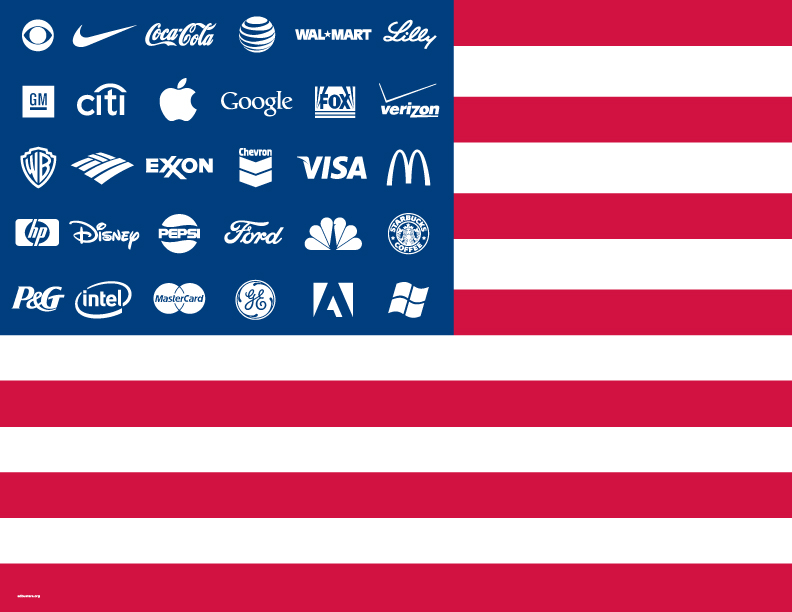
adbusters_corporate_flagAsk a group of people what form of government the United States has and you’ll be met with varied replies. Some insist it’s a democracy, others maintain it’s a republic, democratic republic, or constitutional republic.

Technically, the US Government was founded as a constitutional republic where representatives are democratically elected. However, this definition only typifies the government at its inception. As history has shown in abundance, governments are dynamic—they rise, fall and transform with time. When this occurs gradually, it’s not always clear that a fundamental and often dangerous transition has taken place.

In recent years, the idea that the US government is now an oligarchy, or corporatocracy, has gained traction. An oligarchy is a government “in which all power is vested in a few persons or in a dominant class or clique.” A corporatocracy, therefore, defines that dominant class as consisting of corporate interests.

It’s not hard to see why this term is increasingly being applied to the US, where corporate lobbying is used to buy political leverage, and Congress acts as the fulcrum to carry out this advantage with legislation. The incomes of the super wealthy have grown exponentially in relation to that of the average citizen, and their ability to displace the average voice has grown in tandem.

Even elite institutions are putting out research to back this claim. A recent study conducted by Princeton and Northwestern University called “Testing Theories of American Politics: Elites, Interest Groups, and Average Citizens” measured influence on policy by examining 1,779 policy issues occurring between 1981-2002. Four groups were considered in the analysis: average citizens, economic elites, mass-based interest groups, and corporate interest groups, concluding (emphasis added):

“Multivariate analysis indicates that economic elites and organized groups representing business interests have substantial independent impacts on U.S. government policy, while average citizens and mass-based interest groups have little or no independent influence.”

The study alone doesn’t definitively prove corporate rule, and its authors admit their analytical test should be interpreted in a “tentative and preliminary” fashion. However, absence of “smoking-gun” proof does not suggest absence of oligarchic rule. The empirical data clearly shows that the US government has ceased to represent the people in favor of economic elites.

Examples of corporate hegemony abound:

*The Affordable Care Act was written and implemented by Elizabeth Fowler, former Vice President of Public Policy and External Affairs at WellPoint, the nation’s largest health insurance provider. No surprise, the legislation mandated that everyone purchase private health insurance, inking into law a huge advantage for the industry. One more trip through the revolving door returned her to the pharmaceutical industry to reap the rewards.

*State initiatives for mandatory labeling of GMO foods have been repeatedly stamped out by the propaganda boot of the Grocery Manufacturers of America (GMA) lobbying group, headed by Monsanto and DuPont, despite 91% of public support for GMO labeling (see Initiative 522 in Washington, Prop 37 in California). In May, Vermont passed a GMO labeling bill, only to be immediately sued by the GMA in an attempt to block the law from being implemented. If this wasn’t enough, these giants, plus Koch Industries, are now attempting to preempt the chaos of people knowing what they’re eating with federal legislation to supersede state labeling laws.

*The government bailout of “too big to fail” banks after the housing collapse transferred massive wealth from the taxpayers to the banks, with no disclosure of where the money was going and no arrests for anyone involved in the lead-up to the crisis. In fact, the US Treasury approved executive bonuses for bailed-out bank CEOs, while millions of Americans foreclosed on their homes.

*Bills overtly written by corporate lobbyists constitute a staggering proportion of legislation passed, as exemplified by an analysis of California’s 2007-2008 legislative period. Furthermore, lobbyists are de-registering from the system, limiting the ability to keep track of the extent of corporate influence.

Recently, Senator Bernie Sanders confronted Federal Reserve chairwoman Janet Yellen with statistics suggesting the US had shifted from a capitalist democracy (another misnomer) to an oligarchic form of government. Yellen replied that the statistics shared by the Senator greatly concern her. However, in a deluge of irony, her solution was that these concerns should be brought to the policymakers; the same policymakers seated at the crux of this problem. Because if Congress won’t listen, try asking Congress.

Face it—we live in a corporatocracy.

Consistently low approvals of Congress and the popularity of the Occupy Wall Street movement suggest the average person grasps the nature of the problem, but the magnitude of the corruption hasn’t yet seeped into the public consciousness. Only six corporations control 90% of what Americans see, hear and read, which adds to the disconnect between what the government is doing and what people perceive it as doing on their behalf. Many prefer to see each act of corruption as an isolated incident, rather than a series of interrelated and escalating incidents reflecting a severe systemic deficiency. This cognitive dissonance must be addressed head-on if we ever want to pry ourselves from the government’s corporate clutches.

Written by Marc Frey for Media Roots, Photo by Adbusters