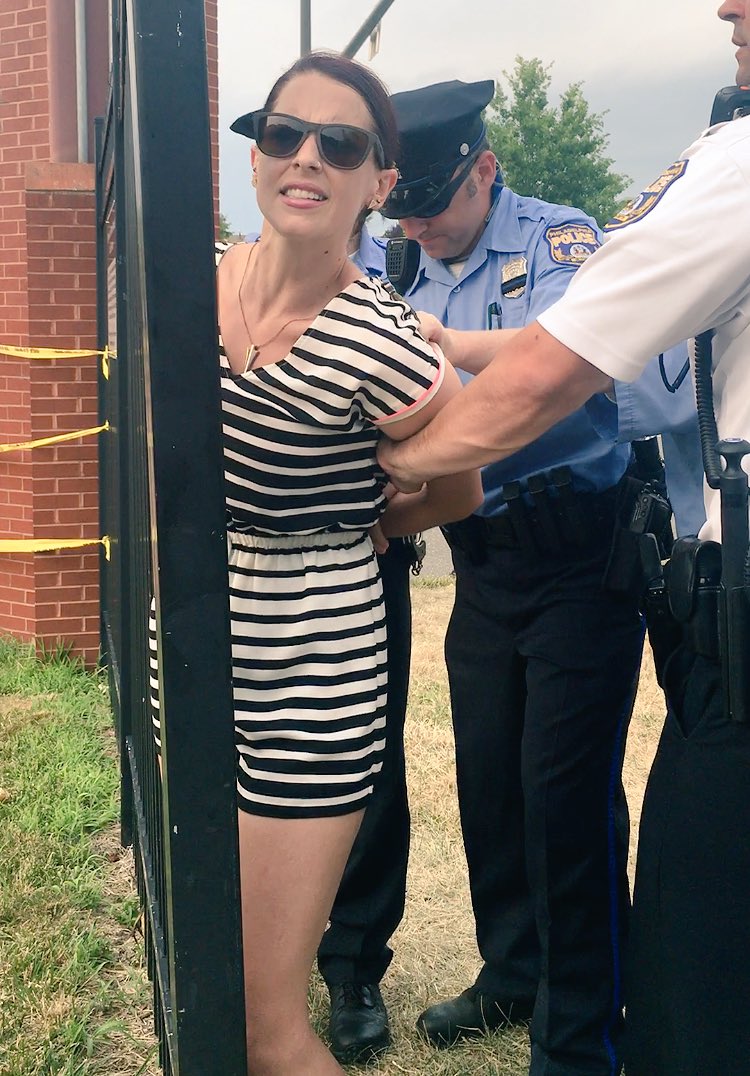
In case you were wondering how Philadelphia police compared to those in Cleveland, journalist Abby Martin was willing to share the details of her own arrest at the Democratic National Convention this week.
“They use this tactic of unlawful mass detainment where they can just sweep people up for hours,” Martin revealed, regarding the police at the DNC. “They do this for sometimes days and then release people with no charges, essentially other than the citation and then just say no arrests were made, our hands are clean, but at the same time, it’s so abusive, what’s happening.”
Martin is a producer for “The Empire Files.” She was arrested on her way to an action and put in custody soon after. Martin described the entire incident as “unreal.”
“My partner Mike and I, a producer for ‘Empire Files’ were trying to get to this action where there was massive civil disobedience arrests happening,” Martin began. “It was at a public park away from the convention center. We got dropped off in a parking lot, tried to get to action, roads are blocked, the train stations were closed, the police are making it difficult as possible to even get to this action.”
After realizing they were fenced in a parking lot, Martin asked a cop how she could get out.
“He said go to this exit. Completely complying with police orders, we walked toward the exit about five feet from the exit [where] another female police officer came up said, Where’s your credentials, you have to have credentials to be in this area. We’re credentialed journalists, but we weren’t credentialed to be in the DNC,” Martin explained.
That didn’t seem to fly with the police.
“As my partner was telling her this, she grabbed my shirt very aggressively, my dress, ripped it and said ‘arrest her to these other two officers were standing at the entrance, and she said, ‘arrest her for disorderly conduct,'” Martin said.
Martin was in shock. But that was just the beginning of her ordeal.
“They twisted my arm extremely hard, my wrists were in excruciating pain, they zip-tied them as close as they possibly could, very very awful experience aggressively, manhandled by three police officers were on me on this fence,” Martin recalled. “I didn’t even see any arrests happening, it was just so shocking, it was so random, I was just stunned and I kept saying ‘we’re credentialed journalists, we were told to come here by another police officer’ and so they carry me to the paddy wagon, totally separate from my producer, I had no idea what’s going on, I just thought ‘I’m spending the night in jail’ and I was just trying to accept my fate and how unreal what was happening was.”
The official line from the police is that “no one has been arrested” at the Democratic National Convention, but that couldn’t be further from the truth. Protestors and journalists are being rounded up, handcuffed, booked, and cited all over the city of Philadelphia, and Empire Files hostAbby Martinwas one of the victims. Ring of Fire’sFarron Cousinswas lucky enough to speak with her about her experience.
ROF Exclusive: Abby Martin Discusses Her Arrest at the DNC
**
I also discuss the story in depth with my brother Robbie on the latest Media Roots Radio.
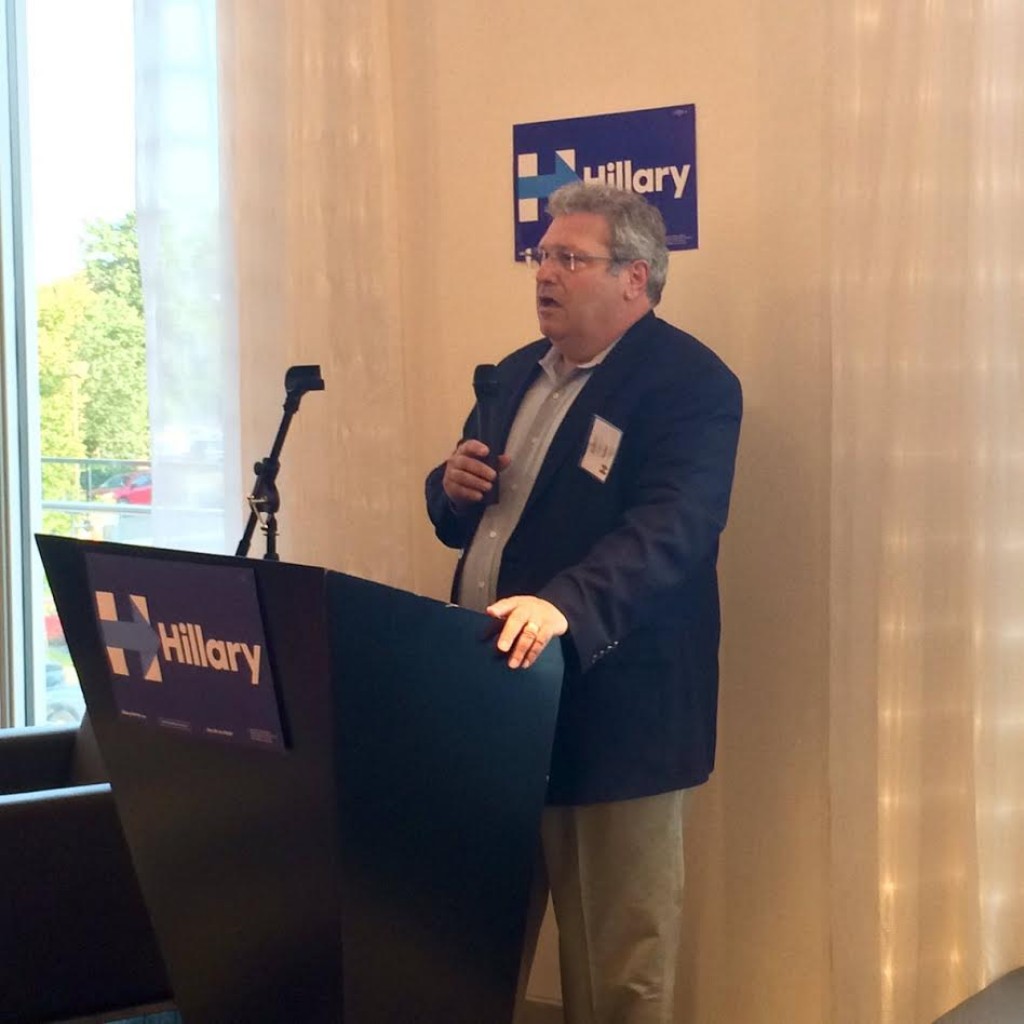
EXCLUSIVE: While left leaning voters in the United States are having a conniption fit over the possibility of a Trump presidency, Hillary Clinton has been quietly building a bridge to a sect of Cold War nostalgic neoconservative policymakers in Washington, D.C., getting regular advice from the likes of Project for The New American Century (PNAC) co-founder Robert Kagan, and Center for New American Security (CNAS) member and former Cheney staff member Eric Edelman.
This neocon collaboration was mostly done under the radar until recently, when Foreign Policy Magazine announced that “young foreign policy professionals” in collaboration with The Center for New American Security would be hosting an official fundraiser for Hillary.
The event was especially notable for me, having just wrapped production on a 7.5 hour documentary series ‘A Very Heavy Agenda‘ about the new neocons in D.C., who have reinvented themselves to maintain credibility and influence in foreign policy making–most notably interventionist ideologue, Robert Kagan. The final installment of ‘A Very Heavy Agenda‘ shows how Hillary invited them into the U.S. State Department while at the same time Kagan’s wife Victoria Nuland served as Assistant Secretary of State of Eurasian Affairs.
Originally I intended to go to this event to tell Kagan about ‘A Very Heavy Agenda’, but instead we ended up having a very revealing and candid conversation about Ukraine. Journalist Rania Khalek accompanied me to this unusual fundraiser.
I detail the surreal experience in the latest Media Roots Radio podcast with Abby Martin, where I play the recording in full. Full transcript below.
Robbie Martin: I wanted to know what your feeling was on Hillary’s approach to Ukraine, is she going to send the weapons to the Ukrainian army?
Robert Kagan: I mean, I’m sure, I mean the answer to that question is I don’t know. I know she cares a lot about Ukraine and certainly cares more about it than the current president does
Robbie Martin: With arms, why do you think the president has sort of dragged his feet?
Robert Kagan: Uh, because he said to me because he doesn’t want to get into a nuclear war with Russia.
Robbie Martin: That’s literally what he said?
Robert Kagan: Yeah, I don’t think…he’s not…he’s through with his agenda with Putin, I don’t think he cares about Putin anymore at all, I think he’s hopeless–uh, he thinks Putin is hopeless, but he says, he thinks Ukraine is part of Russian sphere of influence, and it means more to them than it means to us and therefore we shouldn’t escalate in a situation like that, that’s why he doesn’t want to send arms.
Robbie Martin: He actually said he doesn’t want a nuclear war over Ukraine?
Robert Kagan: He did, ‘I don’t want to have a nuclear war over Ukraine’–my response is well who do you want to have a nuclear war over? Do you want to have a nuclear war over Estonia? I’ll go down the list, Germany? If that’s your going in position, then okay, fine. Whatever nuclear countries don’t want, we won’t do.
He proceeded to speak about the importance of the NATO alliance and how Hillary Clinton understands this better than Trump.
Robert Kagan: I think that my instructions are to–uh, explain to you why Hillary Clinton would be better for the U.S. transatlantic European relationship than for alliances than Donald Trump, um, I’m going to operate on the assumption than all your mental faculties are intact and skip past that. I mean for me, I gotta tell you quite honestly if Donald Trump wins the election, the transatlantic relationship would be item number 10 or 20 on my list, given the threat that I think he poses to our democracy, which is fundamental, and if America is capable of electing someone like Trump and he does behave in the kind of way that I think he will behave, our ability to lead our ability to show…act as an example, our ability to–you know–have close relations with other democracies is going to be severely damaged. I’m going to operate on the second assumption, which is that Donald Trump doesn’t win the election and that Hillary Clinton does, a horrifying as it is to even have to think about that prospect.
I think that American’s understanding of the value of these alliances and the value of america’s role in sustaining these alliances, I think Americans have either forgotten it or are too young to remember. You really do have to have some history in your mind, in order to understand why we are out there, why any of these things matter. You really have to have some memory of of what the world looked like before the United States created this international system based very heavily on the two pillars of our European relations with our allies and our relations with our allies like Japan and Korea and Australia and others. People have to remember that in the absence of that structure, uh, we saw what happened in the first half of the 20th century. Two world wars in both theaters and it was the American commitment to move beyond its own borders and not think narrowly about its own interests, but to regard its interest more broadly to include becoming in effect a European power, with American forces in place to keep the peace and becoming an Asian power with American forces in place to keep the peace in both regions. Uh, before that they had both been engaged in cycles of warfare for quite some time. It was really the American role and sort of putting a plug in some of those conflicts it was created the extraordinary period we’ve been living through. And that’s another thing I think Americans just don’t understand. I don’t think they realize because they’re so focused on the things that have gone in recent years, and things have gone wrong they went wrong during the Cold War too that they miss the sort of basic underlying unusual quality of the international order that we’ve been living in. Um, I’ve been reading all kinds of people saying American foreign policy for the last 25 years has been a disaster, in my view American foreign policy for all its failings–and I’ve commented on those failings myself–has nevertheless continued an extraordinary success. It continues to be a period of great power peace.
When the Arab Spring started in 2011, the Empire decided which revolutions were “good” and which were “bad”, pouring arms and money into police state monarchies to crush legitimate protests, from Egypt to Bahrain.
But some movements were lauded by US politicians as great causes for freedom–conveniently in countries whose governments they had long hoped to overthrow–and rushed to their aid.
In Libya, the US was able to accomplish its plan for regime change in less than a year, thrusting the country deep into misery. But in Syria, the regime change plan hasn’t gone as smoothly–a list of changing rationales and goals have spanned the last 5 years.
Millions of dollars in cash and weapons flowed to the rebel forces fighting to overthrow the government. Once ISIS rose to dominance, US officials said it was no longer about toppling Assad, it was about defeating the terrorist group in Syria, without Syrian permission. But the administration still insists Assad must go in order to defeat ISIS.
Having gone far beyond an internal political struggle, the war is marked by a complex array of forces that the U.S. Empire hopes to command: Saudi Arabia, Turkey, Kurdistan, Iran, Lebanon, Iraq and more. There’s much at stake in a bloody war that has already taken the lives of 250,000 human beings.
To simplify this web of enemies and friends in the regional war, Abby Martin interviews Dr. Vijay Prashad, professor of International Studies at Trinity College and author of several books including “The Poorer Nations”, “A People’s History of the Third World” and “Arab Spring, Libyan Winter”.
Unraveling the Syria War Chessboard
**
VIJAY PRASHAD: When the uprising broke out in Syria, when there was initial protests–at that moment the US ambassador Mr. Ford, Robert Ford, went to the sites of the uprisings. Now this is a very important thing to recognize. A foreign ambassador inside a sovereign country went to support uprisings which were for the overthrow of the government. This is a very important thing for people to remember. In other words, the United States government, by the presence of Robert Ford, was telling the people who were opposed to the Assad government, that we are going to deliver Damascus to you. In other words, the United States took a position in 2011 by allowing Ambassador Ford to go to these places. So there was no confusion. The idea, as part of the anti-Iran policy, the idea was that Damascus has to be delivered to other powers other than Iran, perhaps Saudi Arabia. This has been a clear position. But the Syrian opposition knew from the very first that unless the United States bombed Damascus to smithereens, this regime was not going to fall. So knowing that they were not going to provide the Libyan solution, they nonetheless wound up the opposition to expect US planes to come and bomb in Damascus, which the Americans knew was not going to happen. So this in a sense is where responsibility also lies for the hundreds of thousands of people killed in Syria. In other words, the US green-lighted a regime change scenario which they very well knew they could not follow through on. So I don’t actually see any confusion in American policy. The confusion simply came in that the Obama administration had to in a sense dance around the fact that they were not able to honor what Robert Ford had suggested by his presence at this demonstration. And it was never really about the Syrian people. It was always about Iran.
ABBY MARTIN: And it’s not just the Pentagon, it’s figures within the antiwar movement, the left actually making a main pillar of the demand for Assad to step down. What would this mean for the Syrian people?
VP: The Assad government is a government of a certain class of people. The Syrian government had made enormous advances, despite really quite ruthless prison policies against the opposition. Ruthless against anybody that stood up against the government. They nonetheless made some advances in human welfare, they created institutions of different kinds, etcetera. Bashar Al-Assad, when he in a sense inherited the regime, came at a completely different moment in world history. He was much more open to the Americans and the Europeans. He was very much open to what we consider neo-liberal development, new construction projects, etcetera. He made an alliance with the Turks. Turkey made so much money, in a sense, gentrifying northern Syria in the 2000s. This was a period where it created a sense of displacement among the population. There were real grievances in the country. Nonetheless, despite having these grievances, popular opposition was extraordinarily weak in Syria. There was no way they were going to be able to actually win against the government. And I don’t mean militarily. I mean even in terms of appealing to vast numbers of people who had yet supported the government. So you can’t create revolution by shortcuts. You have to take the protracted road. And, in a sense, the American offer to the Syrian opposition was a shortcut. By opposition what do we mean? You see, the people who were revolutionaries, the left inside Syria, which there was a section, were never the people that the Americans saw as the opposition. Who did they see as opposition? From the beginning they saw the proxies of Turkey, of Saudi Arabia, maybe of the Muslim Brotherhood. These were the people that they were talking to. They were not talking to the socialists on the ground. Those socialists on the ground are disposable for everybody. This term opposition captures too much. Some people when they hear opposition they mean the rebels who came from nowhere fighting on the ground. But actually when Western governments talk about opposition, they mean the people who were in exile in Turkey and formed these groups. This was a certain kind of elite similar to the transnational coalition created in Libya. Who were they? They were bankers. These are the people that the West sees as opposition. So you know, we should not fool ourselves that very early on the poor people had been discounted by the West who had become serious with these proxies. And these proxies as we know are not merely businessmen in suits. They morphed very quickly to the very worst kind of characters and were given free rein by Western backing. And of course Gulf Arab backing to create mayhem in Syria.
AM: It feels like déja vu because we just went through the same thing in Libya not too long ago, where the character of the uprising was secondary to the overthrow of Gaddafi. What lessons can be gleaned from Libya?
VP: It depends on who is going to learn which lesson. See, the West is learning no lessons. The West has believed that regime change against its adversaries is allowed. And by the way, there was so-called soft regime change in this period. In Honduras in 2009, the United States fully backed the overthrow of the legitimate government of the Honduran people. That was when Hillary Clinton was the Secretary of State. In Japan, the Japanese people actually voted a government to power which had a mandate to remove some – some, not all – US bases from Okinawa. Hillary Clinton lobbies the government and they, the United States, overthrows a legitimately elected government and brings another government power. This was barely mentioned in the US press. So at the same time as there’s this kind of regime change in the Middle East, there was a successful regime change in Honduras, successful regime change in Japan. Have you ever heard anybody talk about regime change in Japan? No. They will blame, say, what happens in Afghanistan, what happens in Syria, emergence of ISIS, Taliban –they blame it on somebody else. They’ll say it’s Assad’s fault that ISIS is created. I mean come off it. ISIS is a direct product of the chaos sown by the US overthrow of Saddam Hussein. When Saddam was captured in Iraq, he comes out of his hiding hole and he says to the American troops, “I am Saddam Hussein the president of Iraq, I want to negotiate a surrender.” They mocked him, laughed at him, humiliated him. Imagine if the government had actually said, “Okay, we want to accept the surrender.” In other words, we want to create a new Iraq, which we’ve illegally attacked and illegally destroyed, okay, but we want to bring the fedayeen, Saddam. Your people have to have a role in the future because they are Iraqis. We cannot simply excise them from Iraqi history. But no, they didn’t accept the surrender, they essentially turned him over to be lynched. Gaddafi – Gaddafi was killed by what? A NATO strike hits his car and then he was lynched on the street. There are right now in Sirte, which is Gaddafi’s home town, there ISIS has taken control of Sirte. Inside Sirte, it’s not merely the old jihadis but also people of Gaddafi’s green movement, who have been totally isolated again, and who have joined ISIS. Why? Because that’s the only avenue they have. You’ve marginalized… Why didn’t they arrest Gaddafi? Again, an illegal arrest, but at the time accept his surrender and say, “Your block of supporters will have a place in Libya.” No. They said none of you will have a place in Libya. You know there are tens of thousands of Gaddafi-era supporters who are in prison in Libya uncharged. This is a human rights violation. So when you conduct these regime-change operations and then tell a section of the population you are no longer relevant, you’re condemning them to social death, to political death, and in some cases to prison for life. And I think this is a lesson that nobody’s is thinking about. They’re saying, “I wish there was no war.” Well you’ve done these wars, you’ve destroyed these countries. You must, having done all that illegally, you must open yourself to the possibility that, you know what, an American should not decide what happens in Libya. Let all the Libyan people decide, including those who you now consider persona non grata. In Syria, the military is very well organized, it’s very disciplined. There hasn’t been defections. So to imagine that just because an American ambassador shows up in a square where there are fifty people standing there, that you’re going to somehow terrify the military, was an illusion. A very dangerous illusion. I don’t feel like there’s a need for anybody to say, “I support Assad. I don’t support Assad.” This is an irrelevant question. The question is, I believe in freedom of people, but I also believe that freedom is a protracted struggle. Freedom has to have a set of obligations upon human beings to win other people over. As I said, there’s no short-cut to these things, you can’t bomb your way to freedom. It’s a protracted struggle. And in a place like Syria, the government may not appeal to some people but it does appeal to others. The fact is, vacuums are the worst thing to create in any territory in the world. I think people have now understood that the Syrian Army is going to have to become one of the factors that fights the war against ISIS.
AM: The White House said part of its strategy is working with regional players on the ground. Of course, there’s several contradictory players here. First there’s Saudi Arabia. Is this a logical partner for peace when even Hillary Clinton has said that it’s the biggest exporter of Wahhabi terror worldwide?
VP: The United States government has one principal ally in the region. And that ally, apart from Israel – because Israel is not really consequential for some of this stuff. The principal ally the United States has is Saudi Arabia. The United States has on several occasions said the defense, not of Saudi Arabia, but of the royal family, is the obligation of the United States of America. Why is that so? It’s because of oil. Not because America buys oil from Saudi Arabia, but because the Saudis are able to control oil prices. Look at the recent situation. The Venezuelans fought to rebuild OPEC. They won new unity in OPEC. They raised prices of oil. In raising prices of oil, they were able to collect money and do it for regional transformation, to provide money to lesser countries with no resources, to build up the capacity of the countries, etcetera. Saudi Arabia jacked up oil production, brought down the price of oil deliberately, and did what? Brought to the knees the adversaries of the United States. Who are they? They were Venezuela, they were Russia, they were to some extent but not entirely Brazil, and eventually China. As all these countries went into free-fall, the strategy that the Chinese were building… The oil, the gas station of Saudi Arabia is a weapon against forces around the planet. So if there’s one thing the United States needs to – the people of the United States need to consider, is this unbending alliance with a theocracy that is not only brutal to its population, but is providing the material for counter-revolution around the planet. Saudi Arabia understands its region entirely through sectarian eyes. It sees the struggle in Yemen as a struggle of Shia versus Sunni, which the Yemeni people don’t see exactly like that. It sees Syria as a Sunni-Shia thing.
In Syria it’s much more complicated than Shia and Sunni, per se. So they are sectarian. They have a sectarian viewpoint. Since the 1960s, backed by the Americans, they have pushed this sectarian view on the world, not merely this region. If I asked you, Abby, let’s make a map of where Al-Qaida recruits from, one of the stunning things you’ll discover is that from the 1960s,the Saudi-backed group called the Word Muslim League, the WML, was funding groups in these exact places because Saudis were funding this from the sixties. They opposed Arab nationalism. This was their game. So this is the major American ally. There is a terrific WikiLeaks cable from 2005, again from Syria, where the Syrian political officer of the USembassy says, “We have to back the Saudi game of increasing Shia-Sunni tension.” Imagine this. This is a serious problem. I think now sober Western governments, not necessarily the United States, have understood that this is gotten out of hand. And something needs to be done to rein back this mad dog approach to domination in that region.
AM: Let’s expose another regional player, Turkey. How has Turkey made it possible for ISIS to thrive?
VP: They kept the border open. When Obama in 2014, August 2014, said ISIS is a threat to the world, the United States, etcetera, they could have invoked the NATO charter. Turkey as a NATO member could have been forced to close the border. But the United States didn’t invoke the NATO charter. So the border has remained porous. And so ISIS since August 2014 has continued to get recruits coming in. Look, the press picks it up here and there. They’ll say yes, the Paris attacker, the first time, the woman she is now in ISIS territory. She went through Turkey. How did she go through Turkey? She landed in Istanbul Airport, flew to Sirok, I mean to Gazientep, drove across the border. Are you kidding? Turkey is a sovereign … how can … The border is porous. Turkey has played a game which has set it in a destructive direction wherein in order to deflate the Kurdish balloon it has gone to war against the Kurds. Not only the Kurds inside Turkey, they’re bombing cities in Kurdistan, in Turkey, but they’re also bombing BKK and YPG bases in Iraq where these people are training to fight against ISIS. Understand now, if you are an American strategic planner, you are using Incirlik base inside Turkey to bomb ISIS. Meanwhile you’re providing ground support to the Kurdish militias. Meanwhile your ally, the Turkish Air Force, is bombing the Kurds. Now what is going on here? And why should people like you and I explain this? This is not for us to explain. This is a question that the United States State Department needs to explain, and the [Turkish] foreign ministry needs to explain.
AM: Can you provide any more context to why Turkey has this war against the Kurds?
VP: The point about the Middle East, or any part of the world, is they are complex cultural ecologies. If you travel in northern Iraq, for instance, the landscape is craggy and hilly and mountainous in such a way that from one valley to the next, you have language that can be slightly different. Religious traditions that differ. There is great diversity in the Middle East, it’s incredible. These people lived in various forms of fellowship for a long time. I’m not going to romanticize it. As I’ve said, various forms, there were tensions, whatever, a large Armenian population, etcetera. After the First World War, the Turkish government took a very hard republican Turkish nationalist view, led by Kemal Ataturk, the father of the Turks. They took a Turkish nationalist position, which made no or very little space for minorities. And in this of course is the killings of Armenians, a genocide of the Armenians. But also in this was the relation, the role of the Kurds. Kurds were told, “You are like us, not like the Christians.” They tried to make it about religion initially. But it was never really about religion. The attack on Armenians was not about religion, it was about difference. Are you going to be like us, are you going to assimilate fully or not? It was a very much an assimilative nationalism. And the Kurds therefore were told, “You have to assimilate to become Turks. There’s no such thing as a Kurd.” You know, that’s a very ruthless form of nationalism, and that’s been the history of modern Turkish nationalism. It has had to grapple with this very virulent strain in its nationalism, which doesn’t have space for minorities. And what’s interesting is in Turkish history, in the last twenty odd years, the Kurdish political movements have oxygenated Turkish politics. The HDP for instance is one of the few political parties that is totally socially progressive, and which is why it’s linked with the Turkish left. It’s provided the Turkish left with a mass movement.
In other words, the Kurdish nationalist movement, which surrendered its nationalism in 1993, you know they decided in ‘93 no longer to call for an independent Kurdistan, but to have rights within Turkey. You got a mass constituency for the Turkish left. And so the Kurds therefore are not some alien life form, you know, they’re part of Turkish society. The largest Kurdish city is Istanbul. There are one million Kurds that live in Istanbul. Kurds live all over the country. But they have provided through their struggle for self-determination an oxygenating space for the Turkish people, all the Turkish people. And so they are trying to revise the idea of this virulent Turkish nationalism, which Erdogan has now bizarrely come to represent. The Kurdish struggle is not a struggle of ethnicity, it’s a struggle of values. The HDP is not a Kurdish exclusionary party. It’s a party of a certain set of values, progressive values. So that’s available inside Turkey.
AM: There’s been a scholar that studied every suicide bombing since 1980, and found that 95% of them share one strategic motivation, which is the response to military intervention or occupation in their country. Given this, why do you think that the empire continues to respond with military intervention?
VP: Well there are many reasons. One of them is that if you have no other solution for the people’s problems, you utilize the hammer. If you no longer have the ability to propose a solution for poverty, starvation, desperation, etcetera… If you don’t have a solution in the United States, why talk about the world? Even in American cities you can’t provide jobs. You can’t provide schools. You provide police. You provide prison. This is the domestic cognate of imperialism overseas. Here they have no answer to people who are starving. They only know how to throw them in jail. There they have no answer to people’s demands. They only know how to bomb them. This has become a habit. Why? Because the very rich around the world have gone on strike. They refuse to pay taxes. They refuse to provide wealth for human betterment. They are happy to provide money to bomb people and build gated communities and things like that. They are happy to create dystopia. They are on strike when it comes to creating utopia. It is people who are well-meaning, well-thinking people who believe in the good side of history that have to fight for utopia. They have an end game. It is purely dystopic. We have forgotten that we need to fight for an end game. Our future is not merely resistance. Our future has got to be something beautiful.
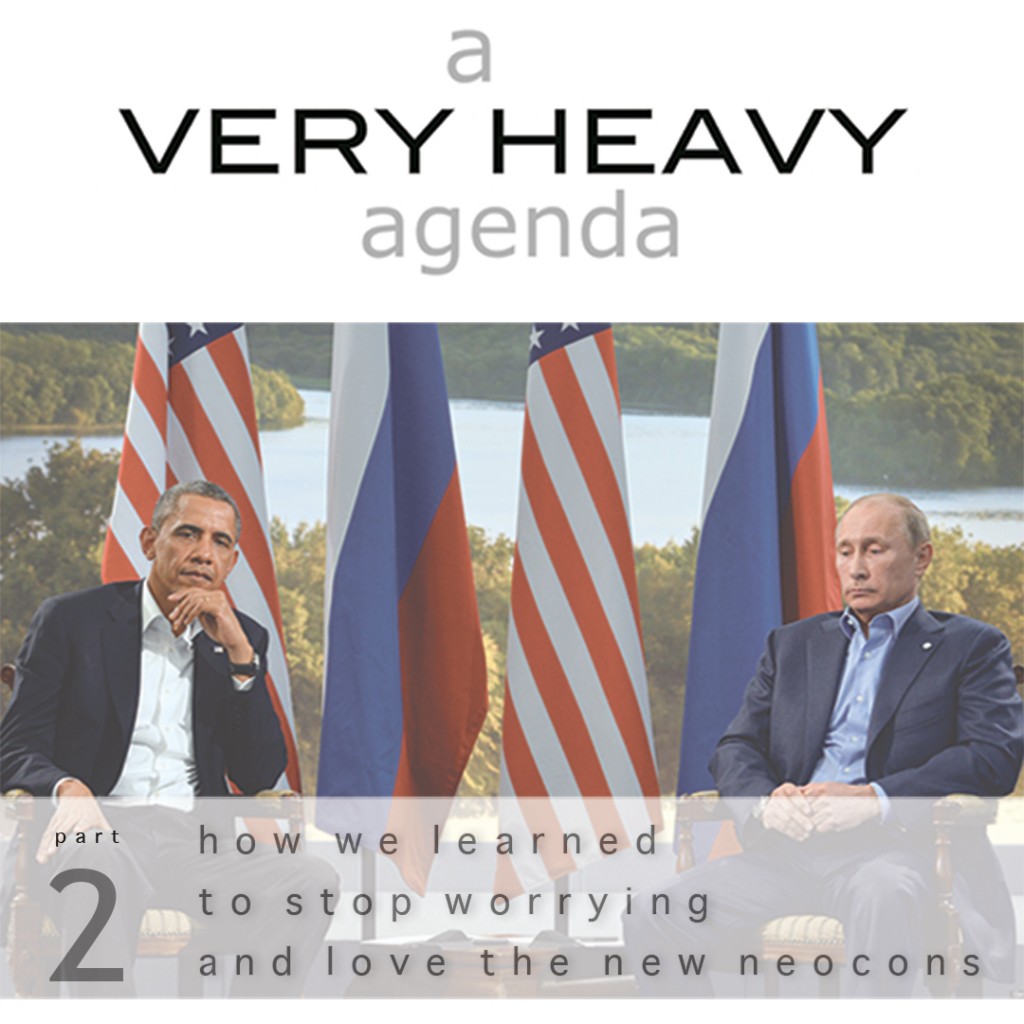
Media Roots co-host Robbie Martin presents the newest installment in his documentary film series about Washington, DC neoconservatives who aim to widen the rift between Russia and the United States.
A Very Heavy Agenda Part 2: How We Learned to Stop Worrying and Love The New Neocons , Out Now on Video On Demand and DVD
After the Cold War, the US-NATO reach expanded significantly to take in most of the old Soviet Union clients in the Warsaw pact. Neoconservative darling Robert Kagan and his diplomat wife Victoria Nuland played key roles inside and out of various administrations as they greased the skids for a US-sponsored coup in Ukraine. The infamous neoconservative Washington DC think-tank ‘The Project for the New American Century’ was re-branded for the Obama era into ‘The Foreign Policy Initiative’ acting as a outside agitator pushing the envelope on what the US should do in the new Cold War landscape. Part 2 shows the resurrection of old Reaganites from beltway depths to deliver blatant propaganda with techniques reminiscent of a red scare era that had only just faded from memory. US-funded outfits like Radio Free Liberty are pitted against Russia’s RT as each nation accuses the other of waging an ever more desperate and transparent “Information War”.
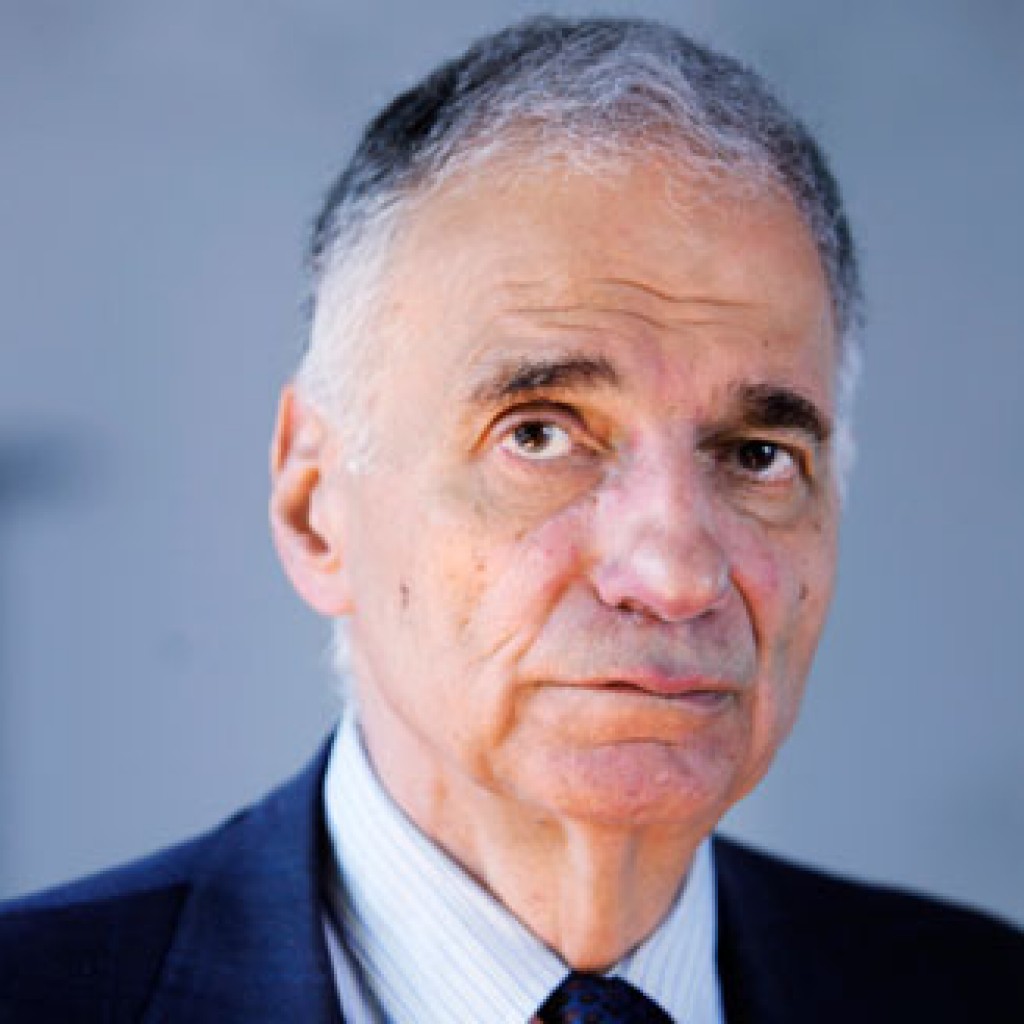
Most people know Ralph Nader as the insurgent third-party Presidential candidate in the 2000 elections, where the popularity of his stand against corporate hegemony struck fear into establishment politics.
But hundreds of millions experience Nader’s legacy everyday. Most notably, how virtually every automobile safety measure, from seatbelts to airbags, are the product of his relentless campaign against auto industry giants. His contributions as a consumer advocate span disability rights to exposing corporate pollution.
A long-time political figure with unique experience fighting from the center of Washington, Nader joins Abby Martin on The Empire Files to discuss today’s political climate, the corporate government and rigged elections.
Ralph Nader and Abby Martin on US Corporate Rigged Elections
**
Nader describes the invasion of Washington by Wall Street as the way in which the government has been indentured by corporatism; the Democrats are dialed into the same corporate interests as Republicans and both work to crush third party representatives from getting on the ballot.
Nader argues that Bernie Sanders gave up his bargaining power when he pledged to endorse Hillary Clinton as the Democratic nominee. “He probably knows that the democratic party machinery is controlled by the Clintons.” Nader says Sanders needs to use his grassroots support to make demands of the Democratic Party, and his followers need to start organizing beyond the campaign.
Hillary Clinton is a “corporate criminal”, who has never met a war or weapons system she doesn’t like. Her hawkish foreign policy casts light on her tendency to chase after war, and her support of Wall Street. “She’s a militarist and a corporatist,” says Nader. Her blind ambition of seeking power will likely push the United States into more wars.
The Clinton Foundation, which is funded by Gulf monarchies and mining magnets, saw an increase in donorship once Hillary Clinton became Secretary of State, showing just how close the Clinton’s ties are to the most oppressive regimes and corporations. While Hillary’s campaign has been supported most passionately by those calling for more women-led leadership, this brand of ‘Clinton feminism’ has latched onto something that is nothing more than an upwards career move, not a substantive movement towards equal representation.



 In case you were wondering how Philadelphia police compared to those in Cleveland, journalist Abby Martin was willing to share the details of her own arrest at the Democratic National Convention this week.
  EXCLUSIVE: While left leaning voters in the United States are having a conniption fit over the possibility of a Trump presidency, Hillary Clinton has been quietly building a bridge to a sect of Cold War nostalgic neoconservative policymakers in Washington, D.C., getting regular advice from the likes of Project for The New American Century (PNAC) co-founder Robert Kagan, and Center for New American Security (CNAS) member and former Cheney staff member Eric Edelman.
 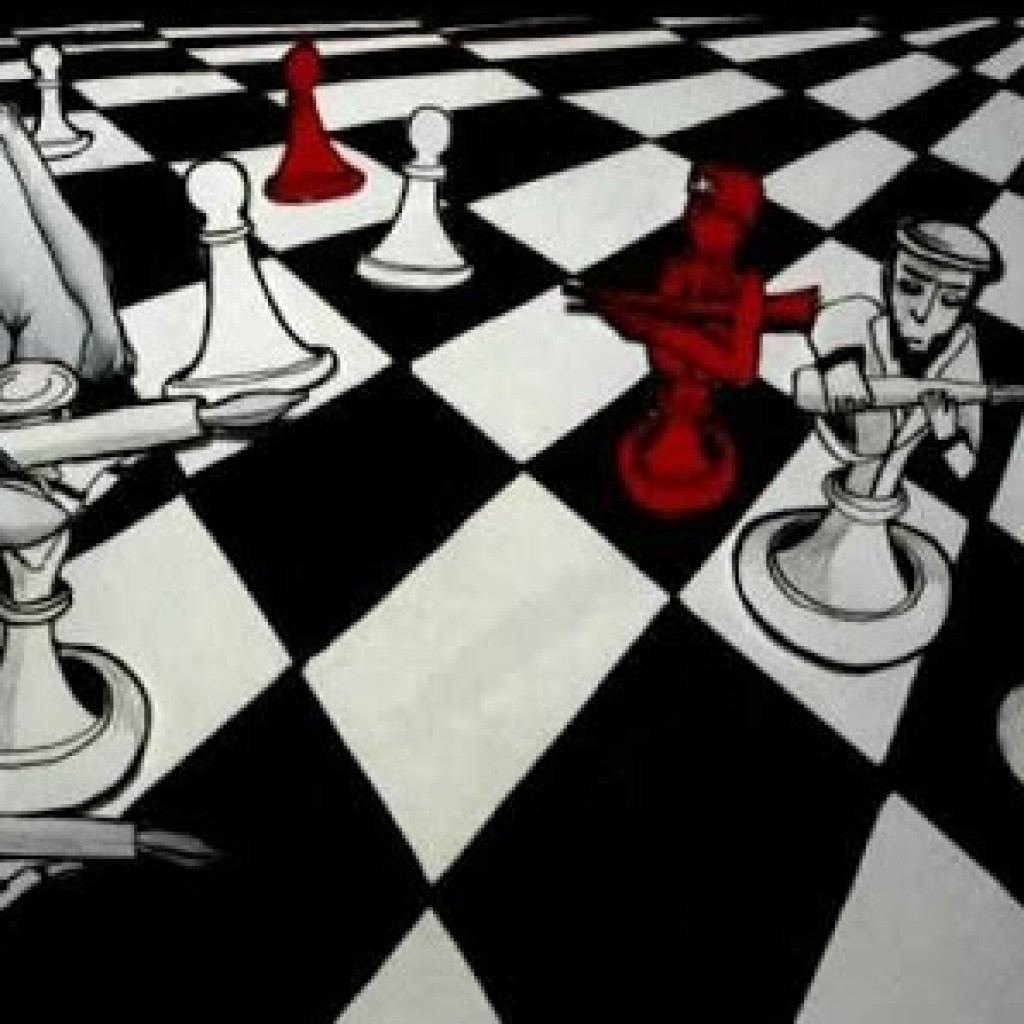 When the Arab Spring started in 2011, the Empire decided which revolutions were “good” and which were “bad”, pouring arms and money into police state monarchies to crush legitimate protests, from Egypt to Bahrain.