MR Original – Trader Joe’s Signs on Fair Food Agreement

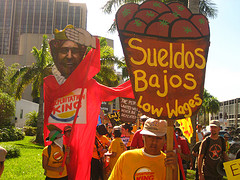
CIWMEDIA ROOTS After a two year campaign, The Coalition of Immokalee Workers (CIW) has finally persuaded Trader Joe’s to sign on to a fair food agreement that will change the working conditions and lives of tomato workers in Immokalee, Florida.  The coalition consists of over 4,000 farm workers who incur unfair wages and dangerous working conditions.  Since its creation in the early 90s, CIW has successfully campaigned against these unjust practices, giving workers the opportunity to have a comfortable working environment.

Trader Joe’s has joined in with a collection of food service providers who have agreed to follow a fair standard of labor practices, as well as a price premium for workers.  The agreement also suggests a healthy and ethical relationship between workers, tomato growers, and food industry bosses.  Interestingly, the original support for the campaign came from fast-food corporations, such as Taco Bell, Burger King, and McDonald’s.  Other food service providers included in the agreement are Bon Appétit Management Co, Compass Group, Aramark, and Sodexo.

The Coalition of Immokalee Workers has worked incredibly hard for over twenty years to ensure justice to farm workers in Florida.  With the inclusion of southern Mexican music and reworked Lady Gaga songs, the CIW has galvanized tens of thousands of people all over the country in their campaign for labor and food justice.  At an event in October, 2011, the CIW organized a large-scale action at the headquarters of Trader Joe’s in Monrovia, California.  A group of clergy stood by the side of many farm workers, leading hundreds of protestors through the streets to the front doors of the building.  The action led to a successful dialogue between the CIW and Trader Joe’s officials. 

“I was so happy to hear of the news,” CIW supporter Natali Rodriguez explains. “It just goes to show that grassroots organizing and the power of the people really can make a difference in the world.”  Rodriguez has participated in numerous CIW actions and was also present for the large action at the Trader Joe’s Headquarters. 

Trader Joe’s has set a precedent that will hopefully encourage others in the food industry to increase their standards of labor practices.  “It shows the power of movements that are led by people who are most affected by the issue, in this case farm workers, and also the power of having strong allies,”  Tim Carlson adds.  “The supermarket industry better watch out.”   It’s inspiring to know that organizations like the CIW are diligently fighing for the rights of community workers by pressuring the food industry to create a more ethical and responsible relationship between their workers and products.”

Written by Zena Andreani for Media Roots

Photo by flickr user NESRI

300,000 Organic Farmers Sue Monsanto

MEDIA ROOTS — Organic farmers, seed growers, and seed businesses took another step at reclaiming their land last month, as 83 plaintiffs representing over 300,000 farmers described Big Agribusiness Monsanto’s harrassment in court.  Monsanto threatens lawsuits against organic farmers for “patent infringement” if farmlands have any trace amounts of Monsanto’s genetically-modified seeds.  Additionally, many organic seeds have not even been planted for fear of any unwanted frankenplants which Monsanto might sue them over.

Willie Nelson successfully rallied many in the Occupy Movement to ‘Occupy the Food System,‘ as hundreds supporting the organic industry assembled outside the federal courthouse in Manhattan for a motion hearing on January 31, 2012.

MR

***

NATION OF CHANGE – Judge Naomi Buckwald heard the oral arguments on Monsanto’s Motion to Dismiss, and the legal team from Public Patent Foundation represented the rights of American organic farmers against Monsanto, maker of GM seeds, [and additionally, Agent Orange, dioxin, etc.]

After hearing the arguments, Judge Buckwald stated that on March 31st she will hand down her decision on whether the lawsuit will move forward to trial.

Jim Gerritsen, President of the Organic Seed Growers and Trade Association, has pointed out that there are 5th and 6th generation family farmers being pushed off their farms today, and because of a “climate of fear” (from possible lawsuits from Monsanto), they can’t grow some of the food they want to grow.

Even organic dairy farmers have had to suffer lawsuits (from Monsanto) when they labeled their organic milk “non-BGH” referring to Monsanto’s bovine growth hormone used by conventional dairies.

Read more about the 300,000 organic farmers suing Monsanto in federal court.

© 2012 Nation of Change

***

Photo by Flickr user Martin Pettitt

US Ends Opposition to GM Labeling Guidelines

ECO WATCH PRESS RELEASE– Consumers International (CI) and its member organizations celebrated victory today as regulators from more than 100 countries agreed on long overdue guidance
on the labeling of genetically modified (GM) food.

The Codex Alimentarius Commissionii, made up of the world’s food safety regulatory agencies, has been labouring for two decades to come up with consensus guidance on this topic.

In a striking reversal of their previous position, on Tuesday, during the annual Codex summit in Geneva, the US delegation dropped its opposition to the GM labeling guidance document, allowing it to move forward and become an official Codex text.

The new Codex agreement means that any country wishing to adopt GM food labeling will no longer face the threat of a legal challenge from the World Trade Organization (WTO). This is because national measures based on Codex guidance or standards cannot be challenged as a barrier to trade.

This will have immediate implications for consumers. Edita Vilcapoma of the Peruvian consumer group ASPEC, representing Consumers International at the Codex meeting in Geneva, said:

“Peru’s recent introduction of GM food labeling faced the threat of a legal challenge from the WTO. This new Codex agreement now means that this threat has gone and the consumer right to be informed has been secured. This is major victory for the global consumer movement.”

The agreement also recognises the enormous health monitoring benefits of giving consumers transparent information about the presence of GM foods. Consumers International’s lead delegate at Codex, and a senior scientist at Consumers Union of the United States, Dr Michael Hansen, stated:

“We are particularly pleased that the new guidance recognizes that GM labelling is justified as a tool for post market monitoring. This is one of the key reasons we want all GM foods to be required to be labelled – so that if consumers eat modified foods, they will be able to know and report to regulators if they have an allergic or other adverse reaction.”

The labeling milestone is particularly welcomed by CI member organizations in Africa, who have been fighting on behalf of their consumers for the right to be informed about GM food. Samuel Ochieng, President Emeritus of Consumers International and CEO of the Kenyan Consumer Information Network said:

“While the agreement falls short of the consumer movement’s long-held demand for endorsement of mandatory GM food labeling, this is still a significant milestone for consumer rights. We congratulate Codex on agreeing on this guidance, which has been sought by consumers and regulators in African countries for nearly twenty years. This guidance is extremely good news for the worlds’ consumers who want to know what is in the foods on their plates”.   

***

Note to Editors

i Consumers International (CI) is the only independent global campaigning voice for consumers. With over 220 member organizations in 115 countries, we are building a powerful international consumer movement to help protect and empower consumers everywhere. For more information, visit www.consumersinternational.org

ii The Codex Alimentarius Commission was created in 1963 by FAO and WHO to develop food standards, guidelines and related texts such as codes of practice under the Joint FAO/WHO Food Standards Programme: http://www.codexalimentarius.net/web/index_en.jsp

Food Companies That Serve You ‘Wood’

THE STREET– The recent class-action lawsuit brought against Taco Bell raised questions about the quality of food many Americans eat each day.

Chief among those concerns is the use of cellulose (read: wood pulp), an extender whose use in a roster of food products, from crackers and ice creams to puddings and baked goods, is now being exposed. What you’re actually paying for — and consuming — may be surprising.

Cellulose is virgin wood pulp that has been processed and manufactured to different lengths for functionality, though use of it and its variant forms (cellulose gum, powdered cellulose, microcrystalline cellulose, etc.) is deemed safe for human consumption, according to the FDA, which regulates most food industry products. The government agency sets no limit on the amount of cellulose that can be used in food products meant for human consumption. The USDA, which regulates meats, has set a limit of 3.5% on the use of cellulose, since fiber in meat products cannot be recognized nutritionally.

Jump directly to the slideshow of companies whose food contains cellulose.

“As commodity prices continue to rally and the cost of imported materials impacts earnings, we expect to see increasing use of surrogate products within food items. Cellulose is certainly in higher demand and we expect this to continue,” Michael A. Yoshikami, chief investment strategist at YCMNet Advisors, told TheStreet.

Manufacturers use cellulose in food as an extender, providing structure and reducing breakage, said Dan Inman, director of research and development at J. Rettenmaier USA, a company that supplies “organic” cellulose fibers for use in a variety of processed foods and meats meant for human and pet consumption, as well as for plastics, cleaning detergents, welding electrodes, pet litter, automotive brake pads, glue and reinforcing compounds, construction materials, roof coating, asphalt and even emulsion paints, among many other products.

“Cellulose adds fiber to the food, which is good for people who do not get the recommended daily intake of fiber in their diets,” Inman said. “It also extends the shelf life of processed foods. Plus, cellulose’s water-absorbing properties can mimic fat,” he said, allowing consumers to reduce their fat intake.

Read the full article about 15 Food Companies That Serve You ‘Wood’.

© 2011 The Street

Photo by Flickr user freya_gefn

Obama Embraces GE Crops on Wildlife Refuges

COMMON DREAMS– The Obama administration has endorsed genetically engineered agriculture on more than 50 National Wildlife Refuges, with more GE-refuge approvals in the works, according to Public Employees for Environmental Responsibility (PEER). The new plan is designed to insulate refuges from environmental court challenges in the wake of a lawsuit recently won by PEER and other groups which halted GE agriculture in all Northeastern refuges.

The national blitz of official filings is intended to remove a perceived barrier to the export of American GE crops – U.S. restrictions on growing GE crops on National Wildlife Refuges. Under a U.S. Fish & Wildlife Service (FWS operates the refuges) policy, GE crops are banned from refuges unless determined to be “essential” to refuge operations. Countries leery of importing U.S. bio-engineered food have cited the policy as one basis for their concern.

Rather than overturn this FWS “Biological Integrity” policy outright, the White House has embarked on a region-by-region approach to file environmental paperwork justifying GE agriculture on – 31 refuge units across 8 Midwestern states; 25 refuges units in 12 Southeastern states; and an unspecified number of refuges in the 8-state Rocky Mountain Region.

The proposal for the Midwestern Refuges would allow more than 20,000 acres to be cultivated with no limits on how many acres could be GE crops. The public comment deadline for that plan is today. In its comments, PEER argues that the GE operations risk harm to wildlife, refuge plants and soil, while contending that there is no refuge purpose for which GE crops are essential, as required by FWS policy.

“These plans are based on the curious notion that wildlife benefit from having the small slivers of habitat set aside for them covered by genetically engineered soybeans,” stated PEER Executive Director Jeff Ruch, noting the Midwest refuges are already surrounded by row crops, most of which are now GE. “To boost U.S. exports, the Obama administration is forcing wildlife refuges into political prostitution.”

In 2010, PEER, the Center for Food Safety and Delaware Audubon brought successful litigation charging that GE agriculture on refuges in the Northeast violated the Refuge Improvement Act as incompatible with refuge purposes and lacked reviews required by the National Environmental Policy Act. That suit was settled when FWS agreed to stop commercial agriculture operations on all refuges within the region. These latest filings are supposed to shield refuges in other regions from similar suits based on failing to meet procedural requirements of environmental statutes. Future challenges would have to show that these new eco-reviews are impermissibly defective – a higher legal hurdle.

“The Obama administration says that it is devoted to scientific integrity but these new reviews are scientific travesties,” added Ruch, pointing to new Interior Department (which includes FWS) rules requiring that scientific information in decision- making “must be robust, of the highest quality, and the result of the most rigorous scientific processes as can be achieved.” “The sole document assessing the environmental impacts of genetically engineered planting in 25 Southeastern refuges is only six pages long.”

Increasingly the only seed available to U.S. farmers, especially for corn and soybeans, is GE. Ironically, it is the ubiquity of GE agriculture that FWS offers as the main reason it must allow these crops on refuges.

***

Read the PEER comments

View the EA for 31 Midwest Refuges

See proposed finding of no impact for GE crops on 25 Southeast Refuges

Examine draft EA for Rocky Mountain refuges

Look at litigation driving GE agriculture out of Northeast Refuges

Review the Interior Department’s new scientific integrity rules

***

Public Employees for Environmental Responsibility (PEER) is a national alliance of local state and federal resource professionals. PEER’s environmental work is solely directed by the needs of its members. As a consequence, we have the distinct honor of serving resource professionals who daily cast profiles in courage in cubicles across the country.

Photo by flickr user Margaret Killjoy 


Posted in Uncategorized | 1 Reply