
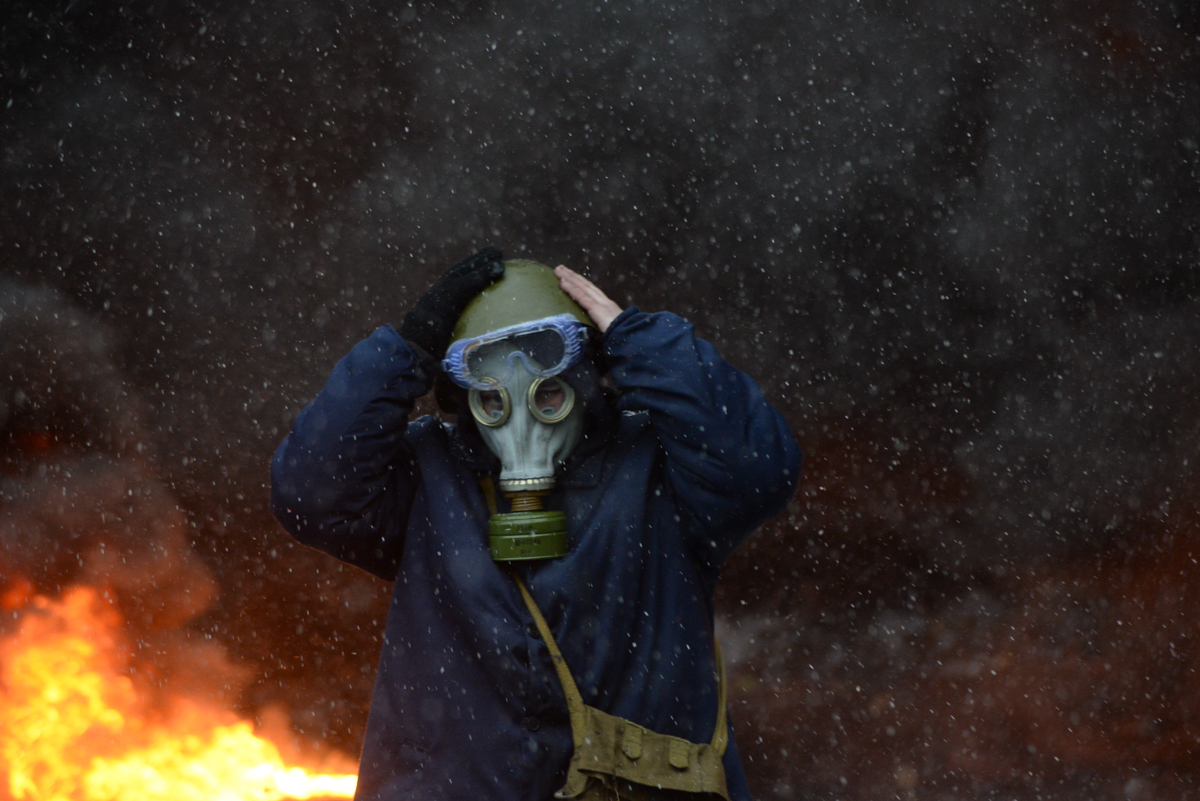
Internationally Banned Tear Gas: For Domestic Use Only

Protester wearing a tear gas mask against background of the massAs unrest erupts from Oakland to Egypt, there’s one weapon of war that has come to define the militarized police state: tear gas.

And while a St. Louis judge ruled recently that limits must be placed on the use of tear gas in Ferguson, he didn’t rule that tear gas should only be implemented as a last resort.

Around the country, contingents of peaceful protesters are being confronted by assemblies of heavily militarized police officers that regularly use chemical agents to disperse crowds. But usually the act of getting doused with chemicals is so infuriating that it only incites chaos.

People have a good reason to be afraid of tear gas, considering it’s a banned agent of war under the 1993 Chemical Weapons Convention. Here’s the catch – there’s a clause in the treaty that includes an exception for domestic use. Yes, it’s illegal for the US military to use tear gas against ISIS, but cool to use against American citizens.

The US ensured the exception, claiming it was afraid the convention may prohibit lethal injection. Because of this caveat for riot control, countries around the world regularly and irresponsibly use chemical agents against their own populations. In American cities like Ferguson, police deploy tear gas at the drop of a hat, often at cameramen and journalists.

Despite all of the apocalyptic imagery associated with the weapon, government officials maintain tear gas is perfectly safe, including Ferguson police chief Tom Jackson, who said “There are complaints about the response from some people… but to me, nobody got hurt seriously, and I’m happy about that.”

He forgot to say yet, considering how Ferguson police are using tear gas canisters from the Cold War era and are so old, there’s a severe risk of shrapnel flying into crowds. Make no mistake, this “less than lethal” weapon can actually be quite deadly. Look no further than Palestine, where a man was killed from a tear gas canister hitting him at close range in 2011. Or in Egypt, when a policeman shot tear gas into a caravan holding  37 protesters, choking and killing them all.

Horrifyingly, tear gas also causes amputations and miscarriages. In Bahrain, Physicians for Human Rights reported that many pregnant women had miscarriages after exposure with the chemical agent. Officials assure there are no long term health effects, but that hasn’t been proven given the lack of long term studies. Sven-Eric Jordt, a leading expert in tear gas, says

“I frankly think that we don’t know much about the long-term effects, especially in civilian exposure…There’s very few follow-up studies. These are very active chemicals that can cause quite significant injury. I’m very concerned that, as use has increased, tear gas has been normalized. The attitude now is like, this is safe and we can use it as much as we want.”

And boy, do we. As the world’s leading military and arms supplier, the US is also the biggest producer of less than lethal weaponry. During Egypt’s revolution, while police gunned down protesters and made mass arrests, they liberally used tear gas that read “Made in the USA” (at a little place called Combined Systems International of Jamestown, Pennsylvania). According to VisionGain, the non-lethal weapons market has exploded over the last decade, and is worth a whopping 1.6 billion dollars this year.

Somehow the government has convinced the American people that using tear gas is perfectly harmless, despite stark evidence to the contrary. So, next time it tries to sell us another war because *this leader gasses his own people*, remember that claim isn’t so far from home.

***

Abby Martin Breaks the Set on the Lethality of Tear Gas

***

Abby Martin / @AbbyMartin

Photo by Wikimedia Commons

 

Aaron Swartz and the Fight for Free Information

aaron swartz flickr quinn norton BWComputer prodigy Aaron Swartz should have been celebrating his 28 years over the holidays. Yet nearly two years ago, he tragically took his own life.
He was the target of a merciless witch-hunt by the Department of Justice, ultimately choosing death over 35 years behind bars for the crime of releasing information. As someone who transformed the way we all use and love the internet, Aaron should have gotten a medal of honor, not a death sentence.

Aaron’s genius mark on the web can be traced back to the development of RSS feeds, a formula that produces a feed of whatever information one chooses to access, changing the way we filter and aggregate data. His passion for making information open source was exemplified in his partnership with Lawrence Lessig at only 15 years old, when he coded creative commons, a database devoted to growing the amount of creative works available to share and build off of. This revolutionized what was capable online, allowing people to use imagery without worrying about copyright or legal ramifications.

Perhaps Aaron’s mark will most be felt by co-founding Reddit, one of the most visited sites in the world that embodies what raw and free access looks like. After Reddit exploded, Aaron sold it for over a million dollars. But he rejected the business world, and instead put his entire being into political activism. He began openlibrary.org, a site that allows users to buy, borrow or browse every published book in the world. The project cemented his obsession with freeing the mind of humanity from its elite clutches. Sadly, it was this beautiful idea that came to define Aaron as a criminal that deserved more time in prison than murderers in the eyes of the federal government

The majority of the wealth of human knowledge is owned by a few publishing companies that hoard information and make billions off licensing fees, although most scholarly articles and journals are paid for by taxpayers through government grants. Aaron sought to change this.

He wrote about his plans to release academic journals and expressed outrage about prosecutorial overreach on the Guerilla Open Access Manifesto in 2008:

“It’s called stealing or piracy, as if sharing a wealth of knowledge were the moral equivalent of plundering a ship and murdering its crew. But sharing isn’t immoral — it’s a moral imperative. Only those blinded by greed would refuse to let a friend make a copy…

There is no justice in following unjust laws. It’s time to come into the light and, in the grand tradition of civil disobedience, declare our opposition to this private theft of public culture….With enough of us, around the world, we’ll not just send a strong message opposing the privatization of knowledge — we’ll make it a thing of the past.”

His first target was JSTOR, a digital library of academic journals and books. But as he attempted to download millions of articles from JSTOR at MIT, authorities were filming him through a surveillance camera. Aaron’s altruism came at a heavy price. The footage was used to charge him with computer and wire fraud, which would have locked him up for decades.

Aaron praised the internet’s ability to give everyone a license to speak, but noted how many of those voices won’t get heard, which is why he dedicated the last year of his life leading the charge against corporate monopolization of the web with legislation like SOPA and PIPA.

Aaron Swartz sacrificed himself to better the world. His blood is on the US government’s hands for institutionalizing a two tiered justice system that immunizes criminals and bone chillingly destroys revolutionaries.

**

Breaking the Set on Aaron Swartz’s legacy

**

Please watch the documentary about Aaron that inspired me to write this tribute, called “The Internet’s Own Boy”.

The Internet’s Own Boy

**

Abby Martin / @AbbyMartin

Photo by flickr user Quinn Norton

How Words Absolve Pillaging and Mass Murder

WordsFlickrKool_SkatkatObama’s election marked a new dawn for hundreds of millions of people, who were looking to an eloquent, constitutional lawyer for “Hope” and “Change” in America. However, it quickly became apparent that Obama had little substance beyond the slogans branded by his campaign.
With a little more than a year left in his presidency, his milquetoast legacy has been embodied by his greatest skill: wordcraft. Obama’s team has continued, if not exacerbated, most Bush era policies, simply rebranding them in order to appease and confuse the public into compliance.

One of the first things his administration did was declare an end to the “War on Terror” that the Bush sociopaths launched worldwide. Turns out, all they wanted to do was stop calling it a “War on Terror,” making clear that any further military involvement abroad would simply be called “Overseas Contingency Operations.”

Six years later, and the Nobel Peace Prize winning president has bombing campaigns in seven different countries under his belt. And the casualties of the empire’s plunders? Collateral damage.

There are also new terms for war. When US and NATO bombed the hell out of Libya resulting in the failed state we see today, it wasn’t a war. No, it was merely a “Kinetic Military Action,” according to government officials.

Torture is now “enhanced interrogation techniques”, and the act of kidnapping and exporting torture is simply called “extraordinary rendition”.

Whenever the administration sends predator drones to bomb people around the world, they’re just “surgical strikes” targeting “militants”. However, simply being military aged male constitutes someone as a militant, and according to the Bureau of Investigative Journalism, less than four percent of drone victims in Pakistan are officially listed as al Qaeda.

When Obama’s cabinet dropped the term “enemy combatant”, it was a purely symbolic move to distance itself away from the Bush Guantanamo era. Unfortunately, over 140 men still remain rotting away in the notorious prison despite what they’re now called on paper. And when these prisoners go on a hunger strike, it’s now called a “long term non-religious fast”.

As journalist Glenn Greenwald reminds us, altering the names of policies doesn’t change the fact that they’re still happening:

“The Obama administration…makes only the most cosmetic and inconsequential changes – designed to generate headlines misleadingly depicting a significant reversal – while, in fact, retaining the crux of Bush’s extremist detention theory.”

Obviously this rebranding tactic wasn’t invented by Obama’s PR team. 

Propaganda was propelled with the advent of PR genius Edward Bernays and later Nazi mastermind Joseph Goebbels, whose powerful techniques have been perfected and employed for decades by governments worldwide. Disturbing Newspeak phrases that absolve their pillaging and mass murder have permeated society and warped our interpretation of reality.


How Words Absolve Mass Murder

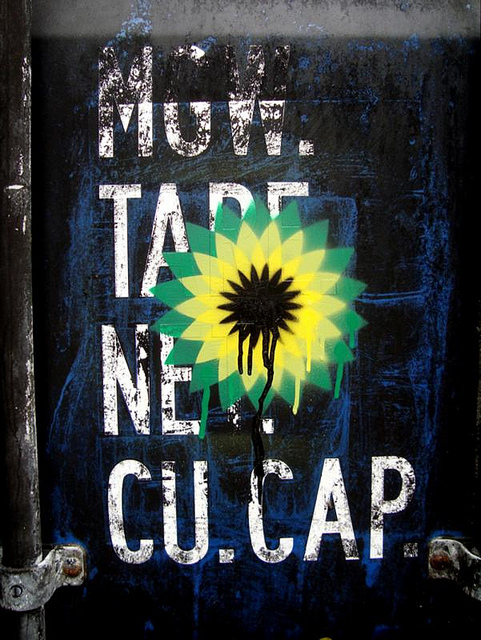
The term “Mowing the Lawn” is what governments say to allude to the literal mowing down of civilians. Shockingly, the callous term has been used not only by Israeli military commanders in reference to the recent bloodbath of Palestinians, but it’s also been used by Obama’s counter-terrorism adviser Bruce Riedel who said this about drone strikes:

“You’ve got to mow the lawn all the time. The minute you stop mowing, the grass is going to grow back.”

If you think that’s bad, officials also use the cute phrase “Shake ‘n Bake” to refer to using banned white phosphorus before blowing up people with high grade explosives. Administrators also think so lowly of the people they’re killing with flying robots that they brutishly call them “bug splats”.

Beyond war, in today’s cut throat capitalist world overrun by neoliberal doctrine, there’s a language of dehumanization employed towards everything, spoken among the elite class and policy heads in order to keep things running efficiently.

As the Guardian points out, the term “cleansing the stock” is actually used to describe excess human beings by parliamentarians. After all, you can’t afford to actually feel emotion, empathy or sorrow for the paupers at the bottom of the totem pole.

Unsurprisingly, when it comes to the natural world, the language is even more crude.

According to journalist George Monbiot,

“Nature is “natural capital”. Ecological processes are ecosystem services, because their only purpose is to serve us. Hills, forests and rivers are described in government reports as green infrastructure. Wildlife and habitats are asset classes in an ecosystems market. Fish populations are invariably described as stocks, as if they exist only as moveable assets from which wealth can be extracted – like disabled recipients of social security.”

All of these devaluing terms have seeped into mainstream consciousness, dutifully repeated by media figures and then, by us.

Words hold tremendous power, and if we don’t reclaim our language and start seeing people instead of “militants”, drone victims instead of “bug splats”, or natural splendor instead of “green infrastructure”, then the voiceless are destined to be silenced forever.

Follow me at @AbbyMartin

BP: Scandal, Lies and Another Massive Oil Spill Cover-Up

BP Thierry EhrmannForget Stephen King. If you want scary, read U.S. District Judge Carl Barbier’s 150-page Findings of Fact released recently in the Deepwater Horizon case.
Although the judge found BP liable for “gross negligence,” some U.S. media failed to mention that Barbier let BP off the hook on punitive damages. And that stuns me, given that the record seems to identify enough smoking guns to roast a sizable pig.

Every rig operator knows that, before a rig can unhook from a drill pipe, the operator has to run a “negative pressure test” to make sure the cement has properly sealed the drill pipe.

If the pipe is safely plugged, the pressure gauge will read zero. The amount of pressure BP measured at 5 p.m. on April 20, 2010, the day of the explosion? 1400 psi (see the findings, pages 62-65).

1400 psi is not zero. Stick a balloon in your mouth with zero pressure and nothing happens except that you look silly. Replace the balloon with a hose delivering a 1400 psi blast and it’ll blow your skull apart.

So, how could the company record zero? Answer: BP’s crew re-ran the test measuring the pressure in something called the “kill line,” which is definitely not the drill pipe.

By reporting that the pipe had no pressure and all was safe, BP could begin to unhook the Deepwater Horizon from the pipe—and sail away. Why would BP do that? In my view, there were three motives: money, money and money. It costs BP a good half million dollars each extra day the rig stays on top of the drill hole. It seems it wanted the rig gone, and quickly.

Instead of halting the disconnection process, BP appears to have lied and recorded the pressure reading as “zero.” The rig’s owner, Transocean of Switzerland, went along with BP’s actions.

So how did BP get away with mere “gross negligence” as opposed to the more serious claim of fraud? Because the court found that the blowout, explosion, fire and oil spill were caused by “misinterpretation of the negative pressure test.”

Misinterpretation? If a woman says “thanks” when you say she’s dressed nicely and you think she wants a kiss, that’s “misinterpretation.” But on the Deepwater Horizon, the drill pipe gauge read 1400 psi and BP picked a different pipe that gave the company the magic zero. That’s not, I contend, “misinterpretation.”

Maybe the judge thought he was pretty tough by calling out BP for “gross” negligence (rather than plain-vanilla negligence, the finding against Transocean and contractor Halliburton). But, in fact, it seems Barbier fell for the Three Stooges defense.

Throughout the 150-page decision, the judge cites one instance after another of bone-headed, buffoonish, slapstick decisions, and plenty of pratfalls and banana-peel slips by BP, Transocean and Halliburton. You have to wonder how these schmucks even found their drill hole. It was a corporate Larry-Moe-and-Curly-Joe routine that would provide a lot of belly laughs if 11 men hadn’t died as a result.

I’ve seen the Three Stooges defense before in federal court. In 1988, the corporate owner and the builder of the Shoreham nuclear plant were on trial on accusations they bilked their New York customers out of $1.8 billion. In court, they pleaded stupidity and incompetence as a defense against deliberate deception. As the government’s investigator, I didn’t buy it—billion-dollar corporations can’t be that stupid—and neither did the jury. (The racketeering charges were settled after trial for $400 million.)

And here is a new set of Stooges: BP plays Larry, Transocean puts on Moe’s wig and Halliburton makes “Nyuk! Nyuk! Nyuk!” sounds like Curly Joe. Halliburton, the judge found, failed to test the final cement mix and BP bitched about it—“[Halliburton engineer Jesse Gagliano] isn’t cutting it any more,” reads an email between two BP managers on the rig—but BP went ahead and used the bad cement anyway (Findings, paragraphs 227-228)

When the pressure in the drill pipe read 1400 psi, BP and Transocean managers should have stopped the rig departure immediately. They didn’t. Nevertheless, other systems should have prevented a blowout. According to Barbier, other safety systems were jacked with to save a penny here, a penny there (or, a million here, a million there). Example: BP used leftover cement (Findings, paragraphs 209-211) that contained chemicals that destroyed the integrity of the new cement, because using the old stuff saved some serious cash.

Barbier had the power to levy a fine big enough to make BP plc, BP America’s London-based parent corporation—a company with revenue of a quarter of a trillion dollars a year—go “ouch.” But to slam BP with a fine that would hurt, the judge needed to hear from the Justice Department about corporate-wide perfidy. He pointed out that the case would have to be made against BP plc, the international parent, if he were to level a fine that would punish the corporation.

Against BP there is evidence aplenty. For years BP plc has played fast and loose with safety—from Asia to Alaska.

Chasing BP across five continents, I’ve found that “gross negligence” could be BP’s corporate motto. In 2010, I was arrested in Azerbaijan hunting down evidence of another BP/Transocean offshore blowout that occurred 17 months before the Deepwater Horizon explosion. The cause of the Caspian blowout was the same as in the Gulf disaster: mishandling of “foamed” cement. Had BP not covered up the prior blowout off the coast of Azerbaijan, the deaths and destruction in the Gulf, I’m certain, would have been avoided.

More on the Caspian Sea blowout and BP ruling on Breaking the Set with Abby Martin:


What?! Another Massive BP Oil Spill Coverup?

**

The ugly truth is that the U.S. State Department knew of the Caspian disaster and kept its lips sealed. Furthermore, the U.S. government can’t tag BP as an endemically rogue, dangerous operator without casting doubt on the administration’s recent grant to the corporation of new deep tracts to drill in the Gulf of Mexico.

So maybe it was not the judge but the public that was blinded by the government and media crowing about a possible $18 billion fine for gross negligence. Eighteen billion dollars may sound like a lot to us mere mortals, but to a trillion-dollar behemoth like BP, it is not a punishment, but a reasonably priced permit for plunder.

Greg Palast is award winning author and journalist.

This article was originally published in Truthdig. Photo by flickr user Thierry Ehrmann

Watch Breaking the Set’s exclusive follow-up on the 2010 BP Oil Spill from the Gulf.

Walmart’s Predatory Profit Model: Low Prices With a Heavy Cost

Stop Walmart by Flickr Lone PrimateAs the saying goes, there’s no such thing as a free lunch. Nowhere does that ring more loudly true than in the aisles of every Walmart store. Always low prices, yes – but at what cost?

There are, unfortunately, two inconvenient truths about the dollars you’ve supposedly saving from having elected the world’s largest retailer over Joe’s little store just down the street. First off, what you don’t pay, someone else is paying for. And secondly, the actual price you pay is much higher than what your receipt tells you.

I’m aware that the slogan I mentioned earlier is outdated. The irony was not lost when, in 2007, the company swapped it for the rather idealistically sounding “Save Money, Live Better” – a far cry from the everyday reality facing the average Walmart employee in the United States. Making an average hourly wage of $8.81 an hour, or about $18,300 a year working full-time, is hardly the way to live better. It’s only slightly over a third of a living wage for an adult with one child. 

That’s why Walmart isn’t quite as cheap as you’d think – because much of what you’re not paying at the cashier ends up getting paid for through your taxes. It’s estimated that every Walmart store in America costs citizens $1.7 million in welfare benefits such as food stamps. Taxpayers are effectively subsidizing the retailer for its failure to pay employees a living wage.

Abby Martin outlines Walmart’s horrible treatment of employees and destruction of the planet on Breaking the Set:

Why Walmart is an Economic Death Star

**

Amazingly, Walmart could afford to give all of its employees a 50 percent raise without even touching its bottom line – but it chooses not to. And why does it choose to perpetrate the countless other assaults on its outsourced workforce, female employees and the environment? The answer’s simple: profit maximization.

We’ve all heard of corporate social responsibility. Be it sincere or mere corporate whitewashing, the “triple bottom line” of economic, social and environmental sustainability surely fares better than the single-minded focus on profit that prevails under the current global economic order.

The existing objective, profit maximization, is exactly what it sounds like: putting profits above all else, be it workers’ right to “live better”, the planet’s capacity to sustain human activity, worker and consumer health and safety, economic stability, or human lives. This reckless pursuit of profit is why taxpayers are propping up large corporations that make obscene profits in the meantime.

It’s why 1100 Bangladeshi workers, many of them making garments sold at Walmart, lost their lives when the Rana Plaza factory collapsed due to blatant disregard for building safety on the part of the companies it supplied (Walmart still refuses to sign an international agreement that would ensure worker safety in its sweatshops).

It’s why General Electric, Toshiba and Hitachi did nothing about the flaws in their nuclear reactors at Fukushima that caused them to melt down in 2011, despite knowing for decades that they were unsafe.

It’s why there is still no vaccine for ebola despite over 2000 deaths at the time of writing – because there’s no money to be made out of it. Or why corporate tax evasion through loopholes and tax havens costs the United States some $300 billion every year.

It’s why governments, on behalf of their grossly bloated financial sectors, are negotiating a secretive international financial treaty that further deregulates global finance known as the Trade in Services Agreement (TISA). 

And so on. What these failures of the capitalist system, or what neoliberal economists term “market failure”, share is a common root in the unwillingness on the part of businesses to fully account for their costs. Taxpayers pay the price for Walmart’s refusal to adequately pay its own workers. The manufacturers of the Fukushima nuclear plants, unwilling to dish out the money to fix their inherent design flaws, unleashed a public health disaster that threatens to get worse. Global finance triggered the Great Recession through their own risky but rewarding behaviour and want to do it all over again.

The very nature of business needs to change if humanity is to avoid yet more Rana Plazas, Fukushimas and Great Recessions, and if it is to ever overcome ebola, tax evasion and corporate welfare. We need to move away from the predatory capitalist “I want it all” ethos and towards new business models that account for all costs rather than leaving them for others to pay. This is not financially impossible, and there’s no reason why such a model can’t be financially self-sustaining. But it’s only when business owners and executives start to acknowledge their responsibility to really help the rest of society to “live better” rather than taking more and more for themselves will that model be possible.

**

Top Five Worst Corporations for US Workers

Abby Martin calls out the corporations that refuse to pay their workers a living wage, despite posting record profits and generously compensating their CEOs.

**

Written by Ming Chun Tang; image by Flickr user Jim