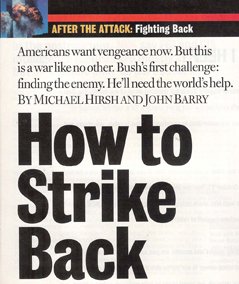
MEDIA ROOTS —A pair of Internet archivists have uploaded Part Five of US corporate media print publications from the immediate days and weeks following 9/11. The duo plans to post more multiple full issues of Time and Newsweek as well as other timely magazines that are filled with propaganda. This issue of Newsweek is from just 2 weeks after the attacks.
Following 9/11, news media accelerated at an amazing rate, and most companies soon adopted Internet versions of their paper or magazines. Before this was commonplace, many interesting pieces of information printed about that day most likely were never reprinted again–due to either misinformation or abandonment by the propagandists. As we know, many government narratives and unfounded claims about 9/11 were re-printed without any journalistic investigation. Also worth noting is how candid some of the reporting is, where journalists admit to things like ‘patriotic bias’ clouding their ability to do actual journalism.
Part Five, God Bless America, gives us a look at a Newsweek magazine published just days after the attacks. The issue includes an in depth explanation of why the US must invade Afghanistan, Iraq and other countries that ‘harbor terrorists’. It also aims to explain why US intelligence networks didn’t collaborate to stop the attacks, already forming the groundwork for the ‘incompetence theory.’
We hope that these archivists continue this fascinating project, it could uncover aspects of the ‘War on Terror’ that most journalists and researchers have completely forgotten about. Above all, it reveals the extent of the conditioning the American people were subjected to immediately after the traumatization of this nation.
Note: The slideshow of the full US News issue looks best at full screen by clicking the box in the right corner. Click play to start. Click the pause button to stop the slideshow from progressing automatically on the right corner.
MEDIA ROOTS – Greenpeace specializes in environmental advocacy, striving daily to convince humanity to care for its planet. Recognizing Earth’s fragile state, the organization provides tangible solutions and affects positive change. Their tactics include lobbying, grassroots campaigns, and bold non-violent direct action. Greenpeace confronts multiple, interwoven environmental concerns, including climate change, deforestation, ocean degradation, toxic pollution, and nuclear weapons.
Recently, Greenpeace has focused on lobbying Brazilian politicians to accept responsibility for rampant deforestation and environmental injustice. After significant pressure from the organization, the public prosecutor of the Brazilian state of Para levied strict fines on abattoirs and retailers, which were linked to illicit ranches operating within his jurisdiction. These farms were functioning on illegally deforested land, selling cow meat and hide to international corporations like Wal-Mart, Nike, and Toyota. Facing fines totaling over $1 billion, the associated abattoirs and international retailers pledged to conduct future business with only registered, legal ranching establishments.
Sometimes Greenpeace must resort to innovative tactics in order to induce environmentally responsible behavior. Recently, they targeted Nestle’s KitKat bar, which contained palm oil derived from unsustainable sources, through a creatively morose internet campaign. As a result, Greenpeace goaded Nestle into halting purchases from their questionable Indonesian supplier. After pressuring corporate heavyweights like Nike, Wal-Mart, and Kraft, Greenpeace received judicious cooperation against illegal deforestation. Any respite from the pressure on all parties will lead to a resumption of illicit activities, inherent to the exploitative measures of international capitalism.
Despite its encouraging track record, there are plenty of reasons why Greenpeace must continue its lobbying efforts, grassroots tactics, and international campaigns. Primarily, corporate behemoths have only responded to Greenpeace’s requests because they’ve received substantial pressure from some socially-responsible consumers who demand strict environmental standards to be adopted along the corporate supply chain. Unfortunately, the average shopper has no desire to pay the increased prices resulting from expensive environmental standards. In response to the conflict between customer responsibility and consumer frugality, corporations continue to cut corners in favor of profit, potentially resorting to illegal strategies to achieve a more profitable bottom line.
Even if all necessary environmental standards are adhered to, corporations don’t consider the deleterious effect, which their mere presence has on local environments. For example, timber corporations build roads into isolated habitats in order to extract timber. Yet these roads remain long after the logging companies depart. By connecting cities to forests in this manner, loggers contribute to an expedited drain of other natural resources, leading to the collapse of many fragile ecosystems. With scant concern for sustainable extraction techniques, irresponsible corporate clientele will continue to degrade our global habitat beyond repair, regardless of any demand for environmental justice.
One cannot help but sympathize with Greenpeace and admire their efforts of using creativity and audacity as weapons against our collective disregard of the environment. Al Jazeera Worldlooks at Greenpeace’s humble beginnings and the courage it takes to stand up to those who deliberately ruin our one and only planet.
Christian Sorensen for Media Roots
***
Al Jazeera World – Greenpeace: From Hippies to Lobbyists
MEDIA ROOTS — A month ago, Luke Rudkowski of WeAreChange and Abby Martin of Media Roots confronted Senator Rand Paul on camera at the Capitol building as he left a press conference. The question they both asked him repeatedly is why he endorsed Mitt Romney if he stands in opposition to almost every Libertarian principle that both he and his father, Ron Paul, hold so dear. Rand’s handler tried to shield Paul from Luke and Abby but failed to do so, creating a few cringe worthy moments that made Rand seem like an utter coward. He silently looked down in embarrassment without even giving them a glance as he skirted away.
Some people may say that any form of ‘ambush’ journalism is unfair; since you don’t have permission to confront someone, don’t expect a friendly attitude or response. However, in the past, a pre-Senate Rand Paul was spotted on the street by WeAreChange and asked about Bilderberg. He seemed eager to speak candidly about the subject, throwing out a lot of anti New World Order rhetoric.
When Abby’s video hit YouTube, the comments and reactions were evenly split. Some WeAreChange fans said they were okay with his endorsement, and that Rand Paul had to ‘make a deal’ in order to gain ground for their cause. Others were furious at Abby and Luke for challenging ‘one of their own.’ Overall, many expressed the thought that Rand had sold out and betrayed his own father by catering to the Republican establishment. Rand and Ron have been big allies with WeAreChange’s philosophical agenda for years, dovetailing off of WeAreChange’s association with the Alex Jones and Infowars. To those unfamiliar with these different groups’ involvement in underground politics, WeAreChange acts as emissaries of the confrontational style of journalism Alex Jones has been known for, i.e. bullhorning in public buildings and confronting politicians about the New World Order. Arguably, Alex Jones is following in the footsteps of Bill Cooper and David Icke with a heavy philosophical dose of the John Birch Society.
I started listening to Alex Jones in early 2004, and from the very first broadcast he spoke very favorably of one politician in particular, a Congressman named Ron Paul. At the time I knew of people like Cynthia McKinney and Dennis Kucinich, but had no knowledge of anyone on the ‘right’ who held strongly to some of my personal beliefs about foreign policy, freedom and civil liberties. After doing a bit of research on Ron Paul, he seemed like the real deal. It made sense why Alex Jones was such a fan since Jones considered himself a ‘paleo conservative,’ neither Republican nor Democrat.
Many years later, Paul’s son, Rand, came onto the scene and became a U.S. Senator in Kentucky; this was directly after the media coverage of the Tea Party movement had reached its peak. Originally, the Tea Party phenomenon was started by 9/11 ‘truthers’ who were fans of Ron Paul and Libertarianism in general because of its focus on restoring liberties and cutting back on military intervention. Eventually, the Tea Party was co-opted by the likes of Fox News and the RNC which turned it into a mainstream commodity to package and sell. Rand stood side by side with the Tea Party and even considered himself one of the first Tea Party Senators. His father, Ron Paul, seemed generally pleased at its success–the Tea Party’s growing appeal would only catapult him to more fame.
Slowly it became clear that Rand was following in his father’s footsteps in a lot of ways, sometimes being one of the few Senators to vote “no” on a bill simply because of a possible threat to civil liberties. However, it was also clear from the beginning that he was different from his father and didn’t have enough political cache to speak ill of American foreign policy or the War on Terror. He definitely didn’t risk saying anything remotely close to his dad’s statements about 9/11 being a result of CIA blowback.
Alex Jones still promoted Rand, along with his father Ron, regardless of their differences on 9/11 and the War on Terror. WeAreChange and the Infowars community seemed to be mostly excited about Ron and his son becoming such well known fixtures in the mainstream media and Republican party. But there were exceptions–early on I noticed that certain fans became leery of these events, wondering why elements of the RNC would accept Rand and his father with open arms unless there was a bigger chess game at play.
The attention reached its peak during the 2011 Republican presidential primaries, when Ron Paul collected over 200 delegates. Just like in 2008, Ron Paul hinted at running third party if he lost the primary, but didn’t end up launching a third party bid after losing the nomination. After discovering that Mitt Romney was the clear victor, it’s most likely that both Pauls were asked by their ‘friends’ in the Republican party to endorse him for president. Apparently, Rand felt compelled to do just that. Less than a month after the dust had settled, he went on television to announce his endorsement for the war mongerer.
Was he offered a sweet deal or did he go into it with the underlying understanding that if he solidified his friendship with the Republican overlords it would pay off in the long term? Surely he knew that the liberty movements’ reaction would range anywhere from mildly unhappy/confused to feeling betrayed–but he decided to do it anyway. Or, is a third possibility conceivable–that Ron and Rand Paul have been used as tools by the Republican party for longer than the Romney endorsement; now they may actually be inadvertently helping this so called ‘New World Order’ they both profess to oppose?
If you have been following the history of the evolution of the Pauls as I have, you can see that Abby and Luke’s video confrontation at the Capitol asking Rand about his curious endorsement of Romney blew up the internet with a heated albeit much needed debate. Many Paul fans feel as if they have been mislead, and that the Pauls are playing into the hands of the very untrustworthy establishment that has shut out their movement for so long. Can we blame them?
UPDATE: A week after this confrontational video was broadcast, Abby’s workplace, Russia Today, received an ominous phone call from a Senate committee staffer who represents mainstream media access to the Capitol building. This representative implied that Abby had trespassed (she did not, they were both credentialed press for the event) into the Capitol to ‘harass’ Rand Paul. It turns out that it was Rand Paul’s staff that put the pressure on this committee to try to strip Abby of her press credentials and intimidate her. Luckily, the Rand Paul campaign was extremely naive and had no idea that Abby only becomes stronger and more aggressive in the face of adversity and threats. Rand Paul has opened a can of worms on this that they will not be able to close. Trying to get a journalist in trouble or even fired from their organization for simply asking a question is one of the sleaziest and oldest tricks in the book; we are even surprised that politicians still employ these strong arm techniques instead of more subtle and nuanced approaches.
I’ve been on the fence for a long time about what the Pauls are really trying to accomplish. Now that we know for sure that Rand Paul tried to threaten and intimidate Abby simply for asking him why he endorsed Mitt Romney, I think I can safely hop to one side of the fence–the side in which Rand and possibly Ron Paul are clearly working on behalf of the “establishment.”
Robbie Martin for Media Roots
To hear Abby and I discussing these events on our most recent podcast click here, or stream below
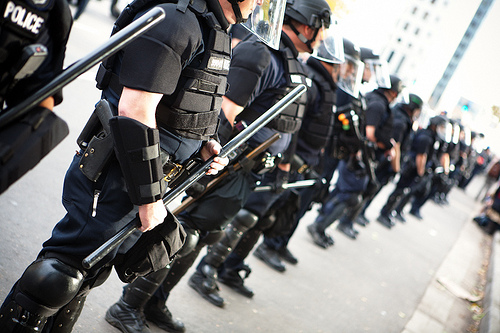
MEDIA ROOTS — After 9/11, U.S. war budgets skyrocketed, leading to a Pentagon purchasing binge previously unrivaled in history. Through the 1033 Program and Homeland Security grants, thousands of law enforcement agencies have received an excess of military weaponry and equipment, which were once reserved for war zones abroad.
In the style of Amazon.com, local police forces can even create “want lists” to facilitate future acquisition. As a result, those charged with protecting and serving Hometown, USA now possess military-grade weaponry and garb. This militarization concerns all U.S. citizens, because taxpayer dollars ultimately fund police militancy.
The Posse Comitatus Act was designed to limit federal military involvement in local law enforcement activity. While the Act is still nominally intact, it is increasingly bypassed through militarization of local police. Militarization is exemplified by arming domestic drones and conducting military exercises in major U.S. cities, including nighttime maneuvers above Miami and Los Angeles, and daytime tank training on the streets of St. Louis. Even small-town Peñitas, TX receives Pentagon weaponry.
Domestic police forces classify many of their weapons as “less-than-lethal” or “non-lethal” in order to shirk the thornier questions associated with militarization. These euphemisms are outright lies, since many of these weapons can cause death, including tasers and rubber bullets. (These concerns don’t stop local police from adding Taser shotguns to their arsenals, or shooting an Attorney with rubber bullets, at which police officials laughed hysterically.) LRADs have been strutted out at town hall meetings, the 2009 G-20 meeting in Pittsburgh, the 2010 G-8 meeting, the 2012 NATO summit in Chicago, against OWS protests, and elsewhere. The LRAD Corporation boasts about many local police departments using LRADs, including Boston, San Diego, and Santa Ana. Unfortunately, by marketing harmful weapons as “non-lethal,” both the compliant U.S. public and zealous U.S. police departments accept their increased use.
Government officials who support increased militarization fail to realize the Pentagon is selling more than just military-grade weaponry and material to local police forces. It is tacitly providing domestic police with a paramilitary ethos, which your local police department may perceive as a green light to behave in a militant manner. Officials who support militarization as a safeguard against terrorism are misdirecting their concerns, since U.S. citizens are more likely to drown in a bathtub than die in a terrorist attack in the U.S. So with no terrorist threat in sight, police forces often end up using military equipment during daily police operations, sometimes with devastating consequences. Meanwhile, all government officials ignore the basic facts that spending on domestic priorities (e.g. education, healthcare, clean energy) creates more sustainable jobs than manufacturing military weaponry and equipment.
Since the last protest movement of national significance, the U.S. government has been learning how to better deal with public dissent, irrespective of public grievances. Meanwhile, no mass protest movement has adapted accordingly. This leaves the peaceful United States citizenry facing an inappropriate use of military-grade weaponry, whether lethal or non-lethal. Essentially, USA is now a weapons testing ground against first amendment activity, often enabled by local officials.
After pressure from independent and international media outlets, the Pentagon temporarily halted a small portion of their weapons sales to certain domestic police forces. Sensitivities to election year politics surely played a part – no branch of the federal government wishes to remind the public of police-state activities or the conflicting message associated with spending rampantly during times of austerity. Regardless, the real question remains: what is the ramping up of police militarization preparing for?
Potentials are grim, since the U.S. government completely ignores the political predicament articulated by the Occupy Wall Street movement. It also avoids confrontation by relocating key functions, like moving the G8 Conference from Chicago to Camp David. When ignorance and avoidance prove inadequate, the government opts to confront protests head-on and crush them where they sprout up. If the Occupy Wall Street movement resurges this summer, look for the U.S. government to continue this pattern of ignorance, avoidance and physical oppression.
Abby Martin reports on the militarization of local law enforcement for RT TV
For further discussion about the militarization of U.S. police, click here.
MEDIA ROOTS —A pair of Internet archivists have uploaded Part Four of US corporate media print publications from the immediate days and weeks following 9/11. The duo plans to post more multiple full issues of Time and Newsweek as well as other timely magazines that are filled with propaganda. This issue of US News is from just three days after the attacks—September 14th, 2001.
Following 9/11, news media accelerated at an amazing rate, and most companies soon adopted Internet versions of their paper or magazines. Before this was commonplace, many interesting pieces of information printed about that day most likely were never reprinted again–due to either misinformation or abandonment by the propagandists. As we know, many government narratives and unfounded claims about 9/11 were re-printed without any journalistic investigation. Also worth noting is how candid some of the reporting is, where journalists admit to things like ‘patriotic bias’ clouding their ability to do actual journalism.
Part Four, War and We Must Win, gives us a look at a US News magazine published just days after the attacks. The issue includes an in depth explanation of how each tower collapsed. Since no steel framed building in has ever collapsed from fire or falling debris in history before, it’s peculiar that there was already such an astonishingly quick narrative set in stone. The final and most ominous page of the magazine has an article with the headline War, and We Must Win, by Michael Barone. It encourages the taking out of dictators in the Arab world including the likes of Iran, Iraq and Libya. It even features a picture of Saddam Hussein. We hope that these archivists continue this fascinating project, it could uncover aspects of the ‘War on Terror’ that most journalists and researchers have completely forgotten about. Above all, it reveals the extent of the conditioning the American people were subjected to immediately after the traumatization of this nation.
Note: The slideshow of the full US News issue looks best at full screen by clicking the box in the right corner. Click play to start. Click the pause button to stop the slideshow from progressing automatically on the right corner.



 MEDIA ROOTS — A pair of Internet archivists have uploaded Part Five of US corporate media print publications from the immediate days and weeks following 9/11. The duo plans to post more multiple full issues of Time and Newsweek as well as other timely magazines that are filled with propaganda. This issue of Newsweek is from just 2 weeks after the attacks.
  MEDIA ROOTS – Greenpeace specializes in environmental advocacy, striving daily to convince humanity to care for its planet. Recognizing Earth’s fragile state, the organization provides tangible solutions and affects positive change. Their tactics
  MEDIA ROOTS — A month ago,
  MEDIA ROOTS — After 9/11, U.S. war budgets
  MEDIA ROOTS — A pair of Internet archivists have uploaded Part Four of US corporate media print publications from the immediate days and weeks following 9/11. The duo plans to post more multiple full issues of Time and Newsweek as well as other timely magazines that are filled with propaganda. This issue of US News is from just three days after the attacks—September 14th, 2001.