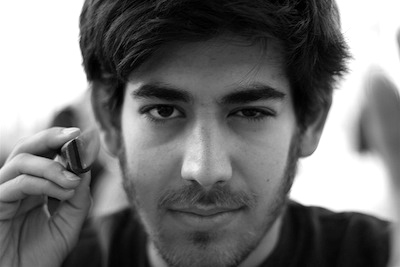
Aaron Swartz and the Fight for Free Information

aaron swartz flickr quinn norton BWComputer prodigy Aaron Swartz should have been celebrating his 28 years over the holidays. Yet nearly two years ago, he tragically took his own life.

He was the target of a merciless witch-hunt by the Department of Justice, ultimately choosing death over 35 years behind bars for the crime of releasing information. As someone who transformed the way we all use and love the internet, Aaron should have gotten a medal of honor, not a death sentence.

Aaron’s genius mark on the web can be traced back to the development of RSS feeds, a formula that produces a feed of whatever information one chooses to access, changing the way we filter and aggregate data. His passion for making information open source was exemplified in his partnership with Lawrence Lessig at only 15 years old, when he coded creative commons, a database devoted to growing the amount of creative works available to share and build off of. This revolutionized what was capable online, allowing people to use imagery without worrying about copyright or legal ramifications.

Perhaps Aaron’s mark will most be felt by co-founding Reddit, one of the most visited sites in the world that embodies what raw and free access looks like. After Reddit exploded, Aaron sold it for over a million dollars. But he rejected the business world, and instead put his entire being into political activism. He began openlibrary.org, a site that allows users to buy, borrow or browse every published book in the world. The project cemented his obsession with freeing the mind of humanity from its elite clutches. Sadly, it was this beautiful idea that came to define Aaron as a criminal that deserved more time in prison than murderers in the eyes of the federal government

The majority of the wealth of human knowledge is owned by a few publishing companies that hoard information and make billions off licensing fees, although most scholarly articles and journals are paid for by taxpayers through government grants. Aaron sought to change this.

He wrote about his plans to release academic journals and expressed outrage about prosecutorial overreach on the Guerilla Open Access Manifesto in 2008:

“It’s called stealing or piracy, as if sharing a wealth of knowledge were the moral equivalent of plundering a ship and murdering its crew. But sharing isn’t immoral — it’s a moral imperative. Only those blinded by greed would refuse to let a friend make a copy…

There is no justice in following unjust laws. It’s time to come into the light and, in the grand tradition of civil disobedience, declare our opposition to this private theft of public culture….With enough of us, around the world, we’ll not just send a strong message opposing the privatization of knowledge — we’ll make it a thing of the past.”

His first target was JSTOR, a digital library of academic journals and books. But as he attempted to download millions of articles from JSTOR at MIT, authorities were filming him through a surveillance camera. Aaron’s altruism came at a heavy price. The footage was used to charge him with computer and wire fraud, which would have locked him up for decades.

Aaron praised the internet’s ability to give everyone a license to speak, but noted how many of those voices won’t get heard, which is why he dedicated the last year of his life leading the charge against corporate monopolization of the web with legislation like SOPA and PIPA.

Aaron Swartz sacrificed himself to better the world. His blood is on the US government’s hands for institutionalizing a two tiered justice system that immunizes criminals and bone chillingly destroys revolutionaries.

**

Breaking the Set on Aaron Swartz’s legacy

**

Please watch the documentary about Aaron that inspired me to write this tribute, called “The Internet’s Own Boy”.

The Internet’s Own Boy

**

Abby Martin / @AbbyMartin

Photo by flickr user Quinn Norton

War on Terror Comes Home to Roost: The Security State’s Plans to Crush Activism

Riot Cop flickr user Tony WebsterHousing discrimination against African-Americans, also known as redlining, has long been a form of institutional racism in the post Jim Crow era.

Under the Federal Housing Act, federal loans were systematically denied to African-Americans, which helped create ghettos and further segregated blacks from whites. Ferguson is just one example among many which employed the practice.

The latent effects of racism are rooted throughout Ferguson. 93% of drivers arrested are black, yet only 67% of the city’s population is black. One-quarter of the town’s revenue is due to fines issued by a police force that disproportionately targets African-Americans.

There are unabashedly racist cops, like police lieutenant Hayes, who ordered officers to racially profile minorities. According to a whistleblower, Hayes said things like “let’s have a black day” and “make the jail cells more colorful.” Adding insult to injury, the police broke the law while investigating him.

With this reality in mind, fatal police shootings of black teens like Mike Brown are bound to happen.

The mass protests in Ferguson caused Amnesty International to make an unprecedented deployment of observers to the streets, including Jasmine M. Heiss, who told Media Roots that “Ferguson has sparked an intense and overdue conversation about race and justice in the United States.”

Heiss also witnessed the racial divide created in the West Bank, where Jewish settlements and surrounding Palestinian population had been segregated by walls and checkpoints. While illegal settlements in Hebron enjoyed basic necessities, Palestinians were denied access to human rights like water. After witnessing numerous arrests of journalists and peaceful protesters amid the tear gas, rubber bullets and sound cannons in Ferguson, Heiss said she felt like she was back in the West Bank, noting the striking similarity between the two cities in their militarized crushing of dissent.

Journalist Max Blumenthal has documented this parallel, underscoring how Israeli security state tactics have been outsourced to the US in a trend he calls the “Israelification” of American police forces. In fact, according to Electronic Intifada’s Rania Khalek, “at least two of the four law enforcement agencies that were deployed in Ferguson—the St. Louis County Police Department and the St. Louis Police Department—received training from Israeli security forces in recent years.”

Enforcing security based on racist ideology has long been field tested by Israel, which uses Palestinians as lab rats before outsourcing its defense and intelligence capabilities to other world powers. Whether it be Israeli forces training ICE officers in Tacoma, outsourcing a Behavior Pattern Recognition security system for US airports, or intelligence contractor Elbit Systems winning multimillion dollar contracts to patrol the US-Mexico border, Israel’s idea of security has now become America’s. As a result, Big Brother’s gaze is discriminatory, and racial minorities are unfairly targeted by the system.

When the state engenders unjust policies like those epitomized in places like Ferguson, the press has a duty to engage, raise awareness and advocate the reinstatement of justice. Standing in solidarity with the oppressed and amplifying the plight of the voiceless is the primary function of the Fourth Estate. Unfortunately, the police state has appropriated the corporate press and criminalized journalists who challenge systemic injustices.

In response to the police killings of Mike Brown, Ezell Ford and Eric Garner, activist groups like Black Youth Project 100, the Dream Defenders and the Million Hoodies Movement for Justice, have gained traction. To be sure though, the Defense Department has been anticipating the growth of such activism, whether it be Muslims in Michigan, blacks in Ferguson, or any other minority group which could “threaten social unrest.”

In a four-part series for Occupy.com, Dr. Nafeez Ahmed unveils a government data-mining project dubbed The Minerva Initiative. Under the guise of enhancing the drone Kill List and targeting American-Muslims that have the “potential to become terrorists,” the flawed algorithms used to search out ‘terrorists’ abroad are now being retrofitted to seek out political dissidents on US soil.

Ahmed details how a nexus of metadata and social media are being used by the Pentagon to develop a “radicalism scale” for potential social uprisings in the US, and the unconstitutional spying operation is being aided and abetted by Universities like Arizona State and the University of Washington. Effectively, social sciences are militarized with professors acting as spy proxies reporting back to their DC overlords.

One specific DoD project “seeks to uncover the conditions under which political movements aimed at large-scale political and economic change originate, and what their characteristics and consequences are.” As Ahmed states in an interview with Abby Martin, Ferguson is an example of what the Minerva Initiative sets out to suppress.

Even more disturbing, the use of predator drones on American soil is a real possibility considering the direct correlation between data-mining and extrajudicial executions. If current trends continue, American skies could soon be populated by drones targeting and potentially even executing non-violent activists.

Given the aggressive characteristics police displayed during Occupy Wall Street and Ferguson combined with the Pentagon’s intent to seek out and destroy potentially “threatening” movements, the War on Terror has officially come home to roost.

Written by Michael D. Micklow, image by flickr user Tony Webster

Posted in Uncategorized | 1 Reply

Hurricane Katrina Unheard: Blackwater, White Militias & Community Empowerment

katrinahomeAfter more than 1,800 deaths, $108 billion in damages, and almost a decade of recovery efforts, Hurricane Katrina is now remembered as the single most devastating natural disaster in US history.

There were more than 50 failures in levees, leading to 80% of New Orleans being flooded. In particular, the construction of the lower ninth ward levee was called into question after a barge destroyed it, which directed the worst of the flood into the poorest areas.

Tens of thousands of people were trapped for days without food nor water and entire neighborhoods were submerged with sewage.

But instead of addressing the catastrophe like the humanitarian crisis it was, government officials treated New Orleans like a warzone. Thousands of police, national guard troops and active duty soldiers invaded the city to restore ‘law and order,’ and private mercenary firms like Blackwater were already on the streets before emergency aide could reach city residents.

Amidst the chaotic scramble by the federal government to deliver relief on the ground, defense contractors had turned large swaths of the city into an armed prison, meanwhile ordering civilians to turn in their firearms (including those legally registered). At the same time, bands of white militias patrolled the streets, using deadly force against African-Americans while police turned a blind eye.

Breaking the Set traveled to New Orleans to follow up on how the city is faring nine years after Katrina, and found miles of roadways in disrepair, tens of thousands of blighted homes and neighborhoods like the ninth ward looking like the storm just hit yesterday. According to 2010 census data, nearly a third of the population has left New Orleans, primarily in poorer communities.

The lessons of Katrina need to be heeded now, because it’s not a matter of if, but when the next Katrina hits. And the question remains: how will we respond if the government  treats its own people like refugees and goes to war with us again?

**

Hurricane Katrina Unheard: Blackwater, White Militias and Community Empowerment

 **

Exclusive coverage from New Orleans includes interviews with Ward ‘Mack’ McClendon, founder of the Lower Ninth Ward Village community center about how he is revitalizing the community and two co-founders of Common Ground Collective, former Black Panther Malik Rahim and notable anarchist Scott Crow, about taking arms against the white militias that patrolled Algiers Point and killed at least eleven black people in the aftermath of the storm.

Photo & report by @AbbyMartin

Posted in Uncategorized | 1 Reply

Oakland’s Anti-Spy Center Campaign Sets Template For US Cities

SpybyFlickrLeoReynoldsMINT PRESS NEWS – Less than a year ago, the city of Oakland, California, took what privacy activists considered to be a major step toward a surveillance state.

In July 2013, the Oakland City Council unanimously approved the implementation of the Domain Awareness Center (DAC), a surveillance hub that would combine public and private cameras and sensors from all over California’s eighth-largest city into one $11 million mass surveillance system.

The components of the program would include integration of closed-circuit feeds from 700 cameras at Oakland public schools and 135 cameras at the Oakland Coliseum complex, which is home to the NFL’s Raiders and Major League Baseball’s Athletics. The video and data flowing into the system would be analyzed with license plate recognition software, thermal imaging and body movement recognition software, possibly even with facial recognition software.

Supporters of the Domain Awareness Center claimed it would improve response times for emergency crews and reduce crime. While the American Civil Liberties Union and others voiced concerns about privacy, a relatively small number of people signed up to speak on the Domain Awareness Center item before the council’s July 30 vote.

But if the eight council members and Mayor Jean Quan thought it would be smooth sailing from there, they were very much mistaken.

Amid unprecedented public outcry, the council in March backed away from a full-fledged “fusion center,” approving an amended resolution limiting the center so it will only monitor feeds from the Port of Oakland and Oakland International Airport.

The original program “would have allowed warrantless mass surveillance of Oakland residents … who are engaged in no wrongdoing whatsoever,” Linda Lye, an attorney for the ACLU, told MintPress News in an interview. “The City Council took the courageous step of dialing it back significantly.”

Among those who mobilized against the center were such diverse groups as North Oakland’s Lighthouse Mosque, the Oakland Privacy Group and former Occupy Oakland activists. At the March 4 council meeting, 149 people signed up to speak, including a nine-year-old who suggested that DAC stands for “Destroy All Coolness.”

One argument that particularly resonated in Oakland was that law enforcement would use the DAC to target minorities. The death of Bobby Hutton, a 17-year-old Black Panther party member, in a shootout with Oakland officers in 1968 helped spark an antagonism toward the police in the black community that has lasted to the present day.

“The importance of the broad coalition of left, right and center groups coming together in less than two months cannot be understated,” Oakland Privacy spokesman Brian Hofer told MintPress. “It was amazing to watch groups previously slow to come to the table in January and February suddenly jump on board in March.”

With other communities around the country considering fusion centers, Hofer and others believe that what has happened in Oakland could serve as a template of how to protect privacy rights from “Big Brother” intrusions.

“Community input really does matter,” Lye said.

The Domain Awareness Center in Oakland was initially authorized in 2009 as part of a nationwide initiative to beef up port security by integrating sensors and cameras in and around port facilities into networks. The Port of Oakland is one of seven U.S. maritime facilities that the Department of Homeland Security considers to be at the highest risk of a terrorist attack.

The first phase of the project was completed in June 2013 at a cost of about $3.4 million in federal grants. By that time, the project had swollen well beyond its original port security parameters, extending to feeds from the Oakland school cameras, city traffic cameras and automated license plate readers, along with data from gunshot detectors and police records.

Renee Domingo, the city’s director of emergency services, told the Center for Investigative Reporting last year that Oakland’s public safety and logistical challenges — the Port of Oakland also operates Oakland International Airport — prompted officials to design an “all-hazards system” capable of aiding responses to crime, terrorism, earthquakes and other disasters.

But Lye, the ACLU attorney, says there was “enormous mission creep. It grew into something much larger … a very expansive project that would have allowed warrantless mass surveillance even though the justification was port security.”

The “aggregation” of data at one location had privacy activists particularly concerned. “A mosaic reveals more information than an individual tile,” Lye noted.

On July 16, 2013, a resolution to approve an additional $2 million in federal grants to fund Phase II of the project — the build-out of the surveillance center at Oakland’s Emergency Operations Center — went before the Oakland City Council. The item was on the council’s consent calendar, meaning the city’s Public Safety Committee regarded it as non-controversial and not requiring much, if any, public input.

According to Lye, the city, like many other local governments, had succumbed to the temptation of accepting federal grant money for technology without going through a rigorous and transparent decision-making process.

The federal government’s largesse, she said, “encourages people to spend money on a device rather than ask the question, ‘Do we need this device?’”

At the July 16 meeting, however, concerned residents did kick up enough of a fuss about privacy and policing to persuade the council to put off a vote. One speaker, Joshua Daniels, complained that the Oakland Police Department “doesn’t respect the rights” of residents.

“This city has a huge trust issue, and it’s not going to be solved by spying on your citizens,” he told the council.

Two weeks later, the council approved the resolution but said it wouldn’t “activate” the system completely until privacy guidelines and data-retention policies were developed and voted on by the council no later than March 2014. City staffers had stated that they planned to get the money first, then design privacy protocols and decide whether or not to store data and for how long.

A speaker at the July 30 meeting voiced his displeasure by singing, “Everybody must get droned.”

By the time the Oakland City Council met on March 4, the political landscape had changed dramatically. “It was a monumental momentum shift,” Hofer said, involving the mobilization of dozens of community groups and an extensive education effort, not only of the public, but elected officials.

“The council was not well-educated about the DAC when the voting process began in 2013,” Hofer explained. “It was clear when attending [council] hearings and in meeting with them privately that the administration had not fully informed the council of the true technical capabilities [of the system].”

Pressure groups, he said, “kept up a continuous education campaign … As each day went by and more citizens became informed, the opposition to this project grew.”

At a protest in February, activists held signs saying, “Welcome to the Domain Awareness Center. We Are Always Watching,” while a costumed “DAC official” put bags over their heads and ziptied their hands behind their backs.

Councilwoman Desley Brooks had introduced the amended resolution limiting the Domain Awareness Center to a “port-only” operation and requiring that any further expansion of the center come before the council. Ahead of the March 4 meeting, Hofer said, more than 40 groups submitted joint letters opposing city-wide mass surveillance.

When the amended resolution came up for debate, representatives of the Muslim community spoke of the detrimental impact of post-9/11 intelligence-gathering and surveillance. The proposed center would be used to “discriminate against minorities and perpetuate racial, religious and political profiling,” warned Maya Schweiky, who described herself as a Muslim.

“All I see is failure after failure after failure to ensure that the civil liberties of Oakland residents are protected,” said Nadia Kayyali of the Electronic Frontier Foundation.

At one point, the booing of city staff got so loud that Councilwoman Lynette Gibson McElhaney plugged her ears. Finally, in the early hours of March 5, the council voted 5-4 in favor of the resolution, with Mayor Quan casting the deciding vote.

“I wish I had paid attention to it a little earlier,” Quan said after the vote. “I really thought it was a no-brainer. I think it is just the time, because people are mad about the [National Security Agency] … It didn’t occur to us that a system that would help the existing cameras coordinate in an emergency would become so controversial.”

The mayor indicated she would push for the project’s scope to be expanded beyond the port in the near future. But activists said they would be vigilant about preventing any further “mission creep.”

“We are aware of [the mayor’s] intent,” Hofer told MintPress. “We will keep watching and keep educating.” Hofer is a member of an ad hoc committee now drafting a privacy and data retention policy, and he is “excited about the model we are creating. Hopefully, we can … use it as a model for other municipalities.”

Last month, Hofer and other activists from Oakland took part in a National Day of Action against fusion centers with residents of 10 other cities, including Boston; Charlotte, N.C.; Dallas; Los Angeles; San Francisco; and Washington.

“Folks are excited about the momentum Oakland has in defending civil liberties,” he said.

By Matthew Heller for Mint Press News, photo by flickr user Leo Reynolds

Dismantling Our Right-Wing World

(A quick note to US readers: left and right in this piece do not refer to the American liberal-conservative spectrum – both of which are considered neoliberal – but to the broader left-right spectrum as traditionally conceived, ranging from far-left communism/socialism to far-right fascism.)

zapatistas flickr aeneastudioIt’s been an eventful few weeks for the Zapatista Army of National Liberation (EZLN), also known as the Zapatistas, midway through their 20th anniversary year.

First, Jose Luis Solís López, also known as “Compañero Galeano”, was murdered by a paramilitary group with ties to the Mexican government, which also injured fifteen other Zapatistas and destroyed a school, clinic and water system in the same attack. The attack then prompted the Zapatistas to change strategies, with well-known spokesperson Subcomandante Marcos stepping down.

These developments serve to remind us of the EZLN’s status as, in the words of Chris Hedges, “the most important resistance movement of the last two decades” – important enough to warrant the rather violent attention of the Mexican government and its paramilitary associates.

The EZLN, a group based in the state of Chiapas in southern Mexico, launched an armed rebellion against the Mexican government on January 1, 1994 as an act of protest against the North American Free Trade Agreement (NAFTA), which entered into effect on the same day. However, instead of attacking the Mexican state and society and causing endless bloodshed, the Zapatistas set up a system of self-governance in the territory it controlled, creating autonomous communities each with its own health clinic and schools to fill the void that the Mexican government had actively sought to widen in the interests of US and Canadian multinational corporations.

What the Zapatistas demonstrate is a vision of the notion articulated in the motto of the World Social Forum: another world is possible. They provide evidence that contradicts the belief that the status quo under neoliberal capitalism, in which the haves have it all and the have-nots are left to fend for themselves, is not only the best system but indeed the only viable system. The Zapatistas represent a victory for the oppressed peoples of the world over the powerful political and economic interests that rule over them. But more importantly, they represent a victory for the values of egalitarianism, compassion and solidarity – what I call the left-wing ethos. A victory over the idea that those who rule have the divine right to further their own interests, regardless of the consequences for the rest of humanity – an attitude that epitomizes what it means to be “right-wing”.

Marko Attila Hoare boils down the left-right spectrum to a simple distinction: that “the left supports the redistribution of wealth from the rich to the poor while the right opposes it”. But we can remove the entire spectrum from politics entirely to expose the values that underlie them: lefties value social equality, whereas righties value social hierarchy. Why, though? The answer lies in our individual worldview. As a self-identified lefty, I consider it more than possible for all of us to peacefully coexist in the world and have all of our common needs met, if (and only if) that’s the goal that we all work together to try to achieve. In a left-wing worldview, it’s therefore neither necessary nor ethical for us to undermine others in order to benefit ourselves. In other words: compassion, not competition. Without claiming complete objectivity, a right-wing worldview revolves around the idea that we live in a dog-eat-dog world in which the best we can do is fend for ourselves and get our share before someone else takes it.

Human history has been almost entirely dominated by the right-wing worldview. It’s been an endless cycle in which privileged groups have taken turns dominating each other in a seemingly eternal battle between the powerful and the powerless. From the imperial conquests of the ancient world through European colonialism, the two World Wars and Soviet communism to modern neoliberal capitalism, it’s always been the same story, flowing through different chapters but reaching the same inevitable conclusion: Oligarchy. It’s a story familiar to the Zapatistas as well as countless other sites of confrontation between the haves and the have-nots in recent years. The hierarchical, conflict-ridden relationship today between those who rule the world and those who are ruled, between corporate bosses and workers, between autocrats and their citizens, between the rich and the poor, is a continuation of this cycle of domination.

The right-wingers among us will assert that history simply reflects human nature, that it is in our nature to be maliciously selfish rather than compassionate, that this is the best we can do, or even that there’s nothing wrong with the world we’ve created. But their argument fails to acknowledge that the dominant worldview of the past has created the world we know today. As an example, the domination of the indigenous populations of the Americas, Africa, Asia and Oceania by European invaders and colonizers was not an inevitable result of human nature, but rather a product of widespread extreme right-wing beliefs such as Manifest Destiny and the white man’s burden. Similarly, the dominant worldview of the present will determine the world of tomorrow. A child raised in a society that values getting ahead at all costs is encouraged is far more likely to act accordingly than one raised in a society that values empathy and compassion. The dominant worldview in a society is therefore not inherent in human nature but in fact reinforces itself.

Right-wing theorists have a crucial role to play in promoting their worldview, too. “Realist” international relations scholars, capitalist economists, or simply those at the top of the social hierarchy love to tell us how it’s in our nature to always act in self-interest. They tell us that “greed is good” and that we all collectively benefit from constantly undermining each other, as ludicrous as that may sound. Yet, for the most part, even despite their contempt for those below them in the social hierarchy, even right-wingers behave in an incredibly left-wing manner towards those closest to them. And that’s because humans organized themselves into what we nowadays call “societies” precisely so that we could all benefit from being interdependent. That interdependence required us to develop compassion to allow us to survive in a society. The “savage” who undermines and betrays everyone he or she comes into contact with doesn’t survive for very long and, sociopaths aside, doesn’t find much happiness either. Surely we as a species are capable of applying that same logic to our everyday actions in today’s world so that we can all thrive at the same time instead of striving to be the “last man standing”?

Roman Krznaric couldn’t have put it any better: we need an empathy revolution. We need to turn the right-wing world that we live in into a left-wing one in which we recognize our fellow human beings as worthy of a livelihood and worthy of happiness and, in return, receive the same recognition. As the economic crisis in Greece goes to show, humans are capable of compassion even in the most desperate of situations: rather than stealing from each other, many Greeks are stepping in to provide the services that their government has failed to deliver and those that some of their compatriots can no longer afford, from food to medical services to street lighting – all for free. Similar systems have been devised in Serbia as well as in Macedonia, where numerous bakeries have introduced “solidarity baskets” to allow customers to buy an extra bun or piece of bread to leave to those who can’t afford to eat. And many customers indeed comply.

But showing empathy on our part only does half the job. While it spares those around us from our own potential malice, what it doesn’t do is liberate ourselves from those who have their hands around our necks. That involves critically examining and rethinking the false ideologies and pseudo-theories invoked by the powerful for the sole purposes of justifying their own dominating behaviour. After all, ideologies are all too often used as pretenses to mask the hidden agendas of those who assert them rather than a reflection of the values that they truly believe – in other words, purposeful bullshit. We mustn’t forget how the left-wing idea of communism was employed by self-described revolutionaries to justify right-wing oligarchic tyranny. Similarly, we can’t afford to look away when libertarians cite the dogma of enriching big businesses at the cost of everyone else, or when rich countries proclaim free trade to justify infiltrating the economies of developing countries. We’ve been raised to regard Soviet-style communism as tyranny and Western capitalism as freedom, but we need to recognize both for what they are: systems of oppression backed up by pseudo-theories that have no empirical basis and only serve those who preach them.

The empathy revolution needs a theoretical and social component. Neither pacifism nor confrontation can do the job alone. We need to channel our discontent into action by adopting the autonomist ethos of the Zapatistas to build the society we want. We need to form cooperatives and make use of cryptocurrencies, local currencies, open source, open knowledge, peer-to-peer practices, the sharing economy and countless other methods of grassroots social and economic organization the mainstream media doesn’t want us to hear a word about. What these methods all have in common is that they’re all built on the basis of cooperation and collaboration rather than malice and treachery – exactly what society needs and what the oligarchs don’t want.

Modern society is diseased and needs treatment. It’s only when we renounce one-upmanship in favour of cooperation and collaboration that we’ll be able to construct a society not for the few at the top, but for all of us. After all, isn’t fulfilling our mutual needs the whole point of even living in a society? It’ll require a good deal of empathy and creativity, as well as plenty of critical thinking to distinguish truth from pseudo-theory and other purposeful bullshit. Left-wing and right-wing are no longer a question of politics, but a question of social values and social justice. The right-wing worldview has failed us, and as the Zapatistas have shown, another world is certainly possible. It’s time to recognize that, for the purposes of redeeming ourselves from perpetual oligarchy, left is right.

Written by Ming Chun Tang, photo by flickr user aeneastudio

http://clearingtherubble.wordpress.com/

**

Jacobin Magazine’s Bhaskar Sunkara on Breaking the Set

How the Zapatistas’ Success Threatens Global Status Quo

Page 12 of 36<<...1011121314...>>