


 MEDIA
ROOTS — On a recent KPFA radio broadcast, Project Censored discussed the ten-year mark of the U.S. Guantánamo Bay gulag and its implications for the Rule of Law. One of Project Censored’s featured guests, Dr. Almerindo Ojeda, delivered an Occupy UC Davis – Dissent Lecture on December 1, 2011 at the University of California at Davis. We present that address here, entitled Guantánamospeak and the Manufacture of Consent. Dr. Ojeda is a professor of Linguistics and the Principal Investigator in the Guantánamo Testimonials Project of the Center for the Study of Human Rights in
the Americas at UC Davis, for which Dr. Ojeda serves as Director.
MEDIA
ROOTS — On a recent KPFA radio broadcast, Project Censored discussed the ten-year mark of the U.S. Guantánamo Bay gulag and its implications for the Rule of Law. One of Project Censored’s featured guests, Dr. Almerindo Ojeda, delivered an Occupy UC Davis – Dissent Lecture on December 1, 2011 at the University of California at Davis. We present that address here, entitled Guantánamospeak and the Manufacture of Consent. Dr. Ojeda is a professor of Linguistics and the Principal Investigator in the Guantánamo Testimonials Project of the Center for the Study of Human Rights in
the Americas at UC Davis, for which Dr. Ojeda serves as Director.
If prisoners at Guantánamo were the canaries-in-the-goldmine, then the U.S. people have not heeded the warning of the decade, a testament to the efficacy of U.S. state propaganda and social control. The Bush era policies of imperialism and domestic repression have only escalated during the Obama Administration–with Obama’s recent signing of the NDAA (S.1867), any one of us may arbitrarily face the same fate as those languishing at Guantánamo.
MR
***
GUANTÁNAMOSPEAK AND THE MANUFACTURE OF CONSENT
For those who stubbornly seek freedom around the world, there can be no more urgent task than to come to understand the mechanisms and practices of indoctrination […] Propaganda is to democracy what violence is to totalitarianism.
Noam Chomsky
Much has been made about prisoner abuse at Guantánamo. And rightly so: Guantánamo is an ongoing crime against humanity. If you don’t believe me, take a look at the Guantánamo Testimonials Project we have been carrying out at this campus. But even though a lot has been said, there and elsewhere, about prisoner abuse at Guantánamo, relatively little has been said about language abuse at the Cuban airbase. Yet, there has been a lot of it. And we need to talk about it, if only because prisoner abuse is enabled by language abuse.
Abusing a human being is not easy to do; consenting to do it is not something that comes naturally. As a matter of fact, the consent to abuse a fellow human being is something that needs to be manufactured. It needs to be built. Like a house. Brick by brick and room by room.
How was this consent to abuse manufactured at Guantánamo? First, you instill fear. You say that Guantánamo holds vicious criminals that would not hesitate to chew on hydraulic tubes to bring an airplane down. Then you cultivate hatred. You say that each and every one of the individuals detained at the base was personally responsible for 9/11. Then you abuse language; you engage in what Orwell would call Guantánamospeak. It is this third step that I want to focus on today.
The abuse of language at Guantánamo began by coining the term war on terror. A war is something that threatens the very survival of a nation. Consequently, no citizen of that nation can be against it. Except for the ‘traitors’ who seek the destruction of their own nation. But is terrorism something that threatens the survival of our nation? It can lead to massive loss of life (as 9/11 did). And it can be a crime against humanity (as 9/11 was). But threaten the survival of a nation? Wars are events that have only two natural outcomes: victory or defeat. Consequently, if you do not root for victory, you are rooting for defeat. Only a traitor can root for defeat.
But casting our response to 9/11 in terms of a war creates a linguistic problem. How would you call someone you capture in that war? Prisoner of war? This would be extremely problematic, as prisoners of war have rights under the Geneva Conventions, one of them being the right to be free from coercive interrogation. But interrogate coercively is something our government very much wanted to do with these captives. So we called them detainees instead of prisoners. This has an added rhetorical advantage: it makes imprisonment at Guantánamo sound like a minor inconvenience (like being detained by traffic). So we should consent to that.
By the way, the verb capture is already loaded. Being captured is what happens to fugitives, possibly of justice, and hence to criminals. Never mind that some of the individuals held at Guantánamo were captured in their homes with their families. Or fleeing carpet bombing. Or coming out of a courthouse that had just cleared them from charges of terrorism. Or were handed to us by local militias in exchange for bounties (a practice that might be called human trafficking in legal circles).
Alternatively, Guantánamo prisoners may be called enemy combatants. This reinforces the context of war, and hence the survival of the nation. But mention of war again brings about the term of prisoner of war. So we should clarify the term enemy combatant and speak of unprivileged enemy combatants. Adding the adjective unprivileged manages to turn the rights of the Geneva Conventions into privileges. Privileges are things which are granted by the grace of a legitimate authority. Rights are something you have regardless of the generosity of the powers that be. Rights are something powers can no more grant than they can withhold.
And just for the record: Guantánamo prisoners have rights under the Geneva Conventions. Everyone held in an armed conflict is protected by these conventions. The fact that some captives did not wear uniforms only means that they do not have the rights Geneva grants to combatants. They would still have the rights granted to civilians. For civilians are protected by the Geneva Conventions as well as combatants. I should add that thinking that the Guantánamo prisoners are in fact protected by the Geneva Conventions is not my interpretation; it is the interpretation of the International Committee of the Red Cross, which is the accepted arbiter for the implementation of the Geneva Conventions. It is the organization the signatories of the Convention, the US included, have agreed to abide by.
But we digress. Let’s return to Guantánamospeak.
Guantánamo prisoners are being coercively interrogated. This, of course, is not called this way. That may enable dissent. In Guantánamo, when you are taken from your cell in order to be interrogated, you are said to be making good on a reservation. Or to be going for an interview. So, being interrogated is like going to a restaurant. Or applying for a job. Nothing to dissent about there.
Interestingly, language does not always take the abuse lying down; sometimes, it fights back. Guantánamo personnel may say, for example, that so-and-so is going to reservation, a phrase which we would never use for making good on a reservation made at a restaurant (and betrays the attempt to veil the reference to interrogations, which are something one would ‘go to’).
As has been thoroughly reported, interrogations at Guantánamo can be brutal. They may involve beatings, sleep deprivation, solitary confinement, exposure to temperature extremes, blaring noise, painful binding, and threats of death or harm to self or to others. Such practices are what independent observers call torture. But they cannot be called that in Guantánamo. That would sow the seeds of dissent. There, these practices are collectively referred to as procedures of enhanced interrogation instead. Interrogation is acceptable in a criminal setting (given legal protections). So, what is wrong with enhancing an acceptable procedure? We should consent to it.
Each one of the aforementioned forms of torture has its own special entry in the dictionary of Guantánamospeak. Food deprivation is called dietary manipulation—a lapse, perhaps, as manipulation often refers to less-than-legitimate doings (language fights back again). Sleep deprivation is called sleep management (nothing wrong with managing sleep, is there? After all, you do not want to be a slouch). Under one of the modalities of sleep management, a prisoner can be moved, almost continuously from one cell to another for weeks. This involves full bodily searches, gatherings of belongings, three-chain shackling, marching from one cell to another, and unshackling. This is done around the clock for weeks, as a consequence of which the prisoner is unable to sleep for more than one hour at a time. This form of sleep deprivation is referred to as the frequent flyer program (so the movement from cell to cell is to be thought of as the benefits program one gets from an airline by traveling a lot with it). This is supposed to be funny. The program is also called Operation Sandman, thus making a perverse reference to the nursery rhyme used to put children to sleep (and acknowledging, via sarcasm, the real purpose of the exercise).
The most common form of beating in Guantánamo comes in the context of forced cell removals. Suppose a non-compliant prisoner refuses to go to interrogation (or to make good on a reservation he never made). An Immediate Reaction Force is called in. An Immediate Reaction Force is a team of six guards in full riot gear that march into a cell, pepper-spray the prisoner (some of you may know about this first-hand)… In any event, they pepper-spray the prisoner, charge on him, slam him onto the ground, beat him up badly, hog-tie him, and take him wherever he needs to be—which, at that point, is usually the infirmary. Interestingly, these events are called irfs (based on the acronym for Immediate Reaction Force), and the action itself is called an irfing. Irf is a new word of American English. But we didn’t need it. We already had a term for that. It would be aggravated battery. But this term, of course, would sow dissent, and cannot be used.
Beyond aggravated battery, bearing three-chain shackling (on wrists, ankles, and waist) is referred to as wearing a three-piece suit (thus making light of excessive binding by reference to an elegant suit of clothes). To soften up a hardened terrorist in reservation, the prisoner is made to squat on the floor about a metal eye-ring where he is painfully chained from his wrists and ankles. This is called a stress position (stress being an unavoidable feature of modern life). Independent observers might call that binding torture instead. Then, if all else fails, a prisoner is threatened with being taken to a country where he can be physically abused (beaten, electroshocked, cut, suffocated, or burned). A practice of torture by proxy from which we can remove ourselves linguistically by appealing to the aseptic term extraordinary rendition. Language is used here to conceal reality rather than to reveal it. But the most common form of torture associated with the war on terror is, by far, waterboarding. Being a widespread form of torture, waterboarding goes under myriad names the world over. It is not certain that waterboarding actually happened at Guantánamo. But other forms of controlled suffocation (dryboarding) have been proposed as explanations for the first three deaths in custody at the base. The one pertinent testimony we have about actual waterboarding has reached us anonymously, allegedly from a guard, who said the practice happened all the time at Guantánamo, where it was not called waterboarding but drown-proofing. As if prisoners were being protected from drowning—which I guess is true. Except that it is us that are causing the drowning. And the protection is only from the natural outcome of drowning (death). And only to prolong the agony of the victim.
Incidentally, waterboarding is sometimes described as simulated drowning. Or as a procedure that induces the misperception of drowning. This is inaccurate and misleading. It is inaccurate because waterboarding is not simulated drowning; it is actual drowning. Only that it is controlled so as to prevent death and thus prolong the agony. Controlled drowning would therefore be closer to the mark. Describing waterboarding as simulated drowning is also misleading, as it suggests that the problem with waterboarding is deception—which would be no problem at all; deception is a perfectly legal interrogation tactic.
In 2004, the Supreme Court dealt the first of three blows to Guantánamo. It ruled that prisoners had to be given a semblance of their day in court. What they got was significantly less than a semblance. They got a farce. They were subjected to so-called Combatant Status Review Tribunals (CSRTs). They were called tribunals in order to say that the ruling of the Supreme Court was followed. But they were nothing like a real American tribunal. First, the prisoners were not allowed a lawyer; only a personal representative. And that representative was a member of the military. Consequently, he had the same employer as the prosecution. The tribunal took place before a panel of three judges. They too were members of the military. As was the “court of appeals” that could overturn the decisions of these tribunals. As if this were not enough, the prisoner could be tried on secret evidence. So, there was no way he could defend himself properly. Hearsay was admitted into the record as well. And the evidence brought about by the prosecution could not be questioned. It had to be taken as fact. This asymmetry between the claims of the prosecution and those of the defense can be traced linguistically in the transcripts of the CSRTs. The allegations of the prisoner are described as such by appealing to verbs of saying (what are known in the trade as verba dicendi). Verba dicendi are verbs like says, alleges, claims. Crucially, however, the charges of the prosecution are mentioned straight up without such verbs. The impression you therefore get is not one of a conflict between charges and refutations, but one of a clash between facts and counterclaims. The former breeds dissent; the latter, consent.
The outcomes of the CSRTs were also interesting specimens of Guantánamospeak. The verdicts of these tribunals were not, as one may expect, innocence or guilt. No; they were still an enemy combatant or no longer an enemy combatant. For, finding that a prisoner was not an enemy combatant would question the original evidence supporting his capture. It would also raise the possibility that he was imprisoned without cause in the first place. But that would detract from the consent being manufactured.
Amazingly, in remarkably few cases, and in spite of having the cards stacked squarely against him, a prisoner could be ruled to be no longer an enemy combatant. At which point, the “court of appeals” which, as we said, was also employed by the military, convened a new tribunal to review the results. Such revised tribunals invariably reversed the ruling of the first tribunals, and found the prisoners to be correctly designated as enemy combatants after all. Interestingly, these new tribunals were called reconvened tribunals. As if the original tribunal had just taken a break for lunch and “reconvened” afterwards. Never mind that the new tribunal had an entirely different panel of judges, was allegedly handed new evidence, and reached the opposite verdict than the old one.
One of the constant fears in Guantánamo is that the prisoners would commit suicide (prison suicides reflect poorly on prisoner treatment). So, suicides are linguistically impossible in Guantánamo. According to the prison manuals that have been made public, what we have there can only be described as self-harm gestures—like slapping your forehead or biting your fingernails, I suppose.
Hunger strikes are linguistically impossible in Guantánamo as well. Like prison suicides, prison hunger strikes are signs of poor conditions at the prison. Thus, what the Guantánamo manuals prescribe is the use, not of hunger strikes, but only of total voluntary fasts. This contorted Orwellian idiom removes hunger strikes from the realm of protest and transfers them into the realm of religious beliefs (the prisoners are religious fanatics anyway). And into the realm of free, voluntary activity, the existence of which would actually reflect well on the prison.
Incidentally, I mentioned that some Guantánamo manuals have been made public (thanks to the transparency organization WikiLeaks). This is no small matter, given the amount of censorship that clouds the base. Once again, censorship (which is unbecoming of a democracy) is called secrecy (an admissible practice in wartime). It is also called redaction when it is applied to a document. But to redact a document means to write it (or used to mean as much before the War on Terror). By coopting the term redaction, censorship vanishes into the very creation of the document; it becomes inevitable (and hence acceptable).
More than 600 of the 779 individuals that have been imprisoned at Guantánamo at one time or another have been released. A few of them went on to engage in hostilities against the United States or their interests (exactly how few is in dispute). This has been described as recidivism. Or as returning to the battlefield. Even if their captors never claimed that the so-called battlefield returnees had ever been in a battlefield in the first place. The possibility that these individuals were actually retaliating for the torture they endured at Guantánamo is seldom raised. For that would suggest that some of the violence we endure is the result of the violence we inflict.
Consenting to abuse a fellow human being is not something that happens naturally; it is something that needs to be manufactured.
Almerindo Ojeda, Principal Investigator
The Guantánamo Testimonials Project
Center for the Study of Human Rights in the Americas
University of California at Davis
Author’s Note: The term manufacture of consent was coined in 1921 by Walter Lippman in his book Public Opinion (see Chapter XV). According to Lippman, the manufacture of consent was a form of propaganda that the élite had to unleash on the unenlightened masses of a modern democracy. The term was subsequently used by Chomsky and Herman in the title to a book they published in 1988. In that book they revealed the way in which profit motive corrupts the mainstream media into manufacturing consent. The term Guantánamospeak is based on the term Newspeak Orwell coined in his book 1984. The epigraph to this paper was taken from “Propaganda, American style,” an article which is available online at zpub.com/un/chomsky.
***
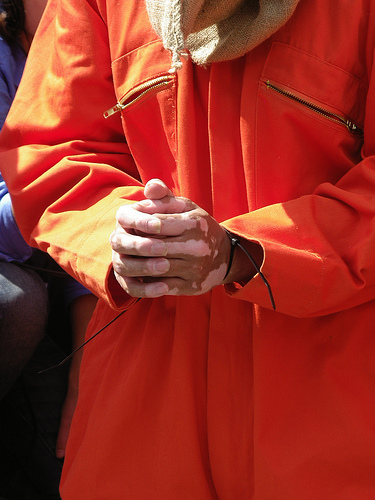
Photo by flickr user Art Makes Me Smile
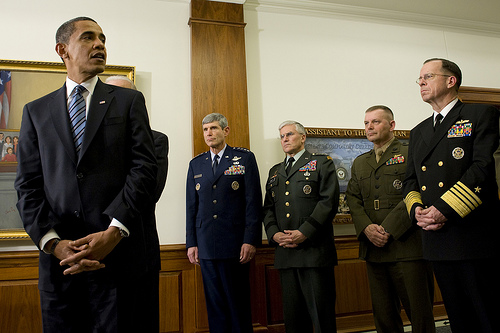 MEDIA ROOTS — Pulitzer Prize-winning journalist Chris Hedges has filed suit against Obama and Panetta to challenge the legality of the NDAA (S. 1867), which includes totalitarian provisions authorising the activation of U.S. Military within U.S. borders to imprison anyone within the U.S., or the world, without charge or trial. Hedges, alongside his attorney, sharply articulates what’s wrong with the Levin/McCain provisions cynically inserted into this year’s NDAA.
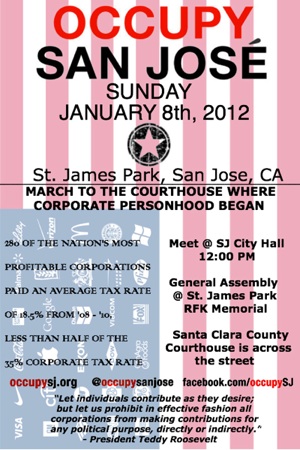 SAN JOSÉ, CA – Occupy San José will hold a general assembly in St. James Park against corporate money in politics, following a march from San José City Hall at 200 E. Santa Clara Street to the Santa Clara County Courthouse at First and St. James Street where, 126 years ago, a judge started our nation down the path to corporate personhood. The march to the Courthouse (St. James Park) will feature leaders from the community, government officials in solidarity with the movement, various unions, and others speaking on the dangers inherent in corporations controlling public policy.