
Greenwald: OM vs. Obama’s Two-Tiered Justice System

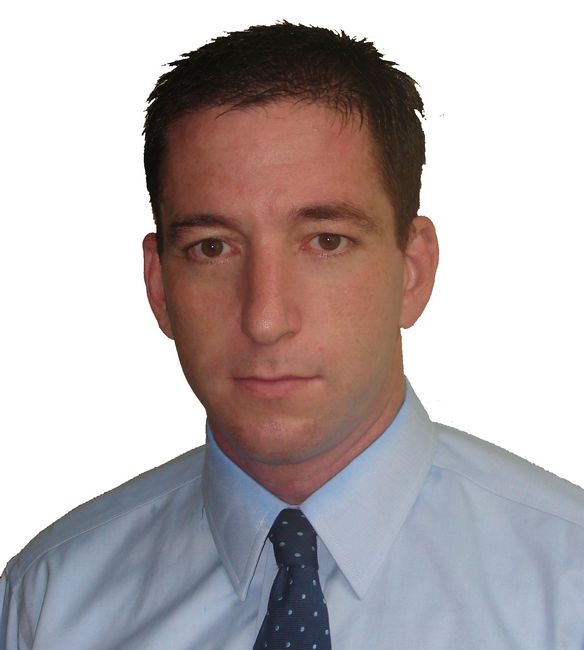
Glenn_greenwald_portraitMEDIA ROOTS — As we look back on 2011, we feature an important and relevant interview many may have missed with Glenn Greenwald on a myriad of topics including the Occupy Movement, Obama co-optation, and the U.S. two-tiered justice system. The interview aired on KPFA’s Letters and Politics on November 4, 2011.  (Please see transcript below.) 

The wake of the successful and historic OM Port of Oakland Shutdown sets the stage for this discussion.  GG answered the decidedly naïve question of whether or not the Obama Administration would be moved or not by the Occupy Movement.  Predictably, it was later revealed that Obama quietly allowed or facilitated the coordinated police state repression against Constitutionally-protected, First Amendment, political expression and activity.

Messina

***

Letters and Politics – November 4, 2011 at 10:00am

Click to listen (or download)


LETTERS AND POLITICS “The thing is if you look at what has happened in the last decade in the United States,” explains Glenn Greenwald, “think about the kind of crimes that we have seen by the most powerful people. 

“So, we’ve seen the construction of a worldwide torture regime, spying on American people without the warrants required by the criminal law, an aggressive attack on another country that killed at least a hundred thousand innocent people, multiple acts of obstruction of justice, systematic fraud on an enormous scale that triggered a worldwide economic crisis that destroyed the economic comfort and middle-class security of tens of millions of people, mortgage fraud where homes were taken without legal entitlements.  And every single one of these crimes has been completely protected.  None have been investigated meaningfully, let alone prosecuted.

“Then at the very same time that we’ve created this template of elite immunity we have created the world’s largest penal state, prison state, in the entire world.  

“So, people are extremely well aware of this vastly disparate treatment that people who are powerful and in positions of privilege and prestige receive versus how ordinary Americans receive treatment before the bar of justice.  And we’re inculcated the idea we’re all supposed to be equal before the law.” 


Good day and welcome to Letters and Politics.  I’m Mitch Jeserich.

“Glenn Greenwald is here.  Glenn Greenwald is a former constitutional and civil rights litigator.  He’s the author of two best-selling books and also writes for Salon.com.  He is a recipient of the first annual I.F. Stone Award for Independent Journalism.  And he’s the winner of the 2010 Online Journalism Association Award for his investigative work on the arrest and detention of Bradley Manning.  He’s the author of the new book With Liberty and Justice for Some: How the Law Is Used to Destroy Equality and Protect the Powerful

“Glenn Greenwald, it is good to have you here.” 

Glenn Greenwald
(c. 6:44):  “Great to be here.  Thanks for having me.”

LAP (c. 6:45):  “You will be speaking at Occupy Oakland.”

Glenn Greenwald (c. 6:47):  “That is true, this afternoon; I’m very excited by that.” 

LAP (c. 6:51):  “And this, we’re speaking on Thursday [3 Nov 2011 to air this 4 Nov].”

Glenn Greenwald (c. 6:53):  “That’s true.  That’s true.  So, it’ll be—”

LAP (c. 6:58):  “So, you’ll have—by the time we play this—”

Glenn Greenwald (c. 6:59):  “Exactly.”

LAP (c. 7:00):  “What are you gonna say?”

Glenn Greenwald (c. 7:05):  “Honestly, I’m not entirely sure because I wanna go down there and get a sense for what is happening and what the mood is and who’s there.  But what I do know is that for me what has happened with the Occupy Protest Movement is the most exciting and inspiring thing to happen in American politics in many years, certainly including and surpassing easily the 2008 Presidential Election.

“I consider everybody who’s participating in this movement and especially at Occupy Oakland where it’s been lots of tumultuous activity to be genuinely heroic.  So, I’m just honoured to be there and excited by it.

LAP (7:42):  “You mentioned, you say surpass sort of the energy in the movement of the 2008 Election.  Do you see a connection there?  Of the people that were backing—”

Glenn Greenwald
(c. 7:49):  “I do.”

LAP (c. 7:50):  “—and supporting the Presidential candidacy at the time of Obama?”

Glenn Greenwald (c. 7:53):  “I do.  You know, one of the interesting things in looking back in retrospect at the Obama Candidacy that, for me at least, is so disillusioning and even angering, is that Barack Obama specifically and deliberately targeted people who had become extremely cynical in the political process and had decided either that it wasn’t worth doing at all or that they had done it before and they no longer wanted to. 

“And he talked about this corrosive cynicism in the citizenry, this perception that working within the political process changes nothing.  And he specifically tried to persuade those people that it would be worthwhile to get behind his candidacy.  And that’s what all this ‘yes, we can’ and the ‘audacity of hope’ was designed to convey.  And huge numbers of people, young people, and first-time voters, and people who had become disillusioned were persuaded by that and poured their time, and energy, and money, and resources into this candidacy and perceived that this was going to be finally the vehicle to re-empower the people of the United States in terms of our government.  And, of course, none of that happened.

“And the disillusionment was so extreme, ironically he, kind of, increased the cynicism in the citizenry more than any one else could have.  And I think a lot of it is getting channelled into this Occupy Movement that’s grounded in the belief, the correct belief, I believe, that political change [can’t] be effectuated through the political system.  It has to be done by citizen anger and unrest and disruption outside of it.”

LAP (c.  9:15):  “Oftentimes we compare what’s happening now to the 1930s.  If you talk about the New Deal, the New Deal came because of a grassroots movement and also a labour movement during that time.  Do you think, I guess it’ll be interesting to see how the White House Responds to this, if it’ll be moved or not.”

Glenn Greenwald (c. 9:37):  “I think we’ve seen already what the White House is thinking about in terms of this Movement.  And I find it somewhat laughable because it’s never gonna work.  But what they’re trying to do and they’ve made it clear, is, essentially, they wanna co-opt the movement to reinvigorate the energy that the Obama Re-Election Campaign is so obviously lacking and have it be the force that basically drove him into the White House in the first place. 

“Organs, Democrat Party organs like the Center for American Progress have openly spoken about the effort to transform this Movement into one that is about electing Democratic leaders and re-electing the President.  And I think that the reason that’s never gonna work is if the people who were out protesting wanted to work for the Democratic Party, there wouldn’t have been a protest movement in the first place.

“I also think the people are able to see quite clearly that despite the rhetoric that we’re now gonna hear, the populist rhetoric from President Obama, that during his first three years in office he’s been far more devoted to the people who have funded his campaign, which is Wall Street and the banking and securities industry, than he has to ordinary Americans whose interests have largely been ignored.”

LAP (c. 10:43):  “So, how do you think this Wall Street Movement then becomes successful?  I mean obviously and a lot of people will say it’s already been successful.”

Glenn Greenwald
(c. 10:48):  “Right.”

LAP (c. 10:52):  “It’s changed the debate.”

Glenn Greenwald (c. 10:54):  “Right.”

LAP (c. 10:55):  “It’s brought visibility to the streets.  Anything else, though?”

Glenn Greenwald (c. 10:58):  “Well, I mean, the way in which it’s already been successful is a critically important development which is that it has injected discussions of income and wealth inequality into mainstream American discourse.  A watershed moment for me was I was watching CNN a couple weeks ago and there was David Gergen who is, sort of, the voice of the political establishment and he said something along the lines of, ‘Well, I think that we need to acknowledge that income inequality is an issue worthy of some attention,’ which for him is a very radical acknowledgement.  That is directly the by-product of the Occupy Movement instead of only talking about austerity and where to cut budgets, we’re now talking about wealth inequality and fairness.

“And it’s very difficult for me to answer your question specifically in terms of what the outcome will be because none of us know.  Right?  It’s in the incipient stages.  Part of what makes it exciting is that it’s organic and relatively unplanned and unstructured and so it could go anywhere—good or bad.  But I think that the more important outcome that it is achieving, that it has already begun to achieve, that will continue to achieve, is that it is putting fear into the hearts of those in who exercise power, political and financial power.  And, for me, if you look at the reason why the ruling-class has been able to run rampant say the last decade or more it’s because this fear has been so glaringly absent.  If people who wield power can wield it without any fear of the repercussions we’ve removed from the threat that they face the idea that if they break the law they’ll be punished because we don’t punish political and financial elites, except for the very rare exception.  We shield them from the consequences of their crime.

And, so, if you don’t have a citizenry that’s willing to march in the street and disrupt things and engage in unrest when they cross lines so egregiously, then it will be without the supreme limit, the most important limit, which is fear of the citizenry and how it will react to this degree of corruption and impropriety.  And I think that’s being re-instituted in a very important way.  And that, I see, is vitally critical.”

LAP (c. 12:57):  “Well, on that note and in that spirit, thinking of the [Occupy Oakland] General Strike [and Port Shutdown] Wednesday [11/2/11] in Oakland, largely peaceful, I mean, you had tens of thousands of people out there and you didn’t have any police anywhere and you didn’t need them.  That part was amazing.  But when you did go by Wells Fargo and a few other banks there were broken windows and vandalism.  Is that part of the fear that you’re talking about?”

Glenn Greenwald
(c. 13:20):  “I think so. 

LAP (c. 13:21):  “And, I guess, can that be included as part of that.”

Glenn Greenwald (c 13:25):  “Certainly.  I mean, if you look at what has happened in other countries that actually face less severe income inequality and economic disruption than the United States has faced, including some Western European countries, what you see is fairly threatening unrest and even riots.  And policy planners in the United States and people in positions in law enforcement and elsewhere have been aware for quite some time that if you start eroding the middle-class and destroying peoples’ economic security, history teaches pretty clearly that nothing triggers backlash and societal unrest and disruption and even riots more inevitably than that.  And so there’s certainly an expectation that at some point that’s gonna happen.  I think that’s part of the police coordination and excessive use of force is about is a way of deterring further acts of protest. 

“So, certainly, if you are somebody who’s very wealthy and who is content with the status quo, anything that threatens it is something that you are gonna fear.  So, I don’t necessarily condone the use of violence or throwing rocks through windows and the like.  But I think that is an inevitable part of the kind of pilfering and plundering that has taken place and on some level has good outcomes from it.”

LAP (c 14:38):  “And it has an effect.  And, again, when we hear the description of what happened with the vandalism, I think people flippantly say, ‘Anarchists.’  And I know a number of anarchists who are like, ‘Well, wait a minute. No. We’re not violent.  It’s a political philosophy that we are about.’  But it does have an effect.” 

Glenn Greenwald (c. 14:59) “The thing is if you look at what has happened in the last decade in the United States, I mean, think about the kind of crimes that we have seen by the most powerful people.  So, we’ve seen the construction of a worldwide torture regime, spying on American people without the warrants required by the criminal law, an aggressive attack on another country that killed at least a hundred thousand innocent people, multiple acts of obstruction of justice, systematic fraud on an enormous scale that triggered a worldwide economic crisis that destroyed the economic comfort and middle-class security of tens of millions of people, mortgage fraud where homes were taken without legal entitlements.  And every single one of these crimes has been completely protected.  None have been investigated meaningfully, let alone prosecuted.

“Then at the very same time that we’ve created this template of elite immunity we have created the world’s largest penal state, prison state, in the entire world.  We imprison ordinary Americans at a faster rate, with less mercy and forgiveness and leniency than any Western country on the Earth.  People go to prison for infractions that in every Western country are considered too trivial to warrant imprisonment and incarceration. 

“So, people are extremely well aware of this vastly disparate treatment that people who are powerful and in positions of privilege and prestige receive versus how ordinary Americans receive treatment before the bar of justice.  And we’re inculcated the idea we’re all supposed to be equal before the law. 

“And, so, when you see the very same people who, through their fraud and theft, collapsed the world economy profit and prospering, while war criminals are out selling books and making money instead of inside a courtroom, the anger is going to be very real and it’s gonna be severe and intense.  And when it’s compounded by economic anxiety, of course, some people are gonna throw rocks through windows.  It’s amazing to me that we haven’t seen more of that and that more widespread yet.”

LAP (c. 16:50):  “And the outrage of people throwing some rocks through windows, breaking windows, and what has happened to people who have ruined the financial system.”

Glenn Greenwald (c. 17:00):  “Yeah. It reminds me of a lot.  I remember the incident when George Bush visited Iraq in 2007 and a journalist, an Iraqi journalist, threw a shoe at him.  And this provoked all kinds of intense outrage by the American punditocracy and the media-class and political elites and demand, we force the al-Maliki Government to prosecute and imprison him.”

LAP (c. 17:20):  “Cathartic for others.”

Glenn Greenwald (c. 17:21):  “Yeah.  Exactly.  And he became a hero in the Arab world.  And, so, here was all this extreme outrage that somebody who had committed, well, basically, a symbolic offence and yet the person whom he was targeting with his shoes is somebody who has extreme amounts of blood on his hands and who has suffered no recriminations or penalties of any kind. 
“And I think you’re exactly right.  All this outrage over people throwing a couple of bricks or rocks through windows is intense when measured against the almost apathy that we have in our political class toward people who have devastated the lives of tens of millions of people with their warmongering and their illegal surveillance and torture and especially with their financial fraud.”

LAP (c. 18:07):  “Again, we are in conversation with Glenn Greenwald, author of With Liberty and Justice for Some: How the Law Is Used to Destroy Equality and Protect the Powerful.  And this is what your book really goes into, is how we got here.  Major question, how did we get here?”

Glenn Greenwald (c. 18:24):  “Yeah, right.  Well, what’s interesting is if you look at the history of the United States, it was really founded in this conception that the rule of law had to be supreme.  We learn through all kinds of clichés that this is the case, that justice is blind, that we’re all equal before the law. 

John Adams thought we only have two choices.  We can be a nation of men, meaning let them make decisions without constraints, or a nation of law.  Those were the only two choices.  Thomas Paine said, to he who asks where is the king in America?  Let a crown be placed on the head of law and declare that in America the law is the monarch.  And, of course, the founders violated those principles in all sorts of violent and heinous ways that are too obvious to merit lots of discussion, but the important point is that they nonetheless affirmed the supremacy, this sacredness of this principle, even when they were violating it,  and that principle became kind of a governing aspirational principle that animated American progress over the next two hundred years. 

“And what we’ve really now done, beginning with, I think, the Ford pardon of Nixon.  And then it became a precedent that was set is that we’ve explicitly repudiated this principle.  We don’t even pretend to believe it any longer.  Now, we make arguments, we in the opinion-making elite-class, anyway, do.”

LAP (c. 19:30):  “Which is a elite immunity.”

Glenn Greenwald (c 19:32):  “Right.  Elite immunity that when somebody is sufficiently powerful and society is sufficiently dependent upon them, they are instrumental in the functioning of the country, that it is not just in their interest but in all of our interests, the common good, to decide that when they get caught committing crimes they will not be subjected to investigation and prosecution on equal terms with other Americans. 

“We saw that with Richard Nixon, who got caught committing crimes in Iran-Contra criminals, the crimes of the Bush era, Wall Street crimes.  And it’s really this prevailing mentality now, this set of rhetorical justifications that enables the most powerful people in the society to commit crimes with absolute impunity.”

LAP (c. 20:11):  “Is this something that has consciously occurred or just has happened over the years.”

Glenn Greenwald (c. 20:17):  “Well, I think what happened was if you go and look at the way in which Gerald Ford, who of course is chosen by Richard Nixon precisely to do this, went on television and justified to what was really an angry and highly resentful nation, the idea that this politician who built his career as the law and order candidate, Richard Nixon, was going to be completely immunised and never see the inside of a courtroom, let alone a prison, he went on the air, Gerald Ford did.  And he was trying to explain why he thought it was just.  And what he said at the time was, ‘Well, of course, I believe in the rule of law, the idea that law is no respecter of persons, which is the crux of this concept.

“Then he went on and added this newly concocted Amendment designed to gut the principle that he just pretended to believe in.  And he said, ‘but the law is a respecter of reality,’ meaning that if there’s too much disruption or if there’s too much divisiveness that comes from prosecuting powerful people, if it’s just too inconvenient for us to do it, then we can and should decide in the interest of the nation that we simply are gonna move beyond what just happened and forget about it and in a a sense sweep it under the rug and not bring about accountability for it. 

“And if this were a leniency that were available to everybody, to ordinary Americans and the powerful alike, then you could have debates about whether or not that was a smart thing to do.  But it wouldn’t be a complete evisceration of the rule of law.  It’s the fact that this is available only to people who are powerful.  And this is the rationale that sort of set the precedent. 

“Lots of even well-intentioned people believe that, yeah, Richard Nixon shouldn’t have been held accountable.  It was time to pardon him because the country needed to heal.  But whatever you feel about that specific case, the application of that mindset, the problem is that, like so many things, once you endorse it in a specific case, it becomes normalised and it grows beyond its original application.  And that’s exactly what has happened.”

LAP (c. 22:08):  “The law is a respecter of reality?”

Glenn Greenwald (c. 22:12):  “That’s what Gerald Ford said, yes.”

LAP (c. 22:14):  “Yeah.”

Glenn Greenwald (c. 22:15):  “And, I mean, which is really another way of saying, ‘If I, a political leader, decide that it is inadvisable to hold somebody accountable under the law, then they should not be held accountable; they should be shielded.’  And that is, really, another way of saying we are not a nation under law, we are a nation of men, of political leaders who, in their own discretion, can decide when the law does and does not apply.  That’s exactly what the founders warned against.  It’s what the Constitution was most intended to avoid.”

LAP (c. 22:44):  “And getting back to the founders and, of course, you gotta keep in mind, and you alluded to this slavery and—”

Glenn Greenwald (c 22:52):  “The disenfranchisement of women and White property owners and Native Americans.”

LAP (c 22:56) “Etcetera, etcetera.  Yet, they meant for the law to be one place where, at least when it comes to economic realities, that’s the one spot, not that they believed in egalitarian society, but it’s the one, under the law it was the one place where people who were seen as people, let’s say that way, were supposed to be treated equal.”

Glenn Greenwald (c. 23:22):  “Precisely.  The founders were not just people who accepted, but who believed in, vigorously, the virtues of wealth inequality and income inequality and inequality in power, which isn’t surprising since they were the elite of the society.  They were very wealthy, by and large.   And so they believed that these fortunes they had amassed and their position in society was justifiable and earned. 

“But what they emphasise is these was that these income inequalities that some people are rich and most people are poor, would be acceptable and legitimate only if we all started at the same starting point with the same set of rules governing all of us, which was what law was meant to be. 

“I analogise it frequently to a running race.  So, that if you have, say, sprinters who are running a hundred-metre race.  And everybody starts at the same starting point.  And everyone has the same rules.  You can’t elbow the other runners out of the way.  You can’t invade people’s lanes.  You have arms-length relationship with the judges and umpires.  You’re not bribing them in order to rule in your favour.  Then whoever crosses the finish line first, we accept that as the winner.  They get rewards.  We all accept that as legitimate.  Whoever comes in second is second.  Whoever comes in last is slowest.

“You know, it’s sort of like when Steve Jobs dies with eight billion dollars, very few people begrudge that, even though there’s mass joblessness and homelessness and foreclosures because there’s a perception, rightly or wrongly, that it was earned, that it was justifiable.  It’s when someone gets to start at a starting point far ahead of everybody else and when the judges are in their back pocket ‘cos they’re being bribed and they’re allowed to elbow people out of the way.  Then when they win, there’s a rejection of legitimacy of that outcome.  I think that’s very much what’s happening in American society now.  Americans by and large don’t mind income inequality.  We’ve been inculcated to accept it as virtuous and just. 

“What people are really angry about in my view is not inequality in and of itself, but it’s the illegitimacy of that inequality, the sense that the people who are winning are not winning because they deserve it, but because they’re cheating.  They are protecting their ill-gotten gains using their power over our political and legal institutions.  And that’s what I think is sparking so much disgust with our prevailing political culture.”

LAP (c. 25:29):  “So far, we have talked about, sort of, this immunity for the political class.  When did this move to the private sector?”

Glenn Greenwald (c. 25:36):  “Well, that’s one of the more disturbing aspects of it.  That’s a great question.  I mean, for me, what really made me realise that it was no longer just available to public sector elites, but private sector ones as well was the battle that was waged, and I worked on this for a long time, over the effort to immunise the nation’s telecom giants from being sued by their customers and being prosecuted for having violated a whole series of laws that prohibited telecoms from allowing governments spying on the communications of their clients without warrants required by the law.”

LAP (c. 26:07):  “The NSA programme of 2005?”

Glenn Greenwald (c. 26:09):  “Yeah.  I mean, AT&T and Verizon and Sprint, the reason why the Bush officials were able to break the law and spy on Americans without warrants is because AT&T, Verizon, Sprint, and most of the other industry leaders turned over huge amounts of documents showing the communications of their customers as well as gave direct access in some cases to those communications even though the law required that their be warrants first.  And they had no warrants. 

“And the Congress, specifically, enacted these statutes that said that if you, the telecom industry, violate these laws because the abuses that led to the reforms in the 1970s, from the Church Committee that discovered decades of eavesdropping abuses on Martin Luther King and others.  It wasn’t just Government officials.  It was Western Union turning over telegraphs to the Government.  All telegraphs sent in the United States to JR Edgar Hoover.  It was AT&T allowing the Government to listen in on calls. 

“So, the Congress, specifically, passed laws that said that, ‘You, the telecom industry, are barred from allowing government spying on your customers’ communications without the warrants required by law.’  AT&T and the rest of them did that.  They got sued by their clients, by their customers, in a whole variety of lawsuits which were centred here in San Francisco.”   

LAP (c. 27:20):  “Yeah.  Electronic Frontier Foundation.”

Glenn Greenwald (c. 27:22):  “Exactly.  The EFF, the outstanding civil liberties and privacy organisation represented those plaintiffs and they began winning.  The Federal Court started saying that if the telecom industry did what it is alleged to have done, it is clearly illegal. 

“And instead of doing what everyone else does when they get sued in court and begin losing, which is think about how to settle the case or continue to contest it, the telecom industry hired an army of bipartisan lobbyists, ex-officials in both parties, who went to Congress and demanded that Congress pass a law that had no purpose other than to retroactively immunise the telecom industry to say that they cannot be held accountable in court, that lawsuits must [discriminate], an extraordinarily radical step to do, a radical expression of lawlessness.  So much so that when I it was first demanded, I was very skeptical about the fact that the Democratic Congress would do it, not because I had faith in the Democrats, but because I just thought it was too glaringly sleazy and corrupt even for our political class to be able to do it.  And, yet, six months later with the leadership of all parties behind it including the current President, the then-Senator Obama, the Congress did exactly that.  It enacted this legislation.  It terminated all lawsuits against the telecoms and shielded them completely from the consequences of their illegal acts.  So, here was a case where that rationale that I described Gerald Ford promulgating.  The idea that, ‘Oh, we need the telecoms for our national security.  It’s unfair to subject them to these high damages awards seeped into the private sector and led to full-scale immunity for them.”        

LAP (c. 28:54):  “So, could you draw a line to these telecommunication companies to then CEOs of the major financial institutions in the 2007/2008 crash?”

Glenn Greenwald (c. 29:06):  “Absolutely.  And if you look at what is said about the reasons why banking executives and Wall Street firms and credit agencies are not being, in the opinion of some, should not be subjected to prosecution, what you will hear is exactly the same mentality, which is, ‘it’s more important that we recover economically than it is that we dig in the past and assign blame or point fingers, all those clichés or that we need these firms for our economic recovery.  And if we start subjecting them to prosecution, it’s gonna disrupt the markets and prevent us from prospering economically again. 

“So, it’s always this argument, Orwellian claim, that it’s in all of our common good to immunise the most powerful people and not subject them to the rule of law.  And what that does, the real outcome of what that does, is that it signals to the elite class that you are free to break the law with impunity however much you want.  We will never prosecute you for it.  And what does is it means that, in essence, they are incentivised to break the law because they know the more they break the law the more protected they will be.”

LAP (c. 30:14):  “The New York Times broke the story in 2005 about the NSA spy programme, won awards for it, but also sat on it for a year until the Election was over.

Glenn Greenwald (c. 30:27):  “This is something that The New York Times does repeatedly.  Interestingly, we saw in the WikiLeaks controversy the Executive Editor of the New York Times, Bill Keller, despite his paper publishing lots of secrets WikiLeaks had provided, went around on this campaign to convince people that the New York Times and WikiLeaks were drastically different. 

“And one of the things Bill Keller consistently pointed to proudly is that unlike WikiLeaks, which publishes secrets without the permission of the Government, the New York Times goes in advance to the U.S. Government and says we intend to publish these secrets and basically allows the Government veto power over it to say,‘You should not publish this secret ‘cos it could it’s too harmful.’  Of course, it’s The Times that retains the decision, ultimately, about whether to do it.  Sometimes, in rare cases they’ll publish it anyway.  But, by and large, they obey the orders of the government

LAP (c. 31:16):  “Ready to protect national security.”

Glenn Greenwald (c. 31:18):  “Exactly.  And what happened was when the New York Times was about to publish the NSA story.  In 2004, the Bush Administration, George Bush, himself, summoned the publisher of the New York Times, then-Executive Editor, to the Oval Office and said, ‘If you publish this information you’re gonna harm national security and render us vulnerable to terrorist attack.’  It was absurd from the start that claim, because the only thing The Times was publishing, everybody knew already that the U.S. was eavesdropping on terrorists. 

“The only thing that story revealed was that they were doing it without warrants, as the law required.  They were doing it illegally, rather than legally.  It’s not information that could possibly have helped anybody attack the United States.  But they obey the orders, essentially, from the Bush White House and as you said sat on the story for almost a full year until after George Bush was safely re-elected.  They abetted and enabled that to go on without the knowledge of the American people for almost a full year.”

LAP (c. 32:10):  “Again, we are in conversation with Glenn Greenwald, award-winning journalist, author of the new book With Liberty and Justice For Some: How the Law Is Used to Destroy Equality and Protect the Powerful.  Something you mentioned earlier made me start thinking about something during our conversation.  That’s the Church Committee, a committee in Congress, I think in the Senate, investigated COINTEL-PRO and just abuses by the FBI, perhaps the CIA, I don’t know.”

Glenn Greenwald (c. 32:38):  “Right.  Yep.”

LAP (c 32:39):  “There is a film on YouTube out now from Occupy Oakland showing some police officers and then showing them again as protesters, infiltrators.  I guess I’m asking you to do some conjecture here but with these Occupy Wall Street Movements gaining steam, do you, and we saw the NSA programme, all these other things, what would you expect right now the authorities to be doing about this?”

Glenn Greenwald (c. 33:10):  “Well, there’s no question that they’re taking it very seriously.  It is not possible, just by the nature of how power is exercised, to pose a threat to people who wield power and have them sit by quietly and passively and accept it.”

LAP (c. 33:27):  “They’re not just watching this.”

Glenn Greenwald (c. 33:28):  “Yeah.  They use their power to undermine and subvert it.  I’ll give you a great example.  There was a top secret report published by or prepared by the Pentagon in 2008 that declared WikiLeaks, which at the time almost nobody in the United States knew, to be an enemy of the state.  That’s the term they used.  And they plotted ways to destroy WikiLeaks.  They talked about exposing their sources to prevent people from having confidence that if they leak they can do so without detection.  They talked about fabricating documents that are fraudulent and submitting them to WikiLeaks in the hopes that they would publish them, which would destroy their credibility and the credibility of future leaks.  They talked about disrupting their financial pipeline—all things that essentially ended up being done, were done to WikiLeaks.  Ironically, this report got leaked to WikiLeaks, which then published it. And that’s how we know about it. 

“But this is what the U.S. Government does all the time to any organisation, including domestic ones, that they consider threatening.  They’ve infiltrated dissident groups for decades in the United States.  They constantly infiltrate Muslim communities with agent provocateurs and spies and double-agents who keep many of the plots that the FBI disrupts and then proudly announces are plots that the FBI actually created and introduced into people’s minds.”

LAP (c. 34:45):  “Oh, in new York.”

Glenn Greenwald (c. 34:47) “Yeah.  And many of these plots involved have been ones that FBI informants, undercover informants—”

LAP (c. 34:54):  “They come in pushing for us.”

Glenn Greenwald
(c. 35:57):  “They come in and they persuade.  They give target some 22-year old kid and convince him that it’d be worthwhile to do a plot and they could feed him the money, they feed him the material and feed him the means.  And then right before he’s about to carry out the act, the FBI plot, they disrupt their own plot and announce to the world that they saved us all from their plot.  This is what the U.S. Government is there to do. 

“The surveillance industry, the national security state, the law enforcement agencies are extremely well-funded at a time when everything else is being stripped away.  They operate under an extreme cloak of secrecy.  And this is the stuff that they’ve been doing forever.  So, if they weren’t infiltrating the Occupy Movement and putting in agent provocateurs and trying to undermine the credibility and disrupt them in all sorts of ways, it would be the first time that ever happened, right?  It would be the first time ever.” 

LAP (c. 35:41):  “Yeah.  And I mean they’ve infiltrated grandmother peace groups.”

Glenn Greenwald (c 35:44):  “Absolutely.  And they used the P.A.T.R.I.O.T. Act to spy on environmental groups and anti-war groups, civil liberties organisations, and pretty much everyone else who at all dissents from mainstream orthodoxy.”

LAP (c 35:55):  “Last week we marked the ten year anniversary of the P.A.T.R.I.O.T. Act.”
 
Glenn Greenwald (c. 35:58) “Yes.  That is still going stronger than ever.”

LAP (c. 36:01):  “Yeah.  Glenn Greenwald, as we move to wrap up, again in 2010 you won the Online Journalism Association Award for your work about Bradley Manning.  At Occupy San Francisco there’s a debate.  I don’t know if there General Assembly has voted on this or not, but to rename Justin Herman Plaza  to either Scott Olsen, who is the Marine that got struck last week in Oakland, or after Bradley Manning.”

Glenn Greenwald (c. 36:30):  “M-hm.”

LAP (c. 36:31):  “It’s interesting to think about Bradley Manning, WikiLeaks in Oakland, even the Oscar Grant incident all of this coming into one big narrative.”

Glenn Greenwald (c. 36:43):  “Well, you know, one of the things that I think you see as a common thread through all of this, I mean, when I first wrote about Bradley Manning and the extremely inhumane and oppressive conditions under which he was being detained for ten months.  The question that a lot of people had and that I actually had as well was, ‘Well, why would the Obama Administration want to, basically, torture Bradley Manning?’  It seems counterproductive.   It creates sympathy for Manning.  It undermines their ability to prosecute him because his statements made in custody become subject to claims of coercion. 

“Ultimately, what I realised is the reason why Bradley Manning is subjected to that treatment is the same reason that the Bush Administration picked up thousands of people around the world and brought them thousands of miles away to a Carribean Island and dressed them in orange jumpsuits and shackles and tortured people and showed it to the world.  It’s the same reason why the police, gratuitously and arbitrarily pepper-spray protesters and shoot them with rubber bullets.  It’s because it’s a way of signalling to people who might challenge their authority or dissent in a meaningful way that ‘you should think twice about doing so, that if you’re somebody who wants to go march in the street, look at what we’ve done to these protesters. If you discover that we’ve committed crimes and wanna expose them, look what we’ve done to Bradley Manning.’ 

And it’s really about using the law coercively as a force to entrench power, which was the exact opposite of what it was intended to be.”    

LAP (c. 38:06):  “Glen Greenwald, thank you.”

Glenn Greenwald (c. 38:08):  “My pleasure.  Thanks for having me.”

LAP (c. 38:09):  “Again, Glenn Greenwald has been our guest, author of the new book With Liberty and Justice for Some: How the Law Is Used to Destroy Equality and Protect the Powerful.”

Transcript by Felipe Messina for Media Roots


***

Looking back as the year comes to a close, so many stories, so much news, and so little time.  As Media Roots looks back on 2011, we feature an interview many may have missed with Glenn Greenwald on myriad topics including the Occupy Movement and Obama cooptation.
Posted in Uncategorized | 1 Reply

Native Americans & OM: Potential Power Partnership


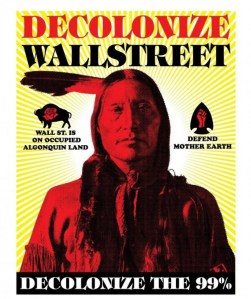
decolonizewallstreet-615x734MEDIA ROOTS — For some of us who either have indigenous roots in the Americas going back to pre-Columbian times or have strong consciousness of colonisation and occupation, we know the terms occupy and occupation are loaded terms.  On one hand, we can understand contemporary Americans attempting to appropriate a term of oppression in defiance of the ruling-class, the 1%.

The fact that Occupy Wall Street caught on and evolved into the national then global Occupy Movement (OM) seems to reflect the popular desire of the U.S. working-class to do to their oppressors what has been done to them and to the proletariat the world over.  Yet, as Nietzsche has noted in Beyond Good and Evil, “Whoever fights monsters should see to it that in the process he does not become a monster. And when you look into an abyss, the abyss also looks into you.”  

This resonates with the importance of the OM to develop its consciousness beyond its dominant culture.  Indeed, the OM has been as progressive as its participants.  Yet, indigenous consciousness, class consciousness, consciousness of White privilege, consciousness of racism and imperialism, all these factors must be incorporated and studied by OM general assemblies, especially as it goes mobile following Obama’s federalised police state crackdowns and dismantling of encampment sit-ins.  At this point, the die is cast.  The OM is here.  What’s in a name?  As it’s always been, the strength and character of a movement, even one aspiring toward horizontalism, is dependent upon the level of consciousness of its rank and file.

Thus, blogger Colin Donoghue provides a synthesis of thought considering Indigenous consciousness and Native American participation within the Occupy Movement.  Similarly, Morning Star Gali of the Achumawi band of the Pit River Nation and the Bay Area Native American Indian Network recently discussed efforts to decolonise Occupy Oakland.  (See transcript below.)

Messina

***

COLIN DONOGHUE — What is now called the United States was founded on occupations of Native land, and in a sort of ironic way, the urban Occupy Wall St. campers being evicted from city parks across the country are getting a first-hand experience of what’s it’s like to be violently forced off the land, out of their small dwellings, dissolving their communities.  Of course the Occupy camp evictions and the police-brutality that has come with it (and preceded it), though inexcusable, is still nothing compared to the indiscriminate killing of Native Americans that occurred on this continent not too long ago, yet it would be productive to consider where similarity between the two events does exist, and what that means as far as understanding what the root cause of social-injustice really is, and what the most effective strategy against it is.

Many of the Occupy activists today seek to “evolve” the same imperial powers that committed genocide against Native Peoples around the world and have since gone on to massacre millions of other innocent women, men and children in other acts of mass-violence.  They believe the existence of these governments can still actually advance liberty & justice, they believe it is just a matter of somehow making these so-called democracies actually live up to that promise, like through more protest.  However, if the Occupy activists look at their nation’s history more through the eyes of Indigenous women & men, they would get a better understanding of what they are really fighting against, and therefore what their focus and plan of action should be.

In America during the past two centuries, activists have tried to reform this institution of extreme violence over and over, without understanding that this government, like all governments, not only tends to be extremely violent and destructive, it was founded on violence and destruction, and in fact continues to be violent and destructive on a daily basis, just by its very existence.  What do I mean by that?  We are actually always experiencing the violence and destruction of an ongoing eviction, an eviction from the Earth, an eviction from a natural way of life that harmonizes with Nature and each other.  These current Occupy camp evictions make partly visible once again how the 99% have all been prevented from living in harmony with Nature and each other, through the existence of social-systems, and the taxes and land costs that come with those systems of human farming.  Two excellent documentaries that also visually show this root injustice repeating are “Broken Rainbow” (about the Navajo in the Southwest) & “The Garden” (about community gardeners in South Central Los Angeles); in both you see the state bulldozing the gardens of low-income people trying to live more self-sufficiently and naturally….

“We no longer see ourselves within the webs and cycles of nature.  The loss of a direct relationship to the world terminates a once universal human understanding of our oneness with the natural world.  The principle of relatedness is at the heart of indigenous wisdom: traditional intimacy with the world as the immanent basis of spirituality. This understanding is an essential and irreplaceable foundation of human health and meaningfulness.”

Twilight of the Machines” by John Zerzan,” p.124

Indigenous wisdom is desperately needed by those who think of themselves as citizens rather than humans, by those who are exploited and indoctrinated by social-systems, systems that are supposedly run by representatives who “serve” the masses.  The truth is a rearranging of those letters; they don’t serve us, but sever us, from the Earth and from each other, through taxation, land control/cost, hierarchy and division of labor.  Seeing through the deceitful promises of government, modern technology and industrialized society, we can reclaim our humanity and base our way of life on principle, on non-violence, equality and true freedom.

So yes, Occupy, but not to petition false masters to treat their slaves better, Occupy to break away the chains to the lie of so-called “representative” democracy.  Then we can unite and harmonize with the Earth, our true nurturing parent, and reject the false parental overlords who continue to deceive the masses into believing that they are better off with their “care.”

Read more about Native Americans & the Occupy Movement: Potentially a Powerful Partnership.

© 2011 Colin Donoghue

***

THE MORNING MIX WITH TARA

Tara Dorabji (c. 45:12):  “You’re tuned in to The Morning Mix on KPFA.  I’m Tara Dorabji.  And those are the sounds of Los Guaraguao, some of our revolutionary freedom fighters, music makers, from El Salvador.  And right now I have with us in the house, in-studio, Morning Star Gali.  She’s a movement maker, human rights warrior, freedom fighter, mother, radio producer, friend, and compañera.  Welcome to KPFA.

Morning Star Gali (c. 45:41):  “Thank you so much for having me this morning.”

Tara Dorabji (c. 45:43):  “Yeah.  Thanks for being with us.  And, you know, just breaking down what’s going on with the Movement to Decolonise Occupy Oakland.  There was a big movement to actually have a name change.  And that was shot down.  So, break it down for us.  What’s going on?  How are folks working to decolonise the Occupy Movement?”

Morning Star Gali (c. 46:05):  “Yeah, definitely.  That’s a lot.  So, I’ll start first with October 10th when Occupy Oakland was first set up.  It was on Indigenous People’s Day.  And there was an effort made; on that day we have the annual Sunrise Gathering that takes place on Alcatraz Island and we had organised a protest that day over at Nady Electronics, at the headquarters there.  And so there was an effort made to insure that the timing would workout where we went to the Alcatraz Sunrise Gathering.  We protested at Nady Headquarters over on Shellmound Street in Emeryville.  And then later that afternoon was the kick-off for Occupy Oakland.  

“And from day one, recognising that on Indigenous People’s Day, you know, having Corrina Gould, who is Chochenyo Ohlone, and other Ohlone representatives there, really, blessing the area and giving their blessing to the Occupy Movement and also recognising from day one that there is this effort being made to decolonise these movements and that we really have an issue with the word occupy.  Our lands are occupied.  And we want them unoccupied.  And, so, there’s that effort being made to decolonise [Occupy] Oakland.  

“On October 31st, there was a declaration of Solidarity with Indigenous Peoples that was passed with a vote of 97% by the General Assembly of Occupy Oakland.  And some of the text of that stated that there was an effort being made to decolonise [Occupy] Oakland.  So, the proposal that was submitted on December 4th was just the next step forward with it.  

“We knew that it was going to be a contentious issue.  We knew most likely that it wouldn’t pass.  But it was really about bringing the conversation to light for people and to talk about why we weren’t comfortable with occupation and with the term occupy being used.  And, really, that it was very nauseating to many of us to continually sit through the general assemblies and hear these claims made about, ‘we need to occupy everything’ and ‘we need to continue the occupation on lands that have been occupied for over 500 years.’  And, so, it didn’t pass just by a slight margin.  It was 1 ½% that was needed to make the friendly amendments that would have changed it to Unoccupy Oakland or Liberate Oakland or Coexist.  There were, really, a number of great suggestions.  

“So, we do plan in the future to bring it up in the future again.  And, at the time, there were also indigenous solidarity teach-ins that were taking place.  And there’s a number of them that are coming up as well.  So, we’re asking folks to get engaged and kind of plug in.  

“There was a really successful action that was held this past weekend by a number of folks involved with the Decolonise Oakland efforts and also the efforts to protect Rattlesnake Island up in Elem Pomo territory.  So, that was really beautiful ‘cos we really reached out to the Decolonise Occupy Oakland folks and really had the support of a lot of folks where we marched up to the territory of the one-percenters, up to [millionaire developer] John Nady’s home.”

Tara Dorabji (c. 49:40):  “We’re talking with Morning Star Gali.  She’s here with us in-studio about the efforts to, really, decolonise the Occupy Oakland Movement.  The Occupy Movements across the Americas and, you know, one of the things, I mean, it struck me—Occupy.  When I hear the word Occupy, I see the soldiers.  There’s a sense of occupation.  And, so, how do you see?  I think that there’s a real difference, like, people who have never been occupied, people who have never lived in an occupied land, people who have had a certain privilege, perhaps, perspective like that word.  It’s gonna resonate, perhaps, differently.  

“And, so, how do you see within the Occupy Oakland Movement; how are you seeing a shift taking place within the organising?  Is it happening?  Are people becoming more aware of the intensity of that word and its impact on folks?  How do you see that dialogue continuing to move forward?”

Morning Star Gali (c. 50:42):  “I definitely think that it’s moving forward in a very positive way.  We have seen even over the past weeks where people’s emotional attachment to the word occupy and what that looks like in terms of branding and people really felt like, ‘Oh, if we change the name then what does that look like in terms of us distancing ourselves from the movement? And people won’t recognise, you know, people are very familiar with Occupy Oakland.’  

“But there have been name changes.  Sedona, Arizona, they did change their name to Decolonise Sedona.  Albuquerque, New Mexico changed to Unoccupy Albuquerque.  And their initial proposal was to decolonise.  Up in Seattle, they also had a proposal put forth to decolonise Occupy Seattle.  And it also didn’t pass up there.  But the QPOC Caucus up there decided that they were gonna go forth and call themselves.  And that they didn’t need permission.  They didn’t need anybody’s permission in what they wanted to name themselves.  And, so, since then they’ve been Decolonise Occupy Seattle.”  

Tara Dorabji (c. 51:57):  “We’re talking with Morning Star Gali about the Movement to Decolonise.  And, so, is the main thrust then in people’s resistance to changing the name, really, the branding?  Is that, sort of, the central impetus for keeping the occupy word in there?”

Morning Star Gali (c. 52:15):  “I feel like that’s definitely one of the stronger arguments that they have, which is interesting because it’s only here in the U.S. where the term Occupy is being used.  And there was argument that over in Egypt and in Tahrir Square that the connection’s made with what’s going on.  And we’re like, ‘No, wait a minute. They’re not calling themselves Occupy.’  You know?  And what would that look like in Palestine, over Gaza, a huge banner that read Occupy Palestine?  And the colonialism here is deep, that entrenched, that people don’t see that it’s problematic.  

“But I do feel like we’re making those steps forward.  I mean four to five years ago, even, if we were to put it out there.  The first day of the Occupy Movement there were those big banners that said ‘Welcome to Oscar Grant Plaza on Ohlone Land.’  And, so, just even that recognition, that’s, really, a huge step forward.  You know?  And, really, calling that out and letting folks know that this isn’t something that’s in the past, that these cultures are no longer alive.  We are here and we are very much present as California Indian people.  There are struggles that are currently taking place, as far as the desecration of our sacred sites and the effort to protect them.  So, I feel like we’ve really been able to bring those conversations into light and to talk about the fact that, as indigenous peoples, we are the original 99% resisters, that we are here and this is what we’ve been experiencing and, so, to really connect those struggles across the board.”

Tara Dorabji (c. 54:02):  “We’re talking with Morning Star Gali about the shift, the need, the Movement to decolonise the occupiers.  And in our last couple of minutes, you know, this is, sort of, a watershed, in a way, of activism and a different wave of resistance coming up right now in the U.S.  And from your perspective as a mother, as an indigenous woman, as someone that has really come up and done a huge amount of organising on the ground in all the spots—I know I can always call on Morning Star, she’ll be there—what do you think is the most strategic thing for the movement to do right now?  Where do you see the pulse?  Where do you see the need to go?  And where do you see the place to strike?”

Morning Star Gali (c. 54:44):  “Well, it’s interesting because a lot of the kind of resistance with the name change was, ‘Why now? Why are you bringing this up now? It’s not the time. Why are we wasting our time focusing on this?’  And we were just like, ‘Wait a minute. Wait a minute. You need to hold up because if now is not the right time, when is it?’  You know?  This is a conversation that’s long overdue.  And, so, where is the movement going from here?  If we’re talking about being inclusive of all the 99%, when recognising that indigenous peoples feel that they can’t participate and a number of people feel they can’t participate in this movement under the label of occupation, we need to have that conversation of what that looks like and how to be inclusive across the board, especially to the First Nations People, whose land that this is.

“And, so, as I mentioned this past weekend there was a really successful action that took place in marching on [millionaire developer] John Nady’s house in Piedmont.  I feel like that’s a really great direction of where we’re going, whether with the Port Shutdowns, which I heard was like a 5% loss to Goldman Sachs, making those connections that with indigenous peoples that are on the front lines here, this is what we’re experiencing on an everyday basis.  So, we need to make those connections and have those further dialogues and conversations.  And that’s what Decolonisation Movement is about.”

Tara Dorabji (c. 56:19):  “Great.  Thank you so much for joining us and coming in the casa this morning.”

Morning Star Gali (c. 56:22):  “Thank you.”

Tara Dorabji (c. 56:23):  “And today’s Morning Mix was produced by, myself, Tara Dorabji with help from Anthony Fest.  Just a heads up that next Monday, December 26th, we’ll be airing a special from the most densely militarised land on Earth, Kashmir.  So, tune in for that next Monday on The Morning Mix.

“I just want to say happy solstice to you all out there.  It’s been an honour being with you on the airwaves over this last year.  If you have any feedback for me, you can hit me up at [email protected].  You are listening to KPFA, 94.1 FM, 89.3 KPFB in Berkeley, 88.1 KFCF in Fresno, online all the time, KPFA.org.  Up next is Democracy Now!.”     

Transcript by Felipe Messina

Point of information:  Morning Star Gali says it’s only in the U.S. that the term Occupy is being used.  Yet, we are mindful of Occupy Toronto, Occupy Montreal, Occupy Jamaica, Occupy Amsterdam, Occupy Bucharest, etc.

***

Occupy Port Shutdowns on Russia Today

MEDIA ROOTS — Felipe Messina of Media Roots spoke with RT about the Occupy Movement and what it’s trying to achieve with the West Coast Port Shutdowns and ILWU rank-and-file solidarity, and peaceful direct action as well as the East Coast Goldman Sachs Shutdowns, on Monday, December 12, 2011.

MR

***

RT speaks with Felipe Messina of Media Roots about the West Coast Port Shutdowns.

Black Agenda Report: Occupy Atlanta Occupies FCC


FCClogoBlackAgendaReportMEDIA ROOTS — On December 1, 2011, FCC Commissioner Mignon Clyburn and Commissioner Michael J. Copps held a public forum, entitled FCC Forum: Information Needs of Atlanta, on Georgia Tech’s campus in order to “assess the needs of Georgia’s citizens in the current media landscape.” 

With the Occupy Movement putting economic inequality and financial corruption on blast, Black Agenda Report and Occupy Atlanta have focused attention on the corporate media obfuscation and whiteout of U.S. media policy, net neutrality, and FCC corruption.  In discussing with Davey D why we must Occupy the FCC, Bruce Dixon, Managing Editor at Black Agenda Report, noted, “The FCC is thoroughly captured by the industry that it purports to regulate.” 

A functioning democracy necessitates an informed electorate.  Yet, the FCC functions anti-democratically by facilitating media consolidation and privatisation, which stifles the free flow of information untainted by corporate interests.  Bruce Dixon reminds us the current FCC privatisation agenda is happening virtually in secret because corporate media, which people depend upon for most of their information, is not reporting it.  Whilst independent and public media is vital, it’s currently a sliver in comparison to the majority of print and broadcast media in monopolistic corporate hands reaching hundreds of millions of Americans. 

As Ron Allen of Occupy Atlanta testified before the FCC, “are the FCC Commissioners public servants or corporate servants?  The wealthiest 1% and corporations use untold amounts of money to lobby politicians and regulators, such as the FCC, to make policies that benefit the 1% and corporations, but harm the public and democracy.”  Yet, the airwaves and broadband bandwidth belongs to the people and must rest firmly in public hands.

The role of the FCC in undermining a healthy media system for a healthy democracy makes it crucial for the people to Occupy, or Decolonise, the FCC.

Messina

***

THE MORNING MIX WITH DAVEY D

Davey D (c. 7:53):  “It is KPFA, The Morning Mix, Davey D hangin’ out wit’ you.  And, that’s right, a lot of Occupy stuff goin’ on today.  Of course, Occupying foreclosed homes.  All that is jumping off at twelve noon [12/6/11] over at the Alameda County Courthouse [in Oakland], the steps there where they do the auctions—very sad if you’ve lost your home to see that being hawked off to the highest bidder.  Many who seem to just not really care [about] the hard times that many fell on.  Folks will be out there to Occupy those steps.  And that’s a good thing, in my personal opinion.  

“But we also wanna talk about other ways in which people are Occupying space, so to speak.  And one of the targets has been the FCC.  Here in the [S.F.] Bay Area, as you know, there’s been a lot of changes in radio with the consolidation showing its impact, as companies like [Cumulus] and Clear Channel have shown up and have decimated popular stations that are on the progressive-leaning side of things, wit’ more to come.  So, that’s gotten a lot of people up in arms, as they are now realising that some of this stuff that they once ignored are hitting them in places where it hurts.  We’re hearing these reports in Sacramento.  We’re hearing these reports down in Texas.  And one of the places where it’s been ground zero has been Atlanta, Georgia.  On the phone line wit’ us is a good friend of the station and the show.  His name is Bruce Dixon from the Black Agenda Report.  Bruce, how you doin’?”  

Bruce Dixon
(c. 9:29):  “I’m doin’ better than a whole lotta folks, how about yourself, brother?”

Davey D (c. 9:33):  “Good.  You know, for a very long time.  You and your partner, Glen Ford, along with Jared Ball, have been talking about the impact that consolidation and how important it was to pay attention to the moves that were being made behind the scenes and, oftentimes, blatantly in our face when it came to, not only, the consolidation of media and radio, in particular, but also the syndication of it and all these other aspects that are now showing up on our front doorstep, as we have all these new laws coming into effect and no place to talk about them.  And as we’re seeing, as you talked about, the wholesale selling of stations that are on certain bandwidths with the public not even knowing.  So, maybe you can kinda clue us in as to where things stand in 2011.”

Bruce Dixon
(c. 10:27):  “Well, it’s a matter, not only, of selling stations, but they are selling the very frequencies that stations might or might not be able to exist on.  The transition from analogue to digital TV, Davey, opened up thousands and thousands of new frequencies across the country that could potentially be brand new channels for community broadcasters like KPFA.  Or these channels could be used for municipal broadband or municipal Wi-Fi.  Those of us, who are old enough to remember the old days of analogue TV, know that with a pair of rabbit ears you could get a TV signal deep inside a building back in the ’50s and ‘60s.  And these are the frequencies that could be carrying community broadcasters now and could be carrying municipal Wi-Fi or municipal broadband.  But instead what the FCC is doing with these newly available frequencies, is instead of redistributing them to the public, redistributing them to the communities, so that we could have more diversity, more local voices, and more news on the radio and TV dial, what the FCC is doing is they are quietly, almost secretly, auctioning them off, privatising them, auctioning them off to the highest bidder, which as I’ve said will, essentially, privatise these vital and irreplaceable pieces of public property forever.”  

Davey D (c. 12:01):  “Now, this is interesting that this is happening because we’ve seen, as I mentioned at the top with my remarks, two companies, Clear Channel and [Cumulus], who are the largest at this point, have been on what they call a firing spree, taking off long-time broadcasters in popular markets or popular broadcasters in markets.  KGO is one example here in the [S.F.] Bay Area.  Green 960 is another one where that’s gonna be taking place.  But this is happening all over the country.  And when the call for consolidation came out the argument that was put forth by broadcasters, these corporate broadcasters, was that they would be able to ‘diversify the airwaves; this would be a good thing; it would open up the channels, communities would have a voice.’  But now what we see is that they are losing; I think Clear Channel is $18 Billion dollars in debt to a company that was started by Mitt Romney, an investment banking firm.  And the other one had promised shareholders that they would immediately get $50 Million dollars in savings and that $50 Million dollars in savings came from consolidating, firing, and syndicating, so you don’t have local content anymore.  Can you speak a little to that?  And are there more aspects to that we should know about?”  

Bruce Dixon (c. 13:25):  “Well, the main aspect you should know about it, well, the main two aspects is that Clear Channel being in debt comes from the fact that Clear Channel, Cumulus, Radio One, and lots of other big operators borrowed money heavily to be able to buy up those hundreds and hundreds of stations that they own.  And now the people that they borrowed that money from are extracting loan shark interest from them to repay those debts in addition to them having to pay this big debt service that has nothing to do with operating a radio station.  Clear Channel, Radio One, Cumulus may be deep in debt, but their officers are still getting paid.  Their officers and top consultants are still getting paid, or are still paying themselves, billions and billions of dollars.  A company, don’t forget, in the way the United States is running right now can pay its CEOs and its top board members millions upon millions and still be deep in debt and still be virtually going out of business.  That’s just one of the pieces of financial trickery that we engage in here in the United States.  We allow companies to run themselves into the ground and go deep in debt, or even go bankrupt, as long as they pay their executives millions and millions of bucks.  So, we shouldn’t shed any tears for Clear Channel.  They’re still getting paid.”

Davey D (c. 14:57):  “Talk a little bit about what took place in Atlanta ‘cos you said this was a last minute meeting, people didn’t know about it.  What was goin’ on?”

Bruce Dixon (c. 15:04):  “Well, first of all, FCC is composed of five members appointed by the President, confirmed by the Senate—five members, including an FCC Chair.  The last four FCC Chairs have gone straight to work for broadcasters, for the cable industry, or for telecomm with the exception of William Kennard who’s now the U.S. Ambassador to the European Union.  What William Kennard is doing for a living now as the Ambassador is he is putting his foot in the door on behalf of AT&T and Verizon, trying to get European countries to privatise their internet backbone like the U.S. has and trying to let U.S. cell phone companies into their markets, which, so far, the Europeans have not done.  So, the FCC is thoroughly captured by the industry that it purports to regulate.  This is Commissioner Michael Copps’ last month in office and so what they’re doing is they had this meeting with only a week or ten day’s notice in Atlanta.  And people from the community in Atlanta found out about it maybe five days before the meeting happened.  And, so, what we did is we came out, and Occupy Atlanta brought a crowd out, and what we did is we demanded that the FCC redistribute these channels, that they stop privatising these precious and irreplaceable broadcast channels, and hand them out to community stations to create the real diversity that it says it’s about, diversity, not only, in the colour of faces in station management, but diversity in programming, diversity in news, and diversity in arts.  You’re one of the people who talk all the time about rappers who can’t get Sony contracts and can’t get Heineken contracts can’t be heard.”

Davey D (c. 17:02):  “Right.  If you’re just tuning in, we’re talking wit’ Bruce Dixon from the Black Agenda Report down in Atlanta.  He’s talking to us about Occupyin’ the FCC, some of the moves that are being made.  As we are focusing on the Herman Cains of the world, a lot of extra bandwidth and stations are being auctioned off to big corporations, leaving us in a position where we will not be able to have those community voices the way we ideally would want to.  Bruce, you picked up some sound.  Maybe we could play a couple of clips, so people can get an idea of what was spoken about.  The first one is from Heather Gray, I believe, who is with WRFG.”

Bruce Dixon
(c. 17:45):  “She is.”  

Davey D (c. 17:46):  “And that’s the sister station—”

Bruce Dixon (c. 17:47):  “Radio Free Georgia.”

Davey D (c. 17:48):  “—that’s right, and we”   

Bruce Dixon (c. 17:49):  “It’s a Pacifica affiliate.”  

Davey D (c. 17:50):  “That’s right. We’re on—”

Bruce Dixon (c. 17:51):  “In Atlanta.”

Davey D (c. 17:51):  “—the air out in Atlanta.  Why don’t we play just an excerpt of what she was talking about?”

Audio of Heather Gray at Atlanta FCC Meeting (c. 17:57):  “We have this concentration in media as well, of course.  Today, we have four corporate giants controlling vast numbers of radio stations and reaping billions of dollars at the expense of independent news.  Where’s the clap for that, you all?  Media in America represents corporate America.  But it does not have to be this way.  The public spectrums that commercial interests use to transmit their signals are owned by us, the people.  Yet, the government has allowed these interests to use the spectrums for free to then monopolise and make billions of dollars while offering next to no public service.  It’s payback time.  This cannot continue.  Democracy demands informed voters.  With corporate media, however, we have a population tainted by information delineated by commercial interests robbing them the breadth of views and opinions of an independent public media system.  Given that the FCC has failed to regulate media in the public interest, the situation cries for integrity and independence.  What does Atlanta need?  It needs more non-profit community media and the existing non-profit media needs financial support in an on-going basis, rather than teetering on the edge by consistently having to go its listeners for funds like a bake sale.  Alternatives need to be adapted and planned for immediately.  Here are three recommendations to support and build community media.  For one, the government auctions off frequencies and there are plans to do more of this.  This is the ultimate of gross privatisation.  Yet, these frequencies are owned by us, the public.  Instead of auctioning them off, they should be given to communities across America for public and non-profit broadcasters and public television.  They are ours, after all.”  

Davey D (c. 20:10):  “So, that’s just one of ‘em.  What are the other couple of points that she made, Bruce?”

Bruce Dixon (c. 20:13):  “Well, there were three points that she made.  The first one is to stop the privatisations of these irreplaceable resources.  [And] to hand these frequencies back to communities, so that they can create new and diverse community broadcasters.  [The second one is ‘commercial media should be required to pay for the right of making use of the frequencies owned by us that they use for their own financial benefit.’]  And the third one is to guarantee the funding of community media.  KPFA is hurting for money.  WRFG is hurting for money.  Black Agenda Report is hurting for money.  It’s hard doing community media because we have no stable and set funding system, while at the same time the commercial broadcasters who pay nothing for their licences are able to rake in trillions of dollars every year.  So, what we want to do is two things.  What Heather said is the same suggestion that was mentioned in Robert McChesney and Bob Nichol’s book of a couple of years ago, The Death and Life of American Journalism, to grant a $300 dollar income tax credit to all Americans, so that there is a check-off on the tax forms where they can say that, either, my $300 dollar tax credit goes into the general community media fund or I can name four community media outlets, in particular, where it will go to.  So, the people can have a check-off on their tax forms, so that KPFA can have a regular source of income.”

Davey D (c. 21:50):  “Right.  Now, one of the things that might have just rolled over a lot of people’s heads was talking about the money that comes in to the corporate outlets.  And much of that centres around these election cycles.  And now that there’s unlimited money that can be poured in, many of these outlets, even though they owe $18 Billion dollars and $50 Million and all these crazy numbers to the people who loan the money, they do rake in a lot of money thanks to the Citizens United situation.  Can you expound upon that, how that all is connected?”

Bruce Dixon (c. 22:25):  “Well, what that is, the election cycle is definitely a cash cow for broadcasters.  Broadcasters are able to reap additional billions of dollars.  The Obama Campaign directly, itself, is supposed to raise and spend $1 Billion dollars-plus.  Most of that will be on radio and TV advertising.  And although they rake in a large amount of money during the election cycles on advertising, the stations do very, very little to inform the public.  If you don’t have the money to buy airtime, then your message doesn’t get across.  It’s just that simple for you.  At the same time that they’re broadcasting lots and lots of political ads and raking in lots and lots of money, the stations are covering very, very little in the way of actual news about the candidates, the campaigns, and the issues.  So, what we’d like to see is we’d like to see that turned around.  The question is how are we gonna get news in the 21st Century when corporate America has withdrawn its willingness to sponsor news departments.  And that’s the question.”

Davey D (c. 23:48):  “You know, if you can speak on a couple of points, Bruce.  We’re talkin’ with Bruce Dixon from the Black Agenda Report, usually when people here these conversations, the first thing they say is, ‘Well, if the public really likes it then they’ll support it and then that will, you know, show up.’  You know, the free market theory.  And maybe you can speak [to] that.  Ratings have nothing to do with this at the end of the day.  The other thing is, if you can just talk, in particular, with the Black community, the decimation that’s come in the news departments.  I know you all have covered this for a very long time and shown how some of these outlets have gone from like hundreds of reporters to like four for the entire country.  So, maybe you can speak on those two scenarios.”

Bruce Dixon (c. 24:29):  “Well, nationwide, the number of broadcast reporters and print reporters is something like a quarter of what it was 30 years ago.  What we’re actually well past the beginning of now is a golden age for corporate crime and local and national government corruption because there are no investigative reporters to speak of covering anything on the local level or on the national level.  There are very, very few.  Without a news media to keep government and powerful corporations in check, there is a corporate crime wave that nobody is reporting on.  And corporate America has withdrawn its support for news, so the news as we used to know it is not coming back any time soon.  And you cannot have democracy without news.”  

Davey D (c. 25:28):  “And it’s also not only this ongoing scenario of what I call product placement where all of a sudden your news headlines are really glorified advertisements for the newest iPad or the newest Nike sneaker.  You know, they have the reporter there, ‘We’re standing in front of the store. The crowds are lined up. What are they there for? To get the latest computer!’  And, we know, just from sitting in the back room—”

Bruce Dixon (c. 25:51):  “Or the latest iPhone.”

Davey D (c. 25:52):  “Right, right.  But those things don’t happen because it’s news, they happen because they’re ad buys.  In case people don’t know, when I used to sit in those meetings, that’s what it was.  You know?  The company bought a bunch of advertisement.  ‘We’re gonna send our morning reporter out there to cover the opening of the store.’  That’s how that works and it’s not always revealed.  But the other thing that I think comes to mind is these conflicts of interest.  For example, one of the reports that we now know is that Fox News in New York is guarded by the NYPD to the tune of half a million dollars a year, 24/7, New York Police Department.  And people are goin’, ‘Well, why is that?’  But very few people knew that one of the anchors on the local Fox stations in New York, his dad is the Police Commissioner.  His name is Greg Kelly.  His father is Ray Kelly, the Police Commissioner.  And, so, you sit there and you watch the news and they’ll sit there and they’ll talk about the police beating the Occupiers on Wall Street.  And he’s making jokes.  And he’s trying to find all the propaganda tools to make you turn against them, is being put forth, and most people don’t make that connection.  ‘Hey, his dad is the one that runs the police department.’  You see those types of unholy alliances all throughout the news media.  Can you speak on that a little?”  

Bruce Dixon (c. 27:16):  “Yeah, news is, indeed, what you said, product placement a lot.  Not only is it product placement, if you wonder what happens to people who go to journalism school, most of the J-school graduates nowadays are going to work for public relations firms.  And what public relations firms do is their job is manufacturing corporate friendly news, manufacturing corporate statements and then inserting them into the news.  So, that a lot of what you see as news broadcast on TV and sometimes on the radio, the little radio news that there still is, turns out to be stuff that has been manufactured by public relations agencies.  When you see a report in the news about some new miracle drug:  that was often put together by a public relations firm working for the drug company.  So, even a lot of the news that we do see that’s branded as news, like you’re saying, it’s very, very directly product placement.  And, so, the remedy for that is we need new, now, KPFA doesn’t do that.  WRFG, here in Atlanta, doesn’t do that.  Black Agenda Report doesn’t do that.  So, the remedy is to have more and more not-for-profit broadcasters, not-for-profit community media.  And what the FCC is doing now is they could be handing out these new frequencies to communities all over the country to create new broadcasters, but the communities don’t know about it, the people don’t know about it.  So, this agenda of privatising these frequencies, auctioning them off to the highest bidder, is happening virtually in secret because corporate media, which people depend upon to get most of their information about the world is not reporting it.”    

Davey D (c. 29:17):  “What’s the position of President Obama on this?  Because there was a lot of hope and, in fact, he gleaned a lot of votes by stating that he was gonna reform the FCC, but it doesn’t seem like that’s happened.”

Bruce Dixon (c. 29:29):  “Yeah, like I said at that beginning of this segment here, the last four FCC Chair people have gone to work, after their FCC careers, for broadcasters in cable, virtually all the FCC’s top staff and Commissioners do the same.  The guy who President Obama appointed as FCC Chair is Julius Genachowski.  He is himself a former lobbyist for AT&T who helped write NAFTA and who helped write the Telecommunications Act of 1996, which made the government sell off the internet backbone infrastructure, which it had built at a cost of hundreds of billions of taxpayers for just pennies on the dollar, just a few billion, to AT&T, Verizon, and the other big telecoms.”    

Davey D (c. 30:24):  “Wow.”

Bruce Dixon (c. 30:25):  “So, that’s who is the FCC Chairman.  President Obama promised he would take a back-seat to nobody in network neutrality, but, of course, once he got into office he’s taken a back-seat to everybody because the wireless internet is not subject, according to Obama’s FCC, to any network neutrality regulations.  And it is the Obama White House, right now, that is privatising these brand new channels, instead of letting the American people know that they exist in the first place and that they could be handed out to community broadcasters to create new and diverse community broadcasters.  And the position of the Obama Administration and of FCC Commissioner Mignon Clyburn, who is the daughter of South Carolina’s esteemed Congressman Jim Clyburn, is that these things need to be auctioned off, so that we can use that money for the deficit.

Davey D (c. 31:27):  “Wow!!  Wow!  Wow! Wow!  This is just, well; we shouldn’t be shocked I guess.  We just shouldn’t be shocked, but it’s just, when it’s so blatant and it’s so in-your-face, it’s just, you know, it leaves you—”

Bruce Dixon (c. 31:39):  “But it’s not in our face because corporate media won’t report it.  The only place that you’re gonna hear about this, so far, is places like KPFA.”

Davey D (c. 31:50):  “Well, that’s true.  I guess, yeah, I guess I take it for granted because I listen to us all the time.  So, we do stay informed that way.”
 
Bruce Dixon (c. 31:56):  “You, may see an excerpt video of this at www.BlackAgendaReport.com we’ve got it on the front page there, which is a 13-minute piece, a YouTube video, that includes the mic check segment, the entire five minutes that Heather Gray did, and a couple of minutes from Ron Allen of Occupy Atlanta.”

Davey D (c. 32:20):  “Well, why don’t we do this?  Why don’t we play what Ron Allen had to say and then we’ll flow into the mic check that you did at the end of your presentation, which was pretty good, you know.  If they don’t listen to what you have to say then they ain’t gonna listen to anybody, but I like the way you had flipped that with the mic check right there at the FCC hearing.  So, why don’t we start off with Ron Allen who is with Occupy Atlanta, hear his remarks and then we’ll go into your thing, Bruce.”

Audio of Ron Allen at Atlanta FCC Meeting (c. 32:45):  “The wealthiest 1% of corporations use media to silence the 99% through consolidation, threatening net neutrality, causing many to ask the question, ‘Are the FCC Commissioners public servants or corporate servants?’  The wealthiest 1% and corporations use untold amounts of money to lobby politicians and regulators, such as the FCC, to make policies that benefit the 1% and corporations, but harm the public and democracy.  How has media consolidation into five major companies helped the public and helped enhance democracy?  Where are the stories in AJC and other media discussing how corporate media conglomerates are corrupting our government?

Audio of Bruce Dixon at Atlanta FCC Meeting (c. 33:34):  “At this point, mic check, mic check!  (Audience responds:  ‘Mic check, mic check!)  

“Here it is:  Stop the privatisations.  (Audience reiterates:  ‘Stop the privatisations!’)  

“The frequencies belong to the people.  (Audience, ‘The frequencies belong to the people!’)  

“Create new and diverse community broadcasters.  (Audience, ‘Create new and diverse community broadcasters!’)

“By giving people back their spectrum.”  (Audience, ‘By giving people back their spectrum!’

“Make the commercial broadcasters and cable operators  (Audience, ‘Make the commercial broadcasters and cable operators!’)

“Pay for the scarce public resources they use  (Audience, ‘Pay for the scarce public resources they use!’)

“By funding community broadcasting.  (Audience, ‘By funding community broadcasting!’)

“Thank you.  (Audience, ‘Thank you!’)

Davey D (c. 34:21):  “What, were they tryin’ to shut you down, Bruce?”

Bruce Dixon (c. 34:23):  “Yeah, well, they only give you two minutes to make comments from the floor.  Of course, we coordinated our remarks with Heather Gray earlier because she made the same demands as the panellists.”

Davey D (c. 34:37):  “Okay.  Well, you know, as we close out, what are two or three things that you want our listeners to absolutely start doing to turn this tide around?”

Bruce Dixon (c. 34:49):  “Well, the first thing we’ve got to do is we’ve got to make the American people aware that the FCC is privatising frequencies that they could be using to create new community stations all over the country.  Go to Black Agenda Report, find that YouTube video at the top, and share that YouTube video with all of your friends.  And then what you’ve gotta do is you’ve gotta contact your member of Congress and your FCC person and your neighbours because the one thing these people do care about is they care about what you think.  That’s why they are withholding this vital information from you.  That’s why they are withholding news from you.  It’s because they care about what you think.  The fact that the FCC has frequencies available that could be used for community broadband, that could be used for wireless internet for everybody, or that could be used for community channels is news that you’re not being told.  What you’ve gotta do, listeners, is you’ve got to share that news with your friends.  Share it with your enemies.  Share it with everybody.  And, then, figure out what you’re gonna do about it.  We need to Occupy public spaces and we need to Occupy the airwaves because they do belong to us.

Davey D (c. 36:15):  “Well, there you have it.  We’ve been talkin’ with Bruce Dixon from the Black Agenda Report out of Atlanta, Georgia, talkin’ about Occupyin’ the FCC and givin’ us an example of some of the work that they’ve been doin’ tryin’ to shed light on some of the happenings on that esteemed agency that we all should keep our eyes and ears focused on.  Bruce, thanks a lot.  I appreciate it.”

Bruce Dixon (c. 36:37):  “Thanks for the invite, Davey.”

Davey D (c. 36:38):  “No doubt.”

Transcript by Felipe Messina

Image by Black Agenda Report


Bruce Dixon

Doug McKenty Speaks With Economist John Perkins


MEDIA ROOTS — Doug McKenty of KZYX interviews economist John Perkins, author of Confessions of an Economic Hitman, The Secret History of the American Empire, and Hoodwinked about the politics of economic hitmen, predatory capitalism, banksters, and much more.  Perkins also discusses his experiences with the Peace Corps, indigenous consciousness, socioeconomic solutions, and why the 99% are Occupying.

MR

***

Posted in Uncategorized | 1 Reply