Empire Files Exposes Steve Bannon’s True Character

From his Wall Street roots and apocalyptic film career to his cultivation of alt-right bigots at Breitbart News, Abby Martin exposes Bannon’s true character in this explosive documentary.


Abby Martin Exposes Steve Bannon

A familiar name to some and a new one to others, Steve Bannon is a right wing ideologue who should not be ignored. With some calling him “the intellectual force behind” Trump’s agenda and others directly referring to him as President, the former executive chairman of Breitbart News has his hands in some of the most controversial executive orders and foreign policy decisions in this administration.

Bannon’s political development began during his time in the US Navy from 1976-1983. During this time he never served in war himself, but his time spent as an officer on ship created a lifelong thirst for military supremacy and war, still bubbling to the surface today.

After leaving the Navy, Bannon found himself at Goldman Sachs for 6 years before founding his own investment firm, Bannon & Company. Two short years later, he sold his firm to a media giant, funding his next endeavor – making apocalyptic films laden with right-wing propaganda, stoking the fears and insecurities of a growing and increasingly agitated audience. His films range in subject from demonizing the Occupy movement to praising Sarah Palin in a potential attempt to ride her coattails to fame, to dangerous propaganda about the perceived dangers of immigration.

Many of Bannon’s business dealings and relationships have been laden with controversy. In 2004 he began working with Internet Gaming Entertainment, exploiting online games such as World Of Warcraft. Utilizing his experience and connections, “Bannon managed to convince Goldman Sachs to plow $60 million into a company that sold imaginary goods in an imaginary world.” All three heads of IGE were sued for sexual abuse of underage boys, including the founder and CEO, Pierce Brock, and investor Marc Collins-Rector, a fugitive on the run for child rape and human trafficking.

In addition to controversy in his business life, Bannon’s personal relationships have been tumultuous. In 1995 Bannon embarked on his second of three marriages, only three days before his new wife, Mary Louise Piccard, gave birth to their twins, stating that he would not marry Piccard until he had proof that the babies were “normal.” After multiple bouts of physical and verbal abuse, Piccard filed a restraining order and divorced Bannon. Unsurprisingly Bannon was never convicted after Piccard was a no show in court, later claiming to have been threatened by Bannon. He retained visitation rights but was later caught hitting one of the twins when they were only 17 months old.

In the early 2000s, Bannon forged a relationship with Andrew Breitbart with Breitbart affectionately referring to Bannon as theLeni Riefenshtahl of the Tea Party movement.” At the time, Breitbart was a protege of Matt Drudge, creator of The Drudge Report. The Drudge Report successfully brought the power of right wing talk radio to the internet. Breitbart expanded on The Drudge Report’s model by manipulating headlines to demonize progressives, women, immigrants, and more. Soon Alex Jones and his following were brought into the fold. As Breitbart News began to go under, Bannon was hard at work sourcing funds from right-wing investors in an attempt to reanimate it, when Andrew Breitbart unexpectedly dropped dead. Bannon quickly stepped in as CEO.

Soon Bannon created the Government Accountability Institute, an official sounding ring-wing think tank, bankrolled by an investment from Robert Mercer. Mercer had recently financed anti-Muslim adds in opposition to the “Ground Zero Mosque” resulting in an increase in xenophobic panic. Other notable GAI investors included the power hungry billionaires, the Koch Brothers. GAI also served as a money laundering scheme for Breitbart in which wealthy donors could donate to the non-profit with their donations quickly forwarded on to Breitbart’s reporters.

With the rise of Trump came a rise in Breitbart News reader loyalty, including an instant increase in monthly readers – from 8 million to 18 million. Trump and Bannon both found something attractive and desired in the other – Trump being a powerful and accessible mouthpiece and Bannon being a household name with a large, loyal, and extremely passionate following.

Bannon preys on society’s problems and falsely directs the blame where he wants it – on immigrants, globalism, progressives, millennials, and more. Bannon’s misdirected desires to halt Muslim immigration, his strategy to rally the white working class against their poor neighbors and his seemingly unquenchable thirst for war are bleeding their way through Trump and into the world.

“The real Resistance will come from what Bannon seems to fear most—a United, multicultural progressive movement in the streets.”

***

Abby Martin: If there’s one person other than Trump who has gained a surprisingly huge amount of political power over the past year, it’s Steve Bannon. The right-wing ideologue is most notorious for his role as former Executive Chairman at Breitbart News, a website that he dubbed, “The Platform of the Alt-Right,” and hosts stories like these. Bannon’s candid about his lust for power — quoted as saying, “Darth Vader, Dick Cheney, Satan, that’s power.” As Trump’s ineptitude, and lack of political ideology becomes increasingly obvious, many have noticed that there are other forces steering the ship.While the Christian right is one sector of the right-wing establishment guiding his policies, the alt-right has their own influence in the White House, namely through Steve Bannon. He’s been called the intellectual force behind Trump’s agenda.And in just mere months, he’s propelled himself from right-wing media outlier, to top propagandist of the U.S. Empire, as Trump’s chief strategist. That means Bannon is the number one person who Trump relies on, to guide his every move. Just like Karl Rove served as the brain for George W. Bush.David Duke, the former Ku Klux Klan Imperial Wizard, said of Bannon, “You have an individual who’s basically creating the ideological aspects of where we’re going. And ideology ultimately is the most important aspect of any government. “Bannon’s power grab hasn’t gone unnoticed. As Trump spends the majority of his time tweeting, watching news about himself, and golfing at the lavish Mar-a-Lago Resort, there’s a big void for Bannon to fill.So, who is this mysterious man behind the curtain? Well, Bannon’s story really starts with a youthful lust for war.Bannon credits his formative political development to his time in the U.S. Navy. He served from 1976 to 1983, mostly on a ship as a pampered officer. It was on this ship that Bannon’s thirst for military supremacy, and war was fully formed. While he never served in war himself, he lamented his missed opportunity as a political turning point.While Bannon was at sea, the empire was hard at work trying to strangle the Iranian revolution. Which had deposed U.S.-backed dictator, the Shah, famous for chilling torture, and executions of political opponents.The Pentagon was planning a military assault on Tehran, which ended in embarrassment, and ultimately was pulled back by Carter. Bannon bitterly sailed on in the lonely seas. Becoming more reactionary over the incident, he developed a fawning loyalty to Reagan, and even attended his victory party in uniform. He ended up working in the Pentagon under Reagan.Although he left the military, his love for war never ceased. Bannon’s long-time writing partner and former close friend, Julia Jones said, “Steve is a strong militarist. He’s in love with war. It’s almost poetry to him.”But apparently Navy life was below Bannon. Even with his preferred Commander-in-Chief. In 1984 he moved on to more lucrative adventures as an investment banker, at financial behemoth Goldman Sachs. He got the job like most who exist in this world of privilege, meeting the son of a Goldman Sachs executive. He stayed at Goldman for six years, before he recruited his banker pals to found his own investment firm — Bannon and Company, which bankrolled media corporations.The industry cashed in big with Clinton’s 1996 Telecommunications Act, which allowed media companies to be gobbled up in massive monopolies. Two years later, Bannon sold his firm to a bigger media giant.This gave him the lavish wealth to focus on his true passion, making apocalyptic right-wing propaganda films.

Crowd: (chanting, drums)

Man: There shall be open borders, and it’s just nuts.

Man: What would have happened if a Senator was killed by Armando Garcia?

Abby Martin: His movies over the years cover an array of far-right dystopian fantasies that depict a society in collapse, invaded by criminal armies.

Man: The cartels control everything.

Abby Martin: Whoa… Dang…Bannon’s political films were never successful outside the dark circles of Tea Party types. So, in 2004, he took a more lucrative position at a peculiar company — Internet Gaming Entertainment. IGE was based on exploiting Internet games, like World of War Craft, paying thousands of people to drone away at mining virtual resources, so that they could be sold to other players.Brought in for his banker connections, IGE’s investment paid off well. As one industry expert pointed out, “Bannon managed to convince Goldman Sachs to plough $60 million into a company that sold imaginary goods, in an imaginary world.”In addition to the bizarre nature of their profits, Bannon was making money for highly problematic people. IGE was an investment project of Mark Collins-Rector, a fugitive on the run for child rape, and human trafficking. In fact, all three heads of the firm were sued for sexual abuse of under-aged boys, including the founder and CEO of IGE.A year after Bannon secured the investment, the company tanked, embroiled in shady dealings, a class-action lawsuit brought by gamers. As the company went down in flames, its remnants became Affinity Media. Bannon had the CEO ousted and replaced, with himself. He stayed in this position until leaving for Breitbart, in 2012.Considering Bannon’s lack of ethics in his professional life, it’s not surprising that his personal life is also marred with scandal.Like several members of the Trump Administration, Bannon has a disturbing history of alleged domestic abuse. Details from the second of his three marriages reveal what kind of man Bannon really is.In 1995 he married Mary Louise Picard, only three days before she gave birth to their twins. According to Picard, he wouldn’t marry her until the babies were proven to be, “normal”. In the divorce documents, Picard wrote, “Bannon made it clear that he would not marry me just because I was pregnant. I was scheduled for an amniocentesis, and was told by the respondent that if the babies were normal, we would get married.”Even though the babies were normal, Bannon didn’t seem to pay much attention to them, as he made them wear costumes to tell them apart, and repeatedly refused to pay them child support.Less than a year into their marriage, a violent incident happened that could be best explained through the police report itself. According to the report, Bannon got angry at his wife for making noise while feeding their newborn twins. When she asked him for money to buy groceries, a fight erupted, and carried out onto the driveway.The fight culminated with Bannon becoming violent, grabbing her wrists and neck, and, “pulled her down, as if he was trying to pull her into the car, over the door.” When she broke free to try to call 911, Bannon jumped over her and the twins, to grab the phone from her.”I took the phone to call the police, and he grabbed the phone away from me, throwing it across the room and breaking it, as he was screaming that I was a crazy F****** C***,” the document states.Police verified the abuse, writing, “I saw red marks on her left wrist, and the right side of her neck.” These were photographed.According to a study in the Journal of Emergency Medicine, women who have been strangled by their partner are seven times more likely to be killed, than other victims of domestic violence. The same study shows that 43% of women murdered in domestic assaults, had been strangled by their partner in the previous year. According to the officer on the scene, she broke down and admitted that their turbulent six-year relationship had been plagued with physical violence early on. Bannon was arrested for misdemeanor domestic violence, battery, and witness intimidation. Picard filed a restraining order, and divorced him. But Bannon was never convicted, because Picard didn’t show up for court.Later, she revealed that Bannon and his lawyers had threatened to ruin her life, if she pursued charges. Bannon retained visitation rights of their children. Yet, just months later when the babies were only 17 months old, he was caught hitting one of them. Picard then requested visitation in public spaces only, because she said he was verbally abusive in front of their kids, and she did not feel safe.He’s also been charged with crude verbal abuse against female employees. When one female worker challenged his leadership, he reportedly called her a bimbo, and threatened to, “kick her ass”.But his relationships, and Wall Street career, have always come second to his drive for political influence. Throughout his years as a propagandist, Bannon hitched his wagon to things he thought would elevate his views.When the Tea Party movement emerged, Bannon praised it as the vanguard of a new American revolution.When Sarah Palin came on the scene, Bannon was so enthused by her popularity; he created an entire film about her. Considering Palin herself isn’t even interviewed in the film, it’s unknown whether Bannon actually saw her as a visionary political leader.

Sarah Palin: The man can only ride ya, when your back is bent. So, strengthen it!

Abby Martin: Or, if she was just a convenient vehicle for his own vision. This strategy of riding a fringe character to power didn’t succeed with Palin. But it would with Trump. But nowhere would Bannon’s quest for political influence be realized more, than at Breitbart News. Bannon developed a friendship with Andrew Breitbart in the early 2000s, through a shared love of arch-reactionary media. Breitbart even had a cute nickname for Bannon, the Leni Riefenstahl of the Tea Party movement. Riefenstahl was a Nazi filmmaker known for creating some of Hitler’s most iconic propaganda. The comparison was meant as a compliment.When Bannon became a protégé of Andrew Breitbart, he entered into a fringe circle with enormous sway over the beliefs of millions of dispirit white men. Andrew Breitbart is credited for changing the way media is consumed, helping launch huge websites, like Huffington Post, with good friend at the time, Ariana Huffington; and of course, his own website, Breitbart News. Breitbart was a protégé of Matt Drudge, creator and head of the Drudge Report. He converted the power of right-wing talk radio, where ideologues had a platform for views unacceptable on TV, onto the Internet.Drudge Report is an aggregate that curates a particular narrative of white male victimization. Long-time Editor, Drudge, Andrew Breitbart, took this model of aggregation, but manipulated the headlines into stories that fostered a hysterical climate against progressives, women, immigrants, etc., As well as a comfortable hub for white nationalists. Along with Breitbart, the elusive Matt Drudge also handpicked Alex Jones, as the next right-wing icon. While Alex Jones is treated as just a loony Internet sideshow, he has a following of millions of people, who take his every word as gospel. Bannon was a fitting addition to this mix. Bannon’s initial role in Breitbart News was as a money bundler, again, using his Wall Street connections to raise capital for their project. But by 2012, the site was going under. It was blacklisted for a hoax against a black government official, where her speech was manipulated to appear as if she had advocated violence against white people.During this time, Bannon was hard at work raising cash from right-wing millionaires to resurrect it, and Andrew Breitbart dropped dead. Bannon promptly stepped in as CEO and relaunched the site under his leadership.In his scheme to inflate his new platform, he created the Government Accountability Institute, a right-wing think tank which issues reports like this one, that attempts to validate the conspiracy of paid protestors.GAI’s donor list shows who among the empire’s ruling elite are behind Bannon. It was bankrolled by a multi-million dollar investment from a man named, Robert Mercer; dubbed one of the most influential billionaires in the world. Mercer has financed anti-Muslim ads that use the so-called Ground Zero Mosque, to whip up xenophobic panic, as well as campaigns advocating the death penalty.But he’s also known for something else — having the largest collection of machine guns in America. What else would a far-right billionaire spend his money on, other than stockpiling an arsenal of weapons in his mansion bunker? Other top donors to Bannon’s GAI, are America’s premiere bloodthirsty, planet-destroying billionaires, the Koch brothers.But GAI had another purpose. It offered a way for these super rich donors to essentially launder money to Breitbart, without them having to deal with the fallout of doing so publically. Hey, they’re just making charitable donations to a non-profit.Their tax-deductible donations through GAI were sent directly to pay Breitbart reporters’ salaries, which is illegal. Though Breitbart News had always been a medium for extreme right-wing forces, Bannon took it even further down that path.While he remains more tight-lipped in public about the true nature of his beliefs, Bannon used this site as the vehicle to promote his most incendiary views. According to one former Breitbart writer, Bannon ran the site and controlled the content as a dictator. Making sure his guests and contributors all fell in line with his own ideological outlook.Among the voices Bannon often highlighted on Breitbart, are Pamela Geller, America’s most prominent anti-Muslim bigot. Michael Flynn, Trump’s short-lived National Security Advisor, who says Islam, is a cancer. And washed up hate peddler, Milo Yiannopoulis.Entire sections of Breitbart are dedicated to sensationalizing distorted facts about minority groups, to whip up and justify hatred of Muslims, and people of color. For example, one tab, labeled, “Black Crime,” aggregates stories of offences committed by black people, another compiles reports of honor killings, and child marriages, from around the globe.The site routinely portrays Muslim refugees as disease-carrying criminals. As it has sought to expand its presence in Europe, the website has frequently attacked Muslim communities, by propagating racist tropes, and justifying violence against immigrants. This site has taken advantage of recent anti-Muslim hysteria in Europe, to exploit their audience’s irrational fears of Muslim immigration.The presumable audience of angry white men that Bannon accumulated at Breitbart, reached far greater heights with the rise of the Trump phenomenon. While Breitbart News, under Bannon drew in about 8 million readers per month, it shot up to over 18 million, in the months after Trump announced his campaign.A new relationship was born. Trump had something Bannon always wanted — a bigger megaphone for his right-wing dreams of transforming American society. And Bannon had something Trump cherished too — a doting audience.Now that Bannon has this much power, a lot has been speculated about his actual political beliefs. And because he rarely gives media interviews to people, other than Breitbart employees, we don’t often see him challenged. Bannon is a well-known critic of mainstream conservatives, but not just for the sake of pushing them further to the right. He wants to build an insurgency — to destroy both traditional Republican institutions, and everything to the left of them.He’s called a populist, but he’s really only a populist for a specific sector of the working class. That’s nothing new. Throughout history rulers have rallied the white working class against other poor people, to avert blame for systemic crisis — in Germany and beyond, this tactic has served as the basis for fascism.His political philosophy is also rooted in a rejection of what the alt-right calls, globalism.

Man: The globalists and their minions just want to get rid of our sovereignty, and say we don’t have a right to have a country.

Man: It doesn’t matter what race, or country you’re from, you should be against the globalists. We need nationalist governments.

Man: But the world at large, however, is not united by a common culture. That’s why the globalists are waging a war against national identity.

Woman: Globalism means any law your government passes is subject to invalidation by unelected hall monitors, who would rather police the boundaries of free speech, than the borders of actual countries.

Abby Martin: It’s a vague concept that’s applied to everything from a shadowy international network of elites usurping American sovereignty, to the destruction of Western culture from foreign invaders –- a.k.a. immigrants. They rail against multiculturism, which really just means people of different religions, and nationalities, co-existing.Bannon vehemently denies the charge of white nationalism, but he proudly calls himself an economic nationalist.

Steve Bannon: The internal logic makes sense. Their corporatist, globalist media, that are adamantly opposed… adamantly opposed (applause) to an economic nationalist agenda, like Donald Trump has. If you think they’re going to give you your country back without a fight, you are sadly mistaken. Every day… every day, it is going to be a fight.

Abby Martin: But who is fighting whom? What is this nation Bannon says he stands for? And who does he consider part of it? Well, it’s clear who he doesn’t consider part of it.

Man: It’s pretty dark here in Europe right now, but there’s something actually much darker, and that is Islam.

Abby Martin: Bannon doesn’t even try to mask his anti-Muslim bigotry as a fear of terrorism, as others do. He’s clear in stating that Islam is a threat to white American Christian culture.

Man: To be brutally frank, I mean, Christianity is dying in Europe, and Islam is on the rise. Let’s talk about that.

Abby Martin: Bannon’s views on Islam, make Trump’s Muslim ban look like child’s play. If it were entirely up to Bannon, no Muslims would ever be able to enter the U.S.

Man: Why are you going through all this thing on vetting? Why even let them in? The opportunity cost to put in a structure to actually vet these people, the cost to do that… to what end? Can’t that money be used in the United States? I mean, I think the issue is, should we just take a pause and a hiatus for a number of years?

Abby Martin: Apart from Muslims, Bannon’s anti-immigrant views go as far as to depict his nation as literally, being at war. In his 2006 film, “Border War: The Battle over Illegal Immigration,” he uses a small majority white border town as a symbol of America — depicting it as being invaded by an evil immigrant army. But Bannon goes even further than most of his anti-immigrant counterparts. His nation doesn’t even include highly educated, totally legal immigrants. In this 2015 recording, we hear Bannon rebuking Donald Trump on the matter.

Donald Trump: We’ve got to be able to keep great people in the country. We’ve got to create, you know, job creators. One man went to, I think it was Harvard, there was a story a month ago — went to Harvard. Did well, good student, wanted to stay in the country, wasn’t allowed to, went back to his home in India, started up a company.Now it’s a very, very successful company, with thousands of people. He wanted to do that here. We have to be careful of that, Steve, you know. We have to keep our talented people in this country.

Steve Bannon: Um.

Donald Trump: I think you agree with that. Do you agree with that?

Steve Bannon: Well, I… I’ve got a tough… you know, when two-thirds, or three-quarters of the CEOs, in Silicon Valley are from South Asia, or from Asia, I think, I… on a… my point is that a country is more like Sessions. A country is more than an economy. We’re a civic society.

Abby Martin: Apart from immigrants, Bannon’s ideology, as seen during his reign at Breitbart, heavily scapegoats African-Americans, with racist depictions as welfare scammers, and violent criminals.So, while Bannon says he’s just a nationalist, not a white nationalist, it seems that his nationalism doesn’t apply to anyone other than white people. At the same time, he claims that the alt-right’s appeal to racists is simply coincidental. Bannon’s fears of Islam and immigrants, are tied to what he sees as the demise of Judeo Christian values, which he believes were foundational to the so-called golden age of capitalism. Bannon’s ideology appeals to people, because he’s pointing out actual problems in society — like the absence of a rising middle class, and many other symptoms of neoliberalism. According to Bannon, America’s golden age was in the 1950s, where institutions, stability, and upward mobility for white families thrived. While African-Americans, and others, continued to be impoverished and brutalized. Bannon thinks the Civil Rights and Social movements of the 1960s, eroded these stable institutions. Without them functioning as they did before, Bannon thinks corporate greed was able to run wild. Big government and big business, schemed together against the interests of small businesses, favoring instead globalization and free trade agreements. The problem is that the globalists gutted the American working class, and created a middle class in Asia, Bannon says. Though Bannon’s story about the economy does contain some kernels of truth, he demonizes those hurt most by these policies. He even blames the 2008 financial crisis on the Civil Rights movement, and anti-racist movements. As his 2010 film, “Generation Zero” explains.

Man: So, white Americans have been in a position where they constantly have to prove that they are not racist. It is that phenomenon of white guilt, is what pressures people in the government to say things like, everybody has a right to a house.

Abby Martin: This hatred of progressive movements was accentuated in Bannon’s 2012 film, “Occupy Unmasked.” Which became the main propaganda piece smearing the movement. With Breitbart News, he often discredited organic mass protests as manufactured fronts, for either communists, Democrats, or George Soros. With the decline of the capitalism that made America great, Bannon curmudgeonly blames millennials, their secularism, and pop culture, as having, “sapped the West of its strength to defend its Judeo Christian ideals.” He even blames this for the rise of ISIS. Bannon’s economic agenda, and his racism, go hand-in-hand.His economic nationalism dissolves any semblance of minority rights, as they are all under a dominant zeitgeist of Judeo Christian values, and a distinctly American — really white, cultural identity.

Steve Bannon: I think we… the center core of what we believe, that we’re a nation with an economy. Not an economy just in some global marketplace, with open borders. But we are a nation with a culture, and a reason for being.

Abby Martin: Bannon’s message had so much reach in the recent election cycle, because it appealed to the same economic issues the Democratic Party establishment has been unwilling to address. All of this is couched in a virulently anti-establishment ethos. Democrats and mainstream Republicans are the ones that got us into this mess.His solution is as apocalyptic as his films. “I want to bring everything crashing down, and destroy all of today’s establishments. “Now, that he has the President’s ear, it’s not hard to see how, even within the first several weeks, his ideology and most outlandish fantasies have been put into action. Bannon is credited for penning the most extreme elements of the Muslim Ban, excluding those on tourist visas, and green card holders initially.Part of Trump’s anti-immigrant plan is a tactic straight from Breitbart News. Trump announced he would publish a weekly list of crimes committed by undocumented immigrants. Trumps main attack strategy on the media, is also straight from Bannon’s mouth.In an interview with the New York Times, Bannon said, “The media here is the opposition party.”

Donald Trump: Yeah, I think the media is the opposition party.

Reporter: …state categorically–

Donald Trump: –You are fake news.

Abby Martin: Perhaps the biggest danger of Bannon’s power and influence in the White House, is leading a march to his first love — war.

Man: You have an expansionist Islam, and you have an expansionist China, right, they are motivated. They’re arrogant. They’re on the march, and they think the Judeo Christian West is on the retreat.

Abby Martin: Last March, Bannon boasted that there is no doubt the U.S. will be going to war in the South China Sea, in the next five to ten years.In January, a Chinese government official wrote, that a war within the President’s term, or war breaking out tonight, are not just slogans. They’re becoming a practical reality.The danger of a war with China is just one terrifying scenario we face under Bannon’s guidance. With a myriad of generals, and politicians, hoping to push Trump into new wars with Iran, North Korea, China, Iraq again, Syria, etc. — Bannon could be the deciding factor. For Trump, with so many loathsome establishment figures in his ear, Bannon is the trusted companion to tell him whether or not to listen.While Bannon may likely be just using Trump to advance his own agenda, there’s a whole extremist group of the empire’s elites who are using Bannon to advance theirs.While it’s imperative to fight every member of the Trump Administration, we need to understand the ideology behind their policies, in order to best defeat them. That demands we expose figures like Steve Bannon, and the entire system that subjects us to the will of such repugnant individuals.The fact that someone like Steve Bannon could attain such a high seat of power, shows how illegitimate the system really is; how quickly steps towards progress can be reversed.The Democrats, who are beholding to their own corporate interests, and advocate the same racist wars, cannot be trusted to lead any real opposition.The real resistance will come from what Bannon fears the most — a united, multi-cultural, progressive movement in the streets.

FOLLOW // @EmpireFiles & @AbbyMartin

WATCH // YouTube.com/EmpireFiles

Chris Hedges & Abby Martin – Trump, Fascism & the Christian Right

For the first time in modern history, a fringe wing of Christian extremists have obtained the highest seats of power in the US government—from Mike Pence to Betsy DeVos.

This new development is coupled with the emergence of the Alt Right, the Trump movement, and the rise of fascist movements abroad.

Renowned journalist and author Chris Hedges has embedded himself in what he calls “Christianized Fascism” and warns that this is the biggest danger we face under Trump.


Chris Hedges & Abby Martin – Trump, Fascism & the Christian Right

**

ABBY MARTIN: Many are calling Trump a fascist, even the next Hitler. Can you define what fascism is?

CHRIS HEDGES: Fascism is not really ideologically based. It’s very protean in terms of its ideology. There’s a German historian I like very much who wrote a book called Male Fantasies1 about the Freikorps, and the Freikorps were the antecedents to the Nazi Party. They were demobilized, right-wing World War I veterans who were used to crush the Spartacus uprising in Berlin and the kind of radical left. They killed Rosa Luxemburg. And it revolves more around emotion, hyper-masculinity, a virulent nationalism, a celebration of “strength” and of “military virtues.” It holds up a kind of moral purity that it claims to represent. Robert Paxton wrote a very good book called Anatomy of Fascism,2 and he notes that fascism in every country has its own peculiar characteristics in the sense that Italian fascism was very different in many ways from German fascism. I think that fascism, although I’ll use the word to describe Trump, is perhaps not finally accurate. I think you’re better off describing our system as what Sheldon Wolin, the political philosopher, calls inverted totalitarianism,3 by which he means that you’re not replacing old symbols and structures. It’s more like the old Roman republic after the civil wars and the rise of Augustus. So you still had a Senate. You still supposedly had a republic, but it was all a facade. So you have corporate forces that purport to pay fealty to electoral politics, the constitution, the iconography and language of American patriotism, but internally they have seized all of the levers of power to render the citizens disenfranchised. And Wolin writes that in that system, politics is never able to trump economics. It’s all about economic consolidation, maximization of profit, and so what we’re getting with Trump is, I think, a species of inverted totalitarianism, with demagoguery.

AM: It’s insane that one of Trump’s first measures was basically making it harder for poor people to get mortgages.

CH: Right, so what we’re going to get is a turbocharged neoliberalism. You can see it from all of the appointments around him.

AM: His political base is far from monolithic. We have the Christian right and the alt-right. I know that you’ve spent an enormous amount of time studying the Christian right, but what exactly is the alt-right. How would you even define this ideology? Would you say it is synonymous with neo-Nazism, like how people are saying that today?
CH: Yes, I think it has a lot of characteristics of neo-Nazism, but so does the Christian right. The Christian right, like the alt-right, is endowed with all sorts of conspiracy theories, coupled with magical thinking, coupled with an utter disdain for historical fact, and I think that what we will see is that the Christian right will fill Trump’s ideological vacuum because he doesn’t really have an ideology. He’s such a narcissist. And I think that that will be handled through Pence, so I think this in many ways will be the empowerment of Christian right, which I’ve always considered a political movement. I went to seminary. I grew up in the church. I do not consider them Christians any more than the German Christian church, which was pro-Nazi, was Christian. The German Christian church had the Nazi flag on one side and the Christian cross on the other. That’s how I look at the Christian right, and that’s why you saw 81% of evangelical voters support Trump, even though his personal life makes a mockery of the very values, the kind of family values that they say they hold sacred. So I think as we’re watching the Trump presidency, especially as it comes under attack from the establishment, both the old landed Republican and Democratic establishment, you’ll see his fortress become the ideology of the Christian right. I wrote a book called American Fascists: The Christian Right and the War on America. I didn’t use that word lightly. I think that they are Christianized fascists.

AM: But certainly there’s a differentiation between the Christian right and this emergence of these emboldened bigots who seem to be much more vitriolic—the alt-right, those who call themselves alt-right.

CH: No, I think the Christian right is as bigoted as the alt-right. The Christian Right is much more sophisticated because it is a network. Tens of millions of Americans are hermetically sealed within this bizarre world. With Betsy DeVos this is going to be expanded if everything goes through: $20 billion of federal money will get, in essence, handed off to religious schools, so they are sealed within their news, their religious information, their entertainment all gets colored with this Christianity. So one of things I learned when I wrote the book, which I spent two years on, was I would go to the services and they would have nice music and the chairs would be a lot more comfortable than the pews in the Presbyterian Church where I grew up. And it was kind of warm, and you would feel good, but then you would be pulled into the back rooms where you would be disciplined, and you would be assigned people. They would really break you down and sever you from your family because the next thing you know, you’re there every night of the week. I was in prayer groups where people were weeping because their children weren’t saved or their husband wasn’t saved, and that’s one of the great ironies. As they talk about family they’re the great destroyer of families. So they’re quite clever in having a kind of public face, which in many ways is even appealing, but which is very dark and cultish. I found many aspects of cults within it in terms of the way they broke people down, the kind of inability to question these white male pastors who had direct communication with God, made fabulous amounts of money off of these people’s despair, so I think that the Christian right is a far more dangerous movement than the alt-right, and I think that it has many characteristics that it shares with the alt-right in terms of its anti-Semitism, it’s homophobia, and it’s Islamophobia. I think the alt-right, because it incorporates so-called New Atheists, has its own coloring, but I think it shares many common traits with the Christian right. But I don’t think it’s as dangerous as the Christian right. I think people focus on it because it’s more visible. There is a strain of deep cruelty, savagery even, fascism and intolerance within the Christian right that is institutionalized in a way that makes it a far more dangerous movement than the alt-right.

AM: You mention that 80% of evangelicals voted for Trump. I wanted to briefly talk about how evangelicals became this highly politicized force because they don’t comprise that much of the population.

CH: It’s really a kind of fascinating story. It was a conscious attempt on the part of right-wing groups to politicize Christian conservative movements because traditionally fundamentalists, for instance, and evangelicals hated each other. Fundamentalists considered evangelicals, because they spoke in tongues and stuff, Satan. There were all these divisions. Fundamentalists called on believers to remove themselves from the political process and not be contaminated by it. This was in the 1920s and 30s. And what you saw roughly around 1980 was the rise of what we call dominionism. It was propagated by Rousas Rushdoony who wrote this very turgid book I had to read based on the ten commandments. This goes back to their saying we don’t have to worry about prisons because all murderers will be put to death and women who commit adultery will be stoned. It’s really crude stuff, and that got very heavily funded. They took over seminaries like Southern Baptist, which used to be a great seminary. They used to have in the Southern Baptist Church a fusion of kinds of Christians who were conservative, in terms their personal piety, but they were very left-wing in terms of their politics, which is how my father was, actually. That’s all gone, and so there was a kind of hostile takeover. The essence was: can we create the Christian society? And that viewpoint got infused into a movement that, while it’s called the Christian right, really doesn’t bear any resemblance to what had come before in terms of evangelicalism or fundamentalism. It was a new entity. Many people call it dominionism, and that’s when it got political and it began to strive for political power, with a lot of mistakes at first. They were too heavy-handed. They were too obtuse. Remember Pat Robertson ran for president, this kind of stuff, and now they’ve got a lot more clever, and they ally, for instance, with The Federalist Society. So Liberty University has a law school. They’re producing these federalist judges, so they have quite effectively seeped into the inner workings of power, and it is an ideology that, in that sense, although they speak about tradition, is really new.

AM: And Mike Pence was told by Trump’s people that he would be running domestic policy. He will be the most powerful Christian evangelical, if I’m not mistaken, ever in political history, especially with the executive power that’s given to the presidency. Will this move us forward to what you call Christianized fascism, and if so what would that look like?

CH: Yes, that’s what I expect because this is an ethics-free administration, as we’ve seen. There’s not even a pretense about ethical rules, whether it’s with Trump or anyone else, and so you have what’s going to become a kind of naked kleptocracy, and I’m not just speaking about Trump’s family, which of course will get fabulously rich, but about all those forces that are predatory, sucking money out of the education department. They’re just going to loot the country, but they’re also inept, which is a very bad combination. As that ineptitude becomes more pronounced and more understood, they are going to have to become more ideologically rigid, and I think the only place they’re going to go is to the Christian right. So what is it going to look like? It’s going to look like a Christianized fascism. It’s going to be the fusion of the American flag with the Christian cross and the Pledge of Allegiance. We’ve already seen it. It is going to be assaults on women’s rights. It’s going to be assaults against the educational system, so we’re teaching creationism and magical thinking. It’s going to be attacks against “those forces of secular humanism that are destroying the country.” It’s going to be a kind of sanctification of law and order, and imperial adventurism turned into a kind of crusade. And I think that as society unravels they will stoke this demonization of the other: Muslims, undocumented workers, African- Americans are on the list… feminists, all the way down the list, to vent the frustration and the rage against segments of the society that are vulnerable within the context of a kind of Christianized language. That’s what I think is coming.

AM: Betsy DeVos: you mentioned her. She’s being roundly condemned for many reasons as being Trump’s appointed secretary of education, but people are under-reporting her ties to Erik Prince, her brother. He’s the famous mercenary founder of Blackwater. He’s also one of Pence’s biggest donors, and now he’s advising Trump.

CH: Right, and I had a conversation with Jeremy Scahill who wrote the great book on Blackwater4, and I had been going around the country speaking about the Christian right, and I said, “We don’t have to worry. They’re not fascists because they don’t have an armed wing,” and Jeremy said, “What do you mean? That is their armed wing.” And I realized he was right and I was wrong, and they do have, through Blackwater, essentially mercenary forces at their disposal, and any totalitarian or even authoritarian government relies heavily on vigilante violence because they’re not held accountable for it, even the excesses of the Brownshirts. People forget Hitler would denounce them because he could, but of course he was giving a green light to them, but then they would go beat up a bunch of people and there would be an outcry, and Hitler would say, “Well, they shouldn’t have done that.” These forces, will, I think, play an increasingly prominent and frightening role within American society because they’re not going to be punished. They’re not held accountable and they can carry out forms of coercion and violence and intimidation, and threats on behalf of the state, and the state will protect them, but they’re kind of immune. And that’s classic fascism.

AM: Yeah, we saw it in Israel. We see it everywhere with these kinds of militias that then become…

CH: I saw it in Yugoslavia.

AM: Yeah, but I was going to say Blackwater and what Eric Prince is doing is kind of institutionalized whereas, as far as the vigilante groups on the ground, the actual armed militias that are emboldened by people like Joe Arpaio and are taking action on their own terms at the border, those are different, right?

CH: They are, but they’ll be brought under control. Again, you can go back to the historical record. The state wants centralized control. That’s what finally did in the Brownshirts with the Night of the Long Knives. When Hitler got rid of Röhm and the SS supplanted the Brownshirts. They want control, so I think all of those groups, if we come to this, will be put within structures that may not be public structures, but will be put within structures.

AM: I think a fascinating example of how this has already happened under the Obama administration is the difference between the Standing Rock North Dakota access pipeline protesters, who are unarmed, and crushed, and then you have the Bundy Ranch Militia.

CH: There you go because imagine Bundy and all those guys were black. They’d all be dead. There’s a good example, but that’s always been true, and Richard Hofstadter wrote about that in his last book on violence.5 Throughout American history we have relied on white vigilante thugs to go after African-Americans, the Chinese labor movement. We’ve had bloody labor wars in US history. Hundreds of American workers were killed, and who killed them? Gun thugs, Pinkertons, Baldwin-Felts, mine militias raised by the Scrantons in Pennsylvania. There’s a long tradition of that, including the klan (the KKK), and so we have this kind of historical precedence for what’s coming.

AM: And as the Trump administration uses the rhetoric of alternative facts to basically shut down any dissent, what about the alternative facts being promoted from websites like Breidtbart or Infowars? Do you have any comment on the fact that Steve Bannon is now in the ear of Trump, and so is Alex Jones.

CH: Well, they’re conspiracy theorists, just like Trump, so they just reinforce his kind of loony worldview.

AM: The US isn’t the only country where we’re seeing this far right rise. Obviously, this is happening in Europe and beyond. How is what we’re witnessing here connected to elsewhere in the world?

CH: Well, it’s the result of neoliberal economics where you destroy public institutions, and, whatever you say about communism, and I was there in Eastern Europe, they had a first- class educational system which people did not pay for. Everyone had health insurance. There was full employment, and so neoliberalism went in and destroyed, in the name of the free market—which everyone confused with freedom, all of those institutions. Huge state enterprises closed, and this caused massive unemployment. I was just in Poland. Two million young Poles work as baristas in Spain or somewhere. And it created a new oligarchic class by selling off state assets. This happened, of course as well, with Russia, and people finally woke up and realized they were being had, and they were being had by that “liberal establishment” in the same way that we’ve been had by these liberal elites on the East Coast and the West Coast. And we’ve seen the rise of proto- fascist movements in Hungary and Poland. We’re seeing powerful proto-fascist movements in France and even Germany. And it all goes back to this idea that human society and human life should be ruled by the dictates of the global marketplace. It’s an insane ideology that’s never worked anywhere in human history, but until we break the back of corporate power, we’re not going to blunt the rise of these movements.

AM: Yeah, we’re in such a post-truth reality that people think that Trump is still anti- establishment because they’ve just learned to blame the state for all of their ills.

CH: That’s right, and when they figure out somehow that he isn’t, when they get what’s happening, then you will see turbocharged the hate talk and the hate crimes. That is classic fascism.

AM: Like you said, the police state was already put in place. It just takes someone like Trump to pull the lever.

CH: This was the big mistake. He has all the tools at his disposal to, with the flick of a switch, turn this into a police state. They were all given to him primarily by the Bush and the Obama administrations. We allowed whole segments of our population to be stripped of their rights. I’m talking about poor people of color and marginal communities, a court system where you know 95-94% never even get a trial, of the system of mass incarceration, the police terror where police can use indiscriminate lethal force against unarmed people. Hannah Arendt writes about this in The Origins of Totalitarianism.6 When you allow a segment of your population—she was talking about stateless persons—she herself was stateless in France—to be stripped of their rights, once rights become privileges, then should unrest spread throughout the society, you have both a legal and physical mechanism to impose. They’re already in place to impose on everyone else, and that’s what we’re seeing: that what poor people of color have been enduring in these mini police states is just instantly expanded once the rest of the population is no longer passive.

AM: You talk about how the biggest way to fight Trump, the Christian right and the alt-right is to revolt. Mass resistance. What does that look like? What does that mean? And why is the Democratic Party not the vehicle for the resistance?

CH: Because the Democratic Party is not going to confront the underlying ideological system of neoliberalism or corporate power, which has created the mess that we now live in. Instead of we, and the opposition, dealing directly with the ravages of neoliberalism and what it’s done, you have a Democratic Party that blames the election result on Putin or on FBI director James Comey. This is ridiculous, and it is a way to be as demagogic as Trump, and a way to present alternative facts of your own, and that’s very dangerous because if we don’t have significant segments of the society that deal with the ideology, the utopian ideology of neoliberalism that has led us to this mess, and continues to offer up these alternative facts, then, in essence, they’re going to collude with Trump to create a form of American fascism, and they will be in many ways as responsible. If we don’t go after those corporate forces through acts of civil disobedience, such as at Standing Rock, we don’t have any other way to have our voices heard or to create resistance. Now, it’s going to be ugly under the Trump administration, and Standing Rock was ugly under Obama—rubber bullets, concussion grenades, water in sub-zero temperatures laced with pepper spray. It was ugly there, but it’s going to be even uglier because there just will be no holds barred at all. And in Standing Rock they brought in private security contractors who had just come from Afghanistan and Iraq, which gets back to these kinds of quasi-militias aligned with the Christian right. We’re just going to see a lot more of that. It’s going to be fierce, but there are no institutions left that are authentically democratic, that are going to challenge the centrifugal forces that have brought us to where we are. That’s only going to be done in the streets.

**

FOLLOW // @EmpireFiles & @AbbyMartin

WATCH // YouTube.com/EmpireFiles

President Correa on Fighting Poverty & Foreign Domination in Ecuador

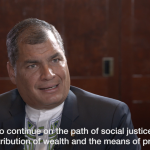
After 10 years and three terms, Ecuador’s President Rafael Correa’s time in office has ended. Under his administration Ecuador made far-reaching economic and social gains, despite having inherited a country on the brink of collapse.

In one of his last interviews before leaving office, Abby Martin talks to him about his legacy, his critics, and the struggle ahead for Ecuador and beyond.

From commenting on Trump and the global crisis of inequality, to addressing CIA plots and opposition in his own country, hear Correa’s last words as President to the people of Latin America and the United States.


President Correa on His Legacy & Critics

**

FOLLOW // @EmpireFiles & @AbbyMartin

WATCH // YouTube.com/EmpireFiles

Abby Martin Interviews President Rafael Correa on Empire & the Environment

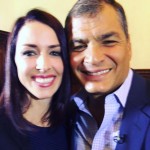
ABBY AND CORREA

After touring Chevron’s oil pollution in the Ecuadorean Amazon, Abby Martin sits down for an exclusive interview with Ecuador’s president, Rafael Correa, about the legal battle against the corporation and push to decolonize the country from Western powers.

They discuss Ecuador’s new constitution that grants legal rights to nature for the first time in history, the country’s proposed ban against individuals using tax havens holding public office, and his administration’s dismantling of neoliberalism, stressing that the world order must shift, so that people come before capital.

Despite its diplomatic relationship with the United States, Correa comments on how Ecuador remains the subject of ongoing regime change efforts and democratic subversion on behalf of the U.S. government through NGOs like USAID. However, Correa is determined that being in the crosshairs of U.S. Empire will only embolden their fight for independence.

When asked about whether Trump or Clinton would be better for the future of Latin America, Correa’s response is surprising. He says Trump’s crudeness would be better to “revitalize the left” in Latin America, but that Hillary would be better for the sake of people in the U.S.


Abby Martin Interviews Ecuador’s President Rafael Correa 

**

FOLLOW // @EmpireFiles & @AbbyMartin

WATCH // YouTube.com/EmpireFiles

Posted in Uncategorized | 1 Reply

Adversarial Journalism in Russia & Dissecting Propaganda with Mark Ames

Screen Shot 2016-01-22 at 10.46.57 PMJournalist Mark Ames is the founder of The Exile, Exiled Online and regular contributor to Pando Daily. In Russia, he worked on the satirical, hard hitting paper The Exile with journalist Matt Taibbi from the late 90s until it was shut down by Moscow’s media censorship arm in 2008.

Ames’ history with The Exile begins with him fleeing the US at the start of the Clinton years, and heading to Russia at the end of 1993. Living in the post-Soviet Union era, he describes Moscow as being “the capital of a collapsed Empire”.

Little voices existed at the time that were speaking out about Russia being plundered blind with the assistance of the international community, specifically The United States. During the country’s neoliberal firesale, there were several assassinations of journalists and political figures, the average Russian male life expectancy went from 68 to 56, and suicide rates skyrocketed.

Despite all the horrors that transpired, the Yeltsin administration was portrayed as being fun, and jolly, and mainstream foreign reviews of his presidency were intensely positive because he posed no threat to US interests. Quite the contrast to how the Putin administration is viewed today through Western lens. 

Robbie Martin of Media Roots speaks to Mark about his experience in Russia, the oft-ignored legacy of the corrupt Boris Yeltsin years after the fall of the USSR, the neoliberal pillaging of the country, and complexities of the current information war.


If you want to directly download the podcast, click the down arrow icon on the right of the soundcloud display.

This Media Roots podcast is the product of many long hours of hard work and love. If you want to encourage our voice, please consider supporting us as we continue to speak from outside party lines. Even the smallest donations help us with operating costs.

Listen to all previous episodes of Media Roots Radio here.

Follow @FluorescentGrey | @MarkAmexExiled