Zeitgeist: The Movie – Documentary

Zeitgeist: The Movie is a 2007 documentary film by Peter Joseph that examines Christianity, the 9/11/01 terrorist attacks and the Federal Reserve bank. It was created as a Not-for-Profit expression to communicate what the author felt were highly important social understandings which most humans are generally not aware of. Zeitgeist: The Movie focuses on suppressed historical & modern information about currently dominant social institutions, while also exploring what could be in store for humanity if the power structures at large continue their patterns of self-interest, corruption, and consolidation.

http://www.zeitgeistmovie.com/

http://thezeitgeistmovement.com/

 

Girl Frozen in Time May Hold Key to Ageing

babyTIMES ONLINE– Scientists are hoping to gain new insights into the mysteries of ageing by sequencing the genome of a 17-year-old girl who has the body and behaviour of a tiny toddler.

Brooke Greenberg is old enough to drive a car and next year will be old enough to vote — but at 16lb in weight and just 30in tall, she is still the size of a one-year-old. Until recently she had been regarded as a medical oddity but a preliminary study of her DNA has suggested her failure to grow could be linked to defects in the genes that make the rest of humanity grow old.

If confirmed, the research could give scientists a fresh understanding of ageing and even suggest new therapies for diseases linked to old age.

“We think that Brooke’s condition presents us with a unique opportunity to understand the process of ageing,” said Richard Walker, a professor at the University of South Florida School of Medicine, who is leading the research team. “We think that she has a mutation in the genes that control her ageing and development so that she appears to have been frozen in time.

“If we can compare her genome to the normal version then we might be able to find those genes and see exactly what they do and how to control them.”

Continue reading about Girl Frozen in Time May Hold Key to Ageing.

© The Sunday Times, 2010

Photo by flickr user paparutzi

Food of the Gods – Book Review

drugsBUZZFLASH– I took some drugs today to help me write this review. Specifically, a xanthine-family drug called caffeine that appears in the berries of a largely equatorial bush, along with a few weaker xanthine-family alkaloids that aren’t as well known but are also present in the coffee bean.

Last night before going to bed, I took another drug. Fermented from the fruit of a vine grown in the south of France, the alcohol in the glass of wine I drank altered my consciousness in a way I found pleasant, while the raw juice (wine is not heated) contains, its promoters say, some other chemicals that may be good for my heart.

Fact is, we’re a society of drug-takers. Outside of Mormons, Seventh Day Adventists and Jehovah Witnesses (and a few other smaller mostly Christian sects), we as a society nearly all take drugs specifically to alter consciousness. We use the most addictive drug known to human kind — five times more addictive than heroin — in a way that earns the tobacco barons billions of profits every year. The three primary drugs of our culture — caffeine, nicotine, and alcohol — are ubiquitous. As are other drugs McKenna takes aim at — sugar, chocolate, and television.

And, says Terence McKenna, they’re the wrong drugs for us to be using. Or at least some of us.

Continue reading about Food of the Gods- Book Review.

© Buzzflash, 2007

Reviewed by Thom Hartmann

Photo by flickr user digitalbob8

Scientists Create a Living Organism

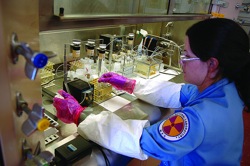
scientistsCNN– Scientists have turned inanimate chemicals into a living organism in an experiment that raises profound questions about the essence of life.

Craig Venter, the U.S. genomics pioneer, announced on Thursday that scientists at his laboratories in Maryland and California had succeeded in their 15-year project to make the world’s first “synthetic cells” – bacteria called Mycoplasma mycoides.

“We have passed through a critical psychological barrier,” Dr. Venter told the FT. “It has changed my own thinking, both scientifically and philosophically, about life, and how it works.”

The bacteria’s genes were all constructed in the laboratory “from four bottles of chemicals on a chemical synthesizer, starting with information on a computer,” he said.

The research, published online by the journal Science, was hailed as a landmark by many independent scientists and philosophers.

“Venter is creaking open the most profound door in humanity’s history, potentially peeking into its destiny,” said Julian Savulescu, ethics professor at Oxford University. “This is a step towards… creation of living beings with capacities and natures that could never have naturally evolved.”

Continue reading about Scientists Create a Living Organism.

© CNN, 2010

Photo by flickr user Idaho National Laboratory

Dark Matter Experiment Disproves Earlier Findings

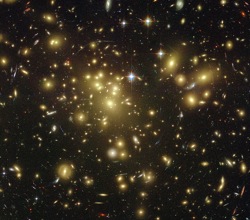
universePHYSORG– Early data from a Columbia-led dark matter experiment rule out recent hints by other scientists who say they have found the elusive particle that holds the universe together. The findings show that dark matter, which is believed to make up 83 percent of the matter in the universe, is more elusive than many had hoped.

continue to escape our instruments, yet we are getting much more clever in our search and feel confident that we will soon unveil them,” said Elena Aprile, spokesperson of the XENON100 experiment and a professor of physics at Columbia University.

Aprile and her collaborators, who number more than three dozen physicists at nine institutions around the world, presented their findings at a workshop on May 1 and have submitted a paper to the journal . The scientists, whose experiment is the most sensitive search for dark matter to date, plan to release a much larger set of data over this summer.

The group did not expect to find dark matter in this short run of data taken last fall. Instead, their results show that the detector is better than any other at screening out that can be mistaken for the elusive particles.

Continue reading about Dark Matter Experiment Disproves Earlier Findings.

© Columbia University, 2010

Photo by flickr user NASA Goddard Photo and Video

Page 21 of 24<<...1920212223...>>