
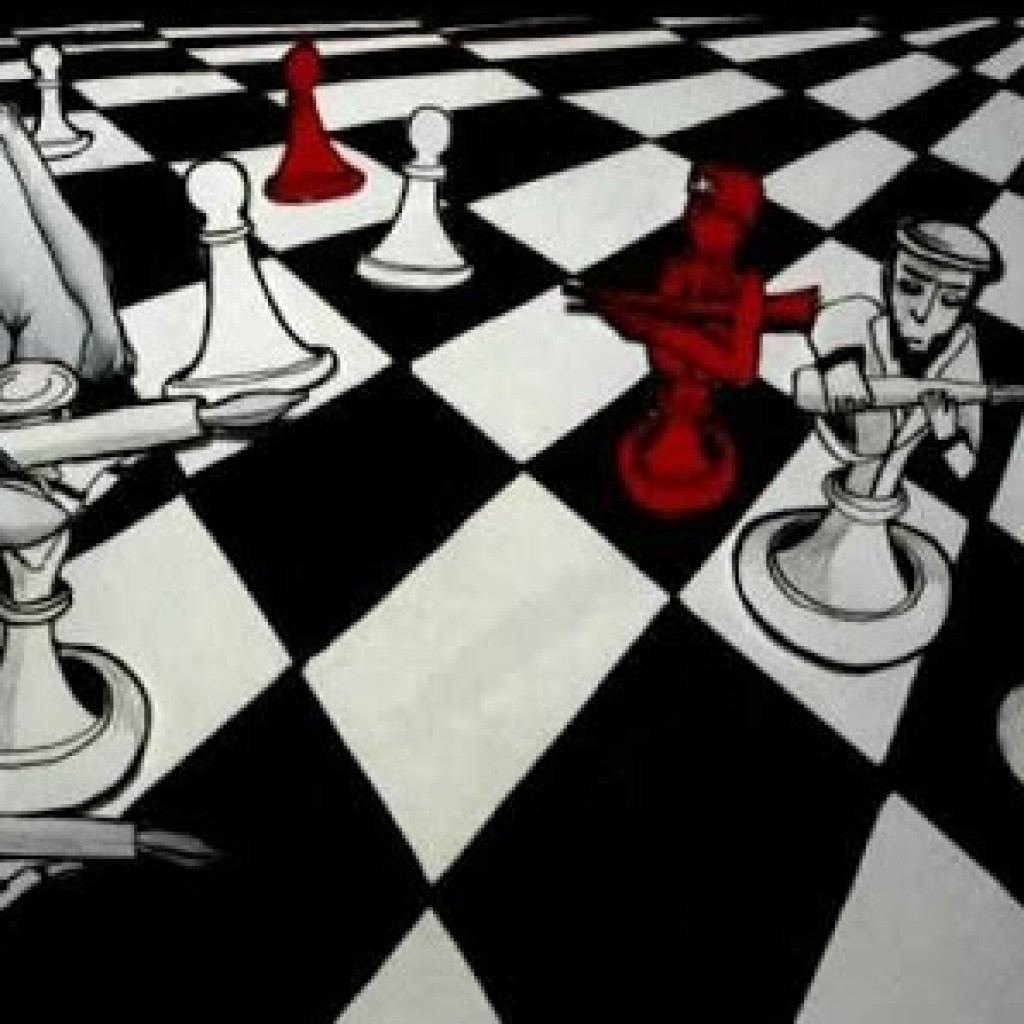
Unraveling the Syria War Chessboard with Vijay Prashad

chessboardWhen the Arab Spring started in 2011, the Empire decided which revolutions were “good” and which were “bad”, pouring arms and money into police state monarchies to crush legitimate protests, from Egypt to Bahrain.

But some movements were lauded by US politicians as great causes for freedom–conveniently in countries whose governments they had long hoped to overthrow–and rushed to their aid.

In Libya, the US was able to accomplish its plan for regime change in less than a year, thrusting the country deep into misery. But in Syria, the regime change plan hasn’t gone as smoothly–a list of changing rationales and goals have spanned the last 5 years.

Millions of dollars in cash and weapons flowed to the rebel forces fighting to overthrow the government. Once ISIS rose to dominance, US officials said it was no longer about toppling Assad, it was about defeating the terrorist group in Syria, without Syrian permission. But the administration still insists Assad must go in order to defeat ISIS.

Having gone far beyond an internal political struggle, the war is marked by a complex array of forces that the U.S. Empire hopes to command: Saudi Arabia, Turkey, Kurdistan, Iran, Lebanon, Iraq and more. There’s much at stake in a bloody war that has already taken the lives of 250,000  human beings. 

To simplify this web of enemies and friends in the regional war, Abby Martin interviews Dr. Vijay Prashad, professor of International Studies at Trinity College and author of several books including “The Poorer Nations”, “A People’s History of the Third World” and “Arab Spring, Libyan Winter”.


Unraveling the Syria War Chessboard

**

VIJAY PRASHAD: When the uprising broke out in Syria, when there was initial protests–at that moment the US ambassador Mr. Ford, Robert Ford, went to the sites of the uprisings. Now this is a very important thing to recognize. A foreign ambassador inside a sovereign country went to support uprisings which were for the overthrow of the government. This is a very important thing for people to remember. In other words, the United States government, by the presence of Robert Ford, was telling the people who were opposed to the Assad government, that we are going to deliver Damascus to you. In other words, the United States took a position in 2011 by allowing Ambassador Ford to go to these places. So there was no confusion. The idea, as part of the anti-Iran policy, the idea was that Damascus has to be delivered to other powers other than Iran, perhaps Saudi Arabia. This has been a clear position. But the Syrian opposition knew from the very first that unless the United States bombed Damascus to smithereens, this regime was not going to fall. So knowing that they were not going to provide the Libyan solution, they nonetheless wound up the opposition to expect US planes to come and bomb in Damascus, which the Americans knew was not going to happen. So this in a sense is where responsibility also lies for the hundreds of thousands of people killed in Syria. In other words, the US green-lighted a regime change scenario which they very well knew they could not follow through on. So I don’t actually see any confusion in American policy. The confusion simply came in that the Obama administration had to in a sense dance around the fact that they were not able to honor what Robert Ford had suggested by his presence at this demonstration. And it was never really about the Syrian people. It was always about Iran.

ABBY MARTIN: And it’s not just the Pentagon, it’s figures within the antiwar movement, the left actually making a main pillar of the demand for Assad to step down. What would this mean for the Syrian people?

VP: The Assad government is a government of a certain class of people. The Syrian government had made enormous advances, despite really quite ruthless prison policies against the opposition. Ruthless against anybody that stood up against the government. They nonetheless made some advances in human welfare, they created institutions of different kinds, etcetera. Bashar Al-Assad, when he in a sense inherited the regime, came at a completely different moment in world history. He was much more open to the Americans and the Europeans. He was very much open to what we consider neo-liberal development, new construction projects, etcetera. He made an alliance with the Turks. Turkey made so much money, in a sense, gentrifying northern Syria in the 2000s. This was a period where it created a sense of displacement among the population. There were real grievances in the country. Nonetheless, despite having these grievances, popular opposition was extraordinarily weak in Syria. There was no way they were going to be able to actually win against the government. And I don’t mean militarily. I mean even in terms of appealing to vast numbers of people who had yet supported the government. So you can’t create revolution by shortcuts. You have to take the protracted road. And, in a sense, the American offer to the Syrian opposition was a shortcut. By opposition what do we mean? You see, the people who were revolutionaries, the left inside Syria, which there was a section, were never the people that the Americans saw as the opposition. Who did they see as opposition? From the beginning they saw the proxies of Turkey, of Saudi Arabia, maybe of the Muslim Brotherhood. These were the people that they were talking to. They were not talking to the socialists on the ground. Those socialists on the ground are disposable for everybody. This term opposition captures too much. Some people when they hear opposition they mean the rebels who came from nowhere fighting on the ground. But actually when Western governments talk about opposition, they mean the people who were in exile in Turkey and formed these groups. This was a certain kind of elite similar to the transnational coalition created in Libya. Who were they? They were bankers. These are the people that the West sees as opposition. So you know, we should not fool ourselves that very early on the poor people had been discounted by the West who had become serious with these proxies. And these proxies as we know are not merely businessmen in suits. They morphed very quickly to the very worst kind of characters and were given free rein by Western backing. And of course Gulf Arab backing to create mayhem in Syria.

AM: It feels like déja vu because we just went through the same thing in Libya not too long ago, where the character of the uprising was secondary to the overthrow of Gaddafi. What lessons can be gleaned from Libya?

VP: It depends on who is going to learn which lesson. See, the West is learning no lessons. The West has believed that regime change against its adversaries is allowed. And by the way, there was so-called soft regime change in this period. In Honduras in 2009, the United States fully backed the overthrow of the legitimate government of the Honduran people. That was when Hillary Clinton was the Secretary of State. In Japan, the Japanese people actually voted a government to power which had a mandate to remove some – some, not all – US bases from Okinawa. Hillary Clinton lobbies the government and they, the United States, overthrows a legitimately elected government and brings another government power. This was barely mentioned in the US press. So at the same time as there’s this kind of regime change in the Middle East, there was a successful regime change in Honduras, successful regime change in Japan. Have you ever heard anybody talk about regime change in Japan? No. They will blame, say, what happens in Afghanistan, what happens in Syria, emergence of ISIS, Taliban –  they blame it on somebody else. They’ll say it’s Assad’s fault that ISIS is created. I mean come off it. ISIS is a direct product of the chaos sown by the US overthrow of Saddam Hussein. When Saddam was captured in Iraq, he comes out of his hiding hole and he says to the American troops, “I am Saddam Hussein the president of Iraq, I want to negotiate a surrender.” They mocked him, laughed at him, humiliated him. Imagine if the government had actually said, “Okay, we want to accept the surrender.” In other words, we want to create a new Iraq, which we’ve illegally attacked and illegally destroyed, okay, but we want to bring the fedayeen, Saddam. Your people have to have a role in the future because they are Iraqis. We cannot simply excise them from Iraqi history. But no, they didn’t accept the surrender, they essentially turned him over to be lynched. Gaddafi – Gaddafi was killed by what? A NATO strike hits his car and then he was lynched on the street. There are right now in Sirte, which is Gaddafi’s home town, there ISIS has taken control of Sirte. Inside Sirte, it’s not merely the old jihadis but also people of Gaddafi’s green movement, who have been totally isolated again, and who have joined ISIS. Why? Because that’s the only avenue they have. You’ve marginalized… Why didn’t they arrest Gaddafi? Again, an illegal arrest, but at the time accept his surrender and say, “Your block of supporters will have a place in Libya.” No. They said none of you will have a place in Libya. You know there are tens of thousands of Gaddafi-era supporters who are in prison in Libya uncharged. This is a human rights violation. So when you conduct these regime-change operations and then tell a section of the population you are no longer relevant, you’re condemning them to social death, to political death, and in some cases to prison for life. And I think this is a lesson that nobody’s is thinking about. They’re saying, “I wish there was no war.” Well you’ve done these wars, you’ve destroyed these countries. You must, having done all that illegally, you must open yourself to the possibility that, you know what, an American should not decide what happens in Libya. Let all the Libyan people decide, including those who you now consider persona non grata. In Syria, the military is very well organized, it’s very disciplined. There hasn’t been defections. So to imagine that just because an American ambassador shows up in a square where there are fifty people standing there, that you’re going to somehow terrify the military, was an illusion. A very dangerous illusion. I don’t feel like there’s a need for anybody to say, “I support Assad. I don’t support Assad.” This is an irrelevant question. The question is, I believe in freedom of people, but I also believe that freedom is a protracted struggle. Freedom has to have a set of obligations upon human beings to win other people over. As I said, there’s no short-cut to these things, you can’t bomb your way to freedom. It’s a protracted struggle. And in a place like Syria, the government may not appeal to some people but it does appeal to others. The fact is, vacuums are the worst thing to create in any territory in the world. I think people have now understood that the Syrian Army is going to have to become one of the factors that fights the war against ISIS.

AM: The White House said part of its strategy is working with regional players on the ground. Of course, there’s several contradictory players here. First there’s Saudi Arabia. Is this a logical partner for peace when even Hillary Clinton has said that it’s the biggest exporter of Wahhabi terror worldwide?

VP: The United States government has one principal ally in the region. And that ally, apart from Israel – because Israel is not really consequential for some of this stuff. The principal ally the United States has is Saudi Arabia. The United States has on several occasions said the defense, not of Saudi Arabia, but of the royal family, is the obligation of the United States of America. Why is that so? It’s because of oil. Not because America buys oil from Saudi Arabia, but because the Saudis are able to control oil prices. Look at the recent situation. The Venezuelans fought to rebuild OPEC. They won new unity in OPEC. They raised prices of oil. In raising prices of oil, they were able to collect money and do it for regional transformation, to provide money to lesser countries with no resources, to build up the capacity of the countries, etcetera. Saudi Arabia jacked up oil production, brought down the price of oil deliberately, and did what? Brought to the knees the adversaries of the United States. Who are they? They were Venezuela, they were Russia, they were to some extent but not entirely Brazil, and eventually China. As all these countries went into free-fall, the strategy that the Chinese were building… The oil, the gas station of Saudi Arabia is a weapon against forces around the planet. So if there’s one thing the United States needs to – the people of the United States need to consider, is this unbending alliance with a theocracy that is not only brutal to its population, but is providing the material for counter-revolution around the planet. Saudi Arabia understands its region entirely through sectarian eyes. It sees the struggle in Yemen as a struggle of Shia versus Sunni, which the Yemeni people don’t see exactly like that. It sees Syria as a Sunni-Shia thing.

In Syria it’s much more complicated than Shia and Sunni, per se. So they are sectarian. They have a sectarian viewpoint. Since the 1960s, backed by the Americans, they have pushed this sectarian view on the world, not merely this region. If I asked you, Abby, let’s make a map of where Al-Qaida recruits from, one of the stunning things you’ll discover is that from the 1960s,  the Saudi-backed group called the Word Muslim League, the WML, was funding groups in these exact places because Saudis were funding this from the sixties. They opposed Arab nationalism. This was their game. So this is the major American ally. There is a terrific WikiLeaks cable from 2005, again from Syria, where the Syrian political officer of the US  embassy says, “We have to back the Saudi game of increasing Shia-Sunni tension.” Imagine this. This is a serious problem. I think now sober Western governments, not necessarily the United States, have understood that this is gotten out of hand. And something needs to be done to rein back this mad dog approach to domination in that region.

AM: Let’s expose another regional player, Turkey. How has Turkey made it possible for ISIS to thrive?

VP: They kept the border open. When Obama in 2014, August 2014, said ISIS is a threat to the world, the United States, etcetera, they could have invoked the NATO charter. Turkey as a NATO member could have been forced to close the border. But the United States didn’t invoke the NATO charter. So the border has remained porous. And so ISIS since August 2014 has continued to get recruits coming in. Look, the press picks it up here and there. They’ll say yes, the Paris attacker, the first time, the woman she is now in ISIS territory. She went through Turkey. How did she go through Turkey? She landed in Istanbul Airport, flew to Sirok, I mean to Gazientep, drove across the border. Are you kidding? Turkey is a sovereign … how can … The border is porous. Turkey has played a game which has set it in a destructive direction wherein in order to deflate the Kurdish balloon it has gone to war against the Kurds. Not only the Kurds inside Turkey, they’re bombing cities in Kurdistan, in Turkey, but they’re also bombing BKK and YPG bases in Iraq where these people are training to fight against ISIS. Understand now, if you are an American strategic planner, you are using Incirlik base inside Turkey to bomb ISIS. Meanwhile you’re providing ground support to the Kurdish militias. Meanwhile your ally, the Turkish Air Force, is bombing the Kurds. Now what is going on here? And why should people like you and I explain this? This is not for us to explain. This is a question that the United States State Department needs to explain, and the [Turkish] foreign ministry needs to explain.

AM: Can you provide any more context to why Turkey has this war against the Kurds?

VP: The point about the Middle East, or any part of the world, is they are complex cultural ecologies. If you travel in northern Iraq, for instance, the landscape is craggy and hilly and mountainous in such a way that from one valley to the next, you have language that can be slightly different. Religious traditions that differ. There is great diversity in the Middle East, it’s incredible. These people lived in various forms of fellowship for a long time. I’m not going to romanticize it. As I’ve said, various forms, there were tensions, whatever, a large Armenian population, etcetera. After the First World War, the Turkish government took a very hard republican Turkish nationalist view, led by Kemal Ataturk, the father of the Turks. They took a Turkish nationalist position, which made no or very little space for minorities. And in this of course is the killings of Armenians, a genocide of the Armenians. But also in this was the relation, the role of the Kurds. Kurds were told, “You are like us, not like the Christians.” They tried to make it about religion initially. But it was never really about religion. The attack on Armenians was not about religion, it was about difference. Are you going to be like us, are you going to assimilate fully or not? It was a very much an assimilative nationalism. And the Kurds therefore were told, “You have to assimilate to become Turks. There’s no such thing as a Kurd.” You know, that’s a very ruthless form of nationalism, and that’s been the history of modern Turkish nationalism. It has had to grapple with this very virulent strain in its nationalism, which doesn’t have space for minorities. And what’s interesting is in Turkish history, in the last twenty odd years, the Kurdish political movements have oxygenated Turkish politics. The HDP for instance is one of the few political parties that is totally socially progressive, and which is why it’s linked with the Turkish left. It’s provided the Turkish left with a mass movement.

In other words, the Kurdish nationalist movement, which surrendered its nationalism in 1993, you know they decided in ‘93 no longer to call for an independent Kurdistan, but to have rights within Turkey. You got a mass constituency for the Turkish left. And so the Kurds therefore are not some alien life form, you know, they’re part of Turkish society. The largest Kurdish city is Istanbul. There are one million Kurds that live in Istanbul. Kurds live all over the country. But they have provided through their struggle for self-determination an oxygenating space for the Turkish people, all the Turkish people. And so they are trying to revise the idea of this virulent Turkish nationalism, which Erdogan has now bizarrely come to represent. The Kurdish struggle is not a struggle of ethnicity, it’s a struggle of values. The HDP is not a Kurdish exclusionary party. It’s a party of a certain set of values, progressive values. So that’s available inside Turkey.

AM: There’s been a scholar that studied every suicide bombing since 1980, and found that 95% of them share one strategic motivation, which is the response to military intervention or occupation in their country. Given this, why do you think that the empire continues to respond with military intervention?

VP: Well there are many reasons. One of them is that if you have no other solution for the people’s problems, you utilize the hammer. If you no longer have the ability to propose a solution for poverty, starvation, desperation, etcetera… If you don’t have a solution in the United States, why talk about the world? Even in American cities you can’t provide jobs. You can’t provide schools. You provide police. You provide prison. This is the domestic cognate of imperialism overseas. Here they have no answer to people who are starving. They only know how to throw them in jail. There they have no answer to people’s demands. They only know how to bomb them. This has become a habit. Why? Because the very rich around the world have gone on strike. They refuse to pay taxes. They refuse to provide wealth for human betterment. They are happy to provide money to bomb people and build gated communities and things like that. They are happy to create dystopia. They are on strike when it comes to creating utopia. It is people who are well-meaning, well-thinking people who believe in the good side of history that have to fight for utopia. They have an end game. It is purely dystopic. We have forgotten that we need to fight for an end game. Our future is not merely resistance. Our future has got to be something beautiful.

***

FOLLOW // @EmpireFiles // @AbbyMartin // @VijayPrashad

WATCH // YouTube.com/EmpireFiles

Transcript by Michael Riches
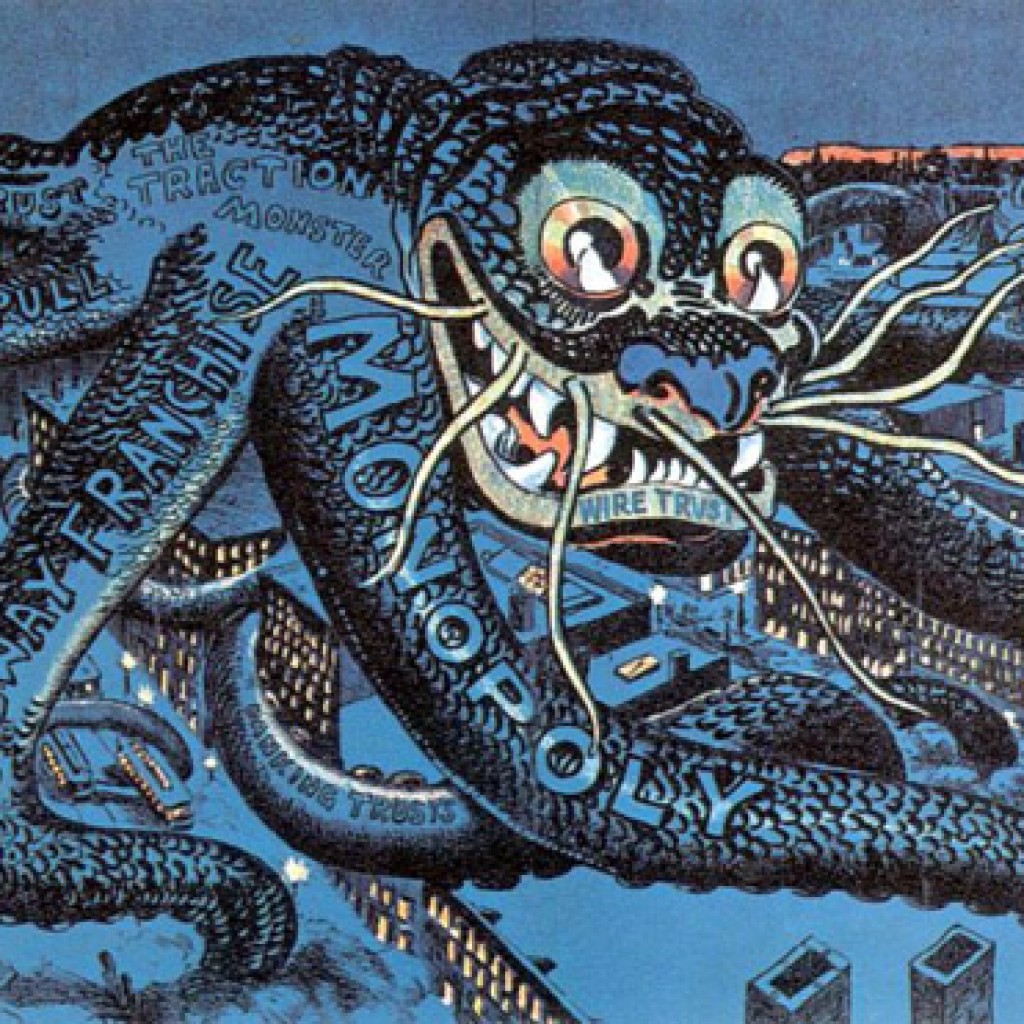
Untouchable Big Oil Threatens All Life On Earth

octopus-monopoly600In a system that puts profits over everything, small gangs of billionaires are given free rein to plunder the planet. One of the richest power cliques in the Empire’s inner circle is also imperiling all life on earth at an alarming rate, only to make their pockets fatter.
In the United States, the oil industry is a giant, cash-engorged beast with the loyal servitude of the state at its beck and call. It’s vast accumulation of wealth led to its vast accumulation of power and influence in today’s society.

All life on Earth is threatened by catastrophic climate change–the main culprit is so powerful that the US government is set up to serve it, rather than regulate it.

In this episode of The Empire Files, Abby Martin uncovers Big Oil’s strong-arm reach–its growth, its crimes, its power and its impunity.

Featuring interviews with two investigative journalists who have covered oil disasters on-the-ground, Antonia Juhasz, author of “Black Tide: The Devastating Impact of the Gulf Oil Spill”, and Greg Palast, author of “Vulture’s Picnic: In Pursuit of Petroleum Pigs, Power Pirates, and High-Finance Carnivores”.


Untouchable Big Oil Threatens All Life on Earth

**

FOLLOW // @EmpireFiles and @AbbyMartin

WATCH // YouTube.com/EmpireFiles

A Deeper Look at Islamophobia in America

Muslim Vandalism2015 was the most dangerous year for Muslims in America, setting records for hate crimes against them. There have been dozens of attacks on mosques, including firebombings, and physical assaults like stabbings, shootings and beatings against Muslims (and perceived Muslims) grew to the highest numbers ever recorded.
Already wrapping up as a deadly year, the last few months of 2015 saw hate crimes against Muslim Americans dramatically increaseMembers of the community are saying the climate of hate is worse now than after 9/11.

Abby Martin interviews Dr. Deepa Kumar, professor of media studies at Rutgers University and author of Islamophobia and the Politics of Empire, about the roots of this alarming situation. From confronting right-wing arguments, to examining how Islamophobia is a reinforcement and basis for the structures of Empire, the first Empire Files episode of 2016 gives essential context to the wave of anti-Muslim hate in America and beyond.


The Most Dangerous Year for Muslims in America

**

DEEPA KUMAR: I think that if you look at the year 2015, it has been a horrible year for Muslims not just in the United States, but around the world because if you see the two events that book-end 2015, it is the Charlie Hebdo attacks, the horrific Charlie Hebdo attacks in France and the Paris attacks later on towards the end of the year and then San Bernardino, and what these attacks have done is that they have exacerbated and really ratcheted up what we’ve seen as tendencies since 9-11. What are some of these tendencies? Well, first of all hate crimes against Muslims and those who look Muslim have skyrocketed. It’s not just people being verbally and physically attacked. We’ve seen mosques being desecrated. We’ve seen all sorts of horrific attacks of these sorts, but we’ve also seen the rise of a kind of a xenophobic nationalism where White supremacy has been the center of nations remaking themselves, like France or like the United States and so on saying these people are a fifth column, they don’t belong here and so on, and what these attacks have done…it has legitimized this, but what it’s also legitimized is the various security apparatuses, so what happens after the Paris attacks is that the French police carried out more than 2,000 raids on Muslims, both citizens as well as immigrants, arrested hundreds of Muslims and so forth, and it legitimizes these activities by the state to keep us safe. So you’ve seen really an exacerbation of the logic of the war on terror take place over the last year. So I’m not surprised that many Muslims feel that today we are in a worse situation than we were back after 2001.

ABBY MARTIN: How do you define Islamophobia?

DK: Islamophobia is anti-Muslim racism, but what I want to argue is that it’s more than just verbal attacks. It’s more than people facing discrimination at work, or facing insults or slights by people around them–what’s called micro-aggressions. It’s also more than physical attacks–hate crimes and those sorts of things. Islamophobia is these things and people do experience verbal and physical attacks, but I want to argue, in my definition of Islamophobia, is that it is an ideology that is tied to a set of practices that sustain and reproduce Empire. I think it’s very important to actually look at the structures of Empire because it’s only when we do that we get to the roots of what causes Islamophobia. Why is it produced? Who benefits from it? Why does it proliferate in the way that it has over the last fifteen some years? And this is not some sort of academic exercise. I am an academic, but this is not just some abstract exercise. It’s important to get to the roots in order to more effectively fight this form of racism. That’s why I’ve argued in the past that simply doing education around Islam, or having inter-faith dialogue, while important, is not enough because it’s not simply about a set of bad ideas in people’s heads. It’s rooted into the very structure of Empire, and that’s where we need to target our attention and our energy and activism.

AM: And one of the objections we hear consistently, particularly from right-wingers, is that Islamophobia does not and cannot exist because Islam is not a race. Your response?

DK: Well they are right. That is to say they’re right in one part of it: Islam is not a race. Muslims are not a race. This doesn’t mean that they don’t face racism, so I think we’ve got to see that both go side by side. Muslims are not a race, but the racism that Muslims face is very real. There’s been a systematic process since 9-11 to keep fear of Muslims and fear of terrorism alive in the American imagination. You talked about a Sikh man who was attacked earlier this year, last year. I think that’s a really big clue as to how racism against Muslims actually works, or those who are perceived to be Muslims, actually works, which is it’s a form of cultural racism that is based on turbans, people wearing turbans, or people wearing hijabs or other forms of Islamic religious clothing. There is an assumption that is made that these people all have a certain behavior that is constant, that is something about their nature that’s constant because when they practice Islam they are programmed to be violent. They are programmed to be misogynistic. If you’re a woman, you’re programmed to be subservient. You’re programmed to be a terrorist and so on and so forth. And so there is a very systematic way in which an entire group of people is turned into a race through this category of Islam in the same way that Jews are turned into a race through the practice of Judaism and so on, and then the entire group gets targeted in these ways. Races don’t exist naturally. They are produced and they’re typically produced by the elite in order to serve certain interests and to serve certain agendas. I think it’s really important always to look at what historical conditions… what is going on in the political economy that leads to the production of races then that leads to the this process of rationalization because when we get to that we get to the heart of why racism exists and how we can fight against it.

AM: I want to address another talking point that I hear used pretty often by people like Bill Maher and Sam Harris: 70% of Muslims in France support ISIS. What’s your response to these kinds of sweeping statements? People will constantly use them and say, “Look we can’t be Islamophobic because we’re just criticizing the religion and look we’re just looking at the data.”

DK: Islam is practiced by 1.5 billion people around the world. It looks different in different countries and there are just as many political views the people in Muslim-majority countries hold as there are around the West, so they’re just as different a group and non-homogeneous a group as those in the West.

What people like Bill Maher and people like Sam Harris do is they collapse all of those differences and they find data that suits their homogenizing mission in order to paint everybody with the same brush strokes. One myth that gets peddled again and again is that Muslim women are just so horribly oppressed all over the world. Well, that’s not true. I mean, first of all, let’s admit that Muslim women, just like all other women in the world, do face oppression. They do face things like inability to get good jobs, or lack of adequate pay or what have you. Women in the US face the same sort of situation. However, conditions vary widely across the Muslim-majority countries. In Saudi Arabia women can’t drive, but in Bangladesh women have been elected to heads of state, not once but twice. And so these are all different countries with different histories. There are regional differences. There are local differences. There are differences between country and town, and that diversity is simply not acknowledged by the likes of Sam Harris and the New Atheists, and all the rest of it.

If anything you know what they do is use the clash of civilizations argument. They somehow hold up this mantle of the West as being this place of enlightened values, and say that they want to critique all religions, but if you look at their work, the work of the New Atheists, the sharpest knife is dug into Islam. That’s true of Hitchens. It’s true of Dawkins. It’s true of Sam Harris and so on, so they actually have an agenda, but they hide behind objectivity as a way to spout Islamophobia as academic, as research.

AM: Exactly. Last year in Texas a Muslim man was outright executed. Before the killer executed this Muslim man, he said, “Go back to Islam.” They haven’t charged him with a hate crime. Authorities said that they don’t have enough evidence to prove that he has hatred even though multiple times on social media accounts he was talking about Islam, Arabs etcetera. I wanted you to talk about why the establishment is so hesitant to just call reality what it is, call these crimes what they are and charge them accordingly.

DK: There is overwhelming data of hate crimes committed against Muslims, but the problem is that the legal system in the United States refuses to acknowledge racism in any kind of systematic way. This is not just true of Muslims and Muslim-Americans. As Michelle Alexander points out in her book “The New Jim Crow,” this is true too of how African-Americans are treated when they go before a judge or what have you. Questions of racism rarely hold up as a legal grounds from which to try a particular case. It’s been a struggle and the same is happening in the case of Muslims as well. Often there will be… in my discussions with lawyers and friends and colleagues who are lawyers… what they’ve told me is that in cases that they have prosecuted there are just ridiculous things that are brought up as evidence to show that somebody is radicalized. What is this evidence? That they had a copy of the Koran in their pocket. That means this person must have been getting ready to commit a violent crime. That’s ridiculous. That’s Islamophobic. That’s cultural racism. It’s the idea I mentioned earlier that somehow Islam is this virus that programs people to go out and do murderous things, so I think there’s a fundamental problem with the way the legal system works that does not acknowledge in any systematic way how racism operates and the actions that people take–violent actions that people take.

Let me say this. I was following the coverage of San Bernardino versus that of the Planned Parenthood shooting, and the differences could not be clearer in terms of how perpetrators of gun violence are treated. So Planned Parenthood happens. The religion of Robert Dear was barely mentioned–maybe a few mentions here and there–even though we know he’s an evangelical Christian, even though we know he was a great admirer of this group called the Army of God, which is this right-wing fundamentalist anti-abortion group that’s committed murders and violence. He calls them heroes, so we know he’s at least in part driven by this kind of Christian fundamentalist ideology, but that doesn’t become part of the story because the reason Robert Dear did this is something is wrong with him. There’s something in his head that’s wrong because we won’t associate his actions with the actions of White Christians overall. We won’t call on White Christians to apologize for the actions of Robert Dear. San Bernardino happened and yes these people are religious. They are fundamentalist and so on. Now, however, even President Obama says there is an extremist ideology that is spreading through Muslim communities and all Muslims have to take responsibility for it. Why are Muslims any more responsible for the actions of the San Bernardino shooters than Christians for Robert Dear?

You see the double standards, and so straight away of course the story is entirely about Islam. It’s about the virus of Islam. It’s about how Islam makes people do all sorts of violent things and the war on terror becomes the way in which the story is spun, so one cheeky way of looking at this is to say they actually carried out what is a tradition that’s as American as apple pie which is shootings. That really is so endemic to American society in a way that it’s not in other societies and we might see this as a sign of their “integration,” but in fact, of course, othering has become so much a part of media coverage, so much common sense ideology, that immediately there are frameworks that come into being that present their violence as somehow being tied to terrorism, as tied to Islam; whereas our violence, people like Robert Dear, are just isolated individuals.

AM: The clash of civilizations is of course the ideology that Islam is destined to clash with the West, that our cultures are just intrinsically separate and they can’t ever coexist, but it seems like time and again this theme is in one part manufactured by the Empire in terms of either destabilizing Middle Eastern countries, to suppress progressive reform, and also to just exacerbate radical Islam. I wanted you to just mention this mantra and also the actual reality of Empire and how it is perpetuated.

DK: In particular Bernard Lewis would write an essay titled “The Roots of Muslim Rage” in which he argues that politics has nothing to do with why people in the Middle East may be angry with the United States or may have grievances with Western Europe. Colonialism has nothing to do with it. The formation of Israel has nothing to do with it. He says that there is an irrational rage that has spanned 14 centuries which characterizes this inevitable clash. First of all, that’s not true. It is not at all the clear case that the East and West have always clashed. There have been various periods of cooperation right through history which I don’t have the time to get into, but it’s in my book. But it becomes a convenient way in which to define the politics in the post-Cold War era. One enemy that justifies US imperialism and US reach all over the world is gone. What is it going to be substituted by? And Samuel Huntington actually, the political scientist, would pick up this term “Clash of Civilizations” and his theory of what politics will be characterized by in the post-Cold War world is the following: conflict is not going to be political conflict. It is going to be culture and Mahmood Mamdani, who has written this book called “Good Muslim, Bad Muslim,” says that what that does is it very conveniently displaces all the political stuff onto the cultural terrain and now we don’t have to talk about occupation. We don’t have to talk about war. We don’t have to talk about drone strikes, which is what we see in the era of the war on terror. We’ll just call it a clash of cultures. These people, they like to wear hijabs. That’s why we don’t get along with them and so on, never mind that every democratic movement that’s existed in the Middle East has been squashed by the US government in order to keep oil flowing, in order to keep alive the dictators who are the allies of the US, and so forth. All of those political grievances get sidelined and instead culture becomes the focus, and I think that’s an extremely problematic way to look at what is fundamentally a political issue.

AM: So what are the roots of Islamophobia and how is it related to Empire maintaining itself?

DK: So all empires, at least most empires, rely on some form of othering in order to justify wars, in order to justify taxation, in order to justify conscription and so on and so forth. I mean this is not just true of American imperialism, and I will talk about American imperialism, but I want to actually start all the way with antiquity, with the Roman Empire. Rome was this massive empire that stretched from England, Hadrian’s Wall in England, all the way to the Euphrates, covering parts of North Africa and the Middle East and so forth, and the question is how did the Roman Empire actually manage to do this? So when the Romans went about conquering people in England or France, or what have you, one of the first things that they would do is try to inculcate them in Roman values, Roman lifestyle, Roman culture, Roman architecture and so on. And when the people accepted these cultural values of Rome, they became Romans. So in this large empire everybody was considered Roman, but for people who were not as easily conquered, who resisted, and who wouldn’t come under the Roman fold just as easily, there was a term invented for them. They were called barbarians.

And the Romans invented this very interesting hierarchy, this kind of typology which was the following: they said all human beings have two elements that define them. One is the physical body. The other is the mind. It is intelligence. It is spiritual rationality, stuff like that, and what they would argue is that Romans–not all Romans–elite Romans are driven by the mind. The mind controls the body. They are rational. They’re intelligent and in that sense they are closer to God; whereas the barbarians are closer to animals because the body controls the mind and therefore they are inferior, and therefore it’s justified that we go off and kill them and bring their people and make them slaves. Or one of the routine forms of entertainment in Rome was that the barbarians would be brought to these amphitheaters and killed either by animals or gladiators or what have you.

So that’s Rome. Now let’s move to the United States. I think there are a lot of similarities, but also some differences. The US takes over the reins of the Middle East from France and Britain in the post-World War period and in fact actually NSC-68 [National Security Council Report 68], which is the secret policy document that I believe was written in 1950, would lay out quite clearly why militarism was going to be the key way in which the US was going to fill the vacuum left behind by the collapse of European empires, the rise of the Soviet Union, and how the world has now become a battlefield and militarily that’s how the US is going to assert its hegemony.

In the Middle East it has many geostrategic interests, rivalry with the Soviet Union, but oil certainly is a part of the story, and Daniel Yergin tells us that part of what he calls the postwar petroleum order is about creating a certain arrangement between oil producing states or states to which oil would flow, so that cheap oil would be available for the reconstruction of Europe, the Marshall Plan and so on because Europe was destroyed by World War II, so anyone who disrupted this post war petroleum order was necessarily an enemy. They were either hand-in-glove with the Soviet Union or they were just barbaric, people who lived in the desert and so on who needed to be taken out.

And so that’s the mythology. They learned the Orientalist language from Europe and started to apply it to people of Middle-Eastern origin as a way to establish control over the flow of oil, so these ideas don’t just exist in ether, in Hollywood films or in novels and so on for no reason. They are systematically reproduced in the academy. They’re reproduced in think tanks. They are used by political figures. They are reproduced in the media and so on as a way to justify US policy, and of course at first it’s about demonizing the Arab, but then the demonization of the Arab turns into the demonization of the Muslim.

Of course today we don’t throw Muslims and Arabs to the lions. We don’t have those sorts of practices, but we do target Arabs and Muslims and South Asians through the national security state, through imprisonment, through indefinite detention, through racial profiling, through surveillance of mosques, of community centers, of college groups and so on and so forth. So there is very much within the system an attempt both to racialize people within Empire as well as to racialize people outside Empire.

I’ve spoken to the similarities, but I do want to make a point of what the differences are. So the key difference really is that racism as a systematic ideology and a set of practices actually is modern in origin; that is, it comes in to being only with the birth of capitalism, and so there are some very important ways in which othering under Rome or othering by various feudal monarchs in the Middle Ages and so on is different from the kind of racism that we see today. Anti-Muslim racism is much more systematic in the era of capitalism and imperialism, in a way that it wasn’t earlier.

AM: And I think Donald Trump shocked the world by his declaration of a ban on Muslims entering this country if he were to be president. This could just be hyperbolic, but at the same time his new campaign ad is actually doubling down on this and making this one of the main pillars of his whole campaign. It’s just shocking. What is the political significance of what we’re witnessing here?

DK: Donald Trump is basically stating out loud and making explicit what actually has been US policy for the last few decades. That is, if you look at the mass deportation of immigrants under Obama, it’s huge. Over two million people have been deported, but you don’t talk about that. In polite society you don’t say such things, and Donald Trump is actually giving voice to some of the most horrific racist, rabid right-wing rhetoric. When he says let’s prevent Muslims from coming in or let’s create a registry and a database to document all Muslims… You don’t say that if you are a respectable politician, but in practice we have been doing that.

Over the last 20 some years, there’s been an attempt to systematically collect information on various groups of Middle Easterners. In fact, going all the way back to the late 70s and Iranians and then counter-terrorism policy under Reagan, and then the 1996 anti-terrorism and effective death penalty act of Bill Clinton, and then later after 9-11 programs and so on. There’s an attempt to collect this information in a database about Muslim immigrants and Muslim citizens and so on, and for people like Trump who represent the class of the 1%, bashing immigrants has been staple because if you look at the same period of time, we’ve seen a massive growth of class inequality, class polarization. The vast majority of people around the world have grown poorer. The 1% has grown phenomenally rich. There have been cuts in social services, attacks on the welfare state. Tuition costs for colleges have been going up. Health care costs have gone up. This is the neoliberal system, but rather than blame the 1%, the regime of the 1%, it’s easy to bash immigrants, and you’ve seen this logic everywhere. This is not just a Western European or American phenomenon. In Russia and Australia, in India, in Myanmar–all over the world this Islamophobic agenda has helped to deflect attention away from the structural inequality and to point fingers, to scapegoat Muslims as a way to get people to fight with each other rather than to look at the structural problems caused by neoliberalism.

So I think to see Donald Trump as some sort of lone wolf who is responsible for the escalation of Islamophobia or who is otherwise corrupting a great political system, I think is deeply problematic because Donald Trump is just a part of a larger system which both Democrats and Republicans are responsible for creating.

AM: What can we, as non-Muslims who are appalled by this Islamophobic rhetoric, do to build solidarity and internationalism with the Muslim community?

DK: One of the things I started this discussion with is to say that we need to understand the roots of Islamophobia. We need to understand that it’s more than just a set of bad ideas, of prejudices in people’s heads, but in fact, it is an ideology and a set of practices that make the war on terror possible. It is what sustains the war on terror, and so the first thing we have to do is to recognize that simply combating these bad ideas is not enough, although that’s important. I think if we don’t get to the root of what causes Islamophobia, which is Empire, which is the national security state, which is the neoliberal order in which we live, and the class power that sustains all of this… if we don’t target that and we don’t target and dismantle imperialism and capitalism, then we’re not going to do away with Islamophobia. As we hold counter-demonstrations when the far right, for instance, is attacking a Muslim mosque, or a Muslim community center, at the same time as we write articles, at the same time as we do education, if we don’t have a long-term strategy that is targeted at opposing these structures of Empire and neoliberalism, then we wind up doing things in the short term which may actually create the same problems again in the middle term, and we wind up fighting these fights again and again. So we’ve got to have a short-term strategy, but we have to keep the long-term goal in mind, and we need to come together across national lines and build a global movement that can take on the regime of the 1% and actually build one that prioritizes the interests of the 99%.

**

FOLLOW // @EmpireFiles // @AbbyMartin // @ProfessorKumar

WATCH // YouTube.com/EmpireFiles

Transcript by Dennis Riches

Posted in Uncategorized | 1 Reply

Ralph Nader & Abby Martin on US Rigged Corporate Elections

110922_ralph_nader_ap_605Most people know Ralph Nader as the insurgent third-party Presidential candidate in the 2000 elections, where the popularity of his stand against corporate hegemony struck fear into establishment politics. 

But hundreds of millions experience Nader’s legacy everyday. Most notably, how virtually every automobile safety measure, from seatbelts to airbags, are the product of his relentless campaign against auto industry giants. His contributions as a consumer advocate span disability rights to exposing corporate pollution.

A long-time political figure with unique experience fighting from the center of Washington, Nader joins Abby Martin on The Empire Files to discuss today’s political climate, the corporate government and rigged elections. 


Ralph Nader and Abby Martin on US Corporate Rigged Elections

**

Nader describes the invasion of Washington by Wall Street as the way in which the government has been indentured by corporatism; the Democrats are dialed into the same corporate interests as Republicans and both work to crush third party representatives from getting on the ballot.

Nader argues that Bernie Sanders gave up his bargaining power when he pledged to endorse Hillary Clinton as the Democratic nominee. “He probably knows that the democratic party machinery is controlled by the Clintons.” Nader says Sanders needs to use his grassroots support to make demands of the Democratic Party, and his followers need to start organizing beyond the campaign. 

Hillary Clinton is a “corporate criminal”, who has never met a war or weapons system she doesn’t like. Her hawkish foreign policy casts light on her tendency to chase after war, and her support of Wall Street. “She’s a militarist and a corporatist,” says Nader. Her blind ambition of seeking power will likely push the United States into more wars.

The Clinton Foundation, which is funded by Gulf monarchies and mining magnets, saw an increase in donorship once Hillary Clinton became Secretary of State, showing just how close the Clinton’s ties are to the most oppressive regimes and corporations. While Hillary’s campaign has been supported most passionately by those calling for more women-led leadership, this brand of ‘Clinton feminism’ has latched onto something that is nothing more than an upwards career move, not a substantive movement towards equal representation.

FOLLOW // @EmpireFiles and @AbbyMartin

WATCH // YouTube.com/EmpireFiles

VISIT // https://Nader.org/ for his weekly column and radio show

Posted in Uncategorized | 1 Reply

‘This Ship is Sinking’ Says Former Bush Official

origLawrence Wilkerson, retired US Army Colonel and former chief of staff to Secretary of State Colin Powell, has some surprising things to say about the US government.

Wilkerson doesn’t hold back when he explains how US foreign policy has always been about the expansion of sheer power. After WWII, the US expanded “imperial dots”, or military impressions in order to generate a financial apparatus that would expand Empire, allowing for the rich to continue to grow their capital.

While many parts of the world are forced to live in abject poverty, there are generations of families that have a concentration of wealth that surpasses the GDP of most countries. According to the latest Oxfam study, only 62 people now own as much wealth as the bottom half of humanity.

Wilkerson decided to come forward and blow the whistle about US crimes after learning about how torture had been authorized and encouraged by the highest levels, violating the Geneva Conventions, the law of war, and the manuals that they operated under. “I can’t stay silent anymore. I’m going to speak out.”

Wilkerson joins Abby Martin for a must-watch interview exposing the dark underbelly of DC bribery, intelligence hoaxes as war pretexts and the ruthless nature of US corporate Empire.


Former Bush Official: “The Ship Is Sinking”

**

ABBY MARTIN: I’m sitting here in Washington, D.C. with the rare opportunity to speak with someone who served in the innermost circles of the US war machine. Colonel Lawrence Wilkerson is a former US Army Airborne Ranger who flew over 1,000 combat missions in Vietnam. He was national security adviser to the Reagan administration and later served as chief of staff to Colin Powell during the Bush administration. You’re a retired Army officer. You’re a Republican. Given your inside experience in the government and military, how would you explain the purpose of US foreign policy?

LAWRENCE WILKERSON: Today? Today the purpose of US foreign policy is to support the complex that we’ve created in the national security state that is fueled, funded and powered by interminable war, and the ramifications thereof. That’s a sad commentary on what America has become, but it’s a realistic and I think honest appraisal of what America has become.

AM: Has it ever been about altruism?

LW: You could say there were even altruistic aspects to the slaughter and ethnic cleansing of Native Americans from the Mississippi to the Pacific coast by Phil Sheridan’s Army of the West. If you wanted to really dip into the bag and find something, but I don’t think overall and comprehensively it’s been altruistic. It’s been about sheer power, and lately it’s not even been about realistic application of that sheer power, or realistic attempts to expand it. It’s been more or less so failed in its overall general aspects that it has diminished our real power in the world. And this is what concerns me most seriously because history demonstrates, I think, that this is what empires do when they’re getting ready to collapse. They began to be so zealous of their own power and its expansion that they actually decrease their power until it becomes inevitable that they cease to exist, or they don’t exist in the same form they did when they were an empire.

AM: And you’ve talked about the capital interests that are behind pretty much every US military intervention in the last decade if not century. What sort of economy are we waging war in today and what capital interest would you say are behind the war on terror?

LW: After WWII, the United States engaged in a monstrous twilight conflict, if you will, that it calls the Cold War. It’s probably a pretty apt term. In that process it built up what are the appurtenances now of a national security state: the military-industrial-congressional complex, all the armaments industry that goes into that, the far-flung basing structure we have all over the world which now is eight or nine hundred places that we have little colonial dots, if you will, imperial dots, and to the wars there we’re fighting now almost interminably.

All of this is the leftover of what we did during that Cold War, which could include physical expenditures beyond the scope even of human imagination. We’ve spent so much money on maintenance of our empire that is becoming a critical part of it too. Our debt now is something like eighteen trillion dollars, unparalleled debt in my mind in the in the history of empire, in constant dollars or in current dollars. So this is a situation that’s unsustainable, but it has come to a point where the power structure, which I would define as both the financial apparatus that this empire has generated, and the economic aspects of it which are less and less industrialized and productive, therefor [less] a real economy, in other words, and more and more playing with money and the interest on money and capital in general, as Thomas Piketty has pointed out in his book Capitalism in the 21st Century so eloquently. We now have more capital awash in the world than we have earned income. Earned income is a very second place in the world. Capital is the real driving force in the world and this capital is passed on from family to family, from generation to generation and therefore corruptive and poisonous.

We’re in real trouble right now because of what this empire has generated, because of the incentives and motivations of it, and because it’s basically run by about 1 percent of the people, if not fewer, in this country constituting essentially a plutocracy. There are 400 families, 400 wealth centers, private wealth centers in the United States constituted around a family structure that equal the gross domestic product of Brazil. Today I read a percentage which I can’t even recall—it had so many zeros in front of it—but it was much less than one percent of the country that has the approximate wealth of the GDP of India. So we’re talking about a concentration of wealth, and a concentration of capital, which is not productive wealth unless it is actually going back into the real economy to generate industry that produces something. It’s unconscionable. It’s reprehensible in many ways because what you’ve got is the rest of the country, and in many respects the rest of the world, living off the rest of the scraps.

AM: And it’s totally unsustainable, as you were mentioning, this is not a trajectory that is going to last. Behind the belligerents waging a war there are certain industries that are in play that continue to garner interest, extract resources.

LW: Look at what’s happening in Syria right now, for example, just a microcosmic example. The Air Force is about to run out of ordnance. It has dropped so many bombs and shot so many cruise missiles that it’s about to run out of ordnance. Well, I will guarantee you that companies like Raytheon and Lockheed and others who make these armaments are salivating because they are going to be making another round of these are armaments, and into the interminable unknown future they’re going to be making these armaments. It’s incredible what we are doing.

AM: And in fact they are salivating at that. At Lockheed, Boeing, all these different institutions, defense institutions, are openly talking about what a great benefit this is to them—this Syria war, all of these escalations. I wanted to read you a quick fact. In 2008, the Government Accountability Office found that over 2,400 former generals were employed at 52 of the biggest defense contractors as senior executives and acquisition officers. A high percentage of retired general officers retire, go straight into jobs in the defense industry making well over six figures, often with the corporations they dealt with while serving. How does this revolving door function? I mean, how close is this relationship in terms of actual foreign policy creation.

LW: It’s so close that you actually had during the Iraq war, and as far as my history lessons go, it’s the first time it’s occurred this way and now is going on continuously, general officers who not only go out into the armaments industry and its associated paraphernalia and make money based on their influence gained while in service, you actually have them going out and joining the media and making the media more conversant with and attuned to and want war. So you actually have general officers who will go to CNN, go to MSNBC, go to Fox News, and they will get again your six-figure salaries for being the security experts on those news shows, and they will report to the American people the dire need for this continued conflict, the dire need for soldiers on the ground in Syria, the dire need for more war. It’s incredible what has happened in that respect. That’s not a direct contribution to the armaments industry, but it’s certainly a very vivid contribution to the war mongering and to the interminable state of war.

AM: Is it the interlocking board of directors in these companies, or is it just advertising injected straight into the corporate media?

LW: I wish it were something that you could put your finger on like that. It’s so many different things, including what you just said, but not necessarily consciously or coherently except in some cases, I think. It’s all of these things contributing and it’s not any one of them. As Eisenhower said in his farewell address, it’s not something you put your finger on and say, “Aha! That’s malicious. That’s intent. It’s not only complicit. It’s intent.” It’s not that. It’s this accumulation of vast power that’s oriented towards what first increases its power, and second what makes it rich that comes together and causes this. If it were something that you could root out and you could hand over to the FBI or to the Supreme Court or someone to adjudicate, it would be a different matter, I think, not that it would get done very easily, but it would be a different matter. It’s not something like that. It’s pernicious. As Eisenhower said, it’s in every state house in every federal office building. It’s even in every home in America. It is this unconscious sometimes power-driven aspect of it that makes it so difficult to combat. In fact, I’ll sit here and be a pessimist, a cynic, and I’ll say we aren’t going to correct this until something truly serious happens to right the ship of state, which might also sink the ship of state. Now we have every other general officer, admiral, walking out and signing up with glee to work for armaments.

AM: Well, other than the egregious unethical nature of how this functions… I mean, what is the legal caveat to how this is actually working? Is it just a machine that’s working on its own and just continues to become more pernicious as time goes on?

LW: They’re not the most competent people in the world. They’re not the most capable people in the world, and they’re not the most, shall we say, professional people in the world. That’s a part of it, but a second part of it is it’s become the thing to do. It’s become de rigueur. I mean, it’s what you do if you serve 30-35 years. You expect to have a six-figure salary with someone like Raytheon or Halliburton or Booz Allen Hamilton. We haven’t talked about the Beltway bandits that do more intelligence than the CIA. Now I use that term very loosely thereintelligence, but it is a corporate complex that is growing, and its surrounds everything else, including what I call fateful decision making, which is the decision-making to send young men and women to die for state purposes.

AM: And speaking of the young men and women who go to die, you know there seems to be a huge class stratification between the people who are making the policy and the people who are actually giving their lives on the battlefield. I mean, if you join the military in today’s age, whose interests are you serving when you do put your life on the line?

LW: You’re serving what one veteran in my seminar at William and Mary [University] said to me not too long ago, about three weeks ago, an Army veteran of Iraq and Afghanistan: You’re serving the ulterior purposes of the leadership of the country, and I said, “What do you mean by that?” And he said, “You’re serving corporate and commercial interests. You’re serving the interests of people who bureaucratically are seeking power within the structure, and you’re serving the interest of what is basically an incompetent governing process.” Wow. That was a pretty powerful statement, I told him, and he said, “Yep, and I’ll never go back again. I guarantee you that because I didn’t realize that until I was about halfway through my last tour in Afghanistan.”

AM: Let’s talk about the draft. It hasn’t been in place for some time. On one hand, you have the military so desperate that they’re paying NFL and sports stadiums for pro-military propaganda. On the other hand, you have women that are now being pushed to enlist. What do these measures of desperation mean and what do you think about the draft?

LW: It really isn’t an all-volunteer force. It’s an all recruited force because we’re spending billions of dollars to entice these people, who feel that they don’t have many other prospects, into the armed forces. We’re bringing them into a service that is supposed to be professional, disciplined and altruistic. We’re bringing them in with the most heinous of selfish, greedy purpose. We’re paying them what they couldn’t make otherwise. We’re giving them bonuses. It is so bad now that the cost for personnel in my army and to certain extent in the marine corps is coming close to being fifty percent of the cost of that service on an annual basis. If for no other reason the all-volunteer force is going to bankrupt the defense department, so they’re going to have to look at some other options.

AM: Let’s talk about your role in the Bush administration during the lead-up to one of the most devastating wars ever perpetrated by the empire—the Iraq war. You not only served as Colin Powell’s chief of staff, but you prepared his infamous speech to the UN about Iraq and its weapons of mass destruction. How did you miss the faulty nature of the intelligence, given your weeks-long analysis, given the stakes?

LW: I’ve looked at it from a much more, shall we say, soul-piercing way. Not only was the intelligence picture a failure on the part of the intelligence agencies for various reasons, it was also cherry-picked by the vice president. It was put together to a certain extent by the Office of Special Plans, in Doug Feith’s shop in the Pentagon, and it was largely orchestrated, as the MI6, the British memo said, it was orchestrated, shaped around the policy or the policy was essentially fed with intelligence that would shape it, that would feed it. So there were a number of reasons for the failure. There were a number of reasons for my own personal failure. I lament those reasons. I will never forget the occasion. I’ll go to my grave remembering it, but I can certainly, from an academic point of view, see how this this is sad, and it frightens me to a certain extent how this happened in the past, has happened in the past or whether it’s something in the future.

For example, let me give you a vivid example. I’ll tell you how I looked at the immediate reports that Bashar al-Assad had used chemical weapons in Syria a year or so ago. I said bullshit. I’ll believe it when I see evidence that it actually happened. And I went to every person I knew in the intelligence community, and every person outside the United States I knew to include two people who were in Syria at the time, and I knew what was going on and I respected their vision and their knowledge. None of them could confirm for me, not a single one, that Bashar al-Assad used those chemical weapons. Instead there were possibilities they were used by other parties in Syria as well as by Assad, and frankly, the evidence looked more strongly for other parties than the president. So I still think there is high potential for this kind of manipulation of intelligence, this kind of fabrication of intelligence, and this kind of refusal to take dissent in the leadership in this country right now today. And I’ll tell you very seriously I’m very skeptical of the intelligence establishment and what it says.

AM: Right, I mean, I always thought it was weird that the UN weapons inspectors were there on the ground and that’s when Assad decided to use the chemical weapons—when he already knew that was the red line. This whole red line mantra is really interesting because why should weapons of mass destruction of any sort of be that red line to actually legitimize the invasion and occupation of a sovereign nation? I wanted to say one more thing about the case. One of the biggest resonating factors, I think, in the speech was Saddam’s anthrax stockpiles and bio-weapons labs. Considering the fact that America had just been traumatized by its own anthrax attacks where five people tragically lost their lives, why did you choose to hinge so much on anthrax in the speech?

LW: No, as a matter of fact, we winnowed that thing to death. We threw tons of stuff out that we simply looked at and said, “All this is is an extrapolation from 1991 or 92. In other words, we looked at it and said the CIA has no evidence that Saddam has done what they’re saying he’s done. All they’ve done is made a linear projection. If he was producing six ounces in 1991, and we knew that positively from the inspectors after the war, then he’s now got 46 ounces because he could do two a year, or whatever. That’s what they’ve done.

AM: Of course, it came out that the anthrax came from our own bio-weapons lab. The final report from the FBI found no hard evidence linking Bruce Ivins to the attack.

LW: Well, I don’t know that, and I can’t tell you why don’t know that, but I don’t know that. I don’t know it with the clarity with which you just expressed it.

AM: That’s what the FBI said.

LW: Well, the FBI is as incompetent as any other bureaucratic entity within the federal structure.

AM: Right, but I think it is pretty much conclusive that it came from within… I mean, the bio-grade of the anthrax came from within the US establishment.

LW: It wouldn’t surprise me.

AM: Well, let’s talk about what was your kind of deciding factor to speak out and be so vocal…

LW: Torture. When Powell came through my door in May, I guess it was, of 2004, and told me about some photographs that we’re going to come out, may be made public, about a place called Abu Ghraib in Iraq… By the time I walked out of the State Department, I was ready to go find somebody and cut his throat because I knew that the United States had been involved in heinous activities in Vietnam. I knew they’d been involved in heinous activities in the Philippines. Indeed, a brigadier general, as I recall it, machine-gunned a thousand people in a ditch in the Philippines, and Teddy Roosevelt had sent him a telegram congratulating him. When people found out what he’d really done, Teddy had to kind of withdraw that approval, but I knew we had done some really bad things in the past, particularly in war, but I never, never knew any time in our history where those bad things had not only been authorized at the highest levels in the land but encouraged by the highest levels in the land. And I mean the president and the vice president of the United States and some of the cabinet officers. They were complicit in this. They gave instructions that they damn well knew we’re going to cause the Armed Forces of the United States to involve themselves in violations of the Geneva Conventions, the law of war and the manuals that they operated under. That just threw me. I said I can’t stay silent anymore. I’m going to speak out.

AM: And looking back at the horrors of the administration, as you mentioned, the torture, wanton detention, and of course, the illegal war that was based on false pretenses that cost the lives of a million Iraqis. Do you think that any members of the Bush administration should be charged with war crimes?

LW: I’ve said so in the past. I do think they should be charged. I think six lawyers in particular ought to be disbarred immediately. They should have been disbarred immediately. I think they should probably also be tried.

AM: Soldiers have been continuously dying in Afghanistan in America’s longest war. Today they’re still facing death, horrific injuries, for essentially no purpose it seems. I mean…

LW: Be careful.

AM: How do you think they should understand the war in Afghanistan?

LW: Be careful.

AM: What do you think their purpose should be?

LW: The war in Afghanistan has morphed. It’s not about Al-Qaida anymore, and it’s not about the Taliban anymore. It’s about China, Russia, the soft underbelly of Russia, which is mostly Muslim, about Pakistan, about Iran, about Syria, about Iraq, about whether Kurdistan is stood up or not, and ultimately about oil, water and energy in general. And the US presence in Afghanistan, I’ll predict right now, will not go away for another half century.

AM: My God. That’s a horrible thought.

LW: And it will grow. It will not decrease. It will grow.

AM: And let’s talk about strategic influence especially. We see this Cold War resurrection going on right now. As someone who lived throughout the Cold War… the schism within the establishment when it comes to Russia and this new posturing with Russia… After the reunification of Germany there was a promise on behalf of NATO that it would not continue to build up.

LW: Not one inch further east is what Jim Baker, Secretary of State, said to Edward Shevardnadze.

AM: What interests are behind the build-up?

LW: Why do we want more countries in NATO? Because then Lockheed Martin and Raytheon and Boeing and others can sell to them. Then the Soviets, now the Russians, won’t be selling to them. Why did we want Ukraine?

AM: Don’t we have enough?

LW: Empire never has enough. That’s the nature of imperial power. It never has enough. Have you ever watched Battlestar Galactica or Star Wars, or Game of Thrones? Empire never has enough power. It never has enough wealth. It never has a more stable status quo. It has an increasingly unstable status quo, and so its efforts are ever more frenetic to protect that status quo, its power and its wealth, and even expand them. That’s the nature of Empire, and that’s what we are now. That’s what we are. Everyone’s protestations to the contrary, that’s what we are. Depending on whose reports you read, about a third, 20% I’ll say, to 30 percent of Russia’s heavy armaments industry is in Ukraine. What do they do for tanks? What do they do for their heavy armaments in their military if Ukraine goes? The idea that we could do something in Ukraine, covert or otherwise, and have Putin not respond is just laughable.

AM: I feel like a lot of people of course feel helpless, especially those of us living within the Empire, paying and sponsoring all these atrocities with our tax dollars. What can we do to prevent this government, the military industrial complex from crushing us?

LW: The people, the American people, or at least a substantial powerful minority of them, hopefully a powerful majority of them, are going to have to get sick and tired of this. They’re going to have to get angry about it, and they’re going to have to take action. That’s the only thing that I see as a way to salvage this republic before it sinks completely. We are going to have to have a very powerful minority, or hopefully, as I said a majority, 51%, 52%, who actually stand up on their hind legs and say, “I’ve had it. This isn’t going to happen anymore. You’re not getting…” Does that mean revolution? It might. It might indeed.

***

FOLLOW // @EmpireFiles and @AbbyMartin

WATCH // YouTube.com/EmpireFiles

Transcript by Dennis Riches

Posted in Uncategorized | 1 Reply
Page 29 of 32<<...2728293031...>>