How Goldman Sachs Created the Food Crisis

FOREIGN POLICY– Demand and supply certainly matter. But there’s another reason why food across the world has become so expensive: Wall Street greed.

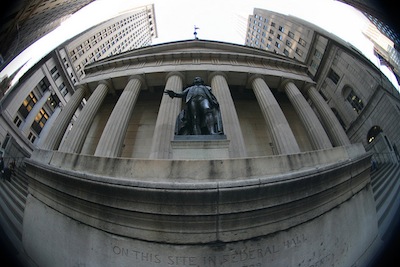
It took the brilliant minds of Goldman Sachs to realize the simple truth that nothing is more valuable than our daily bread. And where there’s value, there’s money to be made. In 1991, Goldman bankers, led by their prescient president Gary Cohn, came up with a new kind of investment product, a derivative that tracked 24 raw materials, from precious metals and energy to coffee, cocoa, cattle, corn, hogs, soy, and wheat.

They weighted the investment value of each element, blended and commingled the parts into sums, then reduced what had been a complicated collection of real things into a mathematical formula that could be expressed as a single manifestation, to be known henceforth as the Goldman Sachs Commodity Index (GSCI).

For just under a decade, the GSCI remained a relatively static investment vehicle, as bankers remained more interested in risk and collateralized debt than in anything that could be literally sowed or reaped.

Then, in 1999, the Commodities Futures Trading Commission deregulated futures markets. All of a sudden, bankers could take as large a position in grains as they liked, an opportunity that had, since the Great Depression, only been available to those who actually had something to do with the production of our food.

Change was coming to the great grain exchanges of Chicago, Minneapolis, and Kansas City — which for 150 years had helped to moderate the peaks and valleys of global food prices. Farming may seem bucolic, but it is an inherently volatile industry, subject to the vicissitudes of weather, disease, and disaster.

The grain futures trading system pioneered after the American Civil War by the founders of Archer Daniels Midland, General Mills, and Pillsbury helped to establish America as a financial juggernaut to rival and eventually surpass Europe. The grain markets also insulated American farmers and millers from the inherent risks of their profession. The basic idea was the “forward contract,” an agreement between sellers and buyers of wheat for a reasonable bushel price — even before that bushel had been grown.

Not only did a grain “future” help to keep the price of a loaf of bread at the bakery — or later, the supermarket — stable, but the market allowed farmers to hedge against lean times, and to invest in their farms and businesses. The result: Over the course of the 20th century, the real price of wheat decreased (despite a hiccup or two, particularly during the 1970s inflationary spiral), spurring the development of American agribusiness. After World War II, the United States was routinely producing a grain surplus, which became an essential element of its Cold War political, economic, and humanitarian strategies — not to mention the fact that American grain fed millions of hungry people across the world.

Read more about How Goldman Sachs Created the Food Crisis

© 2011 Foreign Policy

Photo by Flickr user Tamaki

 

Posted in Uncategorized | 1 Reply

John Rowe and Exelon’s Carbon Advantage

FORBES– On a cold December Chicago afternoon John Rowe stands at a window in his office, a dim, quiet, three-room suite lined with history books and sprinkled with objets d’art, including a stone horse from the Tang Dynasty and an Egyptian sarcophagus. From his 54th floor perch he is looking north to the high-rises of the Gold Coast below and the frigid waters of Lake Michigan shimmering with weak, fading winter light beyond. “You can’t sit up here in the afternoon and see the lights come on and not love this job,” he says.

Spoken like a true utility man. Rowe, 64, the longest-serving utility executive in the industry and chief executive of Exelon ( EXC – news – people ), the country’s most valuable utility by market value, is indeed in the catbird seat. While Exelon and the rest of the utility industry has been battered by a weak economy and suddenly low electricity demand and prices, Exelon has a lot to look forward to. Soon after Rowe created Exelon in 2000 with the merger of the Chicago utility Unicom (parent of Commonwealth Edison) and the Philadelphia utility Peco, he sold off most of the company’s coal plants and focused the company on nuclear. He created a generation subsidiary that sells the power produced by 17 reactors, by far the largest nuclear fleet in the nation and the third biggest in the world (after those of Electricité de France and Russia’s Energoatom).

The gas that billows out of those iconic nuclear plant cooling towers is water vapor. Exelon’s nukes turn out 130 billion kilowatt-hours of electricity every year and not a single metric ton of carbon dioxide, the most important greenhouse gas. That’s a nice place to be now that it appears that Washington–helped along by Rowe’s lobbying–is going to impose a price on carbon, either through a cap-and-trade bill that has passed the House of Representatives or through Environmental Protection Agency regulations. While its carbon-heavy competitors would have to raise prices, Exelon would benefit greatly. Under the House bill, estimates Bernstein Research’s Hugh Wynne, the present value of Exelon’s earnings stream would increase by $14 a share, or 28%.

Read more about Exelon’s Carbon Advantage

© 2011 Forbes

Photo by Flickr user Unanoslucror

Nine Industries That Know Your Every Move

DAILY FINANCE– Don’t kid yourself. Real privacy no longer exists in this country.

We’ve long had government organizations collecting data that paints a pretty clear picture of what we do with our time. The Internal Revenue Service knows everything about what you earn and any major transactions you make. It can access every bit of information it needs to determine how much money you should be sending on April 15.

The most important gatherer of personal information in the country is the Federal Bureau of Investigation. It keeps a database of over 90 million fingerprints, which can be accessed by other law enforcement agencies. It also has an extensive database of DNA, the most specific marker of personal identity. The bureau’s ability to collect information expanded following the terrorist attacks of Sept. 11, 2001. It now tracks a large portion of mail, cell phone traffic and Internet activity of people it deems suspicious.

Thanks to advances in technology, however, there are also now numerous private enterprises that track and record your every move. Although they don’t usually give out this information, there are often worrisome leaks and security breaches where they inadvertently release sensitive information about their customers. Taken together, these industries have data on where you are, who you are communicating with, how you are earning your money, how you are spending that money, as well as the hobbies and interests you are pursuing.

We examined a large number of organizations to find the most intrusive firms and industries. Here they are, ranked by the number of people they track:

 1) Credit Rating Agencies

With each firm having files on over 200 million people, the three credit bureaus — Equifax (EFX), Experian (EXPGY), and TransUnion — know not only your credit history, but also have the data to project your credit future. The companies collect a history of all credit use by an individual, including payment of bills, mortgages, and credit cards. The agencies also track the frequency with which a person applies for credit. That information is used to determine a person’s credit risk through a credit score. These scores are produced using secret algorithms, ensuring that the bureaus know much more about you than you know about them.

 2) Cell Phone Service Providers

As cell phone popularity has increased and technology has evolved, cell phone companies have come to possess a wealth of information about their customers. Covering over 90% of the American population, cell phone providers can tell who you call, when you call, how often you call certain people and what you say in your text messages. With GPS, they also now know where you are whenever you have your phone. As smartphones become the equivalent of miniature computers, cellular companies can also track personal behavior, such as use of multimedia and wireless e-commerce transactions.

3) Social Media Companies

In its ascent to Internet superpower, social enterprise Facebook has amassed an enormous amount of user information. Who your friends are, what you like, and what photos you are in are all information that the company has access to. That, however, is not the full extent of it. Facebook also tracks which profiles you view, who you communicate with most often, companies and causes you support, your personal calendar, and a great deal of personal information about your friends and family. Perhaps most surprising, Facebook can access much of the information you may have deleted, including photos and status updates, from their servers.

See the FULL list & read more about Who Is Watching You? Nine Industries That Know Your Every Move

© 2010 Daily Finance

Photo by Flickr user jonathanmcintosh

BP Plans to Drill in Gulf of Mexico Within Months

GUARDIAN– Environmentalists reacted angrily after BP predicted it would be back drilling in the Gulf of Mexico within months despite facing billions in financial penalties over the Deepwater Horizon disaster – and despite balls of tar still washing up on beaches.

The oil giant’s finance director, Byron Grote, told City analysts: “We expect to be back and actively drilling during the second half of the year.” Such a return would be a major victory for BP – which last summer was threatened by a proposed law to ban the company from the Gulf for up to seven years.

“BP’s reckless approach led to the worst oil disaster in American history, but one year later they’re off the hook and ready to take more risks,” said Phil Radford, director of Greenpeace USA. “It’s a testament to the political influence of these big oil companies that right now Tony Hayward is sailing his luxury yacht rather than facing criminal charges,” he added.

Continue reading about BP Plans to Drill in Gulf of Mexico Within Months.

© 2011 Guardian

Study: CEOS Got 23% Pay Raise in 2010

Wall StreetCBS NEWS – The CEOs of most S&P 500 companies raked in an average compensation of $11.4 million in 2010, amounting to a 23 percent pay raise over 2009, according to a new study from labor union coalition the AFL-CIO.

The AFL-CIO compiled the data as part of its Executive Paywatch initiative, which aims to make information on executive compensation more transparent and to create more accountability. It shows that in 2010, the average S&P 500 CEO made 343 times more than an average worker in his company, compared with just 42 times more in 1980.

As the gap between CEO and worker compensation widens, the AFL-CIO is urging Washington to close corporate loopholes and stop the Republican-led effort to repeal parts of the Democratic Wall Street reform legislation.

“Today’s launch of 2011 Executive PayWatch shows just how out-of-whack things are,” AFL-CIO President Richard Trumka told reporters today. “Despite the collapse of the financial market at the hands of executives less than three years ago, the disparity between CEO and workers’ pay has continued to grow to levels that are simply stunning.”

Read full article about CEOs Got 23% Pay Raise in 2010.

© 2011 CBS NEWS

Photo by Flickr user montse

Page 15 of 29<<...1314151617...>>