Massey Energy: Greed Leads to Manslaughter

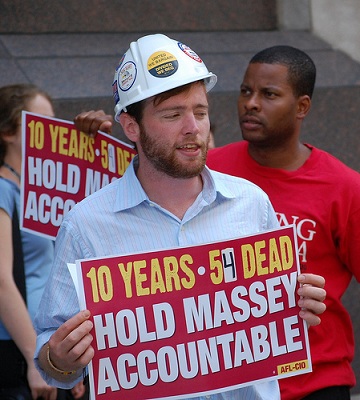
COMMON DREAMS– Just when we thought Massey Energy’s Upper Big Branch (in Montcoal, West Virginia) mining disaster of April 5, 2010, which killed 29 coal miners, couldn’t elicit any more tears or regrets or disgust or outrage, we find out how wrong we were.

Even after an independent investigation commissioned by the state’s former governor reported (on May 19, 2011) that the accident had been the clear result of safety violations, even after we learned that Massey had been cited for more than 1300 safety violations in the five years leading up to the explosion, and even after we concluded, bitterly, that Massey was guilty of wanton carelessness and recklessness—we find that we had aimed way too low.

It turns out that Massey executives were not only negligent, they were calculatingly criminal. On June 28, federal investigators announced they had discovered that Massey Energy was keeping two sets of books (safety logs). One log reflected actual mine conditions, which, alas, were demonstrably unsafe, and the other log was a fictionalized showpiece, a veritable Potemkin village, used to mislead government safety inspectors.

Maybe our first order of business should be to change the nomenclature. Given that Massey knew of the unsafe conditions and not only failed to address them, but attempted to conceal them from the very inspectors whose job it was to protect the miners from injury, we should no longer refer to the Big Branch explosion as an accident, disaster or tragedy. We should refer to it as “manslaughter.”

Read full article about When Greed Leads To Manslaughter–Massey Energy.

© 2011 Common Dreams

Photo by Flickr user Talk Media News

Goldman Sachs Outsources US Jobs to Singapore

BUSINESS INSIDER– Goldman Sachs is going to fire employees in the U.S. and some other countries so that it can hire 1,000 in Singapore, where it’s cheaper.

Charlie Gasparino heard the news from people who were briefed on the hiring in Washington. He says Goldman gave Washington the heads up because hiring offshore is likely to cause a backlash.

He didn’t give a specific timeline, or say which units would be hit, but here’s what’s going to happen, according to Gasparino:

Goldman is so concerned about the potential for criticism that the firm’s representatives have been alerting staffers of lawmakers in Washington of the hiring spree in recent weeks as a way to mollify any concerns they may have about previously undisclosed plans to add 1,000 jobs to the firm’s Singapore office, according to people in Washington with direct knowledge if the matter…

The jobs in Singapore are likely to be “high-paying, skilled positions in sales and investment banking,” the same types that are likely to be cut in the firm’s domestic operations, according to one person with knowledge of the matter. This person added that the firm has recently briefed people in Washington about the new overseas jobs because it “is afraid of the fallout” as it plans to slash $1 billion in costs over the next year — a move that will mean a significant, though still undetermined number of layoffs across its operations, though people close to the firm expect the biggest hit to come from the US.

Read full article about Goldman Sachs Fires US Employees to Hire Singaporeans.

© 2011 Business Insider

Photo by Flickr user Americans4FinancialReform

Google Think Tank Battles Online Extremism

WASHINGTON POST– Technology giant Google, having conquered the Internet and the world around it, is taking on a new challenge: violent extremism.

The company, through its eight-month-old think tank, Google Ideas, is paying for 80 former Muslim extremists, neo-Nazis, U.S. gang members and other former radicals to gather in Dublin this weekend to explore how technology can play a role in de-radicalization efforts around the globe.

The “formers,” as they have been dubbed by Google, will be surrounded by 120 thinkers, activists, philanthropists and business leaders. The goal is to dissect the question of what draws some people, especially young people, to extremist movements and why some of them leave.

“We are trying to reframe issues like radicalization and see how we can apply technology to it,” said Jared Cohen, the 29-year-old former State Department official who agreed to head Google Ideas with the understanding he would host such a conference. “Technology is part of every challenge in the world and a part of every solution.”

In forming Google Ideas, company officials said, they were eager to move beyond the traditional think tank model of conducting studies and publishing books, saying their “think/do tank” would make action a central part of its mission.

Read full article about Google Think Tank Battles Online Extremism.

© 2011 Washington Post

Photo by Flickr user MoneyBlogNewz

Wealthiest 1% Rule Our Politics, But There’s Hope

ALTERNET– A discussion between Noam Chomsky and Michael Lerner:

Michael Lerner (ML): You have made many excellent analyses of the power of global capital and its capacity to undermine ordinary citizens’ efforts to transform the global reality toward a more humane and generous world. If there were a serious movement in the U.S. ready to challenge global capital, what should such a movement do? Or is it, as many believe, hopeless, given the power of capital to control the media, undermine democratic movements, and use the police/military power and the co-optive power of mass entertainment, endless spectacle, and financial compensations for many of the smartest people coming up through working-class and middle-income routes? What path is rational for a movement seeking to build a world of environmental sanity, social justice, and peace, yet facing such a sophisticated, powerful, and well-organized social order?

Noam Chomsky (NC): There is no doubt that concentrated private capital closely linked to the state has substantial resources, but on the other hand we shouldn’t overlook the fact that quite a bit has been achieved through public struggles in the U.S. over the years. In many respects this remains an unusually free country. The state has limited power to coerce, compared with many other countries, which is a very good thing. Many rights have been won, even in the past generation, and that provides a legacy from which we can move on. Struggling for freedom and justice has never been easy, but it has achieved progress; I don’t think we should assume that there are any particular limits.

At the moment we can’t realistically talk about challenging global capital, because the movements that might undertake such a task are far too scattered and atomized and focused on particular issues. But we can try to confront directly what global capital is doing right now and, on the basis of that, move on to further achievements. For example, it’s no big secret that in the past thirty years there has been enormous concentration of wealth in a very tiny part of the population, 1 percent or even one-tenth of 1 percent, and that has conferred extraordinary political power on a very tiny minority, primarily [those who control] financial capital, but also more broadly on the executive and managerial classes. At the same time, for the majority of the population, incomes have pretty much stagnated, working hours have increased, benefits have declined — they were never very good — and people are angry, hostile, and very upset. Many people distrust institutions, all of them; it’s a volatile period, and it’s a period which could move in a very dangerous direction — there are analogues, after all — but it could also provide opportunities to educate and organize and carry things forward. One may have a long-term goal of confronting global capital, but there have to be small steps along the way before you could even think of undertaking a challenge of that magnitude in a realistic way.

ML: Do you see any strategy for overcoming the fragmentation that exists among social movements to help people recognize an overriding shared agenda?

NC: One failing of the social movements that I’ve noticed over many years is that while they are focusing on extremely crucial and important social issues like women’s rights, environmental protections, and so on, they have tended to ignore or downplay the economic and social crises faced by working people. It’s not that they are completely ignored, but they are downplayed. And that has to be overcome, and there are ways to do it. So, to take a concrete example right near where I live, right now there is a town near Boston where a multinational corporation is closing down a local plant because it’s not profitable enough from the point of view of the multinational. Members of the workforce have offered to purchase the plant and the equipment, and the multinational doesn’t want to do that; it would rather lose money than offer the opportunity for a worker self-managed plant that might well become successful. And the multinational has the power to do what it wants, of course. But sufficient popular support — community support, activist support, and so on — could swing the balance. Things like that are happening all over the country.

Read the balance of the interview about Chomsky: Wealthiest 1% Rule Our Politics — But There’s Hope in the Fight Against Global Capital.

© 2011 AlterNet

Photo by Flickr user austinosuide

The Supreme Court’s Free Pass on Sexism for Walmart

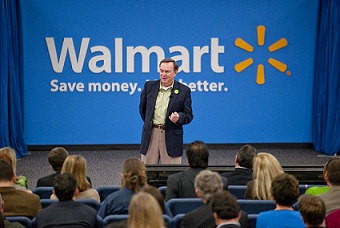
GUARDIAN– Let’s get this right: the world’s biggest boss, supported by companies as diverse as Altria, Bank of America, Microsoft and General Electric and backed up by the godfather of big business (the US Chamber of Commerce) has persuaded the US supreme court that thousands of women workers can’t possibly share enough of an interest to constitute a class?

It’s hard to know which part of the court’s decision in Dukes v Walmart hurts equity most: the assault on class-action jurisprudence generally, at a time of shrinking tools for workers seeking redress, or the defeat of history’s biggest gender-based claim before a court that, for the first time, includes two women, one of whom (Ruth Bader Ginsburg) made her reputation in sex discrimination law.

Dividing 5-4, in Dukes v Walmart, the supreme court on Monday dismissed the plaintiffs’ claim that companywide policy gave local managers too much discretion in pay and promotion decisions, leaving Walmart employees at thousands of Walmart and Sam’s Club stores vulnerable to gender stereotypes. (The company changed the format of its name since the case was filed.) The plaintiffs “provide no convincing proof of a companywide discriminatory pay and promotion policy,” Justice Antonin Scalia wrote for the majority.

Read full article about Walmart: Too Big to Sue?

© 2011 Guardian

Photo by flickr user Walmart Stores

Page 13 of 29<<...1112131415...>>