 MEDIA ROOTS — The Cyber Intelligence Sharing and Protection Act (CISPA) is the next looming threat to internet freedom, as the American government continues its relentless siege of the digital domain. Coming on the heels of SOPA, PIPA and ACTA, CISPA sounds more like the final name in a quartet of lovable Disney characters as opposed to draconian internet legislation. However, this latest incarnation appears to be the internet’s biggest foe to date. If CISPA becomes law, the risk to civil liberties is greater than all the previous bills combined.
U.S. Representative Mike Rogers (R-MI) is the architect of CISPA, or H.R.3523. Prior to his political calling, Rogers served as a Federal Bureau of Investigation special agent. Currently, he serves as the chairman of the Permanent Select Committee on Intelligence. This latest effort to undermine the internet focuses less on intellectual property and does not burden private companies with policing their information flow. Rather, CISPA makes a broader and more sinister reach for power by simply forcing companies to comply with new government regulations, in the name of cyber security. As Andrew Couts of digitaltrends.com aptly points out, “Whereas SOPA and PIPA were bad for many companies that do business on the Internet, and burdened them with the unholy task of policing the Web (or face repercussions), this bill makes life easier for them; it removes regulations and the risk of getting sued for handing over our information to the law. Not to mention doing what the bill says it’s going to do: protecting them from cyber threats.”
CISPA aims to grant non-civilian agencies unrestricted access to all digital information. So, it stands, the National Security Agency will benefit the most from the legislation. If this initiative succeeds, the NSA will have access to emails, social media, library records, online banking and credit card information. In a letter sent by opposition groups and a number of Democratic lawmakers to CISPA sponsors Mike Rogers and C.A. “Dutch” Ruppersburger (D-MA) these alarming implications are made clear. The letter says, “Without specific limitations, CISPA would, for the first time, grant non-civilian federal agencies, such as the National Security Agency, unfettered access to information about Americans’ Internet activities and allow those agencies to use that information for virtually any purpose.”
Supporters of the bill say it will allow private companies to easily share customer communications related to “significant” cyber and national security threats with government agencies. As long as the information meets these two criteria, government agencies can use it on a wide scale. In turn, private companies would be shielded from lawsuits filed by customers. A number of Silicon Valley companies have already pledged their support for the bill including: Facebook, Microsoft, Symantec and IBM.
However, a vocal opposition has developed in an attempt to beat back CISPA. U.S. Representative Ron Paul (R-TX) has been CISPA’s most notable opponent, calling it “Big Brother writ large.” RT (formerly known as Russia Today), a cable news station with an American audience of 50 million, was one of the first media outlets to decry CISPA and to use the phrase “worse than SOPA.” CISPA is particularly dangerous because it would void current privacy laws and create channels for companies to share digital information with government agencies without the need for court orders.
In addition to this attack on internet privacy, the bill contains numerous other disturbing implications. One is the erosion of barriers between the private sector, government and military. Also, like so many bills of the post 9/11 era, the language is ambiguous. The language describing what can be spied on and how that information can be used is extremely vague. Moreover, if a private company violates your privacy, the ensuing legal battle to prove liability is a Herculean task. A complete summary of CISPA’s threats to cyber privacy can be found at Time’s Techland section.
Despite widespread opposition to the legislation, the bill passed the House of Representatives on April 26, 2012. Whereas SOPA and PIPA squared off Hollywood and Silicon Valley against one another, in a fight over piracy, CISPA goes beyond that and zeroes in on privacy. As a result, there is much more widespread support for the bill in the tech-community. Whereas SOPA, PIPA and ACTA would have placed the burden of cyber-policing onto companies, CISPA relieves them of this duty and places the onus government. According to The Vigilant Citizen “Privacy and free speech are not exactly mutually exclusive. Loss of privacy threatens free speech, and the loss of free speech is inevitably a loss of privacy.”
As the American government becomes more authoritarian and American people more paranoid, the battles fought over the privacy of the public digital domain will intensify. Much like the government and the military-industrial complex dumping vast amounts of our America’s wealth into wars abroad, yielding questionable results, the government will continue its aim to control one of the last bastions of free speech. Only time will tell how successful their surge will be. Have the shut downs of SOPA, PIPA and ACTA taught Americans to remain vigilant and make their voices heard, or will CISPA prevail?
Learn more about what you can do here.
Adam Miezo for Media Roots, Edited by Eric Aragon
Photo by Rock1997



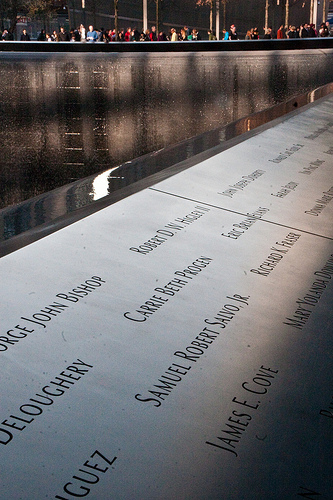 MEDIA ROOTS – At Ground Zero this past September 11, a more docile crowd congregated at the site for eternal mourning. The number of family members and protestors were generally smaller and most in the 9/11 Truth movement honored a four-hour silence out of respect for the victims and their families. What ensued was a gathering of people from across the 9/11 landscape with several constructive conversations and very few emotional diatribes.
 MEDIA ROOTS – Media Roots is a not-for-profit community news sharing platform that has been keeping followers in the loop since 2009. We follow stories that are often marginalized by mainstream outlets and are always looking for fresh perspectives, particularly from the artist and activist community.
 MEDIA ROOTS – Abby Martin initially had little political awareness growing up in Pleasanton, California. When she attended college at San Diego State University, she was introduced to U.S. foreign policy priorities through her studies in Spanish, Sociology and Political Science. Since then – and especially after 9/11 – she began to realize something was terribly wrong in the world. As she began researching more about the underlying motivations of the corporate-controlled federal government, she became a prominent anti-war activist against the invasions of Afghanistan and Iraq.
 MEDIA ROOTS — The Cyber Intelligence Sharing and Protection Act (CISPA) is the next looming threat to internet freedom, as the American government continues its relentless siege of the digital domain. Coming on the heels of SOPA, PIPA and ACTA, CISPA sounds more like the final name in a quartet of lovable Disney characters as opposed to draconian internet legislation. However, this latest incarnation appears to be the internet’s biggest foe to date. If CISPA becomes law, the risk to civil liberties is greater than all the previous bills combined.