Self-Immolation in Tiananmen Square

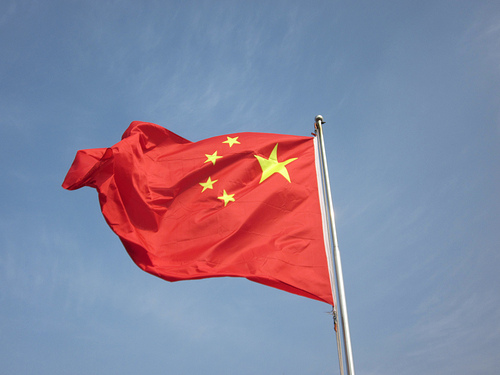
Chinese flag by Gary Lerude flickrMEDIA ROOTS — Reminiscent of the December 2010 act of self-immolation in Tunisia by Mohammed Bouazizi, which helped inspire the globally influential “Arab Spring,” a Chinese man surnamed Wang has undertaken this extreme form of protest at China’s Tiananmen Square on October 21.  Whereas, Mr. Bouazizi’s act of protest was widely covered around the world, Mr. Wang’s act of self-immolation was quickly wiped from public record, consciousness, and memory per China’s state-censored media in Orwellian fashion. 

A state-issued report narrated the action as an isolated case of personal dysfunction.  But the fact that such reports leak out every year in China points to Mr. Wang’s frustration with China’s justice system as being indicative of larger structural problems, similar to the conditions of corruption which led Tunisia’s Bouazizi to commit the ultimate form of protest. 

Censorship in America over such selfless acts of protest exists as well. In 2004, a man named Malachi Ritscher publically burned himself to death in protest to the Iraq War. In the statement he released before self-immolating, he explains that he would rather die than to pay taxes to kill others abroad. The corporate press painted him as a lone lunatic instead of giving heed to his powerful and eloquent message.

MR

***

THE TELEGRAPH— The incident – which happened on October 21 – appeared nowhere in China’s censored state media, but was also witnessed by a Daily Telegraph reader who photographed the aftermath as Chinese police rushed to douse the flames using fire extinguishers.

“The man did it right in front of me. He stepped over the low railing in front of the cycle-lane that runs past the picture of Chairman Mao. He was only two or three metres away from me,” recalled Alan Brown, a retired RAF Engineer from Somerton, Somerset.

“He said something quickly and a policeman nearby was suddenly agitated, but this chap whipped out his lighter and set himself on fire. Without being melodramatic, he looked straight at me and set himself on fire.

Despite being witnessed by several hundred other Chinese bystanders there is no record or mention of the incident either in China’s heavily censored state media, or on Weibo, the Chinese version of Twitter, where news deemed sensitive or undesirable by the state often leaks out.

Chinese authorities in Tibet have also been dealing with a wave of self-immolations this year, with 11 monks and nuns setting themselves on fire in protest against Chinese rule in the Tibetan region since March.

Read more about Chinese man sets himself on fire in Tiananmen Square.

© 2011 Telegraph Media Group Limited

Photo by flickr user Gary Lerude

NATO’s War Crimes in Libya’s ‘Humanitarian’ Intervention

November 8, 2011

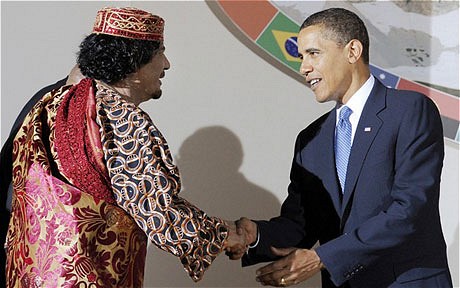
GaddafiObama2009AFPGettyMEDIA ROOTS- As the pro-democracy ‘Arab Spring’ movement spread across North Africa and beyond, Euroamerican imperialists sent a stern message by responding with draconian violence. In Libya, US-NATO forces perpetrated crimes against humanity under the pretext of combating alleged crimes against humanity.

President Obama gloated as NATO advanced in Libya, then cheered the brutal assassination of Gaddafi, who was sodomised with a knife before being extrajudicially executed.  Soon thereafter, the U.S. corporate propaganda machine launched its coinciding media blitz selling the triumphalism of ‘humanitarian intervention’ in the country.  

In a recent article, “NATO’s War Crimes in Libya,” James Petras describes how Libya’s standing with the U.S. and U.K. suddenly soured without provocation.  In fact, Euroamerican imperialists were Gaddafi supporters up until the ‘Arab Spring’ revolution toward democratic, anti-imperialist, and independent governance became contagious.  

To reassert its muscle and send a warning shot to other nations aspiring independence,  Euroamerican imperialists, via the proxy rubric of NATO, claimed to support ‘rebels’ fighting against the Gaddafi government.  And, of course, support is an understatement– NATO brutally devastated Libyan infrastructure through sea and air attacks paving the way for the so-called ‘rebels,’ which otherwise wouldn’t have stood a chance. 

These ‘rebels’ could scarcely claim popular support.  As Petras notes, the “casting of the rag-tag collection of monarchists, Islamist fundamentalists, London and Washington-based ex-pats and disaffected Gaddafi officials as ‘rebels’ is a pure case of mass media propaganda.”

Libya was made an example of by Euroamerican imperialists for many reasons. Gaddafi pursued plans for a ‘Bank of Africa,’ alternative communication systems, and long supported African unity.  Under Gaddafi, despite any demagoguery, Libya maintained the highest standard of living for any African nation. However, now smouldering after NATO’s devastation, it’s projected Libya faces a decade of reconstruction to undo the damage of being bombed back to the Stone Age. 

To be certain, Gaddafi was a complex political figure, developing from a revolutionary to a self-styled symbolic figurehead.  But one simply needs to ask why NATO forces haven’t targeted nations such as Saudi Arabia or Yemen for similar ‘humanitarian intervention’ to see through the glaring hypocrisy.

As historian Dr. Webster Griffin Tarpley has explained:

“Democracy is totally irrelevant to this. This is a cynical imperialist attack aiming at the two things that the US, the British, and the French value. On the one hand the oil and on the other hand the water. And the water may turn out to be more valuable than the oil… Libya will be under IMF conditionality and that will mean the Washington consensus, deregulation, privatization, the destruction of any state-sector that remains, the destruction of any social welfare system, or social safety net, and the destruction of all of those positive things that Gaddafi had done in his regime to distribute the oil revenue to increase the general welfare.”

As in Iraq, Euroamerican imperialists stand to benefit from ‘ruin and rule’ devastation, disaster capitalism, and the years of inevitable reconstruction contracts and continued obstruction of autonomous governance. 

Messina

***

JAMES PETRAS— The NATO assault formed part of a general counter-attack designed to contain and reverse the popular democratic and anti-imperialist movements which had ousted or were on the verge of overthrowing US-client dictators.

What caused the NATO countries to shift abruptly from a policy of embracing Gaddafi to launching a brutal scorched-earth invasion of Libya in a matter of months? The key is the popular uprisings, which threatened Euro-US domination. The near total destruction of Libya, a secular regime with the highest standard of living in Africa, was meant to be a lesson, a message from the imperialists to the newly aroused masses of North Africa, Asia and Latin America: The fate of Libya awaits any regime which aspires to greater independence and questions the ascendancy of Euro-American power.

NATO’s savage six-month blitz – over 30,000 air and missile assaults on Libyan civil and military institutions – was a response to those who claimed that the US and the EU were on the “decline” and that the “empire was in decay”. The radical Islamist and monarchist-led “uprising” in Benghazi during March 2011 was backed by and served as a pretext for the NATO imperial powers to extend their counter-offensive on the road to neo-colonial restoration.

For all the ruling class and mass media euphoria, the ‘win’ over Libya, grotesque and criminal in the destruction of Libyan secular society and the ongoing brutalization of black Libyans, does not solve the profound economic crises in the EU-US. It does not affect China’s growing competitive advantages over its western competitors. It does not end US-Israeli isolation faced with an imminent world-wide recognition of Palestine as an independent state. The absence of left-wing western intellectual solidarity for independent Third World nations, evident in their support for the imperial-based mercenary “rebels” is more than compensated by the emergence of a radical new generation of left-wing activists in South Africa, Chile, Greece, Spain, Egypt, Pakistan and elsewhere. These are youth, whose solidarity with anti-colonial regimes is based on their own experience with exploitation, “marginalization” (unemployment) and repression at home.

Read more about NATO’s War Crimes in Libyia.

© 2011 The Official James Petras Website

***

THE GUARDIAN— As the most hopeful offshoot of the “Arab spring” so far flowered this week in successful elections in Tunisia, its ugliest underside has been laid bare in Libya. That’s not only, or even mainly, about the YouTube lynching of Gaddafi, courtesy of a Nato attack on his convoy.

For the western powers, of course, the Libyan war has allowed them to regain ground lost in Tunisia and Egypt, put themselves at the heart of the upheaval sweeping the most strategically sensitive region in the world, and secure valuable new commercial advantages in an oil-rich state whose previous leadership was at best unreliable. No wonder the new British defence secretary is telling businessmen to “pack their bags” for Libya, and the US ambassador in Tripoli insists American companies are needed on a “big scale”.

But for Libyans, it has meant a loss of ownership of their own future and the effective imposition of a western-picked administration of Gaddafi defectors and US and British intelligence assets. Probably the greatest challenge to that takeover will now come from Islamist military leaders on the ground, such as the Tripoli commander Abdel Hakim Belhaj – kidnapped by MI6 to be tortured in Libya in 2004 – who have already made clear they will not be taking orders from the NTC.

What the Libyan tragedy has brutally hammered home is that foreign intervention doesn’t only strangle national freedom and self-determination – it doesn’t protect lives either.

Read more about If the Libyan war was about saving lives, it was a catastrophic failure.

© 2011 Guardian News and Media Limited

Photo by AFP/Getty

Police Using Surveillance System to Monitor Cellphones

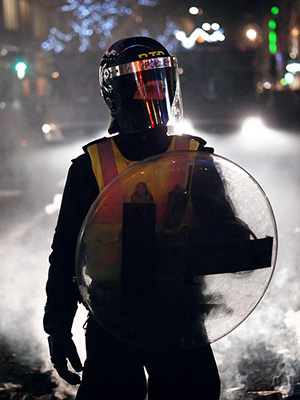
RiotPolice-FlickrUserHozinjaMEDIA ROOTS— As people in the U.S. and abroad endeavour to exercise their rights and civil liberties, such as the right to freedom of speech and peaceful assembly, the state and its police forces continue finding methods to repress such civic activity.  An important component of social control and repression of dissent has been the curtailment of telecommunications. 
Earlier this year, when San Francisco Bay Area Rapid Transit (BART) police killings spurred groups, such as ‘No Justice, No Bart!,’ to call for critical mass demonstrations, BART officials attempted to thwart communication among activists by cutting mobile phone service entirely to transit stations targeted by demonstrators.

Not to be outdone in the U.K., the Metropolitan Police Service of Greater London has been “operating covert surveillance technology that can masquerade as a mobile phone network, transmitting a signal that allows authorities to shut off phones remotely, intercept communications and gather data about thousands of users in a targeted area.”

Messina

***

THE GUARDIAN– The surveillance system has been procured by the Metropolitan police from Leeds-based company Datong plc, which counts the US Secret Service, the Ministry of Defence and regimes in the Middle East among its customers. Strictly classified under government protocol as “Listed X”, it can emit a signal over an area of up to an estimated 10 sq km, forcing hundreds of mobile phones per minute to release their unique IMSI and IMEI identity codes, which can be used to track a person’s movements in real time.

The disclosure has caused concern among lawyers and privacy groups that large numbers of innocent people could be unwittingly implicated in covert intelligence gathering. The Met has refused to confirm whether the system is used in public order situations, such as during large protests or demonstrations.

Nick Pickles, director of privacy and civil liberties campaign group Big Brother Watch, warned the technology could give police the ability to conduct “blanket and indiscriminate” monitoring: “It raises a number of serious civil liberties concerns and clarification is urgently needed on when and where this technology has been deployed, and what data has been gathered,” he said. “Such invasive surveillance must be tightly regulated, authorised at the highest level and only used in the most serious of investigations. It should be absolutely clear that only data directly relating to targets of investigations is monitored or stored,” he said.

The company’s systems, showcased at the DSEi arms fair in east London last month, allow authorities to intercept SMS messages and phone calls by secretly duping mobile phones within range into operating on a false network, where they can be subjected to “intelligent denial of service”. This function is designed to cut off a phone used as a trigger for an explosive device.

A transceiver around the size of a suitcase can be placed in a vehicle or at another static location and operated remotely by officers wirelessly. Datong also offers clandestine portable transceivers with “covered antennae options available”. Datong sells its products to nearly 40 countries around the world, including in Eastern Europe, South America, the Middle East and Asia Pacific. In 2009 it was refused an export licence to ship technology worth £0.8m to an unnamed Asia Pacific country, after the Department for Business, Innovation and Skills judged it could be used to commit human rights abuses.

Read more about Met police using surveillance system to monitor mobile phones.

© 2011 Guardian News and Media Limited

Photo by flickr user Hozinja

Employers Less Likely to Interview Openly Gay Men

MEDIA ROOTS- Several research studies have studied job discrimination by sending out resumes with different identifying features and tracking the response rates. For instance, one study conducted by researchers at MIT and University of Chicago sent out thousands of resumes that were identical except for the name of the applicant: in one version, the applicants name was stereotypically “Black” (e.g., Rasheed, Aisha) and another version had stereotypically “White” names (e.g., Greg, Emily). Even though the resumes were identical in terms of qualifications, those researchers found that the “White” resumes had a 30 percent greater chance of getting responses than the “Black” resumes.
A new study published this week in the American Journal of Sociology has used this method to test whether gay men face similar job discrimination. Identical resumes were sent out, with a key difference being membership in a college club: either the applicant reported membership in an LGBT organization, or a socialist organization. The results were striking: “gay” resumes were significantly less likely to lead to interview requests than “socialist” resumes. The socialist group was used as the comparison to rule out the possibility that any discrimination was due to an “anti-liberal” bias, and this makes the results even more striking: being openly gay is more of a liability on the job market than being openly socialist.

Perhaps even more concerning is that a huge scientific literature now shows that these types of discrimination are not necessarily due to overt, conscious prejudice – these differences tend to emerge from subtle, unconscious preferences that guide our judgments and decision making even when we’re not aware of it.

Steven Frenda for MR

***

EUREKALERT– A new study suggests that openly gay men face substantial job discrimination in certain parts of the U.S. The study, which is the largest of its kind to look at job discrimination against gay men, found that employers in the South and Midwest were much less likely to offer an interview if an applicant’s resume indicates that he is openly gay. Overall, the study found that gay applicants were 40 percent less likely to be granted an interview than their heterosexual counterparts.

“The results indicate that gay men encounter significant barriers in the hiring process because, at the initial point of contact, employers more readily disqualify openly gay applicants than equally qualified heterosexual applicants,” writes the study’s author, András Tilcsik of Harvard University.

For the study, Tilcsik sent two fictitious but realistic resumes to more than 1,700 entry-level, white collar job openings — positions such as managers, business and financial analysts, sales representatives, customer service representatives, and administrative assistants. The two resumes were very similar in terms of the applicant’s qualifications, but one resume for each opening mentioned that the applicant had been part of a gay organization in college.

“I chose an experience in a gay community organization that could not be easily dismissed as irrelevant to a job application,” Tilcsik writes. “Thus, instead of being just a member of a gay or lesbian campus organization, the applicant served as the elected treasurer for several semesters, managing the organization’s financial operations.”

The second resume Tilcsik sent listed experience in the “Progressive and Socialist Alliance” in place of the gay organization. Since employers are likely to associate both groups with left-leaning political views, Tilcsik could separate any “gay penalty” from the effects of political discrimination.

The results showed that applicants without the gay signal had an 11.5 percent chance of being called for an interview. However, gay applicants had only a 7.2 percent chance. That difference amounts to a 40 percent higher chance of the heterosexual applicant getting a call.

The callback gap varied widely according to the location of the job, Tilcsik found. In fact, most of the overall gap detected in the study was driven by the Southern and Midwestern states in the sample — Texas, Florida, and Ohio. The Western and Northeastern states in the sample (California, Nevada, Pennsylvania, and New York) had only small and statistically insignificant callback gaps.

“This doesn’t necessarily mean that there is no discrimination in those states, just that the callback gaps were small in the case of the jobs to which I sent applications,” Tilcsik explained. “I think it’s very plausible that, even in those states, there might be a large callback gap in some other jobs, industries, or counties. What this does show is that discrimination in white-collar employment is substantially stronger for the Southern and Midwestern states in the sample.”

The research also found that employers seeking stereotypically heterosexual male traits were more likely to discriminate gay men. Gay applicants had lower callback rates when the employer described the ideal candidate for the job as “assertive,” “aggressive,” or “decisive.

“It seems, therefore, that the discrimination documented in this study is partly rooted in specific stereotypes and cannot be completely reduced to a general antipathy against gay employees,” Tilcsik writes.

The technique Tilcsik used, known as audit study, has been used in the past to expose hiring prejudice based on race and on sex. This is the first major audit study to test the receptiveness of employers to gay male job applicants.

Understanding the ways in which these biases might operate at the interview stage of the employment process, or how they might apply to lesbian job seekers in the U.S., requires additional research, Tilcsik says.

###

András Tilcsik, “Pride and Prejudice: Employment Discrimination against Openly Gay Men in the United States.” American Journal of Sociology 117:2 (September 2011).

Established in 1895 as the first U.S. scholarly journal in its field, the American Journal of Sociology remains a leading voice for analysis and research in the social sciences.

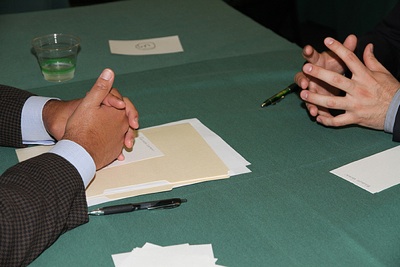
Photo by Flickr user bpsusf

Saudi Women to Vote But Not Drive?

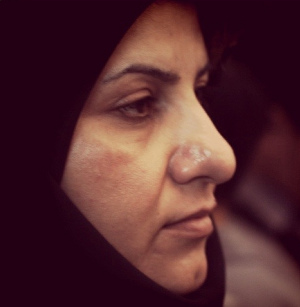
MEDIA ROOTS- The news that King Abdullah would permit women to vote and run in local elections in 2015 was met with the predictable array of responses in the corporate media. Very little was said about American-Saudi relations going back more than half a century. Unmentioned were the anti-egalitarian campaigns that the plutocrats of both societies colluded on, to squash any dissent and threat to the flow and control of oil or petrodollars. 

American policymakers may rehearse and make emphatic speeches in international meetings on human rights or the status of women in other countries, but it’s pretty clear that the policies of succeeding administrations since FDR have created income inequality, political disempowerment, widows, orphans, broken societies, lack of opportunity for education, populations vulnerable to sex trafficking, patriarchy, especially in the majority-Muslim world. 

Conservatives like Laura Bush and well-intentioned but counterproductive liberals often exacerbate the situation for women worldwide, and refuse to acknowledge the role that American foreign policy–serving the interests of a global capitalist class–has in perpetuating, amplifying, and worsening disparities and trauma of women.  

MR

***

SLATE– King Abdullah announced on Sunday that Saudi women will be allowed to vote and run for office in municipal elections beginning in 2015. Saudi watchers view the move as a weaker step than allowing women to drive, a right women have been demanding publicly for more than two decades. Why did Saudi women find it easier to get the vote than a driver’s license?

Because the right to vote is meaningless. Elections are mostly symbolic in Saudi Arabia. Only half of the seats on the municipal councils are up for election, while the ruling alSaud family appoints the other half of the members and the mayors. The councils have little power. The government reserves the right to postpone elections, as it did in 2009. There’s no guarantee that the 2015 elections, in which women are supposed to participate, will happen on time, or at all. Moreover, King Abdullah’s announcement doesn’t carry the force of law. He could change his mind at any time. Or, if the 87-year-old king isn’t around in 2015, his successor could easily go back on Abdullah’s promise to Saudi women.

While voting in municipal elections is hardly a move toward true political authority, Saudi conservatives view female driving as the first practical step away from the kingdom’s guardian system, which keeps women reliant on men. As things stand, women in Saudi cities can’t get around unless they can afford a driver or have a male family member who’s willing to chauffeur them. (Young men with many sisters have it tough in the kingdom.) Public buses have separate doors and seating areas for women, but they are slow and unreliable. Some women are afraid to ride in taxis because there have been reports of inappropriate comments by Saudi drivers. (Foreign-born drivers don’t have the same reputation, because the Saudi criminal justice system has treated immigrants brutally.)

King Abdullah announced on Sunday that Saudi women will be allowed to vote and run for office in municipal elections beginning in 2015. Saudi watchers view the move as a weaker step than allowing women to drive, a right women have been demanding publicly for more than two decades. Why did Saudi women find it easier to get the vote than a driver’s license?
Because the right to vote is meaningless. Elections are mostly symbolic in Saudi Arabia. Only half of the seats on the municipal councils are up for election, while the ruling alSaud family appoints the other half of the members and the mayors. The councils have little power. The government reserves the right to postpone elections, as it did in 2009. There’s no guarantee that the 2015 elections, in which women are supposed to participate, will happen on time, or at all. Moreover, King Abdullah’s announcement doesn’t carry the force of law. He could change his mind at any time. Or, if the 87-year-old king isn’t around in 2015, his successor could easily go back on Abdullah’s promise to Saudi women.
While voting in municipal elections is hardly a move toward true political authority, Saudi conservatives view female driving as the first practical step away from the kingdom’s guardian system, which keeps women reliant on men. As things stand, women in Saudi cities can’t get around unless they can afford a driver or have a male family member who’s willing to chauffeur them. (Young men with many sisters have it tough in the kingdom.) Public buses have separate doors and seating areas for women, but they are slow and unreliable. Some women are afraid to ride in taxis because there have been reports of inappropriate comments by Saudi drivers. (Foreign-born drivers don’t have the same reputation, because the Saudi criminal justice system has treated immigrants brutally.

Read more about Why is King Abdullah Willing To Let Saudi Women Vote But Not Drive Cars?

© 2011 Slate 

Photo by Flickr user Dmunkhuulei

Page 26 of 62<<...2425262728...>>