

Enacting the NDAA: Limiting Protesters’ Rights

MEDIA ROOTS — The U.S. blindly took another giant step further into tyranny last week—no, really.

In most corporate and, even, many independent news outlets, the public was kept up-to-date with the deaths of singer Davy Jones and conservative blogger Andrew Breitbart.  However, relatively little attention was given to the annihilation of Constitutionally-protected civil liberties executed by the National Defense Authorization Act, which went into effect  Wednesday, March 1.  On the very same day two celebrities coincidentally died from unexpected heart-attacks in the U.S., a bipartisan Congress carefully dealt orchestrated attacks against the First Amendment.

Instead of the anti-democratic new law merely taking effect, the House resolved to further the scope of the NDAA by preventing assembly near public officials guarded by the Secret Service.  Not only is the U.S. tradition of protesting at the White House under siege—now those vying to replace the presidency are also exempt from the ‘nuisance’ of protesters.  499 Congressional Representatives voted in favor of HR 347—the Federal Restriction Buildings and Grounds Improvement Act—only three voted against: Paul Broun (R-GA), Justin Amash (R-MI), and Ron Paul (R-TX).

The President signed the NDAA into law on New Year’s Eve, but hardly did a media firestorm result from the fact that the military is now legally able to indefinitely detain U.S. citizens solely based on suspicion.  That’s right.  Despite Presidential Policy Directive 14, future protesters at the White House could be locked up indefinitely, without due process of the law.  Of course, Attorney General Eric Holder has begun engaging in Orwellian semantical double-speak regarding due process in cases of arbitrary targeted killings when he spoke before law school students today at Chicago’s Northwestern University:

“Due process and judicial process are not one and the same, particularly when it comes to national security.  The Constitution guarantees due process, not judicial process.”

It’s a terrible precedent Holder is working to set with regard to due process, which may easily spread to the First Amendment and other rights once the Fifth Amendment is undermined.  Although, no one may be “deprived of life” without due process of law under the Fifth Amendment, Holder claims that due process “doesn’t necessarily come from a court.”

Author Naomi Wolf reminded the world the day before NDAA Day 1 that U.S. citizens are “sleepwalking into becoming a police state.”  She explained further:

“Overstated?  Let’s be clear: the NDAA grants the president the power to kidnap any American anywhere in the United States and hold him or her in prison forever without trial.  The president’s own signing statement, incredibly, confirmed that he had that power.  As I have been warning since 2006: there is not a country on the planet that you can name that has ever set in place a system of torture, and of detention without trial, for an “other”, supposedly external threat that did not end up using it pretty quickly on its own citizens.”

The American Civil Liberties Union is now calling on all U.S. citizens to pressure the Senate to clean up the NDAA.  People must specifically demand that no president ever be given the power to use the military far from armed conflict to imprison civilians indefinitely, especially within U.S. borders.  Additionally, no President should be required to put civilians into military custody without charge.  Chris Anders from the ACLU explains:

“The United States itself should be off-limits for the military to impose indefinite detention without charge or trial.  It would be unconstitutional for the president to apply the NDAA provisions here at home, but the Senate rejected explicit protections to reinforce the Constitution’s and the Posse Comitatus Act’s protections.”

But without much leverage other than the power of the vote, which most voters perpetually award to the same politicians they protest, U.S. civilian demands are easily dismissed, as the Democrat and Republican parties know they have monopolized the political process.  Perhaps, it’s time to boycott both corporate political parties responsible for so much oppression.

Pulitzer Prize-winning journalist Chris Hedges is suing the President for signing the NDAA.  He, along with several other plaintiffs, such as Noam Chomsky and Daniel Ellsberg, blame both political parties for the passing of this totalitarian law.  They suspect that the corporate state ensured its passage because of potentially imminent uprisings in the United States.  In Hedges’ own words:

“This demented ‘war on terror’ is as undefined and vague as such a conflict is in any totalitarian state.  The NDAA expands our permanent war to every spot on the globe.  It erases fundamental constitutional liberties.  It means we can no longer use the word ‘democracy’ to describe our political system.”

Chris Hedges on Alex Jones’ Infowars discusses the lawsuit.

***

Oskar Mosquito is a regular contributor to Media Roots.

Photo provided by Flickr user DVIDSHUB.

***UPDATE

Obama recently came out to issue new guidelines for the NDAA provision, but the move is simply a PR stunt.  It does not strip his absolute power of indefinitely detaining U.S. citizens.

Abby
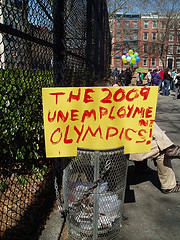
Economist Joseph Stiglitz and the Book of Jobs

joblessgamesMEDIA ROOTS  Although the corporate media touts an improving economy, U.S. citizens continue to suffer cruel economic punishment and austerity.  Millions of citizens still search for employment, and the typical income of a U.S. household is less now than it was in 1997.  Why is the economy not improving?  Wall Street makes an easy target for the ire of struggling workers, but is there a deeper, more complex reason why the economy creaks, tumbles and rolls like an outdated galleon laboring in rough seas?

Economist Joseph Stiglitz offers in-depth analysis of the weakening foundation of the U.S. economy.  In the years leading up to 2008, U.S.A. lived in an easy-credit, fast-money mania, fueled by wildly inflated home values, corrupt appraisers, and financial gimmicks.  However, the integrity of the economy was compromised even before the meltdown, explains Stiglitz.  Our collective economic livelihood had been dealt a slow acting, poisonous blow long ago, as other observers such as Catherine Austin Fitts and Dr. Michael Hudson have described. 

Stiglitz draws insight comparing today with the tumultuous Great Depression, which had been well underway for years before the banking sector crashed.  What brought about the economic paralysis?  The primary cause was a quiet, but massive, transition away from an agriculture-based economy.  As food production modernized and became more efficient, less farmers were required to grow the food necessary to feed the U.S.  Suddenly, a vast portion of the U.S. workforce became obsolete through automation. 

Stiglitz argues broad changes must be made in tandem with large, concentrated investment.  As once industrious manufacturing regions of U.S.A. wither and rust, elected officials neglect investment in education, research, and infrastructure, favoring austerity cuts.  Yet, these three areas provide opportunities for healthy economic growth and future employment, as the nation struggles to adapt to the 21st century.  Addressing these needs, perhaps, U.S.A. can fulfill its promise of greatness and prosperity.

MR

***

VANITY FAIR Even when we fully repair the banking system, we’ll still be in deep trouble—because we were already in deep trouble. That seeming golden age of 2007 was far from a paradise. Yes, America had many things about which it could be proud. Companies in the information-technology field were at the leading edge of a revolution. But incomes for most working Americans still hadn’t returned to their levels prior to the previous recession. The American standard of living was sustained only by rising debt—debt so large that the U.S. savings rate had dropped to near zero.

And “zero” doesn’t really tell the story. Because the rich have always been able to save a significant percentage of their income, putting them in the positive column, an average rate of close to zero means that everyone else must be in negative numbers. (Here’s the reality: in the years leading up to the recession, according to research done by my Columbia University colleague Bruce Greenwald, the bottom 80 percent of the American population had been spending around 110 percent of its income.) What made this level of indebtedness possible was the housing bubble, which Alan Greenspan and then Ben Bernanke, chairmen of the Federal Reserve Board, helped to engineer through low interest rates and nonregulation—not even using the regulatory tools they had. As we now know, this enabled banks to lend and households to borrow on the basis of assets whose value was determined in part by mass delusion.

The fact is the economy in the years before the current crisis was fundamentally weak, with the bubble, and the unsustainable consumption to which it gave rise, acting as life support. Without these, unemployment would have been high. It was absurd to think that fixing the banking system could by itself restore the economy to health. Bringing the economy back to “where it was” does nothing to address the underlying problems.

The trauma we’re experiencing right now resembles the trauma we experienced 80 years ago, during the Great Depression, and it has been brought on by an analogous set of circumstances. Then, as now, we faced a breakdown of the banking system. But then, as now, the breakdown of the banking system was in part a consequence of deeper problems. Even if we correctly respond to the trauma—the failures of the financial sector—it will take a decade or more to achieve full recovery. Under the best of conditions, we will endure a Long Slump. If we respond incorrectly, as we have been, the Long Slump will last even longer, and the parallel with the Depression will take on a tragic new dimension.

Until now, the Depression was the last time in American history that unemployment exceeded 8 percent four years after the onset of recession. And never in the last 60 years has economic output been barely greater, four years after a recession, than it was before the recession started. The percentage of the civilian population at work has fallen by twice as much as in any post-World War II downturn. Not surprisingly, economists have begun to reflect on the similarities and differences between our Long Slump and the Great Depression. Extracting the right lessons is not easy.

Read more about America’s 21st Century Job Engine.

© 2012 Vanity Fair

***

Photo by Flickr user clementine gallot

Poor America on BBC’s Panorama

MEDIA ROOTS — The number of deeply impoverished Americans has exploded since Obama took office, according to Panorama,  BBC’s weekly investigative news program.  In fact, the U.S. is more unequal now than any other time since the Great Depression.  Three million are newly unemployed while one-fifth of the wealth is earned by just one percent of the population.  Additionally, nearly 50 million are now uninsured, up from 46 million in 2008.
BBC Host Hillary Anderson takes viewers inside the storm drains of Las Vegas to meet some of the hundreds of formerly middle-class Americans now living below one of the richest cities on Earth.  She continues to interview a few of the 1.5 million homeless children in the U.S., where one child tragically explains how her family once had to eat rats because no other food was available.  Anderson also stops by Tent City outside of Detroit to meet those who have been surviving the harsh elements for over a year after losing their homes.

The once idealized American Dream is now an out of reach distant memory.  Social mobility in the U.S. may be the lowest it’s ever been—half the poor, about five million families of four, now earn less than $11,000 a year.  Yet, in one of the world’s richest lands it’s even more difficult for those that are impoverished to fully admit their situation. 

MR

***

BBC’s Panorama: Poor America

***

Photo by flickr user nyrk03

Crisis of Capitalism: Radical Politics in Age of Austerity

MEDIA ROOTS — Capitalism Is The Crisis: Radical Politics in the Age of Austerity is a film featuring a diverse array of thinkers offering common sense analysis of the trappings of modern life and critical perspectives on basic assumptions of capitalism and democracy.  The film presents original interviews, including Chris Hedges, David Graeber, Derrick Jensen, Michael Hardt, Leo Panitch, David McNally.

The movie is about waking up our neighbours to the glaring ills plaguing our society. It argues that capitalism is the crisis and dares us to imagine saner alternatives.

“The way to make money is to buy when blood is running in the streets.”  —John D. Rockefeller, American oil magnate, robber baron

“The engines of corporatists cannot be halted.  They are impervious to the will of those who they exploit, they are more powerful than the governments they control, and they have built within them an inevitable, kind of, mechanism for self-annihilation because corporations have this strange pathology where they turn everything into a commodity.  Human beings become commodities.  The natural world becomes a commodity.  And you exploit these commodities until exhaustion or collapse.  And that’s precisely what’s happening.” —Chris Hedges

Messina

***

Capitalism is the Crisis

***

CAPITALISM IS THE CRISIS — The 2008 “financial crisis” in the United States was a systemic fraud in which the wealthy finance capitalists stole trillions of public dollars. No one was jailed for this crime, the largest theft of public money in history.

Instead, the rich forced working people across the globe to pay for their “crisis” through punitive “austerity” programs that gutted public services and repealed workers’ rights.

Austerity was named “Word of the Year” for 2010.

This documentary explains the nature of capitalist crisis, visits the protests against austerity measures, and recommends revolutionary paths for the future.

Special attention is devoted to the crisis in Greece, the 2010 G20 Summit protest in Toronto, Canada, and the remarkable surge of solidarity in Madison, Wisconsin.

It may be their crisis, but it’s our problem.

***

Photo by flickr user JHS

Documentary: The Shock Doctrine

MEDIA ROOTS — Film director Michael Winterbottom has adapted best-selling author Naomi Klein’s book Shock Doctrine in an excellent feature documentary.  Winterbottom, who has directed such films as Welcome to Sarajevo, The Road to Guantanamo and Code 46, produces a compelling treatment of Klein’s book.

The shock doctrine thesis maintains elites have taken draconian shock therapy ‘treatments’ (inflicted upon individual psychiatric patients during the 20th century) and applied them economically, politically, and psychologically to nations where leaders have exploited crises in order to push through elite policies against the interests of the people.  

The film also takes a look at U.S. imperialism and its consequences for humanity.  If you haven’t heard of it, it’d be no surprise.  This is not the kind of film corporate America loves to promote.

Messina

***

The Shock Doctrine directed by Michael Winterbottom

“The thesis of the shock doctrine is that we’ve been sold a fairy tale about how these radical policies have swept the globe, that they haven’t swept the globe on the backs of freedom and democracy, that they have needed shock.  They have needed crises.  They have needed states of emergencies. 

“Milton Friedman understood the utility of crisis.  ‘Only a crisis, actual or perceived, produces real change.  When that crisis occurs, the actions that are taken depend on the ideas that are lying around.’Naomi Klein

***

Photo by Flickr user david_shankbone

Posted in Uncategorized | 1 Reply
Page 25 of 62<<...2324252627...>>