
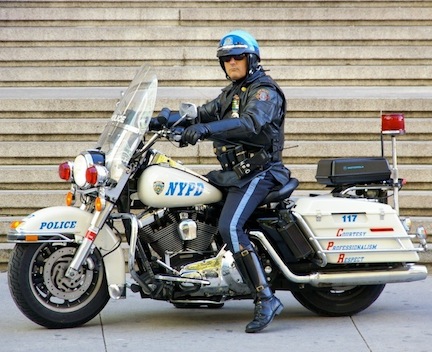
The Thin Blue Line: The First Time a Cop Lied To Me


MEDIA ROOTS – This article by David Noriega, published on TheNewInquiry, vividly diagrams the pressures inherent on a young college graduate when he goes to work for the NYC Civilian Complaint Review Board, wherein he investigates citizens’ complaints against NYPD officers. Where other areas that have the means use attorneys for the important task of holding peace officers accountable to citizens, the overextended CCRB provided steady employment for recent grads like Mr. Noriega, as long as they could accomplish the task of minimizing paperwork and consequences for the NYPD.

Younger, more inexperienced workers were more likely to follow orders and be amenable to a culture that valued exoneration of officers, discounting citizen grievances, and not taking a stand on controversial issues like stop-and-frisk. The author expresses some guarded hope, and lists some recent, albeit limited, improvements to the CCRB’s function. This cautionary tale will give you a glimpse of what it feels like to be on the inside of a powerless bureaucratic machine whose ostensible task is keeping the NYPD from abusing its authority. 

Laurie Kirchner for Media Roots

*****

THENEWINQUIRY – I will always remember the first time a cop lied to me. Or rather, the first time that I knew beyond a doubt that a cop was lying to me, sitting right there in the interview room with a tape recorder in front of him.

It was early in my tenure as an investigator at the New York City Civilian Complaint Review Board, the city agency established in 1993 to investigate allegations of misconduct against NYPD officers. The case was a fairly straightforward stop-and-frisk incident near the massive New York City Housing Authority complexes along Avenue D in Manhattan. The complainant, a man in his early 20s, alleged that a plainclothes cop had stopped, frisked, and searched him after he stepped out of a bodega. He’d given a guy a cigarette, and before he knew it, the cop came up from behind him, grabbed him by the coat, and after a quick scuffle, pushed him against a wall.

I’d already interviewed the cop’s unusually forthcoming partner, whose testimony matched the complainant’s. That’s how I knew the cop was making stuff up. Lots of stuff.

Continue reading The Thin Blue Line

*****

photo by Jean-Edouard BABIN under creative commons
MR Original – Wikileaks Trips Up Trapwire


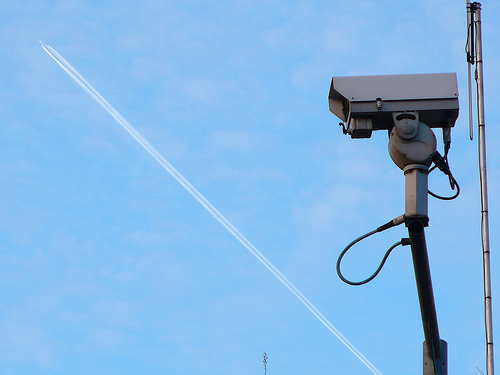
MEDIA ROOTS – It may be a sign of a public awakening when news of government surveillance hits the front page of Gawker’s future and technology blog, io9. The scope of federal survellience was widened on August 10 when Wikileaks released documents that exposed the TrapWire system to the public. The security technology helps group private surveillance recordings into one larger network that may be monitored by the government.

It was top secret software that was designed by former CIA agents. Now TrapWire is trending on Twitter as more enlightening information has been surfacing. International news outlet, RT – America even ties the TrapWire information to the White House and its various three letter agencies, as well as intelligence gathering organizations across the globe.

While conspiracy theories are claimed and refuted, the discussion around TrapWire remains particularly relevant. Thomas Drake, the noted NSA surveillance whistleblower of yesteryear, tweeted the following last week: “#Trapwire not bogus. No liberty w/o privacy.Secret surveillance of people is tyranny. Universal wiretap & profile 4 all?”

What comes next?

According to the io9 article, the Electronic Frontier Foundation might have built a legal standing to prove that TrapWire is not only illegal, but in violation of the Fourth Amendment of the US Constitution. From the EFF:

“In January 2012, the U.S. Supreme Court unanimously confirmed that Americans have constitutional protections against GPS surveillance by law enforcement, holding that GPS tracking is a “search” under the Fourth Amendment.”

To date, there are no pending legal challenges to TrapWire. That is almost certain to change, as more information is uncovered and the general public begins to acknowledge that privacy isn’t merely for those who have something to hide.


Sean Reid is a guest contributor to Media Roots.

Photo provided by Flicker user SE17.

When The Pharmaceutical Industry Writes Our Laws

MEDIA ROOTS – Pharmaceutical companies spend an astronomical amount of money on lobbying and advertising.  Sometimes a marketing campaign is so expensive that even if it’s discovered that a drug is ineffective once it hits the market, the money spent needs to be made back; instead of recalling the drug, they continue to push it. Risperdal, a drug designed to treat PTSD, is one such example; although proven equally as effective as placebo, it has cost the Department of Veterans Affairs $717 million dollars over the course of 9 years. 

Robbie Martin

***

COUNTERPUNCH – Pharma is losing so much money from rising co-pays and prescription abandonment, it has launched cagey, public service announcement-sounding campaigns about “patients not taking the drugs they need,” as if it is a health and not revenue issue. Pharma has even instituted arrangements with some pharmacies to send visiting nurses to patients’ homes to ensure “compliance,” Big Brother overtones notwithstanding.

Prescription abandonment is an especially thorny issue for Pharma when the drugs are taken on faith, to reduce patients’ “risks” and patients do not necessarily feel them working. It is also a thorny issue when studies suggest the drugs being abandoned may not be necessary to begin with or working.

One such expensive placebo is the drug known by the brand name Risperdal. The Department of Veterans Affairs spent $717 million on the drug to treat posttraumatic stress disorder in Afghanistan and Iraq troops with PTSD over nine years, only to discover it worked no better than a sugar pill! Veterans Affairs doctors wrote more than 5 million prescriptions from 2000 through June 2010 for naught, says a 2011 paper in the Journal of the American Medical Association (JAMA). Last month, Johnson & Johnson also agreed to pay $1.2 billion in fines for minimizing or concealing Risperdal’s dangers. Many say unless a drug company’s chief officers go to prison or the company is banned from sales to Medicare and other government programs, penalties are a joke. 

Read more about When Big Pharma Writes The Laws.

***

Abby Martin Interviews Dr. Darcy Smith about Big Pharma’s Direct to Consumer Advertising for RT TV


***

Photo by Flickr US National Archives


Posted in Uncategorized | 1 Reply

WikiLeaks is Back – Corporate Spying

MEDIA ROOTS – Early Monday morning, the controversial website WikiLeaks released a stunning collection of Global Intelligence Files from the private intelligence corporation Stratfor.
According to WikiLeaks:

“The Global Intelligence Files exposes how Stratfor has recruited a global network of informants who are paid via Swiss banks accounts and pre-paid credit cards. Stratfor has a mix of covert and overt informants, which includes government employees, embassy staff and journalists around the world.

The material shows how a private intelligence agency works, and how they target individuals for their corporate and government clients. For example, Stratfor monitored and analysed the online activities of Bhopal activists, including the “Yes Men”, for the US chemical giant Dow Chemical. The activists seek redress for the 1984 Dow Chemical/Union Carbide gas disaster in Bhopal, India. The disaster led to thousands of deaths, injuries in more than half a million people, and lasting environmental damage.”

Most mainstream media reports aren’t covering several important issues that these files bring up, like how Stratfor has been gathering intelligence and spying on journalists and activists all over the world for not only the government, but for private corporations like Coca-Cola.

Comedy/activist duo the Yes-Men found out they were being spied on by Stratfor because of their activism surrounding the Bopal Chemical Disaster.  Other media outlets that had intelligence gathering done on them include Rolling Stone, Wikileaks itself (over 4,000 emails alone), Sunday Star Times, The Hindu, Russia Reporter, Publico and an unknown amount more.  Wikileaks says that more information about journalist spying is yet to be revealed.

Activist Cosmos found an intriguing tidbit of information within the e-mails that uncovered how “out of Wikileaks’ release of 5 million Stratfor emails is the comment from Fred Burton, Stratfor’s Vice President of Intelligence, that the Imam of the controversial so-called Ground Zero mosque is an “FBI operational asset.” Burton, who was formerly a special agent with the US State Department’s Diplomatic Security Service and the Deputy Chief of their counterterrorism division, made the comment on an email chain regarding a New York Observer article, Untangling the Bizarre CIA Links to the Ground Zero Mosque.  The controversy surrounding the “Ground Zero mosque” overwhelmingly dominated the news and discussion surrounding the ninth anniversary of the 9/11 attacks.”

At Media Roots, we recommend that you don’t rely on our or any other media outlet’s coverage of the recent leak.  Instead, you can watch the entire press conference with Julian Assange about the Stratfor leaks here:


Julian Assange Press Conference on Stratfor Leaks

***

Written by Robbie Martin for Media Roots

Photo by Flickr user Animantion Concept


Posted in Uncategorized | 1 Reply

SF Cell Shutdown: Safety issue, or Hint of Orwell?

MEDIA ROOTS- Sometimes I forget that I am living in a police state, and then I hear about stories like this: last Thursday, Bay Area Rapid Transit (BART) shut off cellphone service at several stations in an attempt to stop a planned protest over another fatal shooting by BART police. It was spun as a preventative safety measure by BART and officials, but it’s a disturbing commentary on how de-valued privacy and civil disobedience have become in our society.

BART is technically private, but it has all the auspices of a public space. You can argue that private industry has the right to interfere with first amendment rights being exercised on their property, but when a public transit company works in collusion with the telecommunications industry and the government to shut down modes of communication, how can you call it anything but Orwellian? What is the difference between Mubarak’s regime cutting off the internet for Egyptians during the protests and BART officials cutting off the passengers’ freedom? Corporations are technically “people,” but how far are their rights allowed to infringe upon the rights and progress of a free society?

Abby

***

BREITBARTAn illegal, Orwellian violation of free-speech rights? Or just a smart tactic to protect train passengers from rowdy would-be demonstrators during a busy evening commute?

The question resonated Saturday in San Francisco and beyond as details emerged of Bay Area Rapid Transit officials’ decision to cut off underground cellphone service for a few hours at several stations Thursday. Commuters at stations from downtown to near the city’s main airport were affected as BART officials sought to tactically thwart a planned protest over the recent fatal shooting of a 45-year-old man by transit police.

Two days later, the move had civil rights and legal experts questioning the agency’s move, and drew backlash from one transit board member who was taken aback by the decision.

“I’m just shocked that they didn’t think about the implications of this. We really don’t have the right to be this type of censor,” said Lynette Sweet, who serves on BART’s board of directors. “In my opinion, we’ve let the actions of a few people affect everybody. And that’s not fair.”

Similar questions of censorship have arisen in recent days as Britain’s government put the idea of curbing social media services on the table in response to several nights of widespread looting and violence in London and other English cities. Police claim that young criminals used Twitter and Blackberry instant messages to coordinate looting sprees in riots.

Read more about SF Cell Shutdown: Safety issue, or Hint of Orwell?

Photo by Flickr user Aracio Olvarado