
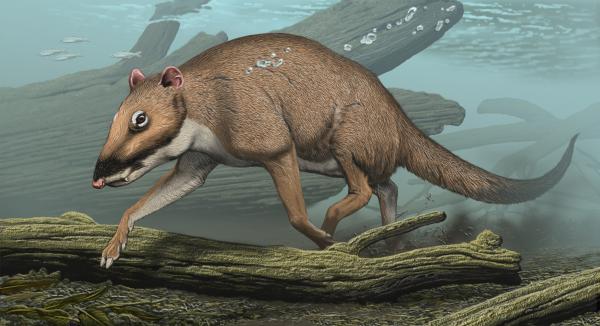
Whales Descended From Tiny Deer-Like Ancestors

SCIENCE DAILY– Hans Thewissen, Ph.D., Professor of the Department of Anatomy, Northeastern Ohio Universities Colleges of Medicine and Pharmacy (NEOUCOM), has announced the discovery of the missing link between whales and their four-footed ancestors.

Scientists since Darwin have known that whales are mammals whose ancestors walked on land, and in the past 15 years, researchers led by Dr. Thewissen have identified a series of intermediate fossils documenting whale’s dramatic evolutionary transition from land to sea. But one step was missing: The identity of the land ancestors of whales.

Now Dr. Thewissen and colleagues discovered of the skeleton of Indohyus, an approximately 48-million-year-old even-toed ungulate from the Kashmir region of India, as the closest known fossil relative of whales. Dr. Thewissen’s team studied a layer of mudstone with hundreds of bones of Indohyus, a fox-sized mammal that looked something like a miniature deer.

Dr. Thewissen and colleagues report key similarities between whales and Indohyus in the skull and ear that show their close family relationship.

Thewissen and colleagues also explored how Indohyus lived, and came up with some surprising results.  They determined that the bones of the skeleton of Indohyus had a thick outside layer, much thicker than in other mammals of this size.  This characteristic is often seen in mammals that are slow aquatic waders, such as the hippopotamus today.  Indohyus’ aquatic habits are further confirmed by the chemical composition of their teeth, which revealed oxygen isotope ratios similar to those of aquatic animals.  All this implies that Indohyus spent much of its time in water.

Dr. Walt Horton, Vice-President for Research at NEOUCOM commented:  “This remarkable research demonstrates that the study of the structure and composition of fossil bones can tell us about how the skeleton of whales and, by extension, other mammals like humans, interacts with the environment and changes over time.”

Read the full article on Whales Descended From Tiny Deer-Like Ancestors.

© 2011 Science Daily

Photo courtesy of Northeastern Ohio Universities Colleges of Medicine and Pharmacy
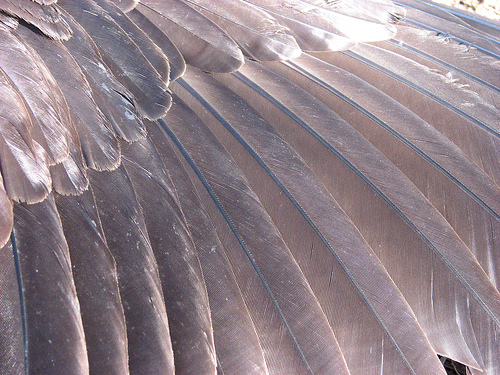
3D X-Rays Piece Together the Evolution of Flight

SCIENCE DAILY – Three-dimensional X-ray scanning equipment is being used to help chart the evolution of flight in birds, by digitally reconstructing the size of bird brains using ancient fossils and modern bird skulls.

In a collaborative project between National Museums Scotland, the University of Abertay Dundee, and University of Lethbridge, Canada, researchers are using an incredibly sensitive CT (computerised tomography) scanner at Abertay to analyse whole skulls and fossilised fragments and recreate accurate 3D models of extinct birds’ brains.

Bird skulls grow to a fixed size before they leave the nest, with the brain then growing to almost completely fill the cavity space. This means that bird skulls can be used to accurately calculate the size and shape of the brain.

By working this out, the size of part of the brain called the flocculus can be established. This small part of the cerebellum is responsible for integrating visual and balance signals during flight, allowing birds to focus on objects moving in three dimensions while they are flying.

Continue reading about 3D X-Rays Piece Together the Evolution of Flight.

© Science Daily, 2011

Photograph by flickr user BotheredByBees

Mimic Octopus


NATIONAL GEOGRAPHIC NEWS– Octopuses are thought to be one of the most intelligent invertebrates and can change the color and texture of their skin to blend in with rocks, algae, or coral to avoid predators. But until now, an octopus with the ability to actually assume the appearance of another animal had never been observed.

“Having studied many octopus species in the wild, I am never surprised by the color and shape change capacities of these animals,” said Mark Norman of the Melbourne Museum in Australia. “However, this animal stood out as it was the only one we’ve encountered that goes beyond camouflage to take on the guise of dangerous animals.”

Norman and fellow researchers Julian Finn of the University of Tasmania in Australia and Tom Tregenza of the University of Leeds in England describe the octopus mimic in the September 7 issue of Proceedings of the Royal Society of London.

“This,” Tregenza said, “is a rather dramatic animal.”

Mimicry is a fairly common survival strategy in nature. Certain flies, for example, assume the black and yellow stripes of bees as a warning to potential predators. But the adaptable octopus is the first known species that can assume multiple guises.

© National Geographic, 2010

Rachel Sussman: The World’s Oldest Living Things

July 2010

TED– Rachel Sussman shows photographs of the world’s oldest continuously living organisms — from 2,000-year-old brain coral off Tobago’s coast to an “underground forest” in South Africa that has lived since before the dawn of agriculture.

Rachel Sussman is on a quest to celebrate the resilience of life by identifying and photographing continuous-living organisms that are 2,000 years or older, all around the world.

Continue reading about Rachel Sussman: The World’s Oldest Living Things.

© TED, 2010

Bizarre Sea Slug is Half Plant, Half Animal

MOTHER NATURE NETWORK– It looks like any other sea slug, aside from its bright green hue. But the Elysia chlorotica is far from ordinary: it is both a plant and an animal, according to biologists who have been studying the species for two decades.

Not only does E. chlorotica turn sunlight into energy — something only plants can do — it also appears to have swiped this ability from the algae it consumes.

Native to the salt marshes of New England and Canada, these sea slugs use contraband chlorophyll-producing genes and cell parts called chloroplasts from algae to carry out photosynthesis, says Sidney Pierce, a biologist at the University of South Florida in Tampa.

That genetic material has since been passed down to the next generation, eliminating the need to consume algae for energy.

However, the baby slugs can’t carry out photosynthesis until they’ve stolen their own chloroplasts, which they aren’t yet able to produce on their own, from their first and only meal of algae.

Continue reading about Bizarre Sea Slug is Half Plant, Half Animal.

© Mother Nature Network, 2010

Photo by Nicholas E. Curtis and Ray Martinez
