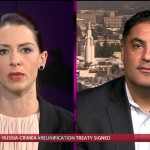
Cenk Uygur Tells Abby Martin That Her Network’s More Tolerant than MSNBC

MEDIAITE – The Young Turks host Cenk Uygur appeared on RT recently with anchor Abby Martin where he was asked about the ongoing controversy surrounding the network’s coverage of Russia’s invasion of Crimea and press freedom in the United States. Uygur said that the distinction between the two countries was evident in the fact that he lost his job on MSNBC for criticizing President Barack Obama while Martin retained her job after criticizing Russian President Vladimir Putin.

Uygur told Martin that he lost his MSNBC show because the White House was not “happy” with his criticism of Obama from the left.

“People give RT a lot of flak for toeing the line of the Russian foreign policy perspective, but here we have a media apparatus entirely funded by corporations that toeing the line of the U.S. government,” Martin opined.

Martin added that CNN is moving to “reality TV” and entertainment journalism. “I think a lot of people on TV are good people and they don’t even quite realize that they’re part of this machine,” Uygur said. “But, what happened was, they got promoted because they toe the line.”

Both Martin and Uygur criticized CNN further for what they said was their “soap opera” coverage of the missing Malaysian passenger plane.

“It seems like this network is constantly in the crosshairs of the U.S. media,” Martin later opined. She asked if Uygur was surprised by that. Uygur replied by saying an “honest” discussion about the funding of cable news networks would also include criticism for networks like CNN and Al Jazeera.

“CNN has lost so much credibility all across the world because everybody knows they cater to the government,” Uygur said. “You criticized the Russian actions in Crimea, you’re still on RT. I criticized the Obama administration and the U.S. government on MSNBC, I’m no longer on MSNBC.”

“So, who has the freer media?” he concluded.

***

MR Original – The Times’ Operations

Israel flag flap MEDIA ROOTS – Dissection of a 20 February 2013 New York Times article demonstrates the extent to which the “newspaper of record” muddles the truth on issues pertaining to Israel. Even the article’s title, Trial Offers Rare Look at Work of Hezbollah in Europe, is deceptive since the article is filled with superficial, Zionist axioms and mere conjecture.

The opening paragraph asserts the testimony of an alleged Hezbollah operative provides “a rare look inside a covert global war between Israel and Iran.” This is highly misleading. There is no global war of parity between the two countries. In reality, the Iranian people have been victimized by cyber-attacks, unjustifiable sanctions, and a wide array of insidious propaganda. Instead of responding in kind, Iran has taken caution not to provoke Zionism’s itchy trigger finger.

According to the Times, this so-called operative “described being handled by a masked man he knew only as Ayman.” Conveniently, the operative “never saw the face of Ayman” because Ayman “was always wearing a mask.”

At the mysterious Ayman’s behest, this operative transported bags, a package, a cellphone, and two SIM cards around Europe and the Eastern Mediterranean. When the operative was arrested, he was in possession of a “small red notebook with the license plate numbers of two buses ferrying Israelis.” Two weeks after he was arrested, a bomb blew up alongside a bus in Burgas, Bulgaria, killing a Bulgarian chauffeur and five Israeli tourists.

According to the Times, “experts say” the Burgas attack was “similar to the one he [the operative] seemed to be planning.” Conveniently, unbiased “experts” are nowhere to be found in the Times’ article, which quotes only two pundits of sharp proclivity.

The first pundit is Daniel Benjamin, a Zionist, who comments on how the operative’s trial might tip European hesitancy in favor of designating Hezbollah as a “terrorist organization.” He also commented on Cyprus’ dedication to see this trial proceed, remarking how Cypriot authorities have “done the right thing and they’ve been resolute about it.” Benjamin has worked tirelessly against Hezbollah. As a careerist whose professional brand thrives implicitly on the pursuit of the United States’ foes, whether real or imagined, Benjamin is hardly an unbiased “expert.”

The second “expert” is Matthew Leavitt, a director at the Washington Institute for Near East Policy (WINEP), which was founded by the American Israel Public Affairs Committee (AIPAC), a powerful, right-wing, Israeli lobby located in Washington, DC. (AIPAC used to be known as the American Zionist Committee for Public Affairs). Instead of disclosing Levitt’s ties to this particular Zionist establishment, the New York Times provided him a platform through which he states “the evidence seems quite compelling that what he [the operative] was doing was conducting surveillance for a bombing that would parallel almost exactly what happened in Bulgaria.”

Belén Fernández, a scrupulous author and acclaimed analyst, reports on how much of the so-called evidence in the Burgas bombing was non-existent or manufactured. Investigative journalist Gareth Porter reveals how Bulgaria eventually conceded extremely tenuous evidence, which pertained to Hezbollah’s potential involvement, but only after Bulgarian officials received immense pressure from U.S. and Israeli officials.

For their part, Bulgarian authorities could only note Hezbollah’s potential involvement after relying “heavily on resources from foreign security services,” according to Tihomir Bezlov of the Sofia-based Center for the Study of Democracy. Even with all these externally-supplied “resources,” Bulgarian officials could only allude to “traces in this attack,” which might lead to “Hezbollah’s military wing.” The Times admits “officials in Cyprus have tried to keep the case as low-key as possible, declining in most instances to comment or to release documents.” Perhaps they too are being fed “resources” from foreign nations.

This lack of context – or perhaps selective detailing – plaguing the New York Times’ article is noteworthy.

The Times was generous enough to concede the so-called operative “described himself as ‘threatened, scared and confused,’ during his initial interrogation.” He was also “adamant that he was not participating in a plot to kill Israeli tourists.”

Perhaps the individual in question, who works as an administrator of a Lebanese trading company and aspires to become a fruit juice importer, will turn out to be a verified Hezbollah “operative,” but he could easily have been working for Mossad, whose patronage boasts a lurid history of conducting false flag operations against a variety of targets.

Unfortunately, the Times paints the suspect, who is still undergoing trial, as genuinely nefarious without disclosing their aforementioned prejudices.

Analysis of this article reveals the New York Times’ bias, which is consistent with their record of erasing Israel’s crimes and altering articles to favor Zionist narratives.

Christian Sorensen for Media Roots 

Photo by Flickr User Ron Almog

Posted in Uncategorized | 1 Reply

Trial Delayed Again for Media Roots Correspondent

MEDIA ROOTS – The criminal trial for my alleged resisting arrest was again delayed this morning after prosecutors demanded access to a video that captured the aftermath of the March 25 detainment when I defied an unlawful order by a US Park Police offcier to put away my video camera. The trial showed increased public interest with several additional pedicab operators in attendance in court this morning for the outcome of the trial will heavily influence the future of this green mode of transport on the National Mall.

Citizen journalists, while lawfully protected by the Constitution, continue to be harassed – and occasionally detained – by many officers of the law for recording them during their duties. I was fortunate enough to be invited to the studios of Russia Today yesterday to discuss how citizen journalists’ rights continue to be marginalized yet how affective their work is at holding law enforcement accountable.

Oskar Mosco

***

Liz Wahl and Oskar Mosco discuss the plight of citizen journalists.

***


What We Need for a Communication Revolution

MENTAL MUNITION“Everyone has the right to freedom of opinion and expression; this right includes freedom to hold opinions without interference and to seek, receive and impart information and ideas through any media and regardless of frontiers.”Article 19, the United Nations Declaration of Human Rights, 1948.

When people talk about human rights, freedom inevitably dominates the conversation. Freedom from being restrained and beaten is a human right. Freedom from toiling under another without just compensation is a human right. So, too, is freedom from being held arbitrarily and indefinitely.

Human empathy makes those rights concrete. Sympathy allows us to understand why it’s important to be safe from beatings and slavery. Yet, there’s another kind of human right which is not understood as well, but is just as important.

In Burma, journalists face death for exposing the cruelty of the military junta, and pro-democracy leader Aung San Suu Kyi remains under a decades-long house arrest. In Sri Lanka, a news editor is assassinated and reporters receive death threats for uncovering war crimes. A young blogger in Egypt, known for revealing police corruption, is dragged out of an internet café and beaten to death. Iran holds 47 journalists in prisons, while it airs coerced confessions daily on state television. At last count, 136 journalists remain in jail across the globe. These actions block the flow of information and ideas and constitute a desecration of human rights.

Problems aren’t limited to the East. In the West, organizations can’t purchase equal time on the ostensibly public Canadian Broadcasting Corporation to air messages that challenge consumerism. Front-groups for major corporations manufacture propaganda to tilt elections. Media barons threaten to dismantle the beleaguered media system in the United States, cutting staff from already bare-bones newsrooms, pursuing maximum profit at the expense of public awareness. Public media is woefully underfunded and must routinely “pass the hat” to keep the lights on. And amidst a communications revolution, a handful of telecommunications giants plot to limit people’s access to information based on the contents of their wallets.

The Universal Declaration of Human Rights is the most widely translated document in the world and is the basis for international law on human rights. Eleanor Roosevelt, who spearheaded the creation of the Declaration and later chaired the UN Human Rights Commission, in a speech following the vote that adopted the Declaration, said: “This declaration may well become the international Magna Carta of all men everywhere. We hope its proclamation by the General Assembly will be an event comparable to the proclamation of the Declaration of the Rights of the Man by the French people in 1789, the adoption of the Bill of Rights by the people of the United States, and the adoption of comparable declarations at different times in other countries.”

There are 30 articles that make up the Declaration. The first two articles form the basis for the rest, that human rights are equal to all people because of a shared humanity, and that these rights are endowed from birth. The Declaration has articles for the former kind of rights, relating to immediate, physical safety. It also has articles about the latter: the rights necessary for a fully-evolved, long-term, humanitarian civilization. Article 19 is of the second stripe; it recognizes the freedom to impart and obtain information as a necessary component of civilized life.

In his 2007 book “Communication Revolution: Critical Junctures and the Future of Media,” media critical theorist Dr. Robert McChesney declared the world was entering a critical juncture, or “a period in which the old institutions and mores are collapsing,” a time in which the decisions we make “establish institutions and rules that likely put us on a course that will be difficult to change in any fundamental sense for decades or generations.”

This current communications revolution, brought about by a combination of technology that undermines existing systems, a crisis in journalism, economic upheaval and political strife, has tremendous stakes. “If fifteen or twenty years from now, the result of the communication revolution is merely technological wizardry or a testament to enhanced market opportunities for the world’s most privileged people, it will have been a failure,” McChesney wrote. “If in a generation social inequality has not begun to be dramatically reversed, democratic institutions are not considerably more vibrant, militarism and chauvinism have not been dealt a mighty blow, the environment has not been significantly repaired, then we will have had an unfulfilled communication revolution.”

Given that the right to communicate is inseparable from other human rights, and that the success of our critical moment hinges on the ability to communicate, a communication revolution requires a human rights revolution. That’s where CommunicationIsYourRight.org comes in.

CommunicationIsYourRight.org is a new initiative to call attention to Article 19, and educate the public about the importance of the right to communicate. It is an active, online petition to lobby the UN to bring the right to communicate to a debate. It is an initiative to pursue issues concerning the right to communicate, and to bring legislators, activists and citizens together to enact policies that strengthen the right to communicate. It also is a forum where people can exercise their right to communicate, by submitting all kinds of media, giving them an opportunity to express their perspective.

The freedom to communicate means the freedom to be part of a global conversation. It means giving the disenfranchised, the censored and the ignored equal footing in this ongoing communication revolution. It means giving all sides of an issue an even chance in the ecosystem of ideas. It means that even if all other human rights are stripped, the oppressed have the opportunity to declare “I am here, I am human.” Most importantly, it means giving people a role in the things that matter to them.

Written by Matthew Schroyer

MR Original – Journalistic Integrity


Laura NaderMEDIA ROOTS- While at UC Berkeley I took two anthropology courses taught by Dr. Laura Nader, which transformed my perspective and approach to the social and political issues that I intended to pursue as a journalist. In these classes I learned not only about studying other cultures, but about the vital importance of critically examining my own society, culture, beliefs and perceptions.

I was taught how to question the basic assumptions of my own, and of those around me. For instance, in the United States, the idea of “progress” commonly means expanding wealth, technological advancement, political power and perpetual abundance of good. But how are such ideas created and by whom? What are the implications of the thoughts and beliefs we hold? Are there alternatives, and do we seriously consider them?

Dr. Laura Nader, one of the world’s leading anthropologist of law, founded the study of controlling processes, or the mechanisms by which ideas become unquestioned assumptions or institutionalized belief systems that influence and persuade people to participate in their own manipulation. It is a field of analysis that spans across disciplines into every arena of life from the interpersonal realm to the professional, from business, to science and the state. The processes of control include, but are not limited to, law and conceptions of order, language, war, political power, trade, coercive persuasion, sex, and gender roles.

Studying methods of cultural control taught me that a journalist’s most important job is to make the connections that uncover these processes at play in our societies. Every day our lives are shaped by mechanisms of influence and control that we are often unaware of because the mainstream media fails to provide us with the information we, as citizens, need to adequately counteract such forces. Dr. Nader wrote that in the United States “a strong belief in free will often impedes understanding of how lives are changed by cultural practices that are external to the individual and intended to modify individual behavior, for example, through political propaganda or economic marketing.”

The mass media is society’s source of information and is a central means by which these behavior and perception altering practices permeate our lives. The media produces the material that shapes our judgments, actions, and expectations. This is illustrated in the use of the media to carry out psychological operations on the US population to boost support for the Iraq and Afghanistan wars; or as the forum for relentless advertising, even to young children, that promotes a culture based in the perception of ever expanding ‘needs,’ and the binds of debt.

Identifying such mechanisms of influence and control requires taking an analytical approach to the world around you, an approach that is ethnographic, historical and reflexive.  Ethnography reveals the embedded customs that make control difficult to detect. For instance, our culture’s reverence for science leads many to defer to scientific experts as the ultimate bearers of truth without considering the political context or funding of such scientific work. History is important because it connects us with the past that shapes and gives context to our present experience. The political, economic and social structures of today’s society cannot be productively discussed without first understanding the history of industrialization and the shift from regional to corporate capitalism. Finally, the reflexive approach enables us to be aware of culturally dominant or ideologically tainted, perceptions and analysis. For example, our cultural views on breast implants provide the illusion of free choice but are instead the product of indoctrination to a specific beauty ideology and social imperative.

Various independent and alternative media sources offer a diversity of information and viewpoints that illuminate critical ethnographic and historical reflections on society. Conversely, the corporate controlled mainstream media does not provide enough context to allow for the development of independent, free thought. When General Electric, the owner of NBC Universal, is also the producer of weapons and aircraft engines for military contracts, the danger is that the news coverage on its networks will simplify, give little attention to, or omit information critical of war efforts. The end result is that people are inhibited from thinking critically. Tom Fenton, former CBS correspondent, highlights the media’s control over public thought in his admission that,

        “Americans are too broadly under-informed to digest nuggets of information that seem to contradict what they know of the world… Instead, news channels prefer to feed    Americans a constant stream of simplified information, all of which fits what they already know. That way they don’t have to devote more airtime or newsprint space to explanations or further investigations… Politicians and the media have conspired to infantilize, to dumb down, the American public. At heart, politicians don’t believe that Americans can handle complex truths, and the news media, especially television news, basically agrees.”

Good journalism will not shy away from such complexity but work to understand it. The simplified information the mainstream media provides incessantly espouses the same set of basic principles as unquestionable truth; principles that further the status quo of a shattered society by promoting relentless excessive consumption, war as means to peace, and perpetual fear of the ‘other,’ whether its Arabs, immigrants or manifestations of “socialism.” This dogmatism, or adherence to a set of principals deemed by some authority as incontrovertibly true, is essential for any journalist or engaged citizen to reject. Dogmatism reinforces control by refusing to question its own basic assumptions and how they were created. There is no room for critical analysis, self-reflection or common sense in dogma’s narrow scope.

Refraining from dogmatism’s black and white framing of the world necessitates a humble recognition of the fact that the world is a complex set of systems in which different people operate daily bringing forward their own layered and diverse experience. Our knowledge and understanding of the world is always evolving whether about social issues, science, economics or politics. Believing that one set of principles holds the claim to ultimate truth is foolish and restricts a productive, open and thoughtful exchange of facts and ideas.

Bias, on the other hand, is essential to be aware of though impossible to fully eliminate because the human mind develops values and opinions that form the lenses through which we see the world. To minimize heavily biased reporting, journalists must carefully choose the language and tone they use to reiterate fact because language holds the tremendous power to influence. It is at the core of all manipulation. Just as words trigger thoughts and emotions, they can shape lasting impressions and judgments. As journalists we must be real and clear about the difference between a fact and our interpretation of it. Furthermore, we must be willing to ask questions and seek out information that challenges our bias, rather than avoiding or ignoring it.

Citizens and consumers are not passive actors. They must take into account who produces our knowledge, how, and to what benefit or interest. The few media corporations that control what is broadcast over the airwaves share many of the same members of their board of directors with a variety of other large corporations including banks, investment companies, oil companies, health care and pharmaceutical companies and technology companies. This is significant because the role of a board member is to act in the best interest of the company it directs, setting its policies and objectives. They are, after all, held responsible for the company’s performance.

With this conflict of interest in mind, the organization Fairness and Accuracy in Reporting (FAIR) has appropriately asked, would someone sitting on a media company’s board object to coverage that is damaging to another company that board member directs? As the highest management authority in a corporation, it is possible that the influential presence of specific board members would likely suffice to make media executives think twice about covering certain stories or reporting them honestly.

This is one example of important connections that the mainstream media doesn’t illuminate for its audience resulting in widespread ignorance among well-intentioned people of how the consolidation of the mainstream media greatly restricts, and otherwise discourages, independent and freethinking citizens. Only by seeking information from various sources, independent and mainstream, can the power dynamics and cultural controls in society be detected. Without taking an analytical approach emphasizing history and reflecting on the embedded customs and assumptions of society, we remain obliviously lost and misdirected due to manipulation by hidden patterns of control. Only by illuminating the different interests at play in the present, can we begin to see the full range of possibilities for the future.

Quite simply — information empowers. People will take different action based on what knowledge is made available to them. The media is a well-recognized mechanism of power and yet control through corporate media is a normalized, subtle means of control. Luckily, this is a pattern of control that we have the power to break from. As Noam Chomsky has said, it doesn’t require extraordinary skill or understanding to break the system of illusions and deceptions that conceals our understanding of reality. All it takes is the willingness to apply skepticism and the analytical skills that almost all people have.

Independent and alternative media sources provide an important break from the profit driven coverage of the mainstream media by giving voice to the interests and concerns of common people. These sources don’t hold the ultimate truth but many do add to the critical analysis of society required for understanding and reclaiming the mechanisms of control that shape our lives and the possibilities for our future. But the responsibility is not on journalists alone. Just as we must be honest in our bias and illuminate the connections and complexities of the world, it is the reciprocal job of citizens and consumers to critically think and engage with the world around them.

Written by Alicia

Photo of Laura Nader

Posted in Uncategorized | 1 Reply