Ten years ago, the US Empire honed its sights more intently on a profitable region of the world–the continent it once ravaged as a captain of the slave trade.
A new massive military command, AFRICOM was born. Its footprint includes an array of drone bases, camps and compounds, carrying out the American tradition of training and arming proxy militaries responsible for flagrant human rights abuses, and a variety of black ops. Far from a low-intensity war on the continent, AFRICOM averages several missions every single day.
Every Empire has longed for ownership of Africa for the same reason: it’s unimaginable treasure of minerals and raw materials. Much of that buried wealth is concentrated in Africa’s south, in the Democratic Republic of the Congo.
Taking into account it’s untapped minerals, it’s considered the richest country in the world, with reserves worth $24 trillion dollars. The DRC has 10% of the world’s copper, 30% of the world’s diamonds, and 70% of the world’s coltan. And it produces over 50% of the world’s cobalt.
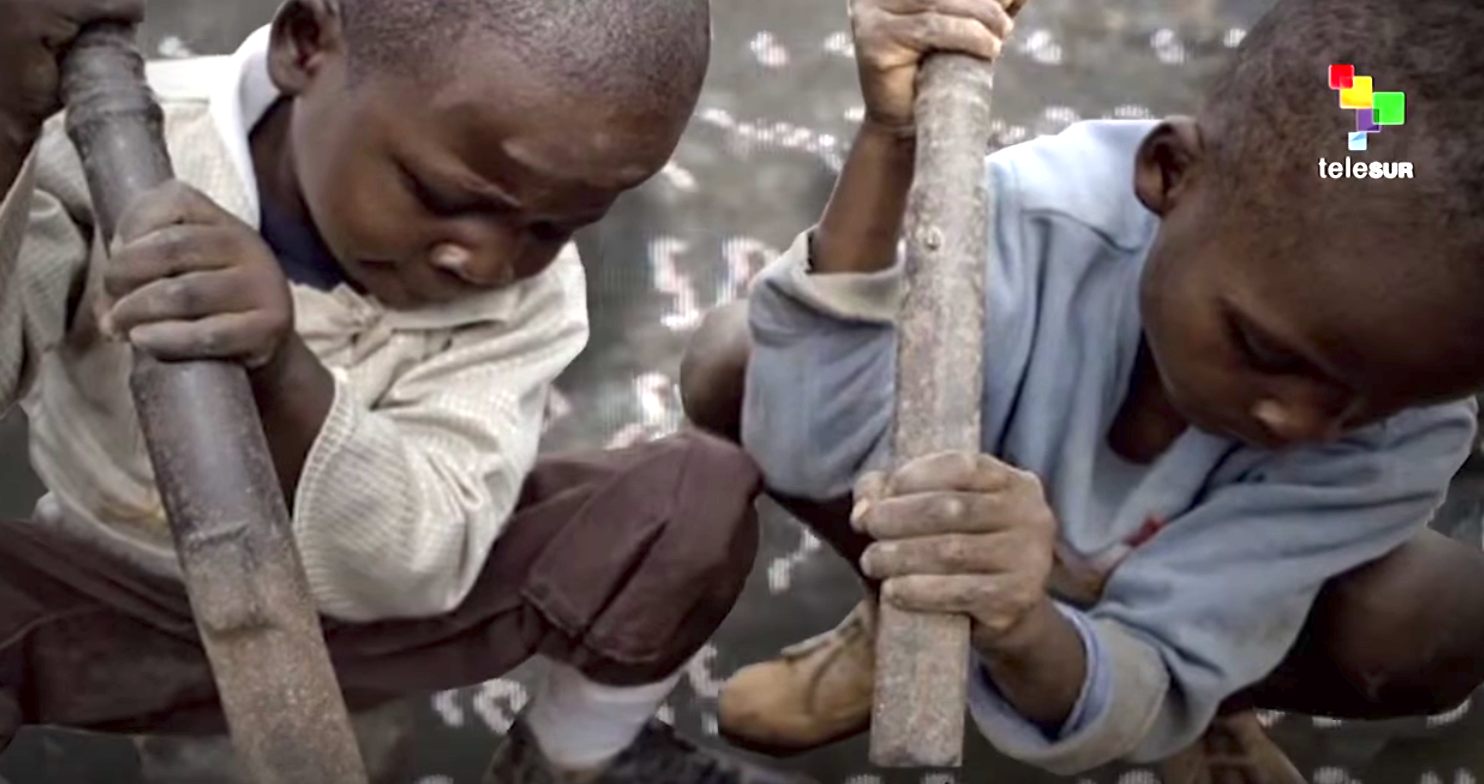
Among Congolese who literally risk their lives working in cobalt mines, tens of thousands are children, working 12 hours a day for one dollar. Paying local militias to illegally dig, Western mining giants make millions off this criminal, enterprise, including Adastra Minerals and Bechtel Incorporated.
On this episode of The Empire Files, Abby Martin is joined by Kambale Musavuli, spokesperson for Friends of the Congo, to look at the DRC’s resource curse and how empires have pillaged the region for over a century.
Although the US Empire deems itself the greatest democracy on earth, its election system is rigged so people are given a choice between only two parties, the Democrats and the Republicans.
Despite their differences, both are united around the interests of Wall Street and militarism, working to maintain a system that churns out disaster at home and abroad. Restrictive ballot access, bias corporate media coverage, and pay-to-play campaigns all let this two party dictatorship put a stranglehold on the process by making it nearly impossible for third parties to run.
Having evolved from a coalition of left wing groups in 1984, the Green Party provides one alternative to the status quo, with a program of social and ecological justice. Since 2012, Dr. Jill Stein has spearheaded the party’s presidential campaign–fighting to establish a bottom up movement for real change. While practicing medicine she authored critical scientific studies about environmental toxicity. Witnessing a broken medical system, she became a community advocate for just and equal health care.
In 2002, Stein ran against Massachusetts Governor Mitt Romney under the Green Party ticket. She continued to elevate in local government until being chosen to run as the Green Party nominee in the most impossible election of all–president of the united states.
Because the media establishment keeps third-party candidates hidden from all election coverage, I sat down with Dr. Stein to find out why her voice is such a threat.
Presidential Candidate Dr. Jill Stein & Abby Martin – Symptoms of a Sick Society
In a country that declared the end of socialism, a major poll released in January 2016 revealed something unexpected. 43% of people under 30 in the US view socialism favorably compared to only 32% who view capitalism favorably. This shows that despite a concerted effort to smother the ideas of a man who died 133 years ago, the analysis put forward by Karl Marx remains extremely relevant today.
Marx is considered the most influential philosopher to ever live. With his co-thinker Friedrich Engels, he developed a way of understanding the world that has not only greatly contributed to the understanding of philosophy and economics but also history, anthropology, political science, biology and many other fields.
As a young man in the mid-19th century Marx embedded himself in the workers’ movement in his home country of Germany and in France from where he was exiled to London for his political activity. In addition to dedicating himself to the scientific study of capitalism and social change, Marx was also an organizer and he convened the very first international organization of socialists with the goal of overthrowing capitalism, known as the Communist League whose slogan was “Working men of all countries, unite.”
His work Capital is regarded as the premier dissection of the economic system we live under. His discovery of dialectical materialism redefined the world of philosophy and his rallying call the Communist Manifesto is considered the most influential political document in the world.
As the US Empire thrashes to survive the current global capitalist crisis, and with rejection of capitalism clearly growing among young people, I wanted to find out what it was about Marx’s work that has had such a profound impact, from peasants in Asia to miners in Africa, to workers in the US alike, so I talked to someone who has been teaching students and the public about Marxism for years, Dr. Richard Wolff, Professor of Economics Emeritus at the University of Massachusetts, Amherst.
Marxism 101: How Capitalism is Killing Itself
***
ABBY MARTIN: You’re a Marxist economist. Let’s start with the basics. What is Marxism? And what does it mean to have a Marxist lens with which to view the world?
RICHARD WOLFF: I think the best way to understand it is that the difference between Marxism and other things is that it wants to go to the root. It is radical in that sense. It wants to see these problems: homelessness, inequality, an economy that bounces around having a recession or depression every 3 to 7 years, a society that concentrates political power in the tiny number. These recurring problems of capitalism, Marxism says, are built into the system, and if you want to solve them you can’t do that within the framework of the system. You have to face the fact that this system itself is the problem, which is why Marxists tend to be people who abide by the idea that we can and we should do better than capitalism. We should reorganize society because that will be a better way to deal with all those problems than dealing with them individually as if you could solve homelessness or solve inequality by a quick fix, by a marginal adjustment. No, the problems are systemic, so you have to understand how capitalism as a system works in order to begin to work your way to a solution.
AM: Can you give a brief explanation of dialectical materialism?
RW: Marx was a philosopher, so being a rigorous and systematic thinker, he didn’t want to jump into economics, which is what he focused on, without grounding it in philosophy, so he begins as a student of Hagel, the great philosopher. When he begins his academic life—Marx began as a professor—he taught philosophy. His doctoral dissertation was on ancient Greek philosophy. He wasn’t an economist when he began. He ended up thinking he had to study economics because of how philosophy got him there. And to be quick in a way of an answer to your question, he comes out of a school of thought that believed that ideas were the supreme achievement of human beings. Ideas are what you get from the most refined reflection that the human brain can do. If you’re religiously oriented, ideas are what you get from God, from the spiritual realm, and so the world is really shaped by something prior to the world, namely ideas, so the notion is, sometimes called idealism, that the real world is the product of ideas, and if you want to really understand the real world, go to the ideas that make it what it is.
Religiously, in the beginning there was nothing. Then there was first God which is a non-material idea and that creates the world. In Genesis, in seven days God, a spirituality, creates the materiality of the world. Marx rejected that. For him the material is just as important as the ideal. If you want to see where the material comes from, it is shaped by ideas. But here comes his radicalism. It runs the other way too. The ideas don’t come from nowhere. They come out of the real world. The ideas we have as people have to do with the real material problems we have as human beings, and how we solve them. Where do we get our food? Where do we get our shelter? How do we get protection as little children from the elements from our parents? All of these real material matters of life and survival are shaping our ideas every bit as much as our ideas shape the reality. Dialectical materialism is the name for a point of view that says if you want to understand the world, you need to look at how ideas shape the material, but the other way too, and the two interact. That’s the way to see the world, and for that reason when it came to explaining the problems of capitalism, he never could and never did suggest it’s all because of the ideas of people about capitalism. It’s the real way human beings make their food, solve their clothing problems, their relationship problems, that shape their ideas as much, and he was going to analyze capitalism through that lens of the interaction of ideas and concrete material reality back and forth.
AM: Marxists take a particular view of history called historical materialism. How does the current era of capitalism fit into the long history? I think you’ve mentioned this before—how this is just the latest chapter in a long history of economic development.
RW: The basic idea is that every economic system has in it conflicting forces. The language in Marxism is internal contradictions. The system has in it problems it is constantly struggling with because they are built into the system, and for long periods of time it finds solutions, but in the end, historical materialism says, the internal contradictions become unmanageable, and then there’s a kind of explosion. The system dies, and a new one is born, so we had slavery, for example, in various parts of the world. It was born. It evolved. It had its contradictions. For example, there was the contradiction that the only way a slave system can continue is if you replace the slaves that reach old age and die. That became a big problem for many slaves societies, so eventually slavery couldn’t solve its problems and it died, replaced by feudalism in Europe which went through a parallel process, and then it blew up because it couldn’t solve its problems. So historical materialism begins to look at capitalism through the same lens. What are the internal contradictions? How do they bedevil the system? What solutions, for a while, had they found? When and where might we get to a level of internal contradiction that makes the system tremble, makes it vulnerable? And at that point, if revolutionaries can see and understand what’s going on, they can intervene to move to the next system, to get beyond this. Just like rebels overthrew slavery, rebels overthrew feudalism. The expectation of Marx was that capitalism would generate the contradictions, then the tensions, then the failed solutions that would then bring into being the rebels with the ideas of criticism, Marx himself being one of those, who would eventually move to the next system.
To illustrate it as concretely as I can, let me give you an example of the kind of contradiction Marx found in capitalism that has been crucial for everybody else. And I pick it because it’s so relevant right now in the United States and around the world. Every capitalist… I think most of the folks watching know this, just from their personal life… every capitalist is always trying to either make more money or survive competitively by saving on his labor costs. One capitalist does it by substituting machines for working people, automating, getting a computer to do what he used to have fifty people do etcetera. Another capitalist does it by trying to get cheaper workers in place of more expensive ones, hiring women, if they are less expensive, to do the job that they used to pay men more for, hiring immigrants rather than native folks, moving to another part of the world where wages are much lower. We all know that. So capitalists are always trying to save on labor costs because they can make a better profit if they do that, but here comes the contradiction. If all capitalists are reducing the number of workers they pay, or reducing the pay they give to their workers, what will result is that the working people have less and less money, and if they have less and less money they can’t buy what the capitalists are producing to sell. The capitalists therefore are destroying themselves, but they have no choice. They have to save on the labor outlay, and then that comes back and bites them in the rear end because there’s no demand. You’ve been so successful becoming rich as a capitalist, but you’ve killed yourself.
These kinds of contradictions for Marx are the beginning of the end of a system. It papers it over. For example, when people couldn’t buy in the 1970s, the capitalist system kept going anyway. How did it do that? How did it keep going when the people didn’t have enough money from their wages to buy? The solution was credit. We loaded the world up with house credit: your mortgage, car payment credit (nobody buys a car except by paying on credit), credit cards, which didn’t exist before the 1970s for anything but traveling businessmen, and a small number of them, and then when that was not enough, we loaded up for the first time in American history, an entire generation of students who can’t get a degree without loading up with tens of thousands of dollars of debt. We kept this system going. People could buy stuff even though their wages didn’t pay for it by borrowing, and in 2008 the predictable happened. It turned out your fix only lasts for a while. You really have to ask this, in a way that many of us as Marxists haven’t done for most of our lives: the problems of capitalism now are so severe, so systemic, so global, that we’re beginning to wonder whether this system is going to find a way out. The Marxists are not the only ones wondering whether this system is coming to an end. The people on the other side of the political fence are very worried too.
AM: You have billionaires writing op-eds: “The pitchforks are coming for the plutocrats!” because they know what’s coming. Let’s talk about the bubbles. You talk about the housing bubble, and I think this is a really interesting indication. The housing crisis, the crisis of overproduction, the fact that we have more [empty] houses than we do homeless people, but because you have this crisis of overproduction, too much of something was produced and people couldn’t utilize it. Talk about that concept and why this is an inescapable phenomenon under capitalism.
RW: Starting in the 1970s, American businesses began to have what I like to call a eureka moment. They realized that in the West, North America, Western Europe and Japan, a hundred, two hundred years of capitalism had built up impressive factories, offices and stores, but they were built up in the places where capitalism was born, Western Europe, North America and Japan. That’s where they had concentrated everything and that’s where they had drawn workers in off the countryside to become urban, industrialized working classes, and along the way the workers, noticing how productive capitalism was since they did the work, demanded for themselves a rising standard of living. So roughly from 1820 to 1970, particularly in the United States, but elsewhere, wages rose. That’s why over that time capitalists were doing so well that they could raise the wages of their workers and still make out like bandits, so it was a system in which people began to get the idea capitalism works. It delivers the goods because it raises wages. You have to not look at what was happening where most people in the world lived—Asia, Africa, Latin America—because for them the situation was horrible, but if you concentrated on where capitalism was born, you could fool yourself into thinking, “Wow, this is a system that works.” And capitalists, of course, and the people who like it, celebrated all of that.
Then in the 1970s capitalists had this eureka moment. They said to themselves, “Wait a minute. We are in North America, Western Europe and Japan where the wages are now very high. Workers are now very happy, but why are we here?” In the rest of the world which has been savaged by the growth of capitalism in those privileged areas, wages are very low. So in this eureka moment capitalists said, “What are we doing here in Western Europe, North America and Japan? It’s much more profitable if we produce in China, India and Brazil.” And there begins what we’re still in the middle of: the exodus, the abandonment of the places of origin of capitalism by the capitalists, so there’s a massive move to China, India, Brazil and all those places, producing what? Well, what every capitalist wants, which is to make a bundle, so they build big factories imagining that they can sell all of this stuff like they used to, but they forgot something. If you go from high wages in the United States to low wages in China, the bottom line is that the people earning wages are earning a lot less than they used to. It’s not just that they’re not Americans; they’re Chinese, but they can’t buy back what you’re building. They can’t manage to consume what you have the capacity to produce. Right now China is slowing down. It’s scaring the whole world, but it’s not China that’s slowing down. It’s the inability of China to sell to the world because the wages of the world’s workers have been depressed now for years as we move out of Western Europe, North America and Japan into these lower… and the system totters as it encounters a very old contradiction in its current form for which they have no solution. And right now when it’s happening on a global scale… Europe is having it. North America is having it… Japan. These are the centers of capitalism. They’re in the most trouble right now and they don’t see a way out, and I don’t either, which makes it possible for the first time in my life to begin to see a capitalism that is in fundamental, shaking difficulty, and if I were to explain to someone why you get bizarre politics unlike what we’ve had for a century, I’d say it’s because of this.
And here in the United States you see the kind of theatrical buffoonery, but there’s more to it. Why is Trump such a character in the Republican Party? Why is that party literally tearing itself apart? Because it can’t cope. And even the Democratic Party [can’t cope], suddenly confronted with a socialist who isn’t marginalized simply because he gives himself the name “socialist.” In fact, it makes him attractive. What Bernie Sanders is proving is that the interest in socialism has captured millions of Americans.
AM: So I think a lot of people are aware of socialism, now especially since you have a self-proclaimed democratic socialist running for president, but they don’t actually understand what it means. I think they’re taking little bits and pieces—free health care, free education… Talk about the means of production and how a socialist economy would actually be structured.
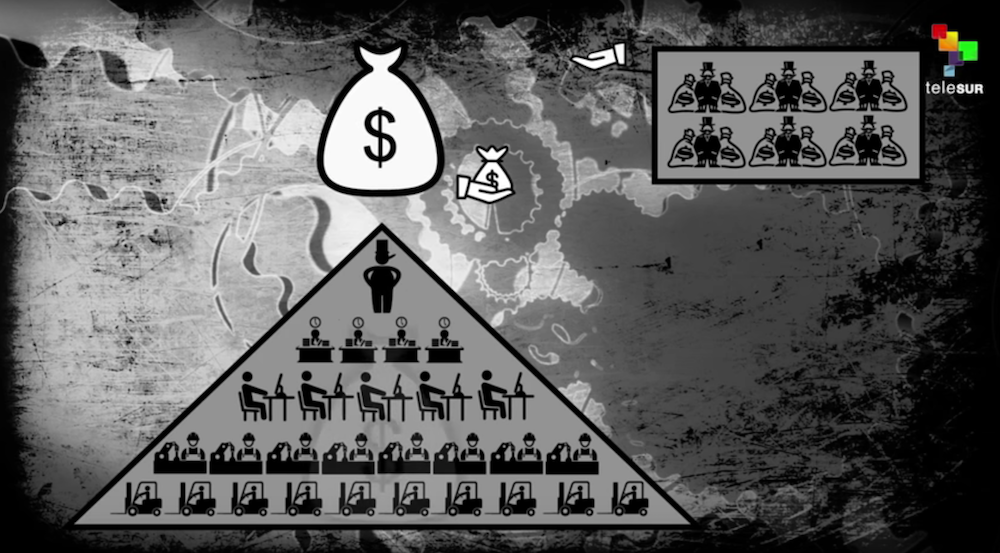
RW: They came up with the following idea: that the problem of capitalism is two fundamental things. One, that private individuals own the means of production. They own the land. They own the factories. They own the stores, the machinery, and the people, the owners, are really a very small part of the population, 1%, 2%, 5%, maybe even 10%, although rarely did it get that high. But that means the vast majority of people are never part of the owners, and the basic socialist idea was if you allow a small number of people to control the means of producing all the goods and services we all need to survive, they’re going to use that control to make the system work for them, and they’re not going to worry about the rest of us. In other words, it’s a recipe for a society that produces wealth for the top 5 to 10%, but not for everybody else. It gives power, political and other power, to those at the top, and not to everybody else, so the socialist idea was this is fundamentally unjust, fundamentally undemocratic. This is what’s wrong with capitalism, and how do you solve it? You make collective ownership, not private. The society as a whole should own the means of production—the factories, the offices, the stores, so that they are good for everybody, so that what they produce is distributed roughly equally, so that the influence on the decisions are made social. It’s why it’s called socialism. It’s the society that should own. It focuses on the workplace. Its idea is that the way you make sure that the government never again becomes an institution over the people, but rather simply an instrument of the people, is by making sure that at the base of society, where people live and work, the wealth, the productive capability, is in their hands.
If you want the slogan of 21st century socialism, it’s this: democratize the enterprise. End this process where there is a handful of people who make the decisions. In most American corporations… and corporations do the bulk of the business in modern capitalism… a tiny group of what are called major shareholders, the people who have big blocks of shares, select the board of directors. 1% of Americans own 3/4 of the shares. It’s highly concentrated. A tiny number of people, the 1%, own the bulk of the shares. How do you run a corporation? At the top is something called a board of directors, usually 15 to 20 people. How do you get on the board of directors? There’s an election every year to get on that board, and the way the election works is if you own a share of stock in the company, you get one vote. If you have 10 shares, you get 10 votes. If you own a million shares, you get a million votes. If you have no shares, that’s how many votes you get. There is no pretense of democracy, so if a handful of people own the bulk of the shares, they control everything. They select the 15 or 20 people on the board of directors. The board of directors decides what the company produces, how the company does it, where the company is located, and what’s done with the profits. Everybody helps produce the profits. The employees have to live with the decision, but have no influence on it. It is the opposite of democracy, and if you don’t have democracy at the workplace, you can’t ever have it real in politics, either, because those at the top will buy the political system, something which we see in the United States so starkly every day that everyone knows.
If workers took over a factory that had a workers’ co-op instead of a top-down [management], and the workers together decided what to do with the profits, do you think they would give a few executives $25 million so they would have more money than they would know what to do with while everybody else has to borrow money to send their kids to college? It’ll never happen. Do you think a collection of workers, say 400 in a factory, considering that you could make more money if you moved production to China… Are they going to vote to get rid of their own jobs? They’re not going to destroy their community by having an empty factory. They’re not going to deprive their local government of the tax revenues to run the schools and the hospitals and they’re not going to deprive themselves of jobs. So what we’ve had in the last 40 years—all those jobs leaving—they would never have left if it had been the collective decision of the workers where this production is going to take place.
AM: And I wanted you to also just counter another argument that I hear constantly: “I earned it! We earned this money!”
RW: The best way to describe this is to go back to Karl Marx and his analysis of capitalism so that we all understand what earning is about. Let’s imagine you are a person looking for a job, and I’m the employer that you’re looking to get hired by, so you come in and you sit down. You fill out your application form and I look at you, and I describe to you the kind of work we’d like to have you do. You come, you do your 9 to 5, Monday to Friday, and you’ll sit over there and you’ll do this kind of work. And we get through all that. You’re OK with that, and then we get to that big question: how much are you going to get paid? And let’s say we go back and forth and we agree on $20 an hour, so I’m going to pay you $20 an hour, and at this point Marx enters with a smile on his face and says, “I’m now going to show you, the reader, that when that deal is done, something is going on that you actually know, but you don’t want to face, but I’m going to show it to you. When I hire you for 20 bucks an hour, I know that for every hour that you give me your work, your brains, your muscles, I’m going to have more stuff to sell at the end of the day because you were added to my work force. You’re going to help me produce more goods or more services, or better quality goods and services than I would have if I didn’t employ you, so I’m going to say to myself, “It costs me to get Abby $20 an hour. What do I get out of it?” I’m going to have the output that Abby adds by her labor. That has got to be more than 20 bucks, so the only way I’m going to hire you for $20 an hour is if you produce more in the hour than I give you. So when you feel in a vague way at the end of the day as you walk home that you’re being ripped off, you’re absolutely right. Or in Marx’s language you’re exploited, so what does the capitalists say? “I earned it.” No you didn’t. You just ripped people off.
The way most corporations work is 4 times a year they take the profits they’ve made in the preceding 3 months and they distribute a portion of them to their shareholders. These distributions are called dividends, so if you own a lot of shares because, say, you inherited them from your grandma, or you stole money and bought them on the stock market. There are lots of ways of getting them, but if you have them, 4 times a year you go to your mailbox in the morning and you get an envelope and you tear it open and inside is a check for your share of the profits that have been distributed to shareholders. For rich people this is millions of dollars. They have all that money. What did they do exactly to earn that money? Nothing. Those people are going to tell me they earned? Do they ever set foot in the factory? No. Do they have any idea what this company does? No. They don’t care! They are simply sitting there collecting. Well let’s now do a little logic. If there are people like shareholders who get a lot of goods and services they didn’t help produce, then there must be elsewhere in that system people who produce what they do not get, so that means if we allow that, we are saying to some people your job is to produce a lot more than you get so that these people can get a lot more than they produce. Marx stands up and says, “I rest my case. This system sucks.”
AM: Famous socialist Rosa Luxemburg once said that it’s either socialism or barbarism. Here we are 100 years later. In what ways have you seen that play out today?
RW: One: the 62 richest people in the world, most of whom are Americans… not all of them are, but most of whom are US citizens… the 62 richest people together have more wealth than the bottom half of the population of this planet—roughly 3.5 billion people. That’s beyond obscene. I don’t have an adjective that captures this, but I can describe what it means. If you look at all the statistics of the World Health Organization, the bottom half of our population are people who die way earlier than they need to. Why? Because their diets are no good, or they don’t have enough food in the first place. Or they can’t get to a clinic. They have little problems that are easily solved by modern medical methods. It’s unspeakable what happens to the lower half. If we took half the wealth of the richest, they would still be the richest, and if we made it available to the bottom half, it would transform their lives, literally. Now there is no moral or ethical justification for this situation.
Number 2: it is well known all over the world, despite a few deniers that are still around, that the way capitalism has evolved has compromised the ecology and environment of this planet, literally threatening us with 27 diseases and 57 losses of fundamental resources. This is crazy to permit this to go on. This is another way capitalism confronts us with barbarism.
And the third one is—and here the United States plays a particular role—is this notion that the Western world, the world that has the wealth and the military might, is in a war, an endless war against something as vague as terrorism, whatever exactly that is. And this is used to justify an endless use of resources not available for people’s needs but to combat one enemy, real or imagined, after another, so we literally confront an endless military warfare state, a cataclysmic destruction of our natural environment, and a level of inequality that has no justification.
Our entire economic situation would have been completely different the last 30 years if we had had a movement, if we had had organizations to make these demands because I haven’t the slightest doubt that the majority of Americans will support all of them.
It used to be at this point in an interview I would have to look at a skeptical interviewer saying, “Ah, Americans support this kind of socialistic stuff?” I don’t have that problem anymore because Mr. Bernie Sanders has done me a favor. By throwing his hat in the ring in the democratic primary and running around the country, as he’s been doing as a socialist, he has proven for all Americans to see that the support for something other than capitalism has now captured millions of Americans, and we don’t know how many millions because that still has to be shown. And the argument that was heard when Occupy Wall Street emerged in 2011: this is a tiny group of people who don’t represent anything—all that’s gone because Mr. Sanders has said, “Well, let’s see.” Let’s see how many people are critical of the 1% vs 99. How many people will support a candidate who says that every day and even accepts the label “socialist”? And the answer is millions.
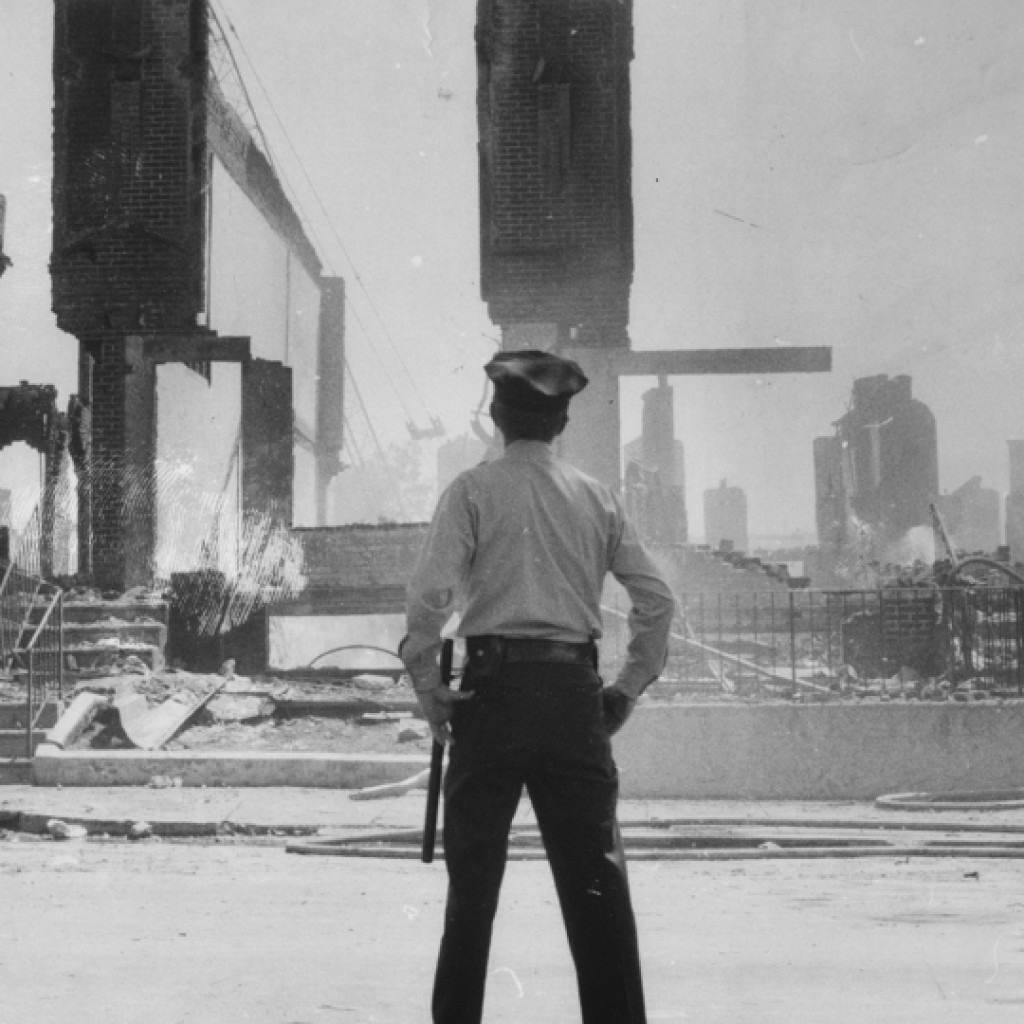
On May 13, 1985, one of the most shameful, horrific attacks by US police ever took place in West Philadelphia. 11 people, including five children, were killed in a deliberate massacre.
A racist and political attack on a radical community group known as the MOVE Organization, city and police officials were revealed to have intentionally set their home ablaze, let the fire rage, and violently kept escaping men, women and children trapped inside.
Featuring a harrowing first-hand account with the only adult survivor of the atrocity, Ramona Africa, Abby Martin documents an indispensable, but largely unheard of, moment in American history. From MOVE’s formation, to the arrest of the MOVE 9 political prisoners, to the build-up to the infamous bombing, The Empire Files chronicles an act that cannot be forgotten.
The MOVE Bombing – When Police Plotted to Exterminate a Family
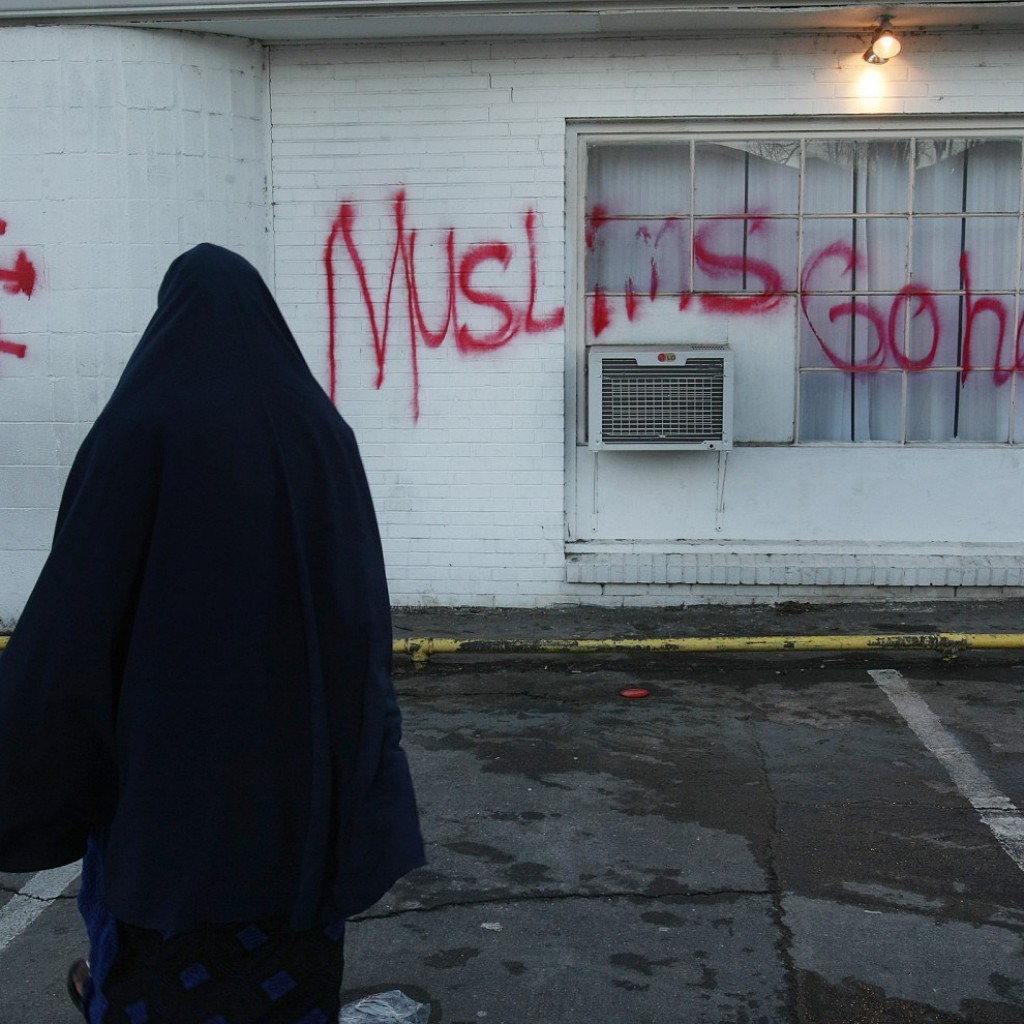
2015 was the most dangerous year for Muslims in America, setting records for hate crimes against them. There have been dozens of attacks on mosques, including firebombings, and physical assaults like stabbings, shootings and beatings against Muslims (and perceived Muslims) grew to the highest numbers ever recorded.
Already wrapping up as a deadly year, the last few months of 2015 saw hate crimes against Muslim Americans dramatically increase. Members of the community are saying the climate of hate is worse now than after 9/11.
Abby Martin interviews Dr. Deepa Kumar, professor of media studies at Rutgers University and author of Islamophobia and the Politics of Empire, about the roots of this alarming situation. From confronting right-wing arguments, to examining how Islamophobia is a reinforcement and basis for the structures of Empire, the first Empire Files episode of 2016 gives essential context to the wave of anti-Muslim hate in America and beyond.
The Most Dangerous Year for Muslims in America
**
DEEPA KUMAR: I think that if you look at the year 2015, it has been a horrible year for Muslims not just in the United States, but around the world because if you see the two events that book-end 2015, it is the Charlie Hebdo attacks, the horrific Charlie Hebdo attacks in France and the Paris attacks later on towards the end of the year and then San Bernardino, and what these attacks have done is that they have exacerbated and really ratcheted up what we’ve seen as tendencies since 9-11. What are some of these tendencies? Well, first of all hate crimes against Muslims and those who look Muslim have skyrocketed. It’s not just people being verbally and physically attacked. We’ve seen mosques being desecrated. We’ve seen all sorts of horrific attacks of these sorts, but we’ve also seen the rise of a kind of a xenophobic nationalism where White supremacy has been the center of nations remaking themselves, like France or like the United States and so on saying these people are a fifth column, they don’t belong here and so on, and what these attacks have done…it has legitimized this, but what it’s also legitimized is the various security apparatuses, so what happens after the Paris attacks is that the French police carried out more than 2,000 raids on Muslims, both citizens as well as immigrants, arrested hundreds of Muslims and so forth, and it legitimizes these activities by the state to keep us safe. So you’ve seen really an exacerbation of the logic of the war on terror take place over the last year. So I’m not surprised that many Muslims feel that today we are in a worse situation than we were back after 2001.
ABBY MARTIN: How do you define Islamophobia?
DK: Islamophobia is anti-Muslim racism, but what I want to argue is that it’s more than just verbal attacks. It’s more than people facing discrimination at work, or facing insults or slights by people around them–what’s called micro-aggressions. It’s also more than physical attacks–hate crimes and those sorts of things. Islamophobia is these things and people do experience verbal and physical attacks, but I want to argue, in my definition of Islamophobia, is that it is an ideology that is tied to a set of practices that sustain and reproduce Empire. I think it’s very important to actually look at the structures of Empire because it’s only when we do that we get to the roots of what causes Islamophobia. Why is it produced? Who benefits from it? Why does it proliferate in the way that it has over the last fifteen some years? And this is not some sort of academic exercise. I am an academic, but this is not just some abstract exercise. It’s important to get to the roots in order to more effectively fight this form of racism. That’s why I’ve argued in the past that simply doing education around Islam, or having inter-faith dialogue, while important, is not enough because it’s not simply about a set of bad ideas in people’s heads. It’s rooted into the very structure of Empire, and that’s where we need to target our attention and our energy and activism.
AM: And one of the objections we hear consistently, particularly from right-wingers, is that Islamophobia does not and cannot exist because Islam is not a race. Your response?
DK: Well they are right. That is to say they’re right in one part of it: Islam is not a race. Muslims are not a race. This doesn’t mean that they don’t face racism, so I think we’ve got to see that both go side by side. Muslims are not a race, but the racism that Muslims face is very real. There’s been a systematic process since 9-11 to keep fear of Muslims and fear of terrorism alive in the American imagination. You talked about a Sikh man who was attacked earlier this year, last year. I think that’s a really big clue as to how racism against Muslims actually works, or those who are perceived to be Muslims, actually works, which is it’s a form of cultural racism that is based on turbans, people wearing turbans, or people wearing hijabs or other forms of Islamic religious clothing. There is an assumption that is made that these people all have a certain behavior that is constant, that is something about their nature that’s constant because when they practice Islam they are programmed to be violent. They are programmed to be misogynistic. If you’re a woman, you’re programmed to be subservient. You’re programmed to be a terrorist and so on and so forth. And so there is a very systematic way in which an entire group of people is turned into a race through this category of Islam in the same way that Jews are turned into a race through the practice of Judaism and so on, and then the entire group gets targeted in these ways. Races don’t exist naturally. They are produced and they’re typically produced by the elite in order to serve certain interests and to serve certain agendas. I think it’s really important always to look at what historical conditions… what is going on in the political economy that leads to the production of races then that leads to the this process of rationalization because when we get to that we get to the heart of why racism exists and how we can fight against it.
AM: I want to address another talking point that I hear used pretty often by people like Bill Maher and Sam Harris: 70% of Muslims in France support ISIS. What’s your response to these kinds of sweeping statements? People will constantly use them and say, “Look we can’t be Islamophobic because we’re just criticizing the religion and look we’re just looking at the data.”
DK: Islam is practiced by 1.5 billion people around the world. It looks different in different countries and there are just as many political views the people in Muslim-majority countries hold as there are around the West, so they’re just as different a group and non-homogeneous a group as those in the West.
What people like Bill Maher and people like Sam Harris do is they collapse all of those differences and they find data that suits their homogenizing mission in order to paint everybody with the same brush strokes. One myth that gets peddled again and again is that Muslim women are just so horribly oppressed all over the world. Well, that’s not true. I mean, first of all, let’s admit that Muslim women, just like all other women in the world, do face oppression. They do face things like inability to get good jobs, or lack of adequate pay or what have you. Women in the US face the same sort of situation. However, conditions vary widely across the Muslim-majority countries. In Saudi Arabia women can’t drive, but in Bangladesh women have been elected to heads of state, not once but twice. And so these are all different countries with different histories. There are regional differences. There are local differences. There are differences between country and town, and that diversity is simply not acknowledged by the likes of Sam Harris and the New Atheists, and all the rest of it.
If anything you know what they do is use the clash of civilizations argument. They somehow hold up this mantle of the West as being this place of enlightened values, and say that they want to critique all religions, but if you look at their work, the work of the New Atheists, the sharpest knife is dug into Islam. That’s true of Hitchens. It’s true of Dawkins. It’s true of Sam Harris and so on, so they actually have an agenda, but they hide behind objectivity as a way to spout Islamophobia as academic, as research.
AM: Exactly. Last year in Texas a Muslim man was outright executed. Before the killer executed this Muslim man, he said, “Go back to Islam.” They haven’t charged him with a hate crime. Authorities said that they don’t have enough evidence to prove that he has hatred even though multiple times on social media accounts he was talking about Islam, Arabs etcetera. I wanted you to talk about why the establishment is so hesitant to just call reality what it is, call these crimes what they are and charge them accordingly.
DK: There is overwhelming data of hate crimes committed against Muslims, but the problem is that the legal system in the United States refuses to acknowledge racism in any kind of systematic way. This is not just true of Muslims and Muslim-Americans. As Michelle Alexander points out in her book “The New Jim Crow,” this is true too of how African-Americans are treated when they go before a judge or what have you. Questions of racism rarely hold up as a legal grounds from which to try a particular case. It’s been a struggle and the same is happening in the case of Muslims as well. Often there will be… in my discussions with lawyers and friends and colleagues who are lawyers… what they’ve told me is that in cases that they have prosecuted there are just ridiculous things that are brought up as evidence to show that somebody is radicalized. What is this evidence? That they had a copy of the Koran in their pocket. That means this person must have been getting ready to commit a violent crime. That’s ridiculous. That’s Islamophobic. That’s cultural racism. It’s the idea I mentioned earlier that somehow Islam is this virus that programs people to go out and do murderous things, so I think there’s a fundamental problem with the way the legal system works that does not acknowledge in any systematic way how racism operates and the actions that people take–violent actions that people take.
Let me say this. I was following the coverage of San Bernardino versus that of the Planned Parenthood shooting, and the differences could not be clearer in terms of how perpetrators of gun violence are treated. So Planned Parenthood happens. The religion of Robert Dear was barely mentioned–maybe a few mentions here and there–even though we know he’s an evangelical Christian, even though we know he was a great admirer of this group called the Army of God, which is this right-wing fundamentalist anti-abortion group that’s committed murders and violence. He calls them heroes, so we know he’s at least in part driven by this kind of Christian fundamentalist ideology, but that doesn’t become part of the story because the reason Robert Dear did this is something is wrong with him. There’s something in his head that’s wrong because we won’t associate his actions with the actions of White Christians overall. We won’t call on White Christians to apologize for the actions of Robert Dear. San Bernardino happened and yes these people are religious. They are fundamentalist and so on. Now, however, even President Obama says there is an extremist ideology that is spreading through Muslim communities and all Muslims have to take responsibility for it. Why are Muslims any more responsible for the actions of the San Bernardino shooters than Christians for Robert Dear?
You see the double standards, and so straight away of course the story is entirely about Islam. It’s about the virus of Islam. It’s about how Islam makes people do all sorts of violent things and the war on terror becomes the way in which the story is spun, so one cheeky way of looking at this is to say they actually carried out what is a tradition that’s as American as apple pie which is shootings. That really is so endemic to American society in a way that it’s not in other societies and we might see this as a sign of their “integration,” but in fact, of course, othering has become so much a part of media coverage, so much common sense ideology, that immediately there are frameworks that come into being that present their violence as somehow being tied to terrorism, as tied to Islam; whereas our violence, people like Robert Dear, are just isolated individuals.
AM: The clash of civilizations is of course the ideology that Islam is destined to clash with the West, that our cultures are just intrinsically separate and they can’t ever coexist, but it seems like time and again this theme is in one part manufactured by the Empire in terms of either destabilizing Middle Eastern countries, to suppress progressive reform, and also to just exacerbate radical Islam. I wanted you to just mention this mantra and also the actual reality of Empire and how it is perpetuated.
DK: In particular Bernard Lewis would write an essay titled “The Roots of Muslim Rage” in which he argues that politics has nothing to do with why people in the Middle East may be angry with the United States or may have grievances with Western Europe. Colonialism has nothing to do with it. The formation of Israel has nothing to do with it. He says that there is an irrational rage that has spanned 14 centuries which characterizes this inevitable clash. First of all, that’s not true. It is not at all the clear case that the East and West have always clashed. There have been various periods of cooperation right through history which I don’t have the time to get into, but it’s in my book. But it becomes a convenient way in which to define the politics in the post-Cold War era. One enemy that justifies US imperialism and US reach all over the world is gone. What is it going to be substituted by? And Samuel Huntington actually, the political scientist, would pick up this term “Clash of Civilizations” and his theory of what politics will be characterized by in the post-Cold War world is the following: conflict is not going to be political conflict. It is going to be culture and Mahmood Mamdani, who has written this book called “Good Muslim, Bad Muslim,” says that what that does is it very conveniently displaces all the political stuff onto the cultural terrain and now we don’t have to talk about occupation. We don’t have to talk about war. We don’t have to talk about drone strikes, which is what we see in the era of the war on terror. We’ll just call it a clash of cultures. These people, they like to wear hijabs. That’s why we don’t get along with them and so on, never mind that every democratic movement that’s existed in the Middle East has been squashed by the US government in order to keep oil flowing, in order to keep alive the dictators who are the allies of the US, and so forth. All of those political grievances get sidelined and instead culture becomes the focus, and I think that’s an extremely problematic way to look at what is fundamentally a political issue.
AM: So what are the roots of Islamophobia and how is it related to Empire maintaining itself?
DK: So all empires, at least most empires, rely on some form of othering in order to justify wars, in order to justify taxation, in order to justify conscription and so on and so forth. I mean this is not just true of American imperialism, and I will talk about American imperialism, but I want to actually start all the way with antiquity, with the Roman Empire. Rome was this massive empire that stretched from England, Hadrian’s Wall in England, all the way to the Euphrates, covering parts of North Africa and the Middle East and so forth, and the question is how did the Roman Empire actually manage to do this? So when the Romans went about conquering people in England or France, or what have you, one of the first things that they would do is try to inculcate them in Roman values, Roman lifestyle, Roman culture, Roman architecture and so on. And when the people accepted these cultural values of Rome, they became Romans. So in this large empire everybody was considered Roman, but for people who were not as easily conquered, who resisted, and who wouldn’t come under the Roman fold just as easily, there was a term invented for them. They were called barbarians.
And the Romans invented this very interesting hierarchy, this kind of typology which was the following: they said all human beings have two elements that define them. One is the physical body. The other is the mind. It is intelligence. It is spiritual rationality, stuff like that, and what they would argue is that Romans–not all Romans–elite Romans are driven by the mind. The mind controls the body. They are rational. They’re intelligent and in that sense they are closer to God; whereas the barbarians are closer to animals because the body controls the mind and therefore they are inferior, and therefore it’s justified that we go off and kill them and bring their people and make them slaves. Or one of the routine forms of entertainment in Rome was that the barbarians would be brought to these amphitheaters and killed either by animals or gladiators or what have you.
So that’s Rome. Now let’s move to the United States. I think there are a lot of similarities, but also some differences. The US takes over the reins of the Middle East from France and Britain in the post-World War period and in fact actually NSC-68 [National Security Council Report 68], which is the secret policy document that I believe was written in 1950, would lay out quite clearly why militarism was going to be the key way in which the US was going to fill the vacuum left behind by the collapse of European empires, the rise of the Soviet Union, and how the world has now become a battlefield and militarily that’s how the US is going to assert its hegemony.
In the Middle East it has many geostrategic interests, rivalry with the Soviet Union, but oil certainly is a part of the story, and Daniel Yergin tells us that part of what he calls the postwar petroleum order is about creating a certain arrangement between oil producing states or states to which oil would flow, so that cheap oil would be available for the reconstruction of Europe, the Marshall Plan and so on because Europe was destroyed by World War II, so anyone who disrupted this post war petroleum order was necessarily an enemy. They were either hand-in-glove with the Soviet Union or they were just barbaric, people who lived in the desert and so on who needed to be taken out.
And so that’s the mythology. They learned the Orientalist language from Europe and started to apply it to people of Middle-Eastern origin as a way to establish control over the flow of oil, so these ideas don’t just exist in ether, in Hollywood films or in novels and so on for no reason. They are systematically reproduced in the academy. They’re reproduced in think tanks. They are used by political figures. They are reproduced in the media and so on as a way to justify US policy, and of course at first it’s about demonizing the Arab, but then the demonization of the Arab turns into the demonization of the Muslim.
Of course today we don’t throw Muslims and Arabs to the lions. We don’t have those sorts of practices, but we do target Arabs and Muslims and South Asians through the national security state, through imprisonment, through indefinite detention, through racial profiling, through surveillance of mosques, of community centers, of college groups and so on and so forth. So there is very much within the system an attempt both to racialize people within Empire as well as to racialize people outside Empire.
I’ve spoken to the similarities, but I do want to make a point of what the differences are. So the key difference really is that racism as a systematic ideology and a set of practices actually is modern in origin; that is, it comes in to being only with the birth of capitalism, and so there are some very important ways in which othering under Rome or othering by various feudal monarchs in the Middle Ages and so on is different from the kind of racism that we see today. Anti-Muslim racism is much more systematic in the era of capitalism and imperialism, in a way that it wasn’t earlier.
AM: And I think Donald Trump shocked the world by his declaration of a ban on Muslims entering this country if he were to be president. This could just be hyperbolic, but at the same time his new campaign ad is actually doubling down on this and making this one of the main pillars of his whole campaign. It’s just shocking. What is the political significance of what we’re witnessing here?
DK: Donald Trump is basically stating out loud and making explicit what actually has been US policy for the last few decades. That is, if you look at the mass deportation of immigrants under Obama, it’s huge. Over two million people have been deported, but you don’t talk about that. In polite society you don’t say such things, and Donald Trump is actually giving voice to some of the most horrific racist, rabid right-wing rhetoric. When he says let’s prevent Muslims from coming in or let’s create a registry and a database to document all Muslims… You don’t say that if you are a respectable politician, but in practice we have been doing that.
Over the last 20 some years, there’s been an attempt to systematically collect information on various groups of Middle Easterners. In fact, going all the way back to the late 70s and Iranians and then counter-terrorism policy under Reagan, and then the 1996 anti-terrorism and effective death penalty act of Bill Clinton, and then later after 9-11 programs and so on. There’s an attempt to collect this information in a database about Muslim immigrants and Muslim citizens and so on, and for people like Trump who represent the class of the 1%, bashing immigrants has been staple because if you look at the same period of time, we’ve seen a massive growth of class inequality, class polarization. The vast majority of people around the world have grown poorer. The 1% has grown phenomenally rich. There have been cuts in social services, attacks on the welfare state. Tuition costs for colleges have been going up. Health care costs have gone up. This is the neoliberal system, but rather than blame the 1%, the regime of the 1%, it’s easy to bash immigrants, and you’ve seen this logic everywhere. This is not just a Western European or American phenomenon. In Russia and Australia, in India, in Myanmar–all over the world this Islamophobic agenda has helped to deflect attention away from the structural inequality and to point fingers, to scapegoat Muslims as a way to get people to fight with each other rather than to look at the structural problems caused by neoliberalism.
So I think to see Donald Trump as some sort of lone wolf who is responsible for the escalation of Islamophobia or who is otherwise corrupting a great political system, I think is deeply problematic because Donald Trump is just a part of a larger system which both Democrats and Republicans are responsible for creating.
AM: What can we, as non-Muslims who are appalled by this Islamophobic rhetoric, do to build solidarity and internationalism with the Muslim community?
DK: One of the things I started this discussion with is to say that we need to understand the roots of Islamophobia. We need to understand that it’s more than just a set of bad ideas, of prejudices in people’s heads, but in fact, it is an ideology and a set of practices that make the war on terror possible. It is what sustains the war on terror, and so the first thing we have to do is to recognize that simply combating these bad ideas is not enough, although that’s important. I think if we don’t get to the root of what causes Islamophobia, which is Empire, which is the national security state, which is the neoliberal order in which we live, and the class power that sustains all of this… if we don’t target that and we don’t target and dismantle imperialism and capitalism, then we’re not going to do away with Islamophobia. As we hold counter-demonstrations when the far right, for instance, is attacking a Muslim mosque, or a Muslim community center, at the same time as we write articles, at the same time as we do education, if we don’t have a long-term strategy that is targeted at opposing these structures of Empire and neoliberalism, then we wind up doing things in the short term which may actually create the same problems again in the middle term, and we wind up fighting these fights again and again. So we’ve got to have a short-term strategy, but we have to keep the long-term goal in mind, and we need to come together across national lines and build a global movement that can take on the regime of the 1% and actually build one that prioritizes the interests of the 99%.




 In a country that declared the end of socialism, a major poll released in January 2016 revealed something unexpected. 43% of people under 30 in the US view socialism favorably compared to only 32% who view capitalism favorably. This shows that despite a concerted effort to smother the ideas of a man who died 133 years ago, the analysis put forward by Karl Marx remains extremely relevant today.
  On May 13, 1985, one of the most shameful, horrific attacks by US police ever took place in West Philadelphia. 11 people, including five children, were killed in a deliberate massacre.
  2015 was the most dangerous year for Muslims in America, setting records for hate crimes against them. There have been dozens of attacks on mosques, including firebombings, and physical assaults like stabbings, shootings and beatings against Muslims (and perceived Muslims) grew to the highest numbers ever recorded.