


Syria and Iran
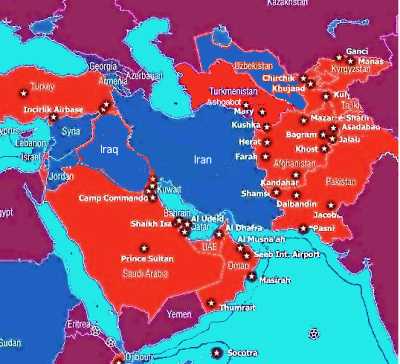 MEDIA ROOTS —Never before has the relationship between Iran and Syria been tested as it will be in the ensuing weeks and months. Syria’s story is rippling through the media as the situation on the ground changes by the hour. Right now, Iran and Syria stand confidently alongside Russia who is moving quickly to advance diplomacy and military assets into the region. Over millennia of shared history, Iran and Syria have been connected and disjoined. Currently, the Middle-East polarization brings them together to defend self-determination, individual and regional sovereignty and the right to a full nuclear fuel cycle. Media Roots contributor Chris Martin offers part two of this Media Roots original on the Iranian Neighborhood. In part one, Martin discussed the role of Israel and the permanent five.
Iran has strengthened it’s presence in Iraq–thanks to foreign imposed regime change, Iranian Shi’ite influence has penetrated Iraqi government institutions. Syria lies geographically west of Iraq and east of Israel, thus Syria and Iraq could be central theaters of war. Israel, America and Europe remain perched atop the slippery slope of war as Syria, Iran, Palestine, Southern Lebanon, Russia and China brace themselves for impact. The Western war hawk gazes upon Syria knowing Iran relies upon the geography of Syria as both a forward operating base and supply conduit.
Indeed the history between Syria and Iran spans back several millennia, but the current relationship emanates from the ashes of early 20th century French and British imperialism. In 1920, Faisal I of the Hashemite family established the independent pan-Arab Kingdom of Syria to unify Sunni and Shia Muslims. European imperialists far from home had other uses in mind and the military muscle to clumsily occupy. Faisal I fled the French mandate assault, landing in the bosom of the British where he was summarily made the British King of Iraq. Together, France and Britain were carving up Syria, Lebanon, Iraq and Israel into various slices of occupation. The cloak of international consensus and impetus was once again deployed in the form of a League of Nations to administer and control the Middle-East, “until such time as they are able to stand alone.”
A decade and a half of Syrian revolution ensued, culminating in the return of Faisal’s original appointment President Hashim al-Atassi under the treaty of independence. Short lived as French legislators refused support and the gyrations of World War II would find the Vichy French themselves occupied by Germany. Syrian nationalists with the “help” of the ever-present British forced the French to evacuate and gain independence in 1946. A two decade chain-reaction of military coups ensued, including a brief union with Egypt. Syria was boiling with internal struggle as the Baathist party entrenched itself and the Syrian Golan Heights were surrendered to Israel in the Six Day War of 1967.
In 1970, Alawite General Hafez al-Assad led the Corrective Revolution demanding a permanent constitution, women’s rights, liberalized economy, domestic inclusion of non-Baathist groups and alliances with Jordan and Saudi Arabia. Through the revolution, general al-Assad ascended to the Syrian Presidency where he ushered in a Syrian constitution in 1973. With oil discoveries, President al-Assad opened Syria to foreign investment and invested in industry, infrastructure, education and medicine, while consolidating central government power under Shia Alawite Baathist leadership.
The Soviets invested in the Syrian regime, helping them build dams and strengthen their military. Subsequently, the country became a regional symbol of independence from British and French imperialist designs. But the Alawite Shia running Syria faced an internal threat more grave than the floundering British and French imperialists: the Muslim Brotherhood, comprised of Sunni Muslims, began an assassination campaign against the ruling Shia Alawite Baathist. In February 1982, Assad ordered the Syrian Army to attack the Syrian town of Hama. More than 30,000 people were killed including thousands of Syrian soldiers and Muslim Brotherhood militants. As a result, Assad moved to tighten his inner circle as evidenced by hundreds of extrajudicial executions of opponents.
President Hafez al-Assad subsequently developed a state sponsored cult of personality campaign, which was adopted by his son and successor–Bashar al-Assad. University of Damascus graduate, army doctor, military academy graduate –Bashar al-Assad took charge of the Syrian occupation of Lebanon. In 2000, Bashar al-Assad ascended to the Syrian Presidency where he tentatively remains today. Bashar al Assad’s Syria is now at the tipping point of international military intervention and regime change as Iran and Russia stand ready to aid the Syrian ally.
Syria and Iran’s Multi-dimensional Relationship
In the first dimension, you find Syria more than 70% Sunni Muslim and Iran more than 90% Shia Muslim. This religious divide is currently irrelevant as the minority Syrian Alawite (>15% total population) share Shia Islam with Iran and cling to power. It can be said that Iran has the hearts and minds of Syria’s ruling Shia minority but only the disdain of the Syrian Sunni masses.
In the second dimension, Syria has always been an Iranian tentacle to influence Lebanon. This opaque relationship has yielded a battle hardened and entrenched Hezbollah fighting force in South Lebanon, which is heavily dependent upon Iranian hardware, training and intelligence. Conversely, over reaching Syrian-Iranian influence in Lebanon opened the door for international condemnation as the assassination of Lebanese Prime Minister Rafiq Hariri was blamed on Syria, precipitating the Cedar Revolution and the epic withdrawal of Syrian troops.
In the third dimension, Syria supported Iran in the Iran-Iraq war. It was the only Arab State to support Iran, which reaped the rewards of Iranian adoration but marked the beginning of strained Syrian regional and international relationships. The founder of the Islamic Republic of Iran, Ayatollah Khomeini, openly expressed his desire to export the Islamic revolution to all Muslim countries. Other Arab states poured their support behind Iraq, fearing Iran would destabilize their own constituency.
In yet another dimension, Syria participated in the wars against Israel in 1948 and 1967, losing more than 500 square miles of territory to Israel known as the Golan Heights. This festering open-sore attracts and internally justifies the Iranian anti-Zionist agenda. The Golan Heights volcanic plateau has been extensively settled by Israel and strategically provides Israel with one-third of its water. In 1981, Israel extended its civil law to the occupied territory and this was condemned by United Nations Resolution 497 as an illegal violation of Syrian sovereignty.
Today, the international community is in a tug-of-war over Syria. The Supreme Leader of Iran, Ayatollah Ali Khamenei, insists the Syrian protests are the machinations of America and Israel. This sentiment is shared across the Iranian power structure as both Iran’s Revolutionary Guard and Parliament have condemned the Syrian uprising as an ongoing American attempt at regime change. Conversely, Iran is anonymously accused of supplying Syria with equipment to put down protests, including techniques on Internet surveillance, drone aircraft and lethal material for riot control. Other reports identify Iran Quds force 3rd in command, Mohsen Chizari, as the individual in charge of training Syrian security services and Iranian snipers are allegedly deployed in Syria to assist the crackdown on protests.
Media manipulation is in full bloom as the battle for public support is waged. Iran insists Syria is being destabilized to serve the Zionist agenda, while the West insists Syria is experiencing an internal revolt ignited by the cinders of the Arab spring. Media aligned with both sides fervently pushes their version of reality. The central banking cabal is whipping the politicians, diplomats and their media slaves to move the international war machine. What emanates from the stinking bowels of media spin is conditioning for the masses. In small pulsating doses the Western mass is coaxed and lulled into support for action against one side of a “civil war.” A civil war induced and now purportedly saved by foreign intervention. As with all human wars the bankers stand to gain, while humanity loses collective dignity, individual life and another opportunity to cooperate.
The Middle-East endures two continuing ailments. The clash of Shia and Sunni Islam across the Middle-East is at the core of regional disunity, which allows opportunity for imperialist penetration of regional sovereignty. The stale imperialist mandates that created the British-Israeli outpost and the borders across the region are toxic. Iran has always considered Syria as a forward theater for placing the building blocks of war and shares the blame for regional trans-national manipulation. Religious tolerance and respect of sovereignty remains the moral and ethical high road and the key to peace in the Middle-East.
Turkey and Iran
Until recently, the rise of Turkish Prime Minister Recep Tayyip improved ties with Iran. Turkey’s increasingly hard line against Israel and Syria has paralyzed the expansion of trust with Iran. Now Iran is walking a diplomatic tight-rope, favoring the Turkish position against Israel but blaming Syrian civil unrest on Turkish collusion with Zionist and Western imperialist powers. Perhaps most damaging to Turkish-Iranian relations is the decision of Turkey to host a NATO missile shield capable of limiting an Iranian counter-attack, should Israel attack Iranian nuclear facilities. The relationship between Turkey and Iran runs through Syria and Israel and untangling the diplomacy to find neutrality and peace will be monumentally difficult and remains fragile by the hour.
In 2005, the Turkish Prime Minister visited Israel to advance economic ties. In 2007, this visit was reciprocated by Israeli President Shimon Peres visiting Turkey to set a precedent as the first Israeli leader to address the parliament of a predominately Muslim nation. A series of ensuing events significantly soured the relationship between Turkey and Israel, much to the pleasure of Iran.
The 2008-2009 Israel-Gaza atrocity leaving 1,300 Palestinian human beings dead placed the Israeli President on the defensive, who reminded Turkey that if rockets had hit Istanbul they would have reacted similarly. Turkey’s Prime Minister fired back under duress that Israeli actions in Gaza were barbaric. He shouted, “I find it very sad that people applaud what you (Peres) have said because you know how to kill people.”
In hindsight, an ominous premonition as Israel would conduct a bloody maritime raid on an international flotilla attempting to bring humanitarian supplies to the blockaded and besieged Palestinians. On May 31, 2010 a ship named Mavi Marmara was stormed by Israeli commandos leaving eight Turkish citizens dead. The raid was condemned as “disproportionate” and “brutal” by the United Nations Human Rights Council. Turkey recalled its ambassador to Israel and summoned the Israeli ambassador to explain the “state sponsored terrorism.”
Turkey’s Prime Minster furthered the alignment with Iran when he described Israel as “the main threat to regional peace,” and called for Israeli nuclear facilities to come under International Atomic Energy Agency inspection. He and the Brazilian President Lula da Silva met in Tehran to secure Iranian uranium enrichment outsourcing contracts to alleviate sanctions on Iran. The Turkish-Iranian dovetail concerning the Israel-Palestine issue was summarized by Turkey’s Foreign minister saying, “Enough is enough. The longer the Palestinian-Israeli issue remained unresolved, the greater the price peoples of the region, including Turkey, pay. Israelis should decide on what they want… Israel has failed to convey any positive message…but continues to build new settlements and make provocative statements…the existing status quo cannot exist anymore. Palestinians deserve their own state.”
Recep Tayyip Erdrogan
This non-collaborative alignment with Iran against Israel is starkly contrasted by Turkey’s rapidly disintegrating relationship with Iran’s number one regional ally –Syria. What started out as Turkish objections to Syrian methods of quelling civil unrest, complaints about the flow of refugees into Turkey and the killing of Syrian refugees on Turkish soil is now teetering on all out war. Syria shot down a Turkish F-4 Phantom reconnaissance aircraft just last week.
The Syrian air defense system near the city of Latakia is also the site of an Iranian funded Syrian military installation. This military facility is close in proximity to the Russian naval base at Tartus and the entire area hosts the NATO missile shield. However, no collusion between Syria and Iran has been reported in the downing of the Turkish F-4 aircraft. The unarmed aircraft did violate Syrian airspace and did crash in Syrian territorial waters, yet Turkey is adamant in clarifying the attack occurred over international waters. Syria is acknowledging justified responsibility noting the aircraft crossed into Syrian airspace and was not known to be Turkish.
Syrian foreign ministry spokesman Jihad Makdissi said, “Syria was merely exercising its right and sovereign duty and defense…There is no enmity between Syria and Turkey, but political tension (exists) between the two countries…What happened was an accident and not an assault as some like to say, because the plane was shot while it was in Syrian airspace and flew over Syrian territorial waters.” Turkey’s Foreign Minister has asked for Iranian support in convincing Syria to apologize and compensate the country of Turkey. Since Turkey’s official accusation of Syrian aggression, their relationship has deteriorated.
Turkey’s decision to host a NATO radar system to track missiles launched from Iran was regarded by Iran as a breach of trust. Iran views the missile shield as a Western effort to protect Israel should Iran decide to retaliate for Israeli strikes on Iranian nuclear facilities.
Iran Supreme Leader Ayatollah Ali Khamenei suggested Turkey should rethink its Syrian policies and the NATO defense shield, but Turkey continues to insist the missile defense system secures Europe and Turkey consistent with NATO goals. In November 2011, the head of the Iranian Guard’s aerospace division threatened to strike the NATO missile shield in Turkey if other countries attacked Iran. Indeed, Turkey and Iran are currently enduring the most strain between the two countries in modern history.
The relationship between Turkey and Iran depends upon their individual relationships with their neighbors. It is hard to imagine Turkey abandoning NATO to fight a war against Israel and equally as hard to imagine Iran sitting idly by should Turkey strike Syria. What is horribly conceivable is Iran lashing out against Turkey should the entire region descend into the madness of war. Thus, Turkey-Iran relations are ominous.
Saudi Arabia and Iran
The relationship between Shi’ite dominated Iran and Sunni dominated Saudi Arabia has always been strained by sectarian differences. Clerics from both countries denounce the others beliefs. Sunni Muslims believe that a group of Muhammad’s prominent companions gathered after his death and elected Muhammad’s father-in-law, Abu Bakr Siddique, as the first of four Caliphs of Islam. Shia Muslims believe Muhammad’s cousin and son-in-law Ali ibn Abi Talib is the rightful successor to Muhammad. Volatile discourse, tense diplomacy and even violence have been the result of interaction between Shia Iran and Sunni Saudi Arabia.
In the early 20th century Iran and Saudi Arabia jousted diplomatically over various Persian Gulf islands, settling peacefully on ownership and waterway rights. The relationship shifted as Iran’s military began to modernize and then radically changed as the Islamic Revolution of Iran went into full swing in 1979. In 1987, Supreme Leader Ayatollah Khomeini declared that “these vile and ungodly Wahhabis, are like daggers which have always pierced the heart of the Muslims from the back,” and announced that Mecca was in the hands of “a band of heretics.” This was ensued by attacks on Shi’ite holy sites and Hajj pilgrims in Saudi Arabia and attacks on Saudi diplomats in Tehran.
The Iraqi invasion of Kuwait in 1990 shifted the relationship between Saudi Arabia and Iran. Both were opposed to the use of force to resolve regional conflict, Iran even backed United Nations sanctions against Iraq. In 1991, the stage was set for restoration of diplomatic ties between Saudi Arabia and Iran. The resumption of diplomatic ties witnessed several visits of high level dignitaries, yet every time the relationship began to warm incidents with shades of false-flag would intervene.
Following the thaw of 1991 the Hajj pilgrimage was expanded for Iranians visiting Mecca, for a period of five years the relationship took incremental steps in a positive direction. On June 23, 1996 American military barracks in Dhahran were bombed, killing military personnel and wounding hundreds of civilians. America immediately blamed Iran but was unable to provide proof significant enough to stunt the budding Iranian-Saudi relationship.
In 1997, the Organisation of the Islamic Conference witnessed regional Arab partners warming to Iran, which was followed by a Saudi delegation visiting Iran and Iranian President Khattami visiting Saudi Arabia. This led to a series of cooperative agreements that culminated in the Saudi-Iranian security agreement of 2001. While Saudi Arabia and America have been allies for sixty years, Saudi Arabia claims to walk a neutral line when it comes to American policy regarding Iran. In 2007, the controversial Iranian President Ahmadinejad accepted the invitation of King Abdullah to visit Saudi Arabia and the trip signaled a strengthening relationship.
This all came crashing down in 2009 when in the shadow of Secretary of State Clinton, Saudi Foreign Minister al-Faisal stated, “the threat posed by Iran demanded a more immediate solution than sanctions.” A statement quickly denounced by Iranian officials, but one that set the Saudi-Iranian relationship back twenty years. In late 2011, Attorney General Eric Holder accused Iran of planning to assassinate the Saudi-Arabian ambassador to the United States. To date, very little public information is available on this allegation and it appears on the surface to be consistent with the American agenda to keep Saudi Arabia and Iran at arms length.
Two weeks ago, the Organization of the Petroleum Exporting Countries met to resolve the differences between Iran and Saudi-Arabia with respect to oil production. Iran would like lower production and higher prices, while Saudi-Arabia would like to serve the tightening of Western oil sanctions by increasing production to stagnate or drop prices. A compromise was reached by agreeing to maintain the status quo of 30 million barrels a day. Saudi-Arabia shares the Persian Gulf with Iran and could be attacked by Iran should Iran perceive Saudi collusion with the Western agenda. Yet, Saudi-Arabia is well armed by America and will likely support any power opposing Iran.
Palestine and Iran
Palestine-Iran relations have shifted on several occasions. Before the Iranian revolution of 1979, the Shah of Iran was engrossed in maintaining good diplomatic relations with Britain, America and Israel. During this time the Palestinian Liberation Organization (PLO) maintained training camps in Lebanon to train Iranian opposition. Only days after the 1979 revolution occurred, PLO chief Yasser Arafat visited Iran and was handed the keys to the former Israeli embassy.
A tenuous relationship was then formed between Iranian leader Ayatollah Khomeini and Yasser Arafat. Khomeini opposed the PLO pan-Arab agenda and was rebuffed by Arafat when he asked that the PLO be modeled after the Islamic revolution. The relationship was severely strained when Arafat supported Iraq during the Iran-Iraq war and disintegrated when Arafat renounced terrorism and called for peace talks with Israel in 1988.
In 2000, Middle-East peace talks held at Camp David in America collapsed. This restored Iranian support of Palestine as evidenced in 2002, when Israel seized a ship carrying 50 tons of weapons from Iran to Gaza, Palestine. In 2004, Yasser Arafat died and a year later Israel withdrew its occupation of Gaza, which ushered in a democratically elected Hamas government. Foreign aid for Palestine quickly diminished and Iran stepped in with substantial aid to avoid Hamas bankruptcy.
The current relationship between Iran and Palestine depends upon which Palestine is being discussed. In January 2006, the Hamas party won democratic legislative elections over the long standing Palestinian Fatah party. The sovereign election results have never been challenged and are internationally accepted as legitimate. However, Israel, America, Canada and Europe all froze financial assistance declaring Hamas a terrorist organization. Hamas leader Khaled Meshaal, survivor of a 1987 Israeli assassination, and Fatah leader Mahmoud Abbas would meet in Mecca, Saudi Arabia in February 2007 to form the Palestinian national unity government.
The newly elected Hamas party would place Ismail Haniyeh as Prime Minister of the Palestinian unity government. On June 7, 2007 the Battle of Gaza was unleashed as Hamas asserted military control over the Gaza strip and forced Fatah out. Fatah leader and Palestinian President, Mahmoud Abbas, declared a state of emergency and dissolved the national unity government. Fatah leader Abbas dismissed the democratically elected Haniyeh and appointed Salam Fayyad to head a new “independent” government that has no Fatah or Hamas members but is supported by Fatah, Israel and America.
Under Palestinian law, the President may dismiss a sitting Prime Minister, but can only appoint a replacement with the approval of the Palestinian Legislative Council. The law clearly states the outgoing Prime Minster, Ismail Haniyeh, heads a caretaker government. The Palestinian Legislative Council never approved the appointment of Salam Fayyad and several prominent Palestinian constitutional lawyers have publicly declared the appointment of Fayyad illegal. Fragmentation of the Palestinian unity government across party lines evolved into geographical separation, as Hamas continues to govern the Gaza strip and Fatah controls the West Bank. Currently, the two regimes are referred to as the Palestinian National Authority and each considers itself as the legitimate Palestinian government. The stench of modern imperialism is thick in the air as America nakedly facilitates and condones an illegal regime change–in lieu of democracy.
Iran was keen to support this new usurper of Western imperialism and Hamas became a favored son. Fatah remains on Western life support and is legally illegitimate and increasingly insignificant without popular Palestinian support. In a recent interview, a Hamas political leader named Salah Barawil surprisingly said, “If there is a war between [the] two powers, Hamas will not be a part of such a war…Hamas is not part of military alliances in the region. Our strategy is to defend our rights.” Hamas formerly based out of Damascus, Syria has trimmed its “proxy” status with Iran given the deterioration of Syria. Iran has since retaliated by cutting off funding to Hamas.
Also, Iran has no relationship with the Western sponsored West Bank Fatah party and as mentioned, has severed its ties with the Gaza based Hamas party. This about face on Hamas’ part benefits Israel in any potential regional war as Hamas and Fatah are the closest in proximity to Israel and are expected to serve the Iranian master. Hamas has continued to defy the Iranian and Syrian axis by refusing to hold rallies supporting the beleaguered Syrian Assad regime. In February 2012, Hamas and Fatah reluctantly signed the Hamas-Fatah Doha agreement. The plan called for joint elections in May 2012, which have yet to materialize.
Of all the nations mentioned in this article Palestine is the most important, because the Middle-East region pivots according to the circumstances on the ground in Palestine. The fate of Palestine is in the hands of a world that does not universally recognize its sovereignty, and the area surrounding Jerusalem has been in flux for more than three-millennia. Iran views Israel as the occupier of Palestine and rejects a two state solution, and President Ahmadinejad has called for a referendum for the Palestinian population to determine the type of government of any future Palestinian state, while reiterating that establishment of a Palestinian state alongside Israel would “never mean an endorsement of the Israeli occupation.”
Lebanon and Iran
Lebanese history predates recorded history – spanning back 7000 years. The Phoenicians maintained their maritime culture in the East Mediterranean for 2500 years from roughly 3000 – 539 BC. Attacked and ruled by Macedonia, Persia, Egypt and many others Lebanon’s geographical location has placed it in the crossfire of war for millennia. As a result Lebanon enjoys significant religious diversity. Largely a Maronite Christian territory it also includes many Greek Orthodox, Druze, Shia and Sunni Muslim citizens.
Ruled by the Ottoman Empire for four centuries, Lebanon on the heels of World War I became part of the French Mandate of Syria and Lebanon. France formed the Lebanese Republic in 1926 as a democratic republic with a parliamentary system. Lebanon gained independence in 1943 when France was attacked and occupied by Germany. The remaining French command, referred to as the Vichy French Army, allied with the Germans and allowed Germany to attack regional British interests during the Anglo-Iraqi war. This led to an attack of the French mandate by Britain and allies, most notably the Australians.
From this independence came Lebanon’s unwritten National Pact. The National Pact required Maronites to not seek western intervention and accept Lebanon as an Arab affiliated country; likewise the Muslims were required to abandon the desire to unite with Syria. Further it divided the seats of power among the various religious groups; the President would always be Maronite, the Prime Minister would be Sunni Muslim, the President of the National Assembly would be Shia Muslim, the Deputy Speaker of the Parliament and Deputy Prime Minister would be Greek Orthodox and the Chief of the General Staff would be Druze.
A period of relative tranquility and prosperity was realized from the withdrawal of French troops in 1946 to the beginning of the Lebanese civil war in 1975. From 1975 to 1990 over 200,000 Lebanese civilians died, upwards of a million were wounded and another million fled the country and conflict. Adding fuel to the fire and changing the Lebanese demographic dramatically, hundreds of thousands of Palestinian refugees fled Palestine as the Israeli occupation deepened. These refugees were armed by the PLO and were significant enough in number to wield a veto in Lebanese politics. This sparked an internal arms race among all Lebanese factions.
As the Lebanese civil war came to a close in 1990, Lebanon would again enjoy a period of relative tranquility and prosperity. Reconstruction of the country was done in such a way that it serves as a model for any country devastated by a civil war catastrophe. As reconstruction was coming to a close and tourism reached peaks never before seen, a war between the Lebanese Hezbollah and Israel broke out in 2006.
Southern Lebanon borders Israel and is the main stomping ground of the Shia Muslim political and military party –Hezbollah. Some allege Hezbollah was created by Iran as a proxy force positioned on the Israeli border. Having emerged in 1982 during the Lebanese civil war, Hezbollah fighters received training and equipment from the Iranian revolutionary guard.
In February 2005, the Prime Minister of Lebanon was assassinated and investigations pointed towards Syria. This led to significant political and military flux known as the Cedar Revolution, culminating in the withdrawal of 14,000 Syrian troops from Lebanon. Four members of Hezbollah were indicted by a United Nations tribunal for involvement in the assassination, while Hezbollah maintains the Israeli Mossad carried out the assassination to dislodge Syria from Lebanon. Several other anti-Syrian politicians and investigators were assassinated in the ensuing months and the incidents remain an open wound.
On July 12, 2006 Hezbollah killed and kidnapped Israeli soldiers to be used as leverage for prisoner exchange. Israel reacted sternly with artillery and airstrikes on civilian infrastructure and Hezbollah countered with thousands of Katyusha rockets fired deep into Israeli territory. Hezbollah dug in with hardened positions on the Lebanese side of the border and fought a guerilla war against Israeli infantry with some “success.” Hezbollah has rearmed since hostilities ceased, expanding its arsenal of rockets with the help of Syria and Iran. Most of its rocket arsenal is either Iranian or Russian and Syria is widely regarded as the main supplier if only the main supply route.
In 2008, after a quasi-successful defense of Lebanon’s southern border in the 2006 conflict, Hezbollah would control eleven of thirty Lebanese cabinet seats. In August 2008, Lebanon’s new cabinet unanimously approved Hezbollah’s right to exist as an armed organization headed by its Secretary General, Hassan Nasrallah. Despite the integration of Hezbollah into the Lebanese government many Western powers still label Hezbollah as a terrorist group.
Iran via Syria and the Lebanese Hezbollah remain on the northern border of Israel ready to defend should Lebanon come under attack. It is the assertion of many military and diplomatic experts that this border area will become a major battlefield should Israel launch a pre-emptive strike on Iran. Hezbollah leader Hassan Nasrallah has also backed off from statements suggesting Hezbollah would support Iran in the event of an Israeli attack. In a Beirut, Lebanon newspaper Nasrallah said, “There is speculation about what would happen if Israel bombed Iran’s nuclear facilities…I tell you that the Iranian leadership will not ask Hezbollah to do anything. On that day, we will sit, think and decide what we will do.” This may be a feint in reaction to Israel’s warning that it will strike Hezbollah if Iran attacks Israel.
Iran and Lebanon are partially allied; to the extent Hezbollah entirely controls the South of Lebanon. The Lebanese Hezbollah continues to maintain close relations with both Iran and Syria. Many Lebanese were displeased with the excessive Israeli destruction of their newly rebuilt country and will not support Hezbollah or Iran. It is quite likely that Lebanon’s partial allegiance with Iran will suck the country back into its familiar state of civil war. The implications of an Israeli strike on Iranian nuclear facilities will engulf the entire region and Lebanon will be the first to suffer.
The entire region remains a tinder box waiting for an ample spark. If the Syrian downing of a Turkish jet won’t ignite the region, certainly an Israeli strike on Iran’s nuclear infrastructure will set off a catastrophic fire. On June 28, 2012 America will increase sanctions to include Iranian oil clients and the European Union is set to embargo Iranian oil on July 1, 2012. Iran is keeping one foot in the door insisting on rapid lifting of existing international sanctions and recognition of Iran’s right to domestically enrich uranium. Western powers insist on the complete opposite and the gluttony of war seems imminent.
The story of the Iranian Neighborhood keeps revisiting a central thread. European imperialism in the Iranian neighborhood saturates relationships with decades of malcontent. France and Britain are predominately responsible for the creation of modern, Israel, Syria, Lebanon and Iraq. America has to decide if it desires to keep watering the roots of terrorism by supporting failed European imperialist endeavors. America is a war machine with a foreign policy hi-jacked by civilian think tanks, the central banking cabal and perverted war-mongering corporate dollars. America should practice some independence and distance itself from Euro-imperialism.
Part three of this three part feature on the Iranian Neighborhood will take a look at the neighborhood through snapshots of allegiance with contiguous countries such as Jordan, Egypt, Armenia, Azerbaijan, Turkmenistan, Afghanistan, Pakistan, Iraq and Kuwait. Join us again at Media Roots for the exclusive conclusion of this in depth analysis of the Iranian Neighborhood.
Chris Martin for Media Roots
Photo provided by Juan Cole
 MEDIA ROOTS – Thomas Morton of
  MEDIA ROOTS – Being held in a solitary cell with virtually no human contact for long periods of time is tantamount to torture. Human beings are social creatures that are supposed to move and interact with other humans–being cramped in a small box and denied human contact is proven to cause massive psychological damage as well as physical deterioration.
  MEDIA ROOTS — “Which do you think came first: [Obama’s] announcement of his “support” for same sex marriage, or the marketing campaign to promote it?” –Media Roots Commenter.




 MEDIA ROOTS – Pharmaceutical companies spend an astronomical amount of money on lobbying and advertising. Sometimes a marketing campaign is so expensive that even if it’s discovered that a drug is ineffective once it hits the market, the money spent needs to be made back; instead of recalling the drug, they continue to push it. Risperdal, a drug designed to treat PTSD, is one such example; although proven equally as effective as placebo, it has cost the Department of Veterans Affairs $717 million dollars over the course of 9 years.