No, Mr. Ellsberg, The Answer is Not Obama

MEDIA ROOTS – Daniel Ellsberg is now advising voters in swing states to vote for President Obama in next month’s election. The unquestionable patriot that leaked the Pentagon Papers is thus often credited with initiating the end of the war in Vietnam. Mr. Ellsberg has since helped organize several major antiwar demonstrations thus it seems peculiar for him to support an administration directly responsible for hundreds of drone assassinations, the continued operation of unlawful military detention centers, pardoning known torturers, and prosecuting whistleblowers such as Bradley Manning.

“I don’t ‘support Obama.’” Ellsberg clarified in an opinion article last Thursday. “I oppose the current Republican Party.” Echoing the recent words of Professor Noam Chomsky, he adds, “if I were a person in a swing state, I’d vote against Romney/Ryan, which means voting for Obama because there’s no other choice.” While this may have been sound advice of yesteryear, today this is simply forfeiture to the modern political duopoly funded by nearly identical corporate entities.

Ellsberg then continues to preach that “the only way for progressives and Democrats to block Romney from office, at this date, is to persuade enough people in swing states to vote for Obama.” While also ironic, this statement is alienating to all progressives who do not consider themselves Democrat. For instance, the majority of those whom continue to support Dr. Ron Paul would likely consider themselves progressives for the congressman’s continued stance against undeclared wars and the unconstitutional Federal Reserve Bank. And as President Obama continues to escalate Bush-era policy, it is puzzling to understand how his administration could be considered progressive in the first place.

To further discourage third-party voters, Ellsberg specifically calls out those in swing states that might be considering a vote for anyone but Obama or Romney. He considers it absurd for anyone residing in these states to think that there’s no difference between the two primary candidates and that this line of thinking is “crazily divorced from present reality.” A third-party vote in a swing state, he contends, is “complicit in facilitating the election of Romney and Ryan.” Ellsberg neglects to recognize that third-party votes in these very battleground states would actually underscore America’s current appetite for new political leadership in this country.

Sometimes things must get worse before they can get better.

The Ellsberg article closes with a reference to one of America’s greatest resisters, Henry David Thoreau. While voting is itself an action, engagement in the electoral process – from private discussion to public outreach – is ultimately of more influence. So when Mr. Ellsberg could have used his influence to publicly support the third-party candidate that he’s voting for, he instead published an item that merely continues to feed into the establishment’s two-party system for continued war, continued unlawful detentions, and continued criminal conduct.

If Governor Romney does end up switching titles, perhaps then America will witness the antiwar movement awaken from its current slumber or, at least, an Occupy Wall Street renaissance. Possibly then those whom already see through the two-party charade could start to make an impression on yesterday’s thinkers while inspiring tomorrow’s leaders. But what is certain is that only when the two-party paradigm is shattered will America witness the dawn of a new political landscape.

Oskar Mosco for Media Roots.

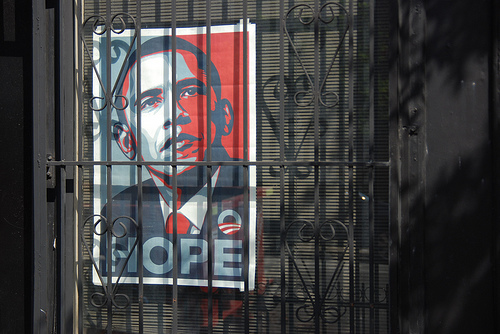
Image by Flickr user jonathan mcintosh.

Obama’s Normalization of Neo-Conservativism

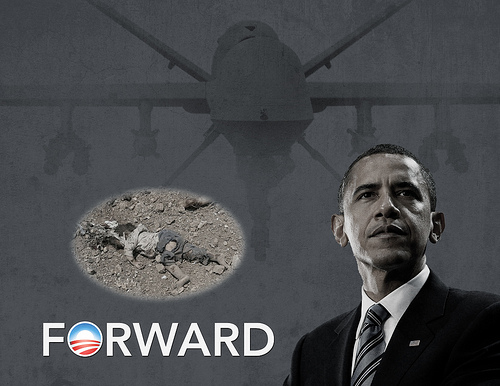
MEDIA ROOTS – While it may be popular to blame George W. Bush for the terror war, it is actually President Obama who has escalated drone warfare from 45 strikes when he assumed office to an additional 292 strikes as of last month. This is in large part due to the relaxed standards this president has set with strikes occurring not just for specific (alleged) combatants but now include targets that merely appear to fit certain criteria.

To date, the office of the president has now approved of more slaughter from drones than the total number of victims on 9/11. The fear that once settled in America’s hearts following the attacks on the World Trade Center and the Pentagon – attacks that were supposedly executed by manned aerial vehicles – hardly compare to the terror that Pakistanis now suffer from the unmanned drones. And while America is not officially at war with Pakistan, 74% of Pakistanis now consider the United States an enemy, according to a report released last week titled Living Under Drones. But why is this genocide continuing with virtually no outcry from the American citizenry?

No compassion, no coverage

The latest drone strike occurred just yesterday in Yemen. Military officials claim that four al-Qaeda militants were killed in the strike but there is simply no way to verify if this information is accurate. Virtually no American news agency covered the event and even fewer media outlets questioned authorities on its legitimacy.

The separation of general society from the terror war is comparable to the president and his weekly kill list or drone operators and their targets. As the war on terror enters its twelfth year on Sunday, almost no corporate media outlet deems this historical mark worthy of reflection thus continuing to alienate Americans from the horrors that are taking place daily in their name.

The president advises drone operators that potential combatants are men of military age – between 18 and 65 – and supports targeting them for assassination from the comfort of armchairs thousands of miles away. Additionally, anyone rushing to the aid of these victims is immediately considered a suspected terrorist and is frequently targeted just seconds later. The result has been the creation of dysfunctional societies that not only fear the skies but also helping one’s neighbor.

 “What is absolutely true is that my first job, my most sacred duty as president and commander-in-chief, is to keep America safe,” President Obama explained in an interview last month. But a much more dangerous precedent is now taking place. David Kilcullen, a former adviser to General Patraeus, explained that for “every one of these dead noncombatants represents an alienated family, a new desire for revenge, and more recruits for a militant movement.”

Several American antiwar activists, including some from the women’s group Code Pink, are now on the ground in Islamabad in preparation for a march to northwest Pakistan that starts tomorrow. They are marching in protest of the seemingly unending barrage of drone-strikes in the region and are led by Imran Khan, a Pakistani official known for his days as one of the nation’s top cricket players.

No end in sight

These crimes against humanity are staggering. But the general tolerance for these crimes by the American electorate is what is of particular concern. How many times must this president murder children before other parents stand up? And will voters actually re-elect such an evil administration that is only perpetuating this terror war? With President Obama and Governor Romney leading in the polls, the outcome appears inevitable.

***

Oskar Mosco for Media Roots.

Photo provided by Flickr user Jayel Aheram.

Living Under Drones is a video published by Brave New Foundation that highlights

a recent report that explains how drone warfare is terrorizing civilian populations.

Israel Curious, Part 2 of 3: UN and Colonialism

Read part one of this series about Israeli espionage against the U.S.

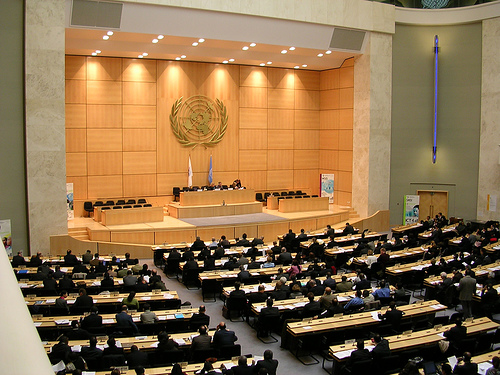
MEDIA ROOTS – The United States boasts a storied history of protecting Israel on the United Nation Security Council (UNSC) and was the lone dissenter against the most recent UN resolution that condemned Israeli settlements in the West Bank. The fourteen other Security Council members backed the resolution. One could almost hear the global community’s collective wheeze when U.S. Ambassador Susan Rice voiced the United States’ incongruence on 18 February 2011.

While claiming the United States strongly opposes Israeli settlement activity, Rice still refused to vote in line with the decency of the international community. Instead, she opted to pepper the world with diplomatic platitudes, as if that lessened the blow. By claiming her actions are somehow helpful to the peace process – although one cannot be sure how voting to perpetuate colonization in violation of international law is helpful – Susan Rice vetoed the resolution and continued the U.S. tradition of irresponsibility. Employing the utmost diplomatic circumlocution, Secretary of State Clinton deemed the colonies “illegitimate,” not illegal.

Reaction to the February 2011 veto was enlightening:

“The Anti-Defamation League, the American Jewish Committee, the Jewish Council for Public Affairs, B’nai B’rith International and the American Israel Public Affairs Committee all issued statements expressing appreciation for the veto. “Exercising the veto is a painful decision, particularly for an administration with a deep and sincere commitment to multilateralism,” said David Harris, the executive director of the American Jewish Committee. “That is why we salute President Obama and his team for their courage in vetoing this mischievous resolution, which would have caused irreparable damage to the future prospects of direct talks between Israel and the Palestinian Authority.”

Contrary to David Harris’ assertion, the only mischievous behavior is the United States’ tradition to abuse its power. From 1972 – 2006, the U.S. vetoed over forty UN Security Council resolutions that criticized or condemned Israel’s actions.

Russia and China have vetoed a series of UN Security Council resolutions, which condemn Syria over its harsh crackdown on anti-government protestors. Susan Rice condemned the Russian/Chinese October 2011 veto, saying it was a “cheap ruse by those who would rather sell arms to the Syrian regime than stand with the Syrian people.” She then concluded “the United States is outraged that this council has utterly failed to address an urgent moral challenge and a growing threat to regional peace and stability.” Surely she sees the irony in her words. Firstly, USA’s use of the veto to protect Israel from criticism is also a “cheap ruse,” whereby the United States government prefers to bow to AIPAC pressure and give Israel weaponry (paid for by the U.S. taxpayer) rather than stand with the Palestinian people and the Israeli citizens who want justice. Secondly, the council’s failure “to address an urgent moral challenge and a growing threat to regional peace and stability” is precisely what the United States does each time it vetoes resolutions critical of Israel’s destructive policies. Israeli foreign policy can easily be categorized as a “growing threat to regional peace and stability, yet the U.S. government continually blocks any progress confronting this particular “urgent moral challenge.” Syria’s brutal internal crackdown and Israel’s ethnic cleansing of historical Palestine are worthy of international condemnation. To condemn the former while protecting the latter exposes the United States’ double-standards and failed policies.

German Chancellor Angela Merkel’s words are an accurate reflection of the international community’s frustration in dealing with Israel’s obstinacy and the United States’ complicity. She reportedly communicated to Prime Minister Netanyahu, after Germany voted in favor of condemning Israel’s settlement activity: “How dare you? You haven’t made a single step to advance peace.” The Chairman of the Bundestag’s Foreign Affairs Committee clarified Chancellor Merkel is “trying to explain to the Israeli government that with the extraordinary changes taking place across the Middle East, time is not on its side when it comes to resolving the conflict with the stateless Palestinians.” British politician Lord Dykes acknowledged the United States’ tradition of harm by stating: “a seemingly unanimous decision in a moderately worded resolution asking Israel to obey its international law duties in occupied Palestine was deliberately – I am sad to use the verb – wrecked by the U.S.” Notably, Netanyahu’s former colleagues, such as Ehud Olmert and Ariel Sharon, have referred to him as a liar (Sharon). The former French President Nicolas Sarkozy also referred to Netanyahu in one word: “liar.” The list goes on, as even the former chief of Shin Bet has no confidence in Netanyahu as a leader.

A leading Zionist pundit unintentionally describes Netanyahu’s view with alarming candor: “Israel, of course, says it’s all the Palestinians’ fault. It says their UN gambit is just the latest move in their campaign to isolate and delegitimize Israel, proving again that they won’t accept Israel’s existence. Israel has no choice but to resist their assault using the tools at its disposal, including the American veto.”

This pundit’s view is enlightening in many ways. Firstly, Netanyahu and many in the Israeli government view the U.S. veto as a “tool at its disposal.” Israel uses the United States’ position on the UN Security Council as an instrument to be manipulated, similar to the manner in which AIPAC views the U.S. Congress. During a 2006 interview with Bill Maher, Netanyahu insinuated as much when he noted: “the secret is that we have America.” In his capacity as Prime Minister of Israel, Ariel Sharon had conveyed a similar, disturbing view during a 3 October 2001 interview with Kol Yisrael radio. Secondly, instead of viewing the Palestinian bid for statehood as an attempt at self-determination, the Israeli propaganda machine spins it as a refusal to accept Israel’s existence. Israel and the United States both declared independence unilaterally but the populaces seem quick to forget. Haaretz columnist Gideon Levy underscored this severety from the Holy Land: “Five million Israelis are deeply convinced today that they are right and seven billion people of the world are wrong.”

Continued Colonialism

The Israeli government persistently colonizes the West Bank, facilitated by the U.S. government’s unconditional, unapologetic support. In referencing the war of 1967, former Israeli Attorney General Michael Ben Yair concedes the war “continues to this day and is the product of our choice. We enthusiastically chose to become a colonialist society, ignoring international treaties, expropriating lands, transferring settlers from Israel to the occupied territories, engaged in theft and finding justification for all this” (Stern: 103). Yair frames the situation well.

This sad political reality, implemented by a relentless ideology, has moved roughly half a million Israelis into more than 100 colonies across the West Bank and East Jerusalem since 1967, amounting to a de facto annexation of land for Israeli use. Over 20,000 Israeli colonists now live in the Golan Heights alone, which was Syrian territory prior to 1967. Meanwhile, Israel’s separation barrier in the West Bank, which many refer to as an apartheid wall, carves chunks out of the future de facto Palestinian state and places favorable amounts of water resources on Israel’s side of the wall. Israeli colonies, which Democratic National Committee Chairwoman Debbie Wasserman Schultz (D – Florida) prefers to call “suburbs,” elsewhere receive a disproportionate share of the water supply.

USA and Israel walk hand in hand. For example, Shimon Peres’ April 2011 visit to Washington, D.C., coincided with a Jerusalem planning committee’s approval of 942 housing units in the Gilo neighborhood, south of Jerusalem, which the international community considers illegal. On 4 August 2011, the Israeli Interior Ministry approved of 900 new homes to be built in the Har Homa area, amounting to a de facto slice between Palestinian neighborhoods in East Jerusalem and Bethlehem. Less than two weeks later, Israeli officials approved 277 new homes in the West Bank colony of Ariel. One month later, Israel’s government approved 1,100 additional housing units to be built in the Gilo area of occupied east Jerusalem. Another 2,600 housing units were given the green light two weeks later. After Palestine received membership in UNESCO, Israel expedited construction of roughly 2,000 homes in East Jerusalem and the West Bank, all of which would “remain in Israeli control under any future peace agreement,” according to Prime Minister Netanyahu. One month later, the Israeli government approved more colonial construction in the dead center of a Palestinian neighborhood in Jerusalem. In April 2012, the Israeli government threw its full weight behind this misery and authorized the West Bank colonies of Bruchin, Rechelim, and Sansana. Israel’s ethnic cleansing of Palestinians in the West Bank in 2011 rose eighty percent when compared to 2010 rates, while the Israeli government increased its spending on West Bank colonies by 38 percent over the same period. 600 Palestinians lost their homes in the first five months of 2012. Israeli officials cite lack of “proper permits” as one pretext for bulldozing Palestinian homes, restaurants, schools, and even demolishing residential solar panels. On 6 June 2012, Netanyahu ordered the construction of 300 new homes in the West Bank colony of Beit El.  Zionism marches on, enabled by the U.S. government.

Israeli officials point to symbolic, menial efforts as proof they care to comply with international consensus. As of 1 March 2011, the Israeli government began dismantling all “illegal settlement outposts built on privately-owned Palestinian land.” Such a concession sounds tremendous, but it only applied to three outposts. Moreover, Israeli authorities simultaneously began to “legalize” illegal colonies built on state land, and even going so far as confiscating an olive grove for “agricultural cultivation” and granting the plot of land to a colonist “with no known farming skills.” Overall, the Israeli government stripped almost 250,000 Palestinians of their residency rights from 1967-1994, a figured which doesn’t include the hundreds of thousands of Palestinians who were driven from their homes around 1948. As a result, Israel gains far more than it loses.

Israel’s colonial obstinacy manifests itself in many forms. As President Obama delivered a major speech on events in the Middle East on 19 May 2011, the Israeli government approved plans to build more than 1,500 new homes on two settlements around East Jerusalem. Arieh Eldad, a member of the Israeli Knesset and head of the Hatikva faction, stated “I hope that [this] sends a clear message to the American administration. I hope that the new building of new settlements next week will send a similar message.” Contrary to Mr. Eldad’s assertions, the United States’ active role in perpetuating Israeli colonization of the West Bank has aligned criminally with Israeli deviance:

“The endorsement of ‘land swaps’ by President Obama, which is a euphemism for the annexation by Israel of major Jewish settlement blocs in the West Bank, is one demonstration of the unquestioning acceptance by the United States of the Israeli narrative of the conflict. By accepting the ‘land swap’ argument, President Obama has in effect declared that it is legitimate for the occupying power to settle and colonize occupied lands. This suits the settler-colonial mentality of the Israeli establishment for, despite arguments to the contrary, Israel itself is a product of settler colonialism with the British mandate over Palestine acting as its midwife. It was British rule that facilitated Jewish migration from Europe to Palestine and laid the basis of the demographic transformation of the mandated territory with the Jewish population in Palestine rising from approximately 10 percent at the beginning of the mandate to roughly 30 percent at its end. An American position endorsing Israel’s annexation of settler colonies is bound to put it at odds with the majority opinion in the international system.”

The modicum of pressure, which President Obama placed on Israel to freeze settlement expansion, was neither laudable nor realistic without proper confrontation of AIPAC. Backing down only days later, President Obama looked like a clown in front of the international community, further undermining the United States’ arrogation of global leadership. Wolf Blitzer foretold of such an occurrence in the event a U.S. administration got tough with Israel on any number of issues:

“If the U.S. administration did pressure Israel and was subsequently forced to back down in the face of reactions from Congress, the Jewish community, and others in the United States as well as Israel and around the world, there would be another price to pay. The limits of U.S. policy would be advertised for all to see. No president wants to show off American impotence” (Blitzer: 14).

According to Blitzer, such pressure would stem from a comprehensive Israeli mobilization against the U.S. presidential administration, an anti-administration enterprise directed by the Jewish community and allegations of anti-Semitism (ibid: 13-14). The Oracle at Blitzer’s predictions came true.

The U.S.-Israel relationship is one of paradox. Israel spies ferociously against the United States, while the U.S. Congress and Executive Branch work overtime to support Israel “unconditionally.” (President Obama even awarded Israeli President Shimon Peres the U.S. Presidential Medal of Freedom). Meanwhile, U.S. public is sound asleep. Until we wake up, the Israeli government will continue to capitalize upon this lopsided relationship.

Christian Sorensen for Media Roots

***

Photo by Flickr user lilivanili.

The Real Global 1% Ruling Class

MEDIA ROOTS — Instead of the run of the mill faceless accusations of ‘The 1% are oppressing the 99%’ research organization Project Censored has compiled a valuable list with names and faces of some of the world’s biggest earners and financial elites.  

Project Censored also characterizes a particular sect of these financial elitists as the ‘Global Economic Super Entity’, the biggest movers and shakers of the world economy. The assertion is made that NATO is now simply an arm of the financial elite global corporate class, a defacto ‘world police force’ to make sure the money keeps flowing as planned. A lot of interesting points are raised with ample documentation contained herein.  

***

PROJECT CENSORED – The Occupy Movement has developed a mantra that addresses the great inequality of wealth and power between the world’s wealthiest 1 percent and the rest of us, the other 99 percent. While the 99 percent mantra undoubtedly serves as a motivational tool for open involvement, there is little understanding as to who comprises the 1 percent and how they maintain power in the world. Though a good deal of academic research has dealt with the power elite in the United States, only in the past decade and half has research on the transnational corporate class begun to emerge.[i]

Foremost among the early works on the idea of an interconnected 1 percent within global capitalism was Leslie Sklair’s 2001 book, The Transnational Capitalist Class.[ii] Sklair believed that globalization was moving transnational corporations (TNC) into broader international roles, whereby corporations’ states of orgin became less important than international argreements developed through the World Trade Organization and other international institutions. Emerging from these multinational corporations was a transnational capitalist class, whose loyalities and interests, while still rooted in their corporations, was increasingly international in scope.

Sklair writes:
The transnational capitalist class can be analytically divided into four main fractions: (i) owners and controllers of TNCs and their local affiliates; (ii) globalizing bureaucrats and politicians; (iii) globalizing professionals; (iv) consumerist elites (merchants and media). . . . It is also important to note, of course, that the TCC [transnational corporate class] and each of its fractions are not always entirely united on every issue. Nevertheless, together, leading personnel in these groups constitute a global power elite, dominant class or inner circle in the sense that these terms have been used to characterize the dominant class structures of specific countries.[iii]

Estimates are that the total world’s wealth is close to $200 trillion, with the US and Europe holding approximately 63 percent. To be among the wealthiest half of the world, an adult needs only $4,000 in assets once debts have been subtracted. An adult requires more than $72,000 to belong to the top 10 percent of global wealth holders, and more than $588,000 to be a member of the top 1 percent.  As of 2010, the top 1 percent of the wealthist people in the world had hidden away between $21 trillion to $32 trillion in secret tax exempt bank accounts spread all over the world.[iv] Meanwhile, the poorest half of the global population together possesses less than 2 percent of global wealth.[v] The World Bank reports that, in 2008, 1.29 billion people were living in extreme poverty, on less than $1.25 a day, and 1.2 billion more were living on less than $2.00 a day.[vi] Starvation.net reports that 35,000 people, mostly young children, die every day from starvation in the world.[vii] The numbers of unnecessary deaths have exceeded 300 million people over the past forty years. Farmers around the world grow more than enough food to feed the entire world adequately. Global grain production yielded a record 2.3 billion tons in 2007, up 4 percent from the year before—yet, billions of people go hungry every day. Grain.org describes the core reasons for ongoing hunger in a recent article, “Corporations Are Still Making a Killing from Hunger”: while farmers grow enough food to feed the world, commodity speculators and huge grain traders like Cargill control global food prices and distribution.[viii] Addressing the power of the global 1 percent—identifying who they are and what their goals are—are clearly life and death questions.

It is also important to examine the questions of how wealth is created, and how it becomes concentrated. Historically, wealth has been captured and concentrated through conquest by various powerful enities. One need only look at Spain’s appropriation of the wealth of the Aztec and Inca empires in the early sixteenth century for an historical example of this process. The histories of the Roman and British empires are also filled with examples of wealth captured.

Once acquired, wealth can then be used to establish means of production, such as the early British cotton mills, which exploit workers’ labor power to produce goods whose exchange value is greater than the cost of the labor, a process analyzed by Karl Marx in Capital.[ix] A human being is able to produce a product that has a certain value. Organized business hires workers who are paid below the value of their labor power. The result is the creation of what Marx called surplus value, over and above the cost of labor. The creation of surplus value allows those who own the means of production to concentrate capital even more. In addition, concentrated capital accelerates the exploition of natural resources by private entrepreneurs—even though these natural resources are actually the common heritage of all living beings.[x]

In this article, we ask: Who are the the world’s 1 percent power elite? And to what extent do they operate in unison for their own private gains over benefits for the 99 percent? We will examine a sample of the 1 percent: the extractor sector, whose companies are on the ground extracting material from the global commons, and using low-cost labor to amass wealth. These companies include oil, gas, and various mineral extraction organizations, whereby the value of the material removed far exceeds the actual cost of removal.

We will also examine the investment sector of the global 1 percent: companies whose primary activity is the amassing and reinvesting of capital. This sector includes global central banks, major investment money management firms, and other companies whose primary efforts are the concentration and expansion of money, such as insurance companies.

Finally, we analyze how global networks of centralized power—the elite 1 percent, their companies, and various governments in their service—plan, manipulate, and enforce policies that benefit their continued concentration of wealth and power.

The Extractor Sector: The Case of Freeport-McMoRan (FCX)

Freeport-McMoRan (FCX) is the world’s largest extractor of copper and gold. The company controls huge deposits in Papua, Indonesia, and also operates in North and South America, and in Africa. In 2010, the company sold 3.9 billion pounds of copper, 1.9 million ounces of gold, and 67 million pounds of molybdenum. In 2010, Freeport-McMoRan reported revenues of $18.9 billion and a net income of $4.2 billion.[xi]

The Grasberg mine in Papua, Indonesia, employs 23,000 workers at wages below three dollars an hour. In September 2011, workers went on strike for higher wages and better working conditions. Freeport had offered a 22 percent increase in wages, and strikers said it was not enough, demanding an increase to an international standard of seventeen to forty-three dollars an hour. The dispute over pay attracted local tribesmen, who had their own grievances over land rights and pollution; armed with spears and arrows, they joined Freeport workers blocking the mine’s supply roads.[xii] During the strikers’ attempt to block busloads of replacement workers, security forces financed by Freeport killed or wounded several strikers.

Freeport has come under fire internationally for payments to authorities for security. Since 1991, Freeport has paid nearly thirteen billion dollars to the Indonesian government—one of Indonesia’s largest sources of income—at a 1.5 percent royalty rate on extracted gold and copper, and, as a result, the Indonesian military and regional police are in their pockets. In October 2011, the Jakarta Globe reported that Indonesian security forces in West Papua, notably the police, receive extensive direct cash payments from Freeport-McMoRan. Indonesian National Police Chief Timur Pradopo admitted that officers received close to ten million dollars annually from Freeport, payments Pradopo described as “lunch money.” Prominent Indonesian nongovernmental organization Imparsial puts the annual figure at fourteen million dollars.[xiii] These payments recall even larger ones made by Freeport to Indonesian military forces over the years which, once revealed, prompted a US Security and Exchange Commission investigation of Freeport’s liability under the United States’ Foreign Corrupt Practices Act.

In addition, the state’s police and army have been criticized many times for human rights violations in the remote mountainous region, where a separatist movement has simmered for decades. Amnesty International has documented numerous cases in which Indonesian police have used unnecessary force against strikers and their supporters. For example, Indonesian security forces attacked a mass gathering in the Papua capital, Jayapura, and striking workers at the Freeport mine in the southern highlands. At least five people were killed and many more injured in the assaults, which shows a continuing pattern of overt violence against peaceful dissent. Another brutal and unjustified attack on October 19, 2011, on thousands of Papuans exercising their rights to assembly and freedom of speech, resulted in the death of at least three Papuan civilians, the beating of many, the detention of hundreds, and the arrest of six, reportedly on treason charges.[xiv]

On November 7, 2011, the Jakarta Globe reported that “striking workers employed by Freeport-McMoRan Copper & Gold’s subsidiary in Papua have dropped their minimum wage increase demands from $7.50 to $4.00 an hour, the All-Indonesia Workers Union (SPSI) said.”[xv] Virgo Solosa, an official from the union, told the Jakarta Globe that they considered the demands, up from the (then) minimum wage of $1.50 an hour, to be “the best solution for all.”

Workers at Freeport’s Cerro Verde copper mine in Peru also went on strike around the same time, highlighting the global dimension of the Freeport confrontation. The Cerro Verde workers demanded pay raises of 11 percent, while the company offered just 3 percent.

The Peruvian strike ended on November 28, 2011.[xvi] And on December 14, 2011, Freeport-McMoRan announced a settlement at the Indonesian mine, extending the union’s contract by two years. Workers at the Indonesia operation are to see base wages, which currently start at as little as $2.00 an hour, rise 24 percent in the first year of the pact and 13 percent in the second year. The accord also includes improvements in benefits and a one-time signing bonus equivalent to three months of wages.[xvii]

In both Freeport strikes, the governments pressured strikers to settle. Not only was domestic militrary and police force evident, but also higher levels of international involvement. Throughout the Freeport-McMoRan strike, the Obama administration ignored the egregious violation of human rights  and instead advanced US–Indonesian military ties. US Secretary of Defense Leon Panetta, who arrived in Indonesia in the immediate wake of the Jayapura attack, offered no criticism of the assault and reaffirmed US support for Indonesia’s territorial integrity. Panetta also reportedly commended Indonesia’s handling of a weeks-long strike at Freeport-McMoRan.[xviii]

US President Barack Obama visited Indonesia in November 2011 to strengthen relations with Jakarta as part of Washington’s escalating efforts to combat Chinese influence in the Asia–Pacific region. Obama had just announced that the US and Australia would begin a rotating deployment of 2,500 US Marines to a base in Darwin, a move ostensibly to modernize the US posture in the region, and to allow participation in “joint training” with Australian military counterparts. But some speculate that the US has a hidden agenda in deploying marines to Australia. The Thai newspaper The Nation has suggested that one of the reasons why US Marines might be stationed in Darwin could be that they would provide remote security assurance to US-owned Freeport-McMoRan’s gold and copper mine in West Papua, less than a two-hour flight away.[xix]

The fact that workers at Freeport’s Sociedad Minera Cerro Verde copper mine in Peru were also striking at the same time highlights the global dimension of the Freeport confrontation. The Peruvian workers are demanding pay rises of eleven percent, while the company has offered just three percent. The strike was lifted on November 28, 2011.[xx]

In both Freeport strikes, the governments pressured strikers to settle. Not only was domestic militrary and police force evident, but also higher levels of international involvement. The fact that the US Secretary of Defense mentioned a domestic strike in Indonesa shows that the highest level of power are in play on issues affecting the international corporate 1 percent and their profits.

Public opinion is strongly against Freeport in Indonesia. On August 8, 2011, Karishma Vaswani of the BBC reported that “the US mining firm Freeport-McMoRan has been accused of everything from polluting the environment to funding repression in its four decades working in the Indonesian province of Papau. . . . Ask any Papuan on the street what they think of Freeport and they will tell you that the firm is a thief, said Nelels Tebay, a Papuan pastor and coordinator of the Papua Peace Network.”[xxi]

Freeport strikers won support from the US Occupy movement. Occupy Phoenix and East Timor Action Network activists marched to Freeport headquarters in Phoenix on October 28, 2011, to demonstrate against the Indonesian police killings at Freeport-McMoRan’s Grasberg mine.[xxii]

Freeport-McMoRan (FCX) chairman of the board James R. Moffett owns over four million shares with a value of close to $42.00 each. According to the FCX annual meeting report released in June 2011, Moffett’s annual compensation from FCX in 2010 was $30.57 million. Richard C. Adkerson, president of the board of FCX, owns over 5.3 million shares. His total compensation in was also $30.57 million in 2010 Moffett’s and Adkerson’s incomes put them in the upper levels of the world’s top 1 percent. Their interconnectness with the highest levels of power in the White House and the Pentagon, as indicated by the specific attention given to them by the US secretary of defense, and as suggested by the US president’s awareness of their circumstances, leaves no doubt that Freeport-MacMoRan executives and board are firmly positioned at the highest levels of the transnational corporate class.

Continue Reading The Global 1%: Exposing the Transnational Ruling Class at Project Censored

Posted in Uncategorized | 1 Reply

Domestic Drones 101: Privacy, Commercialization & Barriers

MEDIA ROOTS – While privacy is certainly the dominant concern surrounding the controversial use of drones in this country, the lack of technological barriers to entry is the grease on the slippery slope. However, despite privacy concerns, the defense industry will continue its voracious lobbying effort to make sure drone technology becomes increasingly accessible to corporate commercialization. Abby Martin of Media Roots and RT reports on the use of domestic drones in the US:

 

Abby Martin – Domestic Drones 101 for RT


4th Amendment to the United States Constitution

The right of the people to be secure in their persons, houses, papers, and effects, against unreasonable searches and seizures, shall not be violated, and no Warrants shall issue, but upon probable cause, supported by Oath or affirmation, and particularly describing the place to be searched, and the persons or things to be seized.

It is reasonable to assert that in the course of your friendly local police department launching a drone over the neighborhood every chimney, window and blade of grass in the neighborhood becomes “the place to be searched.” Many court cases have discussed and ruled that privacy is not protected for incriminating activity that exists from a public vantage point. For the most part, these decisions were always considered with respect to the naked human eye. However, drones are electronic eyes that extend the reach of the human eye making the right to be secure in your person, house, papers and effects substantially more difficult by the day.

Kyllo v. United States

Federal agents from a public vantage point used a thermal-imaging device to search Danny Kyllo’s residence for heat emissions not visible to the naked eye. In 2001, the Supreme Court explained, “[to] explore the details of the home that would previously have been unknowable without physical intrusion, the surveillance is a search and is presumptively unreasonable without a warrant.”  The decision asserted Americans have an expected privacy that cannot be violated even by technology that does not enter the home. This decision contrasted with the lower courts assertion that the device could not “penetrate walls or windows to reveal conversations or human activities.” This oxy-moronic contrast acknowledges that walls and windows are off limits.

Justice Antonin Scalia wrote the majority decision and his words are prophetic. Justice Scalia specifically tailored a “firm but bright” line drawn by the Fourth Amendment as the entrance to the house. Justice Scalia described this interpretation as “the long view” of the Fourth Amendment to specifically protect against more sophisticated future technology. Dissenting Justice John Paul Stevens argued the line would be crossed as soon as this surveillance technology becomes available to the public. While Kyllo v. United States is not drone specific it lifts the veil on the inherent capacity of drones to violate privacy with their electronic eyes and the potential rapid assimilation of drone technology into the commercial and private market.

Drone Commercialization

Though chaperoning Susie on her first date and having a drone dive bomb a pizza onto your front porch are gallows humor, the feasibility and potential use of drones for commercial use is real and ongoing. The Association for Unmanned Vehicle Systems International (AUVSI) was instrumental in crafting legislative language directing the Federal Aviation Administration (FAA) to expedite approval of police departments and universities to deploy drones under five pounds this year. Further, this language sets forth the plans for larger drones to fly the American skies in 2015.

Companies previously shy of entering the drone market due to FAA ambiguity on drones in American airspace are now all clamoring to get a piece of the evil seeping from Pandora’s box. Drone technology was born from war and the companies migrating from weapons of war to “softer” domestic applications still maintain an emphasis on spy and weapons capabilities. Once American police departments and universities are saturated with drones and their long term service contracts the technology will creep into more “innocuous” commercial applications. It is not hard to imagine this evolution ending with Billy, living in the year 2050, building a spy drone from a kit in the garage to spy on his neighbors.

Technological Barriers

This evolution of technology and the increasing accessibility to the average person takes on several dimensions of concern. It is easy to extrapolate Billy’s neighborhood spy drone wreaking havoc on nude sun bathers enjoying the privacy of their back yard or snapping a few photos through Mr. and Mrs. Jones window as they fail to close the blinds in their lust to embrace. A look into the future of drone technology we find hundreds of sovereign states across the world developing advanced war capable drones to launch against America or other states with which they disagree. It is important to understand that weapons proliferation is a collective response to technological monopoly.

A look at nuclear technology reveals technological barriers to entry serve as a counter-balance to proliferation. Because nuclear technology is high science and the materials necessary are only accessible to advanced societies, humans are only able to delay nuclear proliferation. As nuclear technology and materials are shared amongst “friends,” the barriers to entry are demolished. The result of this proliferation today is the placement of social barriers to assign who is worthy of nuclear technology and who is not. These social barriers will only delay the inevitable. Drones being significantly less advanced technologically than nukes will rapidly proliferate beyond Western domination and the Earth may plummet into global drone warfare.

Chris Martin for Media Roots

***

SALON – In November 2010, a police lieutenant from Parma, Ohio, asked Vanguard Defense Industries if the Texas-based drone manufacturer could mount a “grenade launcher and/or 12-gauge shotgun” on its ShadowHawk drone for U.S. law enforcement agencies. The answer was yes.

Last month, police officers from 10 public safety departments around the Washington, D.C., metropolitan area gathered at an airfield in southern Maryland to view a demonstration of a camera-equipped aerial drone — first developed for military use — that flies at speeds up to 20 knots or hovers for as long as an hour.

In short, the business of marketing drones to law enforcement is booming. Now that Congress has ordered the Federal Aviation Administration to open up U.S. airspace to unmanned vehicles, the aerial surveillance technology first developed in the battle space of Iraq, Afghanistan and Pakistan is fueling a burgeoning market in North America. And even though they’re moving from war zones to American markets, the language of combat and conflict remains an important part of their sales pitch — a fact that ought to concern citizens worried about the privacy implications of domestic drones.

*** 

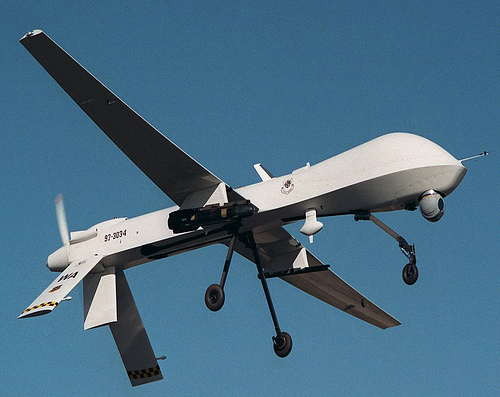
Photo by Flickr user Jim n Texas

Posted in Uncategorized | 1 Reply