Critics Call Obama’s Tribunals “Bush Lite”

CBSIn an apparent reversal, President Barack Obama is reviving the Bush administration’s much-criticized military tribunals for Guantanamo Bay detainees, shocking those who expected the president to end them completely.

CBS News correspondent Kimberly Dozier reports that the president says these will not be your Bush-era tribunals, promising a new system that guarantees more legal rights for detainees.

Mr. Obama said the changes were designed to give defendants stronger legal protections, such as a ban on evidence “obtained through torture, or by using cruel or degrading interrogation methods,” like waterboarding; limiting use of hearsay evidence; granting the accused more say in who represents them; and protecting detainees who refuse to testify from legal sanctions.

But his action was almost instantly denounced by critics who called the new tribunals “Bush Lite,” reports Dozier.

During his presidential campaign, Mr. Obama was highly critical of the commissions used by the Bush administration.

“By any measure, our system of trying detainees has been an enormous failure,” he said last June 18.

And one of his first actions as president was setting in motion the closing of Guantanamo Bay prison within 12 months.

Re-opening these military tribunals may also delay the closing of Guantanamo, says Dozier. The earliest the trials of 13 defendents (9 of whom are charged with helping orchestrate the September 11 terror attacks) can resume is September. That would give prosecutors about four months to finish before the end of the year, because these military tribunals cannot be held back in the United States.

The rest of the 241 Guantanamo detainees will either be released, transferred to other countries, tried in civilian U.S. federal courts or, potentially, held indefinitely as prisoners of war with full Geneva Conventions rights.

Finish reading about Obama’s Tribunals Being Bush-Lite.

© MMIX, CBS Interactive Inc. All Rights Reserved.

Photo by flickr user Steven Damron
Iraq’s Electricity Grid Nears Collapse

MSNBC– Iraq’s electricity grid could collapse any day because of insurgent sabotage, rising demand, fuel shortages and provincial officials who are unplugging local power stations from the national system, electricity officials said on Saturday.

President Bush, meanwhile, was busy on the phone, calling Vice president Adel Abdel-Mahdi and President Jalal Talabani, urging political unity in the country, where the government of Prime Minister Nouri al-Maliki is under a stiff challenge.

Abdel-Mahdi, a Shiite, and Talabani, a Kurd, provided few details of the conversations in statements released by their offices. But both men have been involved in trying to solve a government crisis after Iraq’s largest bloc of Sunni political parties ordered its ministers to quit the government.

For many Iraqi citizens, however, trying to stay cool or find sufficient drinking water was a more urgent problem. The Baghdad water supply already has been severely affected by power blackouts and cuts that have affected pumping and filtration stations.

And now water mains have gone dry in the Shiite holy city of Karbala, where the whole province south of Baghdad has been without power for three days. Power supplies in Baghdad have been sporadic all summer and now are down to just a few hours a day, if that.

Continue reading about Iraq’s Electricity Collapse.

© COPYRIGHT MSNBC, 2007

Khalid Sheikh Mohammed Waterboarded 183 times in One Month

TIMES ONLINE– CIA interrogators used the controverisal waterboarding technique 183 times on Khalid Sheikh Mohammed, the mastermind behind the September 11, 2001, attacks and 83 times on another al-Qaeda suspect, according to The New York Times.

A 2005 Justice Department memorandum revealed that the simulated drowning technique was used on Mohammed 183 times in March 2003.

Abu Zubaydah, the first prisoner questioned in the CIA’s overseas detention programme in August 2002, was waterboarded 83 times, although a former CIA officer had told news organisations that he had been subjected to only 35 seconds under water before agreeing to tell everything he knew.

President Barack Obama has banned the use of waterboarding, overturning a Bush Administration policy that it did not constitute torture.

The memo is one of four authorising “harsh interrogation” that were declassified by the Obama Administration last week. They show that the CIA based more than 3,000 intelligence reports on the questioning of “high-value” terror suspects from September 11, 2001, to April 2003.

Continue reading about Khalid Sheikh Mohammed being Waterboarded 183 Times.

© TIMES ONLINE, 2009

Peace for Israeilis and Palestinians? Not Without America’s Tough Love

CHRISTIAN SCIENCE MONITOR– More than 20 years ago, many Americans decided they could no longer watch as racial segregation divided South Africa. Compelled by an injustice thousands of miles away, they demanded that their communities, their colleges, their municipalities, and their government take a stand.

As Martin Luther King Jr. said, “Injustice anywhere is a threat to justice everywhere.”

Today, a similar discussion is taking place on campuses across the United States. Increasingly, students are questioning the morality of the ties US institutions have with the unjust practices being carried out in Israel and in the occupied Palestinian territories. Students are seeing that these practices are often more than merely “unjust.” They are racist. Humiliating. Inhumane. Savage.

Sometimes it takes a good friend to tell you when enough is enough. As they did with South Africa two decades ago, concerned citizens across the US can make a difference by encouraging Washington to get the message to Israel that this cannot continue.

A legitimate question is, Why should I care? Americans are heavily involved in the conflict: from funding (the US provides Israel with roughly $3 billion annually in military aid) to corporate investments (Microsoft has one of its major facilities in Israel) to diplomatic support (the US has vetoed 32 United Nations Security Council resolutions unsavory to Israel between 1982 and 2006).

Why do I care? I am an Israeli. Both my parents were born in Israel. Both my grandmothers were born in Palestine (when there was no “Israel” yet). In fact, I am a ninth-generation native of Palestine. My ancestors were among the founders of today’s modern Jerusalem.

Both my grandfathers fled the Nazis and came to Palestine. Both were subsequently injured in the 1948 Arab-Israli War. My mother’s only brother was a paratrooper killed in combat in 1968. All of my relatives served in the Israeli military for extensive periods of time, some of them in units most people don’t even know exist.

In Israel, military service for both men and women is compulsory. When my time to serve came, I refused, because I realized I was obliged to do something about these acts of segregation. I was denied conscientious objector status, like the majority of 18-year-old males who seek this status. Because I refused to serve, I spent a year and a half in military prison.

Some of the acts of segregation that I saw while growing up in Israel include towns for Jews only, immigration laws that allow Jews from around the world to immigrate but deny displaced indigenous Palestinians that same right, and national healthcare and school systems that receive significantly more funding in Jewish towns than in Arab towns.

As former Prime Minister Ehud Olmert said in 2008: “We have not yet overcome the barrier of discrimination, which is a deliberate discrimination and the gap is insufferable…. Governments have denied [Arab Israelis] their rights to improve their quality of life.”

The situation in the occupied territories is even worse. Nearly 4 million Palestinians have been living under Israeli occupation for over 40 years without the most basic human and civil rights. One example is segregation on roads in the West Bank, where settlers travel on roads that are for Jews only, while Palestinians are stopped at checkpoints, and a 10-mile commute might take seven hours.

Continue reading about America’s Tough Love.

Jonathan Ben-Artzi was one of the spokespeople for the Hadash party in the Israeli general elections in 2006. His parents are professors in Israel, and his extended family includes uncle Benjamin Netanyahu. Mr. Ben-Artzi is a PhD student at Brown University in Providence, R.I.

Photo by Ray Maclean Flickr User

© CHRISTIAN SCIENCE MONITOR, 2010

Malawi’s Child Tobacco Pickers Exposed to Dangerous Nicotine Levels

(Video Below)

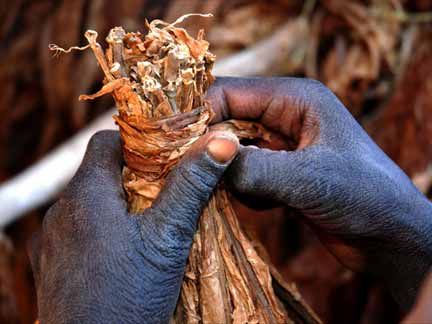
Malawi Children Picking TobaccoTHE GUARDIAN– Children in Malawi who are forced to work as tobacco pickers are exposed to nicotine poisoning equivalent to smoking 50 cigarettes a day, an investigation has found. Child labourers as young as five are suffering severe health problems from a daily skin absorption of up to 54 milligrams of dissolved nicotine, according to the international children’s organisation Plan.

Malawian tobacco is found in the blend of almost every cigarette smoked in the west. The low-grade, high-nicotine tobacco is often used as a filler by manufacturers, reflecting a long-term global shift in production. Tobacco farms in America declined by 89% between 1954 and 2002. Three-quarters of production has migrated to developing countries, with Malawi the world’s fifth biggest producer. Seventy per cent of its export income comes from tobacco and the country is economically dependent on it.

Plan cites research showing that Malawi has the highest incidence of child labour in southern Africa, with 88.9% of five to 14-year-olds working in the agricultural sector. It is estimated that more than 78,000 children work on tobacco estates – some up to 12 hours a day, many for less than 1p an hour and without protective clothing.

Plan’s researchers invited 44 children from tobacco farms in three districts to take part in a series of workshops. They revealed a catalogue of physical, sexual and emotional abuse and spoke about the need to work to support themselves and their families and pay school fees.

The children reported common symptoms of green tobacco sickness (GTS), or nicotine poisoning, including severe headaches, abdominal pain, muscle weakness, coughing and breathlessness.”Sometimes it feels like you don’t have enough breath, you don’t have enough oxygen,” one child said. “You reach a point where you cannot breathe because of the pain in your chest. Then the blood comes when you vomit. At the end, most of this dies and then you remain with a headache.”

GTS is a common hazard of workers coming into contact with tobacco leaves and absorbing nicotine through their skin, particularly when harvesting. It is made worse by humid and wet conditions, which are prevalent in Malawi, as residual moisture on the leaves helps nicotine to be absorbed quicker. Everyday symptoms of GTS are more severe in children than adults as they have not built up a tolerance to nicotine through smoking and because of their physical size. There is a lack of research into the long-term effects of GTS in children, but experts believe that it could seriously impair their development.

Continue reading about Malawi Child Laborers for Tobacco Farms.

© COPYRIGHT THE GUARDIAN, 2009