DEMOCRACY NOW– Protests are continuing in Haiti over the cholera outbreak that has now
killed more than 1,100 people and infected some 17,000. On Wednesday,
residents in the city of Cap-Haïtien clashed with U.N. troops for the
third consecutive day.
Crowds have taken to the streets expressing
anger at the Haitian government and the United Nations for failing to
contain the disease. We go to Cap-Haïtien to speak with independent
journalist Ansel Herz.
JUAN GONZALEZ: Protests
are continuing in Haiti over the cholera outbreak that has now killed
over 1,100 people and infected more than 17,000. On Wednesday,
residents in the city of Cap-Haïtien clashed with U.N. troops for the
third consecutive day. Crowds have taken to the streets expressing
anger at the Haitian government and the U.N. for failing to contain the
disease. Nepalese U.N. troops stationed in Cap-Haïtien have been
accused of inadvertently bringing cholera to Haiti.
The protests
reportedly started at a cemetery where cholera victims were being
placed in mass graves. At least two people have been killed in clashes
between demonstrators and U.N. troops. On Tuesday, the U.N. Mission in
Haiti, known as MINUSTAH, said aid flights have been canceled and water
purification and training projects curtailed, while food at a warehouse
has been looted and burned.
CBS NEWS– The first court award in a vaccine-autism claim is a big one. CBS News
has learned the family of Hannah Poling will receive more than $1.5 million dollars for her life care; lost earnings; and pain and suffering for the first year alone.
In
addition to the first year, the family will receive more than $500,000
per year to pay for Hannah’s care. Those familiar with the case believe
the compensation could easily amount to $20 million over the child’s
lifetime.
Hannah was described as normal, happy and precocious in her first 18 months.
Then,
in July 2000, she was vaccinated against nine diseases in one doctor’s
visit: measles, mumps, rubella, polio, varicella, diphtheria, pertussis,
tetanus, and Haemophilus influenzae.
Afterward, her health
declined rapidly. She developed high fevers, stopped eating, didn’t
respond when spoken to, began showing signs of autism, and began having
screaming fits. In 2002, Hannah’s parents filed an autism claim in
federal vaccine court. Five years later, the government settled the case
before trial and had it sealed. It’s taken more than two years for both
sides to agree on how much Hannah will be compensated for her injuries.
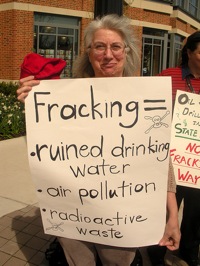
YES!– When politicians refer to natural gas as a “clean” alternative to oil and coal, they seldom mention a commonly used technique called horizontal hydraulic fracturing, also known as fracking.
But in New York, residents were concerned enough about the long-term
environmental, health, and economic fallout of fracking that they
convinced the state Senate to institute a moratorium on the practice.
In a 48-9 bipartisan landslide, state leaders voted to prohibit
fracking for nine months so they can evaluate the environmental and
health impacts of the practice before deciding how to continue.
“It was absolutely the result of thousands of citizens weighing in
with their senators,” said Katherine Nadeau, director of the Water and
Natural Resources Program for Environmental Advocates of New York.
“When that many people call, write, and show up, it gets results. The
other side was spending obscene amounts of money, but the more
compelling argument was that there have been serious tragic
repercussions to drilling.”
Those repercussions have included fatalities from exploding wells,
30-mile stretches of streams without any living organisms, exploding
tap water, diesel fuel spills, sick children and adults, plummeting
property values, farmland that is no longer tillable, the destruction
of vast swaths of once-beautiful scenery, along with many other
documented cases of harm to people and the planet.
MEDIA ROOTS- When was the last time you stopped to think about the one thing you
can’t live without? I don’t mean the Internet – I’m talking about water.
Without clean drinking water, life could not go on. This is why it’s so
important that we know what is in our
water. For the past sixty-five years, city governments nationwide have
been adding a controversial substance called fluoride to municipal water
supplies.
You probably recognize the word fluoride from the back of your toothpaste tube or from your visits to the dentist. But
the fluoride added
to our water is not the same as that in our toothpaste. The chemical added to
our water is a fluorine compound called hexafluorosilicic
acid that is generated as a by-product from the phosphate fertilizer
industry.
Phosphates are minerals that are used to make fertilizer, and phosphate
mining industry is a giant moneymaker. Fluoride is created
by the production of fertilizer as well as in the manufacturing of steel, aluminum,
glass, and cement. Previously, the lack of government regulation allowed gaseous
fluoride to move through factory smokestacks and straight into our
atmosphere. Now, environmental regulations require giant filtration
systems called “scrubbers” atop the stacks to keep these toxic
chemicals from escaping into the air. Fluorosilicic acid is then extracted from these scrubbers and condensed to
a water-based solution which is packaged unrefined and sold to city governments for the purpose of water fluoridation.
By selling the fluoride byproducts for this purpose, companies avoid
the huge cost of disposing of these chemicals in the environment
safely, and according to regulation. Back in the 1930’s, a band of
industrial corporations – including Monsanto, U.S. Steel, Union Carbide,
and Aluminum Company of America (ALCOA), the leading producer of
aluminum – had been cheaply disposing of their fluoride byproducts into
the environment for years. This changed when their toxic waste became the
target of negative press in the local news. A 1933 toxicology report by the
USDA had warned of fluoride’s toxicity, singling out the aluminum industry as
the biggest culprit.
The new potential of legal liability due to the exposure of
workers and communities to industrial fluoride scared these corporations.
Knowing that disposing of industrial fluoride waste safely was expensive, ALCOA
employed biochemist Gerald Cox
in 1936, to argue for fluoride’s dental benefits through experimentation on
rats. Cox, neither a doctor nor a dentist, concluded that fluoride strengthened
and protected teeth against decay and began to tour the country promoting water
fluoridation on behalf of his employers. Interestingly, Cox’s
findings ran contrary to the position originally held by the American Dental
Association (ADA) on water fluoridation.
In 1944, the Journal of the
American Dental Association published
the following statement:
“We do know that the use
of drinking water containing as little as 1.2 to 3.0 parts per million of
fluoride will cause such developmental disturbances as osteosclerosis,
spondylosis, and osteopetrosis, and we cannot afford to run the risk of
producing such serious systemic disturbances…”
In spite of this warning by the ADA, Grand Rapids, Michigan became the first
community to fluoridate its drinking water the very next year.
In 1947 Oscar R. Ewing, a
paid attorney for ALCOA, was picked to head the Federal Security Agency. In
this position he oversaw the Public Health Service or PHS (which is now the
Department of Health and Human Services). This enabled him to change the Code of Federal
Regulations, and place all control of drinking water fluoridation in the hands
of his own department. Making clear his lingering ties to the aluminum industry
and their expensive toxic waste, Ewing made fluoridation
promotion one of the first official policies of the PHS. Over the next three years, 87 additional American cities began fluoridating their water.
The study that is often referred to in fluoride’s defense
was conducted by
the National Institute of Dental Research
(NIDR) of the United States Public Health Service (PHS). It sought to
determine whether there was a relationship between fluoridation and tooth
decay. Released in 1988, the multi-million dollar nationwide survey examined
39,000 U.S. school children aged 5-17 from 84 different fluoridated and
non-fluoridated geographical areas.
Surprisingly, the study uncovered a declining trend in tooth
decay rates in both fluoridated and non-fluoridated areas, mostly due to overall
better hygiene. The overriding conclusion from the extensive study was that
there is no relationship between
tooth decay and fluoride ingestion. Despite this consensus, this study is still commonly cited to link lowered decay
rates in fluoridated areas. A seldom-reported fact is that the same trend was
found in non-fluoridated areas too.
Fluoride overexposure can bring serious health risks. The most common affliction due to overconsumption is
called fluorosis,
a condition characterized by a discoloration of teeth or changes in bone
density. An excess of fluoride eats away at the enamel of your teeth,
causing craters and surface discoloration. Dental fluorosis is the first clear
and obvious sign that your body is being poisoned by too much fluoride, and
cases can range from mild to severe. This occurs because only 50% of all fluoride
taken in by the body is excreted. The remaining fluoride is disseminated
throughout the body, accumulating in our bones, pineal gland and other tissues.
In Karnataka,
India, an excess of fluoride has turned the ground water into a slow
poison, crippling at least 10,000 people.
The Director of the National Institute of Mental Health and
Neurosciences, Dr D Nagaraj, says
that “due to fluoride concentration in water, many people in districts [in Karnataka, India] like Dharwad
and Tumkur have spinal cord diseases. These are progressive diseases,
after decades of consumption. People are battling with permanent disabilities.”
Alarmingly, a 1991 study
by the U.S. Public Health Service found that the rates of osteosarcoma, a
deadly type of bone cancer, were significantly higher in fluoridated
communities than in non-fluoridated communities. The Harvard School of Dental
Medicine found
the same link in study done ten years later. Additional studies
have associated fluoride ingestion with other serious health problems,
including chromosomal damage, morphological changes to their kidneys and brain,
hypo activity (or inactivity), damage to the thyroid gland, skeletal fluorosis,
osteoporosis, liver cancer, and fertility problems.
The most distressing findings come from 18 human studies done in
China, India, Iran and Mexico that show a substantial lowering of IQ in fluoridated
areas. The ingestion of fluoride has been shown to increase the gastrointestinal absorption
of aluminum by over 600%, and the absorption of heavy metals like aluminum is
speculated to have a direct correlation to Alzheimer’s disease and other neurological
brain disorders. Although a direct correlation between Alzheimer’s disease and
fluoride ingestion is inconclusive, it is interesting to note that the rate
of Alzheimer’s is twice as high in America than in Europe, where many countries
have banned fluoridation.
Many countries around the world are
skeptical of the benefits of adding fluoride to drinking water. Austria,
Belgium, Denmark, Finland, France, Germany, Iceland, Italy, Luxembourg,
Netherlands, Norway, Sweden, Switzerland, Japan and China have all ruled out water
fluoridation as a safe and fair practice.
If you want to find out whether you’re drinking
fluoridated water, the first thing you can do is access your city’s
fluoridation status on the Center for Disease Control’s website in its oral health
section.
If your water is fluoridated, it’s not a lost cause. You can speak out in your community or at
city council meetings to let your local representatives know your concerns. To remove
fluoride from your water you have a couple of options. You can equip your home
with water filtration systems like those at Equinox or Burkey. Filters like Pur
and Brita do not remove fluoride. If you
buy bottled drinking water, reverse osmosis and distillation remove almost all
fluoride.
If your city is planning to fluoridate you can stop it! Activists
in Pennsylvania have
successfully fought off fluoridation legislation since 1987 and they’re at it
again. There is still a chance to put a halt to the fluoridation process in
your own city.
Whether or not you support water fluoridation, the
real issue here is having a choice. No chemical, no matter what its supposed
benefits are, should be forced upon the public without their consent. Having access to clean water should be a
fundamental right for every human being.
“Water is the lifeblood of our bodies, our economy, our nation and our well-being.” -Stephen Johnson
***NOTE
After numerous attempts to get data from city officials proving the
benefits of mass fluoridation, I kept getting referred back to either the
respective city’s water website or other government controlled sites. I also
attempted to get in contact with Ellie Nadler, the head of San Diego’s Coalition for Fluoridation, but
couldn’t find any legitimate website or group presence for that matter. Ellie
backed out of any interviews and refused to give a statement.
Written by
Abby Martin, Research help by Jeff Wilson
Interview I conducted with David C. Kennedy, DDS, and former head of the International Academy of Oral Medicine and Toxicology.
Additional Resources–
Tooth
Decay Trends
in Fluoridated and Non Fluoridated Areas
THE INDEPENDENT– Thousands of patients
who are becoming clinically eligible for anti-retroviral treatment (ART)
in Uganda risk early death unless an informal ban on enrollment of new
patients by the ART treatment centres countrywide is lifted.
Several organisations
caring for people living with HIV/AIDS in Uganda have sounded alarm
bells regarding their members who are being turned away at
anti-retroviral treatment centres even when their CD4 counts (which
determine patient immunity levels) show that they are due for treatment.
An evening television news report on NTV Uganda on June 16 June, 2010
highlights the plight of hundreds of people with HIV/AIDS who are
stranded at treatment centres which have declined to enroll them on
treatment citing severe funding dilemmas for the lifelong ART drugs.
For people with
HIV/AIDS, anti-retroviral treatment is the main hope of prolonging life.
Anti retroviral drugs (ARVs) inhibit the ability of the HIV to multiply
in the body.
Dr
Peter Mugyenyi, the Executive Director of the Joint Clinical Research
Centre (JCRC), one of the leading national providers of HIV/AIDS care
and treatment in Uganda, acknowledges the problem.
“In Uganda, lower- than-
anticipated funding support from PEPFAR and other donor entities in the
past couple of years has forced many facilities to turn away new
HIV-positive patients seeking ART,’’ Dr Mugyenyi says in a foreword he
wrote for the latest 2010 report of the International
Treatment Preparedness Coalition (ITPC) entitled Rationing Funds,
Risking Lives: World Backtracks on HIV Treatment.
Dr Deus Lukoye, the Kampala
City Council HIV/AIDS Focal Person, has confirmed to this reporter that
many ART sites in Kampala are turning away new patients due to donor
funding deficits.



 DEMOCRACY NOW– Protests are continuing in Haiti over the cholera outbreak that has now
killed more than 1,100 people and infected some 17,000. On Wednesday,
residents in the city of Cap-Haïtien clashed with U.N. troops for the
third consecutive day.
DEMOCRACY NOW– Protests are continuing in Haiti over the cholera outbreak that has now
killed more than 1,100 people and infected some 17,000. On Wednesday,
residents in the city of Cap-Haïtien clashed with U.N. troops for the
third consecutive day.  CBS NEWS
 YES!
YES! MEDIA ROOTS- When was the last time you stopped to think about the one thing you
can’t live without? I don’t mean the Internet – I’m talking about water.
Without clean drinking water, life could not go on. This is why it’s so
important that we know what is in our
water. For the past sixty-five years, city governments nationwide have
been adding a controversial substance called fluoride to municipal water
supplies.
MEDIA ROOTS- When was the last time you stopped to think about the one thing you
can’t live without? I don’t mean the Internet – I’m talking about water.
Without clean drinking water, life could not go on. This is why it’s so
important that we know what is in our
water. For the past sixty-five years, city governments nationwide have
been adding a controversial substance called fluoride to municipal water
supplies. 