No Easy Truth: Continuous Casualty of Conflict

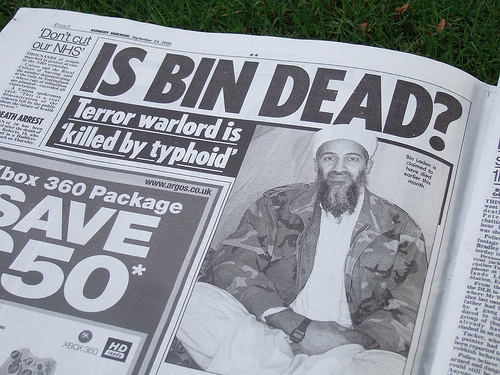
MEDIA ROOTS – The Pentagon and the corporate media establishment are again attempting to control the 9/11 and War on Terror narrative by claiming that they are considering legal action against former Navy SEAL Matt Bissonnette (a.k.a. Mark Owen) for publishing his book No Easy Day. The supposed context for the publication of his story, scheduled for release on Tuesday, is that the veteran did not offer the manuscript to the Department of Defense for prior review and he now may face legal recourse from the agency. Additionally, his name was leaked by the Associated Press last week, resulting in possible threats to his life.

The book was originally scheduled for release on September 11 of this year. It was an attempt made by Owen to remain apolitical about arguably the most politicized event of the decade. But the current debate appears to be scripted for the history books as several hard questions about the death of bin Laden continue to be ignored and will most likely not be answered in the upcoming publication distributed by Dutton.

The first and probably the most obvious discrepancy is if military intelligence had known of his precise location for eight months prior to the raid, then why hasn’t more proof of his whereabouts been released to the American public? “Despite the intense surveillance effort the CIA was unable to obtain a photograph of Bin Laden or a recording of the voice of the mysterious man, presumed to be the al-Qaida leader,” states the Guardian the week after the raid.

With such precise knowledge of the bunker, why was bin Laden not captured for trial in a court of law? Attorney General Eric Holder answers that the operation was not only lawful according to the Authorization for Use of Military Force (2001) but was simply an act of national self-defense. But in a nation where children are taught the belief of liberty and justice for all, it’s quite contradictory for this nation’s leadership to not protect and promote these ideals worldwide.

Furthermore, Owen recounts a scene where bin Laden may actually have already been dead upon their arrival. “At first it was funny because it was so wrong,” Owen reflected in his account of May 1, 2011. This version is in direct conflict with that of the White House in which bin Laden was allegedly reaching for a weapon at the time of the fatal shots. Owen confirms that the suspected terrorist was unarmed at the time of his death and their team may have just been on a kill mission.

But the greatest and most pertinent question has still not been asked: was Osama Bin Laden actually killed on May 1, 2011? This past March, the online hacker group Anonymous was able to obtain emails from the intelligence analysis group Stratfor which directly contradicts the official story about what happened with bin Laden’s body after the raid. While possibly the smoking gun of a White House cover-up, several news stories reported before the raid also directly contradict the official narrative. Below are a just few examples:

2001 – “Usama bin Laden has died a peaceful death due to an untreated lung complication, the Pakistan Observer reported, citing a Taliban leader who allegedly attended the funeral of the Al Qaeda leader.” [Fox News]

2002 – “Pakistan’s president says he thinks Osama bin Laden is most likely dead because the suspected terrorist has been unable to get treatment for his kidney disease.” [CNN]

2006 – “Saudi intelligence services seem to be sure that Osama bin Laden is dead. The elements gathered by the Saudis indicate that the head of Al Qaeda was the victim, while he was in Pakistan on Aug. 23, 2006, of a strong case of typhoid fever that led to a partial paralysis of his lower limbs.” [France’s Directorate-General for External Security]

2007 – “… he also had dealings with Omar Sheikh, the man who murdered Osama bin Laden.” [Benazir Bhutto]

2008 – “The last relatively reliable bin Laden sighting was in late 2001.” [Time]

2009 – “What if everything we have seen or heard of him on video and audio tapes since the early days after 9/11 is a fake – and that he is being kept ‘alive’ by the Western allies to stir up support for the war on terror? Incredibly, this is the breathtaking theory that is gaining credence among political commentators, respected academics and even terror experts.” [Daily Mail]

The War on Terror is riddled with unanswered questions that range in depth and consequence. From numerous eyewitness accounts of what actually hit the Twin Towers to this morning’s attack at a US military base, the corporate media hardly scratches the surface of investigation, often simply regurgitating government propaganda. But as more individuals combat societal ignorance, becoming proactively aware of the atrocities committed by their military establishment and the history of their empire, the War on Terror is destined to end.

Oskar Mosco for Media Roots.

Photo provided by Flickr user Ben Sutherland.


Posted in Uncategorized | 1 Reply

The Real Global 1% Ruling Class

MEDIA ROOTS — Instead of the run of the mill faceless accusations of ‘The 1% are oppressing the 99%’ research organization Project Censored has compiled a valuable list with names and faces of some of the world’s biggest earners and financial elites.  

Project Censored also characterizes a particular sect of these financial elitists as the ‘Global Economic Super Entity’, the biggest movers and shakers of the world economy. The assertion is made that NATO is now simply an arm of the financial elite global corporate class, a defacto ‘world police force’ to make sure the money keeps flowing as planned. A lot of interesting points are raised with ample documentation contained herein.  

***

PROJECT CENSORED – The Occupy Movement has developed a mantra that addresses the great inequality of wealth and power between the world’s wealthiest 1 percent and the rest of us, the other 99 percent. While the 99 percent mantra undoubtedly serves as a motivational tool for open involvement, there is little understanding as to who comprises the 1 percent and how they maintain power in the world. Though a good deal of academic research has dealt with the power elite in the United States, only in the past decade and half has research on the transnational corporate class begun to emerge.[i]

Foremost among the early works on the idea of an interconnected 1 percent within global capitalism was Leslie Sklair’s 2001 book, The Transnational Capitalist Class.[ii] Sklair believed that globalization was moving transnational corporations (TNC) into broader international roles, whereby corporations’ states of orgin became less important than international argreements developed through the World Trade Organization and other international institutions. Emerging from these multinational corporations was a transnational capitalist class, whose loyalities and interests, while still rooted in their corporations, was increasingly international in scope.

Sklair writes:
The transnational capitalist class can be analytically divided into four main fractions: (i) owners and controllers of TNCs and their local affiliates; (ii) globalizing bureaucrats and politicians; (iii) globalizing professionals; (iv) consumerist elites (merchants and media). . . . It is also important to note, of course, that the TCC [transnational corporate class] and each of its fractions are not always entirely united on every issue. Nevertheless, together, leading personnel in these groups constitute a global power elite, dominant class or inner circle in the sense that these terms have been used to characterize the dominant class structures of specific countries.[iii]

Estimates are that the total world’s wealth is close to $200 trillion, with the US and Europe holding approximately 63 percent. To be among the wealthiest half of the world, an adult needs only $4,000 in assets once debts have been subtracted. An adult requires more than $72,000 to belong to the top 10 percent of global wealth holders, and more than $588,000 to be a member of the top 1 percent.  As of 2010, the top 1 percent of the wealthist people in the world had hidden away between $21 trillion to $32 trillion in secret tax exempt bank accounts spread all over the world.[iv] Meanwhile, the poorest half of the global population together possesses less than 2 percent of global wealth.[v] The World Bank reports that, in 2008, 1.29 billion people were living in extreme poverty, on less than $1.25 a day, and 1.2 billion more were living on less than $2.00 a day.[vi] Starvation.net reports that 35,000 people, mostly young children, die every day from starvation in the world.[vii] The numbers of unnecessary deaths have exceeded 300 million people over the past forty years. Farmers around the world grow more than enough food to feed the entire world adequately. Global grain production yielded a record 2.3 billion tons in 2007, up 4 percent from the year before—yet, billions of people go hungry every day. Grain.org describes the core reasons for ongoing hunger in a recent article, “Corporations Are Still Making a Killing from Hunger”: while farmers grow enough food to feed the world, commodity speculators and huge grain traders like Cargill control global food prices and distribution.[viii] Addressing the power of the global 1 percent—identifying who they are and what their goals are—are clearly life and death questions.

It is also important to examine the questions of how wealth is created, and how it becomes concentrated. Historically, wealth has been captured and concentrated through conquest by various powerful enities. One need only look at Spain’s appropriation of the wealth of the Aztec and Inca empires in the early sixteenth century for an historical example of this process. The histories of the Roman and British empires are also filled with examples of wealth captured.

Once acquired, wealth can then be used to establish means of production, such as the early British cotton mills, which exploit workers’ labor power to produce goods whose exchange value is greater than the cost of the labor, a process analyzed by Karl Marx in Capital.[ix] A human being is able to produce a product that has a certain value. Organized business hires workers who are paid below the value of their labor power. The result is the creation of what Marx called surplus value, over and above the cost of labor. The creation of surplus value allows those who own the means of production to concentrate capital even more. In addition, concentrated capital accelerates the exploition of natural resources by private entrepreneurs—even though these natural resources are actually the common heritage of all living beings.[x]

In this article, we ask: Who are the the world’s 1 percent power elite? And to what extent do they operate in unison for their own private gains over benefits for the 99 percent? We will examine a sample of the 1 percent: the extractor sector, whose companies are on the ground extracting material from the global commons, and using low-cost labor to amass wealth. These companies include oil, gas, and various mineral extraction organizations, whereby the value of the material removed far exceeds the actual cost of removal.

We will also examine the investment sector of the global 1 percent: companies whose primary activity is the amassing and reinvesting of capital. This sector includes global central banks, major investment money management firms, and other companies whose primary efforts are the concentration and expansion of money, such as insurance companies.

Finally, we analyze how global networks of centralized power—the elite 1 percent, their companies, and various governments in their service—plan, manipulate, and enforce policies that benefit their continued concentration of wealth and power.

The Extractor Sector: The Case of Freeport-McMoRan (FCX)

Freeport-McMoRan (FCX) is the world’s largest extractor of copper and gold. The company controls huge deposits in Papua, Indonesia, and also operates in North and South America, and in Africa. In 2010, the company sold 3.9 billion pounds of copper, 1.9 million ounces of gold, and 67 million pounds of molybdenum. In 2010, Freeport-McMoRan reported revenues of $18.9 billion and a net income of $4.2 billion.[xi]

The Grasberg mine in Papua, Indonesia, employs 23,000 workers at wages below three dollars an hour. In September 2011, workers went on strike for higher wages and better working conditions. Freeport had offered a 22 percent increase in wages, and strikers said it was not enough, demanding an increase to an international standard of seventeen to forty-three dollars an hour. The dispute over pay attracted local tribesmen, who had their own grievances over land rights and pollution; armed with spears and arrows, they joined Freeport workers blocking the mine’s supply roads.[xii] During the strikers’ attempt to block busloads of replacement workers, security forces financed by Freeport killed or wounded several strikers.

Freeport has come under fire internationally for payments to authorities for security. Since 1991, Freeport has paid nearly thirteen billion dollars to the Indonesian government—one of Indonesia’s largest sources of income—at a 1.5 percent royalty rate on extracted gold and copper, and, as a result, the Indonesian military and regional police are in their pockets. In October 2011, the Jakarta Globe reported that Indonesian security forces in West Papua, notably the police, receive extensive direct cash payments from Freeport-McMoRan. Indonesian National Police Chief Timur Pradopo admitted that officers received close to ten million dollars annually from Freeport, payments Pradopo described as “lunch money.” Prominent Indonesian nongovernmental organization Imparsial puts the annual figure at fourteen million dollars.[xiii] These payments recall even larger ones made by Freeport to Indonesian military forces over the years which, once revealed, prompted a US Security and Exchange Commission investigation of Freeport’s liability under the United States’ Foreign Corrupt Practices Act.

In addition, the state’s police and army have been criticized many times for human rights violations in the remote mountainous region, where a separatist movement has simmered for decades. Amnesty International has documented numerous cases in which Indonesian police have used unnecessary force against strikers and their supporters. For example, Indonesian security forces attacked a mass gathering in the Papua capital, Jayapura, and striking workers at the Freeport mine in the southern highlands. At least five people were killed and many more injured in the assaults, which shows a continuing pattern of overt violence against peaceful dissent. Another brutal and unjustified attack on October 19, 2011, on thousands of Papuans exercising their rights to assembly and freedom of speech, resulted in the death of at least three Papuan civilians, the beating of many, the detention of hundreds, and the arrest of six, reportedly on treason charges.[xiv]

On November 7, 2011, the Jakarta Globe reported that “striking workers employed by Freeport-McMoRan Copper & Gold’s subsidiary in Papua have dropped their minimum wage increase demands from $7.50 to $4.00 an hour, the All-Indonesia Workers Union (SPSI) said.”[xv] Virgo Solosa, an official from the union, told the Jakarta Globe that they considered the demands, up from the (then) minimum wage of $1.50 an hour, to be “the best solution for all.”

Workers at Freeport’s Cerro Verde copper mine in Peru also went on strike around the same time, highlighting the global dimension of the Freeport confrontation. The Cerro Verde workers demanded pay raises of 11 percent, while the company offered just 3 percent.

The Peruvian strike ended on November 28, 2011.[xvi] And on December 14, 2011, Freeport-McMoRan announced a settlement at the Indonesian mine, extending the union’s contract by two years. Workers at the Indonesia operation are to see base wages, which currently start at as little as $2.00 an hour, rise 24 percent in the first year of the pact and 13 percent in the second year. The accord also includes improvements in benefits and a one-time signing bonus equivalent to three months of wages.[xvii]

In both Freeport strikes, the governments pressured strikers to settle. Not only was domestic militrary and police force evident, but also higher levels of international involvement. Throughout the Freeport-McMoRan strike, the Obama administration ignored the egregious violation of human rights  and instead advanced US–Indonesian military ties. US Secretary of Defense Leon Panetta, who arrived in Indonesia in the immediate wake of the Jayapura attack, offered no criticism of the assault and reaffirmed US support for Indonesia’s territorial integrity. Panetta also reportedly commended Indonesia’s handling of a weeks-long strike at Freeport-McMoRan.[xviii]

US President Barack Obama visited Indonesia in November 2011 to strengthen relations with Jakarta as part of Washington’s escalating efforts to combat Chinese influence in the Asia–Pacific region. Obama had just announced that the US and Australia would begin a rotating deployment of 2,500 US Marines to a base in Darwin, a move ostensibly to modernize the US posture in the region, and to allow participation in “joint training” with Australian military counterparts. But some speculate that the US has a hidden agenda in deploying marines to Australia. The Thai newspaper The Nation has suggested that one of the reasons why US Marines might be stationed in Darwin could be that they would provide remote security assurance to US-owned Freeport-McMoRan’s gold and copper mine in West Papua, less than a two-hour flight away.[xix]

The fact that workers at Freeport’s Sociedad Minera Cerro Verde copper mine in Peru were also striking at the same time highlights the global dimension of the Freeport confrontation. The Peruvian workers are demanding pay rises of eleven percent, while the company has offered just three percent. The strike was lifted on November 28, 2011.[xx]

In both Freeport strikes, the governments pressured strikers to settle. Not only was domestic militrary and police force evident, but also higher levels of international involvement. The fact that the US Secretary of Defense mentioned a domestic strike in Indonesa shows that the highest level of power are in play on issues affecting the international corporate 1 percent and their profits.

Public opinion is strongly against Freeport in Indonesia. On August 8, 2011, Karishma Vaswani of the BBC reported that “the US mining firm Freeport-McMoRan has been accused of everything from polluting the environment to funding repression in its four decades working in the Indonesian province of Papau. . . . Ask any Papuan on the street what they think of Freeport and they will tell you that the firm is a thief, said Nelels Tebay, a Papuan pastor and coordinator of the Papua Peace Network.”[xxi]

Freeport strikers won support from the US Occupy movement. Occupy Phoenix and East Timor Action Network activists marched to Freeport headquarters in Phoenix on October 28, 2011, to demonstrate against the Indonesian police killings at Freeport-McMoRan’s Grasberg mine.[xxii]

Freeport-McMoRan (FCX) chairman of the board James R. Moffett owns over four million shares with a value of close to $42.00 each. According to the FCX annual meeting report released in June 2011, Moffett’s annual compensation from FCX in 2010 was $30.57 million. Richard C. Adkerson, president of the board of FCX, owns over 5.3 million shares. His total compensation in was also $30.57 million in 2010 Moffett’s and Adkerson’s incomes put them in the upper levels of the world’s top 1 percent. Their interconnectness with the highest levels of power in the White House and the Pentagon, as indicated by the specific attention given to them by the US secretary of defense, and as suggested by the US president’s awareness of their circumstances, leaves no doubt that Freeport-MacMoRan executives and board are firmly positioned at the highest levels of the transnational corporate class.

Continue Reading The Global 1%: Exposing the Transnational Ruling Class at Project Censored

Posted in Uncategorized | 1 Reply

Dissent Grows Against Indefinite Detention Law NDAA


MEDIA ROOTS – Support to repeal the National Defense Authorization Act of 2012 (NDAA) is growing as the Bush-Obama administrations continue to pursue the ongoing global ‘War on Terror’ of nearly twelve years.
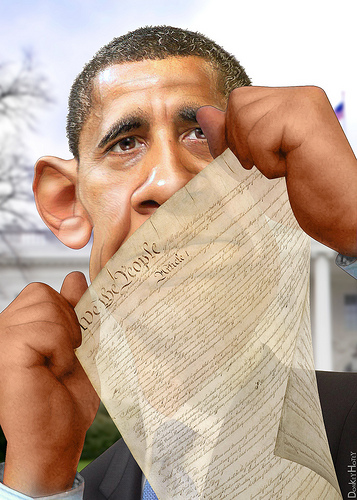
Pulitzer Prize winning journalist Chris Hedges is on the front lines of the battle to nullify section 1021 – the indefinite detention clause of the NDAA – along with professor Noam Chomsky, activist Daniel Ellsberg, and author Naomi Wolf. Less than one month after President Obama signed the bill into law, this astute group sued the federal government for clauses that are, at best, constitutionally vague. Consequentially, Manhattan Federal Court temporarily sided with the plaintiffs by having issued an injunction on the indefinite detention clause which has since been appealed by the Obama administration.

The call to nullify the NDAA continues to surge around the country. Last month, the Clark County Republican Party Central Committee of Nevada unanimously called for its appeal while legislators in Michigan are currently considering a bill that could virtually revoke the federal law in that state.

Additionally, Ben Swann of WXIX recently suggested the president, and some members of Congress, may be in direct violation of the very law that they created by recently supporting Al-Qaeda-affiliated Syrian opposition forces. He explains that “late last year, when Sen. John McCain co-wrote the National Defense Authorization Act, and President Obama signed it into law, they crafted a law that gave the president the authority to use all necessary and appropriate force during the current armed conflict with Al-Qaeda and the Taliban and associated forces, including the power to indefinitely detain anyone caught supporting Al-Qaeda, which in this case is the president and members of Congress.”

Oskar Mosco for Media Roots.

***

TRUTHDIG   [Section 1021] of the NDAA, signed into law by Obama on Dec. 31, 2011, obliterates some of our most important constitutional protections. It authorizes the executive branch to order the military to seize U.S. citizens deemed to be terrorists or associated with terrorists. Those taken into custody by the military, which becomes under the NDAA a domestic law enforcement agency, can be denied due process and habeas corpus and held indefinitely in military facilities. Any activist or dissident, whose rights were once protected under the First Amendment, can be threatened under this law with indefinite incarceration in military prisons, including our offshore penal colonies. The very name of the law itself—the Homeland Battlefield Bill—suggests the totalitarian credo of endless war waged against enemies within “the homeland” as well as those abroad.

In May, Judge Forrest issued a temporary injunction invalidating Section 1021 as a violation of the First and Fifth amendments. It was a courageous decision. Forrest will decide within a couple of weeks whether she will make the injunction permanent.

Barack Obama’s administration has appealed Judge Forrest’s temporary injunction and would certainly appeal a permanent injunction. It is a stunning admission by this president that he will do nothing to protect our constitutional rights. The administration’s added failure to restore habeas corpus, its use of the Espionage Act six times to silence government whistle-blowers, its support of the FISA Amendment Act—which permits warrantless wiretapping, monitoring and eavesdropping on U.S. citizens—and its ordering of the assassination of U.S. citizens under the 2001 Authorization to Use Military Force, or AUMF, is a signal that for all his rhetoric, Obama, like his Republican rivals, is determined to remove every impediment to the unchecked power of the security and surveillance state. I and the six other plaintiffs, who include reporters, professors and activists, will most likely have to continue this fight in an appellate court and perhaps the Supreme Court.

Read Chris Hedges’ complete article at Truthdig.

***

Photo provided by Flickr user DonkeyHotey.

Posted in Uncategorized | 1 Reply

A Look Back: Ike’s Last Call For Military Restraint

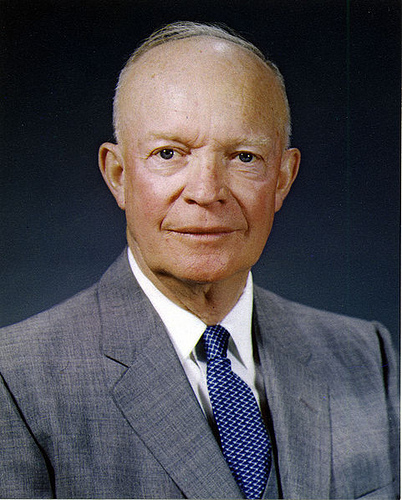
MEDIA ROOTS – The term “military-industrial complex” was originally coined by President Eisenhower in his final address as Commander-In-Chief and has since become a foreshadowing declaration to a country that may have lost its moral compass in pursuit of profits. “God help this country,” the President warned just a few weeks prior to this speech, “when someone sits in this chair who doesn’t know the military as well as I do.” Now it seems, with an annual defense budget of well over one trillion dollars, it has become a civic duty for all Americans to inform their peers of this misplaced power.
As the Supreme Commander of the Allied Forces in Europe, the coalition that defeated the Nazi regime, “Ike” was directly responsible for planning and commandeering the invasion of North Africa and France. Having honorably served in the United States Army for nearly four decades, Ike foresaw a not-so-distant future with the United States held prisoner to a tyrannous warfare industry.

“In the councils of government, we must guard against the acquisition of unwarranted influence, whether sought or unsought, by the military-industrial complex. The potential for the disastrous rise of misplaced power exists and will persist.”

Eisenhower was warning of the emergence of a developing element in society that must continuously be checked. The repercussions of failing to do so could ultimately alter the very foundations of human society. But was the career military officer just being dramatic during his last days in office?

“This conjunction of an immense military establishment and a large arms industry is new in the American experience. The total influence – economic, political, even spiritual – is felt in every city, every Statehouse, every office of the Federal government. We recognize the imperative need for this development. Yet we must not fail to comprehend its grave implications. Our toil, resources and livelihood are all involved; so is the very structure of our society.”

The future of American livelihoods were viewed to be at stake. What Ike was worried about was an America where citizens would continue to make their living from war. He was afraid that if future Americans continue to receive their paychecks directly from the military-industrial complex, then war would be here to stay.  

“Disarmament, with mutual honor and confidence, is a continuing imperative. Together we must learn how to compose differences, not with arms, but with intellect and decent purpose. Because this need is so sharp and apparent I confess that I lay down my official responsibilities in this field with a definite sense of disappointment. As one who has witnessed the horror and the lingering sadness of war – as one who knows that another war could utterly destroy this civilization which has been so slowly and painfully built over thousands of years – I wish I could say tonight that a lasting peace is in sight.”

Disappointed, Ike was afraid Americans would continue to support making war a way of life – affecting the citizenry spiritually – and result in a fascist society similar to that which Hitler had created. He worried that a militaristic fascist state would evolve with an abnormally-increased militaristic culture. He feared an ongoing global war – one that could ultimately destroy humanity – would continue as defense contractors profit from weaponry creation and distribution.

Now, more than fifty years later, have Eisenhower’s worst fears been actualized?

Tom Ball is a guest contributor for Media Roots.

***


When President Eisenhower addressed the nation with three days left in his presidency,

he warned of the dangerous complex that exists between military might and corporate profits.


***

Photo provided by Flickr user Infrogmation.


Israel Curious, Part 1 of 3: Espionage

MEDIA ROOTS – The AP recently reported that Israel is still considered the premier counterintelligence threat to the CIA’s Near East Division. Other media have reported similar findings over the years. The Associated Press has reported the fundamental paradox underlying the U.S.-Israel relationship: Israel spies ferociously against the United States, while the U.S. Congress and Executive Branchwork overtime to support Israel “unconditionally.”

Best friends

During a March 2011 trip to Israel, U.S. Defense Secretary Robert Gates commented how he couldn’t recall an era in his decades of public service when any two countries shared a closer military relationship than the United States and Israel. He remarked that the U.S. and Israel are cooperating closely in many areas including missile defense technology. One must wonder what Robert Gates, a veteran of the Cold War, thought about the September 2010 arms deal signed between Israel and Russia, Mossad’s decision to withhold vital intelligence from the USA regarding an imminent truck bomb, which killed over 240 U.S. Marines on 23 October 1983 (Ostrovsky: 320-322), Israel’s sale of U.S. military technology to China, or the June 2012 revelation that Israel and Russia are cooperating together to develop an advanced unmanned aerial vehicle. Gates eventually summoned a modicum of courage behind closed doors and referred to Israeli Prime Minister Benjamin Netanyahu as an “ungrateful ally.” 

In his capacity as U.S. Secretary of Defense, Gates was undoubtedly aware that Israel spies ferociously on the United States, obtains U.S. weaponry through licit and illicit means, and bootlegs U.S. military technology with a precision that puts Beijing to shame. Despite this threat, the CIA doesn’t spy on Israel; Even though Israel is theoretically an intelligence target, most of the U.S. Intelligence Community refrains from spying on Israel due to “the complexities of U.S./Israel politics” (Jones: 50). Espionage against Israel is mostly limited to counter-intelligence work, which is conducted stateside by the FBI.

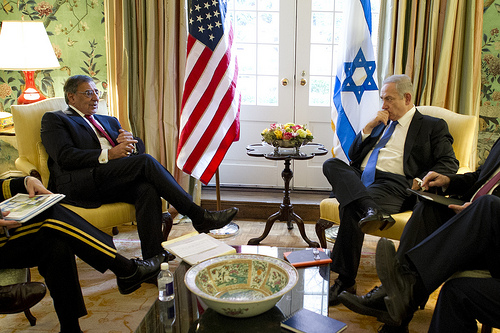
Leon Panetta, who succeeded Robert Gates as U.S. Defense Secretary, traveled to Israel in October 2011. Panetta’s trip mirrored Gates’ in many ways. Following the United States’ great tradition of sycophancy towards Israel, Panetta expressed his pleasure that “the United States and Israel have a closer defense relationship today than ever in history,” in traditional areas as well as in missile defense technology, counterterrorism and joint military exercises. Sound familiar? According to Panetta, this relationship “is yielding tangible benefits” and “helping to save lives.” Like Gates, Panetta reaffirmed “the unshakeable commitment of the United States to the security of Israel,” citing specifically the battery of Iron Dome rockets given to Israel, courtesy of the U.S. taxpayers. At the beginning of August, Secretary Panetta returned to Tel Aviv and pledged fiscal and military fidelity to the Israeli government.

The trips undertaken by Gates and Panetta “reaffirm” Israel’s “security,” while making no mention of the Palestinians’security.” Both trips witness U.S. and Israeli defense officials discussing Iran’s nuclear program, while making no mention of Israel’s substantial nuclear arsenal. Both trips cite “security challenges” such as “violent extremism,” “terrorism,” and “adversarial states.” Although giving arms to Israel benefits the U.S. military-industrial complex tremendously, supporting Israel unconditionally muddles the United States’ ability to act as an impartial mediator. In other words, annually feeding the Israeli government billions of dollars exposes the United States as the world’s worst arbiter. Perhaps unintentionally, the trips undertaken by U.S. defense officials showcase how the U.S. taxpayer subsidizes the Israeli Defense (sic.) Force.  

Deeply comprimised

Israel consistently ranks among the top perpetrators of espionage against the United States, rivaling China and Russia in certain metrics, particularly economic espionage. Israeli intelligence permeates the U.S. Intelligence Community to an alarming extent through elaborate front companies, wiretapping firms, and individual Mossad assets. Simply put, Israel’s operations within the United States are extensive:

“In 2004, the authoritative Jane’s Intelligence Group noted that Israel’s intelligence organizations ‘have been spying on the U.S. and running clandestine operations since Israel was established.’ The former deputy director of counterintelligence at FBI, Harry B. Brandon, last year told Congressional Quarterly magazine that ‘the Israelis are interested in commercial as much as military secrets. They have a muscular technology sector themselves.’ According to CQ, ‘one effective espionage tool is forming joint partnerships with U.S. companies to supply software and other technology products to U.S. government agencies.’”

Stewart Nozette, a noted scientist with a high-level security clearance, was one of the most recent arrests in the FBI’s uphill struggle against Israeli espionage. In true diplomatic cowardice, “the indictment does not allege that the government of Israel or anyone acting on its behalf committed any offense under U.S. laws in this case.” Stewart is expected to serve only 13 years for treason. Numerous individuals have been investigated on allegations of spying for Israel, with many investigations closed prematurely. Individuals include Jonathan Pollard, Richard Perle, Douglas Feith, Ben-Ami Kadish, David A. Tenenbaum, and Larry Franklin. The Mossad operatives who run spies are never pursued.

Yona Meztger, Ashkenazi Chief Rabbi of Israel, has recently called for Jonathan Pollard’s release. Prime Minister Netanyahu even granted Pollard Israeli citizenship while Pollard served his jail sentence in the United States. In spring 2011, two-thirds of Israeli parliamentarians even had the gall to petition the U.S. Embassy for Pollard’s release from U.S. prison. In spring 2012, both the Israeli Prime Minister and President appealed directly to the U.S. President for Pollard’s release.

In a rare display of backbone, Defense Secretary Panetta actually defended the United States’ decision to keep Pollard incarcerated for the duration of his term. “There is a great deal of opposition to the release of Pollard that goes back to the fact that obviously he was convicted as a spy,” Panetta mustered. “And I think for that reason the President and others have indicated that the position of the United States is not to release him.”

Mossad operatives have no problem obtaining secrets, given the following figures: roughly 854,000 U.S. citizens possess top-secret security clearances; an estimated 2,000 distinct companies perform classified work for the U.S. government; and numerous U.S. citizens within the Intelligence Community look upon Israel through religious lenses, which is a helpful lever often pulled by Mossad.

Even Fox News, which is typically taciturn on all issues that put Israel under the microscope, couldn’t ignore Israel’s espionage against the United States. In November of 2001, Fox News journalist Carl Cameron reported nearly 200 Israeli operatives were rounded up by U.S. counterterrorism officials in years leading up to 11 September 2001. This is by no means an implication of the Israeli government in the 9/11 attacks, but it is a clear sign that Israel strives daily to obtain the industrial, Executive, intelligence and military secrets of the United States.

Modern efforts to spy on the United States are part of a storied Israeli history, which shows little regard for the welfare of its target. In 1954, Israeli operatives (read: terrorists) bombed U.S. diplomatic buildings throughout Egypt in Operation Susannah. This false-flag attack was designed to trick the United States into war with Egypt, serving Israel’s regional interests. In 2005, much to the disgust of the international community, Israeli President Moshe Katsav presented nine of the surviving operatives with certificates of appreciation for their work. Other instances of Zionism’s history of manipulation and terrorism include bombing the King David Hotel in 1946; attacking the USS Liberty in 1967; murdering Rachel Corrie and Furkan Dogan, both of whom were U.S. citizens; and posing as CIA personnel when recruiting Iranian operatives. Such cheek knows no equal on the international stage.

Criticism of Israel is necessary from a U.S. standpoint. Current levels of U.S. generosity towards Israel are foolish, wasteful, and unsustainable, considering other places where taxpayer money could be allocated. Fortunately, all such policies are amendable: the billions of dollars given to Israel each year, the United States’ perpetuation of regional conflict by feeding the IDF weaponry, and protecting Israel from justifiable international criticism through using United Nations Security Council veto power. Criticism of U.S. unconditional support for Israel can only commence in earnest through access to these facts. In this respect, the United States needs to join the world community. All other nations, unaffected by AIPAC’s ferocity, although rife with their own Zionist lobbies, have greater abilities to see clearly.

Christian Sorensen for Media Roots.

The next installments in this series will further examine the protection of Israeli colonialism by United States federal, state, and local governments.

***

Photo by Flickr user Secretary of Defense.

Posted in Uncategorized | 1 Reply