Media Roots Radio: Cambridge Analytica Private Mercenaries, Blue Planet & Jones/Stone/Neocon Alliance

Abby and Robbie Martin give tribute to renowned physicist Stephen Hawking, talk about Cambridge Analytica using Facebook data to target voters, and how the company acts as a shadowy private intelligence firm that carries out psyops and regime change ops around the world at the behest of Robert Mercer and other oligarchs.

Abby explains the most amazing underwater discoveries in the new Blue Planet series, including an octopus creating a sea shell suit and the vast communication networks that exist across ocean species. They talk about the new Waco miniseries, and the ATF/FBI attack on the compound where 80 people were massacred, the majority women and children.

In light of John Bolton being appointed as Trump’s National Security Advisor, they describe the bizarre trajectory of Alex Jones and Roger Stone–going from ‘fighting the deep state’ to building an open alliance with Bush-era neoconservatives.

Thanks for listening! If you enjoyed this podcast please consider donating to Media Roots Radio on Patreon.

Posted in Uncategorized | 1 Reply

Monsanto, America’s Monster

MONSANTO HYPNOSIS

Last month, the University of San Francisco made an alarming discovery, that 93% of Americans tested had traces of a chemical called glyphosate in their urine. Last year, the World Health Organization deemed glyphosate a “possible carcinogen”.

Glyphosate is the main ingredient in biotech giant Monsanto’s flagship product: Roundup, an herbicide sprayed all over almost every acre of food grown. Not only has Roundup been dumped around the world more than any other weed killer in history, but the US is its largest customer. According to the US Geological Survey, a record 280 million pounds were used in 2010 alone, nearly a pound of poison for every American.

Monsanto has already proven it cannot be trusted to care about anything but money, especially when lives are at stake. In this episode of The Empire Files, Abby Martin issues a scathing exposé on the corporate polluter, chronicling its rise to power, the collusion of its crimes with the US government, and the serious danger it poses today.


Monsanto, America’s Monster

***

FOLLOW // @EmpireFiles & @AbbyMartin

WATCH // YouTube.com/EmpireFiles


The Climate Change “Debate” and Marketization of Nature: Everyone Loses

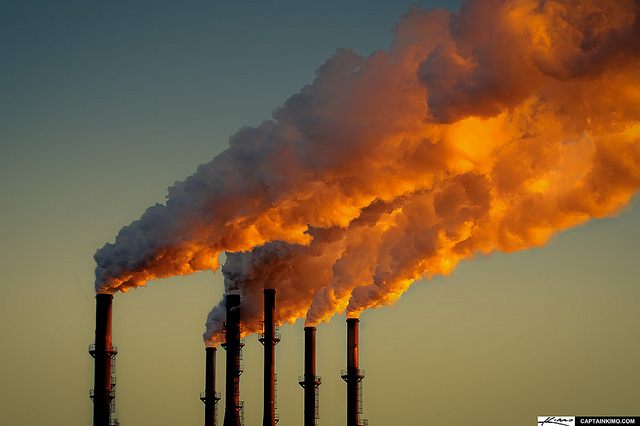
FactoryFlickruserKimSengDespite near-unanimous global scientific and governmental consensus that global warming is accelerating due to human activity, debating this fact is still a favorite political pastime in the United States.

Governments around the world acknowledge the science that connects industrialization, increased greenhouse gas emissions, and their detrimental impact on the climate, and are currently acting upon solutions. Yet the US, one of the largest greenhouse gas producers, has repeatedly refused to participate in global climate reform. To further confound this reality, the November midterm elections placed ardent climate-change deniers in line for senior legislative environmental policy positions.

Meanwhile, the evidence continues to mount. An abundance of reports show that not only does climate change exist, but that it’s human-induced and will cause severe and non-reversible negative consequences for the planet. Most recently, the Intergovernmental Panel on Climate Change (IPCC) released its 2014 Climate Change Report, which states the observed changes in the climate are “unequivocal” and that carbon dioxide, methane and other greenhouse gas emissions have increased exponentially in the past 60 years. The majority of carbon emissions are absorbed into the ocean, causing rapid acidification which has already caused mass die-offs.

Despite having presented overwhelming evidence from over 130 countries that support this conclusion, IPCC reports continue to be attacked by US media outlets. In 2007, minor errors in the Climate Change Report were widely exploited to justify a denial of its findings, forcing scientists in the US to respond in an open letter. Instead of acknowledging climate change science, the US media continues to distort reality by creating a false equivalency between the two sides.

Additionally, when extreme weather phenomenons are reported, climate change is rarely mentioned as a contributing factor. Project Censored found that out of 450 news segments about weather anomalies in 2013, only 16 of them mentioned climate change.

One may be inclined to believe that politicians who deny man-made climate change are innocuously naïve, but many times they are consciously furthering the neoliberal business agenda at the expense of the planet. Accepting the true human impact on the world would mean instilling regulations to curb pollution, which would cut into corporate profits. As Naomi Klein keenly elucidates, the destructive nature of neoliberalism does not lend itself to a sustainable environment, now or ever. Free-market advocates don’t look at earth resources beyond market shares, and their corporate mantra is to continuously maximize profits.

Fossil fuel companies know their time is running out, so they’ve launched a propaganda war to confuse the American public about climate change, raising serious questions about democracy and the right to information. Journalist George Monbiot has extensively researched the ties between oil companies and the reproduction of climate change disinformation. As Abby Martin on Breaking the Set revealed, those who want to protect oil interests fund think-tanks with the sole aim of derailing climate change evidence and environmental advocacy.

One example of intentionally manipulating public opinion is EPA Facts, whose single purpose is to debunk research by the Environmental Protection Agency. Sourcewatch describes it as a “front group operated by the PR firm Berman & Co.” which manages several similar groups that work to further market fundamentalism, including anti-minimum wage campaigns, food safety, and a host of other social policies. Another egregious example of this collusion is the American Enterprise Institute. This Exxon Mobil-funded think tank blatantly offered funding to scientists and academics that could produce research to dismiss human caused climate change.

Other industries that contribute significantly to greenhouse gas emissions, such as the beef industry, also have ties to climate change denial. A report by the 2006 UN Food and Agriculture Organization (FAO) found that livestock production is responsible for up to 18 percent of total emissions, more than all transportation combined. Coincidentally, Koch Industries, which oversees Matador Cattle Company, has consistently funded climate change denial.

These astroturf groups have subverted the dialogue, toxified the political process and halted environmental progress. Sociologist Robert J. Bruelle found just how prevalent they are too, with at least 140 organizations existing solely to poison the well and delay legislative action on climate change. Mega rich donors who also want to chip in are becoming more savvy in their funding techniques, using third-party agencies such as Donors Capital Fund to anonymously funnel money into neoliberal policies. As the Guardian revealed last year, anonymous billionaires donated up to $120 million to anti-climate groups to discredit the scientific consensus using Donors Trust.

As journalist Lee Fang discussed on Democracy Now, Republicans who deny man-made climate change and are largely backed by fossil fuel companies will soon be in key positions to block environmental policies. This includes Senator Jim Inhofe in the Environment Committee, Senator Ron Johnson in the Homeland Security and Government Reform Committee, and possibly Senator Ted Cruz in the Science Subcommittee, which controls federal scientific research. Beyond their proclaimed skepticism or outright denial of climate change, these leaders’ ties with oil giants will dismiss any chance of judicious policy decisions.

Because campaign funding is intimately tied to corporate interests, Americans must recognize the influence that corporations and politicians have on media, advertising, think-tank research, and other avenues of information. It’s also a critical time to recognize neoliberalism (or market-fundamentalism) as a toxic system that places corporate profit over any chance for democracy. Acknowledging climate change as a global reality is the first step to demanding sustainable environment policies and proper investment in renewable energy sources.

Other countries are quickly progressing on this front. Germany’s Energiewende project (energy transition plan) has successfully turned nearly one-third of their electricity production carbon-free over the past ten years, and are projected to be 100% renewable as early as 2050. The country’s renewable plan uses electricity through solar photovoltaic and onshore wind power energy.

The US could do this too. Dr. Mark Jacobson from Stanford University developed a plan for America to shift to 100 renewables by 2050, tailoring the proposals for each state based on regional resources available. California, for instance, would meet its energy needs by switching to 55% solar, 35% wind, 5% geothermal, and 4% hydroelectric power. Details of the intricate plan include land requirements, projected cost and savings, expected job creation, and how the proposed trade-off would significantly reduce pollution and global warming emissions.

Plans like this demonstrate the potential the US has in shifting its energy policies and being a leader in sustainable development. Rather than watching the fictitious ‘climate change’ debate unfold, the American public should be aggressively advocating for the development and implementation of green energy plans. It is now or never, and unfortunately, the planet cannot wait.

Written by Sabrina Nasir

Photo by flickr user Kim Seng

Posted in Uncategorized | 1 Reply

How Words Absolve Pillaging and Mass Murder

WordsFlickrKool_SkatkatObama’s election marked a new dawn for hundreds of millions of people, who were looking to an eloquent, constitutional lawyer for “Hope” and “Change” in America. However, it quickly became apparent that Obama had little substance beyond the slogans branded by his campaign.

With a little more than a year left in his presidency, his milquetoast legacy has been embodied by his greatest skill: wordcraft. Obama’s team has continued, if not exacerbated, most Bush era policies, simply rebranding them in order to appease and confuse the public into compliance.

One of the first things his administration did was declare an end to the “War on Terror” that the Bush sociopaths launched worldwide. Turns out, all they wanted to do was stop calling it a “War on Terror,” making clear that any further military involvement abroad would simply be called “Overseas Contingency Operations.”

Six years later, and the Nobel Peace Prize winning president has bombing campaigns in seven different countries under his belt. And the casualties of the empire’s plunders? Collateral damage.

There are also new terms for war. When US and NATO bombed the hell out of Libya resulting in the failed state we see today, it wasn’t a war. No, it was merely a “Kinetic Military Action,” according to government officials.

Torture is now “enhanced interrogation techniques”, and the act of kidnapping and exporting torture is simply called “extraordinary rendition”.

Whenever the administration sends predator drones to bomb people around the world, they’re just “surgical strikes” targeting “militants”. However, simply being military aged male constitutes someone as a militant, and according to the Bureau of Investigative Journalism, less than four percent of drone victims in Pakistan are officially listed as al Qaeda.

When Obama’s cabinet dropped the term “enemy combatant”, it was a purely symbolic move to distance itself away from the Bush Guantanamo era. Unfortunately, over 140 men still remain rotting away in the notorious prison despite what they’re now called on paper. And when these prisoners go on a hunger strike, it’s now called a “long term non-religious fast”.

As journalist Glenn Greenwald reminds us, altering the names of policies doesn’t change the fact that they’re still happening:

“The Obama administration…makes only the most cosmetic and inconsequential changes – designed to generate headlines misleadingly depicting a significant reversal – while, in fact, retaining the crux of Bush’s extremist detention theory.”

Obviously this rebranding tactic wasn’t invented by Obama’s PR team. 

Propaganda was propelled with the advent of PR genius Edward Bernays and later Nazi mastermind Joseph Goebbels, whose powerful techniques have been perfected and employed for decades by governments worldwide. Disturbing Newspeak phrases that absolve their pillaging and mass murder have permeated society and warped our interpretation of reality.


How Words Absolve Mass Murder

The term “Mowing the Lawn” is what governments say to allude to the literal mowing down of civilians. Shockingly, the callous term has been used not only by Israeli military commanders in reference to the recent bloodbath of Palestinians, but it’s also been used by Obama’s counter-terrorism adviser Bruce Riedel who said this about drone strikes:

“You’ve got to mow the lawn all the time. The minute you stop mowing, the grass is going to grow back.”

If you think that’s bad, officials also use the cute phrase “Shake ‘n Bake” to refer to using banned white phosphorus before blowing up people with high grade explosives. Administrators also think so lowly of the people they’re killing with flying robots that they brutishly call them “bug splats”.

Beyond war, in today’s cut throat capitalist world overrun by neoliberal doctrine, there’s a language of dehumanization employed towards everything, spoken among the elite class and policy heads in order to keep things running efficiently.

As the Guardian points out, the term “cleansing the stock” is actually used to describe excess human beings by parliamentarians. After all, you can’t afford to actually feel emotion, empathy or sorrow for the paupers at the bottom of the totem pole.

Unsurprisingly, when it comes to the natural world, the language is even more crude.

According to journalist George Monbiot,

“Nature is “natural capital”. Ecological processes are ecosystem services, because their only purpose is to serve us. Hills, forests and rivers are described in government reports as green infrastructure. Wildlife and habitats are asset classes in an ecosystems market. Fish populations are invariably described as stocks, as if they exist only as moveable assets from which wealth can be extracted – like disabled recipients of social security.”

All of these devaluing terms have seeped into mainstream consciousness, dutifully repeated by media figures and then, by us.

Words hold tremendous power, and if we don’t reclaim our language and start seeing people instead of “militants”, drone victims instead of “bug splats”, or natural splendor instead of “green infrastructure”, then the voiceless are destined to be silenced forever.

Follow me at @AbbyMartin

BP’s Oil Spill: Criminal Negligence, Thousands Still Sick & A Gulf Graveyard Left Behind

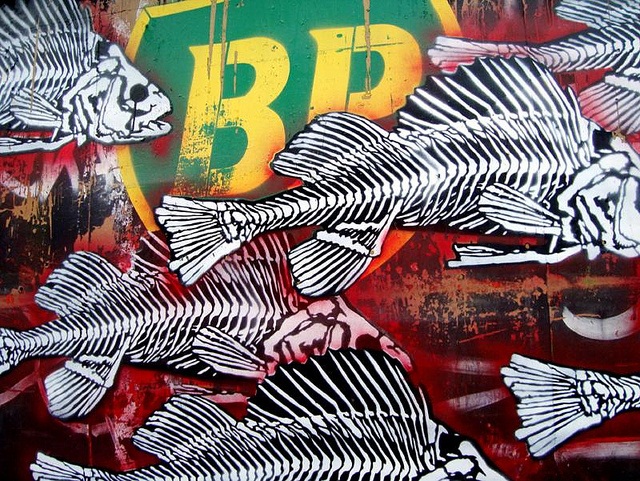
BP dead flickr user thierry ehrmannAfter BP agreed to pay $4.5 billion to the government, and another $9.2 billion in penalties since its catastrophic oil spill, a new ruling has put the corporation under fire again.

A US District Judge has found BP grossly negligent and it’s subcontractors, Halliburton and TransOcean, negligent for their roles in the 2010 Deepwater Horizon explosion and subsequent dumping of more than 210 million gallons of toxic sludge into the Gulf of Mexico, killing 11 people and countless marine creatures in the process. Under the Clean Water Act, the new ruling could effectively quadruple the penalty per barrel spilled that BP will have to pay.

BP’s criminal negligence shouldn’t come as a surprise. After nine years at sea, company management acknowledged that the Deepwater drilling rig was in decline and presented a quote “intolerable risk” to safety, yet chose to do nothing. Halliburton also plead guilty to the destruction of key evidence related to the company’s shady cost-cutting practices like failing to inspect the well’s cement mixture, and using only six of the recommended 21 centralizers to secure the site.

Besides the massive damage that’s been done to the environment as a result of the BP disaster, the health impact on humans continues – largely because of the decision by BP and the EPA to spray nearly two million gallons of a dispersant called Corexit onto the water, making the oil 52 times more toxic, according to the Environmental Pollution Journal.

All this aside, BP’s contracts with the Defense Department have more than doubled in the years since the disaster.

Even though the media is fatigued with its coverage of this disaster, Breaking the Set went down to the Louisiana Gulf Coast to see how the region is faring nearly five years later and to investigate the spill’s lasting damagesWe learned that hundreds of thousands of people are still sick, and that the oil industry has turned the once vibrant shore into a graveyard.

Abby

**

BP’s Oil Spill: Criminal Negligence, Thousands Sick & Gulf Graveyard Left Behind

**

Exclusive coverage includes interviews with Jorey Danos, a sick clean-up worker who was exposed to a toxic chemical dispersant known as Corexit, award winning toxicologist Wilma Subra, Gulf Restoration Network’s Jonathan Henderson and Clint Guidry, President of the Louisiana Shrimpers Association.

We also reached out to BP, which provided the following statements:

Q: Why were cleanup workers refused respirators and even threatened with termination if they requested them, according to multiple interviews with clean-up workers and the Louisiana Environmental Action Network?

A: We certainly do not and would not retaliate against workers. BP worked closely with OSHA, the US National Institute for Occupational Safety and Health (NIOSH) and other US government agencies to take extraordinary measures to safeguard the health and safety of responders.

Workers were provided safety training and appropriate personal protective equipment (PPE), and were monitored by federal agencies and BP to measure potential exposure levels and to help ensure compliance with established safety procedures.

Response workers applying dispersants received training on work procedures and PPE usage designed to minimize exposures, and were provided respirators and other PPE.

Workers who were not exposed to dispersants may have asked for a respirator, possibly in the mistaken belief that it would provide an extra level of protection and safety. This is not true. Perhaps the most important consideration in voluntary respirator usage is the potential physiological burden placed on the user. That was particularly true given the hot working conditions encountered during the response.

Due to the extensive controls in place, there was little potential for worker or public exposure to dispersants. More than 30,000 air monitoring samples were collected by the Coast Guard, OSHA, NIOSH, and BP as part of a comprehensive air monitoring program to evaluate the potential for human exposure to dispersant and oil compounds. The results showed that response worker and public exposures to dispersants were well below levels that could pose a health or safety concern.

Additional Background: OSHA advises that, “in workplaces with no hazardous exposures, but where workers choose to use respirators voluntarily, certain written program elements may be necessary to prevent potential hazards associated with respirator use. Employers must evaluate whether respirator use itself may actually harm employees. If so, employers must medically evaluate employees and, if necessary, restrict respirator use…”

For these reasons, respirators typically are not provided to people who do not need them, and who have not passed the required tests for fitness to wear the equipment. In consultation with NIOSH and OSHA, BP developed guidelines to help determine when PPE, including respirators, was to be used. Known as the “PPE Matrix,” this guideline was made available on several websites, including websites for BP and OSHA. Under the PPE Matrix, respirators were to be used in specifically- identified situations, including during the application of dispersants. There were times, however, when the potential risks associated with using a respirator outweighed the benefits since air monitoring data indicated that worker exposures to chemicals of concern generally were well below occupational exposure limits, and respirator use could place physiological stress on the body. In those cases, protection was provided by work practices and procedures and the use of other PPE.

A paper reviewing OSHA and NIOSH’s response to the accident can be found here.

Q: Why was the public told that Corexit was as harmless as Dawn, when five of the ingredients in it are linked to cancer, 33 are linked to skin irritation and 11 are respiratory toxins, according to expert toxicologists, Wilma Subra and Dr. Susan Shaw?

A: The Material Safety Data Sheet (MSDS) for Corexit, where human exposure characterization is addressed notes, “Based on our recommended product application and personal protective equipment, the potential human exposure is: Low.” Also, Section 16 of the MSDS characterized Corexit’s general product risk- “The human risk is: Low. The environmental risk is: Low.”

The same ingredients contained in Corexit are also found in common consumer products such as household cleaners, food packaging, hand lotion and cosmetics. The product ingredients alone do not determine if a compound has created a public health concern; there must also be exposure to a compound at levels and for sufficient duration that could cause harm.

The results of extensive monitoring conducted by federal agencies and BP show that response workers and the public simply were not exposed to dispersant compounds at levels that might pose a health risk.

Due to the controls in place during dispersant application operations, there was little potential for public or worker exposure when dispersants were applied to the oil offshore. This was confirmed by the government findings as previously mentioned.

Q: Why has the active cleanup of Louisiana’s coast officially ended when thousands of tar balls continue to wash on shore?

A: The Coast Guard ended active cleanup after an extensive four-year effort. Even so, we remain committed and prepared to respond at the Coast Guard’s direction if potential residual Macondo material is identified through the National Response Center reporting process and requires removal. We have teams and equipment at staging areas in Grand Isle, LA and Gulf Shores, AL ready to rapidly respond as necessary.

Additionally numerous studies and reports have documented the presence of tar balls along the Gulf coast in the decades before the Deepwater Horizon accident, and during our cleanup efforts we continued to find tarballs that did not contain residual Macondo oil.

Q: Why have only 148 people received any medical claim whatsoever well over four years after the disaster and why is the average benefit only $1,600 dollars, when doctors such as Michael Robichaux has studied hundreds of patients and observed long term and possibly lifelong health effects in the process?

A: BP and the PSC consulted with medical experts to determine compensation amounts and formulate a list of the conditions that, according to scientific evidence, could be caused by exposure to oil or to the dispersants used in the cleanup. Compensation for these listed conditions is subject to the clear terms of the MSA. As is common in class action settlements, the settlement program did not begin processing and paying out claims until all appeals were exhausted, which occurred earlier this year. As to Dr. Robichaux, his allegations were considered and rejected over a year ago by a New Orleans federal court, which found that the doctor “wholly failed to provide any competent evidence in support of the assertions he makes.”

**

Follow me @AbbyMartin

Art by flickr user Hierry Ehrmann

Posted in Uncategorized | 1 Reply