GUARDIAN– The young marine lit a cigarette and let it dangle. White smoke wafted
around his helmet. His face was smeared with war paint. Blood trickled
from his right ear and the bridge of his nose. Momentarily deafened by
cannon blasts, he didn’t know the shooting had stopped. He stared at the
sunrise. His expression caught my eye. To me, it said terrified,
exhausted and glad just to be alive. I recognised that look because
that’s how I felt too. I raised my camera and snapped a few shots.
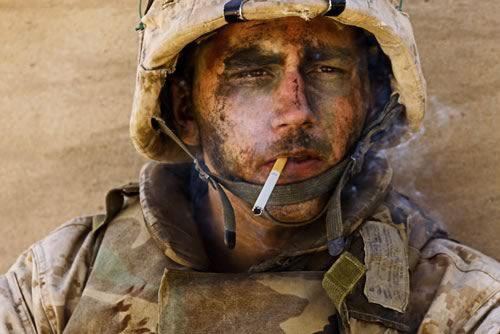 With
the click of a shutter, Marine Lance Corporal James Blake Miller, a
country boy from Kentucky, became an emblem of the war in Iraq. The
image would change two lives – his and mine.
With
the click of a shutter, Marine Lance Corporal James Blake Miller, a
country boy from Kentucky, became an emblem of the war in Iraq. The
image would change two lives – his and mine.
I was embedded with
Charlie Company of the 1st Battalion, 8th Marine Regiment, as it entered
Falluja, an insurgent stronghold in Iraq’s Sunni Triangle, on 8
November 2004. We encountered heavy fire almost immediately. We were
pinned down all night at a traffic circle, where a six-inch kerb offered
the only protection. I hunkered down in the gutter that endless night,
praying for daylight, trying hard to make myself small. A cold rain came
down. I cursed the Marines’ illumination flares that wafted slowly
earthward, making us wait an eternity for darkness to return.
At
dawn, the gunfire and explosions subsided. A white phosphorus artillery
round burst overhead, showering blazing-hot tendrils. We came across
three insurgents lying in the street, two of them dead, their blood
mixing with rain. The third, a wiry Arab youth, tried to mouth a few
words. All I could think was: ‘Buddy, you’re already dead.’
We
rounded a corner and again came under heavy fire, forcing us to scramble
for cover. I ran behind a Marine as we crossed the street, the bullets
ricocheting at our feet. Gunfire poured down and it seemed incredible
that no one was hit. A pair of tanks rumbled down the road to shield us.
The Marines kicked open the door of a house and we all piled in.
Miller
and other Marines took positions on the rooftop; I set up my satellite
phone to transmit photos. But as I worked downstairs in the kitchen, a
deep rumble almost blew the room apart. Two cannon rounds had slammed
into a nearby house. Miller, the platoon’s radioman, had called in the
tanks, pinpointed the targets and shouted: ‘Fire!’
I ran to the
roof and saw smouldering ruins across a large vacant lot. Beneath a heap
of bricks, men lay dead or dying. I sat down and collected my wits.
Miller propped himself against a wall and lit his cigarette. I
transmitted the picture that night. Power in Falluja had been cut in
advance of the assault, forcing me to be judicious with my batteries. I
considered not even sending Miller’s picture, thinking my editors would
prefer images of fierce combat. The photo of Miller was the last of 11
that I sent that day.
On the second day of the battle, I called my
wife by satellite phone to tell her that I was OK. She told me my photo
had ended up on the front page of more than 150 newspapers. Dan Rather
had gushed over it on the evening news. Friends and family had called
her to say they had seen the photo – my photo.
Soon, my editors
called and asked me to find the ‘Marlboro Marine’ for a follow-up story.
Who was this brave young hero? Women wanted to marry him. Mothers
wanted to know whether he was their son. I didn’t even know his name.
Shellshocked and exhausted, I had simply identified Miller as ‘a Marine’
and clicked ‘send’.
I found Miller four days later in an
auditorium in the city’s civic centre. Miller’s unit was taking a break,
eating military rations. Clean-shaven and without war paint, Miller,
20, looked much younger than the battle-stressed warrior in the picture –
young enough to be my son. He was co-operative, but embarrassed about
the photo’s impact back home.
Once our story identified him, the
national fascination grew stronger. People shipped care packages, making
sure Miller had more than enough smokes. President Bush sent cigars,
candy and memorabilia from the White House. Then Major General Richard F
Natonski, head of the 1st Marine Division, made a special trip to see
the Marlboro Marine. To talk to Miller, Natonski had to weave between
earthen berms, run through bombed-out buildings and make a mad sprint
across a street to avoid sniper fire before diving into a shattered
store front. ‘Miller, get your ass up here,’ a first sergeant barked on
the radio.
Miller had no idea what was going on as he ran through
the rubble. He snapped to attention when he saw the general. Natonski
shook Miller’s hand. Americans had ‘connected’ with his photo, the
general said, and nobody wanted to see him wounded or dead. ‘We can have
you home tomorrow,’ he said.
Miller hesitated, then shook his
head. He did not want to leave his buddies behind. ‘It just wasn’t
right,’ he told me later. ‘Your father raised one hell of a young man,’
the general said, looking Miller in the eye. They said goodbye and
Natonski scrambled back to the command post.
For his loyalty,
Miller was rewarded with horror. The assault on Falluja raged on,
leaving nearly 100 Americans dead and 450 wounded. The bodies of some
1,200 insurgents littered the streets. As the fighting dragged on, the
story fell off the front page. I joined the exodus of journalists going
home or moving to the next story. More than a year and a half would pass
before I saw Miller again.
Continue reading about the Marlboro Marine.
© GUARDIAN, 2007



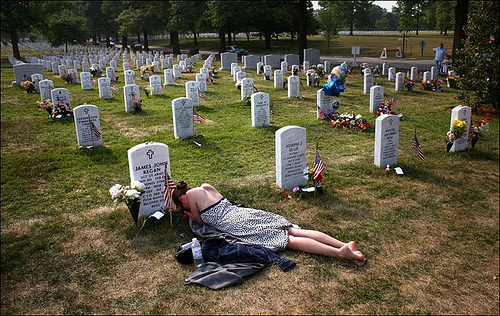 YAHOO NEWS– A man with explosives strapped to his body blew himself up in a
crowd, bombers struck a southern city and gunmen sprayed fire on
security checkpoints in attacks Monday that killed at least 100 people —
most of them in Shiite areas — in Iraq’s deadliest day this year.
YAHOO NEWS– A man with explosives strapped to his body blew himself up in a
crowd, bombers struck a southern city and gunmen sprayed fire on
security checkpoints in attacks Monday that killed at least 100 people —
most of them in Shiite areas — in Iraq’s deadliest day this year.
 With
the click of a shutter, Marine Lance Corporal James Blake Miller, a
country boy from Kentucky, became an emblem of the war in Iraq. The
image would change two lives – his and mine.
With
the click of a shutter, Marine Lance Corporal James Blake Miller, a
country boy from Kentucky, became an emblem of the war in Iraq. The
image would change two lives – his and mine. CNS NEWS