The hallowed halls of a once respected US government are now filled with the hollow promises of an impotent governing class. In a political landscape riddled with indecision, political pageantry and growing despotism, the people are hungry for a leadership that represents them. Instead, we are faced with a corporatocracy – one hellbent on the consolidation of wealth and power rather than the proliferation of freedom and justice.
Believe it or not, there was a time when representative government worked on behalf of the people, but those days have long succumbed to the political distortions of misguided leaders. Thus, the age old questions remain: If it is possible to revitalize the self-governing power potential of the ‘We the People’, then what might be a viable alternative or how might we augment the current system to provide the infrastructure for a change of guard? Perhaps by looking to the revolutionary ideas of the internet and the co-creative force of its users and developers we can begin to find the answers.
One of the groundbreaking ideas that the internet has provided is that of open-source development, which promotes the universal access to a product’s design as well as redistribution of that design. This developmental model set by programmers and software developers exemplifies the highest order of free trade, and serves to utilize the best ideas for the overall benefit of the system. If we are to apply a similar model as the framework for government, we begin to see parallels between open-source programming and the ideas put forth by America’s founding fathers.
Unfortunately, the fundamental ideology of the US political system has been absent from view for quite some time. The growing disconnect between the people and their representatives has led to a lag in public representation, thus resulting in a severe lack of people’s interests and ideas being properly expressed by US legislation.
A recent example of this contrast is illustrated in the debate over the legalization of marijuana, where an overwhelming public support for legalization has not been echoed by the government, nor the legislation regarding the issue. However, the ‘War on Drugs’ is only one of many examples which illustrates the delay we are experiencing in our current democratic process.
In a world where efficiency and speed are essential to human progress, it’s unfortunate that our legislative powers have become cumbersome and inefficient. However, the internet’s crowd-sourcing concept could provide us with the possibility to facilitate some level of autonomy, where the average individual has the ability to exercise their right to self-representation.
The idea of crowd-sourcing was first referenced by Jeff Howe of Wired magazine, and can be best understood as the purposeful re-appropriation of resources for achieving a particular goal by an indeterminate group of individuals. Much like open-source programming which relies upon a multitude of contributors, so too does crowd-sourcing rely upon the involvement and contributions of the collective.
There are many examples of crowd-sourcing being used throughout the internet today. Chemists have crowd-sourced protein folding techniques, YouTube has done so with entertainment, Facebook with different language versions of it’s site, while politicians and artists alike have crowd-sourced funding for their campaigns and projects. If this is a successful tool for science, entertainment and finance, couldn’t it also be possible to apply crowd-sourcing to politics?
Endless possibilities could present themselves once we focus the “spare processing power of millions of human brains” towards the evolution of political representation. For example, a truly participatory system could unfold which no longer relies upon single individuals to represent the will of many, but instead allows all people to become micro-leaders in a process of collective representation. Although this idea may seem farfetched, it’s not far from the framework that helped to build this country’s political ideology.
The founding fathers believed that public office should be held by its citizens, to act as contributors as well as beneficiaries in an effort to provide society with a fair and just governing body. As we continue to evolve socially and intellectually, it’s the hope that our leadership would incorporate the enlightened ideas of the past as well as those that propel us into the future. If they don’t, ‘We the People’ can and will find ways to represent ourselves through active participation in the political process.
As more and more people wake up to the corruption of the current system and the lack of political reflection on a federal level, passive acceptance of oligarchical rule will end, soon to be replaced by an active contribution in the political progress of this country, and ultimately, the world.
In an era of rampant surveillance, government secrecy, and whistleblower crackdowns, more and more questions have arisen over the actions and intentions of the US government. But regardless of how doubtful we may be of its justifications, we’re taught to just accept the explanation that’s given.
And if we don’t – if we openly acknowledge the gaping holes – that makes us ‘conspiracy theorists’, a pejorative term that for years has been cast on those who have been bold enough to seek the truth.
Breaking the Set reports on when the term became an establishment tool to shut down critical thinking and how labeling truth-seekers as ‘conspiracy theorists’ damages democracy.
Abby
***
Conspiracy to Tell the Truth | Interview with Lance deHaven-Smith
Breaking the Set also calls out MSNBC’s Rachel Maddow for promoting the notion that violence is rooted in conspiracy theories, while disregarding the importance of questioning official government narratives.
Abby Martin Blasts Rachel Maddow for 9/11 Comments
BREAKING THE SET— US Congressman, Dennis Kucinich, and Breaking the Set’s Abby Martin discuss accountability on the 10th anniversary of the Iraq war, Obama turning the US ‘Orwellian’, civil liberties, GMOs and other issues that have set him aside from the average establishment politician.
***
Congressman Dennis Kucinich on BTS
***
Abby Martin: “I’m really excited right now to introduce one of the few politicians I actually admire. I’m talking about Congressmand Dennis Kucinich, one of the most honest, credible politicians who ever served, a man who spent his 18-year tenure fighting for the issues, that Americans care the most about. From thewar in Iraq to the food we eat, Kucinich has always stood on the right side, the side of truth, which is why I’m honoured to have the chance to speak to Congressman Kucinich, himself. I first asked him about oil being a motivating factor in the Iraq War, particularly, in light of Bush’s former speechwriter coming out to validate that claim. And here’s what he had to say.”
Dennis Kucinich (c. 0:42): “Well, right from the beginning, it was very clear that there was no legitimate reason to go into Iraq. The only compelling reason would be to try to help corner the market on oil. It didn’t work out that way for those who thought that it would. But the fact of the matter is oil was so well-known to be the motivating factor, that when I ran for President in 2004, going across the country, I’d ask audiences, ‘Tell me what this is about, what this war is about, in three letters.’ And thousands of people would respond, simultaneously, OIL! It was never a secret.”
Abby Martin (c. 1:19): “Right. In 2007, Congressman, you actually introduced articles of impeachmentagainst George Bush and Dick Cheney. When you look at things like Nixon being ousted for wiretapping, Clinton being [impeached] for an affair, how is it that these two men could not be held accountable for initiating an illegal war based on known lies?”
Dennis Kucinich (c. 1:40): “Well, I think we have to place the responsibility for that on the shoulders of Democratic leadership because we could have moved forward with an impeachment, but the Democratic leadership wouldn’t do it. Now, there has to be accountability in a democracy. It is widely understood today that the war was based on lies. So, then, should not the thousands of Americans being killed, tens of thousands being injured, maybe a million innocent Iraqis died, perhaps, damage, in the hundreds of billions of dollars to Iraq—shouldn’t there be some accountability?
“So, what I’ve called for is a process of truth and reconciliation, like South Africa had many years ago, where leaders are required to come forward and state their role in the decision-making process. And, if they lie, then they’re subject to perjury charges. We need to clear the air in America. We need the truth. And it is time, since everyone knows it was based on a lie, then what’s wrong with calling those, who lied to us, forward to, not only, require an explanation, but also to clear the air?”
Abby Martin (c. 2:45): “Absolutely, I remember Pelosi, at the time, saying impeachment was off the table.”
Dennis Kucinich: “Right.”
Abby Martin: “I mean, could it be the Democrat leadership was scared they would open up their can of worms and somehow be complicit in the lies?”
Dennis Kucinich: “Well, you know, two-thirds of the Democrats voted against going to war. But the third, that did vote for it, were involved—as were their counterparts in the Senate—in establishment-type politics, that favoured war. Some of the leading senators, who have become exalted public figures, took a stand for that war. And they’ve never been held accountable, even politically. And, interestingly enough, it would seem as though to be qualified to speak on foreign policy—even still today—that you have to have been for the war, even though it was based on lies. That’s the kind of upside-down thinking, that continues to guide foreign policy decisions in Washington, D.C.”
Abby Martin (c. 3:37): “Well, speaking of upside-down policy, Obama’s reason for not prosecuting—or even investigating—the Bush officials was because he wanted to look forward, not backward. However, I can’t help, but wonder, why he continues to look backward to prosecute those who exposed war crimes, as whistleblowers, instead of the war criminals.”
Dennis Kucinich: “No good deed remains unpunished. And those who were the whistleblowers are being punished. Those who took us into a war based on lies are being celebrated. This inversion of reality isOrwellian. It needs to be, um, reckoned with. And that’s why I call for this period of truth and reconciliation. And, you know what? Isn’t all law enforcement about looking backwards?”
Abby Martin: “Right. Exactly.”
Dennis Kucinich: “Hello.”
Abby Martin: “Exactly. I couldn’t agree more. Let’s talk about the Afghanistan war, in terms of looking backwards. It was sold to us as a war of necessity in a post-9/11 world. Of course, Bush, at the time, had a 95% approval rating [after 9/11]. I don’t blame people for voting for it, thinking that we needed some form of retaliation [for 9/11]. But don’t you find the logic flawed now, looking back? Do you regret your vote to invade and occupy a country to find one man?”
Dennis Kucinich (c. 4:43): “No, we did not, Congress did not vote to invade and occupy. They voted to give the President the ability to respond to the attack on 9/11. And, frankly, I think it was appropriate thatthe United States struck at the training camps and made the point that you are not going to attack the United States with impunity—stop there, end of story—not to invade and occupyand, basically,try to break a country, that hasn’t been successfully conquered in modern times.
“So, this, too, points to the serious flaws in our foreign policy. We have an obligation to defend this country. And I don’t take a backseat to anyone in saying that if Americans are attacked, we have a right to defend ourselves. But it was absolutely—it was criminal to go and think we’re gonna knock off Afghanistan, occupy it, control it, remake a country where a lot of it is just a box of rocks.
“And what do we think—who do we think we are? This was a major flaw. It’s hubris, arrogance. And we need some explanation to the American people.”
Abby Martin (c. 5:55): “Absolutely. Let’s talk about your Presidential run in 2008. Both, you and Ron Paul were pretty much the leading anti-war figures, of course, on both sides of the spectrum, of both parties. I remember leftists and Libertarians, at the time, calling for you guys to be running mates because you were so united against the wars and for the restoration of our civil liberties.
“Now, these factions are so divided. They’re more divided than ever before. And it just seems like, without any representation, to have us—these dividing factions—fighting each other, instead of the forces we should be fighting against is really counter-intuitive. How do you think it got this way? And how can we unite these factions to really focus on cohesive, unified opposition again?”
Dennis Kucinich (c. 6:34): “Well, I think what Ron Paul and I proved is that there is plenty of space in American politics for a new movement, which goes across partisan lines, which embraces the concerns of Democrats and Republicans, liberals and conservatives, that’s based on the truth, on protecting the Constitution, taking care of our practical aspirations here, at home, and in sharply curtailing this aggression, that America has practised around the world.
“So, I think Ron Paul and I have been able to demonstrate this capacity of creating new possibilities. And, frankly, since the two parties continue to fail to address America’s economic problems, I think the American people, increasingly, will be looking, to alternatives, as we move toward the future.”
Abby Martin (c. 7:24): “I call it the two-party dictatorship, Congressman. Let’s talk about civil liberties, which is something that you had been very vocal about in your entire term. Rand Paul, his epic filibuster, not really supported by a single Democrat, I mean, how is that drones and due process are partisan issues now?”
Dennis Kucinich: “Well, they shouldn’t be. What happens in Washington is this: Whatever party holds the White House, their supporters in Congress try to protect the president of a party. But the president isn’t just the president of a party. He’s a president of the United States. And members of Congress aren’t just partisan participants in a process, they are United States Congresspersons. And what we have to remember is that, both, myself and Ron Paul—Rand’s father—raised this issue of the drones in the Congress relentlessly, brought a resolution in front of the Congress, forced a committee to have to consider to it.
“And, you know, finally people are starting to understand there are Constitutional issues here. And good for Senator Rand Paul for raising the issue on the floor of the Senate, but we haven’t resolved it. Other countries are gonna start to use drones. Imagine for a moment that if China thought—or any other nation—thought they could invade US airspace with a drone, as we invade other people’s airspace. We wouldn’t stand for it. How can we expect other countries to continue to standby, while we violate their sovereignty and their territorial integrity? And, then, on the domestic level, we gotta worry about the domestic use of drones. It won’t be long—mark my words—that law enforcement, domestically, will start using these drones to go after suspects using armed force.”
Abby Martin (c. 9:00): “Yeah, and they are counter-intuitive abroad. I mean, it doesn’t take a genius to see that killing people with drones is not a good way to fight, quote, ‘terrorism.’
“You served an epic 18-year run in Congress. You were one of the most vocal leaders against the establishment line time and time again. When you were redistricted, did you feel you were deliberately gerrymandered out of office because of your politics?”
Dennis Kucinich: “By the Democrats, not by the Republicans.”
Abby Martin: “Wow.”
Dennis Kucinich: “It was Democrats in the Ohio legislature who went out of their way to totally distort the map in Ohio and to cut my district up into four pieces, making it impossible for me to win.
“Now, I can tell you, I don’t have any—that’s just a fact. I’m not bitter about it. You know? I still have a home in Washington and a home in Cleveland. I can occasionally see the light of the Capitol on. I just wanna know who’s home.”
Abby Martin: “Unbelievable when your own party turns against the ideals, that this country was founded on.
“When you did leave, Congressman, the media portrayed you as fringe. I mean they even called you the Congressman with the most wacky ideas. Yet, the majority of Americans support what you stood up for. How is it that this depiction is even allowed to exist? And what damage does it do when people feel they are marginalised for sharing views, that you had?”
Dennis Kucinich: “Well, one, it doesn’t hurt my feelings. Two, it never changed my position. When you stand up for the truth, it’s very easy to understand that you take on certain interest groups, who are gonna try to marginalise you.
“It is interesting, as you point out, that someone would try to characterise, as fringe, having opposed the war in Iraq based on facts, having challenged those who made the decisions, that cost our troops, and our Nation, and the Iraqi people so dearly, having challenged other wars, and have proven to be right again and again and again. But you know what that means. If the truth is at the fringe, then what position is being celebrated?”
Abby Martin: “Exactly. And speaking from an inside perspective—you’ve been inside the system for so long—when you look at things like Monsanto, like Vermont not even being able to pass a labelling law because of the fear of a lawsuit from Monsanto—I mean, you were also one of the only people to try to get GMOs labelled.”
Dennis Kucinich: “1999.”
Abby Martin: “What does this say? Do corporations, essentially, have more power than voter resolutions and—”
Dennis Kucinich: “Yes.”
Abby Martin: “—how do—”
Dennis Kucinich: “Yes, after Buckley v. Valeo and Citizens United [v. Federal Election Commission], corporations took enormous power over our government. Monsanto, look, they were able to get the Bush Administration, in its waning days, to be able to claim—the first Bush Administration—to be able to claim in 1993 that genetically modified organisms were the functional equivalent of conventional food. No science based on that at all. But the dollar bill has a science all of its own.
“And, so, now, you have hundreds of millions of acres of crops, that have been planted with genetically modified organisms used to do that. We can’t—our markets are closing in Europe, as a result. People don’t want these crops to come in. And, even more than that, we have no idea, as to the effects with respect toallergenicity, toxicity, functional characteristics, antibiotic resistance. We’re part of a grand experiment now in our food. You know, this is another one of the reasons why I eat organic and I’m a vegan.”
Abby Martin: “Indeed. Thank you for bringing those fringe ideas to the mainstream and standing up to the truth, that so many of us don’t have a voice to share in the system. Thank you so much, Congressman Kucinich.”
Dennis Kucinich: “Thank you.”
Abby Martin: “I’m a huge fan.”
Dennis Kucinich: “Thank you.”
Transcript by Felipe Messina for Media Roots and Breaking the Set.
MEDIA ROOTS – With the Presidential election taking place in less than two weeks, the corporate media spin machine is rife with 24/7 election fervor, pitting the two establishment Presidential candidates against each other. So, Media Roots is here to remind you what other choices you have come election day. Check out our report outlining the views of the Third Party Presidential candidates with exclusive Media Roots and Breaking the Set interviews.
The mainstream press has barely mentioned the Third Party candidates, in fact no US network even aired the Third Party debate. Luckily, RT America, did. Watch the hour pre-debate panel discussion with Adriana Usero, Liz Wahl and I along with the debate in its entirety below.
Abby Martin
***
RT America Third Party Debates and Pre Debate Show Panel
***
For fun, here is Breaking the Set’s wrap-up analysis of the Romney vs Obama Presidential debates for the 2012 election cycle:
Debate #4: President Obama and Governor Romney agree on everything when it comes to foreign policy.
Debate #3: Corporate media ignores issues like the Guantanamo trials, Bradley Manning and Afghanistan.
Debate #2: Blatant media bias and complete disregard of objectivity during the Vice-Presidential debate coverage.
Debate #1: Georgetown University Professor, Chris Chambers, discusses the lies of omission from the Presidential candidates.
***
Tune in from 6-6:30 or 9-9:30 EST M-F on your local cable station
MEDIA ROOTS – United Front Against Austerity (UFAA) is a grassroots coalition with the bold initiative and hopefully the tenacity to inspire a generation increasingly strapped with debt and a diminishing political voice. Lead by such notables as author Webster G. Tarpley, an initial conference is scheduled tomorrow in New York City and will feature input from other activists such as Cindy Sheehan.
The event is sure to invoke a desperately needed review from where previous recent social movements have left off. The assembly intends to build on the advances that have already occurred in Wisconsin with insightful decisions, specific demands, and mobilized action. It will be streamed live and mechanisms are in place for online participants to also share their voice.
Dr. Tarpley, a lifelong historical philosopher, drafted an opinion piece earlier this week on how the establishment political parties (Republicans and Democrats) are succeeding in demeaning the vast majority of the American electorate – the middle and lower classes.
“There is today a consensus between Wall Street and Washington that draconian austerity must be imposed in the United States. This will be the case no matter whether Obama or Romney wins the upcoming election,” predicts the author of George Bush: The Unauthorized Biography, a 1992 publication about the senior past president. Dr. Tarpley continues, “the financiers of lower Manhattan are thus ignoring the evidence offered by these other countries showing that austerity policies reduce employment, lower production, cause severe mass privation, introduce powerful elements of chaos into society, and actually increase the government budget deficits in future years — meaning that austerity fails even in its own terms.”
Because it is already ensured that virtually nothing will change upon the outcome of this year’s presidential election, this coalition is wasting no time to act. After all, effective social movements are not established overnight and time may actually be even more limited than the dwindling value of today’s dollar.
For more information on the UFAA conference, be sure to check out againstausterity.org and tune in to the live feed starting Saturday, October 27 at noon Eastern.
Oskar Mosco for Media Roots.
Image provided by United Front Against Austerity.
***
PRESS TV – Observers have noted that Obama and Biden, in their three debates held so far with their Republican rivals, have never mentioned the traditional Democratic Party platform planks of raising the minimum wage; preserving the funding of the food stamp program (the Supplemental Nutrition Assistance Program of the US Department Of Agriculture) which keeps some 50 million Americans alive; maintaining and extending unemployment insurance payments to the jobless; or making it easier for trade unions to organize.
This failure by Obama and Biden to even mention these concerns of lower middle class working people and the working poor does not represent astute politics. On the one hand, it is true that the Democratic Party has almost entirely lost its earlier base of support among white male workers. But the Democratic Party still has a sizable constituency of working women, often single mothers, who have no college education. These are the so-called “waitress moms,” for whom the economic issues are very important. But the Democratic Party ignores them, since promises of this type might get in the way of delivering the austerity demanded by Wall Street.



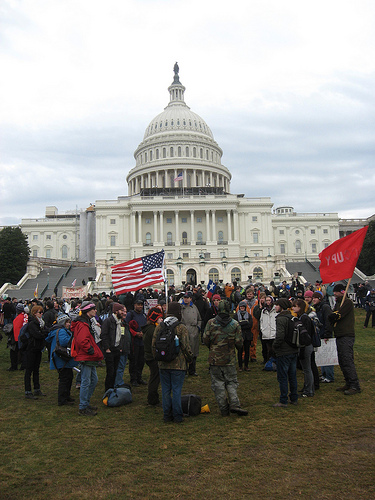 The hallowed halls of a once respected US government are now filled with the hollow promises of an impotent governing class. In a political landscape riddled with indecision, political pageantry and growing despotism, the people are hungry for a leadership that represents them. Instead, we are faced with a corporatocracy – one hellbent on the consolidation of wealth and power rather than the proliferation of freedom and justice.
 MEDIA ROOTS – With the Presidential election taking place in less than two weeks, the corporate media spin machine is rife with 24/7 election fervor, pitting the two establishment Presidential candidates against each other. So, Media Roots is here to remind you what other choices you have come election day. Check out our report outlining the views of the
  MEDIA ROOTS – United Front Against Austerity (