BP’s Oil Spill: Criminal Negligence, Thousands Still Sick & A Gulf Graveyard Left Behind

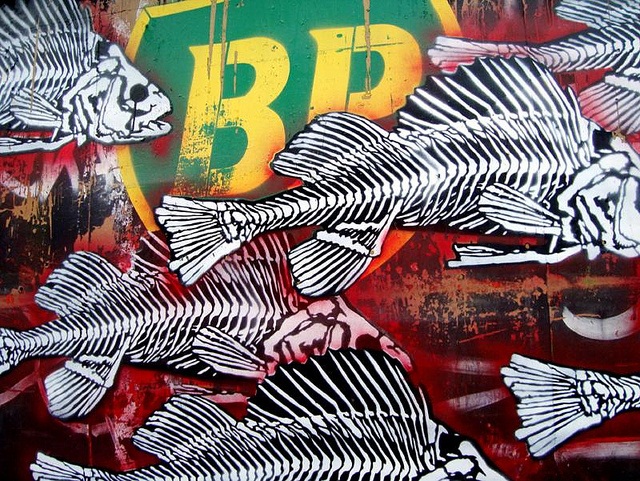
BP dead flickr user thierry ehrmannAfter BP agreed to pay $4.5 billion to the government, and another $9.2 billion in penalties since its catastrophic oil spill, a new ruling has put the corporation under fire again.

A US District Judge has found BP grossly negligent and it’s subcontractors, Halliburton and TransOcean, negligent for their roles in the 2010 Deepwater Horizon explosion and subsequent dumping of more than 210 million gallons of toxic sludge into the Gulf of Mexico, killing 11 people and countless marine creatures in the process. Under the Clean Water Act, the new ruling could effectively quadruple the penalty per barrel spilled that BP will have to pay.

BP’s criminal negligence shouldn’t come as a surprise. After nine years at sea, company management acknowledged that the Deepwater drilling rig was in decline and presented a quote “intolerable risk” to safety, yet chose to do nothing. Halliburton also plead guilty to the destruction of key evidence related to the company’s shady cost-cutting practices like failing to inspect the well’s cement mixture, and using only six of the recommended 21 centralizers to secure the site.

Besides the massive damage that’s been done to the environment as a result of the BP disaster, the health impact on humans continues – largely because of the decision by BP and the EPA to spray nearly two million gallons of a dispersant called Corexit onto the water, making the oil 52 times more toxic, according to the Environmental Pollution Journal.

All this aside, BP’s contracts with the Defense Department have more than doubled in the years since the disaster.

Even though the media is fatigued with its coverage of this disaster, Breaking the Set went down to the Louisiana Gulf Coast to see how the region is faring nearly five years later and to investigate the spill’s lasting damagesWe learned that hundreds of thousands of people are still sick, and that the oil industry has turned the once vibrant shore into a graveyard.

Abby

**

BP’s Oil Spill: Criminal Negligence, Thousands Sick & Gulf Graveyard Left Behind

**

Exclusive coverage includes interviews with Jorey Danos, a sick clean-up worker who was exposed to a toxic chemical dispersant known as Corexit, award winning toxicologist Wilma Subra, Gulf Restoration Network’s Jonathan Henderson and Clint Guidry, President of the Louisiana Shrimpers Association.

We also reached out to BP, which provided the following statements:

Q: Why were cleanup workers refused respirators and even threatened with termination if they requested them, according to multiple interviews with clean-up workers and the Louisiana Environmental Action Network?

A: We certainly do not and would not retaliate against workers. BP worked closely with OSHA, the US National Institute for Occupational Safety and Health (NIOSH) and other US government agencies to take extraordinary measures to safeguard the health and safety of responders.

Workers were provided safety training and appropriate personal protective equipment (PPE), and were monitored by federal agencies and BP to measure potential exposure levels and to help ensure compliance with established safety procedures.

Response workers applying dispersants received training on work procedures and PPE usage designed to minimize exposures, and were provided respirators and other PPE.

Workers who were not exposed to dispersants may have asked for a respirator, possibly in the mistaken belief that it would provide an extra level of protection and safety. This is not true. Perhaps the most important consideration in voluntary respirator usage is the potential physiological burden placed on the user. That was particularly true given the hot working conditions encountered during the response.

Due to the extensive controls in place, there was little potential for worker or public exposure to dispersants. More than 30,000 air monitoring samples were collected by the Coast Guard, OSHA, NIOSH, and BP as part of a comprehensive air monitoring program to evaluate the potential for human exposure to dispersant and oil compounds. The results showed that response worker and public exposures to dispersants were well below levels that could pose a health or safety concern.

Additional Background: OSHA advises that, “in workplaces with no hazardous exposures, but where workers choose to use respirators voluntarily, certain written program elements may be necessary to prevent potential hazards associated with respirator use. Employers must evaluate whether respirator use itself may actually harm employees. If so, employers must medically evaluate employees and, if necessary, restrict respirator use…”

For these reasons, respirators typically are not provided to people who do not need them, and who have not passed the required tests for fitness to wear the equipment. In consultation with NIOSH and OSHA, BP developed guidelines to help determine when PPE, including respirators, was to be used. Known as the “PPE Matrix,” this guideline was made available on several websites, including websites for BP and OSHA. Under the PPE Matrix, respirators were to be used in specifically- identified situations, including during the application of dispersants. There were times, however, when the potential risks associated with using a respirator outweighed the benefits since air monitoring data indicated that worker exposures to chemicals of concern generally were well below occupational exposure limits, and respirator use could place physiological stress on the body. In those cases, protection was provided by work practices and procedures and the use of other PPE.

A paper reviewing OSHA and NIOSH’s response to the accident can be found here.

Q: Why was the public told that Corexit was as harmless as Dawn, when five of the ingredients in it are linked to cancer, 33 are linked to skin irritation and 11 are respiratory toxins, according to expert toxicologists, Wilma Subra and Dr. Susan Shaw?

A: The Material Safety Data Sheet (MSDS) for Corexit, where human exposure characterization is addressed notes, “Based on our recommended product application and personal protective equipment, the potential human exposure is: Low.” Also, Section 16 of the MSDS characterized Corexit’s general product risk- “The human risk is: Low. The environmental risk is: Low.”

The same ingredients contained in Corexit are also found in common consumer products such as household cleaners, food packaging, hand lotion and cosmetics. The product ingredients alone do not determine if a compound has created a public health concern; there must also be exposure to a compound at levels and for sufficient duration that could cause harm.

The results of extensive monitoring conducted by federal agencies and BP show that response workers and the public simply were not exposed to dispersant compounds at levels that might pose a health risk.

Due to the controls in place during dispersant application operations, there was little potential for public or worker exposure when dispersants were applied to the oil offshore. This was confirmed by the government findings as previously mentioned.

Q: Why has the active cleanup of Louisiana’s coast officially ended when thousands of tar balls continue to wash on shore?

A: The Coast Guard ended active cleanup after an extensive four-year effort. Even so, we remain committed and prepared to respond at the Coast Guard’s direction if potential residual Macondo material is identified through the National Response Center reporting process and requires removal. We have teams and equipment at staging areas in Grand Isle, LA and Gulf Shores, AL ready to rapidly respond as necessary.

Additionally numerous studies and reports have documented the presence of tar balls along the Gulf coast in the decades before the Deepwater Horizon accident, and during our cleanup efforts we continued to find tarballs that did not contain residual Macondo oil.

Q: Why have only 148 people received any medical claim whatsoever well over four years after the disaster and why is the average benefit only $1,600 dollars, when doctors such as Michael Robichaux has studied hundreds of patients and observed long term and possibly lifelong health effects in the process?

A: BP and the PSC consulted with medical experts to determine compensation amounts and formulate a list of the conditions that, according to scientific evidence, could be caused by exposure to oil or to the dispersants used in the cleanup. Compensation for these listed conditions is subject to the clear terms of the MSA. As is common in class action settlements, the settlement program did not begin processing and paying out claims until all appeals were exhausted, which occurred earlier this year. As to Dr. Robichaux, his allegations were considered and rejected over a year ago by a New Orleans federal court, which found that the doctor “wholly failed to provide any competent evidence in support of the assertions he makes.”

**

Follow me @AbbyMartin

Art by flickr user Hierry Ehrmann

Posted in Uncategorized | 1 Reply

VICE: From ISIS to The Islamic State

Flag_of_the_Islamic_State_in_Iraq_and_the_Levant.svgVICE – The Islamic State, a hardline Sunni jihadist group that formerly had ties to al Qaeda, has conquered large swathes of Iraq and Syria. Previously known as the Islamic State of Iraq and Syria (ISIS), the group has announced their intention to reestablish the caliphate and declared their leader, the shadowy Abu Bakr al-Baghdadi, as the caliph.

Flush with cash and US weapons seized during recent advances in Iraq, the Islamic State’s expansion shows no sign of slowing down. In the first week of August alone, Islamic State fighters have taken over new areas in northern Iraq, encroaching on Kurdish territory and sending Christians and other minorities fleeing as reports of massacres emerged.

Elsewhere in territory it has held for some time, the Islamic State has gone about consolidating power and setting up a government dictated by Sharia law. While the world may not recognize the Islamic State, in the Syrian city of Raqqa, the group is already in the process of building a functioning regime.

VICE News reporter Medyan Dairieh spent three weeks embedded with the Islamic State, gaining unprecedented access to the group in Iraq and Syria as the first and only journalist to document its inner workings. In part one, Dairieh heads to the frontline in Raqqa, where Islamic State fighters are laying siege to the Syrian Army’s division 17 base.


VICE: From ISIS to The Islamic State

**

Phyllis Bennis, Director at the Institute for Policy Studies, discusses ISIS’ roots, tactics, goals and how the group can be stopped without blowing up more of Iraq on Breaking the Set.

Segment starts at 2:40:

Breaking the Set on ISIS End Game

***

Follow @VICE@AbbyMartin

How the American Dream Died

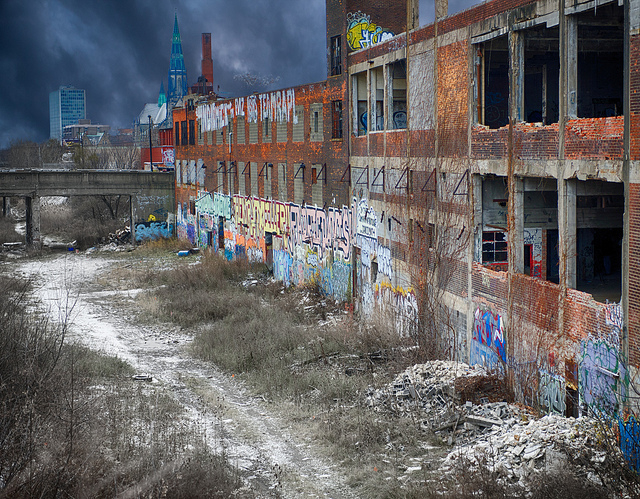
DetroitFlickrMemories_by_MikeThey told us all we had to do to get rich was work hard. They said we had a world of opportunities to achieve all the success we wanted. Yet an uncomfortable truth is dawning over America: the American Dream was simply never meant for everyone. Anyone could get rich – but not everyone at the same time. It’s only a dream for a privileged few, and a nightmare for everyone else.

Let’s take the “Dream” apart so we can take a closer look of what it’s made of. I can reap the fruits of my own hard work. I can forge the career of my dreams, and through that career, I can make good money and live the good life. I can free myself from the oppressive chains of government and oligarchy. Me, myself and I. If there’s a single underlying issue with the American Dream, a single virus behind the symptoms of sick lady America, it’s the individualistic mentality that has it locked in a futile battle against none other than itself. It is this mentality that has academics at the country’s most elite institutions concluding that the United States is not a democracy but an oligarchy.

So how did a country that once provided asylum to refugees of Europe’s aristocracy come to be ruled by a modern-day aristocracy? Part of the problem is the inability to realize that certain freedoms and liberties inherently conflict with each other. My freedom as an executive to make as much money as I want conflicts with your freedom as an employee to be able to make a living and afford basic human rights such as food, shelter, education and health care. I could show you some compassion – but not in hyper-individualistic America. Instead, my power as an executive allows my freedom to prevail, whereas your lack of power as a mere worker leaves you deprived of yours.

That is why Detroit, once the embodiment of the American Dream, now epitomizes its sad end: the unleashing of international trade anarchy opened the door to outsourcing, which in turn wiped out the Motor City’s economy. Wall Street finished it off. Neoliberal economists, feigning scientific-ness in order to legitimize the world’s plundering by the corporate elite, preach free trade in the name of maximizing “efficiency”. Poverty, unemployment and thousands of abandoned buildings aren’t exactly a perfect illustration of efficiency.

Hyper-individualism is unsustainable, and until people find meaning beyond the dollar, the American nightmare will continue to be a harsh reality for many.

**

How America’s Work Obsession is Killing Our Quality of Life

**

How the American Dream Died

Abby Martin comments on a recent poll showing that a growing number of Americans believe the ‘American Dream’ is impossible to achieve; and urges US citizens to rethink what the dream should truly be.

**

Written by Ming Chun Tang; image by Flickr user Memories_by_Mike

Celebrations of Imperialist War Abound

gravesPhotobyKevinDooleySummer is here and the stench of war is all around. Or, as Bob Marley put it, ‘everywhere is war’.
Start with the commemorations over a five-week span of Memorial Day, Flag Day and Independence Day, all presented varyingly as celebrations of our war dead, symbols of our greatness, the freedoms we love so dearly and seek to export to every corner of the world and, perhaps most important, the unquestioned rightness of our cause.

In reality, the celebrations are of imperialist war, with the talk about the hallowed dead just so much cover for the murderous nature of US foreign policy. Celebrating the dead – note that the dead celebrated are just the American dead, not any of the millions killed by US aggression or client states – is a no-lose proposition designed to render anyone who asks the wrong questions a traitor or a terrorist. The notion that the US regularly commits war crimes and that polished, well-educated men like Barack Obama are war criminals is unthinkable; war criminals look like Osama bin-Laden and Saddam Hussein and those other nasty people far away, over there.

It’s also the summer of the centennial of the start of what in its time was known as the Great War, the greatest blood-letting in history except for that of the Second Great War barely two decades later. One thing we can be sure is that the lessons drawn from mainstream discussions of World War I will be all the wrong ones. Worse, the spectacle of the intelligentsia waxing eloquent about the horrors of war while unflinchingly cheering on the warmakers in Washington will be accepted by one and all of their kind as perfectly reasonable – as beyond discussion, in fact.

In recent weeks, meanwhile, mainstream commentators have been shocked to discover that things in Iraq are not alright, in fact are worse than at any time since the second US blitzkrieg in 2003. Gee, who knew that an invasion predicated on a lie of weapons of mass destruction, designed to secure control of massive oil supplies, would go wrong? The political class and intelligentsia pretended they didn’t, but millions around the world who demonstrated against the invasion in the weeks before it was launched certainly did. And one of the points those demonstrators underscored was that a US invasion would fuel sectarian divisions and violence, precisely as has happened. Al-Qaeda, which did not exist in Iraq prior to the invasion, now flourishes while a new group, the Islamist State of Iraq and Syria (ISIS), rampages through the country.

The response of many elites in the US, naturally, is for more war. Calls from certain factions for a third US invasion are growing louder and Obama likely would have done so by now if not for grave ruling class concerns about how much more a war-weary populace can endure. Weary or not, people in the US came together in a remarkable groundswell of protest last summer that prevented Obama from attacking Syria. Given Obama’s penchant for resolving virtually any problem with violence, however, as in his determination to provoke war with Russia in Ukraine, his reluctance to invade Iraq may be temporary.

Also on the war front is the Veterans Affairs’ disgraceful neglect of ex-soldiers in need of medical care. For years, political elites have been slashing benefits for veterans while increasing spending on weapons and cutting taxes for the Super Rich. That the problem came to a head with a Democrat in the White House is simply an accident of timing, and it is especially outrageous that the most enthusiastic cheerleaders of the illegal Bush-Cheney invasions, as well as reductions to the VA’s budgets and the tax cuts for 1%, now pretend that they care about soldiers.

Equally farcical is the commencement of yet another round of hearings on the deaths of four Americans in Benghazi. Such hearings would certainly be valuable if everything related to US actions in Libya since the launch of the 2011 assault were up for review, but there is virtually no chance of that happening. The deaths of tens of thousands of Libyans in yet one more illegal military strike, as well as the resulting chaos and violence in that country, is of no concern to those who long for the good old days of Bush-Cheney interested only in scoring political points.

Last but not least is the saga of the much-vilified Bowe Bergdhal, a young man who came to see the criminal nature of the US invasion of Afghanistan. The refusal of working class youth to fight for Empire is the ruling class’s biggest nightmare and the attacks on Bergdahl, like the show trial that convicted Chelsea Manning, exemplify how far they will go to punish those in uniform who dare challenge their objectives. A hidden aspect of the movement that ended US carnage in Southeast Asia is that it was the widespread opposition of soldiers, both as embodied by organizations like Vietnam Veterans Against the War as well as active duty resisters, that decisively turned the tide.

This development was so alarming that two massive disinformation campaigns were immediately launched: the myth of the hostility of the anti-war movement for returning soldiers that sought to drive a wedge between active duty and homefront resistance (see Jerry Lembcke’s The Spitting Image: Myth, Memory and the Legacy of Vietnam); and the completely fraudulent MIA blitz (expertly exposed by Bruce Franklin in MIA, or Mythmaking in America) concocted by the Nixon Administration to shift attention away from the death and destruction wrought by the US to the plight of nonexistent prisoners of war.

Because preventing any similar resistance among soldiers is central to imperial objectives, discussion has largely avoided what Bergdahl actually said about his service in Afghanistan, including his telling declaration in a 2009 e-mail to his parents: “The future is too good to waste on lies and life is way too short to care for the damnation of others as well as to spend it helping fools with their ideas that are wrong. I’ve seen their ideas, I’m ashamed to even be American. The horror of the self righteous arrogance that they thrive in.” Rather than joining in the Bowe Bergdhal lynch mob, US soldiers everywhere, not to mention those with loved ones in the military, would do well to heed his words and experience.

Lastly, the same standard that applies to the war crimes of others applies to the US. As articulated by Robert H. Jackson, chief US prosecutor at Nuremberg, a war of aggression such as committed by the US against Afghanistan and Iraq “is not only an international crime; it is the supreme international crime, differing only from all other crimes in that it contains within itself the accumulated evil of the whole.” In such a circumstance, what Bergdahl did was proper and, it could be argued, obligatory for anyone party to war crimes.

So amidst the holiday flag waving and speeches that glorify imperialism, we should support prisoners of conscience like Chelsea Manning. We should demand that all services veterans require be provided, that US bases around the world be closed, that soldiers be returned home and that the US cease its campaign of endless aggression. And as enticing as the military may seem in such desperate economic times, we should counsel young people to stay away no matter how bleak the alternatives may be.

Written by Andy Piascik at [email protected]

Photo by flickr user Kevin Dooley

American Drug War Creator on Addiction, Prohibition & the “Green Rush”

MarijuanaPhotobyKayVee.INC_.jpgAs costly as it is ineffective, America’s prohibition on illegal drugs is a contentious subject the corporate media keeps at arm’s length.

Documentarian Kevin Booth is the director of several films that scrutinise America’s dubious relationship with drugs and suggest that illegal trafficking is embedded in the US economy.

As arrests are hastily made for the possession of marijuana – which is proven to have countless medical benefits, people are bombarded with advertisements for alcohol and cigarettes. Booth’s films bring attention to the profit holding priority over public health with big pharma and private prisons reaping substantial benefits to the detriment of patients whose lives could be vastly improved by medical marijuana.


American Drug War: The Last White Hope

**

Booth has lost close friends and family members to legal drug addiction amongst whom include Bill Hicks, legendary comic whose outrage with the establishment’s hypocrisy on drugs paralleled Booth’s. Their shared worldview fueled them to create Sacred Cow Productions which has since produced a host of eye-opening documentaries including American Drug War 2: Cannabis Destiny and How Weed Won the West.

With Colorado recently legalising cannabis and Washington close to follow, it’s due time for the US to review its classification of marijuana. Filmmakers like Kevin Booth deserve worldwide recognition, and we were lucky to sit down with him for an interview with Media Roots.

**

MR: I recently saw a video where you and Bill Hicks are on site covering the Waco massacre in 1993. Is that where your filmmaking career kicked off?

KB: That was in 92. I started shooting in 84. I sold cocaine in order to buy my first video camera all the way back in 1984. In Austin, Texas, they a public access channel which would allow first time filmmakers or people that made videos to able to put videos out that they made up on Austin access which was channel ten on the regular cable vision. If you had basic cable in Austin you would actually get Austin access channel ten. I became a producer for that and that was all the way back in the mid-eighties. Around the same time my band got a record contract with Chrysalis records was actually out of England, they did Jethro Tull who was one of the first bands out of Chrysalis records. I helped do a music video that was on MTV and that’s what really kind got me pushed through into this more seriously. Up until then I thought I was going to be a musician and I just did video as a hobby, and then once I did this help on the music video for MTV I got the bug. I started getting more interested in cameras than I was into guitars. Bill and I did a karate movie called, Ninja Bachelor Party – we started that all the way back in 85. I did a lot of videos before the Waco thing.

My background was first in music then in comedy and then going into documentaries wasn’t until after Bill died. Alex Jones as a conspiracy guy was just getting started up at the Austin access channel up at the time and like you said I did that video with Bill up at Waco. Alex was just this young guy starting off and he was doing some stuff with Waco, in fact he was trying to raise money to help the Branch Davidians rebuild the church and so I started to travel to Waco with him and started filming him up at Waco. That kind of led me into working on my first real documentary with working together with Alex Jones. I worked on several documentaries with Alex for a while until we kind of had a clash of personalities. I wanted to kind of be able to do my own which what led me to do American Drug War besides other personal reasons.

MR: Talk about your reasons for setting out to make films.

KB: At the time I had lost Bill to legal drugs. There’s no proof but Bill was such a heavy, horrible smoker and abused his body horribly with alcohol and cigarettes then my brother died in 97 from having a seizure from pharmaceutical drugs. He was a schizophrenic and was actually court ordered to take anti schizophrenic medication which gave him a seizure. My mom and dad were both alcoholics, my dad he died of throat cancer from cigarettes that he had smoked when he was way younger and my mom died of liver complications so I kind of looked at it like I had lost all my friends and family to legal drugs of alcohol, tobacco and pharmaceutical. A close friend of mine by the name of Mambo Johnny he went to a prison camp for two years for just growing marijuana and then when he got out of this prison camp he died from complications or some disease he got while he was in this prison. Around the same time George Bush was on TV saying, ‘If you buy drugs then you support terrorism.’  All that together made me think decide to put everything I have together to make a documentary about the drug war.

MR: How has the reaction been to your work?

KB: It’s been really great. When the first one came out on Showtime in 2008 I got probably one hundred emails a week from people sharing their stories of drug addiction or their stories of being arrested and how much they appreciate me shedding light on the topic – pretty much all positive reactions. The very few people that have anything negative to say to me will usually just do it on comments, they don’t ever do it face to face. They’ll hide behind their computer if they have anything mean to say to me.

MR: There’s psychoactive properties of some drugs that would make them dangerous, if not life threatening for some people. Personally, I can understand why drugs like LSD are illegal.

KB: Yeah, Bill had a joke about that, how Art Linklater’s daughter took acid and jumped off a building. His joke was would be like, ‘Well, you don’t see ducks lined up to take elevators. If you thought you could fly take off from the ground first! Don’t blame acid on this fucking dumb ass!’  If you take drugs and run into a wall…No, I get it.

Some people watch these films and they don’t really totally get it. Their knee jerk reaction is to think that I’m just out there promoting drug use and it couldn’t be further from the truth. I’m actually kind of conservative!  When I go to some of these pro-legalisation rallies and I have to interact with a lot of these people, I run into a lot of them that say everything should be legal – crystal meth, PCP should be legal ,legal, legal..I have to be honest and say I have a hard time with that. There really does need to be a line.

The problem always comes in to what should be against the law and I think it should be your actions need to be against the law, not ingesting a chemical. If you’re selling drugs to children then that should be against the law. I wish there was a way for people who wanted to do cocaine responsibly in their home to be able to get legally controlled substances.  It’s like when you hear the thing about Phillip Seymour Hoffman dying, right? Most likely what killed him was that he probably got hold of something that was a lot stronger than what he was used to. I think that most of the deaths that are related to illegal drugs have to do with a lack of control. There are more deaths in this country right now from Tylenol than there are from heroin and meth and all these other illegal drugs combined. Of course there’s no deaths from marijuana but when you look at the deaths that happen from illegal drugs it does have to do with the lack of control.

I don’t believe that everybody should be able get everything but I think that if you’re a responsible adult and you want to work through certain channels say you want to be able to take a hit of ecstasy with your wife in the privacy of your own home, have a shared experience maybe you could go to a certain doctor or psychiatrist. They found that it’s really good as a marriage counseling drug. We worked with these people that were doing ecstasy when someone was going to die, like a wife was about to lose a partner they would take ecstasy together and have these amazing experiences before they die. There’s a lot of therapeutic benefits to it all but if someone wants to do it they have to go get it from some scummy person off the streets and that’s what really screws it up. I wish that I could try cocoa leaves for example. I think it would be amazing if I could try chewing on some cocoa leaves like god intended, I mean wouldn’t that be awesome? I’ll never get to do that, all I get to do is do this thing called cocaine that is a powerful chemical derivative that’s very dangerous because you have no idea what people are mixing it with in the jungle to get it across the border. It’s a very cloudy issue.

MR: Has your view on drugs changed since putting out the first film?

KB: My reaction from putting out these movies and the reaction I got is that I’ve probably actually gotten a little conservative with what I think is reasonable. Now that marijuana is legal in Colorado, case in point, I’ve been going to Denver since Colorado has been legalised and I have to be honest it’s a little over board. It’s fun, don’t get me wrong. It’s probably how Chicago was when prohibition ended and people were dancing and drinking in the streets. Now everybody’s ‘Dabbing’ – I don’t know if you know what dabbing is?  Everybody’s smoking these big pipes using blow torches and smoking this really powerful form of marijuana extract. Everywhere you go everybody’s is smoking this and when I see that in Denver I go, ‘Oh my god, when the rest of the country sees this it’s really going to hurt the legalisation!’

People always have to take things too far, you know what I mean? It’s kind of human nature, it’s the blow back from all the years of it being illegal too that people are always going to take things to the far extremes. I’m all for responsible use, I’m all for people being sober when they drive. Then again I believe that alcohol probably is one of the most horrific drugs out there when it comes to making people act like idiots and do really stupid things, acting violent, driving bad, doing dumb things. I think that alcohol is at the very top of the list as one of the most dangerous drugs out there. It’s just amazing to me that I can go to the grocery store and there are bottles of Jack Daniels and tequila right there! If I drunk that I would lose my mind! There’s just so much hypocrisy.

MR: What do you think would be the immediate effects of nationwide cannabis legalisation?

KB: You can look at what’s going on in Colorado right now. Colorado is having a real boom. I’m getting ready to go to a conference of billionaire investors who are all flocking around Colorado to see how they can get involved in the emerging legal cannabis business. Looking at what’s going on in Colorado around the cannabis industry right now is a little indicator of what could happen across the rest of the country. Now of course I’m not talking about legalising cocaine or any of those things, though wouldn’t it be cool if you could grow poppy plants in your back garden? Of course I’m not advocating that you have some big lab or something like that. Anytime you’ve got people mixing dangerous chemicals, that should be illegal. It should probably be illegal to set up a laboratory of flammable explosive things, you know? I don’t think it should be illegal to grow and consume anything. I guess where I draw the line is at nature.  If it grows out of the ground then you should be able to plant it and consume it. If it takes chemistry to do it then yeah, maybe the law should step in.

MR: One fascinating aspect of your films is how deeply embedded the drug market is in American economics, for example the CIA drug running.

KB: You can look at what’s going on right now. We could flash to Afghanistan and the reason why the military is still there. A lot of people believe we are still there basically protecting the opium and the heroin. Right now there’s huge resurgence. There’s stories on the news that are like, ‘Wow, heroin is really having a big resurgence in America!’ and they never connect the dots like, ‘Oh, yeah! That Afghanistan thing!’ They never connect those dots! Another fascinating thing that no one ever talks about is the banks and the money laundering taking place. Anyone can see for themselves if they go to Google maps – go to the Texas border and type in ‘banks’ and zoom in and look at the Mexican border – it’s fascinating to see all the banks. There are so many banks along the border in these border towns. Not only that, there are so many of these weird foreign banks with these names that you’ve never heard of and it’s all just money laundering. Then again other big mainstream banks get caught doing it being knowingly involved in money laundering for cartels and, you know, no one ever goes to jail. Nothing ever happens to the big guys it’s just all the little people that get sent to jail.

MR: What’s next for you?

KB: After doing Cancer in Kids I need to take a break from the seriousness. I’m moving off and getting back into my comedy roots a little bit. One of the documentary projects I’m working on is kind of showing some of the corruption in the marijuana industry – some of the more high end corruption. There are a lot of big companies that are now coming out of the industry and I don’t know if you realise this but a lot of them are actually being publicly traded. Although a lot of them are really great, some of them in my opinion are fraudulent. People when they think about marijuana they think of hippies, peace and love but some of the people in the marijuana industry are some of the most cutthroat people I’ve ever been around. It’s a whole another level. We’re not talking about just drug dealers any more, we’re talking about an industry that is not quite regulated by the government yet but it has been legitimised by the fact that they’ve legalised it in two states!

So you’ve got two out of fifty states that have legalised it, so in a way the government has said, ‘Okay, yeah so it’s illegal’, although people are being arrested in these forty eight states. Meanwhile you have not only the good people like rich investors from all over the world. Tokyo, Germany, Switzerland rushing to Colorado to figure out how they can invest in this thing to get in on it early, you also have a lot of scummy, fly by night, get-rich-quick schemer type people. They call it ‘the green rush’ and in my opinion it really is like a modern day gold rush, because so many people have this idea of easy money and dollar signs in their eyes. I’m working on a documentary that’s going to look at that and a lot of its humorous so it’s going to be more of a comical documentary, because in my mind, once you enter into the world of trying to get rich overnight then it’s all fair. I can’t feel sorry for you if get screwed when you’re trying to get rich overnight. It kind of all becomes comedy to me at a certain point with people scamming each other. I’m also working on a scripted show that’s going to based on the same thing. None of them are drop dead serious. It’s more in the vein of comedy.

Written and transcribed by Aaron Williams, photo by Kayvee Inc.