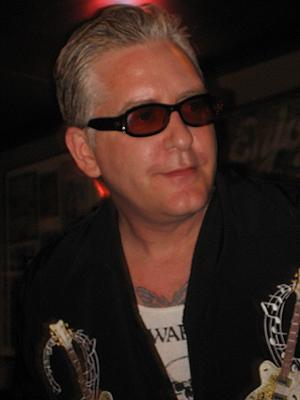
MEDIA ROOTS — Earlier this week on Deadline Live, radio host Jack Blood interviewed our very own Abby Martin. The beginning of the conversation gravitates around Abby’s incident with Rand Paul, where Rand tried to intimidate Abby for confronting him on his Romney endorsement. This leads into a discussion on many topics including how putting your faith and energy behind any politician (even ones who say things you agree with) will ultimately lead to disappointment.
Jack Blood is unique in the ‘liberty movement’ because he was practically black balled by the reigning leader of said movement back in 2010. Jack and Abby discuss how the alternative media movement has been taking over by ‘fear porn’ and a lock step ideology that is based on sensationalism instead of facts. They explore the trap of idealizing yourself as a critical thinker and rejecting mainstream media, but then replacing your intake of information with just another alternative media establishment narrative.
Overall, it’s refreshing to hear a discussion inside this ‘movement’ which isn’t afraid to be critical of certain aspects of it, like its rampant racism (important fixtures in the movement referring to Obama as a ‘spear chucker’) and homophobia. Or, why so many people in the movement keep making excuses for both Pauls, even going so far as claiming he is being held hostage. Bohemian Grove and Bilderberg are also discussed as potential distractions away from where the seeds to actual documented public policy is formed. The conversation finishes up with how art is a vehicle for reflecting our times, and how an artist has a responsibility to inject something into the zeitgeist of culture.
Robbie Martin for Media Roots
***
Jack Blood Interviews Abby Martin on Deadline Live
“Jack Blood welcomes Abby Martin (www.abbymartin.org and www.mediaroots.org) TV Host on Russia Today…. We discuss Rand Paul’s censorship of her and RT, Art as a vehicle for truth, Bilderberg’s Alt media Red carpet, No difference between Alt media and MSM, and what is Russia Today? Abby swears, and denies she is “Toyko Rose” and basically kicks ass all through the entire first hour…. Breaking news from www.deadlinelive.info”
MEDIA ROOTS — Instead of the run of the mill faceless accusations of ‘The 1% are oppressing the 99%’ research organization Project Censored has compiled a valuable list with names and faces of some of the world’s biggest earners and financial elites.
Project Censored also characterizes a particular sect of these financial elitists as the ‘Global Economic Super Entity’, the biggest movers and shakers of the world economy. The assertion is made that NATO is now simply an arm of the financial elite global corporate class, a defacto ‘world police force’ to make sure the money keeps flowing as planned. A lot of interesting points are raised with ample documentation contained herein.
***
PROJECT CENSORED – The Occupy Movement has developed a mantra that addresses the great inequality of wealth and power between the world’s wealthiest 1 percent and the rest of us, the other 99 percent. While the 99 percent mantra undoubtedly serves as a motivational tool for open involvement, there is little understanding as to who comprises the 1 percent and how they maintain power in the world. Though a good deal of academic research has dealt with the power elite in the United States, only in the past decade and half has research on the transnational corporate class begun to emerge.[i]
Foremost among the early works on the idea of an interconnected 1 percent within global capitalism was Leslie Sklair’s 2001 book, The Transnational Capitalist Class.[ii] Sklair believed that globalization was moving transnational corporations (TNC) into broader international roles, whereby corporations’ states of orgin became less important than international argreements developed through the World Trade Organization and other international institutions. Emerging from these multinational corporations was a transnational capitalist class, whose loyalities and interests, while still rooted in their corporations, was increasingly international in scope.
Sklair writes: The transnational capitalist class can be analytically divided into four main fractions: (i) owners and controllers of TNCs and their local affiliates; (ii) globalizing bureaucrats and politicians; (iii) globalizing professionals; (iv) consumerist elites (merchants and media). . . . It is also important to note, of course, that the TCC [transnational corporate class] and each of its fractions are not always entirely united on every issue. Nevertheless, together, leading personnel in these groups constitute a global power elite, dominant class or inner circle in the sense that these terms have been used to characterize the dominant class structures of specific countries.[iii]
Estimates are that the total world’s wealth is close to $200 trillion, with the US and Europe holding approximately 63 percent. To be among the wealthiest half of the world, an adult needs only $4,000 in assets once debts have been subtracted. An adult requires more than $72,000 to belong to the top 10 percent of global wealth holders, and more than $588,000 to be a member of the top 1 percent. As of 2010, the top 1 percent of the wealthist people in the world had hidden away between $21 trillion to $32 trillion in secret tax exempt bank accounts spread all over the world.[iv] Meanwhile, the poorest half of the global population together possesses less than 2 percent of global wealth.[v] The World Bank reports that, in 2008, 1.29 billion people were living in extreme poverty, on less than $1.25 a day, and 1.2 billion more were living on less than $2.00 a day.[vi] Starvation.net reports that 35,000 people, mostly young children, die every day from starvation in the world.[vii] The numbers of unnecessary deaths have exceeded 300 million people over the past forty years. Farmers around the world grow more than enough food to feed the entire world adequately. Global grain production yielded a record 2.3 billion tons in 2007, up 4 percent from the year before—yet, billions of people go hungry every day. Grain.org describes the core reasons for ongoing hunger in a recent article, “Corporations Are Still Making a Killing from Hunger”: while farmers grow enough food to feed the world, commodity speculators and huge grain traders like Cargill control global food prices and distribution.[viii] Addressing the power of the global 1 percent—identifying who they are and what their goals are—are clearly life and death questions.
It is also important to examine the questions of how wealth is created, and how it becomes concentrated. Historically, wealth has been captured and concentrated through conquest by various powerful enities. One need only look at Spain’s appropriation of the wealth of the Aztec and Inca empires in the early sixteenth century for an historical example of this process. The histories of the Roman and British empires are also filled with examples of wealth captured.
Once acquired, wealth can then be used to establish means of production, such as the early British cotton mills, which exploit workers’ labor power to produce goods whose exchange value is greater than the cost of the labor, a process analyzed by Karl Marx in Capital.[ix] A human being is able to produce a product that has a certain value. Organized business hires workers who are paid below the value of their labor power. The result is the creation of what Marx called surplus value, over and above the cost of labor. The creation of surplus value allows those who own the means of production to concentrate capital even more. In addition, concentrated capital accelerates the exploition of natural resources by private entrepreneurs—even though these natural resources are actually the common heritage of all living beings.[x]
In this article, we ask: Who are the the world’s 1 percent power elite? And to what extent do they operate in unison for their own private gains over benefits for the 99 percent? We will examine a sample of the 1 percent: the extractor sector, whose companies are on the ground extracting material from the global commons, and using low-cost labor to amass wealth. These companies include oil, gas, and various mineral extraction organizations, whereby the value of the material removed far exceeds the actual cost of removal.
We will also examine the investment sector of the global 1 percent: companies whose primary activity is the amassing and reinvesting of capital. This sector includes global central banks, major investment money management firms, and other companies whose primary efforts are the concentration and expansion of money, such as insurance companies.
Finally, we analyze how global networks of centralized power—the elite 1 percent, their companies, and various governments in their service—plan, manipulate, and enforce policies that benefit their continued concentration of wealth and power.
The Extractor Sector: The Case of Freeport-McMoRan (FCX)
Freeport-McMoRan (FCX) is the world’s largest extractor of copper and gold. The company controls huge deposits in Papua, Indonesia, and also operates in North and South America, and in Africa. In 2010, the company sold 3.9 billion pounds of copper, 1.9 million ounces of gold, and 67 million pounds of molybdenum. In 2010, Freeport-McMoRan reported revenues of $18.9 billion and a net income of $4.2 billion.[xi]
The Grasberg mine in Papua, Indonesia, employs 23,000 workers at wages below three dollars an hour. In September 2011, workers went on strike for higher wages and better working conditions. Freeport had offered a 22 percent increase in wages, and strikers said it was not enough, demanding an increase to an international standard of seventeen to forty-three dollars an hour. The dispute over pay attracted local tribesmen, who had their own grievances over land rights and pollution; armed with spears and arrows, they joined Freeport workers blocking the mine’s supply roads.[xii] During the strikers’ attempt to block busloads of replacement workers, security forces financed by Freeport killed or wounded several strikers.
Freeport has come under fire internationally for payments to authorities for security. Since 1991, Freeport has paid nearly thirteen billion dollars to the Indonesian government—one of Indonesia’s largest sources of income—at a 1.5 percent royalty rate on extracted gold and copper, and, as a result, the Indonesian military and regional police are in their pockets. In October 2011, the Jakarta Globe reported that Indonesian security forces in West Papua, notably the police, receive extensive direct cash payments from Freeport-McMoRan. Indonesian National Police Chief Timur Pradopo admitted that officers received close to ten million dollars annually from Freeport, payments Pradopo described as “lunch money.” Prominent Indonesian nongovernmental organization Imparsial puts the annual figure at fourteen million dollars.[xiii] These payments recall even larger ones made by Freeport to Indonesian military forces over the years which, once revealed, prompted a US Security and Exchange Commission investigation of Freeport’s liability under the United States’ Foreign Corrupt Practices Act.
In addition, the state’s police and army have been criticized many times for human rights violations in the remote mountainous region, where a separatist movement has simmered for decades. Amnesty International has documented numerous cases in which Indonesian police have used unnecessary force against strikers and their supporters. For example, Indonesian security forces attacked a mass gathering in the Papua capital, Jayapura, and striking workers at the Freeport mine in the southern highlands. At least five people were killed and many more injured in the assaults, which shows a continuing pattern of overt violence against peaceful dissent. Another brutal and unjustified attack on October 19, 2011, on thousands of Papuans exercising their rights to assembly and freedom of speech, resulted in the death of at least three Papuan civilians, the beating of many, the detention of hundreds, and the arrest of six, reportedly on treason charges.[xiv]
On November 7, 2011, the Jakarta Globe reported that “striking workers employed by Freeport-McMoRan Copper & Gold’s subsidiary in Papua have dropped their minimum wage increase demands from $7.50 to $4.00 an hour, the All-Indonesia Workers Union (SPSI) said.”[xv] Virgo Solosa, an official from the union, told the Jakarta Globe that they considered the demands, up from the (then) minimum wage of $1.50 an hour, to be “the best solution for all.”
Workers at Freeport’s Cerro Verde copper mine in Peru also went on strike around the same time, highlighting the global dimension of the Freeport confrontation. The Cerro Verde workers demanded pay raises of 11 percent, while the company offered just 3 percent.
The Peruvian strike ended on November 28, 2011.[xvi] And on December 14, 2011, Freeport-McMoRan announced a settlement at the Indonesian mine, extending the union’s contract by two years. Workers at the Indonesia operation are to see base wages, which currently start at as little as $2.00 an hour, rise 24 percent in the first year of the pact and 13 percent in the second year. The accord also includes improvements in benefits and a one-time signing bonus equivalent to three months of wages.[xvii]
In both Freeport strikes, the governments pressured strikers to settle. Not only was domestic militrary and police force evident, but also higher levels of international involvement. Throughout the Freeport-McMoRan strike, the Obama administration ignored the egregious violation of human rights and instead advanced US–Indonesian military ties. US Secretary of Defense Leon Panetta, who arrived in Indonesia in the immediate wake of the Jayapura attack, offered no criticism of the assault and reaffirmed US support for Indonesia’s territorial integrity. Panetta also reportedly commended Indonesia’s handling of a weeks-long strike at Freeport-McMoRan.[xviii]
US President Barack Obama visited Indonesia in November 2011 to strengthen relations with Jakarta as part of Washington’s escalating efforts to combat Chinese influence in the Asia–Pacific region. Obama had just announced that the US and Australia would begin a rotating deployment of 2,500 US Marines to a base in Darwin, a move ostensibly to modernize the US posture in the region, and to allow participation in “joint training” with Australian military counterparts. But some speculate that the US has a hidden agenda in deploying marines to Australia. The Thai newspaper The Nation has suggested that one of the reasons why US Marines might be stationed in Darwin could be that they would provide remote security assurance to US-owned Freeport-McMoRan’s gold and copper mine in West Papua, less than a two-hour flight away.[xix]
The fact that workers at Freeport’s Sociedad Minera Cerro Verde copper mine in Peru were also striking at the same time highlights the global dimension of the Freeport confrontation. The Peruvian workers are demanding pay rises of eleven percent, while the company has offered just three percent. The strike was lifted on November 28, 2011.[xx]
In both Freeport strikes, the governments pressured strikers to settle. Not only was domestic militrary and police force evident, but also higher levels of international involvement. The fact that the US Secretary of Defense mentioned a domestic strike in Indonesa shows that the highest level of power are in play on issues affecting the international corporate 1 percent and their profits.
Public opinion is strongly against Freeport in Indonesia. On August 8, 2011, Karishma Vaswani of the BBC reported that “the US mining firm Freeport-McMoRan has been accused of everything from polluting the environment to funding repression in its four decades working in the Indonesian province of Papau. . . . Ask any Papuan on the street what they think of Freeport and they will tell you that the firm is a thief, said Nelels Tebay, a Papuan pastor and coordinator of the Papua Peace Network.”[xxi]
Freeport strikers won support from the US Occupy movement. Occupy Phoenix and East Timor Action Network activists marched to Freeport headquarters in Phoenix on October 28, 2011, to demonstrate against the Indonesian police killings at Freeport-McMoRan’s Grasberg mine.[xxii]
Freeport-McMoRan (FCX) chairman of the board James R. Moffett owns over four million shares with a value of close to $42.00 each. According to the FCX annual meeting report released in June 2011, Moffett’s annual compensation from FCX in 2010 was $30.57 million. Richard C. Adkerson, president of the board of FCX, owns over 5.3 million shares. His total compensation in was also $30.57 million in 2010 Moffett’s and Adkerson’s incomes put them in the upper levels of the world’s top 1 percent. Their interconnectness with the highest levels of power in the White House and the Pentagon, as indicated by the specific attention given to them by the US secretary of defense, and as suggested by the US president’s awareness of their circumstances, leaves no doubt that Freeport-MacMoRan executives and board are firmly positioned at the highest levels of the transnational corporate class.
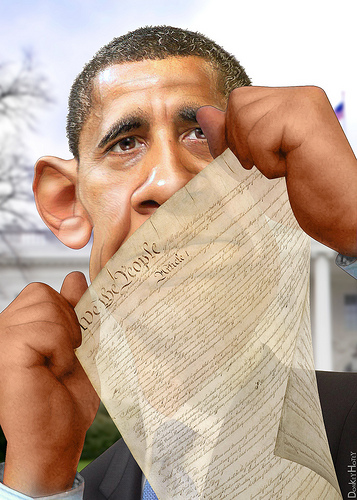
MEDIA ROOTS – Support to repeal the National Defense Authorization Act of 2012 (NDAA) is growing as the Bush-Obama administrations continue to pursue the ongoing global ‘War on Terror’ of nearly twelve years.
Pulitzer Prize winning journalist Chris Hedges is on the front lines of the battle to nullify section 1021 – the indefinite detention clause of the NDAA – along with professor Noam Chomsky, activist Daniel Ellsberg, and author Naomi Wolf. Less than one month after President Obama signed the bill into law, this astute group sued the federal government for clauses that are, at best, constitutionally vague. Consequentially, Manhattan Federal Court temporarily sided with the plaintiffs by having issued an injunction on the indefinite detention clause which has since been appealed by the Obama administration.
Additionally, Ben Swann of WXIX recently suggested the president, and some members of Congress, may be in direct violation of the very law that they created by recently supporting Al-Qaeda-affiliated Syrian opposition forces. He explains that “late last year, when Sen. John McCain co-wrote the National Defense Authorization Act, and President Obama signed it into law, they crafted a law that gave the president the authority to use all necessary and appropriate force during the current armed conflict with Al-Qaeda and the Taliban and associated forces, including the power to indefinitely detain anyone caught supporting Al-Qaeda, which in this case is the president and members of Congress.”
Oskar Mosco for Media Roots.
***
TRUTHDIG– [Section 1021] of the NDAA, signed into law by Obama on Dec. 31, 2011, obliterates some of our most important constitutional protections. It authorizes the executive branch to order the military to seize U.S. citizens deemed to be terrorists or associated with terrorists. Those taken into custody by the military, which becomes under the NDAA a domestic law enforcement agency, can be denied due process and habeas corpus and held indefinitely in military facilities. Any activist or dissident, whose rights were once protected under the First Amendment, can be threatened under this law with indefinite incarceration in military prisons, including our offshore penal colonies. The very name of the law itself—the Homeland Battlefield Bill—suggests the totalitarian credo of endless war waged against enemies within “the homeland” as well as those abroad.
In May, Judge Forrest issued a temporary injunction invalidating Section 1021 as a violation of the First and Fifth amendments. It was a courageous decision. Forrest will decide within a couple of weeks whether she will make the injunction permanent.
Barack Obama’s administration has appealed Judge Forrest’s temporary injunction and would certainly appeal a permanent injunction. It is a stunning admission by this president that he will do nothing to protect our constitutional rights. The administration’s added failure to restore habeas corpus, its use of the Espionage Act six times to silence government whistle-blowers, its support of the FISA Amendment Act—which permits warrantless wiretapping, monitoring and eavesdropping on U.S. citizens—and its ordering of the assassination of U.S. citizens under the 2001 Authorization to Use Military Force, or AUMF, is a signal that for all his rhetoric, Obama, like his Republican rivals, is determined to remove every impediment to the unchecked power of the security and surveillance state. I and the six other plaintiffs, who include reporters, professors and activists, will most likely have to continue this fight in an appellate court and perhaps the Supreme Court.
MEDIA ROOTS — When I think of the most prolific innovators of our generation, there are a couple names that immediately come to mind. The founders of Apple, Steve Jobs and Steve Wozniak, are definitely at the top of the list. There’s no denying that Apple computers have aesthetically designed the world in which we all know and live in today–by simplifying technology to the point where everyone can use and access the internet, Apple products have changed the course of social interaction in the world.
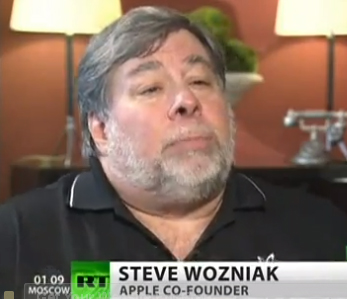
I had the great pleasure of sitting down with the co-founder of Apple, Steve Wozniak, last week in downtown DC. Truthfully, I was a little worried that someone worth billions of dollars would be pretentious and aloof. Instead, I was pleasantly surprised to see how down to earth and open he was to share his perspective.
It was a refreshing and enlightening experience to hear from such a visionary on issues like MegaUpload’s Kim Dotcom, Net Neutrality, WikiLeaks, and government legislation that curbs our internet freedoms.
Abby
***
RT’s Abby Martin sits down with Steve Wozniak, co-founder of Apple,
to speak about net neutrality and his fear that freedom on the Web might become a thing of the past.
***
RT — “Well, we begin today taking a close look at cyber-legislation and the aim to regulate the internet. With the failure of the most recent cyber bill in the Senate and a possible Obama Executive Order, it seems the government is looking for ways to beef up internet protection.
“The head of cyber command General Keith Alexander, also head of the NSA, has come out asking the administration to review the rules when it comes to cyber-attacks. Currently, the Pentagon is only allowed to defend against attacks inside its own boundaries. But they are hoping now to expand that power to outside of their own computer networks and within foreign countries.
“Now, this comes days after Kaspersky Labs identified another apparent state-sponsored virus with links to Stuxnet and Flame. So, as heavy as speculation swirls around the future of the internet, we, here at RT, sat down with someone who had a clear hand in creating our current cyber climate. Steve Wozniak, co-founder of Apple, speaks to RT’s Abby Martin about net neutrality, his fear that freedom on the internet could become a thing of the past. He also weighs in on the Kim Dotcom case against him.”
Abby Martin (c. 1:05): “So, Steve, as co-founder of one of the largest companies in the world, do you think that you have a responsibility to speak out about internet issues like internet regulation?”
Steve Wozniak: “I don’t think anyone comes with a responsibility just because their company is really big. Especially, since I’m not the one who wanted to run a company, just be a great engineer to help start it. I don’t feel that anybody has a responsibility. However, I do like it when well-known people, that are in the public eye, speak out on social issues and give their opinion.”
Abby Martin: “What do you think about legislation SOPA and PIPA? And why do you think they were so unpopular?”
Steve Wozniak: “It turns out that the, well, the internet, when it first came, it was a breath of fresh air. It was so free. Nobody owned the internet space. Countries didn’t own it; they didn’t control it. It was worldwide. It was people to people. It was like we, little people of the world, all of a sudden had this incredible resource. And we didn’t have to go through other people selling it to us and delivering it to us. That has changed a lot. But, still, those were items, that were kind of against just being able to use the wires to send whatever you thought of to somebody else who’s a friend or whatever sharing data.
“So, a lot of people had done that sort of thing. They had freely shared maybe a song with a friend. Or maybe they shared another file with another good friend and they just don’t want interference. Now, sure, it’s illegal to share copyrighted material. Fine, there are laws in place. But these were new laws, that were gonna just totally try to put up roadblocks to services, that had other very good purposes in our life.
“For example, I might make a promotional video for an interview like this and then I’ll email it to you. Well, it’s too big to email. So, I’ll upload it to a little site. It may be Dropbox, maybe it’s my Apple iDisk, maybe it’s Megaupload. I’ll upload it to a site and send you the URL and now you can download it.
And I do that regularly.”
Abby Martin (c. 2:52): “I heard you previously talking about Kim Dotcom’s case. And you mentioned that the charges against him were pretty much phony. Elaborate more on what you mean by that.”
Steve Wozniak (c. 3:04): “Yes, first of all, he ran one of the largest file-sharing services in the world. So, the most movies and all were being exchanged by people through that site. It’s not a site where you could link to it and connect to it and say, ‘Search for Avatar.’ There was no searching. Somebody could upload a file and then pass out a URL on their own. And they are violating the law, if it’s copyright material, like a movie. And the person, who downloads it, is violating the law, too.
“But what Kim Dotcom ran is just a service that’s like the post office. He was the post office it was being mailed through. Why do you shut down the post office, thinking that’s where the problem is? It’s not. So, that was a phony charge.
“They tried to charge him with a copyright violation, himself, for uploading 60 songs or something. But they had come up off of CDs he had purchased.
“So, you see, it was all these attempts, that I call phony. Then they had to figure out a way to extradite him. They needed a crime, that would get him five years in prison to meet the law, the New Zealand law, for extradition.
“So, they made up phony charges of racketeering, like he’s some big mobster connecting, you know, a big financial empire in these countries. I mean Apple does that. But Kim Dotcom is just a nice soft little sweet guy when you meet him, who tells the truth openly. You know when somebody’s being truthful when you’re with them, personally. And he does hide things. He doesn’t harry. He doesn’t have concocted lines to tell. He’s not a racketeer.
“They charge him with mail fraud because he said, ‘I deleted some files.’ And what he had done was delete the links to them. Like, if you have a computer and you take a file and you throw it in the trash. The file is still on your hard disk. It didn’t really get erased. The link is gone. You can’t find it anymore by that link. So, that’s a phony charge. He really had got rid of the one part, that you could have gotten rid of to make it look as though it was deleted.
“The phony charges just indicate that they’re gonna, they’re doing everything they can to make the public think they, the prosecutors, are in the right. You know? But you don’t do phony things when you’re in the right—you have an open and shut case—no. They’re having to go beyond the bounds of what’s right to try to convict him.”
Abby Martin (c. 5:06): “What kind of precedent do you think this sets for, just, government overstepping?”
Steve Wozniak: “I’ve read a lot about how they confiscated his data files, actually, took them to the United States and they didn’t have the right to do that.
“It’s, yeah, the trouble is we’ve developed what sort of rights you have to have against accusers, meaning the police and the prosecutors. They are the accusers. The presumption of innocence means the burden of proof is on the accuser. They have to prove that. You have the right to be notified of what you’re being charged of. You have the right to, you know, a lot of different rights, that make sure you’re being treated fairly. And prosecutors and governments have found every way they can to get around those rights. And that’s what bothers me. It’s that, if they want to convict you of something you didn’t do, they have an awful lot of techniques to do it. A lot of ways to do it.”
Abby Martin (c. 5:51): “You founded the Electronic Frontier Foundation to protect free speech. Should the principles of the First Amendment be protecting something like WikiLeaks?”
Steve Wozniak: “Free speech is not absolute in my mind. It’s a very important right. It has to go through considerations of, ‘Did you violate it in ways, that might be, hurt somebody else?’ Some free speech could actually trigger harmful events. It could trigger even murders.
“So, does murdering an abortion doctor count as free speech? No. There are limits to free speech.
“I don’t know in the case of WikiLeaks. Um, I don’t know where that’s going to fall out.”
Abby Martin:“So, you think there are limitations, in terms of, kind of, opening or protecting free speech online, the war on whistle-blowers?”
Steve Wozniak (c. 6:35): “Well, yeah, free speech online. I was brought up with the belief that the First Amendment was such a good thing. Every one of our Bill of Rights was so crucial to my heart, the way my dad taught me. But free speech meant you could say something bad about the president, even. You could say something bad about your government. You had that right. And we were taught you don’t have that right in Communist Russia. So, I believe in that right very strongly.
“As far as WikiLeaks, you know, I wish I knew more about the whole case. On the surface, it sounds to me like something, that’s good. The whistle-blower blew the truth. The people found out what, they, the people paid for. You know? And the government says, ‘No, no, no! The people should not know what they paid for.’”
Abby Martin (c. 7:15): “You’ve grown up in a generation where you’ve seen the internet proliferate into something so massive where political and social movements are birthed online now. What do you think about the evolution of the internet and how Apple has played a role in expanding that to people?
Steve Wozniak: “You know, when we started the company—I always go back to that point. We have a vision of computers being prolific and in everybody’s hands throughout society. Did we have the idea that it would lead to, you know, the incredible connection that the internet would come on board, that broadband would come on board for almost everyone who wants it and that that would lead to all these, basically, the way we live life and the way do things, everything political, everything social, the way we do things with other people is all done with your computer, on the internet, with your iPhone or mobile devices now. And it’s a totally different world than it was when, well, we had powerful computers, but they weren’t a part of your life as much as now. And I’m just as happy as everyone else to see it having turned out this way.”
Abby Martin (c. 8:17): “And how do you see it going? Do you think it will still continue? Or do you think we’ll see, kind of, a curb. I mean with the political and social movements now where everything is integrated, everything is being homogenised in the entire world and we are seeing the Arab Spring, the Occupy Wall Street movement, really, because of social interaction.”
Steve Wozniak: “Yes. I think that a lot of social interaction will be curbed. I, I—let me take that back. I fear it. I fear it will be. The gatekeepers, those who can turn on and off switches, allow certain things, disallow other things, allow who gets to send me data about a new movie, rather than everyone having equal say so of reaching me. Yeah, I fear that very strongly. Especially, net neutrality, issues like that, internet freedom is being interfered with in major ways. And it shouldn’t.
“I think the internet should, from day one, a country of its own, that isn’t bound by any individual county’s laws. Maybe we could have had an internet government. But it didn’t happen, just like world government doesn’t happen. You know? Space doesn’t belong to anyone. The moon doesn’t belong to anyone. These are really beautiful principles in life. And then, as soon as a country figures out a way to get control of them, it disappears.
“I’m an optimist. I think we can move more and more towards net neutrality. The trouble is a lot of it has to be, um, enforced by the government and conservative types and libertarian types say, ‘Government shouldn’t have any say and control over that! That takes away our freedom!’ Wrong. It takes away the freedom of the companies, that are taking away the freedom from us.
“Every freedom we have in the United States—every one of them—was given to us by Congressional regulation. It’s called the Bill of Rights. That is what gives us our freedom. And, yet, it was from the government. It was government regulation.
“No, there are times when government regulation says, ‘You will not impede with the internet neutrality of the users.’
Abby Martin (c. 10:05): “What do you think about this whole hacktivist movement, that’s come out of, kind of, the war on whistle-blowers, Occupy Wall Street, Anonymous, and you have the take-downs of government websites. And then you see legislation, like CISPA, the Cyber Intelligence Security Protection Act, that, kind of, puts a stop to these things. Do you think that that’s, kind of, working as a guise and using the hacktivism and the hacktivists [as a pretext] for regulating the internet even more?”
“Well, I really think that there are means for legitimate discourse. And trying to bring attention, um, with activist acts is wrong. On the other hand, I believe very strongly that legitimised marches and that sort of stuff, with the approval of the authorities, there’s room in our society to go out and have a microphone, to have a say and be heard by many others, especially, in this day of the internet.
“So, there are a lot of avenues. It’s just trying to, you know, grab some to get on the news, I don’t think that’s the way to, maybe it’s a start, it puts ideas into people’s heads, but I really, um, I, I don’t think that’s the right way to solve things.”
“I know you said before that no one really has the responsibility to speak out about anything. But why do you, Steve, speak out? And why do you think so many others don’t about these issues?”
“You know what? The whole world is very conflict-oriented. We want to take a side and fight for my side. My side might be my country. It might be my computer platform. It might be which browser I use. And I take my side and everybody else is bad. And I want to fight. And I only want to look at the world one way. And I’m the, I try to be so wide and open and just, you know, accept everything and judge it. That’s the logical scientific approach. Don’t take a side. Don’t be, like, for one religion against others, that sort of thing.”
Abby Martin: “Thank you so much for your time.”
Transcript by Felipe Messina for Media Roots and RT
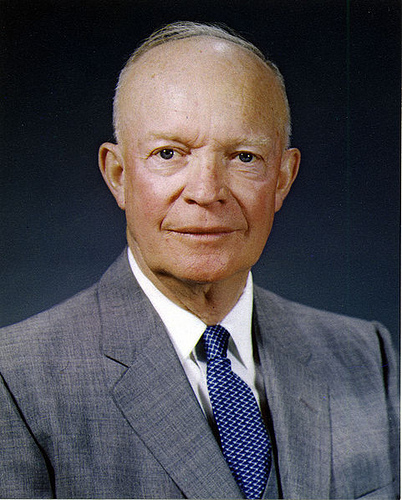
MEDIA ROOTS – The term “military-industrial complex” was originally coined by President Eisenhower in his final address as Commander-In-Chief and has since become a foreshadowing declaration to a country that may have lost its moral compass in pursuit of profits. “God help this country,” the President warned just a few weeks prior to this speech, “when someone sits in this chair who doesn’t know the military as well as I do.” Now it seems, with an annual defense budget of well over one trillion dollars, it has become a civic duty for all Americans to inform their peers of this misplaced power.
As the Supreme Commander of the Allied Forces in Europe, the coalition that defeated the Nazi regime, “Ike” was directly responsible for planning and commandeering the invasion of North Africa and France. Having honorably served in the United States Army for nearly four decades, Ike foresaw a not-so-distant future with the United States held prisoner to a tyrannous warfare industry.
“In the councils of government, we must guard against the acquisition of unwarranted influence, whether sought or unsought, by the military-industrial complex. The potential for the disastrous rise of misplaced power exists and will persist.”
Eisenhower was warning of the emergence of a developing element in society that must continuously be checked. The repercussions of failing to do so could ultimately alter the very foundations of human society. But was the career military officer just being dramatic during his last days in office?
“This conjunction of an immense military establishment and a large arms industry is new in the American experience. The total influence – economic, political, even spiritual – is felt in every city, every Statehouse, every office of the Federal government. We recognize the imperative need for this development. Yet we must not fail to comprehend its grave implications. Our toil, resources and livelihood are all involved; so is the very structure of our society.”
The future of American livelihoods were viewed to be at stake. What Ike was worried about was an America where citizens would continue to make their living from war. He was afraid that if future Americans continue to receive their paychecks directly from the military-industrial complex, then war would be here to stay.
“Disarmament, with mutual honor and confidence, is a continuing imperative. Together we must learn how to compose differences, not with arms, but with intellect and decent purpose. Because this need is so sharp and apparent I confess that I lay down my official responsibilities in this field with a definite sense of disappointment. As one who has witnessed the horror and the lingering sadness of war – as one who knows that another war could utterly destroy this civilization which has been so slowly and painfully built over thousands of years – I wish I could say tonight that a lasting peace is in sight.”
Disappointed, Ike was afraid Americans would continue to support making war a way of life – affecting the citizenry spiritually – and result in a fascist society similar to that which Hitler had created. He worried that a militaristic fascist state would evolve with an abnormally-increased militaristic culture. He feared an ongoing global war – one that could ultimately destroy humanity – would continue as defense contractors profit from weaponry creation and distribution.
Now, more than fifty years later, have Eisenhower’s worst fears been actualized?
Tom Ball is a guest contributor for Media Roots.
***
When President Eisenhower addressed the nation with three days left in his presidency,
he warned of the dangerous complex that exists between military might and corporate profits.



 MEDIA ROOTS — Earlier this week on Deadline Live, radio host Jack Blood interviewed our very own Abby Martin. The beginning of the conversation gravitates around Abby’s incident with Rand Paul, where Rand tried to intimidate Abby for confronting him on his Romney endorsement. This leads into a discussion on many topics including how putting your faith and energy behind any politician (even ones who say things you agree with) will ultimately lead to disappointment.
  MEDIA ROOTS — Instead of the run of the mill faceless accusations of ‘The 1% are oppressing the 99%’ research organization Project Censored has compiled a valuable list with names and faces of some of the world’s biggest earners and financial elites.
  MEDIA ROOTS – Support to repeal the National Defense Authorization Act of 2012 (NDAA) is growing as the Bush-Obama administrations continue to pursue the ongoing global ‘War on Terror’ of nearly twelve years.
 MEDIA ROOTS — When I think of the most prolific innovators of our generation, there are a couple names that immediately come to mind. The founders of Apple, Steve Jobs and Steve Wozniak, are definitely at the top of the list. There’s no denying that Apple computers have aesthetically designed the world in which we all know and live in today–by simplifying technology to the point where everyone can use and access the internet, Apple products have changed the course of social interaction in the world.
 MEDIA ROOTS – The term “military-industrial complex” was originally coined by President Eisenhower in his final address as Commander-In-Chief and has since become a foreshadowing declaration to a country that may have lost its moral compass in pursuit of profits. “God help this country,” the President warned just a few weeks prior to this speech, “when someone sits in this chair who doesn’t know the military as well as I do.” Now it seems, with an annual defense budget of