
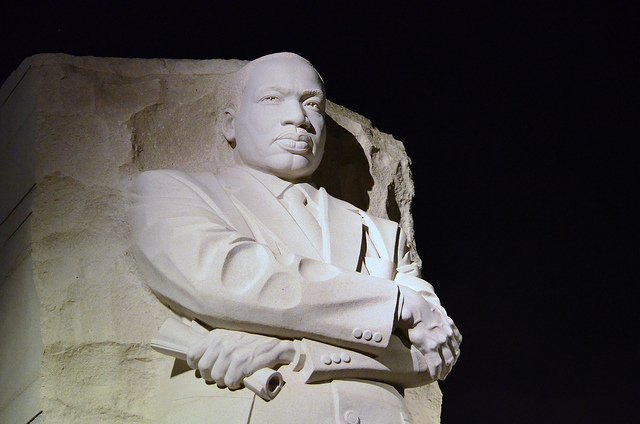
MLK Jr. – The Uncomfortable Truths History Books Won’t Touch

MLKflickruserangelanFor many, the words “I have a dream” are the only thing they associate with Dr. Martin Luther King, Jr.

Dr. King’s legacy is mostly depicted in the context of civil rights, with history books lauding his noble achievements of the Civil and Voting Rights Acts being passed.

But Dr. King gave hundreds of unpopular and controversial speeches ranging from the dangers of the Vietnam War to mass commercialization. During his life, he was attacked and marginalized from the white and black community alike.

The US government coined Dr. King the most “dangerous Negro leader in the country”, routinely spied on him and even went as far as writing him a letter in 1964 urging him to commit suicide.

In fact, MLK Jr.’s surviving family filed a civil suit in Memphis, TN, in which the jury found elements of the US government complicit in his assassination.

Having been arrested thirty times, Dr. King routinely threw his body upon the gears of the machine to show that change doesn’t roll in on the wheels of inevitability, but through continuous struggle against institutionalized injustice.

Focusing on America as the greatest purveyor of violence in the world, Dr. King spent the last year of his life fighting what he called the triple evils of the word: racism, militarism, and economic exploitation.

In fact, when MLK was assassinated he was planning the “Poor People’s Campaign” – a mass march and occupation of DC until the US government granted poor people an “Economic Bill of Rights”.

Listen to his profound speech “Beyond Vietnam”, given exactly one year before Dr. King’s assassination.

Rev. Dr. Martin Luther King Jr. “Beyond Vietnam”

It’s a topic Tavis Smiley explores in amazing depth and clarity in his new book, Death of a King: The Real Story of Dr. Martin Luther King Jr.s’ Final Year in which he talks about the unvarnished truth about Dr. King’s life, and last sermon entitled “Why America May Go to Hell”.

Breaking the Set speaks with Smiley about Dr. King and Mahatma Gandhi’s grandson, Arun Gandhi, about why structural and passive violence are the most inhibiting factors for peace.


Breaking the Set with Tavis Smiley and Arun Gandhi

**

 Abby Martin | @Abby Martin 

Photo by flickr user Angela N.

Detroit’s Bankruptcy Dictatorship: Extinguishing the Homeless & Shutting Down Human Rights

detroit homeSix years ago, Congress passed a bailout to the tune of 80 billions dollars funded by American taxpayers to rescue the bankrupt auto industry, mostly based in Detroit. But when the Motor City itself needed help and retirees were on the brink of losing everything, the money was nowhere to be found, apparently to avoid “meddling” in the bankruptcy process.

Fast forward to today, where the government admits it “only” lost 9.3 billion taxpayer dollars to the auto makers – an amount that could transform the lives of hundreds of thousands of Detroit residents.

And despite the rhetoric that Detroit is on the up and up, there’s still an insurmountable amount of suffering and neglect plaguing the city. Much of Detroit is in squalor, with skyrocketing rates of poverty, homelessness, and even cuts to vital resources like water where 40% of the population faces shut-offs.

At the end of the day, it’s a story of priorities. If this country continues to prioritize guns over water, bombs over shelter, and bloodshed over life, then it won’t just be Detroit that needs saving.

Breaking the Set recently traveled to Detroit to delve deeper into the roots of the bankruptcy as well as connect with activists working tirelessly to help bring city residents back on their feet.

**

Detroit Part I: Extinguishing the Homeless & Shutting Off Human Rights

**

 Detroit Part II: Bankruptcy Dictatorship & Foreclosed Futures

**

Donate to the Detroit Water Brigade here. Find out more about The Tricycle Collective here.

Follow me @AbbyMartin and let me know what you think at #BTSDetroit

Media Roots Radio – North Korea Hype, War on Terror Psy-Op, ‘Liberal’ Warmongers

NKoreak photo yeowatzupRobbie and Abby Martin get together after the holidays for a densely packed episode of Media Roots Radio discussing anti-North Korea propaganda surrounding the Sony hack; the worst aspects of the US torture program not being talked about; and the ‘liberals’ who jump on the bandwagon to demonize every country the US just happens to want to bomb.
If you want to directly download the podcast, click the down arrow icon on the right of the soundcloud display. To hide the comments to enable easier rewind and fast forward, click on the icon on the very bottom right.

This Media Roots podcast is the product of many long hours of hard work and love. If you want to encourage our voice, please consider supporting us as we continue to speak from outside party lines. Even the smallest donations help us with operating costs.

Listen to all previous episodes of Media Roots Radio here.

Follow Abby @abbymartin & Robbie @fluorescentgrey

 Recorded on 1/02/15

Internationally Banned Tear Gas: For Domestic Use Only

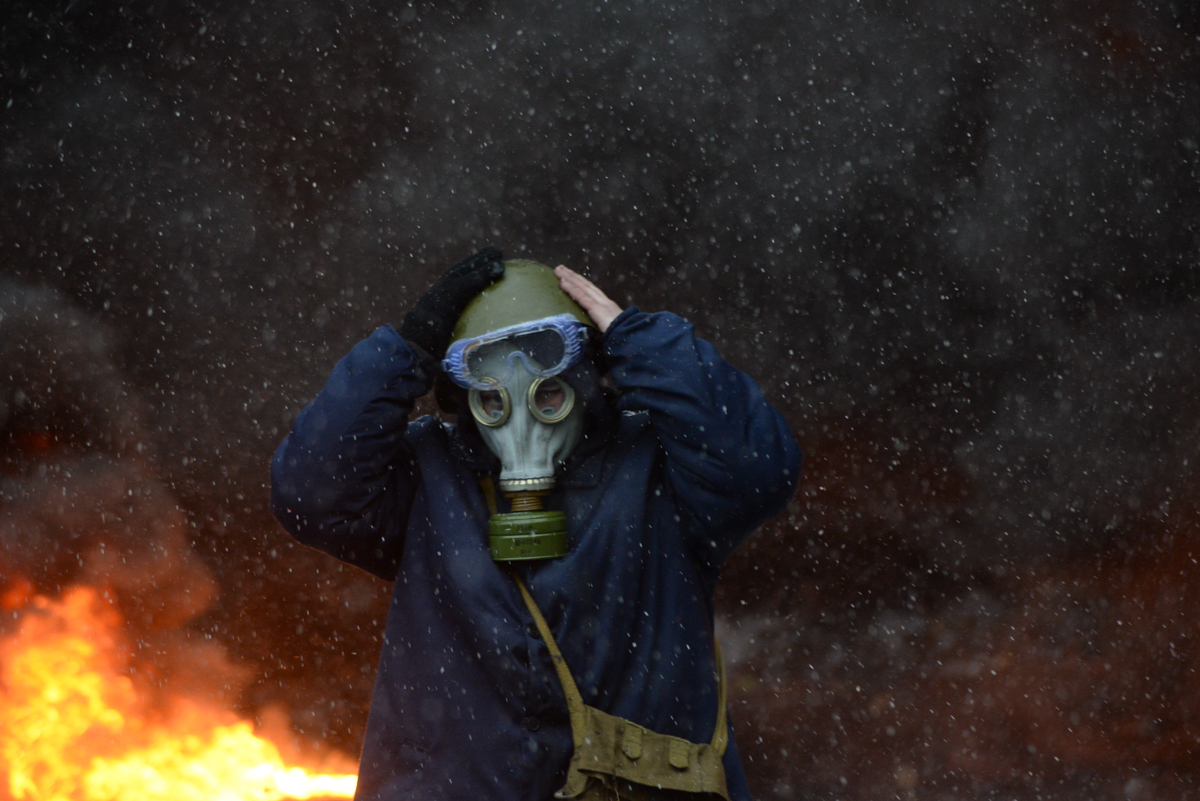
Protester wearing a tear gas mask against background of the massAs unrest erupts from Oakland to Egypt, there’s one weapon of war that has come to define the militarized police state: tear gas.

And while a St. Louis judge ruled recently that limits must be placed on the use of tear gas in Ferguson, he didn’t rule that tear gas should only be implemented as a last resort.

Around the country, contingents of peaceful protesters are being confronted by assemblies of heavily militarized police officers that regularly use chemical agents to disperse crowds. But usually the act of getting doused with chemicals is so infuriating that it only incites chaos.

People have a good reason to be afraid of tear gas, considering it’s a banned agent of war under the 1993 Chemical Weapons Convention. Here’s the catch – there’s a clause in the treaty that includes an exception for domestic use. Yes, it’s illegal for the US military to use tear gas against ISIS, but cool to use against American citizens.

The US ensured the exception, claiming it was afraid the convention may prohibit lethal injection. Because of this caveat for riot control, countries around the world regularly and irresponsibly use chemical agents against their own populations. In American cities like Ferguson, police deploy tear gas at the drop of a hat, often at cameramen and journalists.

Despite all of the apocalyptic imagery associated with the weapon, government officials maintain tear gas is perfectly safe, including Ferguson police chief Tom Jackson, who said “There are complaints about the response from some people… but to me, nobody got hurt seriously, and I’m happy about that.”

He forgot to say yet, considering how Ferguson police are using tear gas canisters from the Cold War era and are so old, there’s a severe risk of shrapnel flying into crowds. Make no mistake, this “less than lethal” weapon can actually be quite deadly. Look no further than Palestine, where a man was killed from a tear gas canister hitting him at close range in 2011. Or in Egypt, when a policeman shot tear gas into a caravan holding  37 protesters, choking and killing them all.

Horrifyingly, tear gas also causes amputations and miscarriages. In Bahrain, Physicians for Human Rights reported that many pregnant women had miscarriages after exposure with the chemical agent. Officials assure there are no long term health effects, but that hasn’t been proven given the lack of long term studies. Sven-Eric Jordt, a leading expert in tear gas, says

“I frankly think that we don’t know much about the long-term effects, especially in civilian exposure…There’s very few follow-up studies. These are very active chemicals that can cause quite significant injury. I’m very concerned that, as use has increased, tear gas has been normalized. The attitude now is like, this is safe and we can use it as much as we want.”

And boy, do we. As the world’s leading military and arms supplier, the US is also the biggest producer of less than lethal weaponry. During Egypt’s revolution, while police gunned down protesters and made mass arrests, they liberally used tear gas that read “Made in the USA” (at a little place called Combined Systems International of Jamestown, Pennsylvania). According to VisionGain, the non-lethal weapons market has exploded over the last decade, and is worth a whopping 1.6 billion dollars this year.

Somehow the government has convinced the American people that using tear gas is perfectly harmless, despite stark evidence to the contrary. So, next time it tries to sell us another war because *this leader gasses his own people*, remember that claim isn’t so far from home.

***

Abby Martin Breaks the Set on the Lethality of Tear Gas

***

Abby Martin / @AbbyMartin

Photo by Wikimedia Commons


Aaron Swartz and the Fight for Free Information

aaron swartz flickr quinn norton BWComputer prodigy Aaron Swartz should have been celebrating his 28 years over the holidays. Yet nearly two years ago, he tragically took his own life.

He was the target of a merciless witch-hunt by the Department of Justice, ultimately choosing death over 35 years behind bars for the crime of releasing information. As someone who transformed the way we all use and love the internet, Aaron should have gotten a medal of honor, not a death sentence.

Aaron’s genius mark on the web can be traced back to the development of RSS feeds, a formula that produces a feed of whatever information one chooses to access, changing the way we filter and aggregate data. His passion for making information open source was exemplified in his partnership with Lawrence Lessig at only 15 years old, when he coded creative commons, a database devoted to growing the amount of creative works available to share and build off of. This revolutionized what was capable online, allowing people to use imagery without worrying about copyright or legal ramifications.

Perhaps Aaron’s mark will most be felt by co-founding Reddit, one of the most visited sites in the world that embodies what raw and free access looks like. After Reddit exploded, Aaron sold it for over a million dollars. But he rejected the business world, and instead put his entire being into political activism. He began openlibrary.org, a site that allows users to buy, borrow or browse every published book in the world. The project cemented his obsession with freeing the mind of humanity from its elite clutches. Sadly, it was this beautiful idea that came to define Aaron as a criminal that deserved more time in prison than murderers in the eyes of the federal government

The majority of the wealth of human knowledge is owned by a few publishing companies that hoard information and make billions off licensing fees, although most scholarly articles and journals are paid for by taxpayers through government grants. Aaron sought to change this.

He wrote about his plans to release academic journals and expressed outrage about prosecutorial overreach on the Guerilla Open Access Manifesto in 2008:

“It’s called stealing or piracy, as if sharing a wealth of knowledge were the moral equivalent of plundering a ship and murdering its crew. But sharing isn’t immoral — it’s a moral imperative. Only those blinded by greed would refuse to let a friend make a copy…

There is no justice in following unjust laws. It’s time to come into the light and, in the grand tradition of civil disobedience, declare our opposition to this private theft of public culture….With enough of us, around the world, we’ll not just send a strong message opposing the privatization of knowledge — we’ll make it a thing of the past.”

His first target was JSTOR, a digital library of academic journals and books. But as he attempted to download millions of articles from JSTOR at MIT, authorities were filming him through a surveillance camera. Aaron’s altruism came at a heavy price. The footage was used to charge him with computer and wire fraud, which would have locked him up for decades.

Aaron praised the internet’s ability to give everyone a license to speak, but noted how many of those voices won’t get heard, which is why he dedicated the last year of his life leading the charge against corporate monopolization of the web with legislation like SOPA and PIPA.

Aaron Swartz sacrificed himself to better the world. His blood is on the US government’s hands for institutionalizing a two tiered justice system that immunizes criminals and bone chillingly destroys revolutionaries.

**

Breaking the Set on Aaron Swartz’s legacy

**

Please watch the documentary about Aaron that inspired me to write this tribute, called “The Internet’s Own Boy”.

The Internet’s Own Boy

**

Abby Martin / @AbbyMartin

Photo by flickr user Quinn Norton