The Capitalist Network That Runs the World

MEDIA ROOTS- In an empirical study using complex systems analysis models, mathematical theorists in Zurich have revealed the architecture of transnational corporations’ (TNCs) interconnectedness. The report bolsters the charges made of late by the Occupy Wall Street Movement touting society’s obscene inequality—1% of the population owns almost half of all U.S. wealth.  This study’s findings, an uncanny correlative of the individual TNC to the individual ruling-class elitist, reveal that less than 1% of all TNCs essentially control 40% of the global economy. 

Messina

***
CapitalistNetworkPLoSOneNEW SCIENTIST— AS PROTESTS against financial power sweep the world this week, science may have confirmed the protesters’ worst fears. An analysis of the relationships between 43,000 transnational corporations has identified a relatively small group of companies, mainly banks, with disproportionate power over the global economy.

The study’s assumptions have attracted some criticism, but complex systems analysts contacted by New Scientist say it is a unique effort to untangle control in the global economy. Pushing the analysis further, they say, could help to identify ways of making global capitalism more stable.

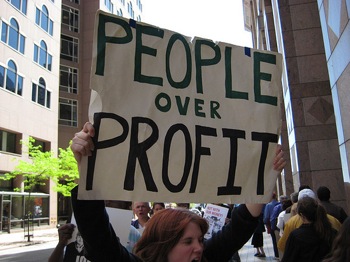
The idea that a few bankers control a large chunk of the global economy might not seem like news to New York’s Occupy Wall Street movement and protesters elsewhere (see photo). But the study, by a trio of complex systems theorists at the Swiss Federal Institute of Technology in Zurich, is the first to go beyond ideology to empirically identify such a network of power. It combines the mathematics long used to model natural systems with comprehensive corporate data to map ownership among the world’s transnational corporations (TNCs).

“Reality is so complex, we must move away from dogma, whether it’s conspiracy theories or free-market,” says James Glattfelder. “Our analysis is reality-based.”

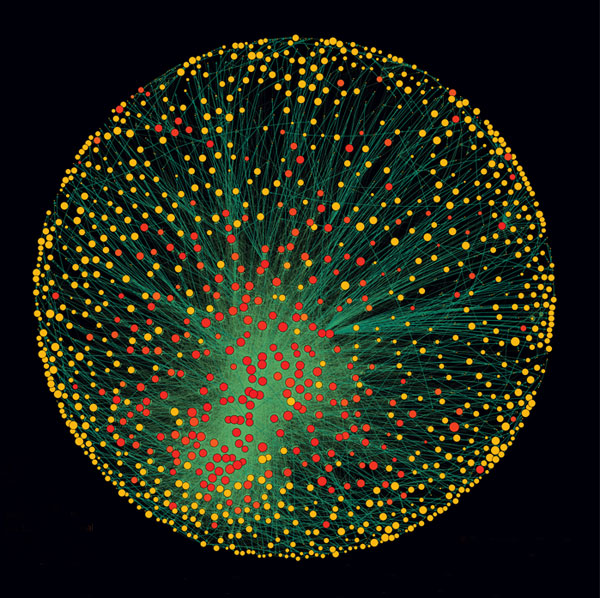
The work, to be published in PLoS One, revealed a core of 1318 companies with interlocking ownerships (see image). Each of the 1318 had ties to two or more other companies, and on average they were connected to 20. What’s more, although they represented 20 per cent of global operating revenues, the 1318 appeared to collectively own through their shares the majority of the world’s large blue chip and manufacturing firms – the “real” economy – representing a further 60 per cent of global revenues.

When the team further untangled the web of ownership, it found much of it tracked back to a “super-entity” of 147 even more tightly knit companies – all of their ownership was held by other members of the super-entity – that controlled 40 per cent of the total wealth in the network. “In effect, less than 1 per cent of the companies were able to control 40 per cent of the entire network,” says Glattfelder. Most were financial institutions. The top 20 included Barclays Bank, JPMorgan Chase & Co, and The Goldman Sachs Group.

Read more about the capitalist network that runs the world.

© 2011 Reed Business Information Ltd.

Image by PLoS One
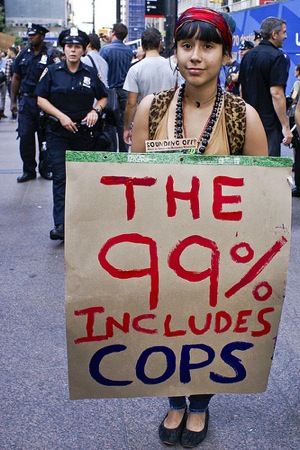
JP Morgan Gave NYPD $4.6 Million Before Protests

DISINFO– Wondering how much it costs to buy off the police department? In June of 2011, JP Morgan Chase gave the New York City Police Foundation the largest donation in its history. How the police show their gratitude will presumably determine whether they receive similar donations from companies in the future.

Via Naked Capitalism:

No matter how you look at this development, it does not smell right. From JP Morgan’s website, hat tip Lisa Epstein:

JPMorgan Chase recently donated an unprecedented $4.6 million to the New York City Police Foundation. The gift was the largest in the history of the foundation and will enable the New York City Police Department to strengthen security in the Big Apple. The money will pay for 1,000 new patrol car laptops, as well as security monitoring software in the NYPD’s main data center.

New York City Police Commissioner Raymond Kelly sent CEO and Chairman Jamie Dimon a note expressing “profound gratitude” for the company’s donation.

“These officers put their lives on the line every day to keep us safe,” Dimon said. “We’re incredibly proud to help them build this program and let them know how much we value their hard work.”

Now readers can point out that this gift is bupkis relative to the budget of the police department, which is close to $4 billion. But looking at it on a mathematical basis likely misses the incentives at work. Dimon is one of the most powerful and connected corporate leaders in Gotham City. If he thinks the police donation was worthwhile, he might encourage other bank and big company CEOs to make large donations.

And what sort of benefits might JPM get? The police might be extra protective of your interests. Today, OccupyWallStreet decided to march across the Brooklyn Bridge (a proud New York tradition) to Chase Manhattan Plaza in Brooklyn. Reports in the media indicate that the police at first seemed to be encouraging the protestors not only to cross the bridge, but were walking in front of the crowd, seemingly escorting them across. Over 700 of the marchers were arrested, and the media has a rather amusing “he said, she said” account, with OccupyWallStreet claiming entrapment and the cops batting their baby blues and trying to look innocent.

We simply don’t know whether the police would have behaved one iota differently in the absence of the JP Morgan donation. But it raises the troubling perspective that they might have.

© 2011 Disinfo

Check out Media Roots photos from Occupy Wall Street.

Photo by Flickr user Sasha Y Kimel

Feral Capitalism Hits the Streets

MEDIA ROOTS- The London riots were mostly summarized as an animalistic decline of civil society by the corporate press, with too little analysis as to what societal, political and economic factors could cause such a backlash to occur. Since there was no apparent political motivation behind the rioting, it was easy to discard the actions as indiscriminate herd looting and burning by “feral teenagers.” Counterpunch writer David Harvey writes about how this breakdown is an inevitable outcome of living under a broken system of “feral capitalism,” where corruption and profiteering are rampant in almost every corporate and political sector.

Abby

***

COUNTERPUNCH– “Nihilistic and feral teenagers” the Daily Mail called them: the crazy youths from all walks of life who raced around the streets mindlessly and desperately hurling bricks, stones and bottles at the cops while looting here and setting bonfires there, leading the authorities on a merry chase of catch-as-catch-can as they tweeted their way from one strategic target to another.

The word “feral” pulled me up short. It reminded me of how the communards in Paris in 1871 were depicted as wild animals, as hyenas, that deserved to be (and often were) summarily executed in the name of the sanctity of private property, morality, religion, and the family. But then the word conjured up another association: Tony Blair attacking the “feral media,” having for so long been comfortably lodged in the left pocket of Rupert Murdoch only later to be substituted as Murdoch reached into his right pocket to pluck out David Cameron.

There will of course be the usual hysterical debate between those prone to view the riots as a matter of pure, unbridled and inexcusable criminality, and those anxious to contextualize events against a background of bad policing; continuing racism and unjustified persecution of youths and minorities; mass unemployment of the young; burgeoning social deprivation; and a mindless politics of austerity that has nothing to do with economics and everything to do with the perpetuation and consolidation of personal wealth and power. Some may even get around to condemning the meaningless and alienating qualities of so many jobs and so much of daily life in the midst of immense but unevenly distributed potentiality for human flourishing.

If we are lucky, we will have commissions and reports to say all over again what was said of Brixton and Toxteth in the Thatcher years. I say ‘lucky’ because the feral instincts of the current Prime Minister seem more attuned to turn on the water cannons, to call in the tear gas brigade and use the rubber bullets while pontificating unctuously about the loss of moral compass, the decline of civility and the sad deterioration of family values and discipline among errant youths.

But the problem is that we live in a society where capitalism itself has become rampantly feral. Feral politicians cheat on their expenses, feral bankers plunder the public purse for all its worth, CEOs, hedge fund operators and private equity geniuses loot the world of wealth, telephone and credit card companies load mysterious charges on everyone’s bills, shopkeepers price gouge, and, at the drop of a hat swindlers and scam artists get to practice three-card monte right up into the highest echelons of the corporate and political world.

Read the full article about Feral Capitalism Hits the Streets.

Written by David Harvey

© 2011 Counterpunch

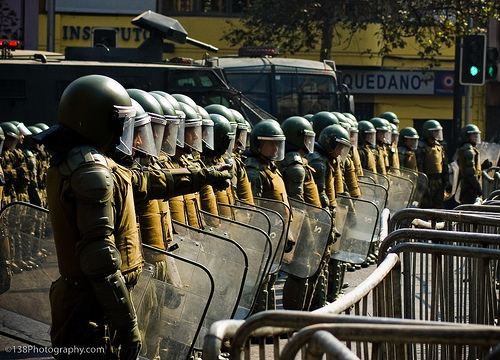
Photo by Flickr user 138_photo

Goldman Sachs Outsources US Jobs to Singapore

BUSINESS INSIDER– Goldman Sachs is going to fire employees in the U.S. and some other countries so that it can hire 1,000 in Singapore, where it’s cheaper.

Charlie Gasparino heard the news from people who were briefed on the hiring in Washington. He says Goldman gave Washington the heads up because hiring offshore is likely to cause a backlash.

He didn’t give a specific timeline, or say which units would be hit, but here’s what’s going to happen, according to Gasparino:

Goldman is so concerned about the potential for criticism that the firm’s representatives have been alerting staffers of lawmakers in Washington of the hiring spree in recent weeks as a way to mollify any concerns they may have about previously undisclosed plans to add 1,000 jobs to the firm’s Singapore office, according to people in Washington with direct knowledge if the matter…

The jobs in Singapore are likely to be “high-paying, skilled positions in sales and investment banking,” the same types that are likely to be cut in the firm’s domestic operations, according to one person with knowledge of the matter. This person added that the firm has recently briefed people in Washington about the new overseas jobs because it “is afraid of the fallout” as it plans to slash $1 billion in costs over the next year — a move that will mean a significant, though still undetermined number of layoffs across its operations, though people close to the firm expect the biggest hit to come from the US.

Read full article about Goldman Sachs Fires US Employees to Hire Singaporeans.

© 2011 Business Insider

Photo by Flickr user Americans4FinancialReform

Wealthiest 1% Rule Our Politics, But There’s Hope

ALTERNET– A discussion between Noam Chomsky and Michael Lerner:

Michael Lerner (ML): You have made many excellent analyses of the power of global capital and its capacity to undermine ordinary citizens’ efforts to transform the global reality toward a more humane and generous world. If there were a serious movement in the U.S. ready to challenge global capital, what should such a movement do? Or is it, as many believe, hopeless, given the power of capital to control the media, undermine democratic movements, and use the police/military power and the co-optive power of mass entertainment, endless spectacle, and financial compensations for many of the smartest people coming up through working-class and middle-income routes? What path is rational for a movement seeking to build a world of environmental sanity, social justice, and peace, yet facing such a sophisticated, powerful, and well-organized social order?

Noam Chomsky (NC): There is no doubt that concentrated private capital closely linked to the state has substantial resources, but on the other hand we shouldn’t overlook the fact that quite a bit has been achieved through public struggles in the U.S. over the years. In many respects this remains an unusually free country. The state has limited power to coerce, compared with many other countries, which is a very good thing. Many rights have been won, even in the past generation, and that provides a legacy from which we can move on. Struggling for freedom and justice has never been easy, but it has achieved progress; I don’t think we should assume that there are any particular limits.

At the moment we can’t realistically talk about challenging global capital, because the movements that might undertake such a task are far too scattered and atomized and focused on particular issues. But we can try to confront directly what global capital is doing right now and, on the basis of that, move on to further achievements. For example, it’s no big secret that in the past thirty years there has been enormous concentration of wealth in a very tiny part of the population, 1 percent or even one-tenth of 1 percent, and that has conferred extraordinary political power on a very tiny minority, primarily [those who control] financial capital, but also more broadly on the executive and managerial classes. At the same time, for the majority of the population, incomes have pretty much stagnated, working hours have increased, benefits have declined — they were never very good — and people are angry, hostile, and very upset. Many people distrust institutions, all of them; it’s a volatile period, and it’s a period which could move in a very dangerous direction — there are analogues, after all — but it could also provide opportunities to educate and organize and carry things forward. One may have a long-term goal of confronting global capital, but there have to be small steps along the way before you could even think of undertaking a challenge of that magnitude in a realistic way.

ML: Do you see any strategy for overcoming the fragmentation that exists among social movements to help people recognize an overriding shared agenda?

NC: One failing of the social movements that I’ve noticed over many years is that while they are focusing on extremely crucial and important social issues like women’s rights, environmental protections, and so on, they have tended to ignore or downplay the economic and social crises faced by working people. It’s not that they are completely ignored, but they are downplayed. And that has to be overcome, and there are ways to do it. So, to take a concrete example right near where I live, right now there is a town near Boston where a multinational corporation is closing down a local plant because it’s not profitable enough from the point of view of the multinational. Members of the workforce have offered to purchase the plant and the equipment, and the multinational doesn’t want to do that; it would rather lose money than offer the opportunity for a worker self-managed plant that might well become successful. And the multinational has the power to do what it wants, of course. But sufficient popular support — community support, activist support, and so on — could swing the balance. Things like that are happening all over the country.

Read the balance of the interview about Chomsky: Wealthiest 1% Rule Our Politics — But There’s Hope in the Fight Against Global Capital.

© 2011 AlterNet

Photo by Flickr user austinosuide