
Darfur Mediator and Sudanese Negotiator Resume Peace Talks

SUDAN TRIBUNE– Darfur’s peace chief mediator discussed today with the Sudanese officials the resumption of Doha talks to end the seven year conflict in Western Sudan.

Djibril Bassole, met Thursday in Khartoum with Amin Hassan Omer, government top negotiator and General Issmat Abdelrahman head of security arrangement sub-committee for the peace process.

The two sides discussed the ongoing preparations to resume the peace talks in Doha after its suspension last month for the general elections.

Amin informed Bassole that the Sudanese delegation would return to the Qatari capital on May 15 in order to continue peace talks with the rebel groups. Previously Sudan said the talks would restart after the swearing-in of the President elect Omer Al-Bashir on May 27.

The rebel Justice and Equality Movement (JEM) suspended its participation in the Doha process accusing Khartoum of violating a truce they agreed last February. Ahmed Hussein Adam, JEM spokesperson told Sudan Tribune yesterday they had informed the mediation of their readiness to sign a ceasefire before the departure of the government delegation to Khartoum but the Sudanese officials preferred to leave without to sign it.

He accused Khartoum of seeking to weaken his group militarily saying they were ready to repel any attack. The government and another rebel group, Liberation and Justice Movement (LJM) are expected to resume the negotiations after the arrival of the government delegation.

Sudanese President Omer Al-Bashir pledged this week to achieve peace in Darfur where some 300,000 people were killed and over 2.7 million are displaced since 2003.

© COPYRIGHT SUDAN TRIBUNE, 2010
Malawi’s Child Tobacco Pickers Exposed to Dangerous Nicotine Levels

(Video Below)

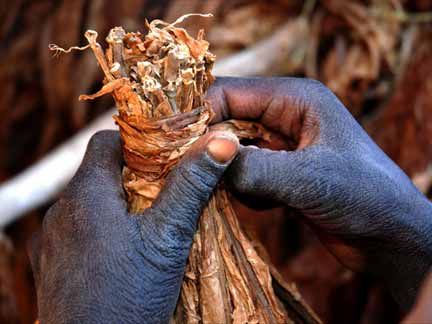
Malawi Children Picking TobaccoTHE GUARDIAN– Children in Malawi who are forced to work as tobacco pickers are exposed to nicotine poisoning equivalent to smoking 50 cigarettes a day, an investigation has found. Child labourers as young as five are suffering severe health problems from a daily skin absorption of up to 54 milligrams of dissolved nicotine, according to the international children’s organisation Plan.

Malawian tobacco is found in the blend of almost every cigarette smoked in the west. The low-grade, high-nicotine tobacco is often used as a filler by manufacturers, reflecting a long-term global shift in production. Tobacco farms in America declined by 89% between 1954 and 2002. Three-quarters of production has migrated to developing countries, with Malawi the world’s fifth biggest producer. Seventy per cent of its export income comes from tobacco and the country is economically dependent on it.

Plan cites research showing that Malawi has the highest incidence of child labour in southern Africa, with 88.9% of five to 14-year-olds working in the agricultural sector. It is estimated that more than 78,000 children work on tobacco estates – some up to 12 hours a day, many for less than 1p an hour and without protective clothing.

Plan’s researchers invited 44 children from tobacco farms in three districts to take part in a series of workshops. They revealed a catalogue of physical, sexual and emotional abuse and spoke about the need to work to support themselves and their families and pay school fees.

The children reported common symptoms of green tobacco sickness (GTS), or nicotine poisoning, including severe headaches, abdominal pain, muscle weakness, coughing and breathlessness.”Sometimes it feels like you don’t have enough breath, you don’t have enough oxygen,” one child said. “You reach a point where you cannot breathe because of the pain in your chest. Then the blood comes when you vomit. At the end, most of this dies and then you remain with a headache.”

GTS is a common hazard of workers coming into contact with tobacco leaves and absorbing nicotine through their skin, particularly when harvesting. It is made worse by humid and wet conditions, which are prevalent in Malawi, as residual moisture on the leaves helps nicotine to be absorbed quicker. Everyday symptoms of GTS are more severe in children than adults as they have not built up a tolerance to nicotine through smoking and because of their physical size. There is a lack of research into the long-term effects of GTS in children, but experts believe that it could seriously impair their development.

Continue reading about Malawi Child Laborers for Tobacco Farms.

© COPYRIGHT THE GUARDIAN, 2009
