MEDIA ROOTS — Yesterday, 500 fellow veterans and I marched in Washington, D.C. in support of Republican Congressman Ron Paul’s bid for Presidency. The Veterans for Ron Paul President’s Day event began with two hours of speakers and musical performances at the Washington
Monument and was followed by a well-organized march and military procession down 15th Street.
Upon reaching the
White House, we promptly did an about-face to symbolically turn our back on the
Commander-in-Chief and held a salute while organizer Adam Kokesh, of Adam vs. The Man, presented a folded U.S. flag to represent the death of a soldier. We held the salute for over
eight minutes—one second for every soldier that has committed suicide while
President Obama has been in office. For an additional ten minutes, our diverse company of men and women then stood at parade-rest to pray
for each soldier who has died while serving Obama’s so-called ‘War on Terror.’
The successful event pulled over a thousand supporters along with many in-town tourists who were able to witness
the historic spectacle. After the rally and march, there was a sold out after-party and concert with performances by Golden State and Aimee Allen.
RT was one of the few outlets to report on the Veterans for Ron Paul Event
Although the monumental event was a great success for all those in attendance, one glaring failure did occur yesterday,
a failure of coverage from the corporate media.
Most news outlets simply didn’t cover the event; and the outlets that did cover it marginalized its significance or
omitted important information. For example, ABC initially downplayed the number of attendees from hundreds who were
actually in attendance to only “dozens.” There was also no mention of event organizer Adam Kokesh in ABC’s report. Kokesh is a former Marine, Russia Today anchor and New Mexico Congressional
candidate, yet he was simply referred to as one “organizer.” Kokesh hosts the online news show “Adam
vs. The Man,” which garners thousands of viewers.
Fortunately, Ben Swann of WXIX is
expecting to cover the event in his weekly “Reality
Check” segment, in which Kokesh is scheduled to appear. Swann
has previously produced segments critical of the corporate media’s failure to cover Dr. Paul’s consistently strong anti-war campaign.
Oskar Mosco, who
participated in yesterday’s event, is a veteran of the U.S. Army and a producer at truth-march.
MEDIA ROOTS —After a two year campaign, The
Coalition of Immokalee Workers (CIW) has finally persuaded Trader Joe’s to sign on to a
fair food agreement that will change the working conditions and lives of tomato
workers in Immokalee, Florida. The coalition consists of over 4,000 farm
workers who incur unfair wages and dangerous working conditions. Since its creation in the early 90s, CIW has successfully
campaigned against these unjust practices, giving workers the opportunity to have
a comfortable working environment.
Trader Joe’s has joined in with a collection of
food service providers who have agreed to follow a fair standard of labor
practices, as well as a price premium for workers. The agreement also suggests a healthy and
ethical relationship between workers, tomato growers, and food industry
bosses. Interestingly, the original support for the campaign came from fast-food corporations, such as Taco Bell, Burger King, and
McDonald’s. Other food service providers included in the agreement are Bon
Appétit Management Co, Compass Group, Aramark, and Sodexo.
The
Coalition of Immokalee Workers has worked incredibly hard for over twenty years
to ensure justice to farm workers in Florida.
With the inclusion of southern Mexican music and
reworked Lady Gaga songs, the CIW has galvanized tens of thousands of people all
over the country in their campaign for labor and food justice. At an event in October, 2011, the CIW organized a large-scale action at the headquarters of Trader
Joe’s in Monrovia, California. A group of
clergy stood by the side of many farm workers, leading hundreds of protestors
through the streets to the front doors of the building. The action led to a successful dialogue between the CIW and Trader Joe’s
officials.
“I was so
happy to hear of the news,” CIW supporter Natali Rodriguez explains. “It just
goes to show that grassroots organizing and the power of the people really can
make a difference in the world.”
Rodriguez has participated in numerous CIW actions and was also present
for the large action at the Trader Joe’s Headquarters.
Trader Joe’s has set a precedent that
will hopefully encourage others in the food industry to increase their standards of labor practices. “It shows
the power of movements that are led by people who are most affected by the
issue, in this case farm workers, and also the power of having strong allies,”
Tim Carlson adds. “The
supermarket industry better watch out.” It’s inspiring to know that organizations like the CIW are diligently fighing for the rights of community workers by pressuring the food industry to create a more ethical and responsible
relationship between their workers and products.”
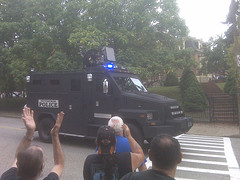
MEDIA ROOTS — Despite the national economy still tenuously hanging on life support and many cities financially flatlining, police departments throughout the U.S. still creatively invest enormous amounts of money in futuristc, “non-lethal” crowd control weapons. As we arrive at a point in U.S. history when true democracy is fleeting and the 1% breed new ways of absolute control, the necessity to appear less heavy handed in response to large street protests becomes paramount. U.S. power brokers seek ever devious ways to bend protesters to their will, whilst maintaining a positive image in the global media machine.
U.S. cities, such as Pittsburgh and Oakland have already introduced their citizens to the Long Range Acoustic Device (LRAD), a devastating weapon capable of causing permanent hearing damage. The latest addition to this high tech class of police weaponry is the Silent Guardian. The Silent Guardian emits a high powered beam of heat, much like a microwave. The beam can generate temperatures over 120° Fahrenheit.
During an era marked by popular unrest, we must ask ourselves, how safe do we feel being increasingly confronted by police weaponry more appropriate for armies and battlefields? As U.S. imperialism delivers deadlier and more efficient violence across the globe, how easily can the same hardware and methods seep into civilian policing at home? The distinction between the police and the military is fading as our two-party system criminalizes dissent and transitions toward paramilitary domestic repression. With the G8/NATO summit coming to Chicago in May likely to be met with mass protest, U.S. citizens may get a more accurate glimpse of what’s to come in the land of the free and home of the brave.
MR
***
ZNET — But
the prohibition on such repression enforced by those traditions has had
an ironically negative and authoritarian aspect in the context of
concentrated capitalist and imperial power. It has provided a great
incentive for corporate and state authorities to invest heavily in the
deadly arts and sciences of propaganda and manipulation. It has
encouraged “the 1%”and its servants to develop quieter methods of
“taking the risk out of democracy” (Alex Carey) by “manufacturing [mass]
consent” (Edward Herman and Noam Chomsky) through public relations,
propaganda, media control, education control, highly controlled and
personalized election spectacles, among other “soft” forms of population
management. At the same time, the proscriptions against sheer
repression have also incentivized American authorities to develop more
subtle, technically sophisticated forms of repression that operate
behind the scenes (the surveillance cameras that are ubiquitous in
England and ever more prevalent in the U.S. are a key example) and to
deploy forms of coercion that prevent or discourage citizens from
assembling and protesting without creating provocative images of state
brutality.
The legal and cultural ban on outwardly murderous rule in the
nominally free and democratic U.S. has compelled elites and their
servants to develop new, less provocative ways to “incapacitate” angry and active citizens – more quietly sinister methods of repression that are deadly for democracy: penned-off “free speech zones” and “frozen zones”[54] (where protestors are denied access to those they seek to influence), “rubber
bullets” that hurt and harm but do not generally kill, “concussion
grenades” that disorient and confuse without generally shattering
skulls, tear gas and pepper spray that sends protestors running, Tasers that stun but do not generally kill[55],
sonic canons and other acoustic devices that make your eardrums feel
like they are splitting, and perhaps – someday soon to be deployed in
freedom’s “homeland” – Raytheon’s perfectly named (for the purposes of
my argument) “Silent Guardian,” which noiselessly seems to cook human
skin and eyeballs and has the capacity “to inflict limitless, unbearable pain.”
Repressive
acoustic and heat ray technologies can bring special technical
dividends for those who wish to coerce without seemingly overly
coercive. As Xeni Jardin explained as LRAD-toting troops with the
Louisiana National Guard patrolled otherwise abandoned and black New
Orleans in September of 2005: “Crowd
control is a constant challenge to law enforcement — how to stop
potential troublemakers without endangering those who are simply in the
wrong place at the wrong time. Rubber bullets can kill, tear gas drifts
with the wind.”[56]
Jardin might have added that mass billy-clubbing looks really bad on
YouTube in an allegedly free society; so does the close-range
pepper-spraying of the faces of young sitting protestors (as occurred at
the University of California at Davis and went viral on television and
internet last November).[57]
Who can forget the live-televised police riot images of from the 1968
Chicago Democratic Convention – the wildly swinging police batons
landing on the skulls and torsos of white middle class reporters and
youth as the crowd chanted “The Whole Word is Watching”[58] (the chant was revived during last fall’s pepper-spray incident).[59]
It’s not for nothing that Wall Street super-titan and New York City
Mayor Michael Bloomberg and his NYPD forced news helicopters to land and
ordered a de facto media blackout[60] when they went in for the kill on Occupy Wall Street’s original camp last November.
Better
to blare and/or cook the right of public assembly to death in carefully
focused and targeted ways without actually killing (Tiananmen Square
1989) or beating (Chicago 1968) anyone (or too many people) if you can
help it. And without letting the acrid taste of your repression drift
into comfortable middle class neighborhoods as occurred during the break
up of the mass marches against the World Trade Organization in Seattle
in November of 1999.[61] Smart repressors keep it as clean, quick, and contained as possible.
MEDIA ROOTS — With governments,
citizens, and activists worldwide increasingly relying on the internet, the environment the
internet fosters is a hotly contested issue.
Last summer, the United Nations declared that disconnecting people from
the internet was a human
rights violation and against international law. Considering internet access as a human right
and witnessing the vital contribution it has played in the Arab Spring and Occupy Movements,
the sanctity of preserving a free and open internet, or net neutrality, can’t
be understated. Even the U.S. military
recently acknowledged the critical role of cyberspace by including the digital
domain in its latest concept of “full spectrum dominance.”
As humanity’s relationship with the
burgeoning information age matures, threats to a free and open internet
continue to proliferate. Indeed, when the
printed press, radio, TV, and every other technological innovation, which have promised
to revolutionize public access to a diversity of information, were developed, they’ve
faced consolidation, monopolization, and the resultant transferences of power
and control into few hands. Now, potential
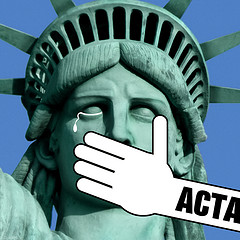
predators stalk the digital realm; and they have been revealed as SOPA, PIPA
and ACTA.
SOPA, PIPA and
ACTA all generally share the same goals which are to ostensibly protect
trademarks and intellectual property, while fending off counterfeiting and
pirating. SOPA and PIPA are U.S. pieces
of legislation, while ACTA is a transnational agreement. After recent public outcries, internet users
defeated an attempt to pass SOPA and PIPA on Capitol Hill. However, SOPA will be resurrected soon. Meanwhile, countries around the world
vigorously protest the enactment of ACTA.
What’s the significance of these acronyms on our digital routines? Let’s break each one down individually and
have a closer look.
PIPA: Protect IP Act – Preventing
Real Online Threats to Economic Creativity and Theft of Intellectual Property
PIPA’s stated
goal would have given the U.S. government and copyright holders additional
capabilities to restrict access to websites involved in copyright infringement
and the distribution of counterfeit goods.
Senator Patrick Leahy (D-VT) originally introduced Senate Bill 968 on May
12, 2011, but the motion to proceed with the legislation was withdrawn January
23, 2011.
The most controversial
aspect of the bill would have enabled Domain Name System (DNS) blocking and
redirection. DNS serves as the virtual
yellow pages of the internet. By
blocking and redirecting DNS, this essentially tears entire pages out of the
phone book, creating an incomplete version, no longer compatible with the rest
of the world. In this scenario, a simple
search for a site would yield a message stating the site no longer exists.
SOPA: Stop Online Piracy
Act
SOPA (H.R. 3261) is the
sister bill to PIPA in the House of Representatives. SOPA was introduced by U.S. Representative
Lamar Smith (R-TX). Its legal aim was to
provide law enforcement agencies greater online jurisdiction to prevent
violation of copyrighted intellectual property and the creation of counterfeit
goods.
“This bill would
establish a system for taking down websites that the Justice Department
[DoJ] determines to be dedicated to copyright infringement. The DoJ or the copyright
owner would be able to commence a legal action against any site they deem to
have ‘only limited purpose or use other than infringement,’ and the DoJ would
be allowed to demand that search engines, social networking sites and domain
name services block access to the targeted site. It would also make
unauthorized web streaming of copyrighted content a felony with a possible penalty
up to five years in prison.”
The bill’s
inherent dangers would have allowed the U.S. government and private companies to
arbitrarily incapacitate websites, thus threatening freedom of speech. Furthermore, thousands of websites would have
been jeopardized based on their user-generated content, which in turn,
frequently relies on copyrighted material.
Following the SOPA Blackout Day on January 18th, Senate
Majority Leader Harry Reid (D-NV) rescinded
H.R. 3261’s vote on January 24, 2012.
This brief video offers a concise explanation of SOPA.
The battle for
online freedom plows ahead, in light of a new bill
originating in the Senate Homeland Security and Government Affairs
Committee. Senator Joe Lieberman (I-CT),
who chairs the Committee, is engineering the latest attempt to widely expand
authority by Executive Branch departments over the internet. The debut of this new cybersecurity bill is
expected today, February 16, 2012.
Details of the cybersecurity bill have not been revealed, a result of
the legislation’s crafters meeting behind closed doors. Theories
abound that the bill, which has benefited
from bipartisan support, would grant the Department of Homeland Security
expansive new powers to regulate and stake out the internet under the pretext
of cybersecurity. However, the
persistent attempts to pass such legislation adversely impacting free speech and
the flow of information must be questioned.
Large amounts of financial contributions to politicians, as well as dubious connections, may indicate that a broader agenda is at work.
Supporters of
SOPA and PIPA will likely vigorously lobby for the new cybersecurity bill to be
passed. Backers of this type of
legislation read like a who’s who
list of Hollywood industry bosses. From
the MPAA (Motion Picture Association of America) to the RIAA (Recording Industry
Association of America), major Hollywood power brokers angle to protect their
interests. A total of 161
entities have stumped for the passage of
SOPA and PIPA. Besides the MPAA and
RIAA, they include the AFL-CIO, the International Brotherhood of Teamsters,
Comcast, Disney, and Sony. Based on some
of the groups in favor, the entire matter appears to be a pet project of the
Democrat Party. This comes as no
surprise when considering who the vanguard of Hollywood intellectual property has historically been.
Chris Dodd has made it his mission to crusade in Washington D.C. on
behalf of Hollywood under the pretext of copyright protection legislation. Dodd is the perfect bridge between Hollywood
and the Beltway. On March 1, 2011, Dodd
was chosen as chairman
of the MPAA. On the side, he also lobbies for an
organization called Creative America.
“…everyone in
the community recognizes what a grave threat content theft poses to our
livelihood and creativity – that thieves are making millions of dollars
trafficking in stolen film and television while our jobs, pensions and
residuals continue to decline.”
Some of the
groups involved with Creative America
include the CBS Corporation, NBC Universal, the Screen Actors Guild, Twentieth
Century Fox, Viacom, and Warner Bros. Entertainment. A simple search into Dodd’s previous career
uncovers much cozier ties to D.C.
Dodd has enjoyed
over three decades as a senator and has the distinction of being Connecticut’s
longest serving senate member. He’s one of the
most recognizable Democratic senators of years past, with posts on the Committee
on Foreign Relations, the Committee on Banking, Housing and Urban Affairs, and
the Committee on Health, Education, Labor and Pensions. However, his post-political career has proven
quite lucrative. According to sources,
Dodd rakes in a $1.5 million salary as chairman of the MPAA. The appointment of Dodd to head the MPAA
might be the biggest coup Hollywood has had in years.
Further evidence
from Dodd himself reinforces this as he
threatened to cut off financial contributions from Hollywood to politicians who
did not support SOPA and PIPA. The
pipeline of sizeable contributions from Hollywood going to politicians is a
healthy one most on Capitol Hill would prefer to preserve.
Democrat Senator Harry
Reid has also asserted himself a champion of SOPA and PIPA legislation. He has brought various versions of the bill
to the Senate floor and may be bound to three and half million vested interests
to pass the legislation; Reid was the beneficiary
of $3.5 million from SOPA and PIPA
advocates during the last campaign cycle. Although donations to Reid stand out by far,
other elected officials supporting the legislation have received contributions,
too: Democrat Chuck Schumer ($2.6 million), Democrat Kirsten
Gillibrand ($2 million), Democrat Barbara Boxer ($1.4 million), and Republican Michael Bennet ($1
million). Clearly, millions of reasons
jeopardize maintaining a free and open internet. One of those reasons is another piece of
little known legislation, called ACTA.
ACTA:
Anti-Counterfeiting Trade Agreement
ACTA protests
have flashed across Europe over recent weeks.
Anti-ACTAvists have sprung up
from the Netherlands to Germany to Poland and many other countries throughout
Europe. The contentious nature of ACTA attempts
to normalize an international legal framework that enforces intellectual
property rights, but also endeavors to target counterfeit goods and even generic
medications. On October 1st,
2011, Australia, Japan, Canada, Morocco, New Zealand, Singapore, South Korea,
and the United States signed the agreement.
At the start of 2012, the European Union and 22 of its member states
ratified ACTA, bringing the total signatories to 31.
Battle lines
have been drawn and two organizations are standing toe to toe—the MPAA and the Electronic
Frontier Foundation (EFF). According to
the EFF, “[…] copyright industry rightsholder groups have sought stronger
powers to enforce their intellectual property rights […] to preserve their
business models.” This sentiment
essentially drives to the heart of the debate, one which also includes SOPA and
PIPA. Those opposed to restricting the
internet view these efforts as a veiled and desperate attempt at trying to
preserve an atrophying business model, being rendered obsolete by the age of digital
file sharing. This sentiment has
galvanized many who sense that the true reason the public digital domain is under
siege is in attempts to undermine free speech and democracy. Due to what’s at stake, emotions have run
high. U.S. Rep. Darrell Issa (R-CA) has called it
“more dangerous than SOPA.” Popular
opinion likely agrees with Issa, but is the truth harder to discern?
A lot of misinformation
swirls around ACTA. The hacktivist group Anonymous shares some
of the blame. A popular video
produced by the amorphous, hacktivist collective shines light on ACTA’s
pitfalls. But is the hit piece video
accurate? According to ArsTechnica.com,
there are four dubious claims that Anonymous makes: ISPs will monitor all your data packets, ACTA
obliges its member countries to assent to the worst features of SOPA and PIPA, generic
drugs will be banned and seeds will be controlled via patents, and ISPs will be
constantly required to scour their servers for even the smallest bits of
copyrighted material. The Anonymous
video, which includes a qualifying disclaimer at the outset, has been widely
embedded in articles online and reached nearly one million views. Anonymous noted, “This video may not reflect
the recent changes within the ACTA text.
However, it will give you an idea of what ACTA is about and why the
internet should fight it.” And, of
course, after sorting any conflicting claims, ACTA still deserves a thumbs-down
verdict. We also bear in mind internet
censorship, freedom of speech restrictions, loss of net neutrality, domestic
surveillance, and civil rights erosions and police state repression have already
been ongoing issues plaguing the U.S. ACTA
would simply codify existing repressive policies for people in the U.S. under
the pretext of opposing counterfeiting.
ACTA is a poorly
crafted agreement and simply bad. ACTA’s
basic criticisms are threefold: the agreement’s designers are not
democratically elected nor accountable, the ACTA negotiations were held in secret, and there was no discussion held in a public forum. ReadWrite
Enterprise does a fine job laying
out ten reasons why ACTA fails.
Furthermore, even though ACTA probably won’t change U.S. law, it would
lock us into a constrictive legal space in an area of law that changes
rapidly. Much like activists around the
world can now respond more quickly to police brutality and government tactics
of repression thanks to the internet, file sharing enthusiasts are finding new ways to
circumvent internet censorship just as quickly.
The Internet Can’t Be
Bound and Gagged
Already the hive
mind of the internet has developed a solution to undercut potential censorship
attempts. Many people are unaware the
internet exists similarly to an iceberg; only a small portion of it is visible
to the average user. A significant
amount of the internet lies hidden in an area called the deep web. The deep web lies
obfuscated to the armchair web surfer due to an inability to access it by simply
typing it into a search engine and accessing it.
For example, the deep web does not employ the use of meta tags or DNS
and blocks search engines, among other characteristics, making navigation there
challenging. In this secretive
environment, hackers have been diligently working on a new protocol calledTribler.
Tribler
works in a similar fashion to other BitTorrent clients except that when search
results are produced, they aren’t procured from a central index, rather they
are directly produced from other peers.
According to TorrentFreak,
“Downloading a
torrent is also totally decentralized. When a user clicks on one of the search
results, the meta-data is pulled in from another peer and the download starts
immediately. Tribler is based on the standard BitTorrent protocol and uses
regular BitTorrent trackers to communicate with other peers. But, it can also
continue downloading when a central tracker goes down.”
This type of
decentralized structure would allow users to create ‘channels’ amongst
themselves and make Tribler an
indomitable force, making neutralization by censors extremely difficult. Tribler
will make it “impossible
to shut down unless the whole Internet goes down with it.” This will come as excellent news to millions
of people witnessing attempts to stifle internet freedom with ACTA, SOPA, PIPA,
and ongoing attacks on net neutrality.
The race to control
the internet rages on, but developments like this beg the question: Does the
internet adapt and evolve too quickly for elected officials to harness it? This brings to mind Wile E. Coyote and the Roadrunner. Some things can just never be
caught. However, U.S. voters continue
to support the two-party system, which continually abandons them whilst
representing corporate interests. Time
will tell.
MEDIA ROOTS —Americans currently suffer from one of history’s most successful propaganda campaigns. We are often distracted, numbed and herded into behaviors, thought patterns and policies that don’t serve our own interests, much less the interests of an endangered democracy.
Too often we are unconsciously manipulated by advertising ploys. As a result, Americans succumb to the mundane: to mindlessly consume while paying attention to reality television. Little do we realize how we are being controlled and steered away from actively participating in our democracy.
Occupy Wall Street fights for the freedom that many of us are too apathetic to protect as we occupy our couches in front of our TV sets. However, there are cracks appearing in the foundation beneath The Powers That Be, and if we are to seize this as an opportunity to better humanity, it will require adapting to an entirely new mindset. First, however, we must seek to fully understand how we got here.
Jim Quinn of The Burning Platform gives an excellent analysis to some of the complex issues plaguing American society, culture, and politics.
MR
***
The Burning Platform — The erroneous notion that Americans have a choice between two political parties that offer distinct and clear opposing policies addressing the major issues facing our country is still perpetuated by politicians and the corporate media. It is untrue, as we have seen the Obama administration employ the same repressive methods instituted by the Bush administration. Military spending rises. Wars of choice proliferate and grow. Obamacare is virtually identical to a plan created by the leading GOP presidential nominee. Further restrictions, regulations and laws are put forth to keep the masses controlled, sedated and fearful. The governing elite and their propagators of misinformation are again formulating a false storyline to convince the easily fooled ignorant public that a sovereign country 7,500 miles from our shores is actually a threat to their lives. While our government has already committed acts of war against Iran (sanctions, assassinations, cyber warfare, and using drones to spy), the public is being worked into a bloodthirsty frenzy of nationalism. Bipartisanship worked so well with Iraq. How could it possibly go wrong with Iran?
In the last six months cracks have begun appearing in the fascist façade masquerading as a democratic republic. The rise of the Occupy Movement, increasing pain and discontent among the middle class, a small but vocal irate minority utilizing the internet to organize, inform and spread knowledge, and the growing support among the liberty minded for Ron Paul’s candidacy are the opening salvos in a coming revolution. The volleys being traded between the forces of the American aristocratic elite and the leading forces of this revolution are only the opening shots on par with Bunker Hill. The oligarchs have won the initial skirmishes with the Occupy Movement through their control of superior mercenary fire power and ability to falsify the message and nature of the protestors. The corporate mass media propaganda machine convinced an apathetic, non critical thinking public the protestors were nothing but dirty, lazy, college students looking for government handouts organized and led by George Soros. Journalist Robert Fisk reveals the true nature of the protests and rage:
“And that is the true parallel in the West. The protest movements are indeed against Big Business – a perfectly justified cause – and against “governments”. What they have really divined, however, albeit a bit late in the day, is that they have for decades bought into a fraudulent democracy: they dutifully vote for political parties – which then hand their democratic mandate and people’s power to the banks and the derivative traders and the rating agencies, all three backed up by the slovenly and dishonest coterie of “experts” from America’s top universities and “think tanks”, who maintain the fiction that this is a crisis of globalization rather than a massive financial con trick foisted on the voters.
The banks and the rating agencies have become the dictators of the West. Like the Mubaraks and Ben Alis, the banks believed – and still believe – they are owners of their countries. The elections which give them power have – through the gutlessness and collusion of governments – become as false as the polls to which the Arabs were forced to troop decade after decade to anoint their own national property owners. Goldman Sachs and the Royal Bank of Scotland became the Mubaraks and Ben Alis of the US and the UK, each gobbling up the people’s wealth in bogus rewards and bonuses for their vicious bosses on a scale infinitely more rapacious than their greedy Arab dictator-brothers could imagine.” – Robert Fisk, Bankers are the Dictators of the West
The mounting desperation of the oligarchs is palpable. They have circled the wagons as one of their leaders – Jon Corzine – was caught stealing $1.2 billion directly from the accounts of his customers after making reckless bets that went wrong and bankrupted his firm. The Department of Homeland Security coordinated brutality unleashed upon peaceful protestors in cities across America opened the eyes of more people to the approach of an increasingly oppressive state. The media lapdogs have come out in force with an organized smear campaign designed to derail the presidential campaign of Ron Paul, the only candidate talking about real change and a real downsizing of the American empire. Ron Paul’s platform of liberty, freedom, non-interventionism, sound money, and a government not controlled by bankers and corporate interests is anathema to the ruling elite of both parties. A vote for one of the hand selected candidates offered by the moneyed interests is simply a vote for the special interest status quo. As our economic system becomes more saturated with debt by the day a tipping point approaches.



 MEDIA ROOTS — Yesterday, 500 fellow veterans and I marched in Washington, D.C. in support of Republican Congressman Ron Paul’s bid for Presidency. The Veterans for Ron Paul President’s Day event began with two hours of speakers and musical performances at the Washington
Monument and was followed by a well-organized march and military procession down 15th Street.
MEDIA ROOTS — Yesterday, 500 fellow veterans and I marched in Washington, D.C. in support of Republican Congressman Ron Paul’s bid for Presidency. The Veterans for Ron Paul President’s Day event began with two hours of speakers and musical performances at the Washington
Monument and was followed by a well-organized march and military procession down 15th Street. 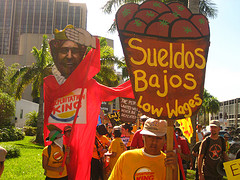 MEDIA ROOTS — After a two year campaign, The
Coalition of Immokalee Workers (CIW) has finally persuaded Trader Joe’s to sign on to a
fair food agreement that will change the working conditions and lives of tomato
workers in Immokalee, Florida. The coalition consists of over 4,000 farm
workers who incur unfair wages and dangerous working conditions. Since its creation in the early 90s, CIW has successfully
campaigned against these unjust practices, giving workers the opportunity to have
a comfortable working environment.
MEDIA ROOTS — After a two year campaign, The
Coalition of Immokalee Workers (CIW) has finally persuaded Trader Joe’s to sign on to a
fair food agreement that will change the working conditions and lives of tomato
workers in Immokalee, Florida. The coalition consists of over 4,000 farm
workers who incur unfair wages and dangerous working conditions. Since its creation in the early 90s, CIW has successfully
campaigned against these unjust practices, giving workers the opportunity to have
a comfortable working environment.
 MEDIA ROOTS — Despite the national economy still tenuously hanging on life support and many cities financially flatlining, police departments throughout the U.S. still creatively invest enormous amounts of money in futuristc, “non-lethal” crowd control weapons. As we arrive at a point in U.S. history when true democracy is fleeting and the 1% breed new ways of absolute control, the necessity to appear less heavy handed in response to large street protests becomes paramount. U.S. power brokers seek ever devious ways to bend protesters to their will, whilst maintaining a positive image in the global media machine.
 MEDIA ROOTS — With governments,
citizens, and activists worldwide increasingly relying on the internet, the environment the
internet fosters is a hotly contested issue.
Last summer, the United Nations declared that disconnecting people from
the internet was a
MEDIA ROOTS — With governments,
citizens, and activists worldwide increasingly relying on the internet, the environment the
internet fosters is a hotly contested issue.
Last summer, the United Nations declared that disconnecting people from
the internet was a 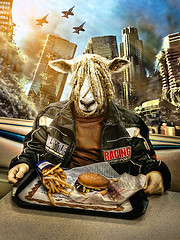 MEDIA ROOTS — Americans currently suffer from one of history’s most successful propaganda campaigns. We are often distracted, numbed and herded into behaviors, thought patterns and policies that don’t serve our own interests, much less the interests of an endangered democracy.