

Chris Hedges: The Collapse of Industrial Civilization & the Antidote to Defeatism

Chris Hedges flickr theNerdPatrolPine Ridge is one of the poorest counties in the US, and its conditions are comparable to developing countries. This is partly why Pulitzer Prize-winning journalist and brilliant social critic, Chris Hedges, has referred to places like Pine Ridge as capitalism’s “sacrifice zones.”

Although this systemic subjugation is as old as civilization itself, the oppression of people in far away lands is now backed with an unprecedented amount of military force. Society’s toxic perpetuation of the “Military Mind” causes profound destruction, both domestically and internationally.

As 21st century capitalism thrives on an unsustainable model of endless growth, Hedges discusses the inevitable collapse of industrial civilization, analyzes cult-like behavioral patterns that rise out of desperation and explores the antidote to defeatism in an enlightening interview series with Breaking the Set.

“I don’t fight fascists because I’ll win. I fight fascists because they are fascists.” – Chris Hedges

Abby

 **

 Chris Hedges Part I: Crisis Cults and the Collapse of Industrial Civilization

**

Chris Hedges Part II: The Military Mind and the Antidote to Defeatism

**

AM: Why are places like Pine Ridge so susceptible to extreme poverty?

CH: These are places where unfettered capitalist forces – backed by force on behalf of the railroad companies, timber merchants, and the people who profited from decimating the buffalo herds – minding concerns, came in and seized the land of Native Americans and killed most of them. Not only that, but after herding them into what—in essence—were prisoner of war camps set out to destroy their culture, their religion, their language. That’s why Indian children were taken from their parents and put in Christian boarding schools where they were not allowed, for instance in Pine Ridge, to speak Lakota. What’s happening now with the late end of the industrial age and capitalism is that the reservation; that environment that Native American people have endured and suffered under is being extended and growing in greater and greater areas. We’re all being sacrificed as the residents of Charleston, West Virginia were sacrificed when their water was poisoned by coal companies, and it’s still poisoned. Although they’ve been told to drink it, people and children are coming home from school sick. This is not something that is unknown to Native Americans. I think that whole demented project of ceaseless exploitation, expansion, and violence. The template for that was set in the Westward expansion.

AM: You discuss how the world is globally integrated under an unsustainable form of capitalism, but America positions itself atop the totem pole justified by the notion of American exceptionalism. How do you think that that notion plays into the global collapse?

CH: Well, corporations are preying on the United States in the way that they prey on all nation’s states. They are in this essence super-national. They owe no loyalty to any one nation. That’s how you have seen the decimation of the American manufacturing base; that is how you’ve seen the transference of capital overseas where it lies beyond the reach of taxation. You have seen the rise of the decimation of the working class, and the rise of tremendous numbers of poor, whether they are listed as ‘in poverty’ or a category called ‘near poverty’. We’re now talking about half the country. The myth of America is still there; the idea of if you work hard, you can make something of yourself; the idea that we have a right to travel the globe and impose our virtues—supposed virtues—on other countries by force, which is what we are doing and attempting to do throughout the Middle Easy, although it’s not going very well for us.

Imperialism has always been a mask for trade, for business, for control of natural resources. That has been true since the United States began its imperialist expansion with the conquest of the Philippines, Cuba, the control of the Caribbean for sugar and bananas, into the Middle East for oil. So, what we are seeing is a clash between the myths that America once used to identify itself. Let’s not forget that many of the most fervent supporters of imperialist expansion came from labor unions. I mean, GOMPers was at the Versaille Treaty. All segments of this society are complicit. But these forces, which in essence kind of cannibalize both the natural environment and exploit human labor and have been doing this on the outer reaches of empire for decades, are now being done internally just as it was done in the original conquest of the United States against Native Americans.

AM: You talk about the impending environmental catastrophes, and also the severe economic uncertainty on the horizon—why do you think there is no sense of urgency on a large scale to address these troubling trends?

CH: Because they’re not reported. The commercial media is about bread and circus. It’s about spectacle. It’s about celebrity gossip. It’s about the Super Bowl. I mean, every week it’s something new. If we had a responsible media, especially a broadcast media, we would understand that climate change at this point is an emergency; that at this point the effects of climate change are unstoppable, and if we don’t radically configure our relationship with the ecosystem, very, very quickly the human species itself is in jeopardy. You can look at the World Bank report on climate change, turn up the heat, the World Bank can hardly be accused of being a radical organization and they speak at the end of that report in utterly apocalyptic terms. So, scientists—especially people who study climate change—they know very well what’s happening, and yet we are not hearing their voices.

We are mesmerized by electronic hallucinations, and that’s of course how corporations want it. When forty percent of the summer Arctic Sea ice melts, companies and corporations, like Shell Oil, look at the death throes of our planet as a business opportunity and they’ll run up and drop a half a billion dollar drill bits down into the Arctic Sea. I think what we have seen is a kind of iron control of the systems of information by corporate power who are determined to exploit, and exploit, and exploit until collapse, and now we’re about to see—in all likelihood—the President approve the northern leg of the Keystone XL Pipeline. So, it’s an uninformed public. It’s a public which has been diverted. They’re emotional and intellectual energy has been invested into spectacle, coupled with a ruthless corporate totalitarianism that thinks only in terms of quarterly profit and has absolutely no concern for the common good or sustenance of the ecosystem that might provide some kind of decent and acceptable living standards for future generations.

AM: Chris, but on the flip side you’ve also said that as collapse become palpable, humanity will retreat in what anthropologists call ‘crisis cults’. What is a ‘crisis cult’ and why does our psychological hardwiring always revert back to these modes of groupthink?

CH: When things become so desperate, human societies retreat into forms of magical thinking. At the end of the Indian Wars and the latter part of the 19th Century, you saw the rise of the Ghost Dance which swept through the remnants of native communities. These communities believed that the Great Spirit, the warriors would come back; the buffalo herds would come back; they would get their lands back; the white colonizer would disappear. That is replicated, as anthropologists have studied, throughout societies that collapse.

Now, the way we express our crisis cult, is through the radical Christian right, again, a form of magical thinking which denies evolution, which believes in the rapture; that those believers, when Jesus returns, will be raptured up into heaven. That’s a classic example of a crisis cult, so that when things become desperate you gather in a church, you pray, you carry out Christian ritual, you tend to lash out at a society to purge. You see it in the rhetoric. Whether it’s against homosexuals; whether it’s against undocumented workers, Muslims, a long list of contaminants that will somehow make the society right—all of that has within it the makings of a crisis cult. But crisis cults are what societies do when despair reaches such a level—and we’re certainly headed in that direction—when you are unable in a real way to affect the environment of the world around you, then you wrap yourself in these cocoons of fantasy.

AM: In the article The Myth of Human Progress, you write in reference to truth that people quote, ‘get as close as they can before the flames and heat drive them back. This intellectual and moral honesty, Nietzsche wrote, comes with a cost. Those singed by the fire of reality become ‘burnt children’, he wrote, eternal orphans in empires of illusion. Chris, if this is the way it has always worked, and those who seek truth are constantly ostracized, is humanity just doomed to be subject to empires of illusion?

CH: Well, I’m quoting Nietzsche there about looking down that only artist and philosophers have the capacity to look into what he calls the ‘molten pit of reality’, and when they come back out they find that the wider populous which is unable to look can’t deal with it. So, I depart a little bit from Nietzsche there. Nietzsche, like Plato, says that you create illusions, myth in order to explain a reality or help people cope with a reality. Unfortunately, the role of truth tellers in distraught or disturbed societies, and we have our own examples of that whether it’s Noam Chomsky, or Ralph Nader, or Cornell West—all of them, for getting up and speaking an unpleasant truth, have been pushed to the fringes of society.

The Liberal class is guilty, maybe even guiltier than the stations like MSNBC, which are utterly subservient to the Democratic Party and to the cult of Barack Obama, have kept those voices form us. So it’s not just the right, it’s the left, too; they are both trading in a false reality and that’s very dangerous, because when you can’t confront reality, when your society shuts out those voices that seek to describe what reality is and how it works, then you can’ talk about hope and you can’t talk about change because all hope and change is essentially redirected into a dead political process, or redirected in phantasm, in the idea that Barack Obama is going to save us from Wall Street or from the drone wars, or from environmental degradation. It’s a bit like those poor prisoners in the Gulag were writing letters to Uncle Joe Stalin. That is symptomatic and I think the United States would be probably a good example of an empire in serious decay and decline. These are qualities that are symptomatic of a society that no longer has the intellectual and moral health to face hard facts, readjust and carry out forms of self-criticism and self-correction.

AM: Let’s talk about that new Oxfam study that recently came out that shows how eighty-five people control the equivalent of the bottom half of the World’s wealth. What’s your response to people that say, “We just have to remove those eighty-five people”?

CH: Well, it’s a system of corporate power which is not necessarily driven by individuals so much as driven by corporate interests. Exxon Mobil, Citibank, Goldman-Sachs. So, you can arrest and imprison the head of Golman-Sachs, Lloyd Blankfein—which is where he belongs—but somebody will take his place. What has to happen is we have to break the back of corporate power which is now global, and break the logic whereby everything is about profit; that nothing has value beyond its monetary value. That’s an extremely dangerous moment for any society to live in, because when nothing has an intrinsic value, whether that’s water, air and human beings, then the ruthlessness of those corporate forces mean that you will squeeze every ounce of potential profit. Everything becomes a commodity and you squeeze those commodities until there’s nothing left and that’s exactly what’s happening. So, it’s not individuals, it’s the rise of corporate power which is a species of totalitarianism. Different; it differs from past systems of totalitarianism but it is no less totalitarian than fascism or communism, or totalitarian forces.

AM: Right. The system is a machine at this point. If those people died today, it would still grind on. In a recent article you discuss the menace of the military mind and how only devotion to establish forms of behavior result in individual success. How do you think this concept applies to the director of National Intelligence, James Clapper, and his feelings towards journalists who have exposed NSA documents?

CH: Well, I speak as a former war correspondent who spent twenty years covering conflicts around the globe—Latin America, the Middle East, the Balkans, Africa—so, I know the military really well and blind obedience, aggressiveness resort to violence.  All of these things; you know, destruction of individuality, all of these things work really well on a battlefield. They don’t work very well in a peacetime society. So, when Clapper made this comment that Edward Snowden and his quote-unquote ‘accomplices’—and he was clearly referring to journalists such as Laura Poitras and Glen Greenwald—should be prosecuted, I understood exactly what he was saying. He was a former Lieutenant General; he comes out of this military culture which detests the press, and has always made war on an independent press. Their vision of journalism are all the little lackeys who sit through their press conferences and follow them around and write glowing tributes to their heroism, or whatever they’re directed to write in press pools.

But actual journalism is something that within the military culture they’re deeply hostile, too, and the triumph of military values is—again—symptomatic of a civilization in decline; the rigidity, the celebration of hyper-masculinity, the lack of empathy, the belief that every problem should be dealt with by force both internationally and domestically, militaristic hyper-masculine regimes speak exclusively in the language of force, and then you see within popular culture, subsequently, a celebration of those hyper-masculine military values. I’ve been in enough combat to tell you those values are quite useful in a firefight, but they will destroy a civil society. I think that is a window into how tattered our civil society has become, and how we have shifted our allegiance from an open society, from empathy, from a capacity to embrace various opinions and outlooks and political stances to this increasingly rigid militaristic society, and Clapper is a figure who exemplifies precisely this sickness.

AM: Chris, in a recent speech you gave, you said quote, ‘I do not know if we can build a better society. I do not even know if we will survive as a species. But I know these corporate forces have us by the throat. And they have my children by the throat. I do not fight fascists because I will win. I fight fascists because they are fascists.” Chris, Glen Greenwald recently spoke about how one man, Edward Snowden, has changed the world, and that singular capacity is the antidote to defeatism. What do you regard as the antidote to defeatism?

CH: You can’t talk about hope if you don’t resist, and Edward Snowden has certainly resisted. Heroically. We must carry out the good, or at least the good so far in as we can determine it, and then we have to let it go. The Buddhists call it ‘karma’. I come out of the seminary; that’s what faith is. It’s the belief that it goes somewhere even if empirically everything around you seems to point in the other direction. Once we give up, once we stop resisting, then we’re finished. Not only finished in a literal sense, but finished spiritually and morally. So, I fall back in moments of distress like this on that belief, which is one that I learned in seminary; that we have a capacity and an ability and a moral duty to fight against forces of evil even if it looks almost certain that those forces will triumph.

Transcript by Juan Martinez, Photo by flickr User theNerdPatrol

***

LIKE Breaking the Set @ http://fb.me/BreakingTheSet
FOLLOW Abby Martin @ http://twitter.com/AbbyMartin
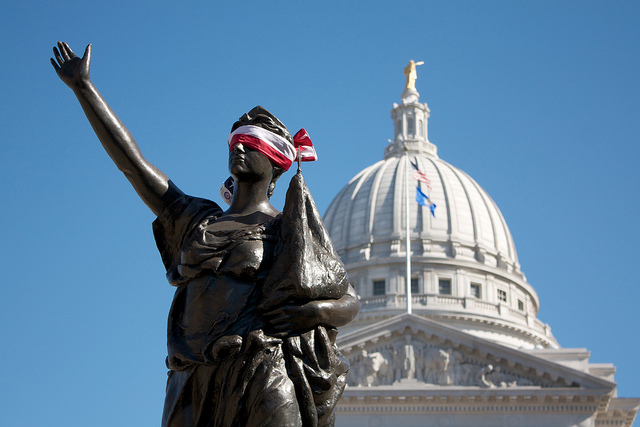
From Squawk Box to CSPAN – Cutting Through the Beltway Bubble & Democracy Gap

LadyLibertyByRobChandanaisFailed ideas, infighting, and glimmers of hope.

I found myself watching CNBC’s Squawk Box the other morning and an Ohio Republican named Ron Portman was on. He was being beamed in from the Russell Rotunda in Washington, with its columned grandeur and air of gravitas. What a lovely backdrop for the savaging of America. Portman is the Republican prototype. Innocent eyes. Puritan earnestness. Flour white face. Bland coat and tie. As part of that long-running hit, the GOP Weekly Address, Portman announced a seven-point plan to create American jobs. He said his program would spark an economic recovery, a whip that political hacks never tire of using to flog the presses. Here are his seven sterling steps to the next big boom:

1. Adopt “Common Sense” Healthcare Solutions

Portman didn’t go into much depth on this one, but a majority of Americans would agree. Although Portman and the people might fall into a bit of a quibble over what exactly “common sense” meant. For Portman and his colleagues, common sense healthcare means leaving it to the market, where the all-important profit margin invariably dictates stingy coverage and unaffordable premiums. For many Americans, health is a sacred human right that ought not to be subjected to human greed. But more to come on that front…

2. Power America’s Economy

Note the pun in this one? Clever. This is mostly about fracking, faster permitting, and exporting liquid natural gas (LNG). None of which are the slightest bit helpful from a climate change standpoint (See Gasland and this fast-track special for more on that). As the powers that become ever more enthralled by “energy independence” and the wondrous profits it promises our billion-dollar petro giants, the work of committed anti-frackers may be increasingly marginalized by the enormous financial incentives to fracture the bedrock of the earth, no matter how many poisoned aquifers result.

3. Begin Living Within Our Means

This is more fearmongering around the Koch brothers’ deficit reduction campaign, a bipartisan con if there ever was one. Without mentioning the elephants in the room—the military budget and the periodic trillion-dollar bailouts of corrupt mega-banks—Portman wants to slash the deficit in other ways. Gee, I wonder where those cuts will come from? Perhaps “reform to entitlement programs”? Republicans like nothing more than anything that will “encourage personal responsibility,” a perpetual refrain of Senatorial millionaires. Perhaps Goldman Sachs’ Jamie Dimon can be brought in to help make this case to Main Street.

4. Reform Tax Code to Spur Economic Growth

This is especially farcical coming right after the harangue about cutting debt. It must be acknowledged that cutting taxes cuts government revenue, which pays for programs that must otherwise be sustained with loans or—as the GOP prefers—not sustained at all, but rather demolished altogether. Yet “reform tax code” is itself code for lowering taxes on corporations and individuals, with particular callouts for cutting taxes on the rich. It’s not as though taxes are already pretty low by historical standards, and when you begin factoring in deductions, you soon arrive at globally competitive corporate rates, and occasionally discover that your multinational owes no tax at all. In any case, this concept is based on the fallacy of trickle down economics, that the more money you put into the pockets of rich people, the more they will spend creating jobs for poor people.

Perhaps Portman and his rabid neoclassical colleagues have been napping since 2008 and missed the mortgage meltdown, the too-big-to-fail bailouts, and the aftermath, when banks sat on more than a trillion dollars in government money since they had what is sometimes referred to as a “liquidity preference.” As political economist Alan Nasser has noted, nobody likes to invest in a crappy economy. Hence the need for Keynesian stimulus. But that would require government intervention, a terrifying scourge at which we’ll soon arrive. Even Obama seems to believe jobs can only come from the private sector, as he famously touted in 2009. But set reality aside, and let’s embrace failed economic theories in the hopes that uneducated workers will fall for the ruse of tax cuts one more time. Viva a falsidade!

5. Unburden the Economy from DC Regulations

This is perhaps the most comical point, especially when Portman tosses around terms like, “regulatory relief” as though American business is simply hamstrung by the myopic interference of our frothing socialist government. It’s not as though the lack of regulation, happy encouraged all through the Clinton years, led directly to the mortgage meltdown and the subsequent horror show, thanks to savings and investment bank mergers, lax lending standards, unregulated derivatives and commodities markets, and toothless criminal regulation of premeditated mortgage fraud, pension theft, and so on. And it’s not as though the history of British, American, and German, not to mention Korean, Japanese, and Chinese industrialization was dependent precisely on regulation in the form of protectionist measures such as import tariffs and currency and price controls.

6. Create Competitive Workforce

This is another laugher. As if Barack Obama isn’t already fast-tracking America labor toward Third World status. Have any Republicans been paying attention to the jobs being produced by the Obama-conomy? Part-time, low-wage, low-skill, high-turnover, nontradeable service positions. In other words, bartenders, wait staff, and bedpan emptiers. Or, to put it another way, we’re only creating jobs that can’t be exported. A Chinese laborer in Shanghai can’t bring a beer to your table in Des Moines, no matter how cheaply he can be had.

Of course, Portman’s bullet points on the workforce ignores the need to generate good jobs, and instead offers a fog of rhetoric about consolidating job training programs, consolidation being a synonym for cutting programs, as is the call to defer decisions on how to allocate training monies to states, where Republicans control the majority of legislatures. There is some logic to this: why train people for nonexistent jobs? Portman’s colleagues also smuggled education beneath the banner of a competitive workforce—another strange inclusion. Why waste money educating the population? But the purpose of mentioning education is, as always, the desire to enervate the Department of Education and empower the privatization of education, primarily by creating more charter schools.

7. Increase Exports to Create More American Jobs

Perhaps the only way to do this on a mass scale would be to drive wages down far enough for America to be competitive with Bangladesh and other nations were factories routinely collapse on top of their employees. Of course, ten buildings have collapsed in Harlem in just the last five years, so perhaps the analogy isn’t so apt. If this is indeed the goal—and the president does frequently harp on exports—this may be as much of an admission as point six that the bipartisan objective of our government is to pauperize America. Then feudal conditions can be implemented. Fiefdoms overseen by CEOs instead of Lords. We vassals can trade our labor for subsistence, never wondering where the surplus goes (who reads Marx anymore?). And perhaps then we will proudly become the world’s sweatshop, filling shipping containers with the plastics craved by Indian parvenus and Chinese arrivistes. It has been suggested that in a few years a Detroit autoworker will be competitive with his Chinese cohort. Should we rue the day, or accept our reduced privileges, even as our corporate moguls, untethered from their employees by labor arbitrage, soar above us in private sky fleets, while their state minions monitor our hoods from hovering drone helicopters, awaiting the advent of a tepid protest?

Hope Springs Infernal

But then you see Senator Dianne Feinstein making a speech before Congress that accuses the CIA of spying on the Senate. This is mighty surprising coming from one of Edward Snowden’s biggest haters on Capitol Hill. I suppose so long as the spying is done on low-wage, low-profile Americans, it’s fine. But once the surveillance community turns its wanton eye to Congress and its bevy of millionaire influence peddlers, the ethics take a sharp U-turn. Feinstein was plenty irate at the thought of Obama’s paramilitary “agency” impeding her committee’s investigation into its torture habits after 9/11. Anxious to further impair its public reputation, the CIA has accused the Senate of criminal activity and asked the DOJ to investigate. Nothing like getting out in front of a scandal, right?

But there’s always a harsh rebuke in store for a freethinker. This one comes in the form of CIA Director James Brennan, who openly scoffs at Feinstein’s accusations. A bemused Brennan claimed that illegal, clandestine activity is far below the ethical code of the CI—but wait, isn’t illegal, clandestine activity the heart of the CIA’s mission statement? You hear him tell a CSPAN staffer that Congress ought to be careful not to inflate its description of what the CIA has done. Yes, Mr. Brennan, because prudence has long been the byword of the Central Intelligence Agency. We all remember how careful it was in assessing the threat of Iraqi WMDs—it’s not as if it played fast and loose with the facts in the lead up to the Second Iraq Oil War.

What is occasionally mind-boggling is just how close these federal agencies actually come to seeing the truth—and even stating it. The Quadrennial Defense Review, or QDR, released last week, provided a summary of international threats. The authors were remarkably clear-eyed in noting that Al-Qaeda has vastly expanded its influence across the Middle East. Then, in a staggering admission, they conceded that destabilizing events in the region, such as wars in Syria and Iraq, were the leading causes of Al-Qaeda’s resurgence. It’s only the smallest of leaps from here to the question, “Why is the Middle East unstable?” Answering this question would lead our brave military leaders to the nearest mirror. But the leap is never made, the question left unasked, and the dark visage never glimpsed. This habitual lack of self-incrimination is increasingly a device employed by the White House.

Few presidents have spoken the truth with more regularity than Barack Obama. He has talked about the uninsured, income inequality, the trouble with surveillance, the need to reboot American manufacturing, and on and on. It’s clear, in some compartment of his brain, he knows what’s wrong with America, but is incapable of acting to fix it. It’s as though, in his incrementalist philosophy of political change, merely stating the truth is an innovation worthy of the name ‘progress.’ He might feel differently if his most secret conversations were being openly compiled by the dismissive Mr. Brennan.

The Subversive Breakout Session

Thankfully, there are pockets of sunlight, blades of brightness that slice through the dark cloud of ignorance that darkens the beltway day. A couple weeks ago, the irrepressible Senator Bernie Sanders hosted a hearing on healthcare, an event expressly designed to cast scorn on Obama’s Affordable Care Act (ACA). Sanders assembled a Benetton ad of healthcare experts from around the world—Taiwan, Canada, Denmark, Australia, and one dismayed and defensive defender of the ACA. This paladin of corporate interest increasingly retreated to some fortuitous study on infant mortality, only to see it quickly discredited by a bored academic seated along that dire row of socialists.

One after another, goaded by Sanders, the guests dispassionately extolled the virtues of free publicly funded healthcare—taking time, as one Canadian did, to disparage elements of their system (prescription drugs) foolishly left to the private sector. From lower costs to higher outcomes, the case was made. Eventually, the sole guest defender of the ACA and a couple of Republican Congressmen—condescendingly bemused by this minor specter of socialized medicine—argued that all of these Benetton nations were simply benefiting from America’s prodigious research budgets and thus able to offer free care. The implication being that only private industry was driving the medical innovation that saved lives. Nobody bothered to mention that vast funding for R&D comes from the government itself via taxpayer dollars. In any event, Sanders soon closed the proceedings and the foreign guests were sent packing, while the transcript of the festivities were hurled down Orwell’s memory hole. But trust me, this actually happened.

The Continental Divide

While there’s plenty of media coverage now—thanks to Occupy—about the gross inequalities of American incomes, very little coverage is given to another gap: the democracy gap. Or, to frame it otherwise, the gap between what Americans say they want and what American politicians give them. An abyss has opened between our desires and our policies. A majority want universal health care. We get the ACA. A majority want us out of other countries. We get clandestine coups. A majority want more spending on education. We get bigger Pentagon budgets. If polls like those of Pew or Gallup are to be believed, Americans generally don’t get what they want. Examining some of the debates underway in the beltway bubble is enough to illuminate you to this fact—you needn’t poll anyone. The story of our anti-democratic drift also occasionally surfaces, like a bubble from a gaseous swamp, amid the general miasma of mainstream media. The stray left-wing blogger. A labor union old-timer scribbling in a socialist rag. The curious senator with a bottomless ire for injustice. If only there were some force multiplier by which we could clone and amplify their voices. But then, something like that would have to be called democracy.

Jason Hirthler is a veteran of the communications industry. He lives and works in New York City and can be reached at [email protected].

Photo by Flickr User Rob Chandanais

MR Documentary – American Anthrax

Media Roots presents American Anthrax, a documentary comprised of news footage that establishes how everything you’ve been told about the Anthrax Attacks is a lie. Conceptualized, edited and produced by Robbie Martin, co-host of Media Roots Radio.

***

 American Anthrax, by Robbie Martin

***

September 11, 2001, shook the United States to the core, a country that had been nearly untouchable since its democratic inception. However, immediately following this horrific tragedy, another equally as impactful ‘terrorist attack’ occurred when weaponized anthrax was sent to multiple Congressman and journalists through the U.S. Postal Service.

AnthraxWikimeidaCommonsThe attacks on the World Trade Center and the Pentagon were both one-time events that happened in two prominent cities. Unlike 9/11, the Anthrax Attacks localized terrorism and spread fear to every corner of American life, where the simple act of getting your mail could prove fatal. Five people died as a result of breathing in the deadly anthrax spores, including postal workers and one NY Post reporter. Countless others were infected.

The Bush administration initially tried to link this ‘second wave of terrorism’ to al-Qaeda. Once that talking point out-lived its usefulness, the official narrative began leaning towards Saddam Hussein and his mythological biological weapons program. Establishment propagandists like John Mccaine and ABC news reporters intentionally spread disinformation to plant the seed in the public mind that the anthrax came from Iraq, which eventually lead to Colin Powell’s infamous 2003 WMD speech at the UN.

All the while, the U.S. government was fully aware that the anthrax did not come from an external source, because the strain showed tell-tale signs of being a specific anthrax strain that was weaponized and manufactured by the U.S. military. Eventually, two different men were accused of being the perpetrators behind the attacks, yet no charges were ever brought to either of them. The first accused individual, Steven Hatfill, ended up being rewarded a multimillion dollar settlement from the government for being wrongly accused before any evidence was presented. The subsequent accused individual, Bruce Ivins, allegedly committed suicide while the FBI was trying to break him into confessing.

Ultimately, the FBI asked the National Academy of Sciences (NAS) to verify its evidence pointing to Ivins as the main suspect. Instead, the NAS concluded that the DNA in the anthrax sent in the mail was in fact not a match to the anthrax Ivins worked with. Before the National Academy of Sciences finished their independent investigation, the FBI rushed its pre-established conclusions about Ivins’ guilt to the press, and the case was closed. To this day, the FBI has never commented on the many glaring contradictions in the official narrative of the attacks, and Obama has threatened to veto any future investigation into them.

MR

Follow Robbie at @fluorescentgrey, photo by Wikimedia Commons

***

Robbie and Abby Martin talk ‘American Anthrax’ on Breaking the Set

***

The Ongoing, Never-Ending JFK Mythology

JFKCliff1066The latest eruption of John Kennedy hysteria, bordering on deification, seems safely behind us now that the 50th anniversary of his assassination has passed. Though there is much disinformation about JFK’s legacy that could and should be discussed, two areas stand out: his relationship to the Black Liberation Movement and his actions in Southeast Asia.
Despite all the evidence to the contrary, Kennedy has come to be seen as an ally of – even a hero of – the Black Liberation Movement. In fact, he opposed both the goals and actions of that movement from early in his term when terrorists were beating unarmed and vastly outnumbered Freedom Riders, to the final months of his life when four young girls were blown up in an Alabama church.

When black moderates announced plans for an action in Washington in 1963, Kennedy worked overtime to derail it, with significant success, mainly by strong arming black moderates eager to remain in good with the White House. As a result, the planned direct action protest with civil disobedience morphed into a march and the moderates went so far as to force the day’s most radical speaker, John Lewis of the Student Nonviolent Coordinating Committee, to drop portions of his speech critical of the administration.

As for Southeast Asia, many in the mainstream have argued that Kennedy was about to withdraw U.S. troops and leave the Indochinese to fight their own battles when he was assassinated. This fixation on what he might have done is understandable, for the historical record – what JFK actually did – is quite horrifying and laid the groundwork for the decade of slaughter that followed.

First was the escalation of U.S. aggression in Laos, accompanied by diplomatic shenanigans that undermined coalition governments that included the Pathet Lao revolutionaries despite their being the most popular force in the country. The goal, as always with empire, was all out victory and the annihilation of anyone who favored national liberation.

In Vietnam, a similar approach led to massive devastation. In the winter of 1961-62, Kennedy initiated the full-scale bombing of those parts of South Vietnam controlled by the National Liberation Front (all but Saigon and its immediate surroundings). The justification that bombing was needed to defeat the revolution masked the indiscriminate nature of the aerial assault, which resulted in casualties that were overwhelmingly civilian. And so the tone was set for the next eleven years of war.

It was also Kennedy who authorized the first use of Chemicals of Mass Destruction in Southeast Asia, with napalm the best-known and most deadly. Never had chemical warfare been used so extensively, though the U.S. had also used napalm in Korea in the early 1950’s. Again, the tone was established as massive amounts of phosphorous, Agent Orange and other chemicals were used for the rest of the war, chemicals the deadly affects of which are being felt to this day throughout Indochina.

And it was under Kennedy that the notorious strategic hamlets were set up throughout South Vietnam. “Strategic Hamlets” is a term worthy of Orwell at his best or Madison Avenue at its worst, designed to induce thoughts of happy, grateful peasants gathered around a campfire. The more accurate phrase would be Concentration Camps, as Vietnamese by the thousands were rounded up at gunpoint and forced to live behind barbed wire. Anyone who resisted was beaten or worse; anyone attempting to escape was shot. The aim was to separate the people from the NLF though the result, not surprisingly, as with the bombing and the chemical weapons, was the opposite, as ever larger segments of the population became supporters of the revolution.

As each of these moves failed and the NLF grew stronger, Kennedy ordered ground troops to Southeast Asia in the spring of 1962, the number of which he gradually increased until his death. There is no evidence to indicate any plan for withdrawal short of victory, the myth-making of Oliver Stone, Arthur Schlesinger, Jr. and so many others notwithstanding.

One way to get a handle on the JFK withdrawal myth is to recall another assassination in November of 1963, that of South Vietnamese dictator Ngo Dinh Diem. For much of 1963, Diem threatened to undermine empire’s goals by pushing for a negotiated peace with the NLF and a U.S. withdrawal. In response, Kennedy did what his kind frequently do in such circumstances: he authorized a hit on Diem and replaced him with generals willing to follow orders.

For all the wishful thinking about what Kennedy would have done in Indochina had he lived, the inescapable truth, as opposed to the fantasy, is that he escalated the war and initiated increasing levels of terror that eventually resulted in the deaths of millions. Significantly, there is no mention of withdrawal short of victory in the many Camelot memoirs, biographies and histories until after the tide had turned dramatically against U.S. aggression. Only then did the myth of “Kennedy the Peacemaker” emerge.

Perhaps the JFK cult can be explained by the odious legacies of his two immediate successors, Lyndon Johnson and Richard Nixon, both of whom massively escalated the carnage in Indochina and ultimately abdicated in disgrace. Odious their legacies may be but there’s no way around the fact that Kennedy’s legacy smells just as foul. Such an explanation also obscures the fact that it was Kennedy who established the terms for the domestic conflict that would rage throughout the 1960’s – outraged hostility on the part of the ruling class to the democracy movements that shook the empire to its foundations. It is those movements that will be remembered and celebrated long after the JFK cult hopefully, eventually, finally, finds its rightful resting place in the proverbial dustbin of history.

Andy Piascik is a long-time activist and writer for Z, Counterpunch and many other publications. He can be reached at [email protected].

Photo by Cliff1066

Posted in Uncategorized | 1 Reply

‘I Have a Nightmare,’ But We All Have a Choice

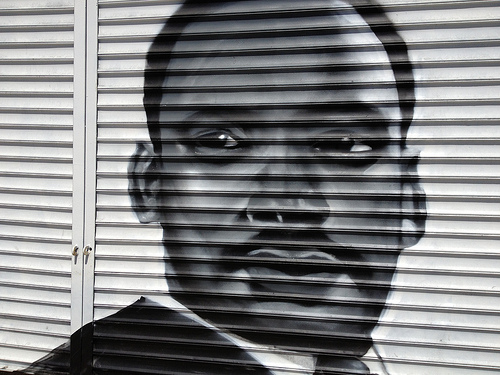
MLKbyjasonRosenburgNow that the nation has celebrated MLK’s heroic agitation for civil rights, there’s another facet of Martin Luther King Jr. often ignored in the media that deserves reflection.

What do MLK, JFK and RFK share in common?

Indeed, all three of them had undeniable charisma which directly and emphatically threatened the powers that be. Each demanded a presence with their sheer character, possessing an uncanny ability to embody the words they spoke rather than simply acting as another suit-and-tie with a political platform pre-scripted by some other PR suit-and-tie.

All three had the ability to enact change at a fundamental level, because they were personally convicted and committed to dissenting against war in a world that had become hellbent on destruction and violence.

But there is a further striking similarity between these three charismatic leaders: all of them were assassinated after focusing their critiques against the war machine.

In his formative stages, MLK was a radical proponent of non-violent protest against segregation and racism. He orchestrated sit-ins and marches in order to fight on behalf of African-Americans and the deprivation of their basic civil liberties as stamped in the Constitution. Nowadays, MLK is known for his success as a civil rights champion in regards to race equality. But later down the road, he had a stark realization which radically shifted the way he thought about political dissidence. This change of heart is what I wish to underscore, in remembrance of MLK and what he was willing to stand – and die – for.

We’re all familiar with MLK’s “I Have a Dream Speech” speech that he delivered in 1963 in Washington, D.C., culminating his March on Washington protest. In the speech, MLK envisions a day when racial inequality is no more, replaced by an egalitarian, racially colorblind America. However, in April of 1967, some four years later, Martin Luther King had a different culprit in mind – American foreign policy. In a speech entitled “Beyond Vietnam: A Time to Break Silence” delivered at Manhattan’s Riverside Church, King excoriates the military industrial complex and sees it as a fundamental wrong that ought to be first and foremost on our minds. King begins by addressing himself, critiquing his own “silence” on matters of foreign policy:

“Over the past two years, as I have moved to break the betrayal of my own silences and to speak from the burnings of my own heart, as I have called for radical departures from the destruction of Vietnam, many persons have questioned me about the wisdom of my path. At the heart of their concerns this query has often loomed large and loud: “Why are you speaking about the war, Dr. King?” “Why are you joining the voices of dissent?” “Peace and civil rights don’t mix,” they say. “Aren’t you hurting the cause of your people,” they ask? And when I hear them, though I often understand the source of their concern, I am nevertheless greatly saddened, for such questions mean that the inquirers have not really known me, my commitment or my calling. Indeed, their questions suggest that they do not know the world in which they live.” 

He then goes on to say, in some of the most moving words I have ever heard:

“As I have walked among the desperate, rejected and angry young men, I have told them that Molotov cocktails and rifles would not solve their problems. I have tried to offer them my deepest compassion while maintaining my conviction that social change comes most meaningfully through non-violent action. But, they asked, what about Vietnam? They asked if our own nation wasn’t using massive doses of violence to solve its problems, to bring about the changes it wanted. Their questions hit home, and I knew that I could never again raise my voice against the violence of the oppressed in the ghettos without having first spoken clearly to the greatest purveyor of violence in the world today, my own government.

For those who ask the question, “Aren’t you a Civil Rights leader?” and thereby mean to exclude me from the movement for peace, I have this further answer. In 1957 when a group of us formed the Southern Christian Leadership Conference, we chose as our motto: “To save the soul of America.” We were convinced that we could not limit our vision to certain rights for black people, but instead affirmed the conviction that America would never be free or saved from itself unless the descendants of its slaves were loosed from the shackles they still wear.

Now, it should be incandescently clear that no one who has any concern for the integrity and life of America today can ignore the present war. If America’s soul becomes totally poisoned, part of the autopsy must read “Vietnam.” It can never be saved so long as it destroys the deepest hopes of men the world over.”

We could call this MLK’s “I Have A Nightmare” speech, as King begins to realize that the systemic evils involved in racism are also found in the roots of militarism. After transitioning his critique from domestic to foreign policy, King was shortly thereafter assassinated.

Likewise, JFK lived out the beginning of his first term acquiescing to the Joint Chiefs of Staff and the CIA in their bid to prevent the dominoes from falling in favor of Communism, orchestrating coups and military operations in different regions of the world so to spread the seed of democracy and fulfill the long held tenants of Manifest Destiny. Like MLK, over time JFK eventually transitioned his aim toward the end of his first term, threatening to remove troops from Vietnam, negotiate an arms-treaty with Russia, and call for peace with Cuba, all of which would have effectively shut down the military machine. JFK was assassinated shortly thereafter.

Furthermore, RFK, who in his early years as the Attorney General to JFK was quite hawkish in regards to covert operations against Cuba, platformed his own presidential bid on fulfilling his brother’s wishes for peace, not war. RFK was also assassinated shortly thereafter.

Is it simply a coincidence that all three of these charismatic leaders were snuffed out by psychotic, nutty lone assassins whilst activating their political stance to reappropriate a republic that had been hijacked by aggressive militarism? In the case of MLK’s assassination, a Memphis, Tenn. grand jury in 1999 ruled his death not as the result of a lone nut but rather a government conspiracy, warranted by an enormous amount of evidence.

Fast forward to today, with Obama being another charismatic possessing the ability to sway an entire nation with his rhetorical skills. He too started out like JFK in critiquing the war machine, but after getting into office wholly relented to the military-industrial complex. In similar fashion to JFK’s unsanctioned war crimes, Obama’s drone policy has claimed the lives of many innocent human beings and so-called “terrorists,” strikes which are happening without Congressional oversight and thereby subject to the rubric of a war crime per international law.

Will we perhaps see a pang of conscience in Obama like we’ve seen with the aforementioned charismatics? Maybe. But let’s not forget, JFK committed his own war crimes even though he’s often heralded as an agitator of peace. Early on in his presidency, he was directly responsible for authorizing operations like Operation Mongoose, and the coup of South Vietnam’s president. Yet in the end, JFK had the spine to face up to his own atrocities and instead promote peace and democracy.

Although, it’s important to note that JFK made reform late in his first term, whereas Obama has dutifully served his corporate paymasters and war mongers all the way through his first term and so far into his second.

A considerable amount of evidence points to the simple fact that our presidents are only figureheads. They hold very little political power in any actual, substantive sense, because their financial backers and corporate lobbies are the ones ultimately calling the shots. Nevertheless, U.S. Presidents do retain the highest office in the land and thus have a media platform unlike any other individual. They are able to reach the masses immediately with a single speech.

While Obama has demonstrated himself to be an agent of illegality, we as political dissidents must not fall into the trap of demonizing him. Russian novelist and Nobel Prize winner, Aleksandr Isayevich Solzhenitsyn, once said:

“If only there were evil people somewhere insidiously committing evil deeds, and it were necessary only to separate them from the rest of us and destroy them. But the line dividing good and evil cuts through the heart of every human being. And who is willing to destroy a piece of his own heart?”

In the same vein of JFK, Obama retains the ability to choose to turn against the military machine and stand up for what is right and just and good. In similar fashion to MLK, Obama still has the chance to look deep within himself and break the betrayal of his own silence.

Will Obama use his undeniable charisma and fight back against the corporate masters that currently play him like a puppet, as did some of his predecessors? Or will he continue to live up to his placard of hope and change in name only, nothing more than a nice-looking, smiley suit-and-tie on strings?

One thing is for sure: if Obama were to cut the strings and stand up for what’s right, there could very well be a heavy price to pay.

Written by Mike David Micklow

Photo by flickr user Jason Rosenburg

Page 26 of 82<<...2425262728...>>