After Downing Street- Bush Began Invasion Before Authorized by Congress

DEMOCRACY NOW– Writing in The Nation magazine, Democracy Now! correspondent Jeremy Scahill reports on Washington’s undeclared air war against Iraq in 2002:

“It was a huge air assault: Approximately 100 US and British planes flew from Kuwait into Iraqi airspace. At least seven types of aircraft were part of this massive operation, including US F-15 Strike Eagles and Royal Air Force Tornado ground-attack planes. They dropped precision-guided munitions on Saddam Hussein’s major western air-defense facility, clearing the path for Special Forces helicopters that lay in wait in Jordan. Earlier attacks had been carried out against Iraqi command and control centers, radar detection systems, Revolutionary Guard units, communication centers and mobile air-defense systems. The Pentagon’s goal was clear: Destroy Iraq’s ability to resist. This was war.

“But there was a catch: The war hadn’t started yet, at least not officially. This was September 2002–a month before Congress had voted to give President Bush the authority he used to invade Iraq, two months before the United Nations brought the matter to a vote and more than six months before “shock and awe” officially began.”

AMY GOODMAN: Here to talk about this all with us is Jeremy Scahill, producer and correspondent for Democracy Now!, has an article at The Nation magazine’s website, called “The Other Bomb Drops: How Bush Began the Iraq Invasion Before He Went to Congress or the U.N.” We are also joined on the telephone by Hans Von Sponeck, former Assistant Secretary General of the United Nations. And we are joined by John Bonifaz, who has just begun a website that deals with this issue. He is author of Warrior King: The Case for Impeaching George W. Bush. The website is called, AfterDowningStreet.org, a coalition of various groups urging Congress to begin a formal investigation to whether Bush has committed impeachable offenses in connection with the invasion of Iraq. Let’s begin, Jeremy, with you. Welcome to Democracy Now!, on this side of the mic.

JEREMY SCAHILL: Thank you, Amy. It’s good to be here.

AMY GOODMAN: Talk about what you found.

JEREMY SCAHILL: I think for many people who have been following the politics of the invasion and occupation of Iraq, it comes as no surprise to learn that the Bush administration intentionally misled the U.S. public and the world and operated with tremendous bad faith when it said it was trying to do everything it could to avoid war. And what we have here is really solid documentation that backs that up. What the British Times of London published last weekend was statistics from the British defense ministry that showed that in the second half of 2002—let’s remember that the invasion of Iraq officially began in March of 2003—that from May 2002 until the end of 2002, that the United States and Britain doubled the amount of attacks that—the number of attacks that they were carrying out against Iraq, from the whole of 2001. So, what you saw was the Bush administration ordering attacks, offensive attacks on Iraq, that were intended to take out communications infrastructure in the country, the ability of commanders in the Iraqi military to communicate with one another, pretty much defensive mechanics for the country, and these attacks were happening with the justification that they were protecting the so-called no-fly zones in Iraq.

The real scandal here is that the Bush administration, like the Clinton administration before it, oversaw the longest sustained bombing campaign since Vietnam. We reported on this show for years consistently that the United States was bombing Iraq once every three days. This bombing began—you could say that the preparations for this invasion began the moment that the so-called Gulf War ended and that Clinton laid the groundwork for this in his regular bombings of Iraq. We saw a spike in activity in these so-called no-fly zone attacks which had no U.N. mandate whatsoever, which were not approved by the international community.

AMY GOODMAN: Which are often mistakenly called the U.N. no-fly zones.

JEREMY SCAHILL: Right. And it was only the United States and Britain. France pulled out almost immediately after the United States began this program. So you had the United States and Britain, and then with the approval and support of some of the puppet regimes in the region that were for whatever reason in bed with the United States. After the passage of the Iraq Liberation Act in 1998, you saw an escalation in the so-called no-fly zones. The Clinton administration was using them to try to provoke Saddam Hussein’s regime into attacking the United States to justify further attacks. And you remember there was the heavy bombing known as “Operation Desert Fox” in December of 1998. So the Clinton administration is not innocent here. It carried out illegal bombings against Iraq consistently throughout the presidency of Clinton.

What we saw that sort of changed here under Bush is that the Bush administration dropped all of the rhetoric about the no-fly zones having something to do with defending Shiites or Kurds and actually were quite public about what they were using these no-fly zones for. They were using them to systematically and preemptively degrade Iraq’s ability to defend itself, not from an uprising of Shiites or Kurds, but from the invasion of a foreign army.

AMY GOODMAN: And then, can you locate the Downing Street memo, talk about its significance, and what happened with the bombing then? This Downing Street memo, what, July 23rd, 2002.

JEREMY SCAHILL: Yes. It reports on a meeting that senior British officials had had with members of the Bush administration, and what it is is a reflection of what the British understood to be the United States’ policy at the moment. And what’s clear from reading this—it’s actually not a memo, it’s minutes, but it’s called the Downing Street memo. It’s minutes of this meeting with Tony Blair and some of his most senior defense advisers. And the picture that is painted from this memo is that the United States already was not just planning and preparing for war, but was actively carrying out air strikes in support of this war. The invasion had begun already when the British had this meeting. And we find that in the form of remarks attributed to Geoff Hoon within these minutes, where he is talking about the Americans already spiking up activity against Saddam Hussein, and what he’s referring to is the increasing use of these so-called no-fly zones to degrade Iraq’s ability to defend against a U.S. invasion and to prepare the route for U.S. Special Forces to enter into the country. In September of 2002—now this is months before the actual invasion officially began, and a few months before Bush went to the Congress or the United Nations—100 aircraft violate Iraqi airspace, British and American aircraft. They go in and they carry out a systematic campaign of air strikes in the west of Iraq and basically destroy the west of Iraq’s ability to defend against an invasion. And that was one of the main places where U.S. Special Forces troops came in from Jordan into the west of Iraq. That happened in September of 2002. We’re talking about months before the actual invasion began.

AMY GOODMAN: We are talking to Democracy Now! correspondent, Jeremy Scahill, has a piece in The Nation online called “The Other Bomb Drops.” When we come back, we’ll also be joined by attorney John Bonifaz and the former U.N. Assistant Secretary General, Hans Von Sponeck..
Giant US Military Base Emerges in Afghanistan

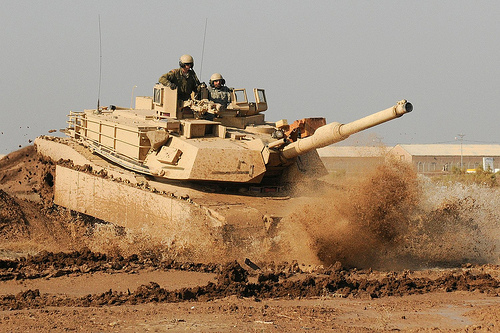
AFP– In the forbidding Afghan desert, US engineers are carving out a sprawling military camp as part of a dramatic American troop build-up designed to confront Taliban insurgents.

The desolate plain in southern Helmand province that Afghans call the “desert of death” has turned into a hive of frenetic activity, underscoring President Barack Obama’s decision to expand the US military commitment to the war.

Defence Secretary Robert Gates flew into Camp Leatherneck on Thursday to get a first-hand look as dozens of bulldozers kicked up clouds of dust and soldiers swung hammers in searing heat. Some of the newly arrived soldiers at the camp told Gates they were still waiting for radios and other equipment to arrive.

Gates promised to look into the problem and said later at a news conference in Kabul that moving such a large number of troops and so much equipment was a “logistical challenge” in a country with a shortage of airports and major roads.

Every day military planes ferry in more marines and soldiers to the camp that has emerged out of the desert seemingly overnight, protected by miles of sand walls topped with barbed wire along with rows of barrier walls.

“It’s been real busy,” said Captain Jeff Boroway from the 25th Naval Construction regiment.

“This place was desert at the end of January. I mean nothing. And now you’ve got a 443-acre (179-hectare) secure facility,” he told reporters.

Boroway said engineering units were rushing to finish work on the camp to accommodate the deployment of thousands of additional troops, including most of an 8,000-strong brigade of US Marines.

Continue reading about the Giant US Military Base Emerging in Afghanistan.

Photo by the US Army flickr

© COPYRIGHT AFP, 2009

Al-Qaeda Blames 9/11 on US Support for Israel

ISRAEL NATIONAL NEWS– American support for Israel was the reason for the 9/11 terrorist attacks on the United States in 2001, according to an audio message purported to be from Osama bin Laden, the leader of the international Al-Qaeda terrorist organization. The whereabouts of Bin Laden are not known, and the video image accompanying the audio featured only a still picture of him.

The title of the audio was, “Message to the American People.” and was released two days after the eighth anniversary of the multiple aerial attacks on the U.S.

“If you think about your situation well, you will know that the White House is occupied by pressure groups,” the speaker on the audiotape said. “Rather than fighting to liberate Iraq – as Bush claimed – it (the White House) should have been liberated.”

Bin Laden added that U.S. President Barack Obama does not have enough power to change American policies. “The bitter truth is that the neo-Conservatives continue to cast their heavy shadows upon you,” he continued. “All we will do is to continue the war of attrition against you on all possible axes, like we exhausted the Soviet Union for ten years until it collapsed with grace from Allah the Almighty and became a memory of the past.”

Continue reading about Al Qaeda Blaming 9/11 on US Support for Israel.

Photo by Ron Almog

© ISRAEL NATIONAL NEWS, 2009

Barack Obama Continues US Military Global Dominance

2009- 2010

PROJECT CENSORED– The Barack Obama administration is continuing the neo-conservative agenda of US military domination of the world— albeit with perhaps a kinder-gentler face.  While overt torture is now forbidden for the CIA and Pentagon, and symbolic gestures like the closing of the Guantanamo prison are in evidence, a unilateral military dominance policy, expanding military budget, and wars of occupation and aggression will likely continue unabated.

The military expansionists from within the Reagan, George H. W. Bush, Clinton, G. W. Bush administrations put into place solid support for increased military spending. Clinton’s model of supporting the US military industrial complex held steady defense spending and increased foreign weapons sales from 16% of global orders to over 63% by the end of his administration.

The neo-conservatives, who dominated the most recent Bush administration, amplified this trend of increased military spending. The neo-cons laid out their agenda for military global dominance in the 2000 Project for a New American Century (PNAC) report Rebuilding America’s Defenses. The report called for the protection of the American Homeland, the ability to wage simultaneous theater wars, to perform global constabulary roles, and to control space and cyberspace. The report claimed that in order to maintain a Pax Americana, potential rivals — such as China, Iran, Iraq, and North Korea — needed to be held in check. This military global dominance agenda required forward deployment of US forces worldwide and increasing defense/war spending well into the 21st century. The result was a doubling of the US military budget to over $700 billion in the last eight years. The US now spends as much on war/defense as the rest of the world combined, making Americans the highest war-tax payers in the world.

Barack Obama’s election brought a moment of hope for many. However, the Obama administration is not calling for decreased military spending, or a reversal of US military global dominance. Instead, Obama retained Robert Gates, thus making Obama the first president from an opposing party, in US history, to keep in place the outgoing administrations’ Secretary of Defense/War. Additionally, Obama is calling for an expanded war in Afghanistan and only minimal long-range reductions in Iraq.

The US military industrial complex is deeply embedded inside the Washington beltway. According to the most recent reports from OpenSecrets.org, 151 members of Congress in 2006 had up to $195.5 million of their personal assets invested in defense companies.

Major defense contractors were seriously involved in the 2008 elections. Lockheed Martin gave $2,612,219 in total political campaign donations, with 49% to Democrats ($1,285,493) and 51% to Republicans ($1,325,159). Boeing gave $2,225,947 in 2008 with 58% going to Democrats, and General Dynamics provided $1,682,595 to both parties.  Northrop Grumman spent over $20 million in 2008, hiring lobbyists to influence Congress, and Raytheon spent $6 million on lobbyists in the same period. In a revolving door appointment, Obama nominated Raytheon’s senior vice president for government operations and strategy, William Lynn, for the number two position in the Pentagon. Lynn was formally the Defense Department’s comptroller during the Clinton administration.

The International Monetary Fund’s prediction for global economic growth in 2009 is 0.5 percent—the worst since World War II. The United Nations’ International Labor Organization estimates that some 50 million workers will lose their jobs worldwide this year. There are an estimated 62,000 U.S. companies expected to close in 2009, and while official unemployment is at 7 percent in the US, when you add people no longer looking for jobs and part-time workers, joblessness is closer to 14 percent. The military-industrial-political elite are worried about the potential of increasing global insecurity. The answer inside the Obama Administration is to continue high defense/war spending to insure military control of both domestic and foreign instabilities.

The military, industrial, congressional, and administrative elite profit from defense spending, both financially and ideologically.  Insider profit taking from pentagon spending is widespread in Washington. But perhaps more important is the belief that this global military machine is seen as necessary for the protection of US corporate interests and the American upper classes in an increasingly destabilized world. Given that belief, the Obama administration is unlikely to change the defense spending policies of the previous US administrations without significant disruptive pressure from anti-war activists and global empire resisters.

Peter Phillips is a Professor of Sociology at Sonoma State University and Director of Project Censored a media research organization. His 2006 study on the Global Dominance Group in the US is available on line at: http://www.projectcensored.org/articles/story/the-global-dominance-group/

Photo by flickr user Ethan Bloch

Critics Call Obama’s Tribunals “Bush Lite”

CBSIn an apparent reversal, President Barack Obama is reviving the Bush administration’s much-criticized military tribunals for Guantanamo Bay detainees, shocking those who expected the president to end them completely.

CBS News correspondent Kimberly Dozier reports that the president says these will not be your Bush-era tribunals, promising a new system that guarantees more legal rights for detainees.

Mr. Obama said the changes were designed to give defendants stronger legal protections, such as a ban on evidence “obtained through torture, or by using cruel or degrading interrogation methods,” like waterboarding; limiting use of hearsay evidence; granting the accused more say in who represents them; and protecting detainees who refuse to testify from legal sanctions.

But his action was almost instantly denounced by critics who called the new tribunals “Bush Lite,” reports Dozier.

During his presidential campaign, Mr. Obama was highly critical of the commissions used by the Bush administration.

“By any measure, our system of trying detainees has been an enormous failure,” he said last June 18.

And one of his first actions as president was setting in motion the closing of Guantanamo Bay prison within 12 months.

Re-opening these military tribunals may also delay the closing of Guantanamo, says Dozier. The earliest the trials of 13 defendents (9 of whom are charged with helping orchestrate the September 11 terror attacks) can resume is September. That would give prosecutors about four months to finish before the end of the year, because these military tribunals cannot be held back in the United States.

The rest of the 241 Guantanamo detainees will either be released, transferred to other countries, tried in civilian U.S. federal courts or, potentially, held indefinitely as prisoners of war with full Geneva Conventions rights.

Finish reading about Obama’s Tribunals Being Bush-Lite.

© MMIX, CBS Interactive Inc. All Rights Reserved.

Photo by flickr user Steven Damron

Page 76 of 79<<...7475767778...>>