Remarks by the President to the Troops in Afghanistan
by Barack Obama
THE PRESIDENT: How’s it going, Bagram? (Applause.) Well, you know, it turns
out that the American people, they let me use this plane called Air Force One.
And so I thought I’d come over and say hello. (Applause.)
Couple of people I want to thank, in addition to Sergeant Major Eric Johnson
for the outstanding introduction and his great service. I want to thank Major General
Mike Scaparrotti. (Applause.) Thank you for your great work as commanding
general. I want to thank Ms. Dawn Liberi, who is the senior civilian
representative of Regional Command East, for her outstanding work; and
Brigadier General Steven Kwast, commander — (applause) — commander 455th Air
Expeditionary Wing. Thank you all for your outstanding service. Give them a big
round of applause. (Applause.)
Thank you for the unbelievable welcome. I know this was on a little bit of
short notice.
AUDIENCE MEMBER: No worries.
THE PRESIDENT: No worries. (Laughter.) It is great to be here at Bagram, and
it’s great to see all the services. We’ve got Air Force, we’ve got Army —
(applause) — we’ve got Navy — (applause) — we’ve got some Marines in the
house. (Applause.) And we’ve got a lot of civilians here too — (applause) —
who are making an outstanding contribution to this effort, and I’m honored to
be joined by America’s outstanding civilian military leadership team here in
Afghanistan, Ambassador Karl Eikenberry, who’s doing outstanding work, and the
commander of our 43-nation coalition, General Stan McChrystal. The two of them
together have paired up to do an extraordinarily difficult task, but they are
doing it extraordinarily well and we are proud of them. Please give your
outstanding team a big round of applause. They’ve got my full confidence and my
full support. (Applause.)
We’re also joined by troops from some of our coalition partners, because
this is not simply an American mission or even just a NATO mission. Al Qaeda
and their extremist allies are a threat to the people of Afghanistan
and a threat to the people of America,
but they’re also a threat to people all around the world, and that’s why we’re
so proud to have our coalition partners here with us. Thank you very much for
the great work that you do. We salute you and we honor you for all the
sacrifices you make, and you are a true friend of the United
States of America. Thank you very much.
(Applause.)
And we also salute the members of the Afghan National Army who are fighting
alongside all of you. They’re risking their lives to protect their country. And
as I told President Karzai today, the United
States is a partner but our intent is to
make sure that the Afghans have the capacity to provide for their own security.
That is core to our mission, and we are proud of the work that they are doing
and the continuing increased capacity that we’re seeing out of Afghan national
security forces. So thank you very much for the great work you’re doing to take
responsibility for security here in your own country.
And to the Afghan people, I want to say that I’m honored to be a guest in
your country. Now, the Afghans have suffered for decades — decades of war. But
we are here to help Afghans forge a hard-won peace while realizing the
extraordinary potential of the Afghan people, Afghanistan’s
sons and daughters, from the soldiers and the police to the farmers and the
young students. And we want to build a lasting partnership founded upon mutual
interests and mutual respect, and I’m looking forward to returning to Afghanistan
many times in the years to come.
Now, I know for most of you, you didn’t get a lot of notice that I was
coming. But I want you to understand, there’s no visit that I considered more
important than this visit I’m making right now, because I have no greater honor
than serving as your Commander-in-Chief. And it is a privilege to look out and
see the extraordinary efforts of America’s
sons and daughters here in Afghanistan.
So my main job here today is to say thank you on behalf of the entire American
people. (Applause.)
You are part of the finest military in the history of the world, and we are
proud of you. And so I want you to know that everybody back home is proud of
you. Everybody back home is grateful. And everybody understands the sacrifices
that you have made and your families have made to keep America
safe and to keep America
secure in this vital mission.
And I know it’s not easy. You’re far away from home. You miss your kids. You
miss your spouses, your family, your friends. Some of you, this is your second
or your third or your fourth tour of duty. I’ll tell you right now the same
thing that I said at West Point last December. If I
thought for a minute that America’s
vital interests were not served, were not at stake here in Afghanistan,
I would order all of you home right away.
So I want you to know, I want every American serving in Afghanistan,
military and civilian, to know, whether you’re working the flight line here at
Bagram or patrolling a village down in Helmand, whether you’re standing watch
at a forward operating base or training our Afghan partners or working with the
Afghan government, your services are absolutely necessary, absolutely essential
to America’s safety and security. Those folks back home are relying on you.
We can’t forget why we’re here. We did not choose this war. This was not an
act of America
wanting to expand its influence; of us wanting to meddle in somebody else’s
business. We were attacked viciously on 9/11. Thousands of our fellow
countrymen and women were killed. And this is the region where the perpetrators
of that crime, al Qaeda, still base their leadership. Plots against our
homeland, plots against our allies, plots against the Afghan and Pakistani people
are taking place as we speak right here. And if this region slides backwards,
if the Taliban retakes this country and al Qaeda can operate with impunity,
then more American lives will be at stake. The Afghan people will lose their
chance at progress and prosperity. And the world will be significantly less
secure.
And as long as I’m your Commander-in-Chief, I am not going to let that
happen. That’s why you are here. I’ve made a promise to all of you who serve. I
will never send you into harm’s way unless it’s absolutely necessary. I anguish
in thinking about the sacrifices that so many of you make. That’s why I promise
I will never send you out unless it is necessary.
But that’s only part of the promise, because the other part of the promise
is that when it is absolutely necessary, you will be backed up by a clear
mission and the right strategy to finish the job, to get the job done. And I am
confident all of you are going to get the job done right here in Afghanistan.
I am confident of that. (Applause.)
That’s why I ordered more troops and civilians here into Afghanistan
shortly after taking office. That’s why we took a hard look and forged a new
strategy and committed more resources in December. That’s why we pushed our
friends and allies and partners to pony up more resources themselves, more
commitments of aid, and additional forces and trainers.
Our broad mission is clear: We are going to disrupt and dismantle, defeat
and destroy al Qaeda and its extremist allies. That is our mission. And to
accomplish that goal, our objectives here in Afghanistan
are also clear: We’re going to deny al Qaeda safe haven. We’re going to reverse
the Taliban’s momentum. We’re going to strengthen the capacity of Afghan
security forces and the Afghan government so that they can begin taking
responsibility and gain confidence of the Afghan people.
And our strategy includes a military effort that takes the fight to the
Taliban while creating the conditions for greater security and a transition to
the Afghans; but also a civilian effort that improves the daily lives of the
Afghan people, and combats corruption; and a partnership with Pakistan and its
people, because we can’t uproot extremists and advance security and opportunity
unless we succeed on both sides of the border. Most of you understand that.
Many of the troops that I ordered to Afghanistan
have begun to arrive, and more are on the way. And we’ll continue to work with
Congress to make sure that you’ve got the equipment that you need, particularly
as we complete our drawdown in Iraq.
We’re providing more helicopters, we’re providing more intelligence and
reconnaissance capabilities, more special operations forces, more armored
vehicles that can save lives.
And here in Afghanistan
you’ve gone on the offensive. And the American people back home are noticing.
We have seen a huge increase in support in — stateside, because people
understand the kinds of sacrifices that you guys are making, and the clarity of
mission that you’re bringing to bear.
And together with our coalition and Afghan partners, our troops have pushed
the Taliban out of their stronghold in Marja. We’ve changed the way we operate
and interact with the Afghan people. We see Afghans reclaiming their
communities, and we see new partnerships that will help them build their own
future and increase their security.
And across the border, Pakistan
is mounting major offensives. We’ve seen violent extremists pushed out of their
sanctuaries. We’ve struck major blows against al Qaeda leadership as well as
the Taliban’s. They are hunkered down. They’re worried about their own safety.
It’s harder for them to move, it’s harder for them to train and to plot and to
attack, and all of that makes America safer. And we are going to keep them on
the run because that is what’s going to be required in order to assure that our
families back home have the security that they need. That’s the work that you
are doing.
So thanks to you, there’s been progress these last several months. But we
know there are going to be some difficult days ahead. There’s going to be
setbacks. We face a determined enemy. But we also know this: The United States
of America does not quit once it starts on something. (Applause.) You don’t
quit, the American armed services does not quit, we keep at it, we persevere,
and together with our partners we will prevail. I am absolutely confident of
that. (Applause.)
And I also want you to know that as you’re doing your duty here, we’re going
to do right by you back home. We’re going to help take care of your families,
and that’s why the First Lady Michelle Obama visited with military families and
makes sure that their needs are met. That’s why she stays after me once she
gets home, when I’m at the White House. And we’re going to make sure that we
are keeping to improve your pay and your benefits, but also things like
childcare and support that ensure that you’ve got a little bit of security
knowing your family is being looked after back home.
And we’ll be there for your when you come home. It’s why we’re improving
care for our wounded warriors, especially those with PTSD and traumatic brain
injuries. We’re moving forward with the Post-9/11 GI Bill so you and your
families can pursue your dreams. And we’ve made the biggest increase in the VA
budget in 30 years, because we’re going to keep our sacred trust with all those
who serve.
You’ve been there for us, tour after tour, year after year, at a time when
too many American institutions have let us down, when too many institutions
have put short-term gain in front of a commitment to duty and a commitment to
what’s right. You’ve met your responsibilities, you’ve done your duty — not
just when it’s easy. That’s why you’ve inspired your fellow Americans. That’s
why you inspire me. That’s why you’ve earned your place next to the very
greatest of American generations.
And all of you represent the virtues and the values that America so
desperately needs right now: sacrifice and selflessness, honor and decency.
That’s why you’re here today. That’s what you represent.
I’ve seen your sense of purpose and your willingness to step forward and
serve in a time of danger. I’ve seen it from the Marines I’ve met at Camp
Lejeune to the cadets at West Point, from the midshipmen at Annapolis to the
troops I’ve met in Iraq, and at bases across America and here in Afghanistan.
I’ve seen your courage and your heroism and the story of a young Sergeant First
Class named Jared Monti who gave his life here in Afghanistan to save his
fellow soldiers and his parents. I was proud to present with our nation’s
highest military declaration, the Medal of Honor. I’ve seen your tenacity —
(applause) — I’ve seen your tenacity and determination in our wounded warriors
in Landstuhl and Walter Reed — Americans fighting to stand again and to walk again
and to get back with — get back with their units; incredible dedication,
incredible focus, incredible pride. And I’ve been humbled by your sacrifice and
the solemn homecoming of flag-draped coffins at Dover, to the headstones in
Section 60 at Arlington where the fallen from this war rest in peace alongside
the fellow heroes of America’s story.
So here in Afghanistan each one of you is part of an unbroken line of
American servicemembers who’ve sacrificed for over two centuries. You’re
protecting your fellow citizens from danger. You’re serving alongside old
allies and new friends. You’re bringing hope and opportunity to a people who
have known a lot of pain and a lot of suffering.
And I know that sometimes when you’re watching TV, the politics back home
may look a little messy, and people are yelling and hollering, and Democrats
this and Republicans that. I want you to understand this: There’s no daylight
when it comes to support of all of you. There’s no daylight when it comes to
supporting our troops. That brings us together. We are all incredibly proud. We
all honor what you do. And all of you show all of America what’s possible when
people come together, not based on color or creed, not based on faith or
station, but based on a commitment to serve together, to bleed together and to
succeed together as one people, as Americans.
Make no mistake, this fight matters to us. It matters to us, it matters to
our allies, it matters to the Afghan people. Al Qaeda and the violent
extremists who you’re fighting against want to destroy. But all of you want to
build — and that is something essential about America. They’ve got no respect
for human life. You see dignity in every human being. That’s part of what we
value as Americans. They want to drive races and regions and religions apart.
You want to bring people together and see the world move forward together. They
offer fear, in other words, and you offer hope.
And that’s why it is so important that you know that the entire country
stands behind you. That’s why you put on that uniform, because in an uncertain
world, the United States of America will always stand up for the security of
nations and the dignity of human beings. That’s who we are. That is what we do.
Much has happened to our country and to the world since 9/11. But I’m
confident that so long as brave men and women like you — Americans who are
willing to serve selflessly half a world away on behalf of their fellow
citizens and the dreams of people they’ve never met — so long as there are
folks like you, then I’m confident that our nation will endure, and hope will
overcome fear. And I am confident that better days lie ahead.
So thank you very much, everybody. (Applause.) God bless you. God bless the
United States Armed Forces. And God bless the United
States of America. (Applause.)
END 11:33 P.M. (Local)
Photo by US Army flickr



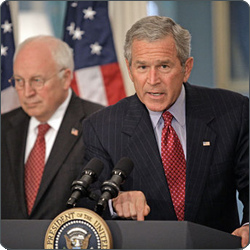 ABC NEWS– In dozens of top-secret talks and meetings in the White House, the most
senior Bush administration officials discussed and approved specific details of
how high-value al Qaeda suspects would be interrogated by the Central
Intelligence Agency, sources tell ABC News.
ABC NEWS– In dozens of top-secret talks and meetings in the White House, the most
senior Bush administration officials discussed and approved specific details of
how high-value al Qaeda suspects would be interrogated by the Central
Intelligence Agency, sources tell ABC News.