
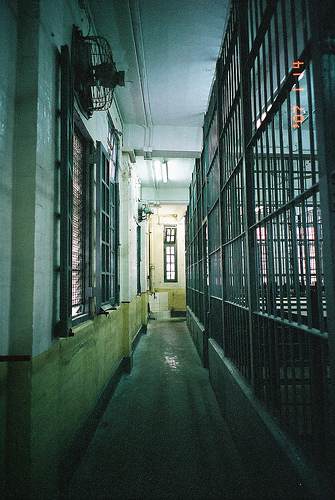
Georgia Prison Strike: A Hidden Labor Force Resists

December 18. 2010

IN THESE TIMES – Last week a diverse group of nonviolent protesters across Georgia stood up for their rights, calling for decent wages, better social services and respect for their civil liberties. It didn’t take long for the government to crack down on the demonstrations, however: the protesters were already in prison.

The uprising of Georgia inmates on December 9 defied the stereotype of the chaotic “prison riot” in the public imagination. Yet neither did “Lockdown for Liberty” fit within the conventional model of civil disobedience or industrial action. But when the inmates in at least six different prisons refused to leave their cells to report to work and other activities that day, a strike began. And it effectively paralyzed a small chunk of the bureaucratic monstrosity of America’s prison system.

The incarcerated have historically filled the dregs of the American workforce, an emblem of racial subjugation often invisible in the politics of labor and social policy. It was against this hidden legacy of exploitation that the Georgia inmates, with the support of the NAACP and other civil rights advocates, raised issues common to incarcerated people nationwide: abusive treatment, degrading living conditions, a lack of accountability in the administration and parole authorities, and a lack of basic educational and social services (see below).

Pointedly invoking the term “slave” to describe the circumstances under which they toiled, the strikers showed how historically entrenched racial divisions play out today in the black-white disparities throughout the criminal justice system. Still, Georgia protesters included Latinos and whites as well as blacks, in a joint effort to resist and challenge structural injustices.

Their demands were hardly radical, but rather, embodied mainstream standards for reasonable and humane treatment: protection from cruel and unusual punishment by officers, affordable medicine when they’re sick, and above all, fair pay for their labor. According to the Atlanta-Journal Constitution, “state law forbids paying inmates except for one limited program.”

Final Call quoted reports trickling out from inmates earlier this week:

One brother told me, ‘We will ride until the wheels fall off,’ and that’s been the sentiment amongst the men when they started this,” said Elaine Brown, a spokesperson for the strike… Part of our purpose for doing this is that Georgia is the only state that does not pay its inmates at all. Some guys in here work seven days a week and they don’t get a dime,” said Dondito, one of the strikers, who requested anonymity.

You can almost hear the zero-tolerance conservatives in Washington now: how dare these criminals demand better treatment from the state? The official reaction was to immediately curtail what few resources the inmates possess. According to news reports, prison staff locked down four facilities, attempted to transfer out the leading troublemakers, cut off the hot water, and revoked cell phone privileges (yes, according to Facing South, “Cell phones are contraband in Georgia’s prisons, but widely available for sale from correctional officers.”)

The strike was called off after six days, following reports of violent crackdowns and rising fears that the situation would escalate. But by then, the inmates had made their mark with one of the largest prison protests in U.S. history. The decision to end the strike, moreover, seems like the beginning of another phase in the inmates’ collective action, now that they’ve caught national political attention. The AJC reported:

an inmate at Smith State Prison in Glenville said in a telephone interview prisoners had agreed to end their “non-violent” protest to allow administrators time to focus on their concerns rather than operating the institutions without inmate labor.

“We’ve ended the protest,” said Mike, a convicted armed robber who was one of the inmates who planned and coordinated the work stoppage. “We needed to come off lock down so we can go to the law library and start … the paperwork for a [prison conditions] lawsuit.

The proactive militancy of the strike organizers underscores the fact that the entire action not only proceeded largely without violence, but also spread rapidly through several institutions thanks to careful planning and clandestine technology–messages spread via cell, expanding the traditional jailhouse grapevine.

It may be a while before we see another prisoner strike going viral, as the potential for prison-based activism remains constrained by the criminal-justice power structure. But the Georgia inmates helped change the public face of Americans who’ve been caught up in the country’s incarceration industry. Under the most oppressive of conditions, they used disciplined strike tactics to align their grievances with broader struggles for human rights.

It makes sense. Prison is the everyday reality lived by a huge swath of the population (roughly one in one hundred, according to recent surveys) Meanwhile, the impact of prison labor leaves a hidden imprint on our economy as well. Noah Zatz of UCLA Law School has estimated that:

well over 600,000, and probably close to a million, inmates are working full time in jails and prisons throughout the United States. Perhaps some of them built your desk chair: office furniture, especially in state universities and the federal government, is a major prison labor product. Inmates also take hotel reservations at corporate call centers, make body armor for the U.S. military, and manufacture prison chic fashion accessories, in addition to the iconic task of stamping license plates.

As a captive workforce and disenfranchised populace, the prison system reaches deep into American society, and the distance between the people on the inside and those on the outside is increasingly a matter of luck–whether you’re unfortuate enough to have been born the wrong color or in the wrong neighborhood. If the movement launched by the Georgia inmates, and their demands for dignity, look surprisingly familiar, there’s a good reason for that: they are us.

For more information, follow the Black Agenda Report’s ongoing coverage of the Georgia prison activists.

The strikers’ demands, which they continue to press with state officials, are as follows:

A LIVING WAGE FOR WORK: In violation of the 13th Amendment to the Constitution prohibiting slavery and involuntary servitude, the DOC demands prisoners work for free.

EDUCATIONAL OPPORTUNITIES: For the great majority of prisoners, the DOC denies all opportunities for education beyond the GED, despite the benefit to both prisoners and society.

DECENT HEALTH CARE: In violation of the Eighth Amendment prohibition against cruel and unusual punishments, the DOC denies adequate medical care to prisoners, charges excessive fees for the most minimal care and is responsible for extraordinary pain and suffering.   AN END TO CRUEL AND UNUSUAL PUNISHMENTS: In further violation of the Eighth Amendment, the DOC is responsible for cruel prisoner punishments for minor infractions of rules.

DECENT LIVING CONDITIONS: Georgia prisoners are confined in over-crowded, substandard conditions, with little heat in winter and oppressive heat in summer.

NUTRITIONAL MEALS: Vegetables and fruit are in short supply in DOC facilities while starches and fatty foods are plentiful.

VOCATIONAL AND SELF-IMPROVEMENT OPPORTUNITIES: The DOC has stripped its facilities of all opportunities for skills training, self-improvement and proper exercise.

ACCESS TO FAMILIES: The DOC has disconnected thousands of prisoners from their families by imposing excessive telephone charges and innumerable barriers to visitation.

JUST PAROLE DECISIONS: The Parole Board capriciously and regularly denies parole to the majority of prisoners despite evidence of eligibility.

Michelle Chen’s work has appeared in AirAmerica, Women’s International Perspective, Extra!, Colorlines and Alternet. She is a regular contributor to In These Times’ workers’ rights blog, Working In These Times. She also blogs at Racewire.org.


Photograph by flickr user mocvdleung
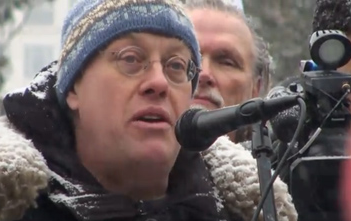

Media Black Out of Veterans Chained to WH Fence

COMMONDREAMS – There was a black-out and a white-out Thursday and Friday as over a hundred US veterans opposed to US wars in Afghanistan and elsewhere around the world, and their civilian supporters, chained and tied themselves to the White House fence during an early snowstorm to say enough is enough.

Washington Police arrested 135 of the protesters, in what is being called the largest mass detention in recent years. Among those arrested were Ray McGovern, a former CIA analyst who used to provide the president’s daily briefings, Daniel Ellsberg, who released the government’s Pentagon Papers during the Nixon administration, and Chris Hedges, former war correspondent for the New York Times.
No major US news media reported on the demonstration or the arrests. It was blacked out of the New York Times, blacked out of the Philadelphia Inquirer, blacked out in the Los Angeles Times, blacked out of the Wall Street Journal, and even blacked out of the capital’s local daily, the Washington Post.

Making the media cover-up of the protest all the more outrageous was the fact that most news media did report on Friday, the day after the protest, the results of the latest poll of American attitudes towards the Afghanistan War, an ABC/Washington Post Poll which found that 60% of Americans now feel that war has “not been worth it.” That’s a big increase from the 53% who said they opposed the war in July.  

Clearly, any honest journalist and editor would see a news link between such a poll result and an anti-war protest at the White House led, for the first time in recent memory, by a veterans organization, the group Veterans for Peace, in which veterans of the nation’s wars actually put themselves on the line to be arrested to protest a current war.

Friday was also the day that most news organizations were reporting on the much touted, but also much over-rated Pentagon report on the “progress” of the American war in Afghanistan–a report that claimed there was progress, but which was immediately contradicted by a CIA report that said the opposite. Again, any honest journalist and editor would see the publication of such a report as an appropriate place to mention the unusual opposition to the war by a group of veterans right outside the president’s office.

And yet, the protest event was completely blacked out by the corporate news media, even as the capital was whited-out by a fast-moving snowstorm that brought traffic almost to a standstill.

If you wanted to know about this protest, you had to go to the internet and read the Huffington Post or to theSocialist Worker, or to this publication (okay, we’re a day late, but I was stuck in traffic yesterday), or to Democracy Now! on the alternative airways.

My old employer, the Sydney Morning Herald in Australia, showed how it’s supposed to be done. In an article published Friday about the latest ABC/Washington Post Poll, reporter Simon Mann, after explaining that opposition to the war in the US was rising, then wrote:

“The publication of the review coincided with anti-war protests held across the US, including one in Washington in which people chained themselves to the White House fence, leading to about 100 arrests.”

That’s the way journalism is supposed to work. 

Relevant information that puts the days news in some kind of useful context is supposed to be provided to the reader.

Clearly, in the US the corporate media perform a different function. It’s called propaganda. And the handling of this dramatic protest by American veterans against the nation’s current war provides a dramatic illustration of how far the news industry and the journalism profession has fallen.

Dave Lindorff is a Philadelphia-based journalist and columnist. He is author of Marketplace Medicine: The Rise of the For-Profit Hospital Chains (BantamBooks, 1992), and his latest book “The Case for Impeachment” (St. Martin’s Press, 2006). All his work is available at www.thiscantbehappening.net


Civil Society Groups Protest Climate Summit

DEMOCRACY NOW! – As the Cancún climate talks headed toward a conclusion on Friday, civil society groups spoke out against what they said was a flawed United Nations process. As the talks wrapped up inside the conference rooms of Cancún’s luxurious Moon Palace resort, civil society groups protested the process—and found themselves increasingly iced out. John Hamilton files a report from Cancún.


MR Original – Personal Revolution

“The biggest impediment to revolution is a personal one: our own deep-seated feelings of cynicism and impotence. How can anything “I” do possibly make a difference? Most of us have trouble accepting radical change as a viable option. Entrenched in a familiar world, we cannot imagine another. It’s hard to see our current system as simply one stage of a never-ending cycle that sooner or later will fall and be succeeded – but this process of creative destruction is exactly how the world works.”Kalle Lasn, contributing writer for Adbusters

MEDIA ROOTS– Galvanization in the world of social media is increasingly difficult, despite a level of interactive accessibility that was inconceivable two decades ago. People look to Twitter and Facebook for information, advice and input to their own queries, but you can’t ask too much of your connections. They aren’t friends, they aren’t family, but acquaintances with which we share very limited common social threads. As Malcolm Gladwell explains, “Social networks are effective at increasing participation—by lessening the level of motivation that participation requires.”

The result is a culture of noncommittal semi-passion, casual unrest and part-time activism that tokenizes the opposing view to the status quo and eliminates any genuine threat of effectiveness. It allows our conveniences to work against us, by removing all potency in the simplicity of action. How impressive is a thousand “like” clicks on your new group page, when all it takes is an uncommitted finger movement? It’s token activism, “clicktivism,” empty and largely another layer on the white noise of saturated information.

The rinse/repeat culture of sarcastic cool and cynicism rules the day, blotting out the nourishing light of compassion and the open-minded communication that’s crucial to a productively evolving society. One-uppery has replaced interactive, real-life storytelling & inspiration garnered through collectively shared experiences. Part of this can be attributed to our runaway free-market hyper-addiction, and our total complacency in the face of the fact that we are no longer citizens first, but consumers. Friends are now collections. Healthy is expensive, deadly comes in a myriad of value meals.

It’s clear that something is very wrong. Still, there is no rational, collective sense of motivated urgency as a society. No fists pounding the tables and podiums on network TV, demanding that the focus move from saving the banks and the executives to saving the homes, the jobs and the schools, rebuilding what truly makes us functional. There is a massive and deliberate blind eye being turned on the treacherously detrimental use of factory farming and genetically-engineered crops. By design, there are critically few, readily visible and widely viable alternatives to the status quo.

In the complete convenience and 24 hour full-blast entertainment access of today’s consumerist culture, the grounds for a truly meaningful uprising is at both points more fertile and more complicated than ever before. Organizing has reached hyperactive levels of interactivity, yet it’s largely done on the wings of casual, uncommitted interest. All the same, there is valid argument against Gladwell’s logic, given that awareness now takes flight over the digital realm, and his idea of a return to an authoritarian or even hierarchal activism model is precisely the opposite of what is needed for effective social revolution. What we need is to awaken the bits of humanity within all of us, that we’ve consumed our way away from.

The promise of passion’s proximity to youth is shackled by encouraged naivete, enabled in its aimlessness at a time when calculated, impassioned unrest is badly needed. A time when far more than a “like” button on a Facebook page or a retweet is necessary to make a meaningful impact, despite an encouraged and growing belief to the contrary. We need to learn how to find that passion once more, to water the seeds of effective activism and motivated focus in a climate of encouraged delusion and critical overexposure. We need to learn how to build a meaningful momentum in a climate where informed dissent is easily encapsulated and polarized, and how to feed the crucial fires of passion with a raw truth and motivation. We need to learn how to make a unified difference both within and without a digital playing field that’s overwhelmingly complex, and against an adversary that’s become inconceivably multi-faceted. We must be willing to tear down the walls of the box of commercial culture in very literal ways.

We accept the billboard horizon as reality each day, despite the unmistakable signs of full-scale class warfare being waged – and won – against us. We delightfully and collectively consume toxic ammunition, scrambling in our idiot rituals for the latest product updates, commiserating with nuanced passion over the design flaws in the latest minor tech boost. We silence our conscience whispers by bemoaning society’s mucosal sheen of vapid idiocy lathered on by the Lohans and Kardashians, all while perpetuating their undeserved spotlight with our prolonged attention and wholehearted addiction to tabloid culture. We’re a proud car crash flashbulb society, dipping toes into reflective self-loathing only for those token moments of inevitable reflection at what we’ve become. We deal poorly with these minor flashes of clarity, largely viewing them as inconvenient truths best medicated away or left for the hand-wringers and worrywarts, to be swiftly replaced by the next hype magnet.

We’re racing to rot the soul of our entire existence, because we’ve been programmed to know and do only this. To champion idiocy, retard our spirituality and wear our deference to marionette leaders like MVP jerseys at a football game. My team versus your team. The only catch – they’re both the same team, and neither are scoring points for us.

But not all of us are proud. Not all of us are content in our disposable culture, our celebration of cynicism and culturally impotent existence between the seemingly unstoppable glaciers of the Left/Right corporate body. Not all of us see the rising millions of unemployed as lazy freeloaders, or questioning the media narrative, the voracious capitalism machine & untethered funding of the industrial military complex as our nation’s foundation corrodes as anti-American.

Like you, there are those of us who understand the immense, gnawing reality of this frustration we’re feeling. We see the mechanics beneath the formidably valid fog of confusion we’ve found ourselves caught in, huddled in reluctant refuge under the umbrella shelter of the soothsayer’s broad-stroke assessments and promises as the torrents of terrifying, confusing and agonizing truth pound down all around us. Don’t get caught out in the rain – results may be horrifying. 

We are led by our entertainment and quest for immediate comfort. The government and media’s relentless focus on bank bailouts and Wall Street rather than urgently finding immediate solutions for the suffering citizens is a giant, vague, monolithic nightmare to the average American, who knows something is very wrong but feels entirely powerless to stop it. Especially with all these wonderful distractions…

We’re no longer communities of individuals seeking connection, but hyper-connected consumer groups, subjects in the latest advertising onslaught, promotional campaign, marketing blast. The chaos of the 24-hour news cycle- the parade of pundits with their myriad of bullshit nutshell assessments- is enough to bring about a collective migraine and personal inner turmoil unlike anything we’ve ever known. It chips at our resolve and our ability to find and hold truth. It gives us an unease that every fiber of our beings tells us needs remedying.

And so the latest line of designer medications arise, for those less-chipper moods, for nicotine or caffeine or shopping addiction, for the latest adolescent energy-suppressant. The problem doesn’t have to go away – where’s the profit in that? It just has to not seem so scary. We have to know that every cloud has a silver lining, every problem can be compartmentalized and treated with a flurry of life-crushingly expensive name-brand medications. As a result, more than half of all insured Americans are now taking prescription medicines regularly for chronic health problems, due in no small part to the explosion of pharmaceutical advertising.

The feeling of this dark momentum weighs on you like a hundred pounds of fat. Are you alone in your disgust & disassociation from the current political landscape of corporate America? The empty echo chamber dialogue that only truly furthers and enables one side of the argument? Are you alone in your horror at the arrogant, shameless profiteering and cultivated confusion all around us? You’re most certainly not. There are millions who empathize with your discontent. Your sense of isolated disconnect in the white noise of conflicting information and punditry is an understandable and natural reaction to this manufactured mirage of immediacy-overload, aimed at preventing organization, galvanization and true change in the interest of the general welfare.

So where do we make a stand? How do we make a difference? Devoted activism carries the guaranteed weight of polarization these days, the promise of external definition and damnation by a system with everything to lose. Every risk taken becomes high-risk when the opposition provides nearly every aspect of your daily reality. A modern social architecture has risen, one that’s led to a greater disconnect between the true spirit of humanity and our realization of its value than ever before. This is a vital reason why making educated, calculated movements is so crucial, why going to yet another rally or holding yet another sign will not make a lasting difference. It’s not enough. We must participate, of course, but we must also be smarter in doing so – and turn up the subversion. We must organize more efficiently and act out more symbolically, so the impact of our actions resonates far more clearly than simply another cupful of water in the ocean of discontent. FUCK YES

By all means, wear your heart on your sleeve. Be proud and vocal of your beliefs, and think outside the box of what’s now considered “acceptable activism”. Live your word. But most of all, be informed. And when it’s time to make a real move, when an opportunity arises to be heard far and wide, do it from a platform of educated discontent with words and actions of impact, not armchair cynicism. Step outside the current pattern of activism and ask yourself, what’s the next step in the evolution of this process? How do I personally affect change? How can I shock the system without fearmongering? And most importantly, how do I get others to actively participate?

Conversation. It’s the most basic way for an idea to spread and myths to either thrive or be shattered. Communication is key, be it as direct as a conversation with a neighbor or as abstract as the breaking of instilled patterns and routines in the public eye. Don’t rely on a prompt from the outside. Start your own ball rolling. Begin the process of new activity that rejects vulture commercialism but thrives with passion, with revolutionary joy, and you may soon find yourself amidst a groundswell of not just onlookers, but supporters and enthusiastic companions.

What will it take to shake us awake? What will finally bring about the motivated focus so desperately needed to cauterize the festering wound eating a gangrened hole through the fabric of our nation? The solution is a sweeping social revolution, not defined by a funding contributor but by a collective of minds willing to take risks for an egalitarian movement diametrically opposed to the consumerist stockpile culture of haves, have-nots and an extinct middle class.

We forget the power of an uprising. An uprising based on free-thinking independence and impassioned rejection of pop culture pollution. To channel this passion, this explosive unrest, progressively, in a series of strategic maneuvers, can be to create an avalanche of awareness & motivation. A tidal shift in consciousness, a momentary lapse in our consumer catatonia that allows a breath of true life to pass through us. A reminder of what was, for those who remember, and a glimpse of what can be for the generations who are inheriting this infinitely complex, badly rotting system.

Perhaps this can serve as an entry point for those who feel the sense of wrongness within and without, but wonder what kind of impact one person can have. For people who feel a rising, precipitous guilt over our collective casual complicity, while living in the shadow of the shimmering mountain of distraction and discouragement from true involvement, and true living-community evolution. We can join in non-linear activism that will represent more than another grain of sand among the identical billions in the vast deserts of vague discontent. Perhaps, for those desperate for a sign of true change, for those willing to lend a hand but hesitant to be another lost voice in the white noise, this can offer some confidence and reaffirmation.

There are many voices shouting their certainties of what will happen next. The new model for galvanization, the next version of the movement. They’ll want you to sign their petitions, wave their flags, scream your affiliations. Don’t participate in anything you haven’t analyzed enough to put your heart behind. Contemplate your steps. Be willing to make waves, black out the ads, deconstruct the mirage. Be the alternative you’re looking for.

Chris Blaszczyk is actively helping to build new horizons of personal activism and sociopolitical progress in Los Angeles, where he runs Antiquiet.com and is a senior writer/editor at CraveOnline.

Photo by flickr user Andreas Helke

Buy Nothing Day Rejects Black Friday Shopping

8NEWS– It seems you are supposed to spend money on Black Friday. The media tells you to. The ads tell you to. Well, Chad Martinez will tell you something different.

“I have bought nothing today,” he said on campus at UNLV. He had not even been into a store. Martinez is participating in Buy Nothing Day, a controversial holiday of sorts that rebels against Black Friday sales.

Counter culture magazine Adbusters started the tradition to get people to think differently about their purchases. “I think our happiness and gratification is tied up so much with what we buy,” he said.

Dedicated shoppers do not agree. “I think we need to spend money to keep the economy going. By doing nothing we’re not going to do anything,” said Stephanie Cuellar as she clutched multiple bags in each arm. 

Raquel Guzman simply shook her head back and forth, saying “no” to the idea of Buy Nothing Day. She and a number of friends from Mexico City loaded up two shopping carts.

It is that level of shopping acumen that puzzles Martinez. He doesn’t want to seem anti-consumer or against spending. He just wants people to buy what they need and not overextend credit on useless items. Hype and marketing add up.

“Businesses, governments, everything relies on us to spend. Our economy is based on the model of never-ending growth, which doesn’t make sense,” Martinez said.

But in the down economy, bargains attracted more attention. Deep discounts make everyone think twice. Even if you may not need that extra sweater.

Photo by Flickr user Justin Marty

Check out more about the Buy Nothing Day campaign at Adbusters: Carnivalesque Rebellion


Page 32 of 36<<...3031323334...>>
