
Ultra-Orthodox Jews in Israel Draw the Line

thursdaydemoPrime Minister David Cameron got more than he expected at the Israeli Knesset in his recent visit, receiving a cold shoulder from ultra-Orthodox and Palestinian legislators who share common interests, being the state’s most oppressed communities. Cameron’s visit to the Knesset took place on the same day that two controversial laws, the Conscription Law and the Governability Law, were finally approved following a prolonged legislative battle. As Prime Minister Netanyahu welcomed the guest of honour the ultra-Orthodox parliamentarians left the plenary session in protest while their colleagues, Palestinian Members of the Knesset, refused to attend the event altogether. This was the culmination point of several months of heated protest over the Conscription Law which brought to the surface contradictions between Zionism and Judaism.

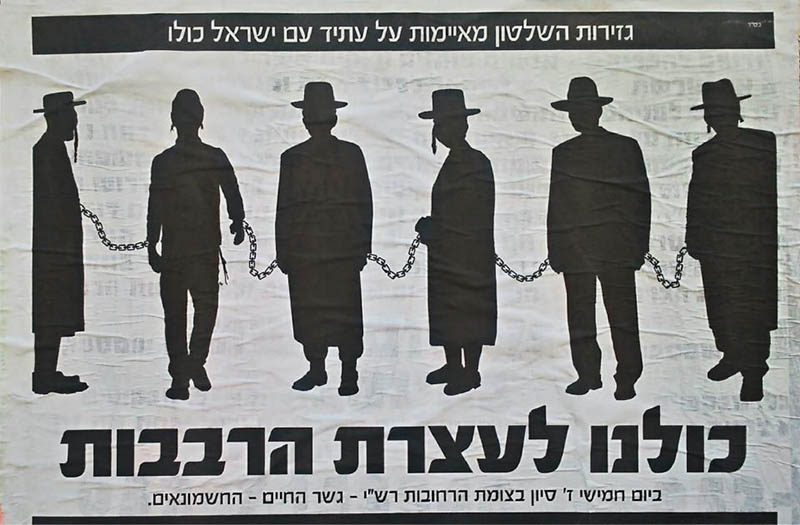
Hundreds of thousands of ultra-Orthodox Jews (Haredim) of all denominations took to the streets of Jerusalem to oppose the draft law several days before its legislation. In a mass prayer, the worshippers-protesters declared their faithfulness to Torah study rather than to the military. United under the banner declaring that “the State of Israel is fighting against the Kingdom of Heaven” they held signs stating that military draft is a spiritual suicide. The event was not merely an opposition to the law but nothing short of a battle cry against the very legitimacy of a state that encroaches upon their spiritual autonomy and poses a danger to their religious liberty.

Under the slogan “Equality in the Burden” both religious-Zionist Naftali Bennett and secular-Zionist Yair Lapid were elected and became the two largest coalition partners of a Haredi-free government. The campaign called for the forced conscription of the ultra-Orthodox and garnered wide support from the Israeli public. Unlike the purist Edah HaHaredit group which prohibits its members from partaking in, voting and receiving funds from the Zionist state, the Haredi rabbinical councils which called for the mass protest have their elected representatives at the Knesset. They all walked out of the plenum stating that Netanyahu is an enemy to their religion, yet this did not stop the Prime Minister from addressing Cameron in his welcoming speech by saying “David, welcome to the City of David and to the Jewish Knesset”.

The law enforces an incrementally growing annual quota of ultra-Orthodox students to be drafted, reaching 5,200 by 2017. Religious schools that would send their students to the military will receive financial incentives but in case the goal is not met, a draft for all the ultra-Orthodox would be imposed and financial sanctions implemented. The ultra-Orthodox argue that sanctioning and criminalizing students of the Torah proves that the State of Israel cannot possibly be regarded as being Jewish. The Law’s initiators, Lapid and Bennett, along with Prime Minister Netanyahu, were subsequently depicted in an animated film as they physically abuse a Haredi Jew and place him behind bars.

People of the book, not people of the rifle

The forced conscription of the ultra-Orthodox into an army that is foreign to their culture is deemed by the Haredim as a Zionist attempt to destroy their millennia-old tradition of Jewish learning. The draft law has therefore achieved the rare feat of uniting all non-Zionist religious streams of the Sephardic, Ashkenazi, Hassidic and Lithuanian communities who are currently working together in an emergency action committee.
ZionismIsraelFollowing the massive Jerusalem demonstration, an immense protest of over 150,000 people took place in the United States, which united all major ultra-Orthodox Jewish denominations. Yet, the law achieved more than simply uniting the Haredi groups but has also allowed for the more radical voices, like the Mahara Satmar Rabbi, to gain dominance. While the initial call for protest referenced the word “Israel,” the Satmar Rabbi conditioned his support on omitting it and managed to convince all other Rabbis to re-sign an amended declaration that will not give an ounce of legitimacy to the Zionist state.

While the religious Zionists see serving in the IDF as a holy obligation, the ultra-Orthodox believe that living according to the Torah and serving God is the ultimate goal of Jewish life. Recent days have displayed a clear divide between the latter and the religious Zionists as the Haredi paper Hamodia referred to religious Zionists in terms unused before, such as “collaborators with Satan,” “deeply messianic” and “worshippers of the state.”

Religious nationalism, a contradiction in terms

Appalled by the statement of the revered Haredi rabbinical councils, claiming that the State of Israel is an enemy to the religion of Israel, Rabbi Haim Druckman, spiritual leader of Bennett’s nationalist Jewish Home party, instructed his students not to attend the massive gathering. For the ultra-Orthodox, such a rabbi objecting to a gathering for prayer exposes the inherent flaw in religious Zionism whereby, to put it bluntly, the state is worshipped rather than the Almighty.

In response, an op-ed in the Haredi newspaper Yated Ne’eman took the harsh and unusual step of publishing Rabbi Druckman’s name while omitting the title “Rabbi”. Ultra-Orthodox Knesset member Aryeh Deri referred to Jewish Home member Ayelet Shaked, chairwoman of the draft law committee, as a “traitor of Judaism,” “the Jewish Home and Ayelet Shaked did not [only] betray the Haredim, they have betrayed the Torah.”

This unholy union of Zionism and religion is what mainstream Israeli society perceives as the Jewish identity. Yet, the ultra-Orthodox perspective is that Zionism is nothing short of an aberration of Judaism, insisting that Zionism goes against Judaism while claiming to speak on its behalf. The late Prof. Leibowitz, an Orthodox scholar, philosopher and a proponent of separation between state and religion, explained that: “Religious nationalism is to religion what National Socialism is to socialism. National Socialism is not socialism but its opposite and likewise religious nationalism is not religion but its opposite.”

Boycotting the state, saving Judaism

Opposition to Zionism is not new to the ultra-Orthodox. From its very first days, the Zionist movement was strongly condemned by almost all traditional Rabbis in Palestine and throughout the world, who prohibited any Jew from embracing Zionism. As a result, Zionist ideology took hold almost exclusively among secular Jews, i.e. those of a Jewish ethnicity rather than religion.

While talks were underway concerning the future of Jerusalem, Rabbi Dushinsky, the leader of the 60,000 people strong Haredi community in the city, expressed his definite opposition to the Zionist movement and its attempt to expropriate the holy city of Jerusalem. He claimed that religious Jews have not the slightest intention of subjugating the local Arab population. Even earlier, in the years following the Balfour Declaration, Dr. Jacob Israel de Haan who acted on behalf of Rabbi Sonnenfeld, saw the Arabs as natural allies against the Zionist project and met Arab leaders accompanied by the Rabbi, in order to protect their religious autonomy under Arab rule rather than accepting an alien Zionist governance.

Merely a day before embarking for Britain to address the British government, with a delegation expressing its staunch opposition to the Balfour Declaration, de Haan was assassinated outside the Sha’are Zedek synagogue where he attended the afternoon prayer. The assassins confessed to receiving orders from the top Zionist leadership at the time, including Yitzhak Ben-Tzvi who later became the second president of the State of Israel. It is speculated that David Ben-Gurion was also involved in the decisionmaking. According to Avraham Tehomi, one of the assassins, de Haan was marked for execution due to his meeting with King Hussein and Emir Abdullah. In January 1924, the Jewish Telegraphic Agency reported: “The Hejas King stated that all of the Arab countries are prepared to receive the Jews on terms of equality, but he loathes political Zionism.” A signed royal letter to the same effect is also believed to have been given to de Haan and later stolen by the culprits. Following the murder, it was the Zionist Jewish Agency which in turn limited Jewish immigration into Palestine by choosing to provide ‘certificates’ only for Zionist Jews, even during the Holocaust.

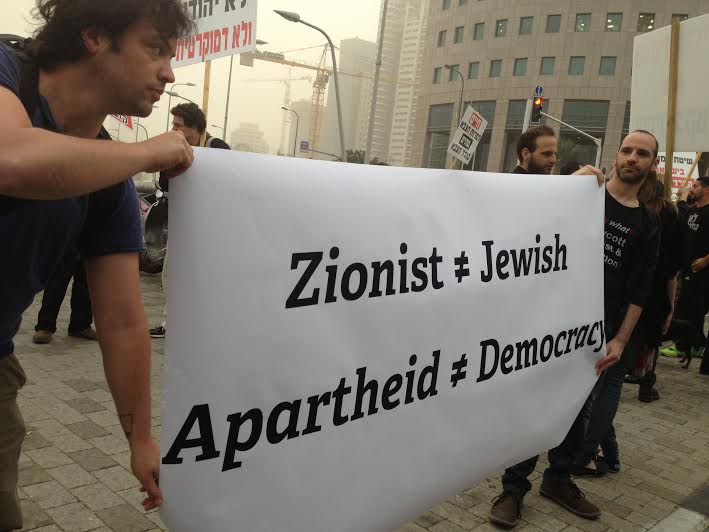
While most secular Israelis detest the Haredim, rare stems of solidarity have recently appeared from the almost negligible number of progressive Israelis. The group Democracy or Rebellion claims that a state that denies civil equality and minority rights has no democratic virtue. In its activities it also reaches out to the ultra-Orthodox community and had posted its message of solidarity on the walls of Me’ah She’arim in Jerusalem as well as demonstrating their support in Tel-Aviv.

A whole new discourse is now emerging within the Haredi community. Some call for a political re-alignment with progressive parties and even with elements on the radical left. Others call to boycott the settlements and their produce, while a growing number of rabbis call on Jews abroad to boycott and divest from Israel at large. One Hassidic group went as far as making plans to migrate en masse to the US, seeking political refuge there with the assistance of American senators.

Neither Jewish nor democratic

During Cameron’s visit at the Knesset, Prime Minister Netanyahu’s speech focused on four points. He declared that the boycott is racist, that Jews have religious-nationalist rights to the land and that indigenous Palestinians hardly existed before the Zionist colonization of the land. Aside of the fact that these claims are patently false, a more rational and humane approach would be to propose an end to the criminal policies leading to boycotts, insisting on equality between Jews and non-Jews and acknowledging the rights of all indigenous people.

Finally, Netanyahu argued that the Balfour Declaration validates Zionist exclusive rights over the land and that this is the will of Jews worldwide. The declaration states, however, that “nothing shall be done which may prejudice the civil and religious rights of existing non-Jewish communities in Palestine” and the political assassination of de Haan by the Zionists can hardly be regarded as a form of agreement between Jews and Zionists. Therefore, it would have been appropriate for the British Prime Minister to correct his colleague and explain that the Balfour Declaration, as unfair as it is, has never recognized the right to dispossess, expel or subjugate.

The so-called “Jewish and democratic” state is neither Jewish nor democratic. Religiously speaking, Zionism is a secular movement that went as far as dehumanizing and mocking the religious Jews of Europe. Israel’s majority is secular rather than religious, while it can hardly be argued that the state’s oppressive policies are in agreement with Jewish values. As religion has been “nationalized”, hardships also exist for those practicing Jews who choose a different path from the state sanctioned form of Judaism.

Ethnically, the majority of world Jewry prefers to live abroad rather than in Israel. At the same time, Israeli figures show that ethnic Jews are no longer a majority between the river and the sea, while not even counting the many Palestinians living in exile.

Paramount to the Zionist project in Palestine is the claim that the land is exclusively Jewish and that all others, even its indigenous people, are alien and unwanted. It is therefore no coincidence that Israel refuses to have a constitution or to acknowledge an Israeli nationality since this would mean, at least on paper, that its citizens are to be treated as equals. Instead, the privileged group is defined as having a “Jewish” nationality while the others may be “Arab,” “Druze” or “Circassian,” none of which are nationalities. On this basis, discrimination has been codified into law.

The Israeli regime can therefore best be characterized as an ethnocracy which practices the Crime of Apartheid as defined by international law. Israel is only “Jewish” in the ethnic-supremacist sense, in the same way that South Africa was white. Consequently, the demand to recognize its Jewish character is just as questionable as legitimizing white supremacy in South Africa at the time.

After many decades, new bonds between anti-Zionists – ultra-Orthodox, Palestinians, and progressives – are now being forged. While dispelling the myth of Zionism, a new path is being paved in the Holy Land.

Let us walk that path.

By Ronnie Barkan and Joshua Tartakovsky, photo by Tamar Aviyah
Earlier versions of this article appeared on AlterNet and Tikkun Daily

***

Ronnie Barkan is an Israeli human rights activist, conscientious objector and co-founder of Boycott from Within, a group of Israeli citizens and residents that supports the Palestinian call for Boycott, Divestment and Sanctions (BDS).
Follow at: @ronnie_barkan

Joshua Tartakovsky comes from an ultra-Orthodox family in Jerusalem, went to a Zionist-Haredi army unit and is a graduate of Brown University and the LSE. He is an independent researcher and filmmaker.
All the Unfit News

On 15 October 2013, the New York Times featured an op-ed piece from the Israeli Minister of Intelligence entitled ‘How Palestinian Hate Prevents Peace.’ Publishing such disinformation harms the New York Times’ readership, since the Intelligence Minster deliberately omits historical context and social realities from his commentary.

Rudimentary knowledge of recent history shreds the Intelligence Minister’s pablum. To begin with, Zionism and Judaism are completely different. Zionism is a fabricated ideology of aggression, which was created in the late 1800s, whose implementation colonizes much of the Eastern Mediterranean. Judaism, on the other hand, is a religion of peace.

With this fresh breath of history, one is now able to properly assess the following assertions from the Israeli Intelligence Minister:

“The Palestinian Authority’s television and radio stations, public schools, summer camps, children’s magazines and Web sites are being used to drive home four core messages. First, that the existence of a Jewish state (regardless of its borders) is illegitimate because there is no Jewish people and no Jewish history in this piece of land. Second, that Jews and Zionists are horrible creatures that corrupt those in their vicinity. Third, that Palestinians must continue to struggle until the inevitable replacement of Israel by an Arab-Palestinian state. And fourth, that all forms of resistance are honorable and valid, even if some forms of violence are not always expedient.”

When spreading the above decontextualized inaccuracies, the Intelligence Minister has resorted to a revolting trick: deliberately conflating Judaism and Zionism in order to garner support from U.S. readership. In reality, Palestinian grievances are aimed specifically against Zionist oppressors, not against Judaism, Jews, or any specific religion. There is nothing anti-Semitic about self-determination or about wanting to live free from military occupation. Calling criticism of Israel “anti-Semitic” demeans Jews everywhere and dilutes shared histories worldwide.

The Minister also fails to mention that it is the obligation of the occupying power, Israel, to care for the women, men and children under military occupation. This includes refraining from forcibly transferring the people it occupies and refraining from collectively punishing those under its control. Yet Israel does both on a daily basis, often through ceaseless colonialism. Israel’s other violations of international law are not featured in the Minister’s New York Times opinion piece.

The Israeli Intelligence Minister takes issue with Mahmoud Abbas attending a presentation of an Egyptian poet and various other acts of “incitement” against the “Jewish state and the Jewish people.” Again, Palestinian grievances have nothing to do with Judaism. This grand misdirection distracts from the core issue: Palestinians are fighting an anti-colonial struggle against undemocratic, racist ethno-religious ideology.

The Minister alleges Palestinian media reminds “viewers that Palestine extends ‘from Eilat to Rosh Hanikra’ — that is, not just the West Bank and Gaza Strip, but the entire land of Israel.” The Minister deliberately omits his support for colonizing “Judea and Samaria,” otherwise known as the West Bank. Fetid hypocrisy at its finest.

The Minister cites two gestures of Israeli goodwill, which he defines as “a courageous attempt to build trust and improve the atmosphere surrounding the negotiations”:  a) Israel’s “anguished decision on July 28 to release over 100 convicted terrorists” b) efforts to help the Palestinian economy.

These “terrorists” were convicted in the court of Zionist colonialism, which detains indefinitely, punishes arbitrarily, and prioritizes ethno-religious supremacy for colonial purposes. This is hardly a fair arbiter, Minister. As you know, the word “terrorist” is often used by those in power against those who resist imperial agendas.

By “Israeli efforts to help the Palestinian economy,” one may presume the Intelligence Minister is referring to this recent U.S. plan, a Band-Aid on gaping colonial sores. In other news, ending military occupation and settler colonialism, and allowing for commercial self-determination has a chance to positively affect the Palestinian economy over the long-term. The Minister has removed this option from the table.

He chimes in reminding us, “Palestinian leaders must now reciprocate by immediately and fully halting their encouragement and sponsorship of hatred.” Duly noted, sir. Fait accompli. He then threatens reconciliation, stating “Israelis will become more skeptical about the peace process and we in the Israeli government will have greater difficulty taking the additional confidence-building steps that we have been considering,” unless “Palestinian leaders” stop inciting hatred.

The Israeli Intelligence Minister, who also works as Minister of Strategic Affairs, knows exactly what he’s doing. In a strategic capacity, he’s trying to milk the Palestinian Authority of any remaining vestiges of anti-colonialism. In doing so, he finesses the PA into facilitating the final stages of a colonial agenda: mandatory silence as Judea and Samaria are gradually wrested into Zionist control. Meanwhile, resistance is deemed hatred – a classic imperial ruse.

Christian Sorensen for Media Roots

MR Original – The Times’ Operations

Israel flag flap MEDIA ROOTS – Dissection of a 20 February 2013 New York Times article demonstrates the extent to which the “newspaper of record” muddles the truth on issues pertaining to Israel. Even the article’s title, Trial Offers Rare Look at Work of Hezbollah in Europe, is deceptive since the article is filled with superficial, Zionist axioms and mere conjecture.

The opening paragraph asserts the testimony of an alleged Hezbollah operative provides “a rare look inside a covert global war between Israel and Iran.” This is highly misleading. There is no global war of parity between the two countries. In reality, the Iranian people have been victimized by cyber-attacks, unjustifiable sanctions, and a wide array of insidious propaganda. Instead of responding in kind, Iran has taken caution not to provoke Zionism’s itchy trigger finger.

According to the Times, this so-called operative “described being handled by a masked man he knew only as Ayman.” Conveniently, the operative “never saw the face of Ayman” because Ayman “was always wearing a mask.”

At the mysterious Ayman’s behest, this operative transported bags, a package, a cellphone, and two SIM cards around Europe and the Eastern Mediterranean. When the operative was arrested, he was in possession of a “small red notebook with the license plate numbers of two buses ferrying Israelis.” Two weeks after he was arrested, a bomb blew up alongside a bus in Burgas, Bulgaria, killing a Bulgarian chauffeur and five Israeli tourists.

According to the Times, “experts say” the Burgas attack was “similar to the one he [the operative] seemed to be planning.” Conveniently, unbiased “experts” are nowhere to be found in the Times’ article, which quotes only two pundits of sharp proclivity.

The first pundit is Daniel Benjamin, a Zionist, who comments on how the operative’s trial might tip European hesitancy in favor of designating Hezbollah as a “terrorist organization.” He also commented on Cyprus’ dedication to see this trial proceed, remarking how Cypriot authorities have “done the right thing and they’ve been resolute about it.” Benjamin has worked tirelessly against Hezbollah. As a careerist whose professional brand thrives implicitly on the pursuit of the United States’ foes, whether real or imagined, Benjamin is hardly an unbiased “expert.”

The second “expert” is Matthew Leavitt, a director at the Washington Institute for Near East Policy (WINEP), which was founded by the American Israel Public Affairs Committee (AIPAC), a powerful, right-wing, Israeli lobby located in Washington, DC. (AIPAC used to be known as the American Zionist Committee for Public Affairs). Instead of disclosing Levitt’s ties to this particular Zionist establishment, the New York Times provided him a platform through which he states “the evidence seems quite compelling that what he [the operative] was doing was conducting surveillance for a bombing that would parallel almost exactly what happened in Bulgaria.”

Belén Fernández, a scrupulous author and acclaimed analyst, reports on how much of the so-called evidence in the Burgas bombing was non-existent or manufactured. Investigative journalist Gareth Porter reveals how Bulgaria eventually conceded extremely tenuous evidence, which pertained to Hezbollah’s potential involvement, but only after Bulgarian officials received immense pressure from U.S. and Israeli officials.

For their part, Bulgarian authorities could only note Hezbollah’s potential involvement after relying “heavily on resources from foreign security services,” according to Tihomir Bezlov of the Sofia-based Center for the Study of Democracy. Even with all these externally-supplied “resources,” Bulgarian officials could only allude to “traces in this attack,” which might lead to “Hezbollah’s military wing.” The Times admits “officials in Cyprus have tried to keep the case as low-key as possible, declining in most instances to comment or to release documents.” Perhaps they too are being fed “resources” from foreign nations.

This lack of context – or perhaps selective detailing – plaguing the New York Times’ article is noteworthy.

The Times was generous enough to concede the so-called operative “described himself as ‘threatened, scared and confused,’ during his initial interrogation.” He was also “adamant that he was not participating in a plot to kill Israeli tourists.”

Perhaps the individual in question, who works as an administrator of a Lebanese trading company and aspires to become a fruit juice importer, will turn out to be a verified Hezbollah “operative,” but he could easily have been working for Mossad, whose patronage boasts a lurid history of conducting false flag operations against a variety of targets.

Unfortunately, the Times paints the suspect, who is still undergoing trial, as genuinely nefarious without disclosing their aforementioned prejudices.

Analysis of this article reveals the New York Times’ bias, which is consistent with their record of erasing Israel’s crimes and altering articles to favor Zionist narratives.

Christian Sorensen for Media Roots 

Photo by Flickr User Ron Almog

Posted in Uncategorized | 1 Reply

MR Original – Translating Subtle Zionism

IsraelFlagFlickrRonAlmogMEDIA ROOTS Suzanne Maloney is a mainstay within élite U.S. foreign policy circles.  A former employee of ExxonMobil and the U.S. State Department, Maloney now works for the Brookings Institution’s Saban Center for Middle East Policy.  She recently presented testimony to the United States Congress entitled Progress of the Obama Administration’s Policy toward Iran.  The Saban Center later provided an Arabic translation of her testimony on their website.  Maloney’s testimony and its Arabic translation afford valuable insight into the ideology, which directs U.S. foreign policy in the Middle East.

Ideology and the Saban Center 

Haim Saban, who holds dual citizenship between the USA and Israel, founded the Saban Center in 2002 with a multi-million dollar donation.  By his own admission, Saban boasts, “I’m a one-issue guy, and my issue is Israel.”  Saban, who has a personal net worth of roughly $3 billion, was also the second biggest private donor to U.S. Presidential and Congressional candidates.  He describes his formula for influencing U.S. politics thusly:  “make donations to political parties, establish think tanks, and control media outlets.”  According to The New Yorker, “he is most proud of his role as political power broker.  His greatest concern,” he says, “is to protect Israel by strengthening the United States-Israel relationship.”  In line with Saban’s words, the Saban Center attracts those who adhere to a rigid brand of Zionist ideology.  

Ideology is a constellation of ideas, which form the basis of a group’s political theory and actions.  Zionism is a political ideology, which supported the establishment of an occupying Jewish state in the historical land of Palestine.  Today, Zionism is dedicated to furthering Israel’s nationalist aspirations.  The most widespread form of Zionism in the U.S. foreign policy arena is Revisionist Zionism, which romanticizes Jewish nationalism, emphasizes a perceived necessity of military force against any Arab or Persian ‘threat,’ and condones Israel’s territorial expansion and aggression.  Adhering to this Zionist ideology, the Saban Center has employed Visiting Fellows whose ranks include numerous former IDF employees, the former head of Shin Bet, and a sprinkling of Arab nationals who turned their backs on the Palestinians and sought the prestige inanely associated with D.C. think tanks.  In this context, the Saban Center doesn’t just publish texts periodically, but rather is a constituent to extensive dynamics, which prescribe Revisionist Zionist policy and advance it throughout the U.S. foreign policy lobbying apparatus.

Maloney’s testimony highlights the fact that, although the majority of U.S. think tanks are diffused across the Democrat-Republican two-party system, even the most respected think tank doesn’t deviate from the Revisionist Zionist narrative with respect to U.S. foreign policy towards the Middle East.  Maloney testified in the autumn of 2011 during a time when Israeli Prime Minister Benjamin Netanyahu was mobilizing the American Israel Public Affairs Committee (AIPAC) and its propaganda apparatuses in Washington, D.C. to inflate the Iranian ‘threat.’  Netanyahu is no fool.  He targets Iran, which is Israel’s lone regional rival, because Iran supports groups, which resist Israeli aggression.  Maloney testifies within that context.  She critiques President Obama on behalf of the Saban Center, as part of the political ebb and flow, which ensures all Washington actors adhere to the precepts of Revisionist Zionism.

Numerous U.S. think tanks perpetuate Revisionist Zionist ideology with even greater aggression than others.  The Washington Institute for Near East Policy, the Center for Security Policy, the Heritage Foundation, and the American Enterprise Institute are the most prominent.  However, it is crucial to focus on the Saban Center for Middle East Policy precisely because it is not often considered a Zionist enterprise, unlike these other think tanks.  This low visibility allows the Saban Center to propagate a subtler, smoother mode of Revisionist Zionism throughout the U.S. foreign policy lobbying apparatus.  With deliberate concealment, the Saban Center professes to provide “Washington policymakers with balanced, objective, in-depth and timely research and policy analysis from experienced and knowledgeable scholars,” while claiming that its “central objective is to advance understanding of developments in the Middle East through policy-relevant scholarship and debate.”  This prevarication is even more dangerous when one considers its influential status as the 2011 “Top Think Tank in the World.”

The Saban Center’s subtle use of Revisionist Zionism is exemplified in the salient fact Maloney’s testimony doesn’t reference Israel once.  This intentional silence speaks volumes.  Omissions of Israel, its regional hegemony, or the USA’s history of interference in Iran’s internal affairs, are all part of a deliberate effort to de-historicize Iran and flush away any useful socioeconomic perspective.  Other relevant facts—Israel possesses nuclear weapons and didn’t sign the Nuclear Non-proliferation Treaty (NPT), while Iran has no nuclear weapons and has signed the NPT—are simply not allowed to penetrate the prevailing narrative.

Mark Dubowitz and Dr. Kenneth Pollack accompanied Maloney in testifying to Congress.  Mark Dubowitz is Executive Director of the Foundation for the Defense of Democracies.  That think tank describes itself as a “non-partisan policy institute” dedicated to “defending free nations against their enemies,” specifically against the “threat facing America, Israel, and the West.”  Kenneth Pollack is Director of the Saban Center for Middle East Policy.  In 2006, the U.S. Department of Justice alleged Pollack aided two AIPAC employees while they were under investigation on allegations of spying for the state of Israel.  After immense political pressure, all charges were eventually dropped.  These three, the only panel members to testify before that Congressional Subcommittee, were selected deliberately to provide policymakers with the narrowest possible viewpoints of the Iranian ‘threat‘ through the lens of Revisionist Zionism.

Ideology via Translation

Revisionist Zionism is present within Maloney’s original English language testimony and also underpins the Saban Center’s translation of this document into the Arabic.  (The Saban Center does not credit any individual(s) for translating Maloney’s text into Arabic).  Aside from examples to be discussed momentarily, the Arabic translation is outstanding and remains completely loyal to Maloney’s English text.  This faithful, direct translation is itself a strategy, stemming from the deliberate collocation of an ideology with persuasive, incisive writing (Lefevere: 51).  

When reading the Arabic translation in comparison to the English text, it is evident that the Saban Center’s translator spent a great deal of time selecting the appropriate words to convey Maloney’s challenging, academic vocabulary.  Therefore, one can reasonably conclude that any deviation from Maloney’s source text is entirely deliberate and may have ideological motives. As the Persian language, Farsi, is the national Iranian language, any changes, which took place during translation from the English into the Arabic, imply a sense U.S. power is omnipotent and unavoidable.  These changes can foment dissent among Arab populations who read that text, and provide an Iranian minority, which is literate in the Arabic, with a sense of ascending capability to confront the Iranian theocracy.

Although the Arabic languge translation of Maloney’s testimony is a direct, accurate, and faithful translation, the instances where the translator deviates from said fidelity are fantastic discussion points. These deviations are also valuable precisely because they’re rare and offer tremendous insight into the nature of Revisionist Zionism and the broader aims of Maloney’s text. For example, Maloney’s English testimony stated, “Iran has experienced very little of the upheaval that has beset its neighbors over the course of the past year.”  However, the translator opted for a stronger word in Arabic, which means “to storm through, to blow through, or to shake thoroughly.”  The Arabic translation reads:  “Iran had witnessed very little of the protests that stormed through its neighboring countries over the past year.”  Later on, the English language testimony states Iran’s “neighborhood has been engulfed in historic change,” while the translation expresses how “the historic change stormed through/blew through Iran’s neighboring countries.”  The Saban Center translated these passages in this manner in order to address the Arab audience, and emphasize Middle Easterners’ agency and ability to affect change in their region.  Perhaps the translator is also targeting the slice of Iranian Persians who can read Arabic or the many Arabs who fled to Iran after USA’s 2003 invasion of Iraq.  The translator deliberately selects words, which emphasize how populations in the Greater Middle East can positively affect their environments; the audience can engage in protests, which storm through regions, not passive, nameless upheaval, which besets regions.

The Saban Center often interfered with the Arabic language text during translation.  In multiple instances, the translator selected two different Arabic words to translate the English language word for “liabilities.”  The first context speaks of “the regime’s internal political liabilities,” which I would have translated as “political responsibilities.”  The second context broaches how “the regional environment has also created new liabilities for Tehran,” which I would have translated as “obligations.”  By telling the Arabic audience responsibilities are actually liabilities and obligations, the Saban Center advises the populace has a right to be upset if any regime reneges on its obligations.  This can be extrapolated to other regional, oppressive regimes.  This is a deliberate, indirect message to the Middle East, fitting perfectly with an Israeli propaganda apparatus, which prides itself on sewing strife within Arab and Persian lands.

Maloney’s testimony affirms “sanctions and export controls have played a subtle but significant role in slowing Iran’s capability to acquire” nuclear technology.  The Saban Center deliberately didn’t translate the word “subtle” into the Arabic, despite the fact that the Arabic language contains multiple words with which to convey subtlety well.  The Saban translator instead selects a word, which means “covert” or “hidden.”  This Arabic word meshes well with the U.S.-Israeli clandestine subversion of Iran’s sovereignty.  A covert program, supported by two hegemonic powers, is unlikely to be stopped; it can’t even be pinpointed.  Those who read the Arabic translation of Maloney’s testimony may retain a feeling of inevitability the hegemons will prevent Iran from obtaining nuclear technology and the reader must go along with such a foregone conclusion.

Maloney contends “Iran’s dogmatic theocrats perceive the Arab uprisings in triumphal terms.”  The Saban Center translates this into the Arabic as:  “Iran’s dogmatic zealots perceive the Arab uprisings in triumphal terms.”  There is no mention of a theocracy.  In theocracy’s stead, the Saban Center refers to dogmatic “zealots” or “hardliners.”  Zealotry, synonymous with fanaticism and intolerance of opposing views, is an amplification of mere theocracy.  Theocracy, by definition and Iranian tradition, is a system of government in which clerics lead the nation.  In practice, the Saban Center actualizes a cognitive distinction in the reader of its Arabic language text.  The Arabic reader, having no knowledge of the tamer wording in Maloney’s original testimony, understands the Iranian rulers as fanatics, not mere theocrats.

The Saban Center’s mutation of theocrat into zealot also confines the Persian Other within Western stereotypes.  “By employing certain modes of representing the other… translation reinforces hegemonic versions of the [neo]-colonized” (Niranjana: 3) and emphasizes damaging stereotypes.  The readers are fully cognizant of this distortion of identity, but are helpless to alter the source of these representations, located distally in Washington, D.C., where these images serve as a mobilizing force.

Early in her testimony, Maloney asserts the Iranian regime’s durability is “the product of a resourceful campaign” to hamper popular uprisings.  Notably, the Arabic translation of Maloney’s testimony indicates the regime’s durability results from a “sly” or “insidious” campaign to suppress dissent.  By portraying the Persian with great negativity, the reader of Maloney’s translated testimony is imbibed with a sense of antipathy towards the Other.  Perhaps this revulsion will contribute to existing Persian-Arab tensions around the Persian Gulf, or perhaps this revulsion will be internalized within the Arab or Iranian readership.  No matter its effect, portraying the Persian with great negativity benefits practitioners of Revisionist Zionism.

Near the end of her English language testimony, Maloney remarks “the impediments to American sanctions represent tactical challenges,” which the Saban Center translated as representing “large” or “considerable” challenges.  The Saban Center’s omission was deliberate, since the word “tactical” exists in Arabic and is used frequently.  Tactical challenges are related to military manoeuvres in support of immediate martial gain and are designed to contribute to strategic objectives.  By omitting any mention of the tactical nature of the challenges posed by U.S. sanctions, the Saban Center avoids military correlations and any concept Iran might possibly achieve military advantage.  Furthermore, by translating the utterance “tactical” into the adjective “large,” the Saban Center places an amorphic, conceptual obstacle of indeterminate volume in Iran’s path.  Once again, the Saban Center employs slight translation techniques to dramatically affect the Arabic reader’s perception.  The message to the Middle East is clear: Revisionist Zionism, and those who support it, whether willingly or otherwise, will win.

In addition to manipulating individual words, the Saban Center adds Arabic words during translation.  Maloney’s testimony asserts “disturbing new allegations [surround] Iran’s efforts to acquire nuclear weapons technology and its involvement with terrorism.”  The Saban Center’s Arabic translation deliberately adds to Maloney’s initial assertion through contending allegations exist about “Iran’s efforts to acquire nuclear weapons technology and its involvement in acts of terrorism.”  The insinuation is profound to the Arabic reader.  In diplomatic terms, general involvement with terrorism pales in comparison to direct complicity in acts of terrorism.  The Saban Center’s ideological additions frame Iran as an exporter of global terrorism and implicate it in finite acts of the worst kind, a contention Maloney’s counterparts at the Subcommittee hearing were eager to emphasize.

A similar narrative arises in Maloney’s testimony when she remarks “the resistance and persistence of the Islamic Republic presents a greater concern within the region than at any time in the past two decades.”  The Saban Center translates this seemingly bland introduction as: “the Islamic Republic’s resistance and persistence is a source of great worry within the region, more so than at any point in the past two decades.”  This addition incriminates Iran as the paramount source, insinuating boldly all fear will evaporate once Iran is dealt with. Interference through addition is a clever, measured action, calculated specifically to frame the Iranian regime in a negative light.

As expected, there are many instances where English language utterances do not exist in Arabic.  These cases provide the Saban Center translator with free range to convey the precise meaning of the English word by using whatever Arabic words the translator sees fit.  When discussing USA’s position relative to Iran, Maloney asserts “the threat of new measures has persuaded Tehran to take a number of steps over the years to mitigate its vulnerability to external economic leverage.”  That statement alone, like much of Maloney’s testimony, is loaded with ideological prejudices.  Despite all, the Saban Center chose to insert greater ideological force in the Arabic translation.  Since a single, complete, apropos utterance for “leverage” doesn’t exist in Arabic, the Saban Center could have conveyed its essence through multiple words or various other translation techniques.  Instead, it selects one word, whose meaning conveys influence, effectiveness, and even prestige.  None of these descriptions satisfy leverage’s definition, which conveys an exertion of force designed to achieve a particular outcome.  By deliberately avoiding explaining this in the Arabic, the Saban Center instead drops any connotation the U.S. achieves its goals through the application of force and implies the U.S. is enigmatically influential.  In sum, the Saban Center doesn’t attempt to explain the concept of “leverage” in Arabic, because that doesn’t suit its ideological goals; implications of the inexplicable influence of non-native entities aligns well with the ideology of Revisionist Zionism.

The heart of Zionism explains why the Saban Center would omit words during translation.  Zionism, by definition, is based on exclusion, both territorially and conceptually.  It emphasizes a state-building process, which rejects Palestinians, prioritizes land allotment for a chosen people, and deliberately propagates ethnic division (Gordon: 821).  By its very nature, Zionism demands the expulsion of aspects, which might disrupt its traditionally cohesive character (Ibid: 811).  Hence, ideology tends to trump linguistic considerations during the translation process (Lefevere: 39).

Caution is mandatory because some translators might not be conscious of how the Saban Center’s ideology affects their work.  Hence, deliberate intent might not be applicable to all instances where the Saban Center distorts Maloney’s text during translation into the Arabic.  Concordantly, critics of the Saban Center’s perpetuation of Revisionist Zionism must accept not all ideological acts are premeditated.  Nonetheless, dissecting Dr. Suzanne Maloney’s testimony and its Arabic translation illuminates how a subtle U.S. think tank adheres to a strict Zionist narrative when prescribing policy about the Greater Middle East.  This analysis is a small step towards understanding how the ideological undercurrents of a refined think tank intersect with the U.S. geopolitical process.

Written by Christian Sorensen for Media Roots

***

Photo by Flickr user Ron Almog

Additional labour by Messina