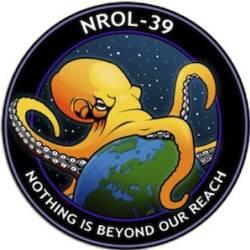
logo taken from an actual NSA spy satellite exterior called: NROL-39
PBS’ United States of Secrets is a stunning, must watch documentary covering the detailed history of the post 9/11 NSA mass surveillance program.
The two part series lets state officials prop up the narrative that such spying is needed amidst a ‘War on Terror’, but juxtaposes their rhetoric with stories from NSA whistleblowers’ who were targeted for speaking out.
Incidentally, the history of ‘The Program’ derives in large part from an internal leaked document, which outlines how former Attorney General Alberto Gonzales helped shield the Bush administration from the illegality of dragnet spying. After Obama inherited Bush’s spying apparatus, he charged multiple whistleblowers with espionage for leaking information about ‘The Program’ to the press.
United States of Secrets puts the Snowden leaks in context with the NSA’s sordid past, and cogently outlines how the surveillance state got to where it is today.
MR
**
You can watch United States of Secrets on You Tube, albeit in lower quality than PBS:
The United States surveillance state has grown to a level never witnessed before in history. Following the revelations of Edward Snowden, the world is now privy to the lengths to which the U.S. government has been watching every single one of us in the global community. International governments caught off guard by the breadth of the United States spying program are now questioning to what extent they want their internet traffic funneling through U.S. servers and ISPs.
In all aspects of the global contemporary life, the U.S. government has found its way into the far reaches of personal space. From NSA email and phone spy programs, to FBI surveillance drones, the airwaves are filled with the prying eyes of our so-called protectors. These discriminating eyes which have creeped their way into every facet of our lives continue to intensify their surveillance efforts across the planet.
It all begs the question, what is it they are so afraid of? Why the need for such an extensive surveillance program? What threat do “We the People” pose to the powers that be? The proliferation of these programs began with the Bush administration’s warrantless wiretapping and the FISA amendments act of 2008, and has continued on through into the Obama administration who renewed those changes in U.S. surveillance law in 2012.
Government officials from all sides have attempted to defend the programs by rationalizing the need for added security in a post 9/11 world. Former NSA director Michael Hayden earlier this week on Sunday spoke from the pulpit of a previous generation of politicians, a generation whose ideas of government revolve around secrecy and political ambiguity. He defended the United States’ “militarization of the World Wide Web” and spoke out against the anonymity of the internet and the tension it creates “between security and Liberty.” A tension that has been over inflated by the misguided fears of the United States Government.
Those fears became apparent when Edward Snowden leaked sensitive documents to the Washington Post and The Guardian earlier this year, giving us a peek into the NSA spying efforts of PRISM. A program whose legal justification found its roots in FISA and began with a marriage between the NSA and tech giant Microsoft on September 11, 2007. A relationship which would mark the first in a long stream of technology titans finding their way into the bed of the NSA, including prominent companies like Google, Yahoo, Facebook, YouTube, Apple and others.
Although the Snowden documents implicate these companies first hand knowledge of the program, many of them have argued that they knew nothing of the PRISM program and the extent of the government’s surveillance activities. In an attempt to win back the trust of their users, many have now begun campaigns to prioritize the privacy of their customers.
Facebook CEO Mark Zuckerberg has warned the U.S. government that its venture into voyeurism will only lead to bad business on the international level, initiating further apprehension from international customers. Zuckerberg went onto say that “the more transparency the government has, the better folks would feel.” How convenient are the campaigns of these companies to prioritize privacy when previously they showed no interest. Their efforts to protect the people look more like a concerted effort to protect their pockets and the positions of power and influence they currently hold.
With the assistance of their corporate cohorts and their control of the majority of the world’s servers, the United States has been granted the responsibility of gatekeeper of a global information network – a network which grants them access to some of the most intimate aspects of human interaction. From 2007 onward the NSA and the United States government would become the proud owners of some of the world’s most sensitive information, the information of the People, both foreign and domestic.
From this moment forward, intelligence gathering would no longer be focused primarily on the criminal activities of state enemies but would encompass the whole of internet communication. Unsuspecting and in many cases, innocent global citizens would now become the focus of government inquiry without the need of court permission. While incrementally dissolving the people’s right to privacy the government has simultaneously relinquished the trust of the American people and the people of the world.
An inherent distrust was implied when our government implemented a surveillance program of this magnitude – a distrust which is reciprocated by the people in the form of resentment and ultimately anger. If it is true that the anonymity of the internet is such a threat to freedom as they say, then let us also recognize that the anonymity of U.S. surveillance programs is an equal if not greater threat to the preservation of a free society.
Unfortunately, it has been our government’s decision to give precedence to “security” while neglecting our long honored tradition of freedom. It’s a decision which exemplifies the despotism that has grown throughout the hallowed halls of a once respected United States government. This despotism is forged through the partnerships of corporations and government leadership that seek to solidify their positions of power instead of leading a nation of free people.
Fortunately, the internet has provided the people a platform to stand shoulder to shoulder with the titans of modern society and profess their beliefs and ideas in an equal forum for all to hear. This free forum will continue to give rise to people power movements the world over, despite government attempts to quiet public dissidence. Edward Snowden along with Barrett Brown, Chelsea Manning and Wikileaks are just the beginning of people power representatives, that in a reciprocating effort, will continue to expose the secrets of despotic governments in the same way they seek to expose the secrets of the people.
No longer are the governments of the world free from the watchful eye of public discourse. So long as the United States government continues its pursuit for a surveillance state, “We the People” will stand in opposition to that state, in our fight for freedom.
By now, you’ve probably heard about Edward Snowden, the 29 year old National Security Agency contractor who defected to Hong Kong after leaking explosive revelations about the extent of the agency’s spying program.
In an exclusive interview with the Guardian’s Glenn Greenwald, Snowden explains that NSA analysts have the technological ability and blanket legal authority to snoop on anybody. “Any analyst at any time can target anyone. Any selector, anywhere… I, sitting at my desk, certainly had the authorities to wiretap anyone, from you or your accountant, to a federal judge, to even the President.”
The story sent shock waves through diplomatic circles and the corporate media. But it’s just the latest story in long wave of recent scandals, including the Associated Press phone records subpoena, the IRS- tea party investigation, the Rupert Murdoch phone hacking and Occupy Wall Street undercover police informant and provocateur revelations.
Snowden further explained the far-reach of NSA capabilities to intercept every mode of our private lives, by saying “with this capability, the vast majority of human communications are automatically ingested without targeting. If I wanted to see your e-mails or your wife’s phone, all I have to do is use intercepts. I can get your e-mails, passwords, phone records, credit cards.”
His bold confession is not to be understood in a vacuum. There are countless videos of low level US government personnel poking gloved fingers around travelers’ genital areas, causing permanent distress and embarrassment. Racial, religious profiling and clever contrary profiling of white infants and grandmothers is now encountered at train stations, bus stations and highway checkpoints as well. For more than two centuries, this heavy, iron fist did not figure anywhere in the American republic.
Now, police departments across the country issue “administrative subpoenas,” i.e. without a search warrant signed by a judge, to routinely seize troves of customer details from mobile carriers, enabling them to track the whereabouts of millions of subscribers.
High tech surveillance drones are being acquired to spy on Americans while the constitutional scholar and Nobel Peace Prize President uses predator drones to kill thousands abroad, including women and children and American citizens, without bothering to bring any criminal charges in court, let alone convict them of any crime.
Often, the targets’ names are unknown. The killing is based on appearances called signatures: purported intercepted speech, including emails and people the targets are associated with. Its a remote, high tech way to profile targets and it is in this context that Snowden’s revelations should be digested.
The assertion that only bad guys need to worry about PRISM is very naive. Something as innocent as dialing a wrong number could bring you unwarranted scrutiny. Someone with an ax to grind could drop a dime on you and wreck your life.
The intelligence services and the military take a prophylactic approach. This means they increasingly believe that with programs like PRISM, they can identify likely criminals and terrorists before a crime or terrorist act has occurred.
For all its acronyms and technical jargon, the PRISM spy program rests on a simple premise: Secretly record all information about everybody, everywhere at all times, then archive it forever. Since any human being has the potential to become a criminal or terrorist suspect in the future, a dossier on that person will be readily available, including who that person has associated with in the past
The dossier focuses on four areas: financial transactions, phone records, Internet records and travel logs. This diary of bytes makes it possible to ruin anybody under any pretext at will. It creates undreamed of leverage of the state to terrorize the individual and groups of individuals. All manor of abuse is justified under the ‘War on Terror.’
An exhaustive review is beyond the scope of this article, but a few simple but clever changes of habit can go a long way towards protecting yourself from warrantless, illegal, unconstitutional and invasive collection of your genuine private information. To begin, I will focus on the encrypted payments and communication system called Swiftcoin. From a recent press release:
“Users running the Swiftcoin application present a challenge to eavesdroppers. This free application requires no identification or payment to download. Once installed, it enables users to opt out of the common email servers operated by large corporations that are obliged, under gag orders, to provide back door access to invasive, over reaching public and private interests.
Swiftcoin, like numbered Swiss bank accounts, does not identify users by their names. Unlike bank accounts, the user number changes every time he/she presses the send button. The Swiftcoin application may be moved off the user’s computer into a pen drive and opened up again on another computer at will. Swiftcoin users can not be traced by name, by IP address or by device. “
This is called deep encryption because the literally encrypted communication, including its “meta data,” is not identifiable unless the user chooses to make her wallet id public. Every sent message departs from a new “location” or the same location as the user wishes. The same is true for the recipient. Every message or payment is unique and may employ disposable meta data. In addition, the user device itself can be substituted at will. Furthermore, a Swiftcoin wallet can be moved to a pen drive and uploaded to a different device. All of this makes it substantially more difficult to spy on and record a user’s activity, because the correlation between a Swiftcoin id and a particular person is tenuous. Swiftcoin does not rely entirely on encryption which, at the end of the day, can be cracked by cryptographers. The very way that Swiftcoin is designed to be used does not lend itself to tracking any individual over time.
Alas, the Swiftcoin homepage states that it is not available to U.S. citizens. However, the Swiftcoin telegram remains freely available to all regardless of nationality. Every new user may receive ten free Swiftcoins, ( good for 10 000 telegrams; every Swiftcoin ” telegram ” costs 0.001 Swiftcoin ) which is returned to sender upon a return mail from recipient, for a net cost of zero to send and receive a telegram. No money or purchase of Swiftcoin is required to download the program and use the telegram feature.