Abby Martin Meets the Venezuelan Opposition

Abby Martin goes on the deadly front lines of the anti government protests in Venezuela and follows the evolution of a typical guarimba—or opposition barricade.

She explains what the targets from the opposition reveal about the nature of the movement and breaks down the reality of the death toll that has rocked the nation since the unrest began, and how a lynch mob campaign came after her and the Empire Files team for reporting these facts.

Hearing from peaceful opposition marchers, to Chavistas to violent protesters at the guarimbas, this must-watch episode exposes the dark reality on-the-ground that is completely obscured from Western media.

Abby Martin Meets the Venezuelan Opposition

Venezuela has been painted as a failed state by both politicians and corporate media for years. With three months of intense protests in the country, this propaganda has only increased, with much of it romanticized and celebrated by U.S. mass media. To get an accurate glimpse of the situation and hear from Venezuelans engaged in and affected by these protests and the current political climate, Abby Martin spent three weeks on the ground in Venezuela.

Since Chavez was elected in 1998, the United States has paid over $50 million to the opposition movement, with Marco Rubio recently proposing an additional $20 million in aid to “defend human rights.” Donald Trump has referred to the current situation in Venezuela as a “very very horrible problem.” With millions of dollars in aid from the U.S., protesters in the streets calling for the ousting of their democratically elected president and the opinions of Venezuelans in the barrios being ignored, who are the players in this game and which, if any, narrative can be trusted?

Mass media is filled with images of violent protests, large crowds and data on deaths caused by government forces in Venezuela. To get to the bottom of this complicated political puzzle, Abby met with both protesters and the opposition forces responsible for violent confrontations. A common theme being that Venezuelans are living under an oppressive dictatorship- crying out for assistance from the U.S. and demanding a fair election.

As the sun sets on city streets packed with largely peaceful protesters donning yellow, blue and red, the scene quickly becomes more tense and volatile. In Caracas, the opposition sets up strategic roadblocks to interrupt the functioning of the area, burning wood and trash in the streets, using vehicles to block and shutdown highways and instigating violence with security forces. In fact, the opposition repeatedly pushes as far as they can until security forces are forced to respond. While the media shares a picture of a Venezuela in which free speech and protesting comes at a cost and is not widely accepted, there were no arrests the night Abby followed the guarimbas. Could this mean that there is, in fact, a right to protest in Venezuela?

Surprisingly, low income Venezuelans residing in the country’s barrios, are not the ones protesting their government and their stories and their opinions are rarely shared. It was in these places where Abby encountered many Chavistas, eager to dispel the opposition’s narrative that Venezuela is a dictatorship in which Venezuelans are oppressed, struggling and living in fear. Also, the protesting is not countrywide– the most volatile protests are taking place in the upper and middle class states, far from the barrios.

While in Venezuela Abby uncovered a shocking truth surrounding statistics being pushed by the corporate media. In a period of three months, 95 deaths and over one thousand injuries were attributed to the violent protests. Abby worked to unpack these numbers and investigate the real causes of these deaths.

Of those 95 deaths, 11 were of unknown cause. According to the Attorney General only 23 of those deaths can be attributed to state security forces. Assuming that number is correct, what can the additional 61 deaths be attributed to? Abby’s investigation, detailed in this episode, concludes that 23 of the 95 deaths from that three month period can be attributed to state forces while the other 61 can be linked to the opposition– including violent murders and the hindering of access to lifesaving services.

Because Abby questioned these statistics and reported her findings, opposition spokespeople quickly created a campaign of false hysteria surrounding her trip, her research and her career. A wave of social media propaganda claimed that Abby and Empire Files producer, Mike Prysner, were not, in fact, journalists but were contracted by the state to gather sensitive intel– taking photos for police rather than interviewing protestors in the streets. This campaign resulted in a virtual lynch mob, culminating in protestors gathering at an event where Mike was scheduled to speak, after publicly sharing the event’s location.

As Abby has clearly documented, the tumultuous situation in Venezuela is just that. It is not cut and dry– there are multiple players on multiple sides utilizing the streets, social media and corporate media to further their narratives in an effort to reach an end goal without much compromise or cohesion when it seems that may be what is needed most.

***

Abby Martin: Venezuela, a country painted as a failed state by U.S. politicians and corporate media. One that is under a total dictatorship, brutally repressing free speech and the right to protest. The protests, which have been going on for three months, are across the board uncritically romanticized and celebrated by the mass media. Many outlets are openly calling for regime change.Since President Chavez was elected in 1998, the U.S. government has paid over $50 million to the opposition movement. Now, Senator Marco Rubio just spearheaded a bill pledging another $20 million to “defend human rights,” among other types of aid. Long wanting to overthrow the democratically elected socialist government, U.S. politicians are seizing the moment of unrest for regime change.

Donald Trump: The stable and peaceful Venezuela is in the best interest of the entire hemisphere. We will be working with Colombia and other countries on the Venezuelan problem. It is a very, very horrible problem, and from a humanitarian standpoint it is like nothing we’ve seen in quite a long time.

Abby Martin: With new U.S. sanctions, direct threats from the Trump administration to overthrow another sovereign government, and corporate media painting a one-sided narrative, I wanted to go see the reality on the group for myself. During my investigation in Venezuela, spending nearly three weeks in Caracas, one thing was a constant: traffic jams from guarimbas, or protest barricades, intended to disrupt life in the city. While most things carried on like normal, some parts of the city were always inaccessible, with police and military constantly scurrying to whatever streets were shut down that day.Knowing how much mass protests define life in Venezuela, as well as the media coverage, I attended an opposition protest in Miranda State near Caracas. The demonstration, which consists of thousands of people, was a peaceful gathering, with typical speeches and chants.What is your biggest problem with what’s happening right now?

Speaker 3: I think right, the biggest problem is, that the president don’t want us to go to election, because if we go he knows he’s going to lose.

Speaker 4: [In Spanish] There is no constitution, the rule of law does not exist. This is an absolute dictatorship in Venezuela. There’s repression, there’s a constant and severe tyranny. Out with the dictator in Venezuela; we don’t want him.

Speaker 5: [In Spanish] We’re suffering from hunger, misery, anxiety and desperation. We want this regime to get out, along with all of their followers, so that peace and tranquility is reinstated in this country.

Speaker 6: Seventeen years and some months, the country is every day falling down, down, down. It doesn’t work if you have money. Because if you have money, you need medicine, you don’t have work to buy.

Speaker 7: I have 27 years old and I’m married. And my wife, she doesn’t buy anything that she wants to.

Abby Martin: You said you’ve been fighting since 2002. What happened? Why have you been fighting so long in the streets?

Speaker 7: Because I’ve never been Chavista because I knew that, [inaudible 00:03:53], everything. Okay? Because they have a wrong idea what revolution is. My father took me to one riot, take me another, and it [inaudible 00:04:10] years.

Speaker 8: [In Spanish] They just want to plant communism, another Cuba, that’s all. Cuba won’t release us, because if they do, they can’t eat any longer.

Abby Martin: Is the United States doing enough to help Venezuela?

Speaker 3: No, I don’t think so. I mean like, a lot of Venezuelans live in the States, so we send like, the Green Cross, the one who help with medicine, like the ones who help with the protestors that get hit, they get a lot of help from the States.

Speaker 5: [In Spanish] I wish it was so, that the United States and the rest of the countries in the world would help us.

Abby Martin: Is the United States doing enough to help Venezuela?

Speaker 4: [In Spanish] Yes, they are doing fine, along with Luis Almagro [Sec. General, Organization of American states], but we need an outcome, we need a happy ending. We want international support from the United States. It is very important that they help us from New York. They need to help us, to help us non-stop. We need the United States to turn up their power towards us.

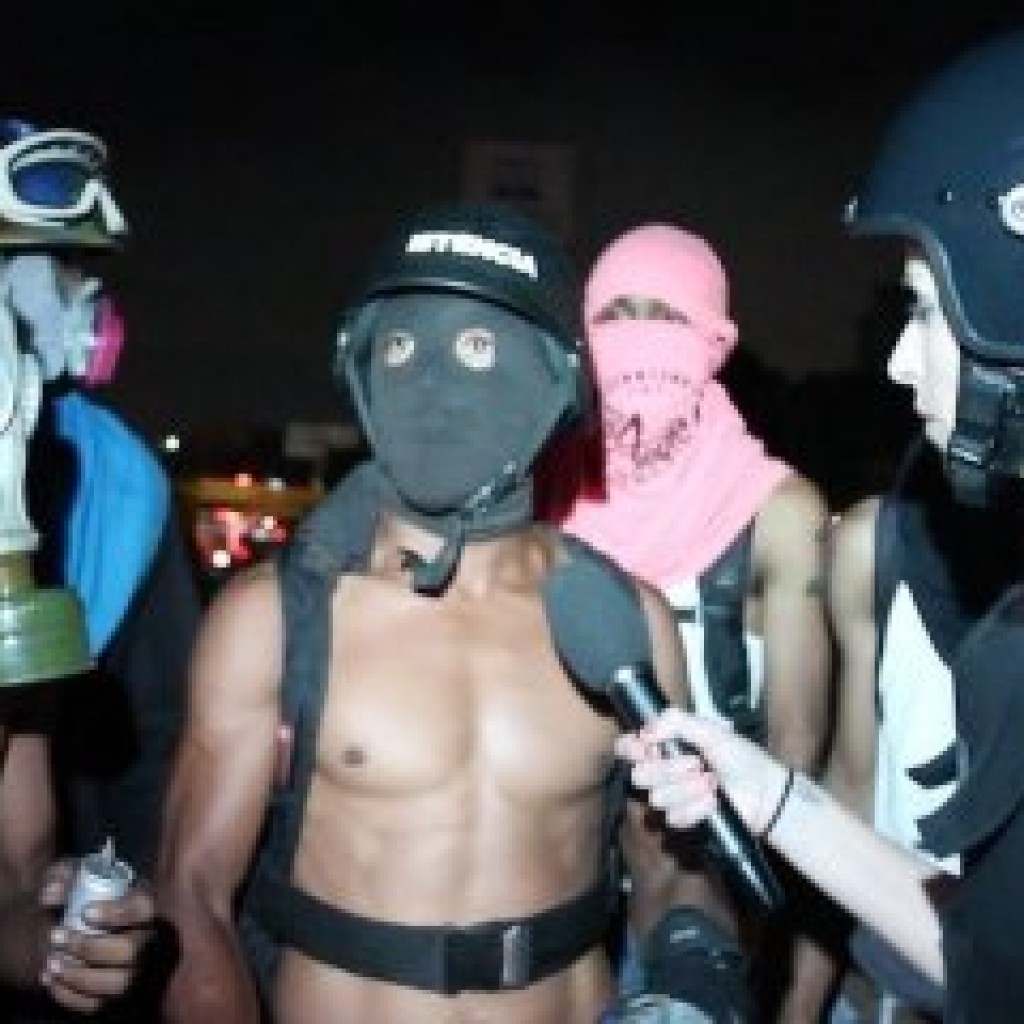
Abby Martin: We are very near Plaza Altamira right now, where the opposition looks like it’s setting up a barricade. This is a tactic that the opposition does to deter traffic, to cause a lot of problems here in Caracas. We’re going to go follow them right now and see what’s going on.As the sun started to set, things began to change. Smaller groups donning masks and shields starting forming up. While the majority of the crowd held a candlelight vigil to commemorate those killed in the protests, the others lit flames of their own. They poured incendiary liquid in the streets and began stopping traffic.We’re here in the middle of the plaza. There are thousands of protestors down there for the march of the torches. Right now, there are a couple dozen protestors right here with shields, helmets, masks. They’re lighting fires; they’re doing a blockade. They say their tactic is to get as many people out in the street as they possibly can.

Speaker 10: [in Spanish] Well, up to what we know, we are protesting because we want a better Venezuela like the one that existed before. Well, look, I…to our knowledge, there is a dictatorship. And we can’t live with the Cubans here in Venezuela because it’s bad.If you see the dictatorship we are going through, there’s scarcity of food and all that, we only want to retake how things were before.

Abby Martin: And how many people have the government killed, security forces, military police, so far?

Speaker 10: [In Spanish] There have been more than 200, or less, about 180 dead.

Abby Martin: And what are the demands, right now, for protestors?

Speaker 10: [In Spanish] What we want is mostly, well, ousting the president. We want elections. We fight for elections because we want to change everything and we need a new president.

Speaker 11: [In Spanish] The only message we can send from the resistance to the rest of the world is help us, that’s the first thing we ask for. Because, when you look at it we go to the streets and the first to repress you is the government. At the moment we cannot show you the bullets they shoot, these are large marbles, of iron. They have killed several in this way. The guy killed in Los Teques yesterday was shot with a marble. And it’s a lie, they don’t shoot tear gas or pellets. They’re shooting live rounds.

Speaker 12: [In Spanish] Gun shots! That’s a bullet and this is true. And Maduro says it’s a lie. This is true. They only shoot and shoot.

Abby Martin: Several times we were aggressively surrounded by masked protestors demanding to see what media outlet we worked for. Only when they heard that we were from the United States did they back down. But told me to only film repression against them, not their actions. As the crowd grew, they announced they would be marching a blocked major freeway. Protestors and squadrons of motorbikes began mobbing through the streets, setting fires and creating roadblocks along the way.So, we’re here at the highway right now. We just talked to some protestors who said that they’re blocking the highway. They just set up a barricade of fire. They’re doing it down there. The national guard is about to come, which they say they want us to see how they oppress them when they do come. Stopping cars leaving the highway, they trap drivers on the off-ramp. I talked to several in the heat of the offensive.

Speaker 13: [In Spanish] At the moment they have done nothing but we came to represent today, we won’t stay still, we are still fighting. Fighting for freedom, and fighting against this 17-year dictatorship.

Abby Martin: How hard is it to live under a dictatorship?

Speaker 13: [In Spanish] It is very hard, because as an entrepreneur, you don’t work for yourself, but for the government. You cannot be independent, all of your work and effort is for the government, and that’s what we don’t want here.

Abby Martin: What is this? What are you carrying?

Speaker 12: [In Spanish] This is what they attack us with. With this they have killed our fellow fighters in the chest. And all those corrupt people and government officials, they have to go. They must go to prison. It is unbearable that people are killing each other, to buy corn meal or a packet of rice, when the government should provide all of this, because this is a human right, being able to work, and have food, and freedom of speech.

Crowd: [In Spanish] Venezuela, freedom, active resistance!

Abby Martin: Then the protest moved onto the highway itself, shutting down all lanes in both directions. Most surprising is how they did this, taking over two large trucks. So right now we’re on the highway. Every single entrance to the highway has been blockaded, lit on fire, and now we’re looking at two enormous trucks that have been somehow taken over and maneuvered in order to block the main thoroughfare of the highway right now.Protestors held the freeway like this for some time. According to them, waiting for state forces to respond. Then they commandeered a third truck, pushing it towards the edge of the freeway. Below is Miranda Air Force Base. They started hurling rocks and chunks of concrete at the base below. And that’s when soldiers guarding the base responded.

Crowd: [Spanish 00:11:29][inaudible 00:11:35] More, more, more.[inaudible 00:11:44] Right here. Right here.[inaudible 00:11:55][Spanish 00:11:59] Go back, go back, go back.

Abby Martin: They fired several tear-gas canisters that landed directly in front of me and my team. And the protestors quickly retreated from the freeway back to the streets above. Apparently there was an air force base there and they were throwing rocks.

Speaker 16: Yeah.

Abby Martin: And a big blockade. And then they hurled tear-gas canisters over the side and we got hit. But not really hard because it wasn’t that close. The protest regrouped at their fallback position. When national guard soldiers I couldn’t see fired more tear gas. This time, staying on the front lines hurt a bit more.

Crowd: Go this way.[inaudible 00:13:02][Spanish 00:13:14]Watch the holes.

Abby Martin: So yeah, right after I said I didn’t get hit hard with tear gas, we’re running away and, you know, there’s all these provocations with the police and the protestors and they just started hurling tear-gas canisters at us and we were just caught in a huge plume of tear gas. It’s extremely painful. My ears are really, really burning. I felt like I was blind for like, five minutes, so, that just happened.While soldiers had cleared the freeway, protestors continued to block several intersections in the area, with more trucks and barricades. What I had experienced was a typical guarimba, a few hundred or less semi-armed protestors ruling the streets, shutting down as much as they can. Using largely violent tactics. They push as far as they can go until security forces respond, then flee with new photos of repression. Given what the media has been saying, I was shocked to learn that there were no arrests that night. It seems like there certainly is a right to protest in Venezuela. And the curated images we see in the news are obscuring a much darker, deadlier reality. Since the beginning of the protest on April 6, through July 1, we found 95 deaths attributed to the protests, with over 1,000 injured. Of that 95, 11 have unknown or undetermined connections to the protests, and are murders that took place in the vicinity of a protest. So let’s look at the remaining 84 deaths. It is true that many protestors have been killed by police and the national guard. Several have been killed in shootings, and two killed by tear gas. According to Venezuela’s attorney general, one of the most outspoken critics of the government’s response, 23 deaths are attributed to state forces. Many investigations into alleged killings by state forces are still ongoing. In several cases, people were first reported in the media to have been killed by state forces, but evidence later revealed that they were actually killed by opposition weapons. But let’s assume that number is correct, 23. So if only 23 out of the 84 are attributed to state forces, what has caused the majority of the deaths? The remaining 61? Those 61 actually have been caused by opposition protestors. Many of those killed directly in murders and political assassinations. Let’s look at those numbers that so many unquestioningly attribute to state repression. We found 23 to have been indirectly killed by opposition violence, in a variety of ways. For example, six people have died in vehicle accidents while trying to escape opposition barricades. Three are civilians who died because opposition barricades prevented lifesaving ambulances from reaching them. Nine of those 23 are opposition protestors who accidentally killed themselves. One in an explosion from an opposition mortar. And eight electrocuted themselves to death while looting a bakery. In addition to these indirect deaths from opposition violence, 38 people have been directly killed by opposition violence. Sixteen of those 38 are seemingly random killings of civilians at opposition barricades or near a protest. Seven of the 38 are police and national guard members killed by protestors. Six of them were shot by protestors, and one national guard member was beaten to death by a mob of protestors. One would think these facts would be included in a fair report of force used by the state. But more heinously, 14 deaths are political murders and assassinations of Chavistas and government supporters by the opposition. Most were targeted for attending a pro-government demonstration or for being identified as Chavistas. Two were socialist figures who were kidnapped, tortured, and executed. Most chilling was the lynching of 21-year-old Orlando Figuera, who was brutally beaten, stabbed, and burned alive by opposition protestors. According to an interview with Orlando in the hospital, they yelled, “Hey black guy, see what happens to Chavistas” before throwing a Molotov cocktail on him and lighting him aflame. Orlando died from his injuries just days later. At least four other people have set on fire but lived, allegedly for being Chavistas. And many others brutally beaten by opposition mobs. So of those 84 fatalities associated with the protest movement, 23 deaths are allegedly from state repression, and 61 deaths from opposition violence. As surprised as I was to see that the reality of these numbers is so warped, I was completely unprepared for what would happen to me for simply reporting these facts. Because I questioned the validity of the fatality count being 100% due to state forces, prominent opposition spokespeople created a false hysteria over an outrageous lie, that myself and Empire Files producer Mike Prysner were not journalists, but in fact working directly for the government intelligence forces. And that we weren’t actually conducting interviews of protestors, but taking their pictures to turn in to police forces. And not only that, but the police had then arrested protestors based on our intelligence.The life-threatening lie was first promoted by a professor at Venezuela’s Simon Bolivar University and opposition activist, Jose Vicente Carrasquero. The rumors were echoed and exaggerated by several prominent opposition journalists, like Manuel Malaver, and Miami reporter Angie Perez. The disinformation campaign incited a virtual lynch mob against us for days, which translated into real-life stalking and threats, calls to find and kill us, doxxing of personal information, and more. Revealing their character, scores of opposition Twitter accounts specifically used the word “lynch” when calling for violence against us. More than that, this opposition hate campaign also posted the address of an event Mike was speaking at, inciting people to come confront us. And worse. Dozens of Venezuelans ex-pats actually showed up, chanting against socialism, and tried to physically force their way into the event to disrupt it. But the threats of violence were not empty. Just days later, a TeleSUR journalist was actually shot in the back by opposition protestors, when her and her team were viciously attacked with Molotov cocktails, bullets and explosives. Many other journalists have also been called infiltrators and attacked, like when a Globalvision crew was doused with gasoline by protestors at a recent demonstration, and told to leave or they would get burned. Amazingly, international human rights organizations like Human Rights Watch and the Committee to Protect Journalists have been silent on the attacks on journalists from the opposition, and have only condemned the government for press repression. For as much as Venezuela’s poor is used as the basis of the international media campaign to oust the government, the poor people from the barrios of Venezuela are not the ones protesting. The marches and violent guarimbas are concentrated in only a few states, where the middle and upper class areas are, most of them run by opposition governors or mayors. And the targets of the protestors speak volumes about the nature of the opposition: factories, public transportation, Socialist Party offices, hospitals, and clinics have all been attacked. Even the childhood home of Chavez was set on fire. They have also set fire to the government’s housing ministry, the supreme court, and more.In one case, a maternity clinic was raided and the facility besieged by opposition forces for two days. A cultural center I visited, which gave free music lessons to youth and provided space for art collectives, had also recently been attacked and vandalized by opposition protestors. Ironically, even though protestors use food shortages as one of their main grievances, they frequently attack food distribution centers. Most recently they burned a warehouse containing 50 tons of food intended for schoolchildren.The representatives of the opposition don’t denounce the violent guarimbas sustained by the small contingent of protestors. In fact, top opposition leaders have directly called for violence. But there is another side of this story: the millions of Venezuelan voices who are rendered invisible to the Western media.

Speaker 17: [In Spanish] There has been a very strong economic war on the part of the sectors of the bourgeois elite, and the entrepreneurs, towards the people, those who produce food, those who produce staple goods and have been hoarding them. Much like what they did to Salvador Allende in Chile.

Speaker 18: [In Spanish] Look, really for a process of polarization in which we are living in Venezuela, we’re reached a point of zero tolerance. Where to identify someone as a member of the Revolution or something that has to do, for example, with Comandante Chavez, they point us out, beat us, burn us, kill us. We are categorized by our skin color, by our hair, there are a number of factors that have caused us revolutionaries to be concerned about going to the streets. Because they identify us easily, because we are not afraid to wear clothing that identifies us with Chavistas. The situation in the streets is quite tense, quite complicated by the situation, by a group of people who don’t believe in tolerance and does not respect the other for thinking differently.

Abby Martin: And what do they do to you if they see that you’re a Chavista? I mean, what have they done to people who identify themselves as this?

Speaker 18: [In Spanish] Look, they point us out, corner us, threaten us. At least to me, in my house, in my building. I was given a car from the Revolution, and they threw human excrement on the hood. They scratched the car. They wrote things to my mother for being a spokesperson for the communal council, and for the new system of distributing food. My mom was pointed out and trapped in an elevator. So that is what happens to us Chavistas, for wanting to help others they point us out and mistreat us.

Speaker 17: [In Spanish] There are some people who are filled with hatred, and they want to divert it towards the people, hurting people, they want trouble. But they are a minority if we go to the statistics.

Abby Martin: Do you think that you live in a dictatorship?

Speaker 17: [In Spanish] No, not at all. Here you can see that the people have free transit, people do what they want, to participate, talk, even though the country is burning from the sectors of the fascist right. They are burning the country and have committed acts of vandalism, terrorist acts, and the full strength of the law has not been applied to them, like is done in the United States or Europe. These people are going around doing whatever they want. Here a person has free will, freedom to think, to believe in the political, the economic, the social, the cultural, the religious arenas. Whoever says that this is a dictatorship is completely mad. So in what kind of dictatorship are there elections, where people participate, where people do what they want? That is completely illogical.

Speaker 19: [In Spanish] I am 100 percent revolutionary, Chavista, and I think what the right-wing factions are doing is wrong. The problems can’t be solved in the way they propose, with violence and chaos in the streets of Venezuela, in Caracas, by attacking the police, the National Guard. I think things should be discussed in a dialogue to solve problems. And as long as they don’t have a plan and a leader, they won’t be able to oust a government as revolutionary as the one we have today.

Speaker 17: [In Spanish] They are violent people who tend to show only violence by screaming and hitting, all these characteristics. But no one is scared here. Actually here there are many people who are restrained from falling into the same violent game as the others do. Because we think that’s no way to solve problems. Dialogue and the achievement of a peaceful solution, as rational people within philosophy and the human Aristotelian though, but nobody is scared. Here there are groups on the left who are really radical and they would like to respond, but we have not done it, since the solution must be rational. We can’t fall for that reptilian behavior and hurt people, that’s their game.

FOLLOW // @AbbyMartin

WATCH // YouTube.com/EmpireFiles
Abby Martin: World Ignores Opposition Violence at Venezuela Protests

Empire Files host Abby Martin just returned from Venezuela where she saw first hand how violent opposition protesters attempt to intimidate reporters and thereby give a false impression of what is happening.

Sharmini Peries: It’s The Real News Network. I’m Sharmini Peries, coming to you from Baltimore. Violent protests between opposition demonstrators and police forces in Venezuela have been going on for over two months now with an average of almost one dead per day. Most of the international press portrays it as being the result of police state repression. However, a detailed breakdown from the Attorney General’s Office, which has recently been increasingly at odds with the government of President Maduro, shows that of the 73 people that died, 11 were the responsibility of state security forces, 21 of them has been attributed to the opposition, 13 due to looting, and two due to government civilian protests, and 26 are still under investigation. One of the victims of the protests was Orlando Figuera, who was burned alive last month when opposition demonstrators accused him of being a thief or a Chavista. He died from his wounds last Monday. This is what his mother had to say.

Speaker 2: [Spanish 00:01:22]

Sharmini Peries: Obviously, his mother considers this the responsibility of the leadership of the opposition. Joining us to discuss the latest developments in Venezuela is Abby Martin. Abby is the host of the teleSUR English documentary program Empire Files that Abby and Mike Prysner independently produce, and they recently returned from a trip to Venezuela, and they were caught up in the midst of opposition demonstrations. Thank you for joining me, Abby.

Abby Martin: Thanks so much, Sharmini. It’s great to be on.

Sharmini Peries: So Abby, you went to Venezuela to … I spoke to you before you left, and you were going there on an inquiry to figure out what was going on. You found yourself in the midst of opposition demonstrations. Describe how you got there, why you were there, and what happened.

Abby Martin: Sure. My partner, Mike Prysner, and I wanted to go to Venezuela, of course, with a country that’s been in the crosshairs of the U.S. empire for the last decade, plus, obviously, since the Bolivarian Revolution. It’s even been deemed the greatest threat to the Western Hemisphere, of course, amidst all of these threats, and of course, regime change calls from Trump himself, and of course, this bill from Marco Rubio offering to give $10 million to the opposition, which would turn into exponentially more on the black market there. Of course, we wanted to go and check out what was going on. We actually had planned the trip before all the unrest popped off, so we were kind of scared … I had seen all this footage of the crackdowns, what I thought was really harsh repression based on the footage and news that I was seeing from here, so I was going with a completely open mind. I was going there as an independent, fiercely independent, investigative journalist with the show, as you said, produced completely independently from teleSUR, to tell exactly the reality that I was seeing, and I even told teleSUR management that I was going to report exactly what the truth was that I uncovered. So when we went there, I was very surprised to see that the reality was vastly different than what we are being told, Sharmini. I mean, yes, you hear all these horrific stories, right, from on the ground, amidst these protests, and you keep hearing 60 dead, Maduro kills 60 protestors, Maduro’s forces. And what you realize when you get there is, the country is pretty much split in two. It’s heavily divided between Chavistas and the opposition, and of course, amidst such economic, such a horrible economic crisis, people are going to have really strong opinions, but there are certainly huge marches on the ground on both sides. Tens of thousands of people marching for the government, for the opposition, and these are peaceful marches, jubilant atmosphere. Things are very calm, and then what you realize is, when you see these violent statistics and casualties and the death toll that’s rising, and the harsh quote unquote “repression” from government forces, it’s not happening at these marches. It’s happening at something called guarimbas. It’s a sustained blockade that a small contingent of protestors create to provoke a response from government officials, so we actually followed one of these guarimbas one night. We were almost attacked just simply for being there. We got accosted by a hyped-up group of protestors who were saying, “What are you … Who are you with? Who are you with?” Demanding to see our press credentials, and I was scared for my life, knowing that if we admitted that we were from teleSUR, we could have gotten lynched, burned alive, beaten to death by the mobs that you see happening all too often, so we, of course, said that we were independent journalists, that we were from America, and then they immediately said, “Okay, great. We can use you, essentially, for propaganda.” They said, “Do not film anything that we do. Just film what the government does to us,” Sharmini. So we saw that night what these people do on the quote unquote “front lines” at these protests. I mean, they pulled out giant 16-wheeler trucks. They pulled people out of the trucks, moved the trucks onto the highway to block entrances and exits. They were pulling huge piles of trash and burning them, pouring gasoline on the front entrances and exits of these highway overpasses, and erupting in flames, and so trucks and cars were trying to frantically get out of the way, and this is how a lot of people have died. This death toll that you see being kind of parroted, regurgitated mindlessly by MSM does not account for the actual breakdown that you mentioned in the intro, which is the vast majority has been caused by either indirect or direct violence by the opposition.

Sharmini Peries: In what form did you see these threats launch against you about lynching, about attacking you? Is that Twitter attacks, or did you actually hear it on the ground?

Abby Martin: Well, yeah, good question, Sharmini. This has been translated, actually, into real-life actions now. It started off on Twitter, and a lot of people can say, “Oh, just turn off your Twitter.” It’s not as easy as that when you have hundreds of death threats coming and you have to take it seriously, especially when these people do act on it there, and there are teleSUR journalists risking their lives to still be on the ground at these protests, and now have a target on their back. It started off on Twitter, of course, Instagram, Facebook, which are all manageable until it translates into real life. And this one woman, Angie Perez, a quote unquote Emmy award-winning journalist from Miami, was tweeting out coordinates where Mike was going to be speaking in LA when we got back, and about 20 right-wing anti-communists came out with giant signs saying that Mike and I were spies for the dictatorship, and narcotraffickers, and … So you see this actually being translated into real life, where now we’re getting harassed in person by the same people who are inciting people to lynch us, so we have to have security now. I’m contemplating legal action against this woman, at least, in the U.S., who’s doing this. I mean, it’s just completely insane that these people can perpetuate such an audaciously fake myth, knowing that our lives are on the line and that other journalists’ lives are on the line instead of actually just denouncing the violence, which would be a lot easier.

Sharmini Peries: Abby, one thing I’ve noticed when it comes to Venezuela is that all of these international watchdogs, like Human Rights Watch, the Organization of American States, particularly their Committee on Human Rights, and freedom of expression, and so on, as well as so many other mainstream organizations that, if this was happening anywhere in the world, they would be on it. And when it comes to Venezuela, very little is reported from these organizations. I’m wondering what your thoughts are and what’s not getting reported here.

Abby Martin: Yeah, and to give some context to this, I mean, to really explain the violence that the opposition is carrying out and the complete absence of commentary on this violence from these watchdogs, Sharmini, I mean, we’re talking about these protestors that have attacked hospitals, burned down government buildings. They burned down the Housing Ministry, which has provided 1.6 million homes for poor people over the last decade. Political assassinations. I mean, directly assassinating Chavistas, attacking communes. We visited one building that was, all the windows were broken. It was just simply an art commune that gave out free dance lessons and music lessons to local kids. I mean, it’s kind of sick when you see on the front lines what is being attacked and why, what is the political motivation behind these lynch mobs. Before I get into the story that happened to us and what’s going on to journalists, I mean, you mentioned that young man, Orlando Figuera, that was burned alive. This is the third Afro-Venezuelan who has been lynched, attacked by a mob during these protests, black, and the clip with his family being interviewed, and even him before he tragically died from his severe burns. He said that they said, “Hey, black guy, are you a Chavista?” And they threw a Molotov cocktail on him. I mean, they have pulled bus drivers out of the buses and torched the buses. They, throwing explosives at people, so it is just quite astounding not only is that happening, but then when you look at what happens to journalists there. Before we went, of course, we heard even Reuters journalists had been attacked by these people, but we know how dangerous it is to be a state-run journalist there, Sharmini, which is why we didn’t say that we were openly with teleSUR. But we didn’t know how bad it was until after we were there on the ground reporting, because once the photos came out that we were there and started circulating and tying us back to teleSUR, then things got really, really bad. A complete fake propaganda campaign, we basically became the center of a fake news viral campaign in Venezuela started and fomented by major opposition leaders, and the media, major academics there, that were propagating a theory that Mike and I were actually spies infiltrating the protest to collect intelligence for the GNB, the Venezuelan intelligence services, based on absolutely nothing, based on me doing my job as a journalist going there and actually trying to get the truth, to cover all sides. I mean, I put my life on the line. We all put our lives on the line to get this story from these people creating these barricades, and the peaceful marches on all sides, average Venezuelan from the streets. So it was so shocking and disheartening to see this campaign being subjected against us simply because we brought up opposition violence. Here we are looking at a country that kind of opines about how all the press is controlled by the state, how the government has a lockdown on all press, how you can’t be safe as a journalist reporting on the street, that there’s a total police state there. It was the complete opposite. I mean, I had no problems filming anything. The clear assault on the press is from the opposition who doesn’t want you to report the truth. I mean, they put up free press as this beacon, but they don’t want you to report anything that contradicts their narrative, even when it’s completely proven by the Attorney General herself, who was even at odds with Maduro, as you mentioned. So when we dare to bring up the fact that the opposition was responsible for half the deaths, because half of the story’s been omitted by the Western media and these human rights watch organizations, we became subjected to a lynch mob. Not only was this fake news perpetrated around about us, but it incited hundreds of death threats, actual lynch threats. I’ve never been subjected to actual lynch threats before, and it was just all the same thing. “Lynch them. Lynch them. Burn them. Throw Molotov cocktails on them. We know what to do to infiltrators. Do to them what we’ve done to the other infiltrators,” saying like, “Burn them alive.” I mean, basically, if we were still there, Sharmini, we would have a target on our back, and we’ve seen that play out in the wake of us leaving, where a teleSUR journalist actually just got attacked with Molotov cocktails, nails, and shot in the back by opposition protestors when she was clearly marked press and standing with cameramen. This is not the first time journalists have been attacked. Someone else from Globovisión was doused with gasoline and luckily escaped before they were burned alive. If this was happening to journalists in any other part of the world, there would be a huge outcry from international watchdogs, but unfortunately, because it’s Venezuela, and because the U.S. empire wants regime change there, this is completely obfuscated, and in fact, these people are painted as peaceful, democracy-loving freedom fighters, and it makes me sick, because I see the same thing played out in Ukraine, Syria, time and again, and I was there. We risked our lives and were getting a lynch mob incited against us, and there’s not a peep from these people. Instead, you see Ken Roth from Human Rights Watch actually calling for a violent coup and has the audacity to just completely marginalize the real situation, Sharmini.

Sharmini Peries: All right, Abby. I know you just got back, and you’re still recovering from that experience. I thank you so much for joining us just after your return, and as the situation unfolds and you are able to reflect on what happened, we would love to have you back to continue to report this very important story.

Abby Martin: Thanks so much, Sharmini. Real News is definitely the best place to get your news on the front lines of this story. Thanks for your coverage.

Sharmini Peries: And thank you for joining us here on The Real News Network.

This video was originally posted on The Real News Network.

Venezuelan Opposition Spreads Lies About U.S. Journalists, Inciting Violence, Death Threats

Prominent members of the right-wing Venezuelan opposition, including professors and journalists, are spreading blatant lies about U.S. journalists, inciting violence and subjecting them to a torrent of extreme death threats.

abby_martin_venezuela_interview

As the price of oil has plummeted, Venezuela has seen growing inflation and goods shortages. The South American nation’s right-wing opposition — which has long been backed by the United States government, and which in 2002 briefly carried out a coup, with U.S. support — has exploited this crisis to launch a borderline insurgency against the democratically elected socialist government.

For months, the right-wing opposition has been engaging in large, often bloody demonstrations. Protesters have lynched three Afro-Venezuelans, whom they accused of being “infiltrators”; two of the men were burned alive. Right-wing demonstrators have also set fire to government buildings and buses, and even thrown explosives and molotov cocktails at police.

In response, Venezuelan security forces have cracked down on the violent protests. Dozens of people have been killed, on both sides. Some academic experts have suggested that the opposition is intentionally provoking a violent response, in hopes of attracting international media attention.

Reporters Abby Martin and Mike Prysner, co-producers of the political television show The Empire Files, traveled to Venezuela in May to report on the ongoing violent protests, and to provide an independent perspective often ignored in Western corporate media outlets.

In the midst of these bloody protests, several influential voices in the Venezuelan opposition have circulated lies about Martin and Prysner, accusing them of being “spies” for the country’s intelligence agencies, without presenting a modicum of evidence. They have also shared the journalists’ private information, and even appeared to have incited violence against them.

“For doing my job –– for interviewing government officials, protesters at los guarimbas, average Venezuelans and peaceful marchers –– I am called a spy who should be killed by the same people called ‘peaceful freedom fighters’ by Western press,” Martin told AlterNet in an interview.

“These unsuccessful attempts to intimidate us reveals how much they really fear accurate reporting that might undermine their narrative.”

Abby Martin has established herself as one of the most influential independent journalists in the U.S. A staunch critic of the mainstream corporate media, Martin was also a popular former host of the daily program Breaking The Set, on the television network Russia Today.

Her current show, The Empire Files, is hosted by TeleSUR, a pan-Latin American news network that is collectively funded by several South American governments, including Venezuela’s. Martin’s and Prysner’s program is editorially independent, however, and they produce it themselves.

“The show is totally independent of TeleSUR,” Martin explained. “We merely sell them the content; they have zero control over anything we do.”

Extreme, Unsubstantiated Smears

When opposition forces learned that Martin and Prysner had been in Venezuela reporting, multiple right-wing opposition journalists took to social media to accuse the two of being paid “spies” for the Venezuelan National Guard (GNB). None of the accusers provided any proof whatsoever for the extraordinary allegation.

Martin and Prysner stressed that this accusation completely false — a baseless lie that amounts to libel. They told AlterNet that they are considering legal action both inside and out of the U.S. based on the fabricated claims.

Jose Vicente Carrasquero Aumaitre, a professor of political science at Venezuela’s Simon Bolivar University and opposition activist, was one of the first key figures to spread unsubstantiated rumors about Martin and Prysner. On May 31, he claimed on Twitter that the reporters “infiltrate opposition protests in order to collect intelligence for the GNB.” (All translations were done by AlterNet.)

Despite the fact that Carrasquero did not provide any proof, his rumor was echoed, and even further exaggerated, by several ostensible journalists.

Prominent opposition journalist Manuel Malaver spread more uncorroborated accusations. He claimed on Twitter that Martin and Prysner “spy” for the government and are collecting information for SEBIN, Venezuela’s intelligence service.

Angie Perez, an opposition activist who describes herself as a journalist and says she is an Emmy Award winner, amplified the unsubstantiated claims. On her popular Twitter and Instagram accounts, Perez stated, without providing a shred of evidence, that Martin and Prysner are “paid spies of the GNB.”

Taking things even further, Perez also asked her Instagram followers, in reference to Abby Martin, “Who wants to greet her on our behalf?” In follow-up tweets, Perez doubled down, sharing the private information of Mike Prysner, and even posting the address of an event at which he was scheduled to speak. She also openly called on her followers to protest the event, writing, “Invite ALL your friends,” using the hashtag #Escrache.

Martin and Prysner accused Perez and others of inciting violence against them with these comments that effectively implore their followers to take action.

Unlike some of the other prominent Venezuelan opposition figures spreading lies about Martin and Prysner, Perez is based in the U.S. According to her social media accounts, Perez lives in Miami, Florida. She also studied at the University of Miami, her LinkedIn account says.

Perez was not the only Venezuelan opposition activist based in the U.S. to spread the unconfirmed rumors, however.

Roberto Olivares, another opposition activist and self-described journalist based in Miami, claimed on Twitter that Martin and Prysner had falsely claimed to be working for CNN, and are “spies” and “infiltrators.” Martin and Prysner said Olivares also appeared to incite violence against them, using the phrase, “Candela con ellos!

In lieu of any proof, these opposition activists simply shared contextless photos of Martin and Prysner in Venezuela. One photo, Martin explained, shows Prysner posing with two mall security guards who had asked him for a photo because they were a fan of his show. Another photo shows Martin with a government official whom she had just interviewed.

AlterNet reached out to Perez, Oliveras and Carrasquero with a request for comment. In multiple emails, AlterNet inquired if they had any evidence at all for their accusations. None of them replied.

Incredibly Violent Death Threats

A torrent of extreme death threats followed the unsubstantiated accusations made by the Venezuelan opposition figures — many of whose tweets and Instagram posts garnered thousands of likes and shares.

In scores of tweets and other social media posts, right-wing Venezuelan activists threatened in excruciating detail to brutally murder and rape Martin and Prysner.

Opposition activist @Alejandrojx wrote, “The next time we see you, we’re gonna kill you, motherfucker whore.” He added, “We’re gonna crush your fucking face and rape you the next time we see you, motherfucker bitch. Were gonna beat you to death.” Magno then told his Twitter followers, “KILL THEM. Their throat need to be cut.” (His account was later suspended.)

Several opposition activists openly called for Martin and Prysner to be lynched. A Twitter user with the name @GregCornilliac wrote, “We will lynch them.” (This account was also suspended.) One man with the handle @Carlos_DC said, “Lynching them is the minimum that they deserve, miserable whores.”

Another opposition activist, @Marifletasp, wrote, “We already know what to do with them. The same with other infiltrators” — a reference to the multiple people who have been burnt alive by right-wing Venezuelan protesters.

Abby Martin voiced concern about the threats in an interview with AlterNet. “Based on our experiences on-the-ground in Venezuela, we are not surprised at the lynching threats from an opposition movement defined by violence and right-wing ideology,” she said.

“However, we are shocked that such an inciteful disinformation campaign would be spread by major media outlets, academics and other figures without question,” Martin added.

Patricia Villegas, a Colombian journalist and the president of TeleSUR, said the media network is looking into how it will respond to the threats. She wrote on Twitter, “We demand respect for the journalist work of our teams and we are considering relevant action before these threats that are exposing us to danger.”

Spreading Disinformation

This is not the first time false claims have been widely circulated about Abby Martin. In January, the Director of National Intelligence released a report alleging that Russia “interfered” in the U.S. election, while providing almost no evidence. In lieu of solid proof, the DNI cited Russia Today, and specifically Martin’s previous program Breaking the Set.

In its report on the DNI allegations, the New York Times spread demonstrably false claims about Martin, which she corrected in a public statement.

Martin has traveled to numerous countries throughout the world to report on issues often overlooked and whitewashed by corporate media outlets. Before visiting Venezuela, Martin and Prysner went to Palestine and Ecuador for reports on the Israeli military occupation and oil pollution in the Amazon.

Reflecting on her time in Venezuela, Martin said, “With the US government giving tens of millions of our tax dollars to regime change efforts in the country, open calls for US intervention and a corporate media promoting one-sided imperial propaganda, we felt it was imperative as US journalists to put ourselves in harm’s way in order to get the truth from all sides of the conflict.”

“Journalists working for state and left media in Venezuela are viciously attacked and threatened by the opposition on a regular basis,” she told AlterNet. “With this recent incitement campaign, we fear for the lives of the teleSUR correspondents still in Caracas who heroically put their lives on the line every day and could be targeted as a result.”

“We call on all media and figures who have spread this dangerous libel to retract, correct and apologize — and uphold the democratic values of a free press they so fervently espouse.”

This article was originally posted on AlterNet by Ben Norton.

Israel Bars Abby Martin From Gaza on Baseless ‘Enemy State’ Charges

BN-LU966_Gaza12_J_20151222100452The Israeli Government Press Office has denied the host of TeleSUR’s popular “Empire Files” program Abby Martin credentials to enter Gaza, citing baseless charges that she is associated with the “enemy country” of Iran.

“We are currently examining information that TeleSUR is associated with the government of Iran, an enemy country under the Israeli law,” Ron Paz, the director of the Foreign Press Department, wrote to Martin in an email dated September 4. “The GPO [Government Press Office] rules prevent us from issuing accreditation to those working on behalf of enemy countries.”

Paz wrote that the application for press credentials filed by Martin and her TeleSUR colleague Michael Prysner is being subject to a probe, noting that he does not expect the investigation “will reach a final conclusion within days.”

In a statement emailed to AlterNet, Martin said, “All the American journalists we have talk to here said they received their press credentials within hours—so the claim by the Israeli press office that they cannot honor our request in a timely manner is an obvious diversion.”

“The Israeli government is using a bizarre and unprecedented claim that journalists working for TeleSUR are considered enemy agents on behalf of Iran, despite there being zero proof to this charge,” Martin continued. “This has major implications for all journalists working for any media that receives state funds.”

TeleSUR receives funding from multiple Latin American states, including the governments of Venezuela, Cuba and Bolivia.

Martin is host of the program “The Empire Files,” which describes its mission as “recording a world shaped by war and inequality.” Her reporting has consistently reported on Israel’s human rights abuses against Palestinians and raised questions about why major media outlets are failing to cover these abuses.

“So far on our travels in Palestine, we have witnessed a massive and desperate human rights catastrophe—so it is not surprising that the perpetrator of these crimes is attempting to limit how much we can see and report on,” said Martin. “I believe this is part of a larger effort by the Israeli state to hide the grim reality of their illegal occupation and expansion.”

Israel has repeatedly denied Gaza entry to human rights investigators and journalists, leaving United Nations officials seeking to research atrocities committed during Israel’s 2014 military assault on Gaza stranded in Amman after their application for an evidence-gathering mission was rejected. 

The Israeli government sparked outrage in 2015 when its foreign ministry released a 49-second, animated video, styled after the cartoon South Park, which mocks foreign correspondents reporting on Israeli human rights abuses in Gaza as being duped by “terrorists.” The video attracted controversy because it followed Israel’s 2014 war, which killed at least 15 media workers in Gaza, prompting both the Committee to Protect Journalists and Reporters Without Borders to protest the targeting of journalists.

One of the most densely-populated places on earth, Gaza is home to roughly 1.8 million people, approximately 75 percent of them refugees. The 25 by six mile strip of land has been under a crippling Israeli military siege since 2008, with military and diplomatic support from the United States and logistical assistance from the military junta of Egypt. Numerous wars and the blockade have left Gaza’s economy on the brink of collapse, decimated civilian infrastructure and killed thousands of Palestinians.

This article was originally posted on AlterNet by Sarah Lazare. 

**

Abby Martin, host of teleSUR’s “The Empire Files,” has been accused by the head of Israel’s foreign press office, Ron Paz, of not being a journalist because of her her pro-Palestinian views.

“We took a look on your Twitter account too, just to get a sense of it,” Paz told Martin in an email Wednesday. “What we found can easily be labeled as pure Palestinian advocacy, and sure not journalism.”

Paz provided three examples of tweets by Martin, which are clearly critical of the Israeli occupation of Palestine.

“Our squad, from all different backgrounds, in solidarity with #Palestine’s resistance — One day this wall will fall!” reads one tweet that was reshared by Martin and used by Paz in his email to point to her pro-Palestinian “bias.”

Requesting an explanation, Paz said: “Please explain if this is the correct professional approach of a team of journalists arriving to cover the Israeli-Palestinian conflict. Isn’t supporting ‘Palestine’s resistance’ already taking side(s) in the most biased way can be (sic) imagined?”

“US issues biggest military aid package ever to Israel, $38 billion to ensure apartheid & brutal occupation continues,” reads the second tweet shared by Paz in his email. “Please explain if this too falls under professional, unbiased journalism, or is it pro-Palestinian activism,” the Israeli foreign press chief asks.

Last week Paz told Martin that her press pass to enter the Palestinian Gaza Strip was put on hold pending an investigation by his department about teleSUR cooperating with Iran’s state-run media outlet, HispanTV, a country branded an “enemy state” by Israel.

In his latest email, the senior Israeli official said the investigation has confirmed the allegations, and requested both Martin and teleSUR address the issue.

This comes despite teleSUR English issuing a formal letter to Israeli authorities highlighting the fact the channel is not associated with any other government in a manner that goes beyond the types of relations typical of other press outlets.

Martin arrived in Israel in late August, spending time in the occupied West Bank. She was planning on travelling to Gaza in order to continue work for an upcoming episode of The Empire Files.

“I believe this is part of a larger effort by the Israeli state to hide the grim reality of their illegal occupation and expansion,” she told teleSUR English, commenting on the earlier email exchange.

Gaza has been under an Israeli blockade since 2008 and has witnessed three major escalations with Israeli occupation forces that have claimed the lives of thousands of Palestinian civilians.

While some media outlets have been able to access the strip, Israel has been known to place restrictions on representatives from critical media organizations wishing to enter Gaza to report on the hardships faced by the 1.5 million Gazans as a result of the Israeli air, land and sea blockade.

This article originally appeared on teleSUR English and was reprinted on Mint Press News