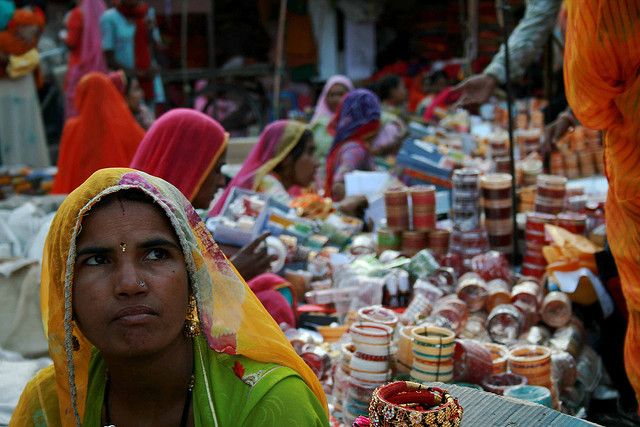
 TRUTHOUT– Fears about loss of privacy are being
voiced as India gears up to launch an ambitious scheme to biometrically
identify and number each of its 1.2 billion inhabitants.
TRUTHOUT– Fears about loss of privacy are being
voiced as India gears up to launch an ambitious scheme to biometrically
identify and number each of its 1.2 billion inhabitants.
In September, officials from the Unique
Identification Authority of India (UIDAI), armed with fingerprinting
machines, iris scanners and cameras hooked to laptops, will fan out
across the towns and villages of southern Andhra Pradesh state in the
first phase of the project whose aim is to give every Indian a lifelong
Unique ID (UID) number.
“The UID is soft infrastructure, much like mobile
telephony, important to connect individuals to the broader economy,”
explains Nandan Nilekani, chairman of the UIDAI and listed in 2009 by
Time magazine as among the world’s 100 most influential people.
Nilekani is a co-founder of the influential National
Association of Software and Services Companies and, before this
assignment, chief of Infosys Technologies, flagship of India’s
information technology (IT) sector.
According to Nilekani, the UID will most benefit
India’s poor who, because they lack identity documentation, are ignored
by service providers.
“The UID number, with its ‘anytime, anywhere’ biometric authentication, addresses the problem of trust,” argues Nilekani.
But a group of prominent civil society organisations
are running a Campaign For No-UID, explaining that it is a “deeply
undemocratic and expensive exercise” that is “fraught with unforeseen
consequences.”
Participants in the campaign include well-known human
rights organisations such as the Alternative Law Forum, Citizen Action
Forum, People’s Union for Civil Liberties, Indian Social Action Forum,
and the Centre for Internet and Society.
A meeting was organised by the campaigners in New
Delhi on Aug. 25 where speakers ridiculed the idea of a 12-digit number,
and said it is unlikely to rectify, for example, the massive corruption
in the public distribution system that is supposed to provide food to
poor families.
J.T. D’Souza, an IT expert, asserted at the meeting
that the use of biometrics on such a massive scale has never been
attempted before and is bound to be riddled with costly glitches.
Other speakers raised issues of security and the
possibility of hackers getting at databases and passing on information
to commercial outfits, intelligence agencies or even criminal gangs.
In talks and television interviews, Nilekani has
maintained that the benefits of the UID project far outweigh its risks.
“It’s worth taking on the project and trying to mitigate the risks so
that we get the outcomes we want,” he told the CNN-IBN television
channel in an interview.
But the possibility of religious profiling by state
governments or misuse by caste lobbies is real. This is because the
central government has decided to include caste as a category in the UID
questionnaire to be filled out by applicants.
Because identity is already a potent issue and the
trigger for frequent identity-related conflict – such as the 2002
anti-Muslim riots in Gujarat that left 2,000 people dead – any exercise
that enhances identification is fraught.
Usha Ramanathan, a prominent legal expert who is
attached to the Centre for the Study of Developing Societies in the
national capital, does not buy the UIDAI’s assurances.
At the Aug. 25 meeting, Ramanthan said that while
enrolling with the UIDAI may be voluntary, other agencies and service
providers might require a UID number in order to transact business.
Indeed, the UIDAI has already signed agreements with banks, state
governments and hospital chains which will allow them to ask customers
for UIDs.
Ramanathan said that, taken to its logical limit, the
UID project will make it impossible, in a couple of years, for an
ordinary citizen to undertake a simple task such as travelling within
the country without a UID number.
The UIDAI will work with the National Population
Register (NPR) which draws its powers from the Citizenship Rules of 2003
and provides for penalties if information is withheld.
And as a government website says: “Certain
information collected under the NPR will be published in the local areas
for public scrutiny and invitation of objections.” Seeking to allay
privacy fears, the website goes on to explain that this is merely “in
the nature of the electoral roll or the telephone directory.”
But things begin to look ominous when seen in the
context of the National Intelligence Grid (NATGRID), the setting up of
which home minister P. Chidambaram announced in February as part of his
response to a major terrorist attack.
Chidambaram said NATGRID would tap into 21 sets of
databases that will be networked to achieve “quick, seamless and secure
access to desired information for intelligence and enforcement
agencies.”
He added that NATGRID will “identify those who must be watched, investigated, disabled and neutralised.”
“Internationally only a few countries have provided
national ID cards because of the unsettled debate on privacy and civil
liberties,” says Prof. R. Ramakumar at the Tata Institute of Social
Sciences in Mumbai. He added that several countries have had to withdraw
ID card schemes or drop biometric aspects because of public opposition.
Nilekani maintains that the main purpose of the UID
project is to empower the vast numbers of excluded Indians. “For the
poor this is a huge benefit because they have no identities, no birth
certificates, degree certificates, driver’s licences, passports or even
addresses.”
By Ranjit Devraj

This work by Truthout is licensed under a Creative Commons Attribution-Noncommercial 3.0 United States License.
Photo by Tom Thai



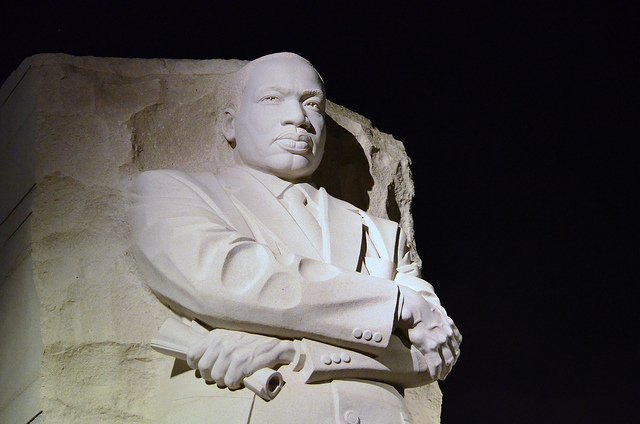 For many, the words “I have a dream” are the only thing they associate with Dr. Martin Luther King, Jr.
 NY TIMES
 TRUTHOUT
