Cancer: A Different Beast Entirely?

MEDIA ROOTS- Fascinating new research being done at Berkeley could completely transform the way we look at cancer from now on. Scientists are now arguing that the disease might actually be its own foreign species, instead of a creation of our own DNA. If this incredible discovery is indeed true, it could explain a lot about cancer’s resilience and the nature of the beast.

Abby

***
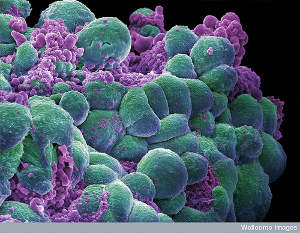
SALON– The science is complex, but it boils down to a shift in thinking about the way in which cancer is born. For years, scientists have believed that the disease begins when a few mutated genes give rise to renegade body cells that multiply beyond control.

But the Berkeley team, led by Dr. Peter Duesberg, argues that cancers are actually born from entire chromosomes, the long bands of genetic material that house our genes. What occurs is a process called aneuploidy, in which “disruptions” in chromosomes cause perversions of our genetic material, which can multiply during cell division. As a result, our DNA is rendered nearly unrecognizable.

According to PhysOrg.com: 

Normally this would be a death sentence for a cell, but in rare cases, [Duesberg] said, such disrupted chromosomes might be able to divide further, perpetuating and compounding the damage. Over decades, continued cell division would produce many unviable cells as well as a few still able to divide autonomously and seed cancer.

The genetic makeup of the cancerous cells, because of aneuploidy, bears strikingly little resemblance to our original DNA. However, the cancer still shows “relatively stable chromosomal patterns.” Those patterns are called karyotypes, and are a hallmark of living organisms.

[Duesberg] and his colleagues analyzed several cancers, clearly demonstrating that the karyotype is amazingly similar in all cells of a specific cancer line, yet totally different from the karyotypes of other cancers and even the same type of cancer from a different patient.

Translation: Each different case of cancer is a unique, parasitic species. And these species are flexible, adaptable, immortal and autonomous — as long as the host survives, of course.

A group of researchers at University of California at Berkeley have proposed a radical new theory that would cast most everything we know about cancer in a new light. While scientists have for years believed that the disease was the result of our own DNA run amok, the truth might be much weirder — that cancer is, maybe, its own separate species.
The science is complex, but it boils down to a shift in thinking about the way in which cancer is born. For years, scientists have believed that the disease begins when a few mutated genes give rise to renegade body cells that multiply beyond control. But the Berkeley team, led by Dr. Peter Duesberg, argues that cancers are actually born from entire chromosomes, the long bands of genetic material that house our genes. What occurs is a process called aneuploidy, in which “disruptions” in chromosomes cause perversions of our genetic material, which can multiply during cell division. As a result, our DNA is rendered nearly unrecognizable.
According to PhysOrg.com: 
Normally this would be a death sentence for a cell, but in rare cases, [Duesberg] said, such disrupted chromosomes might be able to divide further, perpetuating and compounding the damage. Over decades, continued cell division would produce many unviable cells as well as a few still able to divide autonomously and seed cancer.
The genetic makeup of the cancerous cells, because of aneuploidy, bears strikingly little resemblance to our original DNA. However, the cancer still shows “relatively stable chromosomal patterns.” Those patterns are called karyotypes, and are a hallmark of living organisms.
[Duesberg] and his colleagues analyzed several cancers, clearly demonstrating that the karyotype is amazingly similar in all cells of a specific cancer line, yet totally different from the karyotypes of other cancers and even the same type of cancer from a different patient.
Translation: Each different case of cancer is a unique, parasitic species. And these species are flexible, adaptable, immortal and autonomous — as long as the host survives, of course.
In a press release, Duesberg said:
Cancer is comparable to a bacterial level of complexity, but still autonomous, that is, it doesn’t depend on other cells for survival; it doesn’t follow orders like other cells in the body, and it can grow where, when and how it likes. That’s what species are all about … Once a cell has crossed that barrier of autonomy, it’s a new species.

Read more about A Different Beast Entirely.

© 2011 Salon

Photo by Flickr user crafty_dame

Posted in Uncategorized | 1 Reply

Regulation of Animal-Human Hybrids Needed

INTERNATIONAL BUSINESS TIMES– Experiments that create animal-human hybrids by implanting human material in lab animals should be more rightly regulated, a group of British scientists said in a new report.

It may sound like something from a horror movie, but implanting a small number of human genes or cells in animals is nothing new: scientists have already made strides in medical treatment by testing cancer drugs on mice engineered to have human DNA, by seeing how human stem cells behave in rats, and by studying a blood clotting problem through goats with a human protein in their milk. But a report issued by the UK’s Academy of Medical Sciences recommended creating a government body to advise whether certain tests should be permissible.

“There are a small number of future experiments, which could approach social and ethically sensitive areas which should have an extra layer of scrutiny,” said Martin Bobrow, a professor of medical genetics at the University of Cambridge  chair of the group who wrote the report. “There are good reasons for doing these experiments because they lead you to a better understanding of really important questions, but we need to go slowly and it needs to be regulated in a way that’s open, and transparent and looks very carefully at each step.”

2008 experiment in which British researchers created a human-animal embryo sparked considerable controversy, with religious groups condemning the experiment. Bobrow and his colleagues wrote that most experiments should be allowed to proceed, but they elaborated a small number of experiments that could cross the line.

“Where people begin to worry is when you get to the brain, to the germ [reproductive] cells, and to the sort of central features that help us recognize what is a person, like skin texture, facial shape and speech,” Bobrow told reporters. “The closer [an animal brain] is to a human brain, the harder it is to predict what might happen,” he added.

The report references the issue’s powerful resonance, addressing what the authors dub the “‘Frankenstein fear’ that the medical research which creates ‘humanised’ animals is going to generate ‘monsters.'” A poll included in the study found that a majority of respondents supported the idea of research using animals that contained human material, so long as it was to advance medicine. But people were wary of anything that would sacrifice the mental capacities that separate humans from animals.

Read more about Report Calls for Regulation of Animal-Human Hybrid Experiments

© 2011 International Business Times

Photo by Flickr user Gravitywave

Scientists Find Molecular Switch For Skin Growth

BIO SCHOLAR– Scientists have discovered a regulator of gene activity that tells epidermal stem cells when it”s time to grow more skin, as well as a “crowd control” molecule that can sense cell crowding and turn the growth off.

The study, in mice and in human cancer cells, provides clues to new therapeutic strategies for cancer, particularly squamous cell carcinoma, the second most common skin cancer, in which epidermal cell growth is inappropriately turned on.

The findings could also aid efforts to grow skin grafts and treat burn patients.

We have found a molecular switch that tells your skin to keep growing or stop growing,” said Fernando Camargo at Children’s Hospital Boston.

Read more on Scientists Find Molecular Switch That Controls Skin Growth.

© 2011 BioScholar News

Photo by flickr user kaibara87

Other Types of Ancient Humans Interbred with Us

BBC– Professor Chris Stringer: “It’s nothing short of sensational – we didn’t know know how ancient people in China related to these other humans”

Scientists say an entirely separate type of human identified from bones in Siberia co-existed and interbred with our own species. The ancient humans have been dubbed “Denisovans” after the caves in Siberia where their remains were found.

There is also evidence that this population was widespread in Eurasia. A study in Nature journal shows that Denisovans co-existed with Neanderthals and interbred with our species – perhaps around 50,000 years ago.

An international group of researchers sequenced a complete genome from one of the ancient hominins (human-like creatures), based on nuclear DNA extracted from a finger bone.

Continue reading about Other Types of Ancient Humans Interbred with Us.

© BBC, 2010

Photo by flickr user David_C_1977

Posted in Uncategorized | 1 Reply

NASA Finds New Life in Mono Lake

GIZMODO– Hours before their special news conference today, the cat is out of the bag: NASA has discovered a completely new life form that doesn’t share the biological building blocks of anything currently living in planet Earth. This changes everything.

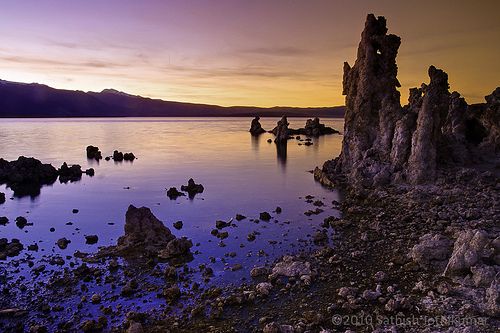
photo by satosphere/flickrAt their conference today, NASA scientist Felisa Wolfe Simon will announce that they have found a bacteria whose DNA is completely alien to what we know today. Instead of using phosphorus, the bacteria uses arsenic. All life on Earth is made of six components: carbon, hydrogen, nitrogen, oxygen, phosphorus and sulfur. Every being, from the smallest amoeba to the largest whale, share the same life stream. Our DNA blocks are all the same.

But not this one. This one is completely different. Discovered in the poisonous Mono Lake, California, this bacteria is made of arsenic, something that was thought to be completely impossible. While she and other scientists theorized that this could be possible, this is the first discovery. The implications of this discovery are enormous to our understanding of life itself and the possibility of finding beings in other planets that don’t have to be like planet Earth.

No details have been disclosed about the origin or nature of this new life form. We will know more today at 2pm EST but, while this life hasn’t been found in another planet, this discovery does indeed change everything we know about biology. I don’t know about you but I’ve not been so excited about a bacteria since my STD tests came back clean. And that’s without counting yesterday’s announcement on the discovery of a massive number of red dwarf stars, which may harbor a trillion Earths, dramatically increasing our chances of finding extraterrestrial life.

Continue reading about NASA Finds New Life in Mono Lake.

© Gizmodo, 2010

Photograph by flickr user satosphere