


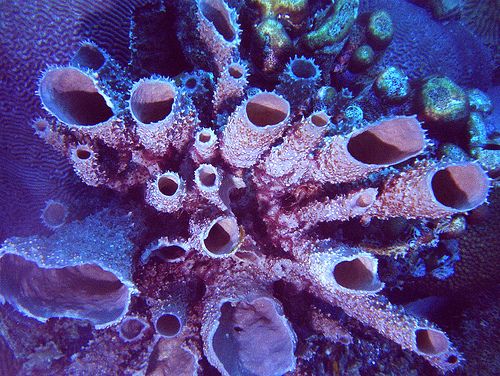
 NATURAL NEWS– An international team of
scientists was recently surprised to discover that sea sponges — one
of the oldest multicellular life forms — share nearly 70 percent of
the same genes as human beings, according to a study published in the
journal Nature.
NATURAL NEWS– An international team of
scientists was recently surprised to discover that sea sponges — one
of the oldest multicellular life forms — share nearly 70 percent of
the same genes as human beings, according to a study published in the
journal Nature.
The team worked for five years to sequence the genome of the 650-million year old group of organisms, which was one of the first to develop the specialized cell groups that characterize organs.
“The sponge represents a window on this ancient and momentous event,” said University of California-Santa Barbara researcher Kenneth S. Kosik. “Curiously, the cells of a sponge bear little resemblance to cells found in the rest of the animal kingdom. For example, sponges lack neurons; however, the sponge genome reveals the presence of many genes found in neurons.”
Significantly, many of the genes that sponges share with humans may play a role in the development of cancer.
“Once there is a transition from single cell to multicellular organisms, conflict is set up between the different cells of the multicellular organism,” researcher Todd Oakley said.
“It is in an individual cell’s best interest to keep replicating, and this actually is what cancer is — the uncontrolled replication of cells in the body. So in the history of animals, we can see this link with cancer, because the genes that are involved in the transition to multiple cells during evolution are also known to be linked to cancer.”
However promising, the recent findings are only the beginning in terms of uncovering new cancer therapies.
Continue reading about Humans Share 70% of Genetics with Sea Sponges.
© Natural News, 2010
Photograph by flickr user icelight
 TIMES ONLINE