In 2016, more than 50 bills were introduced in Congress targeting Trans people. Since Trump took office, dozens of pieces of landmark legislation have been cancelled, severely rolling back Trans rights. To explore this wide-ranging assault,Abby Martinspeaks with two leading voices and activists in the Trans community: Chase Strangio, attorney with the American Civil Liberties Union, and Jennicet Gutiérrez, founding member of La Familia: Trans Queer Liberation Movement.
In the first installmentof the series, Abby Martin introduced viewers to a neighborhood called Lakewood that was virtually ignored by both state and federal officials during and after the hurricane. Lakewood is home to working class Houston residents, many of which are Black or Latino. Is it simply a coincidence that neighborhoods like Lakewood receive far less attention and support when it comes to recovery efforts than wealthier neighborhoods filled with middle to upper class white Houstonians?
According to the testimony of residents on the ground in Lakewood, the answer is a very clear no. In this second installment of Hurricane Harvey’s aftermath, Abby Martin explores how the petrochemical industry dominates the city and why its low-income, minority areas are at the highest-risk for flooding and pollution, earning them the name “sacrifice zones.”
Abby explores Houston’s unique lack of zoning and regulations that maximized the impact of the storm, the “fence-line communities” deliberately put in harm’s way, inhumane treatment of incarcerated people during the disaster, and how the ownership of the city by Big Oil puts thousands of lives in peril.
Houston is unique in that it is the largest U.S. city to have no zoning laws. It is also overrun with petrochemical corporations operating with few rules and regulations. Neither of these things lend to a safe and healthy city for those with few resources. Houston has a high amount of residential segregation and housing discrimination which forces residents seeking affordable housing into marginalized areas where they are exposed to higher amounts of pollutants, less access to amenities, and are often at a higher risk of flooding. In the second installment of the series “After Harvey,” Abby speaks with Dr. Robert Bullard about these issues, touching on gentrification of the city, where wealth is focused, and how modern weather events impact communities like Lakewood.
Not only were Houston residents affected adversely by the structure of the city, inmates being held in three prison units in the area were all but ignored during the disaster. Abby speaks to Azzurra Crispino, from Prison Abolition Prisoner Support, about what inmates experienced in the hours and days following Harvey. Reports from inmates included a buildup of standing water in the units, the inability to bathe for at least 10 days, and reports that when portable toilets were finally made available, they were only accessible to prison staff. In one unit, 500 men were evacuated to a gymnasium where they stayed and slept in close quarters without air conditioning or functioning fans, near portable toilets that were not being emptied or cleaned and with insects roaming the floors at night. According to Crispino, despite being located on a floodplain, the facility does not have a constitutional evacuation plan in place, leading to numerous health and safety concerns for inmates.
Abby also speaks with Yvette Arellano of the Texas Environmental Justice Advocacy Services. Yvette shared details surrounding the dangerous situation that unfolded at a chemical plant in Houston after Hurricane Harvey hit the area. As the emergency at the chemical plant began, the surrounding community was not properly informed of the situation, despite seeing smoke and flames at the plant. As time went on, few details were shared about what chemicals were stored at that particular plant and if the situation posed any immediate threat to the surrounding residents. Chemical plants like this are no longer required to be transparent when it comes to their operations due to the supposed threat of terrorist attacks. While hiding behind Homeland Security in an effort to keep the country safe, the communities surrounding these facilities are left in an unsafe position, completely unaware of potential disasters looming right around the corner. In fact, FEMA stepped up to make the community aware of the threat posed to the community as the emergency unfolded, but the very next day rescinded those statements due to pressures from above. Not only were communities subjected to significantly polluted air due to emergencies at individual chemical and oil plants in the area, floodwaters were contaminated as well, putting residents at risk in the midst of harrowing rescues.
Shockingly, there is a 16 mile stretch of residential communities located on the edge of the second largest petrochemical complex in the world, running from Houston to Louisiana, filled with cancer clusters and high emissions. Not only is this harmful situation allowed in the United States, there were no extra precautions taken to protect these communities during the disaster, communities full of children. These communities are subjected to harmful emissions daily and those emissions increased dramatically after the hurricane. The correlation is obvious – the higher the poverty rate in these areas, the greater the rate of harmful emissions. Human lives are sacrificed for the profit of the petrochemical industry, with major plants in view of elementary school playgrounds.
Houston is dominated by the petrochemical industry with little regard to the health and safety of its most vulnerable residents. Hurricane Harvey did not cause this problem but it has finally brought more of the shocking situation to light. Profits are valued over people in Houston and the basic layout of the city along with its laws and regulations are proof.
**
Abby Martin: Houston is not an unusual place for devastating hurricanes but in the air of climate change disaster, Harvey hit the state like no other. In just six days, 33 trillion gallons of water were dumped onto the area, the greatest amount of rain for a single storm in continental US history with three times more rain than Katrina. The catastrophic flooding destroyed thousands of homes and left many areas of Houston in ruins, but these homes all have something in common. Like the devastated neighborhood I visited in Northeast Houston, low income Black and Latino residential areas are what is known as fence-line communities, or those in the highest risk borders of flooding and pollution.To learn more, I talked to an expert on fence-line communities, Dr. Robert Bullard, distinguished professor of urban planning and environmental policy at Texas Southern University.
Robert Bullard: Well, if you look at … Houston is a petro capital and it’s has lots of industries. Many of the communities that are near the refineries and petrochemical plants along the Ship Channel, many of them are also in the areas that’s prone to flood. And so you get this … people who are living in the areas that’s affordable, areas that … Because of residential segregation, because of housing discrimination, in many cases, people are forced to live in the areas that are risky and very vulnerable not just to storms like Harvey or these monster hurricanes but also just with downpours. Harvey was different is that it spreaded the pain. It kind of democratized the suffering, but yet and still when you look at it, the communities that have few resources and few bank accounts that can allow them to bounce back quickly, that’s how it’s hit them the hardest, because they don’t have the cushion to make them more resilient.
AM: Right, the recovery certainly was not democratized, Professor, as we know. Let’s talk about how urban planning and gentrification has exacerbated these fence-line communities and vulnerable communities.
RB: Well, you know that Houston is a city that, in many cases, defies logic in terms of where things get built and how they get built and the whole idea of where investments go. We have sparkling downtown areas, we have beautiful urban complexes that’s of high-rises. But at the same time, we have areas that are semi-rural, areas that have very little infrastructure in terms of drainage, in terms of flood control, the areas that have basically open ditches and gullies and no sidewalks and kids have to walk along the street next to ditches to get to school. When it rains, those gullies and ditches fill, presents a lot of problems in terms of health and safety for children.Houston is the only major city in United States that does not have zoning. It has allowed for really willy-nilly, haphazard kinds of development. Because of that unrestrained capitalism, it means that if you have the money, you can almost build anything anywhere. That kind of less protection for poor communities and communities of color and not having the kinds of investments in infrastructure, such as flood control, has made many communities basically sacrifice zones. When you start looking at laying a map out on the table and talking about which communities are over-polluted by industry and air pollution and water contamination, which communities have open drainage ditches and which communities are more likely to have illegal dumping of waste, I mean, these are the same communities that are low-lying and generally poorer and have an infrastructure that’s older and not maintained.Most of this is on the east side of Houston. In Houston, Houston’s east side is heavy industrial, heavy concentration of African American and Latinos. And so when you talk about that schism between these two Houstons that we’re talking about … The west side is more residential and it’s more upscale, and then you talk about on the east side is where you have a lot of these industries and these neighborhoods that are fence-line. Often times, people call them sacrifice zones, in the areas that are where anything goes. These are the same areas that don’t have grocery stores. These are where you have concentration of food deserts. These are the neighborhoods where you don’t have a lot of parks and green space. When you talk about things that communities don’t have, what we’re saying is that if we are to recover in a way that’s equitable, we have to address a lot of those disparities that existed before the storm.
AM: The areas that suffered most from the hurricane are Houston’s historically oppressed and marginalized communities.
RB: In many cases, the people that live closest to the industries don’t even get the benefits of working at the industry. They get the pollution and they get the risk and many times, they get sick. The environmental racism is when we allow certain types of risk and health threats to somehow be targeted toward groups and communities because of their race. It’s real. We live, as I say, we live in areas in the South and in Houston, and Houston is definitely a Southern city, that many of us … Its neighborhoods and its environmental landscape was shaped by Jim Crow segregation, racial segregation.If you look at, as I say before, we have … In 2017, we still have racially identifiable neighborhoods that we know by name and we know when you travel through, you know by when you see the population. You see certain things are not there, you can identify in terms of amenities. What happened in terms of the infrastructure and the flooding of certain neighborhoods and the disparate impact of the flooding, that’s not natural. That’s an unnatural disaster. The political dynamics involved in pushing people toward risk and not allowing certain communities to have the benefits of infrastructure improvements, that’s not natural. That’s unnatural. Racism is unnatural, it doesn’t make sense, it’s an illness. It’s becomes a mental health issue.
AM: But it’s not just poor residential areas that were treated so inhumanely, and even more marginalized sectors treated with similar heartless disregard. I talked to Azzurra Crispino, co-founder of PAPS, Prison Abolition Prisoner Support, to find out what happened to Houston’s incarcerated population.Let’s start by discussing what you know about the damage done to those three prison units run by the Texas Department of Criminal Justice.
Azzurra Crispino: In terms of the Gist, Stiles, and Leblanc Unit, we know that there was standing water in all three of the units. We know that there was lack of sanitation available to the inmates. They weren’t able to shower for a minimum of 10 days. When porta potties were finally delivered, they were insufficient porta potties. In at least one of the units, the porta potties were clumped together in such a way that it was not accessible to all of the inmates to be able to go there. We have widespread reports that only the guards were allowed to use the porta potties. So men are obviously having to make do, in terms of sanitation, however they can.
AM: You mentioned the evacuees. What happened to them?
AC We know from an activist who went to visit inmates in Ferguson Unit that more than 500 men were evacuated to this unit. They were placed in a gymnasium. They were told to bring their fans but no other property. When they got to the gymnasium, they were not allowed to plug in their fans, so no air conditioning, no ability to plug in your fan. There are porta potties but the porta potties are not being cleaned. Ants, roaches, and snakes crossing them at night. No ability to go anywhere or do anything except to be in this gymnasium.You have a situation where a Federal Government agency has recognized that this is a coastal floodplain that is likely to flood anytime. If I lived there, I would have to carry additional flood insurance. But TDCJ does not have an evacuation plan in place that is constitutional, humane, and respects the taxpayer.
AM: That’s the big question, right? I mean, you mentioned that these prisons were built on a known floodplain. I guess you can ask that about all these facilities in Houston: Why were there no precautionary measures taken, knowing that this is going to happen not just now but again and again?
AC: Because prisons are built for profit, not rehabilitation. It’s cheaper to build on a floodplain, right? The reality is that we have this fiction that prisoners are people who have done something wrong and they’re being punished for a reason. The reality is that prisons are a huge profit-making industry. If you were to put these units in non-floodplain areas, that’s real estate that’s substantially more expensive.
AM: But it’s much more than flood water that earns Houston’s low-income areas the title sacrifice zones. The mega corporations that siphon vast wealth from Texas land puts them in even graver danger. On the poorer, mostly minority east side of Houston, you’ll find big oil refineries, which emit countless harmful pollutants. You’ll also find all the chemical plants, which emit even more toxic emissions, littering the residential areas hurt by the floods. This gets even more disturbing when you see it’s not just homes but also schools. Countless children go to schools built inside of these poison-spewing zones. When hurricanes strike these facilities, it’s the east side communities who bear the brunt of the toxic fallout. Hurricane Harvey was no exception.Behind me is the Arkema chemical plant, the facility that exploded one month ago during Hurricane Harvey. Innumerable noxious, polluting chemical were released into the air endangering thousands of local residents, some of whom live directly next to the plant. They were told to return home but to wear protective clothing and to not drink the water.We’re driving by the Arkema Chemical Plant right now, where water was about six-feet deep in the plant. They said it was an unprecedented amount of flooding but as we know, they had experienced something very similar just a few years prior and actually failed to take those precautionary measures to prevent more explosions. Right across from the plant, there’s people. There’s houses, there’s trailers, hundreds of people who live here who have to return back to their home. Many of them have farms, they have lives to live. Holy– There’s just a huge dead deer in the gutter. Wow. That was really intense.I spoke with Yvette Arellano of Houston’s grassroots Texas Environmental Advocacy Services to learn more. Can you start by outlining what exactly happened at the Arkema chemical plant back in August?
Yvette Arellano: In August, Arkema basically lost their backup energy source, and they had a total of nine different refrigerated units. The first three went up on Thursday and Friday of that week, and nobody even knew. The community had no idea that a fire was bound to happen. The plant knew because they were inundated with six feet of water. The next day, all of a sudden, you had notices that Arkema was having any issues. People were trying to find out what was the volume of substances that were being held. All we were told was that there were organic peroxides but not the amount and not any other chemicals.Any plant like Arkema that is a chemical plant will produce more than just organic peroxides, but because they hide behind Homeland Security and terrorist threats, they’re not forced to disclose that information to local communities, which is completely unfair. All of a sudden, you had FEMA come out and say, “Well, we have plume modules. Our plume modules disclose that these are hazardous chemicals to public health and safety.” The next day after he made that statement, he rescinded that statement because of pressures that came from above. We’re under Scott Pruitt’s EPA. When we spoke directly to the EPA a week after Harvey had passed, during this entire Arkema situation, we asked, “Are the plumes hazardous?” This is Region 6 EPA, under Scott Pruitt, and they said no.
AM: Your response to the whole, “It’s nothing more than a campfire,” the smoke inhalation and also just their warning to the community about returning.
YA: That was absurd. The community wasn’t given the information that they needed, just like none of the communities during the Harvey disaster were. We were told that no flood waters were toxic because of industrial entities during the storm.
AM: And this had happened before about 10 years prior at the Arkema Chemical Plant, not six feet of water but at least six inches of water. Why were no precautionary measures taken then?
YA: All this stems back to the Chemical Disaster Rule. The Chemical Disaster Rule outlines that these facilities that are called RMP facilities, or Risk Management Plan facilities, have to be transparent with communities and outline evacuation plans and let communities know what they’re storing. Under the Trump administration, there was a 90-day delay. That 90-day delay kept any of those safety mechanisms from going into place. After the 90-day delay, everyone was very hopeful that the mechanisms would go into place, and all the sudden, we were slapped with a 20-month delay. That was beyond belief. We’re talking about common sense policies that protect our communities. Of course, they’re not gonna be in favor of it because then they’d not only lose revenue but they would have to put in safety mechanisms and that costs money.
AM: But still, it seems like such a measly amount of money when the owner is a multimillionaire. We’re really just talking about putting these bins or vats up on stilts.
YA: There’s no enforcement. Under the TCQ, which is the Texas Commission of Environmental Quality, their head is basically appointed by Governor Greg Abbott, or whoever the governor is at the time, a governor who sued the EPA over 28 times, a governor who is a climate denier, a governor who receives a ridiculous amount of money from oil and gas and petrochemical industry in general. When you have that amount of influence, you’re going to protect your best interest, which, in that situation, is money.
AM: I think the part that shocked, at least me, the most was that we’re at a point of this high-stage capitalism where CEOs of chemical plants can just sit back, how many years after Fukushima, and say, “We’re just gonna sit back and watch this explode because we can’t do anything else.” That’s insane.
YA: Any single time that there’s a chemical fire along the Ship Channel, first responders are never fully trained on how to deal with chemical fires. They’re told to allow anything, any substance it is, and most of the time, they have no idea what’s even burning. We still have no idea what burned at Arkema. There is no information that’s come out. The information that was relayed to the community is old, it’s outdated. None of it’s up to date.
AM: It’s not just Arkema, it’s Exxon, it’s multiple other petrochemical, big oil companies that basically dominate the state, Yvette. And Exxon also had refineries damaged during Hurricane Harvey and released massive amounts of pollutants in the air. Can you give us just kind of a general assessment of what kind of pollution was emitted from these companies during the hurricane?
YA: Right behind you is a running list of just the amount of emissions that we were able to track. We stopped at 5 million in excess pounds of fugitive emissions that were let off into the communities affected by Harvey. Three days after the storm, we took an aerial tour all the way from the east side of Houston to Port Arthur and not only saw Shell Deer Park terminal, ExxonMobil, Chevron, and the Motiva plant. The Motiva plant in Port Arthur is the largest refinery in this nation, ExxonMobil plant is the second largest refinery in this nation, and they both produce over 500,000 barrels per calendar day.They were flaring like crazy, and no one was there to stop them because there are loopholes hidden within our regulations currently. Our regulations and any policies that are there to protect our community stand like Swiss cheese. The lowest fine that we’ve seen for any of these companies has been around $2,500 for doing air releases. Now, I can’t even buy a used car for that amount of money. It’s cheaper for these companies to pay the fines than it is to actually update the equipment. The companies are allowed to do any number of things. They’re not fined if any of these events happen during a natural disaster or during startup and shutdown.What was told to the community was that these refineries and the chemical plants were going to go through a shutdown process. They weren’t told how many emissions they were gonna let off. In fact, you had public officials just kindly reminding these entities, “Please be considerate as you’re starting up and you’re shutting down.” When you have public officials asking kindly, these entities, to please be considerate, that means there is absolutely nothing else. They are not enforcing. When you’re asking politely, you have no power in that situation. That’s what we were facing. This is the largest petrochemical complex in the entire nation, the second largest in the world. The first largest is in Saudi Arabia. You’re telling me that a first world nation, a developed nation who lives in a democratic society allows a 16-mile stretch of frontline communities with children, elderly, sick, cancer clusters running from Houston all the way to Louisiana? You’re telling me that this is what’s allowed in this kind of nation in this kind of society?
AM: Houston’s open secret is that these same communities are subjected to deadly hazards from these big corporations every single day, not just during natural disasters. The correlation is clear, areas with very low poverty rates have very low rates of harmful emissions. The higher the poverty rate, the greater the rate of dangerous pollutants. Cancer clusters, which are heightened rate of deadly cancer in these polluted areas, prove how many lives are sacrificed for big oil, how many are sentenced to sickness. According to a 2016 report by the Union of Concerned Scientists, the Manchester community, 98% minority and mostly low income, experiences cancer at 30% greater than those in more wealthy areas. 19 industrial oil and chemical facilities dot this small community.
YA: Not only were the families along the Houston Ship Channel affected by any current leaks or fires or emissions but legacy contamination that continues to sit at these sites. When we asked Texas A&M to come in and do testing, when they got to the Brio site over on the south side of Houston, there was an attorney at the Superfund site manually … He was physically attempting to stop them from taking a water sample. They had a Community Department liaison with them who used their body as a barricade.These are wild stories that people have no idea even exist. Whenever we go ahead and we recount them, they sound like lies. They’re not lies. This is what happens in states that are infiltrated with oil and gas infrastructure, they’re extractive industries. Everyone is affected, everyone in Houston sits under a benzene plume. Houston has never even met the federal air quality standards since the Clean Air Acts’ establishment.
AM: Let’s talk about how this all happened. Let’s talk about urban planning. Let’s talk about gentrification and how basically this concrete jungle was built on a swamp and how that’s affected this.
YA: This entire area wasn’t meant to be inhabited by people in general. Houston is nicknamed The Bayou City, but most of our natural waterways and bayous were covered in order for development to even start. The communities of Manchester, of Clinton Park, of the Fifth Ward, have always been predominantly communities of color. The Houston Ship Channel was originally only 10-feet wide, 4-feet deep, and it wasn’t until oil and gas infrastructure started coming in after the discovery of oil in Corsicana and Spindletop, Texas in 1901 … What Houston saw was throughout Goose Creek and the Houston Ship Channel, hundreds and just hundreds of oil derricks and pumps just coming straight out of the ground. From 1901 to 1906, you have oil and gas just infiltrate the entire area.We didn’t export any of this. Originally, it was cotton. It’s the South, so the communities that also outlined the Houston Ship Channel were going to be your historically Black communities. Slavery, cotton, the exportation of cotton, historically Black neighborhoods, the same ones who continue to have to pay the price except now you also have communities that are majority immigrant communities or Latino communities and you can look down the Houston Ship Channel and see this legacy continue.You have the east side and the west side. On the east side, you have every single refinery worker job, every just worker job. Every refinery, any oil infrastructure’s going to be there. On the west side of town, you have the densest population for the headquarters of these energy firms. You have BP America sitting on the west side of Houston in their high towers. You have an entire section of Houston called the Energy Corridor. You have the densest amount of headquarters sitting right in downtown, and they’re all sitting there with nothing to fear.
AM: And you’re gonna get a lot of resistance, obviously, in a petrochemical, big oil town where people are working in the industry. We saw the same thing with the BP oil spill. It seems like there’s so much resistance. As you mentioned, these are entrenched red states with climate denial public officials. What can be done to get environmental justice here?
YA: We’re the only entity down here in this city, basically advocating for environmental justice. It’s difficult, just like you said. You have an education system that STEM programs, science and math, are completely funded by oil and gas interests, where teachers get reprimanded if they talk too long about climate change, where the future of students lies in maritime programs, where they don’t necessarily get advanced math or science skills, they get taught how to work a tractor or a pipe. There is no study that even has chemical exposures and their effects on public health available. You just won’t see that. Why? Because you have hospitals in the medical center with wings that are funded by Kinder Morgan, with wings that are funded by ExxonMobil and Shell, and it’s not going to happen. Our local universities, as much as you have kind-hearted souls working there, their departments are held at the behest of oil and gas because as soon as they have any real studies, they’ll lose funding. What we do is try to uplift the narrative and the stories and we try to advocate, and then we get down to the main issue, which is the people who are being sacrificed are the most powerless in this situation. The people who are being sacrificed are also those who lack the influence with public officials. We don’t have the amount of PACs or money to basically sway the vote. We live in the deep red south, an extremely racist area in this entire nation. We’re not in a post-racial society. We’re poor and we’re affected, and no one cares.
Abby and Robbie Martin discuss Trump’s first week in office carrying out several executive orders that violate human rights and the environment, namely the Muslim Ban which blatantly discriminates against 130 million people around the world. They discuss the line that has been drawn in the sand, and why people need to stop carrying water for the Empire’s CEO and join the fight against fascism.
This podcast is the product of many long hours of hard work and love. If you want to encourage our voice, please consider supporting us onPatreon. Listen to all previous episodes of Media Roots Radio onsoundcloudor subscribe onitunes.
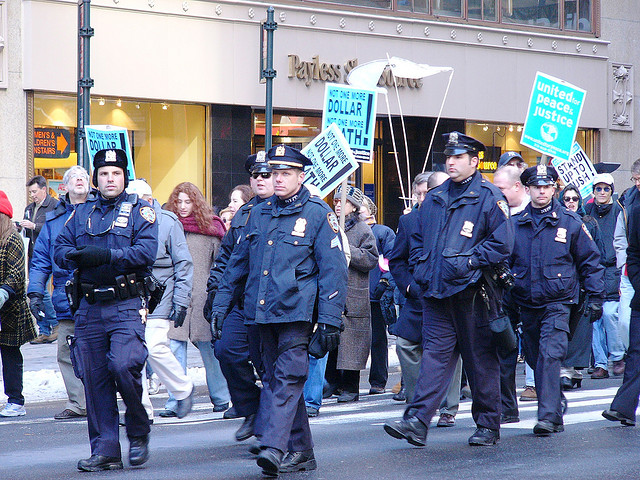
MEDIA ROOTS – In recent years, the New York Police Department has not only developed into an international police division, its officers regularly flaunt constitutionally-protected civil liberties and single-out minorities. As the “war on terror” enters its eleventh year next week, the question now is who are the actual terrorists?
Currently targeting activists with facial recognition technology, the force also uses drones in the skies and in the harbor with no sight of a horizon in this sea of surveillance. Additionally, several units regularly brutalize offenders of minor laws because of a widespread mentality that the legal code is not applicable to them.
While possibly some of America’s finest officers work on this force, it is the current state of this police culture that is of dire issue. After all, it is not only a direct threat to a peaceful and prosperous future, it is indeed the exact mindset that America has spent over a decade fighting by sacrificing well over a million human lives and having spent approximately $11,000 for every man, woman, and child in America.
***
AlterNet – [New York City]’s population is a little over 8 million. That means that there are 4.18 police officers per 1,000 people. By comparison, Los Angeles, the second largest city in the U.S. with 3.8 million people, has only 9,895 officers — a ratio of 2.6 police per 1,000 people.
What has the New York Police Department been doing with all that … manpower? In addition to ticketing minorities for standing outside of their homes, spying on Muslims who live in New Jersey, busing protesters, and gunning down black teens over weed, the NYPD has expanded into a massive global anti-terror operation with surveillance and military capabilities unparalleled in the history of US law enforcement.
In an email published by WikiLeaks, an FBI official joked about how shocked Americans would be if they knew how egregiously the NYPD is stomping all over their civil liberties. But what we already know is bad enough.
MEDIA ROOTS — Independent journalists have a passion to get information out to individuals who might not otherwise receive it and most often require supplementary sources of income to survive. Here at Media Roots, life’s no different.
My second line of work is operating a pedicab, a three-wheeler that helps shuttle tourists to various monuments, memorials, and museums in the nation’s capital. Pedicabs have been in operation here for over five years and boast a perfect safety record and a near-perfect customer satisfaction record. And while 38 police departments now claim jurisdiction within the District, only the U.S. Park Police find issue with the hard-working and generally light-hearted independents operating on the National Mall.
Most pedicabbers have other lines of work, like indy journalists, and are typically rather articulate and rational. The majority have never had previous issue with the law and are not looking to create any unnecessary trouble for law enforcement. But after only a few hours at the third-most popular tourist attraction in the United States, anyone can witness how the aggressors wear an official costume, while the pacifists cruise around accepting gratuities.
While peddling on Sunday, March 25, I found myself pulling up to the Smithsonian Natural History Museum at approximately 3:00 pm. Another pedicab appeared to have been abandoned in front of the museum. And nearby was a Park Police cruiser. In order to prevent the missing operator from having to pay the $195 to recover the cab from the impound lot, I briefly attempted to cart the empty cab back to our shop downtown.
Almost immediately, Officer Blake of the U.S. Park Police, the same officer whom had issued me a previous citation just weeks before (only to be dismissed by DC adjudication services), appeared and ordered me to not take the human-powered vehicle. I immediately complied and moved approximately 20 feet from the scene. Blake would follow me and continued to instruct me I couldn’t stop where I had – in front of a parked tour bus.
“Where would you like me to go?” I asked.
“Off the Mall,” he would reply with an unlawful attempt to exile me from over 300 acres of public property.
Unsure how to respond, I steered my pedicab to what appeared to be a legal parking spot a motor vehicle had just vacated. Again, the officer was hot on my trail.
“Give me your ID. You’re getting a ticket.” I complied with no hesitation. In order to maintain a level of accountability, I also pulled out my video camera to capture the scene.
“Put your camera away,” he continued.
“I don’t have to put my camera away.” After all, I am the organizer for DC CopBlock and quite familiar with the First Amendment.
“Put your hands behind your back.”
I had officially been placed under arrest, despite the fact that two other pedicabbers were seemingly ignored by officer Blake. I was in utter disbelief that not only was I getting arrested again (the first arrest in November, also a charge for resisting arrest, was eventually dismissed by federal prosecutors), but I was now getting arrested for a Constitutionally-protected act.
As the handcuffs were aggressively placed on my already-sore wrists, I became dizzy and uncertain about the officers’ intentions. They screamed orders at me, even though I was not talking back nor were there any loud noises nearby. A tourist and his son a few feet away were visibly traumatized by the incident with the younger crying and his father yelling at the police for their blatant display of excessive force.
“Stop resisting,” Officer Hiatt continued to yell at me, even though he was close enough to kiss me.
“I’m not resisting,” I calmly replied, uncertain what else to say.
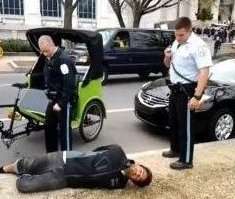
The officer then slammed me down to the gravel. Because I was already cuffed, I couldn’t break my fall and ended up landing face-first. The fall knocked me out for a minute and the trauma to my shoulder is still present to this day. But the emotional damage of a tyrannical police force, operating without regard to the law or morality might take years to recover from.
Oskar Mosco is a regular contributor for Media Roots
***
TBD — Two Park Police officers bend down to look at another groaning black-haired pedicab operator, his face against the grass and lying on his stomach on the National Mall. They talk into their radio. On the street is a little green pedicab, abandoned. One officer fastens handcuffs on the young man, a manager at National Pedicabs.
This pedicab operator calls himself Oskar Mosco and is the same one who was arrested last fall and formed the D.C. Pedicab Operators’ Association to advocate for operators amid the evolving regulations and allegations of harassment that have come up in the last year. He was last arrested in November, but the case was dismissed earlier this year. The National Park Service controls the pedicab territory of the National Mall, and Park Police enforce the rules. Yet the NPS is still developing its formal pedicab regulations, which will apparently mirror those the District Department of Transportation released last year. The Park Police note that D.C. traffic regulations apply, however, and regularly write tickets to the region’s pedicabbers.
Mosco attempts to ask what orders he disobeyed.
“We are no longer discussing this,” the Park Police officer tells him. “You are under arrest.”
The two officers pull Mosco to his feet and escort him to a police car, in which a second pedicab operator sits, as Mosco shouts that he was arrested for videotaping the police. “You should not get arrested for videotaping a police officer!” Mosco yelled to onlookers in front of the Natural History Museum. “This is a free country, not a police state!”
Pedicabs are a human-powered transportation option that fill a unique demand in an increasingly petroleum-dependent society. They have proven to be safe and fun in areas that demand a variety of transportation options. The very survival of America’s emerging pedicab industry depend on a population that is informed, and concerned, with the what else can be possible. Those interested in following the development of American pedicab culture can follow the page Everything Pedicab.



 MEDIA ROOTS – In recent years, the New York Police Department has not only developed into an international police division, its officers regularly flaunt constitutionally-protected civil liberties and single-out minorities. As the “war on terror”
  MEDIA ROOTS — Independent journalists have a passion to get information out to individuals who might not otherwise receive it and most often require supplementary sources of income to survive. Here at Media Roots, life’s no different.