MEDIA ROOTS – Whenconfronting the global crisis waiting on Earth’s doorstep, most people deconstruct the bulk catastrophe and break it down into more palatable, bite size pieces. These smaller pieces are easier and less frightening to consume. No one dares to face the painful truth of reality as a whole. But there is one movie that has defied the status quo, rejects the fear and valiantly plunges forward, realizing that it would be fatal not to analyze global challenges as a systemic whole:Crisis of Civilization. The provocative 2011 documentary examines an array of global crises as its own ecosystem of sorts, rather than as isolated, discrete events. When taken as a composite, these crises pose an imminent threat to humanity and civilization as we know it. Director Dean Puckett leads the viewer on a tour through a plausible and, frightening scenario, using the expert commentary of Dr. Nafeez Mossadeq Ahmed.
The documentary relies on the help of animator Lucca Benney and uses several clips from campy educational films to provide an amusing visual flow that offsets the gravity of the issues discussed. The seamless insertion of these scenes offers a brief recess from the incisive and grim sociological, political, and economic insights served by Dr. Ahmed. He is the sole expert interviewed throughout the documentary which potentially compromises the film’s objectivity but given the topics discussed there may not be a reason to tap anyone else’s knowledge. Dr. Ahmed boasts a very impressive array of credentials and while calm and collected, he warns of a world that faces a tidal wave of massive and radical change.
The film acknowledges that the four main crises presented are not new. Many people before him have identified climate change, energy depletion, food production and economic crisis as major areas of concern. However, standard academic procedure examines each one of these issues in isolation, rather than in a holistic manner. The movie suggests that by framing these crises in a macro-perspective, the resulting synergy becomes the impetus of a failing global system. The system’s fatal flaw is due to a zealous belief of infallibility for neoliberal capitalism. This doctrine assumes unlimited growth and globalization but no longer suits the needs of the vast majority of people around the world. In order for these overwhelming challenges to be rectified, the film emphasizes that society must recognize the fundamental interconnection between all four crises.
Is there anything that can be done?
Unfortunately, the documentary falls a bit short on complete remedies. However it does provide some basic ideas of how the world could tackle the arduous process of systemic change. Part of the solution is to decentralize and regain land ownership. A new emphasis must be placed on localization and “participatory forms of organization and agriculture.” The overwhelming majority of people are currently dispossessed. Who owns the land? How can we reclaim it for the productive use of our local communities?
It may be unrealistic to think all the solutions have been introduced in this film given the depth and breadth of the crises presented. Due to the United States’ neoliberal agenda and mass consumer culture, many have created their own crises. Quality solutions to many of today’s issues will not be resolved until civil society is honest enough to first recognize the totality of such problems. Crisis of Civilization does a fine job starting that search.
MEDIA ROOTS — Noted economist and syndicated TV show host, Max Keiser has studied, and reported on, the global economy for decades. He looks at financial systems according to the mathematical laws of systems analysis and occasionally discusses the warning signs of impending economic collapse. On last Friday’s episode of The Alex Jones Show, Keiser discussed the looming collapse of global markets. With the Congressional Budget Office having echoed Keiser’s prediction of “fiscal tighenting” yesterday, it appears the former stock-trader is again on the mark.
“I’m saying that there is a 90% chance of collapse by next April, but it could happen at any time between now and April,” Keiser reported on August 17. “You have to look at [the global economy] in terms of the way a systems analyst would look at any complicated system. Every time you add more to the system the complexity doesn’t rise in a linear fashion, it rises exponentially. So every time the Fed puts on more quantitative easing, every time investment banks bail out some other investment bank, every time more derivatives are released into the system, you don’t go from, let’s say, 700 trillion notional value derivatives to 800 trillion in a linear way. You have to think of it in terms of this global quadrillion to two quadrillion derivative soufflé being encumbered with, exponentially, more risk. This is classic systems analysis.”
This nation’s economy has been growing in complexity, exponentially, since 1971 when the U.S. dollar was taken off the gold standard. “The game here is to try to pick where it starts, what is the trigger, and to study it in terms of how the economies rattle and roll, as a result of this complete and utter systemic breakdown,” continued the founding host of The Keiser Report, a biweekly program, that aired its 330th episode yesterday.
Could Japan trigger the global economic collapse?
Keiser looks to the economy of Japan as a “weakest link” and a possible trigger for systemic collapse. He says what turned his eye toward Japan was the recent announcement that the second biggest buyer of U.S. Treasury debt is no longer China. Keiser explains, “America is the biggest buyer of its own debt. But taking the second spot is Japan. China is walking away from the table.”
Keiser continues, “Japan has always been under the treasury of America’s thumb. They will do whatever America says. And now they are the number two biggest buyer [sic] of US Treasury bonds. But that is extremely dangerous because their economy itself is a tinderbox, probably the weakest, most fragile economy in the world—after the Fukushima disaster, after 20 years of the zombie economy and the zombie banks. But now they are supporting America. Japan, the zombie economy, is supporting the American economy, to give you an idea how fragile the system is.”
“There is no avoiding the collapse. There is no remedy for the collapse.”
He then predicts civil unrest and a generational civil war. Therefore, the government is preparing for civil unrest, long anticipated by the John Warner National Defense Authorization Act of 2007, which rewrote federal law to allow deployment of the military, specifically, in cases of “economic collapse.”
After describing our evolving “hard gulag” situation in this country with private prison systems increasing capitalization, expecting 20-50 million more inmates in the near future, Keiser defines a new type of dystopia he calls a “soft gulag,” where citizens give up more freedoms—such as facial recognition—in exchange for deals on consumer goods.
Tom Ball and Oskar Mosco for Media Roots
Photo provided by Flickr user Stacy Herbert
***
Max Keiser recently appeared on The Alex Jones Show to discuss the imminent financial collapse of global markets. (Also, see his Guns and Butter radio broadcast below.)
***
August 22, 2012
GUNS AND BUTTER — “You don’t know which snowflake is going to start the avalanche. You know that the system is under such stress that it will only take one more snowflake to start the avalanche, that the system, itself, is under extreme stress right now. It cannot take even one bit more of systemic complication, you know, exponential increase in system complication. So, we’re at that pre-avalanche phase.”
Bonnie Faulkner (c. 1:15): “I’m Bonnie Faulkner. Today on Guns and Butter: Max Keiser. Today’s show: ‘Countdown to Currency Collapse.’
“Max Keiser is a financial analyst, television and radio host, journalist, and entrepreneur. He is host of the biweekly The Keiser Report with Stacy Herbert on RT. His co-host was Stacy Herbert of the weekly radio talk show on Resonance 104.4 FM in London and is host of On the Edgeon Press TV. He produces documentary films covering markets for Al Jazeera’s People & Powerseries and is a frequent guest on Al Jazeera English and France 24. Max Keiser is creator of PirateMyFilm, an alternative media funding mechanism, that supports the creative commons.
“Max Keiser: Welcome.”
Max Keiser (c. 2:13): “Always a pleasure to speak with you, Bonnie.”
Bonnie Faulkner (c. 2:15): “It’s been a year since we last spoke, Max. At that time, you had just returned from Greece. And we spoke about the crisis there. A lot has happened in the past year. Let’s start with fraud. Bring us up to date on the latest in financial fraud. What’s been going on?”
Max Keiser (c. 2:37): “Well, the number of frauds are increasing. And they’re getting bigger.
“At HSBC, they’re implicated in a multi-hundred-billion-dollar money laundering scandal for Mexican drug cartels.
“There’s also Barclays. They’re involved with the multi-hundred-trillion-dollar LIBOR rigging scandal.
“JPMorgan was caught fiddling their books in London on this recent two- and then five-billion-dollar error. So, the list goes on and on.
“Standard Chartered, now fined a few hundred million dollars for money laundering for Iran.
“Just about every single one of the so-called too-big-to-fail banks is involved in a multi-hundred billion dollar scandal of some type. So, the level of fraud is increasing. The numbers are getting bigger. The response from regulators around the world is still a big nothing, a big silence.”
Bonnie Faulkner (c. 3:43): “Now, I never completely understood the LIBOR scandal—banks fixing interbank lending rates. I mean, haven’t they always done this?”
Max Keiser: “Well, it’s a question of trading on the advance information. They fix the rate. But they are telegraphing their machinations to the market ahead of time to trade on that inside information.”
Bonnie Faulkner: “Well, now what about this MF Global and John Corzine with people’s money in their own private accounts just disappearing. Has anything happened with that at all?”
Max Keiser (c. 4:19): “Well, the John Corzine story at MF Global is really introducing a new chapter in all this ‘cos as you point out, money was directly taken out of segregated customer accounts—over a billion dollars.
“Corzine, himself, his defence is that money simply ‘vaporised.’ That’s the word he used. And that has held up. No regulatory agency is questioning his defence the money simply ‘vaporised.’ He has no idea where it went. And, now, the new scuttlebutt is he’s starting a new hedge fund. So, John Corzine is up and running. He’s starting a new hedge fund, back in business. And his crimes, along with Jamie Dimon at JPMorgan, are just being swept under the rug.”
Bonnie Faulkner (c. 5:15): “Yes, I did read that he was going to start a new hedge fund. I mean how can he do that? There’s no law anymore, I guess.”
Max Keiser: “Well, he’s a made man. You know he’s a former governor of New Jersey. He’s former head of Goldman Sachs. He’s part of the inner circle of the global financial mafia. He’s untouchable.”
Bonnie Faulkner: “Right. And what do you think about this Facebook IPO fiasco?”
Max Keiser: “This is a—I think it’s pretty interesting because on Wall Street for years there have been the notorious bucket jobs, as peddled in, usually, penny stocks. And it’s a really kind of an unseemly side of Wall Street, that’s operated, really, since Wall Street’s been around.
“And the pump and dump scam is [where] the insiders buy up a bunch of some company with very dubious prospects. And then they start calling people up to get them to buy into this ‘amazing’ story. And [insiders] sell out their stock at a much higher price to the new investors. And then, once [insiders] stop selling their stock, the market collapses and investors are [left] holding worthless stock.
“So, here, this is the first $104-billion-dollar pump and dump scam. Facebook’s business prospects are dubious. There’s not really much of a model there. You had the likes of [Democrat president] Barack Obama putting his arm around Mark Zuckerburg in the White House promoting this pump and dump scam. The insiders, as the stock crossed in valuation from $30 billion, $40 billion, $50 billion, etcetera, all the way up to $100 billion, all the way up to the IPO, the insiders were dumping, including Zuckerberg.
“So, the insiders, the venture capitalists, they’ve sold out. They’ve made billions of dollars. The people, who ended up buying in to this at $38 dollars a share on the IPO, they are the suckers. They are the victims. They got—the stock has been dumped on to them. And it’s a classic pump and dumpscam. It’s unusual because you have never seen one ever—I don’t think there’s ever been one—a $100-billion-dollar pump and dump scam. That’s certainly novel.
“But the underlying story here is a classic penny stock Wall Street pump and dump scam.”
Bonnie Faulkner (c. 7:42): “I didn’t realise that Zuckerberg had been dumping his stock.”
Max Keiser: “Oh, sure. He’s raised over a billion dollars in cash.”
Bonnie Faulkner: “Well, now, do you think this was intended as a big scam right from the beginning?”
Max Keiser: “Well, by what I’m saying is, it’s one of many tried and true scams, that Wall Street uses to sucker people out of there money. It’s called a pump and dump scam. It’s one of many types of scams. And the people who’re behind it, when they organise it, they begin to begin the story, the narrative to this they do so with full knowledge that they are engaged in a fraudulent activity—the same thing with Groupon, the same thing with Zynga.
“Oh, by the way, all three of those companies are all pump and dump scams: Zynga, Groupon, and Facebook. And, collectively, in the last three months, shareholders have lost over $62 billion dollars. And all three of those companies share Ernst & Young, as their auditor. And that brings up another aspect to this racketeering, that’s going on because there’s several components to the racket. There’s the Wall Street banks. There’s the auditors, that are involved. Then there’s the hedge funds. Then there’s the rating agencies. Then there is mainstream financial media, like CNBC.
“But the auditor’s role is that they sign off on books, that characterise things, such as losses as revenue. So, in the case of Zynga, they were generating losses, but they mark it as revenue. I mean that’s what the auditor does. They are very corrupt and they are part of this mafia racket.”
Bonnie Faulkner (c. 9:32): “Right. So, there’s fraud in all of these accounting firms. I mean I’m reminded of Arthur Andersen. I think they went under, didn’t they?”
Max Keiser: “Well, Enron—Arthur Andersen was Enron’s accountant—they were engaged in massive fraud and hiding tens of billions of dollars’ worth of liabilities. Then, when it was exposed, they went out of business. But the remaining Big Four(or Big Five, whatever they’re down to now), they have not changed their practices at all. They’ve only gotten more egregious in their outrageous accounting misconduct because they’ve been very aggressive in getting Congress to change laws, modify laws, bring in new laws, to strengthen their stranglehold with this mafia approach. So, they’ve gotten much worse.”
Bonnie Faulkner (c. 10:23): “How important or dangerous is this continuing financial fraud? Is it something, that’s always going on? Or do you see this as a real shift, as a break down in the financial system, itself?”
Max Keiser: “The financial system started to break down in the 1970s and it’s just been getting worse. And it’s been accelerating, in terms of its breakdown.
“I just wanted to you give you a good reference here. Francine McKenna, who’s a former, one of the big accountants, writes for Forbes, and she has a great story here about Groupon, Facebook, Zynga. And they share the same accountant—Ernst & Young is the accountant.
“But the system—you asked, how much damage is this doing to the system?—it’s approaching to a point now where the system is now so overloaded with fraud and derivatives, which are desperately trying to cover over this fraud. That we are kind of rapidly approaching a point of a global financial breakdown, that would be far in excess of what we saw in 2008.”
Bonnie Faulkner (c. 11:52): “Right. And what in your opinion is keeping the stock market afloat? I mean they’re—what?—12-, 13,000, still. And, yet, I keep reading that the average investor has lost confidence in it. What’s keeping this all floating?”
Max Keiser (c. 12:11): “Well, 86% of the volume on the New York Stock Exchange are computers trading with other computers. They’re not humans.
“And the computers are programmed, using algorithms, to make massive amounts of trade. They’re funded with off-balance accounts, that are not officially on anyone’s books. And those values are basically you know ephemeral. It’s a hologram generated by computer trading, high-frequency trading, algorithmic trading, just to keep the value of the presumed collateral on these banks at a level, that they can continue their operations. That is unsustainable. And we see it breaking apart. We see these flash crashes, that are occurring, whereKnight Capitalblew up in 45 minutes, lost $440 million dollars in five minutes because an algorithmic trading robot blew up. So—and these are happening with greater frequency, with bigger numbers. So, that’s what we’re heading for.
“We have a systemic collapse. You’ll have a multi-trillion-dollar flash crash affecting the financial markets, that will occur, like the Enron situation, quite rapidly. And the system will be irreparably damaged.”
Bonnie Faulkner: “Now, when we talk about a systemic collapse, particularly, of the financial system. And it’s all tied together now. As you’ve stated, things are much worse now than in 2008. How do you see this happening? Nobody’s got a crystal ball. But at some point, the system’s gonna give away, isn’t it? I mean is the whole thing gonna come crashing down? People have been predicting this for a long time. But somehow it just keeps continuing.”
Max Keiser (c. 14:11): “Well, the people, who have been predicting different scenarios, they’ve been predicting, you know, different versions of this story, and with different outcomes, and different timelines. But it’s important to remember that the basic timeline is still very much in place over the last five to ten years.
“The markets are coming unglued. The income gaps are widening dramatically. The potential for civil unrest, the actual civil unrest, is increasing sharply. The amount of contortionist monetary policies required to cover the gaping holes of the system are becoming more extreme. So, you have programmes, like quantitative easing manoeuvres.
“So, all these things are coming together. And, though, the timing of it—I’ve gone on record as saying that by April of 2013 you’ll have this global collapse. You’ll have at the outset now probably in April of 2013, when they do the taxes. For the U.S., there will be a remarkable shortfall in taxes. And U.S. government paper will be downgraded pretty sharply.
(c. 15:34) “But what it looks like is the currencies, the major currencies of the world—the dollar, the euro, the yen, the Chinese RMB—collapse. Like we saw a currency fall in Argentina; like we saw a currency collapse in Iceland; as we’ve seen in the central Asian collapse of the ‘90s. But there’s a global synchronous currency collapse.
“Now, when I say currencies, I do not include gold and silver. Gold and silver, of course, would be the opposite trade, the opposite of this. This is where the smart money is moving now.
“The central banks are buyinggold. China is very aggressively buyinggold. Smart hedge funds, like John Paulson, increased their gold. Soros is increasing his gold. ‘Cos they know what’s about to happen. They know we’re at the end game now. So, they wanna have the only thing, that’s been good money for the last 5,000 years—gold and silver.”
Bonnie Faulkner: “I’m speaking with financial analyst and broadcast journalist Max Keiser. Today’s show: ‘Countdown to Currency Collapse.’ I’m Bonnie Faulkner. This is Guns and Butter.
“So, when you say you see the system breaking down April 2013, you’re basing that on when U.S. taxes are due, correct?”
Max Keiser (c. 16:58): “I think that’ll be the—if the system is still around by then, I project that that remarkable shortfall come April next year will be, if there needs to be a trigger, yet, to fire to cause this global meltdown—that would be the trigger. And that would be the time frame.”
Bonnie Faulkner: “You know it’s interesting because a lot of people I know who barely have any money at all are getting these letters from the IRS and the Franchise Tax Board after them for these little bits of money. And I’ve just noticed this in the last month. So—I don’t know—are they going after the little guy? It’s kind of nutty.”
Max Keiser (17:46): “Well, this is predictable. And it’s historically predictable. They’re broke. They’re looking for any money they can. They’re broke. The government is completely broke. There’s no economic scenario, that you can imagine or create, that would pay off U.S. government debt. It just mathematically can’t happen under a so-called world scenario.
“There’s only two outcomes. One is a default on the debt. That would be an utter collapse. Or, two, hyperinflation, or a currency collapse, which is what I think is gonna be the outcome.
“I think they will attempt to inflate their way out of this debt, by allowing the dollar and other currencies to collapse in hyperinflationary endgame. And that’s coming.”
Bonnie Faulkner (c. 18:46): “Well, if you see a collapse in fiat currency, how is that gonna look? I mean what would happen?”
Max Keiser: “The price of gas would be $15 dollars a gallon. And groceries would be $2-, $3-, $400 dollars for a bag of groceries.”
Bonnie Faulkner (c. 19:08): “So, when you’re talking about hyperinflation, like something like what occurred in pre-World War Germany.”
Max Keiser: “Right. Exactly.”
Bonnie Faulkner: “What about global debt and U.S. debt, in particular? A lot of economists think that because the U.S. government prints its own money and that the dollar is the world government reserve currency, that the U.S. government can stimulate the economy and create an economic recovery by creating a new New Deal (i.e., putting money into infrastructure, reconstruction, hiring people, etcetera).
“Do you see an FDR-type New Deal scenario as a possible fix?”
Max Keiser (c. 19:49): “At the time of the New Deal, the U.S. was the world’s biggest creditor. Now, the U.S. is the world’s biggest debtor. And they simply don’t have any room for that. You know, right now, the biggest buyer of U.S. debt is the U.S. government. Up until recently, the second biggest buyer was China. Now, it’s Japan. China is dumping their U.S. debt, as are various other global creditors.
“You can’t finance debt with more debt infinitely. It just doesn’t work that way. It’s like inventing an anti-gravity machine or something. It’s not gonna happen. So, you can’t make the comparison really. If you want to make the comparison, say, to another period of time, the crash of the period of the ‘20s and of the Depression, if you get go back and draw the right conclusions from that period of time.
“You know the Depression was caused primarily by the run up in speculation on Wall Street in the ‘20s. And you had the crash of ’29. The recovery was, really, the number one contributor to its recovery were the reforms, that were put in place by FDR, and also the Pecora Commission, that was in place, that went ahead and prosecuted bankers and put many, many bankers in jail, and brought in things like Glass-Steagall, and FDIC, etcetera.
“And, now, the crisis today is we have the same problem. Wall Street speculation creates this enormous bubble in derivatives, that crashed in 2007. And the solution is similar. You need to reform the banks, if you want to recover from the resultant Depression, which is the result of the banking speculation. But we’re nowhere near that. There’s no Pecora Commission. There’s no bankers going to jail. There’s nothing.
“So, there’s no hope of any kind of recovery until you learn the lessons from the crash of the Depression of the ‘20s and ‘30s.
“A stimulus programme based on issuing more fiat currency, that simply gives bankers more leeway to commit more fraud is, you know, throwing gasoline onto the fire. You don’t wanna give stimulus, print money, and to have it circulate through Wall Street, so that they can leverage that up another ten or fifteen times, create another five or ten trillion dollars of unsustainable debt. And then make simply the result a crash that much worse.
“But I don’t think we’re gonna even have the opportunity to try that experiment because I believe we’re in the last 35 weeks of the timeline, before we get the global fiat currency obliteration. So, there won’t be any time, really. It’ll be a moot point in six months.”
Bonnie Faulkner (c. 22:51): “So, you’re saying that you think that the systemic fraud, this time around—as opposed to the Depression era—is much, much worse and, actually, the banks control the government, rather than vice versa, right?”
Max Keiser (c. 23:06): “Well, I’m not necessarily saying it’s worse. I’m saying that there’s been no response. In the ‘30s there was a response. Banksters were put into jail.”
Bonnie Faulkner: “Right.”
Max Keiser: “Here, there’s been no response at all.”
Bonnie Faulkner: “Exactly.”
Max Keiser: “So, until there’s been a response, then expect more of the same.”
Bonnie Faulkner: “Now, how do you see the next nine months going? It looks pretty bleak. What do you think is gonna trigger this whole thing—the inflation of the currency?”
Max Keiser: “Well, that’s an interesting point. Then you get more into a grey, fuzzy area: What, ultimately, will be the trigger?
“I think, at the worst, at the outset of this timeline, I’m saying tax receipts April 2013 is gonna be the ultimate trigger, if there is no trigger between now and then.
“But, before that, you could get something like Japan, [which] is extremely fragile. They’ve got GDP: over 200%. They’ve got, now, demographically, a horrible situation, where, instead of being allowed to finance their debt internally, they’ve got a whole generation, that’s pulling money out of the retirement systems. So, that’s essentially collapsing. And they’re a big part of this global, globalised, financialised, transactionalised world.
“So, that could be the trigger, there. And, right at the moment, that’s my—I’m kind of looking at that pretty closely. I think that what’s happening in Japan could be the trigger to set this up.
“But it could come from a number of different sources.
“In South Africa, you know, they had these huge labour riots and the government responded by murdering many, many people. South Africa, of course, is very key on the global commodity business—gold, platinum business. If that spreads to gold–mining in South Africa, some nationalisationwave occurs across the commodity sector, that could be the possibility. There are other possibilities. Any one of those could be the trigger.
“You don’t know which snowflake is going to start the avalanche. But you know that the system is under such stress that it will only take one more snowflake to start the avalanche. But the system, itself, is under extreme stress right now. It cannot take, you know, even one bit more or systemic complication, exponential increase in system complication. And, so, we’re at that pre-avalanche phase.”
Bonnie Faulkner (c. 25:41): “And, now, you mention Japan, as a possible triggerbecause why? Japan is the second-largest buyer of U.S. debt?”
Max Keiser: “Well, the yen is a currency, that everyone has flocked into, as a safe haven trade. And, so, there’s a tremendous amount of money locked up in Japan right now with the idea that the economy is relatively stable with other G20 economies.
“But it looks as though that is about to reverse itself and the country will not be seen as a safe haven anymore, which would precipitate outflows, many, many, many trillions out-flowing. And then that would be the beginning of this avalanche.”
Bonnie Faulkner (c. 26:29): “Well, now, let’s say that the system, which is teetering, really does crash in some fashion. What else do you think that that would look like?
“I’ve done shows on the militarisation of the local police departments. Obviously, the U.S. has the most advanced technological weaponry. We’ve got a huge prison-complex industry going on here.
“Do you see a martial law type scenario? What do you think might it look like?”
Max Keiser (c. 27:05): “Well “Well, first of all, in terms of one or the other attributes, aside from hyperinflation, you’d have bank, so-called, holidays. So, banks would shut down. So, this would make it very difficult to fund operations. You know in 2008 we had that situation where the credit lines amongst the top banks in the world froze. And they couldn’t get money from each other. They couldn’t lend to each other. There was a complete freezing up of the global system.
“So, imagine this more comprehensively with ATMs running out of money.
“Already, in Europe we see instances—for example, here in France—the limits, that you can take out of your bank, using an ATM card, have been reduced. So, that’s kind of a soft run on the bank. So, the banks can simply say you can only take out a hundred dollars a day. Then, a week later, they’ll say you can only take out $50 dollars during the course of the day.
“In Britain, recently, you had two banks go through multi-day systemic failures where people couldn’t get their money. They couldn’t move their money. They couldn’t pay their bills.
“So, the system, again, is highly stressed. And that would be what it looks like. You can’t get money in the machine. You’re completely without money.
“You know, we’ve seen this in Argentina. And we’ve seen this before.
“But, as far as what it looks like on the social—what The Economist magazine would call—the social cohesion. You know they ran a story two or three years ago they called The Social Cohesion Index, where they tried to predict which countries would be the least fun places to be during such an event. And my general rule of thumb is you don’t wanna be anywhere with a lot of tanks, soldiers, guns, and prisons. Try to stay away from those areas.
“So, certainly, in the U.S., you have a lot of soldiers, guns, and prisons now. And that’s not a good place to be. I’m not there for this reason. So, that would be a good rule of thumb. If you see a lot of drones, cops, guns, tanks, soldiers. Try to stay away from those areas.”
Bonnie Faulkner (c. 29:29): “Yeah, no kidding.”
“I’m speaking with financial analyst and broadcast journalist Max Keiser. Today’s show: ‘Countdown to Currency Collapse.’ I’m Bonnie Faulkner. This is Guns and Butter.”
“Well, I understand that you’re planning a move to Great Britain. Now, isn’t Great Britain pretty much right up their with the police state scenarios?”
Max Keiser: “Well, as a media figure it’ll be interesting to see how that plays out. Of course, you’ve got the Julian Assange story playing out where Julian Assange, a journalist, has now taken on the biggest governments in the world. And, so far, he’s doing quite well.
“So, Britain is becoming a really interesting place, and not only for journalists’ rights, but also ground zero for global banking fraud. So, all the biggest bank frauds of the last ten years have gone through Britain, gone through the City of London, whether it’s AIG, MF Global, JPMorgan’s London Whale, Bernie Madoff, the Royal Bank of Scotland, HSBC, Barclays. They all go through London. It’s really the epicentre of the global bank fraud market. And, as we cover bank fraud, as kind of the thing, that we cover, we decided that since we’re heading into the endgame, we wanted to be in a front-row seat ‘cos the whole City of London is about to blow up. We want to be there, cover it, and give a first-hand account of that.”
Bonnie Faulkner (c. 31:02): “Boy, I’ll say. But do you ever feel that your safety is at risk, or not?”
Max Keiser: “I don’t have any fear of that. And I’ll tell you why. There was a poll done recently, asking people if they knew who Jamie Dimon was. 66% have absolutely no idea. So, if our work has in some way educated people about the people, that are abusing them, then there might be some risk. But, since 66% of the population or more have absolutely no idea how they are being abused, then the banksters, who are doing the abusing, don’t really care.”
Bonnie Faulkner: “Oh, I see. So, they feel that everyone is so uneducated that who cares if they’re being exposed.”
Max Keiser (c. 31:53): “Yeah, they are not at any risk. There’s no possibility of them being penalised or facing any kind of jail time. So, they are too busy spending their money, having fun. You know? They’ve got yachts to make payments on and vacations to go on. They’re not under any threat whatsoever. I doubt any of them even know I exist.”
Rush Transcript by Felipe Messina for Media Roots and Guns and Butter (Please check back soon for complete transcript)
MEDIA ROOTS — Instead of the run of the mill faceless accusations of ‘The 1% are oppressing the 99%’ research organization Project Censored has compiled a valuable list with names and faces of some of the world’s biggest earners and financial elites.
Project Censored also characterizes a particular sect of these financial elitists as the ‘Global Economic Super Entity’, the biggest movers and shakers of the world economy. The assertion is made that NATO is now simply an arm of the financial elite global corporate class, a defacto ‘world police force’ to make sure the money keeps flowing as planned. A lot of interesting points are raised with ample documentation contained herein.
***
PROJECT CENSORED – The Occupy Movement has developed a mantra that addresses the great inequality of wealth and power between the world’s wealthiest 1 percent and the rest of us, the other 99 percent. While the 99 percent mantra undoubtedly serves as a motivational tool for open involvement, there is little understanding as to who comprises the 1 percent and how they maintain power in the world. Though a good deal of academic research has dealt with the power elite in the United States, only in the past decade and half has research on the transnational corporate class begun to emerge.[i]
Foremost among the early works on the idea of an interconnected 1 percent within global capitalism was Leslie Sklair’s 2001 book, The Transnational Capitalist Class.[ii] Sklair believed that globalization was moving transnational corporations (TNC) into broader international roles, whereby corporations’ states of orgin became less important than international argreements developed through the World Trade Organization and other international institutions. Emerging from these multinational corporations was a transnational capitalist class, whose loyalities and interests, while still rooted in their corporations, was increasingly international in scope.
Sklair writes: The transnational capitalist class can be analytically divided into four main fractions: (i) owners and controllers of TNCs and their local affiliates; (ii) globalizing bureaucrats and politicians; (iii) globalizing professionals; (iv) consumerist elites (merchants and media). . . . It is also important to note, of course, that the TCC [transnational corporate class] and each of its fractions are not always entirely united on every issue. Nevertheless, together, leading personnel in these groups constitute a global power elite, dominant class or inner circle in the sense that these terms have been used to characterize the dominant class structures of specific countries.[iii]
Estimates are that the total world’s wealth is close to $200 trillion, with the US and Europe holding approximately 63 percent. To be among the wealthiest half of the world, an adult needs only $4,000 in assets once debts have been subtracted. An adult requires more than $72,000 to belong to the top 10 percent of global wealth holders, and more than $588,000 to be a member of the top 1 percent. As of 2010, the top 1 percent of the wealthist people in the world had hidden away between $21 trillion to $32 trillion in secret tax exempt bank accounts spread all over the world.[iv] Meanwhile, the poorest half of the global population together possesses less than 2 percent of global wealth.[v] The World Bank reports that, in 2008, 1.29 billion people were living in extreme poverty, on less than $1.25 a day, and 1.2 billion more were living on less than $2.00 a day.[vi] Starvation.net reports that 35,000 people, mostly young children, die every day from starvation in the world.[vii] The numbers of unnecessary deaths have exceeded 300 million people over the past forty years. Farmers around the world grow more than enough food to feed the entire world adequately. Global grain production yielded a record 2.3 billion tons in 2007, up 4 percent from the year before—yet, billions of people go hungry every day. Grain.org describes the core reasons for ongoing hunger in a recent article, “Corporations Are Still Making a Killing from Hunger”: while farmers grow enough food to feed the world, commodity speculators and huge grain traders like Cargill control global food prices and distribution.[viii] Addressing the power of the global 1 percent—identifying who they are and what their goals are—are clearly life and death questions.
It is also important to examine the questions of how wealth is created, and how it becomes concentrated. Historically, wealth has been captured and concentrated through conquest by various powerful enities. One need only look at Spain’s appropriation of the wealth of the Aztec and Inca empires in the early sixteenth century for an historical example of this process. The histories of the Roman and British empires are also filled with examples of wealth captured.
Once acquired, wealth can then be used to establish means of production, such as the early British cotton mills, which exploit workers’ labor power to produce goods whose exchange value is greater than the cost of the labor, a process analyzed by Karl Marx in Capital.[ix] A human being is able to produce a product that has a certain value. Organized business hires workers who are paid below the value of their labor power. The result is the creation of what Marx called surplus value, over and above the cost of labor. The creation of surplus value allows those who own the means of production to concentrate capital even more. In addition, concentrated capital accelerates the exploition of natural resources by private entrepreneurs—even though these natural resources are actually the common heritage of all living beings.[x]
In this article, we ask: Who are the the world’s 1 percent power elite? And to what extent do they operate in unison for their own private gains over benefits for the 99 percent? We will examine a sample of the 1 percent: the extractor sector, whose companies are on the ground extracting material from the global commons, and using low-cost labor to amass wealth. These companies include oil, gas, and various mineral extraction organizations, whereby the value of the material removed far exceeds the actual cost of removal.
We will also examine the investment sector of the global 1 percent: companies whose primary activity is the amassing and reinvesting of capital. This sector includes global central banks, major investment money management firms, and other companies whose primary efforts are the concentration and expansion of money, such as insurance companies.
Finally, we analyze how global networks of centralized power—the elite 1 percent, their companies, and various governments in their service—plan, manipulate, and enforce policies that benefit their continued concentration of wealth and power.
The Extractor Sector: The Case of Freeport-McMoRan (FCX)
Freeport-McMoRan (FCX) is the world’s largest extractor of copper and gold. The company controls huge deposits in Papua, Indonesia, and also operates in North and South America, and in Africa. In 2010, the company sold 3.9 billion pounds of copper, 1.9 million ounces of gold, and 67 million pounds of molybdenum. In 2010, Freeport-McMoRan reported revenues of $18.9 billion and a net income of $4.2 billion.[xi]
The Grasberg mine in Papua, Indonesia, employs 23,000 workers at wages below three dollars an hour. In September 2011, workers went on strike for higher wages and better working conditions. Freeport had offered a 22 percent increase in wages, and strikers said it was not enough, demanding an increase to an international standard of seventeen to forty-three dollars an hour. The dispute over pay attracted local tribesmen, who had their own grievances over land rights and pollution; armed with spears and arrows, they joined Freeport workers blocking the mine’s supply roads.[xii] During the strikers’ attempt to block busloads of replacement workers, security forces financed by Freeport killed or wounded several strikers.
Freeport has come under fire internationally for payments to authorities for security. Since 1991, Freeport has paid nearly thirteen billion dollars to the Indonesian government—one of Indonesia’s largest sources of income—at a 1.5 percent royalty rate on extracted gold and copper, and, as a result, the Indonesian military and regional police are in their pockets. In October 2011, the Jakarta Globe reported that Indonesian security forces in West Papua, notably the police, receive extensive direct cash payments from Freeport-McMoRan. Indonesian National Police Chief Timur Pradopo admitted that officers received close to ten million dollars annually from Freeport, payments Pradopo described as “lunch money.” Prominent Indonesian nongovernmental organization Imparsial puts the annual figure at fourteen million dollars.[xiii] These payments recall even larger ones made by Freeport to Indonesian military forces over the years which, once revealed, prompted a US Security and Exchange Commission investigation of Freeport’s liability under the United States’ Foreign Corrupt Practices Act.
In addition, the state’s police and army have been criticized many times for human rights violations in the remote mountainous region, where a separatist movement has simmered for decades. Amnesty International has documented numerous cases in which Indonesian police have used unnecessary force against strikers and their supporters. For example, Indonesian security forces attacked a mass gathering in the Papua capital, Jayapura, and striking workers at the Freeport mine in the southern highlands. At least five people were killed and many more injured in the assaults, which shows a continuing pattern of overt violence against peaceful dissent. Another brutal and unjustified attack on October 19, 2011, on thousands of Papuans exercising their rights to assembly and freedom of speech, resulted in the death of at least three Papuan civilians, the beating of many, the detention of hundreds, and the arrest of six, reportedly on treason charges.[xiv]
On November 7, 2011, the Jakarta Globe reported that “striking workers employed by Freeport-McMoRan Copper & Gold’s subsidiary in Papua have dropped their minimum wage increase demands from $7.50 to $4.00 an hour, the All-Indonesia Workers Union (SPSI) said.”[xv] Virgo Solosa, an official from the union, told the Jakarta Globe that they considered the demands, up from the (then) minimum wage of $1.50 an hour, to be “the best solution for all.”
Workers at Freeport’s Cerro Verde copper mine in Peru also went on strike around the same time, highlighting the global dimension of the Freeport confrontation. The Cerro Verde workers demanded pay raises of 11 percent, while the company offered just 3 percent.
The Peruvian strike ended on November 28, 2011.[xvi] And on December 14, 2011, Freeport-McMoRan announced a settlement at the Indonesian mine, extending the union’s contract by two years. Workers at the Indonesia operation are to see base wages, which currently start at as little as $2.00 an hour, rise 24 percent in the first year of the pact and 13 percent in the second year. The accord also includes improvements in benefits and a one-time signing bonus equivalent to three months of wages.[xvii]
In both Freeport strikes, the governments pressured strikers to settle. Not only was domestic militrary and police force evident, but also higher levels of international involvement. Throughout the Freeport-McMoRan strike, the Obama administration ignored the egregious violation of human rights and instead advanced US–Indonesian military ties. US Secretary of Defense Leon Panetta, who arrived in Indonesia in the immediate wake of the Jayapura attack, offered no criticism of the assault and reaffirmed US support for Indonesia’s territorial integrity. Panetta also reportedly commended Indonesia’s handling of a weeks-long strike at Freeport-McMoRan.[xviii]
US President Barack Obama visited Indonesia in November 2011 to strengthen relations with Jakarta as part of Washington’s escalating efforts to combat Chinese influence in the Asia–Pacific region. Obama had just announced that the US and Australia would begin a rotating deployment of 2,500 US Marines to a base in Darwin, a move ostensibly to modernize the US posture in the region, and to allow participation in “joint training” with Australian military counterparts. But some speculate that the US has a hidden agenda in deploying marines to Australia. The Thai newspaper The Nation has suggested that one of the reasons why US Marines might be stationed in Darwin could be that they would provide remote security assurance to US-owned Freeport-McMoRan’s gold and copper mine in West Papua, less than a two-hour flight away.[xix]
The fact that workers at Freeport’s Sociedad Minera Cerro Verde copper mine in Peru were also striking at the same time highlights the global dimension of the Freeport confrontation. The Peruvian workers are demanding pay rises of eleven percent, while the company has offered just three percent. The strike was lifted on November 28, 2011.[xx]
In both Freeport strikes, the governments pressured strikers to settle. Not only was domestic militrary and police force evident, but also higher levels of international involvement. The fact that the US Secretary of Defense mentioned a domestic strike in Indonesa shows that the highest level of power are in play on issues affecting the international corporate 1 percent and their profits.
Public opinion is strongly against Freeport in Indonesia. On August 8, 2011, Karishma Vaswani of the BBC reported that “the US mining firm Freeport-McMoRan has been accused of everything from polluting the environment to funding repression in its four decades working in the Indonesian province of Papau. . . . Ask any Papuan on the street what they think of Freeport and they will tell you that the firm is a thief, said Nelels Tebay, a Papuan pastor and coordinator of the Papua Peace Network.”[xxi]
Freeport strikers won support from the US Occupy movement. Occupy Phoenix and East Timor Action Network activists marched to Freeport headquarters in Phoenix on October 28, 2011, to demonstrate against the Indonesian police killings at Freeport-McMoRan’s Grasberg mine.[xxii]
Freeport-McMoRan (FCX) chairman of the board James R. Moffett owns over four million shares with a value of close to $42.00 each. According to the FCX annual meeting report released in June 2011, Moffett’s annual compensation from FCX in 2010 was $30.57 million. Richard C. Adkerson, president of the board of FCX, owns over 5.3 million shares. His total compensation in was also $30.57 million in 2010 Moffett’s and Adkerson’s incomes put them in the upper levels of the world’s top 1 percent. Their interconnectness with the highest levels of power in the White House and the Pentagon, as indicated by the specific attention given to them by the US secretary of defense, and as suggested by the US president’s awareness of their circumstances, leaves no doubt that Freeport-MacMoRan executives and board are firmly positioned at the highest levels of the transnational corporate class.
MEDIA ROOTS — Life in modern USA is increasingly polarised. A false two-party system, designed and executed by the elite class, erodes democracy and allows elites to continue to swim in money whilst public institutions, such as schools and parks and post offices, cease to operate. Public purpose is often distorted and the social contract is undermined, as families are dispossessed.
In communities around the country, many working-class Americans know about class repression and resistance while many academics often seem to operate in a detached, parallel universe. This is primarily why independent media, along with its popular support, must continue to honestly articulate the searing indictments of our supposed democracy.
Free speech is an American tradition, which must always be protected. Often times, it’s difficult to question the decisions of contemporary politicians without catching the full belligerence of the state apparatus behind them. The USA’s War on Kids signifies our march to render a free-thinking citizenry, a notion of the past.
“Punishment and fear have replaced compassion and social responsibility as the most important modalities mediating the relationship of youth to the larger social order,” reminds cultural studies professor Dr. Henry Giroux. “And as the War against Poverty is transformed into [a War against the Poor and] a War against Crime, young people are often subjected to intolerable conditions, that inflict irreparable harm on their minds and bodies. Many youth have to now endure drug tests, surveillance cameras, invasive monitoring, random searches, security forces in schools, and a host of other militarising and monitoring practices, typically used against suspected criminals, terrorists, and other groups represented as a so-called threat to the state.”
Messina is a guest contributor to Media Roots (Additional comments below)
***
AGAINST THE GRAIN— “And this is Against the Grain on Pacifica Radio and online at kpfa.org. My name is C.S. Soong.
“Ideally, young people grow up to be engaged, critical, and politically aware participants in a robust public sphere. Is this in fact happening? Or is it even possible, given this nation’s political and cultural systems and priorities? Henry Giroux has many things to say about what’s happened to democratic possibility in the U.S., about the rise of what he calls the punishing state, and about how market fundamentalism infects how we’ve come to treat and educate young people.
“In a wide-ranging talk at Eastern Michigan University, the veteran author, educator, and outspoken social critic connected the history and ideology of neoliberal policies to trends in education, incarceration, and social control.
“Henry Giroux is a professor of English and Cultural Studies at McMaster University in Ontario Canada. His books include Against the Terror of Neoliberalism: Politics beyond the Age of Greed, and Schooling and the Struggle for Public Life. Let’s go now to Professor Henry Giroux speaking at Eastern Michigan University in Ypsilanti, Michigan.”
Dr. Henry Giroux (c. 8:52): “As the current financial meltdown reaches historic proportions, free market fundamentalism or neoliberalism, as it’s called in some quarters, appears to be losing, neither, its claim to legitimacy, nor its claims on democracy. As the recent healthcare debate made clear, the decades-long conservative campaign against the alleged abuses of ‘big government‘ is far from over. In the 1980s, when Ronald Reagan insisted that government was the problem not the solution, he unleashed what was to become a neoliberal juggernaut against, both, the welfare state and the concept of the public good.
“Reagan’s conservative ideological stance revealed a kind of smouldering market-driven disdain for any form of governance, that assumed a measure of responsibility for the education, the health, and the general welfare of the country’s citizens. He also helped launch a political era, in which consumerism and profit-making were defined as the essence of democracy, and freedom was redefined as the unrestricted ability of markets to govern economic relations, free of government regulation. Even worse, the obligations of citizenship, if not agency, itself, were reduced to the never ending need to consume goods, buy into market-driven services, and fashion public needs according to the protocols of celebrity culture. (I’m just sick of it. He-heh. Do I really need to hear about breast implants anymore?) (Audience Laughs)
(c. 10:42) “For over 30 years, the American public has been reared on a neoliberal dystopian vision, that legitimates itself through the largely unchallenged claim that there are no alternatives to a market-driven society, that economic growth should not be constrained by considerations of social cost or moral responsibility, and that democracy and capitalism were virtually synonymous. At the heart of this market rationality is an egocentric philosophy and culture of cruelty, that sold off public goods and services to the highest bidders in the corporate and private sectors, while simultaneously dismantling those public spheres, social protections, and institutions serving the public good. And as economic power freed itself from traditional government regulations, a new global financial class reasserted the prerogatives of capital and systematically destroyed those public spheres advocating social equality and an educated citizenry as a condition for a viable democracy.
(c. 11:55) “At the same time, economic deregulation merged powerfully with the ideology of unregulated self-interest, effectively evading any notion of social and corporate responsibility, while undercutting any sense of corporate accountability to a broader public. And, as a result of the triumph of corporate sovereignty over democratic values, the supervisory authority of the state was reconfigured into a disciplinary device, largely responsible for managing and expanding the mechanisms of control, containment, and punishment over a vast number of American institutions.
“And as the social contract came under sustained attack, the bridges between public and private life have been dismantled and the market has become a template for structuring all social relations. And with the devaluing of public goods, public values and public institutions, the model of the prison has begun to emerge as a core institution and mode of governance under the neoliberal state.
“Democracy has suffered a major hit. And the list of casualties is long and includes the ongoing privatisation of public schools, health care, prisons, transportation, wars, the public airwaves, the public lands, and other crucial elements of the commons along with the undermining of some of our most basic civil liberties.
(c. 13:38) “At the same time, those institutions, that once offered relief and hope to people, were now replaced by the police and other vestiges of the criminal justice system.
“The legacy of casino capitalism, with its reckless gambling and corruption, has contributed to the loss of trillions of dollars and the undermining of the most basic of American values. Making a mockery of an aspiring American democracy, the economic neo-Darwinism of the last 30 years has given reign to a society, that ‘celebrates fraud, theft, and violence.’
“The holy trinity of deregulation, privatisation, and commodification has produced vast inequities in wealth, income, and power, exemplified by the fact that ‘at the start of the recession, the collective wealth of the richest 1% of Americans was greater than the bottom 90% combined.’
“But the regime of neoliberal capitalism has, not only, produced ‘the biggest concentration of income and wealth since 1928,’ it’s also caused enormous hardship and suffering among those populations now considered redundant and, increasingly, disposable.
“Undeniably, the social and economic collapse we are now experiencing was preceded by a moral and political collapse, largely caused by a political class and a formative culture deeply insensitive to its ethical and social responsibilities. The renowned historian Tony Judt has insisted that, since the 1980s, we have inhabited what he calls the ‘Age of Pygmies—
“(Did somebody say the vice president’s name? The former vice president? No? Okay.) (Audience Laughs)
“—a time largely consumed by locusts‘ and characterised by an ‘uncritical admiration for unfettered markets, a disdain for the public sector, the delusion of endless growth, and an obsession with the ‘pursuit of material wealth, while indifferent to almost everything else.’
“The dreamscape of neoliberalism has ushered in a long period of social and economic revenge against those populations marginalised by race and by class. The new government of insecurity has reshaped welfare through punitive policies, that criminalised poverty, push people into workfare programmes, so as to force them into menial labour, and, where that failed, made incarceration the primary tool for making such populations disappear. [As Loic Wacquant has argued, ‘Poverty has not receded, but the social visibility and civic standing of the trouble-making poor have been reduced.’ Moreover, we have witnessed in the last few decades the rise of a punishing state, that ‘offers relief not to the poor, but from the poor, by forcibly ‘disappearing’ the most disruptive of them, from the shrinking welfare rolls on the one hand and into the swelling dungeon of the carceral castle on the other.]
“Populations, that were once viewed as facing dire problems in need of state interventions and social protections, are now seen as a problem threatening society. This becomes clear when the War on Poverty is transformed into a War Against the Poor, when young people, to paraphrase W.E.B. Dubois, become problem people, rather than people who face problems, when the plight of the homeless is defined less as a political and economic issue in need of social reform, than as a matter of law and order, or when the state budgets for prison construction eclipses the budgets for education.
“The reach of the punishing state is especially evident, in the ways in which many public schools now use punishment as the main tool for control. Just as neoliberal logic extends well beyond the economic realm, we must also consider at a deeper level how we dismantle permanent war, fear, and cruelty, how we learn to think beyond the narrow dictates of instrumental logic, how we decriminalise certain identities, how we depathologise the concept of democracy and recognise how we force a culture of questioning and shared responsibilities, and how we reclaim the public good, and how we reconstitute, in short, a viable and sustainable democratic society. What are the implications of theorising education pedagogy and the practice of learning as essential to social change? And where might such interventions take place? It seems to me, one such place to begin is with the current state of young people in the United States.
“While youth have always represented an ambiguous category, young people are under assault today in ways, that are entirely new because they face a world far more dangerous than at any other time in recent history. As Jean-Marie Durand points out, as war and the criminalisation of social problems becomes a mode of leadership, a mode of governance, youth is no longer considered the world’s future, but is a threat to its present. For youth, there is no longer any political discourse, except for a disciplinary one.
“This intensifying assault on young people can be more fully grasped through the related concepts of, what I call, the soft war and the hard war. The soft waranalyses the changing conditions of youth within the relentless expansion of a global market society, that devalues and exploits all youth by largely treating them as markets and commodities. This low-intensity war is waged by a variety of corporate institutions, through the educational force of a culture, that, both, commercialises every aspect of kids’ lives and uses the internet, cell phone, and various social networks, along with the new media technologies, to address young people as markets and consumers in ways that are more direct and expansive than anything we have ever seen in history.
“The reach of the new screen electronic culture on young people is disturbing. For instance, a recent study by the Kaiser Family Foundation found that young people ages 8-18 are spending more than seven and a half hours a day with smart phones, computers, televisions, and electronic devices, compared with less than six-and-a-half hours five years ago. When you add additional time youth spend texting, talking on their cell phones, watching TV, updating Facebook, the number rises to eleven hours of total media content each day outside of school.
“There’s more at stake here than what we would call attention deficit disorder. There’s also the issue of how this new media is being used to create a new generation of consuming subjects. Corporations have hit gold with the new media. They can inundate young people directly with their market-driven values, desires, and identities, all of which are removed from the mediation and watchful eyes parents and adults. This is not to suggest that there aren’t other ways to use this media. This is to suggest something about the way in which the media is controlled, who has ownership. This is not simply about being inventive. This is not simply about being able to use this media in marvellously political and in some way socially useful ways. It’s about questions of ownership. It’s about questions of what happens to that media when it’s owned by very few corporations.
“The hard war is more serious and dangerous for young people and refers to the harshest elements and values and dictates of a growing—what I call—youth crime complex, that increasingly governs poor minority youth through the logic of punishment, surveillance, and control.
“For example, the imprint of the youth crime complex is evident in the increasingly popular practice of organising schools through disciplinary practices that subject them to constant surveillance through high-tech security technologies, while imposing on them harsh and often thoughtless zero-tolerance policies, that closely resemble the cultures of prisons.
“Poor minority youth have not just been excluded from the American Dream, but have become utterly redundant and disposable, waste products of a society, that no longer considers them of any value. And such youth, subjected to a form of racial and class dumping, now experience a kind of social death, as they are pushed out of schools, denied job training opportunities, subject to rigorous modes of surveillance and criminal sanctions, viewed less as chronically disadvantaged than as flawed consumers or worse, civic felons.
“And as the social safety net unravelled in the last 30 years, as they unravel, the cultural and administrative apparatus of the prison, operating within the narrow registers of punishment and crime management, has become a core institution of American society. In part, this is evident in the fact that over 7 million people are now under the jurisdiction of some element of the criminal justice system. And within this regime of harsh disciplinary control, there is no moral or political vocabulary for, either, recognising the systemic, economic, social, and educational problems, that young people face, or for addressing what it means for American society to invest seriously in the future of its young people.
“What are we to make of a society, that allows the police to come in to a school to arrest, to handcuff, to haul off, a twelve-year old student for doodling on her desk?
“Even worse, where is the public outrage over a school system, that allows a five-year old kindergarten pupil to be handcuffed and sent to a hospital psychiatric ward for being unruly in a classroom?
“What does it mean when a society looks the other way when 25 Chicago middle schoolers, ranging in age from eleven to 15, are arrested for a food fight and held for eleven hours in a police station, charged with misdemeanour reckless conduct, and later suspended from school for two days? Or when an eleven-year old autistic and cognitively-impaired is repeatedly abused in school by, both, teachers and security guards?
“Where’s the public outrage when two police officers, called to a day care centre in central Indiana to handle an unruly ten-year old, Tasered the child and slapped him in the mouth?
“Sadly, this is but a small sample of the ways in which children are being punished instead of educated in American schools.
“The suffering and hardship, that many children face in the United States have been greatly amplified by the economic crisis. And current statistics paint a bleak picture for the nation’s young people—1.5 million unemployed, which marks a 17-year high. 12.5 million without food and a number of unsettling reports, that indicate that the number of children living in poverty will rise to 17 million by the end of 2010. In what amounts to a national disgrace, one out of every five kids live in poverty. It gets worse.
Mark R. Rank, Ph.D. on Poverty in America
(c. 25:36) “Mark [Rudd] Rank, a sociologist at Washington University in Saint Louis reports that nearly half of all US children and 90%—90%!—of Black youngsters will be on food stamps at some point during their childhood, and that the fallout from the current recession could push these numbers even higher. An entire generation of youth will not have access to decent jobs, to material comforts, or the security available to previous generations. These children are a new generation of manchilds, who have to think, act, and talk like adults, worry about their families, which may be headed by a single parent, or two out of work, and searching for a job, wondering how they’re gonna get the money to buy food and what it will take to pay a doctor in case of illness.
“What does it say about a society, that can put trillions of dollars into two politically and ethically dubious and, likely, unwinnable wars, while offering generous tax cuts for the rich and bails out corrupt banks and insurance industries, but cannot provide a decent education and job training opportunities for the most disadvantaged youth?
(c. 26:45) “We can’t take 1/10th of what that war budget is for Afghanistan and for Iraq and build, for instance, completely rebuild the infrastructure of the schools in this country? We can’t do that? And the Republicans say that’ll drive the deficit right through the roof. (They’ve been drinking the wrong Kool-Aid.) I mean, if I remember correctly, they drove the deficit through the roof. They started the war in Iraq. And they gave away two trillion dollars away to the rich. (Hello? Are you still here?) But all of a sudden when we talk about using money for the social state, when we talk about using money to invest in people, when we talk about using money not to benefit the rich, when we talk about using money not to benefit the bankers and the insurance companies, when we talk about using money in ways that would expand the common good we hear it’s bad for the deficit. That’s not hypocrisy. It’s more than that. It’s criminal. It’s not simply an injustice. It’s degrading. It undermines democracy. And it doesn’t speak to what a democracy should be. I don’t recognise myself in that discourse and neither should America.”
C.S. Soong (c. 27:58): “That is Henry Giroux. And we have more portions of this talk to present to you. But this is, listener-sponsored, KPFA. […] Henry Giroux is Professor of English and Cultural Studies, at McMasters University in Ontario, and the author of many acclaimed books, including Against the Terror of Neoliberalism, Politics beyond the Age of Greed, […]
“Henry Giroux is one of the most important and influential thinkers on the Left. He has been called such. He’s an outspoken and passionate advocate for a democratic practice. He is an astute social critic. And, of the book we are offering, Against the Terror of Neoliberalism, one reviewer said, ‘Giroux thinks and writes with an unrelenting urgency rigor and clarity, that provides us with critical tools for thinking hard about the world.’ And another review said, ‘this book showcases why Henry Giroux is one of the most important and influential thinkers on the cultural Left. It makes an incontrovertible demonstration of the ways that education is at the centre of, both, how the forces of oppression gain ascendance and how the forces of dissent need to think about the future of opposition. […]
“Henry Giroux; he has so much to tell you about neoliberalism, about democracy, about ideology, about citizenship, about new forms of citizenship, about market fundamentalism, about casino capitalism, about speculation, about cultural consciousness. […]
“Henry Giroux is society’s teacher and conscience. And you can understand why someone would say that about him, which they did, based on what you’ve been hearing about the, sort of, the moral force and the dynamism, that undergirds everything that Giroux has to say. He’s a very effective speaker. He’s a passionate speaker. He’s a provocative speaker. He tells the truth. He speaks truth to power. And that’s what KPFA is all about. […]
“We return now to more of Henry Giroux, Professor at McMaster University, giving a talk at Eastern Michigan University.”
Dr. Henry Giroux (c. 34:36): “Punishment and fear have replaced compassion and social responsibility as the most important modalities mediating the relationship of youth to the larger social order. And as the War against Poverty is transformed into a War against Crime, young people are often subjected to intolerable conditions, that inflict irreparable harm on their minds and bodies. Many youth have to now endure drug tests, surveillance cameras, invasive monitoring, random searches, security forces in schools, and a host of other militarising and monitoring practices, typically used against suspected criminals, terrorists, and other groups represented as a so-called threat to the state.
(c. 35:25) “I mean there is a thoughtlessness in education, that has emerged with this emphasis on testing and stripped-down pedagogy and teacher-proof curriculums. This is an assault on teachers. It’s an assault on everything that is decent and basic about education. It’s an assault on creativity. It’s an assault on kids. And that method may be good for measuring the heights of trees, but it has nothing to do with education! Nothing. [Audience Applauds]
(c. 35:55) “You know we live in a country where we’ve confused training with education. We live in a country where we no longer understand education is providing the formative culture, that actually can enable people to become real engaged citizens, to look beyond themselves, to have some sense of community, to bring back words like social responsibility, democracy, sensitivity, moral values. And I’m not talking about Newt Gingrich. You know? I’m just talking about the formative culture, that makes democracy possible, that makes a culture of questioning possible, the kind of formative culture, that insures that each generation will fight for the very conditions, that gave it the opportunities to struggle in the first place.
(c. 36:50) “But, no, this is a country, that believes in short-term investments, quick profits, fast turnarounds. How about the language? Don’t you love the language? I now walk into universities and somebody says, ‘Oh, I want you to meet the head of the university. This is CEO Jones.’ [Audience Chuckles] CEO Jones? Do you remember when university presidents used to be intellectuals? None of you are old enough, are you? [Audience Laughs] Well, actually, they used to be intellectuals. They had ideas. You know? They took stands on important issues. They didn’t refer to faculty as the entrepreneurial vanguard in the war for, I don’t know, profits. They didn’t say your scholarship is worthless unless you write grants. [Audience Moans] They believed that people could cooperate with each other. There was a space to think. The notion that students mattered was somehow taken seriously. They actually had recess, art, gym. They did other things than prepare for tests.
(c. 38:00) “Schools mattered because there was a vocabulary that said they were a public right, rather than a private right. They were a public good and not simply a source of investment. I mean what happens when you turn over schools to these companies. Why shouldn’t they money go back into kids, rather than their coffers? Why shouldn’t the money go into hiring more teachers? Why shouldn’t the money go into putting lobbyists together who can go to Washington and say, ‘Hey, look, you really wanna in initiate reform in this country? Let’s make teachers the highest paid professionals in this country.’ [Audience Applauds]
(c. 38:38) “Let’s give them schools that count. Let’s talk about democracy, and the formative culture, and the infrastructure, and the economic resources, for the most part, that will allow it to flourish. But we don’t get that. You know? Instead we get Every Child Left Behind. [Audience Laughs] You know? And now we get Race to the Top and Jump off the Building. [Audience Laughs] Instead of getting wise, philosophical, in some way, understanding intellectuals, instead we get Arnie Duncan. [Audience Laughs] He doesn’t know if he’s on a basketball court or if he’s in a classroom. He can’t tell. He has no sense of what it means to link the language of democracy and the public good to schooling.
“And Obama is completely confused. Obama’s a lovely man, personally. But that doesn’t count. You judge Obama by his policies. And you judge his rhetoric next to his policies and his practices. [Audience Cheers, Applauds]
“And it seems to me, that if you’re gonna do that, you have to ask yourself, take three areas; in what ways is he expanding the discourse of democracy in his policies, expanding the possibilities for young people, and in what ways is he reclaiming those democratic values that are capable of criticising the very values that got us into this financial crisis and into this culture of greed in the first place. I give them a D, a D, on all three.
(c. 40:07) “First of all, we still have preventive detention. We still have military commissions. We still have state secrecy laws. We still have people being held in Afghanistan, who all of a sudden disappear.
“We have an educational policy at work, under [Obama’s] administration, that seems to me, is Bush-like. But actually it’s worse. It’s worse because, once he institutionalises these policies in a second administration, they’ll be more difficult to get rid of.
(40:31) “Let me just say three things, in summing this up. Look, when I say that the struggle of a language is central to the struggle of a politics, what I’m really arguing is that the struggle of a language and the struggle of a consciousness is what is central to schooling itself. And that is the struggle over agency.
“There are people who will say to you, schools are not political. But they are political because they decide, they intervene, they direct, they form, they produce, they engage, they set the setting for how students understand themselves, their relationship to other people, and the future. That’s political.
(c. 41:07) “The future we provide for young people, often, is provided in those schools. And it seems to me until we rethink what kind of language we wanna use and what kind of education we want, and what kind of future we want, we’re in big trouble. Schools have got to be seen as democratic public spheres, not as testing factories.
“Secondly, teachers are public intellectuals. That’s what they are. They are public intellectuals. They are people who work with ideas in public education and higher education. And to work with ideas and to be creative means you need autonomy. It means that education cannot be abstracted from questions of governance, from questions of power. We’ve got to get away from these hierarchically organised, top-down, CEO, neoliberal, market-driven, business oriented structures, that do nothing, but violence to people. They don’t work in schools. We don’t produce products. We create the possibilities for people to be in the world. That’s a different vocabulary. That shouldn’t be in the schools. [Audience Applauds]
(c. 42:17) “Thirdly, we need to find ways to finance schools, that are not tied to a set of class and racist policies, that allow kids to walk into schools and find themselves taking a dip in an Olympic swimming pool at lunch, while they carry their math computers around and other kids who are writing on toilet paper because they don’t have adequate resources to work. And then to say that those kids who failed because they don’t pass the test, they’re ultimately responsible for that and the teachers who teach them, ultimately, should be fired. That’s an injustice. [Audience Applauds]
(c. 43:02) “That leads people to believe that you can talk about excellence without talking about equity. And you can’t do it. You can’t do it.
“Fourthly, it seems to me, you need a social movement, in which questions of youth and their rights—one might say—become a reference point for organising people around building all those institutions, modes of community, and modes of interaction, in which kids could really have a future. National healthcare, excellent quality public education, a minimised war machine, right? To see money in the richest country in the world be put into children and not being put into drones.
“So, it seems to me once the dreamscape of democracy is illuminated, once we have a reference for linking it to that, once we see schools and teachers as absolutely central to that democratic vision, hopefully that’ll mobilise a different generation, your generation of young people, because it seems to me that these fights, they can’t be privatised. These are fights that are gonna have to be waged collectively, not alone. You don’t just go in the classroom and close your door. You don’t just go home and watch TV and say I’m sick of this stuff. I can’t stand it. You have to find ways to organise collectively because the future is too important to let it go, to turn it over to the Cheneys, to turn it over to the investment bankers, to turn it over to all those people who, for the most part, don’t even have an allegiance to the country anymore. They don’t even have an allegiance. They just go where the money goes.
(c. 44:47) “But on that note let’s hope, as Hannah Arendt once said, ‘These may be dark times, but the future is open.’ Thank you. [Audience Applauds]”
Transcript by Felipe Messina for Media Roots and Pacifica Radio
Photo by Flickr user Maistora
***
THE USA’S WAR ON KIDS
This particular speech by Dr. Giroux holds great value in its ability to encapsulate the myriad problems facing our society today. Dr. Giroux doesn’t hold back any punches, including devastating critique of Obama, stripping away the misguided false hopes of many progressives and activists, which, tragically, disable riled up generations of dissidents from being able to form a genuine opposition party. The failure of our great activist movements to recognise and denounce the wholly corrupt nature of the Democrat Party has been the failure of our great activist movements to seize political power.
The false left/right paradigm is a crucial concept for progressives to grapple with and overcome. This speech by Dr. Giroux helps shed light upon such critical questions of our time.
Did you know that “in 1998, the U.S. Supreme Court ruled that schools may censor student newspapers”?
Or that teachers and administrators are routinely allowed to bully students?
Or that in “1977, the U.S. Supreme Court ruled that due process is not required prior to physically beating a child as punishment in school?”
Or that one report found 97% of student suspensions per Zero-Tolerance policies initiated against weapons possessions did not involve weapons of any kind.
Striking facts like these are illuminated in the 2009 documentary film (now available online), in which Dr. Giroux, among others, is featured, The War on Kids. Students’ rights have always been vulnerable, but the ruling-class struggle against education has made vast strides. As Michael Haas, president of the Political Film Society, has noted, “only two nations have refused to sign the Convention on the Rights of the Child, Somalia and the United States.” The film exposes a wide range of police state repression being imposed upon our young and developing students at school. Many working-class parents are often too busy or disempowered to participate meaningfully in their kids’ lives within the school system machinery.
Film Trailer, The War on Kids
I’ll never forget driving past an Oakland school one morning and seeing innocent primary schoolers queud at a gate before entering a metal detector and submitting to invasive searches. We are really going down as a society, I thought. As if it wasn’t bad enough in my day.
The state, under Democrats and Republicans, has an often repressive grip on our young people within our schools, but parents aren’t empowered to participate. And PTAs are, unfortunately, something of a joke, as they are only designed to impose regressive taxes on themselves by going home and selling fundraisers to their own families, friends, and neighbours. So, what funds are raised by PTAs for schools come from the families and communities themselves. This amounts to further regressive taxation subsidising school budgetary deficits when working-class families are already taxed by the state, ostensibly, to honour the social contract, which includes quality public education.
Lacking adequate advocacy, our students are too often mired in schools increasingly modelled after prisons, which means, of course, our children are increasingly being viewed by school officials as prisoners. And as school officials’ criteria for running afoul of Zero-Tolerance policies becomes broader and vaguer, school staff are increasingly deferring disciplinary authority to cops being called into schools.
Stratford High School in South Carolina made global news in 2003 when the world was given a glimpse of what schools are like when police state terrorism ossifies into the norm. Stratford High in Goose Creek, SC, became an example of schools as prisons. Anne Brick, a staff attorney with ACLU, observed:
“The problem with what happened in Goose Creek or the use of drug-sniffing dogs in schools, in general, is (a) it creates a police state atmosphere in the school, no matter how cute and cudly those dogs may be. And, second, it teaches kids the wrong lesson. It teaches them that you are guilty until proven innocent.We are going to assume that all of you have drugs. And, therefore, we need to bring these drug-sniffing dogs—instead of requiring schools to have reasonable suspicion that a particular student has broken school rules or broken the law. And then engage in that sort of intrusive search.
“And there’s a third thing, by the way, that’s wrong with these drug-sniffing dogs. And that is they have a really high false positive rate. So, often, the dogs will alert and then the student is subjected to a very intrusive search, somebody’s going through their backpack, they have to empty their pockets, their car is searched. When in fact, the dog alerted to the kid’s bologna sandwich.”
“If students go to school in an atmosphere, in which school officials get to control what they read, what they say, and what they can put in their school newspaper, they’re going to grow up thinking, ‘Well, gee, that’s the way it is.’ And when they become adults and government tries to control what they read, what they say, or what they put in their newspaper, they’re going to shrug their shoulders and say, ‘Well, that’s the way it is.’
“And that’s how we lose our freedom.”
Laurie A. Couture, M.Ed. is author of Instead of Medicating and Punishing:
“Public schooling is the antithesis to democracy. We live in a democratic society. Our society is built on freedoms and personal liberties.
“And, yet, it’s like we take our children and we lock them up in a prison for 13 years of their life. And we regiment every aspect of their physical bodies, of their emotions, of their social contacts, and, most importantly, their minds—what they can and can’t learn, and how they learn it.
“And then when they’re 18 years old and we open the key and we release them into society, suddenly, they are now supposed to know how to think for themselves and be self-starting, innovative, creative, imaginative individuals, who are supposed to take part in a democratic process. It’s impossible! It’d be like sending the kids over to a fascist nation for 13 years and having them come back and explain what democracy is all about. And, yet, that’s what we do each and every generation since compulsory schooling was instituted in the 1800s.”
Morgan Emrich, a public school teacher, notes:
“The curriculum comes down, now, from the state. That was different 20, 25 years ago when I was a kid. Now it’s decided by the state. And, in there, you will not find anything that is critical of governments, of institutions—and I teach history.”
John Taylor Gatto is an author and NYC, NY State Teacherof the Year:
“If you wanted to simplistically say what is the one purpose of schooling, it’s to psychologically indoctrinate into their proper social class their proper relation to authority. They’re laboratories of psychological indoctrination. Everything else is trivial.”
Couture:
“Children don’t have any say in being able to debate the validity of the curriculum. They can’t say, ‘you know what, teacher? I heard otherwise. Or, ‘you know what? This is my opinion. Or, ‘this is my thought.’ Or, ‘wait a minute. I read a book, that told me something different.’ If you do that, you know—I’ll see you after school, mister. Your name is on the board. One more outburst like that and you’re mine after school today.”
“Kids are burned out on having their minds force fed facts all the time and being told what they have to do and what they should be doing and never having it asked of them, what are your opinions, what are your curiosities, what are your hopes, dreams, needs, wants?”
“That’s what marks the War on Kids,” says Dr. Giroux. “I think that what’s taking place is that we have an educational discourse, that’s become dominant in shaping our traditional policies and practices that’s really about controlling kids, rather than investing in them, that’s real about containing them, rather than supporting them. And it’s really about making them silent and drugging them, rather than listening to them.
“When any form of behaviour, that isn’t utterly adaptive, is now treated with a medical prescription or viewed as a police infraction, clearly, something has tipped over. Right? I mean we’ve crossed some kind of line where the only way in which we could deal with students is to either treat their problems like a medical problem or to treat their problems as a criminal practice.”
MEDIA ROOTS — The 1980s anti-communist film Red Dawn is a favorite among the liberty movement and any paleo-convervatives whom support big government. The cult film portrays a youthful resistence movement that formed in response to a full-scale military invasion of the United States by a communist nation.
Thirty years later, the upcoming independent film Gray State has recently released a concept trailer which puts a fresh spin on the martial law scenario featured in Red Dawn. In this scenario, militas form in order to fend off the U.S. military and other federal agents from taking advantage of declared martial law. As the trailer progresses, the savior against Big Brother becomes a rag-tag group of thirty-something, gruff-looking, alpha-male milita fighters organized to take on American “peacekeepers.”
The movie intends to shed light on the impending power of the federal government and many facets of an increased domestic police state, but it seems to fall into the fantasy pipe dream that with the citizenery armed, it can defend itself against the most technologically-advanced military force in the world.
Most three-act films end on some kind of cathartic or happy ending, one where the protagonist prevails and the viewer leaves the theatre fufilled–so I understand why the filmmakers didn’t end the film with a more realistic outcome. However, if the scenario portrayed in Gray State were to actually occur, there would be little room left for happiness. The most realistic ending would leave one possibly very helpless for guns alone will not save American society.
Regardless, the trailer has a lot of high quality visuals and special effects. We hope the filmmakers complete the project with a strong script and in the end don’t force in a happy ending. Check it out below as well as a mini documentary featuring interviews with activists and journalists explaining the concept behind the film.
Robbie Martin for Media Roots.
***
The film Gray State recently released its first concept trailer and is scheduled for release later this year.
Abby Martin, along with other independent journalists, discuss the scope and importance of the film Gray State.



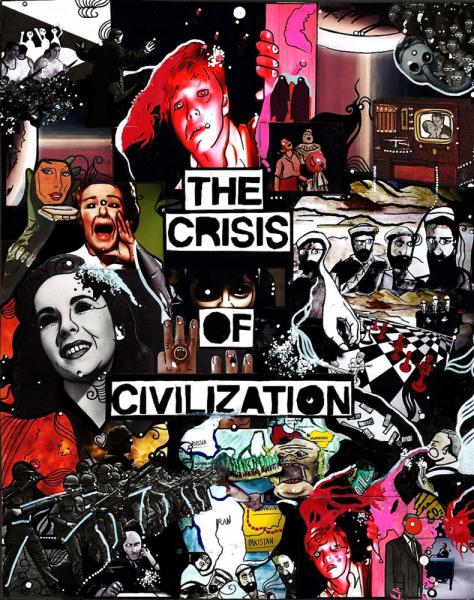 MEDIA ROOTS – When confronting the global crisis waiting on Earth’s doorstep, most people deconstruct the bulk catastrophe and break it down into more palatable, bite size pieces. These smaller pieces are easier and less frightening to consume. No one dares to face the painful truth of reality as a whole. But there is one movie that has defied the status quo, rejects the fear and valiantly plunges forward, realizing that it would be fatal not to analyze global challenges as a systemic whole: Crisis of Civilization. The provocative 2011 documentary examines an array of global crises as its own ecosystem of sorts, rather than as isolated, discrete events. When taken as a composite, these crises pose an imminent threat to humanity and civilization as we know it. Director Dean Puckett leads the viewer on a tour through a plausible and, frightening scenario, using the expert commentary of Dr. Nafeez Mossadeq Ahmed.
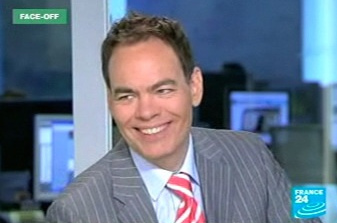 MEDIA ROOTS — Noted economist and syndicated TV show host,
  MEDIA ROOTS — Instead of the run of the mill faceless accusations of ‘The 1% are oppressing the 99%’ research organization Project Censored has compiled a valuable list with names and faces of some of the world’s biggest earners and financial elites.
  MEDIA ROOTS — Life in modern USA is increasingly polarised. A false two-party system, designed and executed by the elite class, erodes democracy and allows elites to continue to swim in money whilst public institutions, such as schools and parks and post offices, cease to operate. Public purpose is often distorted and the social contract is undermined, as families are dispossessed.
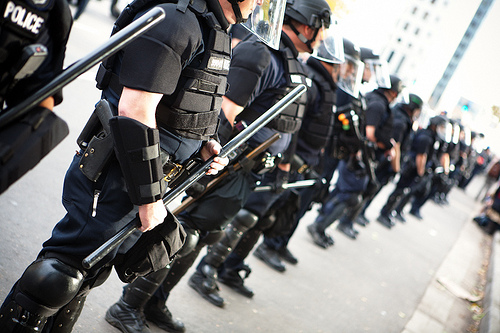 MEDIA ROOTS — The 1980s anti-communist film Red Dawn is a favorite among the liberty movement and any paleo-convervatives whom support big government. The cult film portrays a youthful resistence movement that formed in response to a full-scale military invasion of the United States by a communist nation.