Thailand Extends Emergency Rule

AGENCE FRANCE PRESSE– Thailand on Tuesday extended emergency rule across about one quarter of the country by three months over lingering fears of unrest, despite calls from rights groups for the sweeping powers to be lifted.

The state of emergency, imposed in April after mass opposition protests broke out in the capital, will be maintained in Bangkok and 18 other provinces — out of a total of 76 — but lifted in five others, officials said.

Prime Minister Abhisit Vejjajiva said there were still reports of activity by the anti-government “Red Shirts”, whose protests in Bangkok erupted into the country’s worst political violence in decades.

“The government still needs the tools to ensure peace, order and stability for a while,” he said.

The emergency law bans public gatherings of more than five people and gives security forces the right to detain suspects for 30 days without charge.

The authorities have used the powers to arrest hundreds of suspects — including most of the top leaders of the “Red Shirt” protest movement — and shut down anti-government TV channels, radio stations and websites.

Two months of mass anti-government rallies from mid-March by the Red Shirts, who were seeking immediate elections, sparked outbreaks of violence that left 90 people dead, mostly civilians, and nearly 1,900 injured.

Continue reading about Thailand’s Emergency Rule.

© AGENCE FRANCE PRESS, 2010

Photo by null0 flickr user

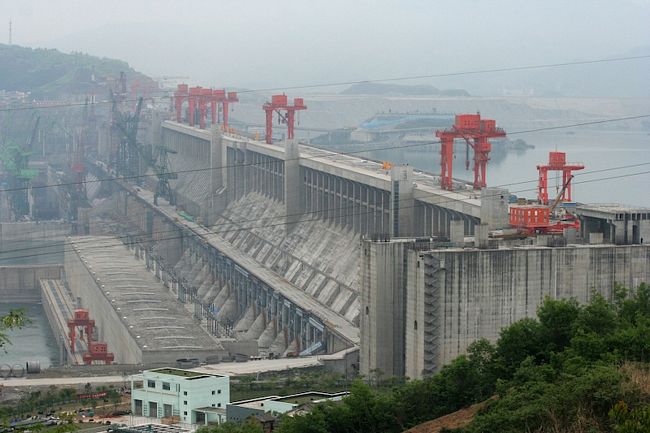
China’s Monster Three Gorges Dam About to Slow Rotation of the Earth

BUSINESS INSIDER The Myth: The filling of the reservoir behind Three Gorges Dam in China changed the rotation of the Earth.

The Evidence: Three Gorges Dam, China crosses the Yangtze River in Hubei province, China. It the world’s largest hydroelectric power station by total capacity, which will be 22,500 MW when completed. When the water level is maximum at 175 meters (574 ft) over sea level (91 meters (299 ft) above river level), the reservoir created by the dam is about 660 kilometers (410 mi) in length and 1.12 kilometers (0.70 mi) in width on average.

The total surface area of the reservoir is 1045 square kilometers, and it will will flood a total area of 632 square kilometers, of land.  The reservoir will contain about 39.3 cu km (9.43 cubic miles) of water. That water will weigh more than 39 trillion kilograms (42 billion tons).

A shift in a mass of that size would affect the rotation of the Earth due to a phenomena known as the moment of inertia, which is the inertia of a rigid rotating body with respect to its rotation. The moment of inertia of an object about a given axis describes how difficult it is to change its angular motion about that axis. The longer the distance of a mass to its axis of rotation, the slower it will spin. You may not know it, but you see examples of this in everyday life. 

For example, a figure skater attempting to spin faster will draw her arms tight to her bodies, and thereby reduce her moment of inertia. Similarly, a diver attempting to somersault faster will bring his body into a tucked position.

Raising 39 trillion kilograms of water 175 meters above sea level will increase the Earth’s moment of inertia and thus slow its rotation. However, the effect would extremely small.  NASA scientists calculated that shift of such as mass would increase the length of day by only 0.06 microseconds and make the Earth only very slightly more round in the middle and flat on the top.

It would shift the pole position by about two centimeters (0.8 inch). Note that a shift in any object’s mass on the Earth relative to its axis of rotation will change its moment of inertia, although most shifts are too small to be measured (but they can be calculated).

The Verdict: True.

Copyright © 2010 Business Insider, Inc. All rights reserved.

China Tries to Sterilize 10,000 Parents Over One Child Rule

TIMES ONLINE– Doctors in southern China are working around the clock to fulfil a government goal to sterilise — by force if necessary — almost 10,000 men and women who have violated birth control policies. Family planning authorities are so determined to stop couples from producing more children than the regulations allow that they are detaining the relatives of those who resist.

About 1,300 people are being held in cramped conditions in towns across Puning county, in Guangdong Province, as officials try to put pressure on couples who have illegal children to come forward for sterilisation. The 20-day campaign, which was launched on April 7, aims to complete 9,559 sterilisations in Puning, which, with a population of 2.24 million, is the most populous county in the province.

A doctor in Daba village said that his team was working flat out, beginning sterilisations every day at 8am and working straight through until 4am the following day. Zhang Lizhao, 38, the father of two sons, aged 6 and 4, said that he rushed home late last night from buying loquats for his wholesale fruit business to undergo sterilisation after his elder brother was detained. His wife had already returned so that the brother would be freed.

Mr Zhang said: “This morning my wife called me and said they were forcing her to be sterilised today. She pleaded with the clinic to wait because she has her period. But they would not wait a single day. I called and begged them but they said no. So I have rushed back. I am satisfied because I have two sons.”

Thousands of others have refused to submit and officials are continuing to detain relatives, including elderly parents, to force them to submit to surgery. Those in detention are required to listen to lectures on the rules limiting the size of families.

On April 10 The Southern Countryside Daily reported on about 100 people, mostly elderly, packed into a damp 200sq m (2,150sq ft) room at a township family planning centre. The newspaper said: “There were some mats on the floor but the room was too small for all people to lie down and sleep, so the young ones had to stand or squat. Owing to the lack of quilts, many cuddled up to fight the cold.”

Among those being held was the 68-year-old father of Huang Ruifeng, who has three daughters. Mr Huang said: “Several days ago a village official called me and asked me or my wife to return for the surgery. Otherwise they would take away my father.” He said that he was too busy to go and did not have confidence in village medical techniques. In any case, he wanted his wife to give birth to a son first.

An official at the Puning Population and Family Planning Bureau, who declined to be identified, told The Global Times: “It’s not uncommon for family planning authorities to adopt some tough tactics.”

In Puning county couples with illegal children and their relatives who apply for permits to build a house are rejected. Illegal children are refused residency registration, a penalty that denies them access to healthcare and education. Authorities have discovered, however, that those methods have less success than rounding up relatives. One official said that an investigation would be launched to establish whether authorities in Puning had exceeded their remit.

A state-level regulation stipulates that couples who violate the family planning policy must not be punished without proper authorisation and family members may not be penalised to put pressure on couples. In the years after China launched its strict “one couple, one child” family planning policy in the late 1970s abuses such as forced late-term abortions, sterilisations and even the killing of newborn babies were widely reported. Such practices have diminished in recent years, as the policy has become more widely accepted and exceptions have been introduced.

Officials in Puning are under particular pressure, however: they risk failing in their bid for promotion to a second-tier county if they cannot meet all quotas. That includes keeping the number of births within government limits. The county is under criticism from Guangdong authorities, who want to slow a population growth that is reflecting badly on the entire province. One reason for Puning’s large population is that families in the mainly rural region often have up to three or four children.

Many of those with extra children have left to find factory jobs along the more developed coast, taking advantage of being away from local government surveillance to give birth outside the quotas. Rules in Puning, as throughout rural China, allow farmers to have a second child if the first is a daughter. After that couples must stop. By the morning of April 12 Puning officials said that they had achieved, in a mere five days, about half of their sterilisation goal after their “education” persuaded people to comply.

Family planning

• China is the world’s most populous country with about 1.3 billion people. By 2025 the population is expected to exceed 1.4 billion

• The birthrate is low at 14 births per 1,000 people every year but the infant mortality rate is also low, at 20.25 deaths per 1,000 live births

• The single-child policy, referred to by the Chinese Government as the family planning policy, was introduced in 1978 to ensure that China could feed all of its people

• The policy stipulates that couples living in cities can have one child, unless one or both are from an ethnic minority or they are both only children. In most rural areas a couple may have a second child after a break of several years

• Despite the policy, it is common to find couples in the countryside, where 80 per cent of the population live, with a large number of children

• Many couples get round the law by sending pregnant women to stay with relatives, then claiming that the baby was adopted or belongs to a friend or relative

• Critics say that the policy has led to the killing of female infants because of the traditional preference for boys

Sources: BBC; CIA World Factbook

© COPYRIGHT TIMES ONLINE, 2010

Photo by Flickr user Benoitflorencon

South Korean Couple Raise Virtual Baby While Real Baby Starves

CNN– A South Korean couple arrested for allowing their baby to starve to death had been raising an online child, state media reported citing police sources.

The couple, residents of a Seoul suburb, allegedly neglected their prematurely born three-month-old daughter, feeding her just once a day in between 12-hour stretches at a neighborhood internet cafe, the official Yonhap news agency reported.

Police said the couple had become obsessed with raising a virtual girl character called “Anima” in “Prius Online”, a popular role-playing game in South Korea.

“The couple seemed to have lost their will to live a normal life, because they didn’t have jobs and gave birth to a premature baby,” said Chung Jin-won, a police officer.

“They indulged themselves in the online game of raising a virtual character so as to escape from reality, which led to the death of their real baby.”

Professor Kwak Dae-kyung of Seoul’s Dongguk University told the Yonhap news agency that the couple appeared to have lost track of reality.

“Online game addiction can blur the line between reality and the virtual world. It seems that taking care of their on-line game character erased any sense of guilt they may have had for neglecting their daughter.”

Dae-kyung urged the government to prepare measures so that families and neighbors can contact local authorities or hospitals if anyone shows symptoms of online addiction.

“This kind of situation is not a problem that an individual can solve,” he said.

© COPYRIGHT CNN, 2010

China to Continue Buying US Debt

FOX NEWS– China will continue buying U.S. government debt while paying close attention to possible fluctuations in the value of those assets, a vice governor of Beijing’s central bank said Monday.

Investing in U.S. Treasury bills is “an important component part of China’s foreign currency reserve investments,” People’s Bank of China Vice Governor Hu Xiaolian said at a news conference on Monday.

“So as an important component we are naturally relatively concerned with the safety and profitability of U.S. government bonds,” Hu said – statement apparently aimed at concerns that rising debt to fund Washington’s stimulus package could spur inflation and weaken the dollar.

China is Washington’s biggest foreign creditor, holding an estimated $1 trillion in U.S. government debt. A weaker dollar would erode the value of those assets.

Hu’s comments follow remarks earlier this month from Chinese Premier Wen Jiabao that he was “a little bit worried” about China’s holdings of U.S. government debt. Wen called on the U.S. to honor its commitments, remain credit-worthy, and ensure the safety of Chinese assets.

China’s investments are likely to be a major topic of discussion when Chinese President Hu Jintao meets with President Barack Obama on the sidelines of an April 2 summit in London of the Group of 20 major economies called to discuss remedies for the global financial crisis.

Continue reading about China’s Buying of US Debt.

© COPYRIGHT FOX NEWS, 2009

Photo by flickr user peruisay

Posted in Uncategorized | 1 Reply