Pentagon Successfully Tests Hypersonic Flying Bomb

MEDIA ROOTS – Two weeks ago the U.S. department of defense tested a new weapon that, by being able to travel faster than the speed of sound and strike any location on the planet in under an hour, combines the global reach of the Cold War’s intercontinental ballistic missiles, and the surgical precision of today’s robotic flying drones.

In doing so, the military problem of Mutually Assured Destruction that once kept adversaries at bay is being stripped away, making the use of military force more “reasonable.”

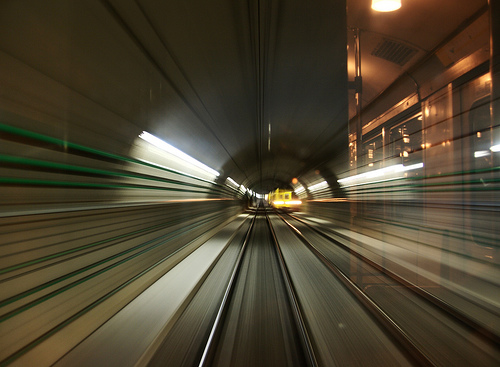
The new weapon, called the “Advanced Hypersonic Weapon,” or AHW, is a remote controlled flying weapons delivery system (a flying bomb) that travels at hypersonic speeds within the earth’s atmosphere.  The weapon was launched from the Hawaiian islands and steered 2,300 miles over the Pacific ocean to the Marshall Islands in under half an hour.

The AHW is a first-of-its-kind glide vehicle designed to fly long range carrying a payload of up to 5500 kgs, including a nuclear bomb, according to a statement issued by the US  Department of Defense.  A hypersonic speed is one that exceeds Mach 5- or five times the speed of sound (3,728 mph).

Among other things, this means the army will no longer have to depend on forces stationed around the world as they can lay down fire power anywhere they need from the comfort of a home base, without risking any American lives.

During the Cold War, the West and East developed nuclear and intercontinental missile delivery capabilities, but the concept of Mutually Assured Destruction made the actual use of the weaponry “unreasonable.”  Using them would have been an act of insanity and suicide for both parties because the destruction would be so wide spread for everyone involved.  As instruments of policy, these weapons were deemed useless.

The new AHW, however, promises to be a very usable weapon of policy.  By eliminating the need for U.S. forces in the immediate theater of war, the AHW moves offensive actions further along a continuum that distances the warrior from their target and, in effect, from the moral responsibility for pulling a trigger.

Such a weapon even allows for plausible deniability.  No blood on their hands, and you certainly can’t place them at the scene since they were halfway around the world at the time.

For these reasons, the AHW is a weapon that allows its possessor a step in the direction of absolute power.  We don’t risk our people, we don’t risk our sense of morality, and we don’t even risk blame.  It’s a clean and detached method of warfare, but how will it change our moral and ethical code as a people who are sponsoring this futuristic weaponry?

Written by Joel E. Hersch for Media Roots

Photo by Flickr user lrargerich
The Capitalist Network That Runs the World

MEDIA ROOTS- In an empirical study using complex systems analysis models, mathematical theorists in Zurich have revealed the architecture of transnational corporations’ (TNCs) interconnectedness. The report bolsters the charges made of late by the Occupy Wall Street Movement touting society’s obscene inequality—1% of the population owns almost half of all U.S. wealth.  This study’s findings, an uncanny correlative of the individual TNC to the individual ruling-class elitist, reveal that less than 1% of all TNCs essentially control 40% of the global economy. 

Messina

***

CapitalistNetworkPLoSOneNEW SCIENTIST— AS PROTESTS against financial power sweep the world this week, science may have confirmed the protesters’ worst fears. An analysis of the relationships between 43,000 transnational corporations has identified a relatively small group of companies, mainly banks, with disproportionate power over the global economy.

The study’s assumptions have attracted some criticism, but complex systems analysts contacted by New Scientist say it is a unique effort to untangle control in the global economy. Pushing the analysis further, they say, could help to identify ways of making global capitalism more stable.

The idea that a few bankers control a large chunk of the global economy might not seem like news to New York’s Occupy Wall Street movement and protesters elsewhere (see photo). But the study, by a trio of complex systems theorists at the Swiss Federal Institute of Technology in Zurich, is the first to go beyond ideology to empirically identify such a network of power. It combines the mathematics long used to model natural systems with comprehensive corporate data to map ownership among the world’s transnational corporations (TNCs).

“Reality is so complex, we must move away from dogma, whether it’s conspiracy theories or free-market,” says James Glattfelder. “Our analysis is reality-based.”

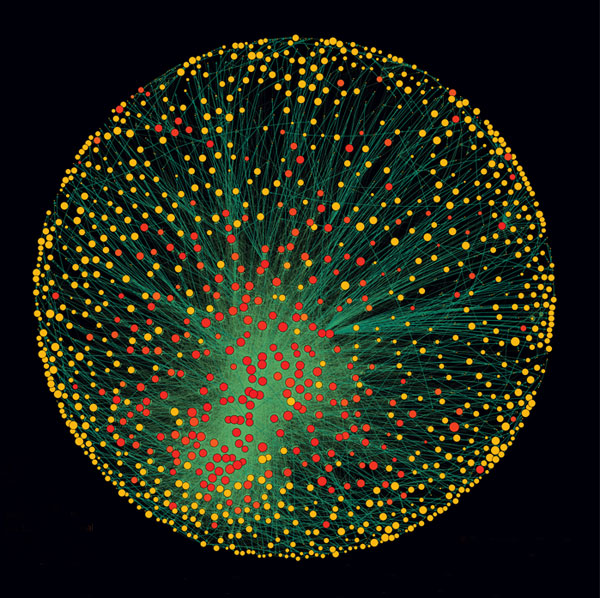
The work, to be published in PLoS One, revealed a core of 1318 companies with interlocking ownerships (see image). Each of the 1318 had ties to two or more other companies, and on average they were connected to 20. What’s more, although they represented 20 per cent of global operating revenues, the 1318 appeared to collectively own through their shares the majority of the world’s large blue chip and manufacturing firms – the “real” economy – representing a further 60 per cent of global revenues.

When the team further untangled the web of ownership, it found much of it tracked back to a “super-entity” of 147 even more tightly knit companies – all of their ownership was held by other members of the super-entity – that controlled 40 per cent of the total wealth in the network. “In effect, less than 1 per cent of the companies were able to control 40 per cent of the entire network,” says Glattfelder. Most were financial institutions. The top 20 included Barclays Bank, JPMorgan Chase & Co, and The Goldman Sachs Group.

Read more about the capitalist network that runs the world.

© 2011 Reed Business Information Ltd.

Image by PLoS One

Scientists Remodel Brains’ Visions Into Digital Video

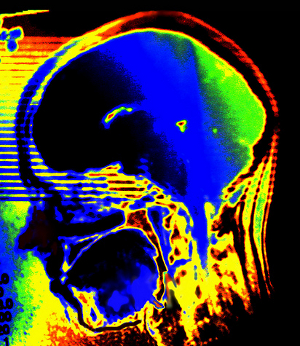
MEDIA ROOTS- Ten years ago, the concept of visually mapping out one’s thoughts, dreams or memories seemed like far-fetched science fiction. Now, it’s a looming reality. UC Berkeley scientists have made a mind-blowing technological breakthrough by developing a system that collects visual activity in the human brain and roughly remodels it as digital video clips. After the process is perfected it will eventually lead to the reconstruction of dreams onto computers.

Abby

***

GIZMODO They used three different subjects for the experiments—incidentally, they were part of the research team because it requires being inside a functional Magnetic Resonance Imaging system for hours at a time. The subjects were exposed to two different groups of Hollywood movie trailers as the fMRI system recorded the brain’s blood flow through their brains’ visual cortex.

The readings were fed into a computer program in which they were divided into three-dimensional pixels units called voxels (volumetric pixels). This process effectively decodes the brain signals generated by moving pictures, connecting the shape and motion information from the movies to specific brain actions. As the sessions progressed, the computer learned more and more about how the visual activity presented on the screen corresponded to the brain activity.

After recording this information, another group of clips was used to reconstruct the videos shown to the subjects. The computer analyzed 18 million seconds of random YouTube video, building a database of potential brain activity for each clip. From all these videos, the software picked the one hundred clips that caused a brain activity more similar to the ones the subject watched, combining them into one final movie. Although the resulting video is low resolution and blurry, it clearly matched the actual clips watched by the subjects.

Think about those 18 million seconds of random videos as a painter’s color palette. A painter sees a red rose in real life and tries to reproduce the color using the different kinds of reds available in his palette, combining them to match what he’s seeing. The software is the painter and the 18 million seconds of random video is its color palette. It analyzes how the brain reacts to certain stimuli, compares it to the brain reactions to the 18-million-second palette, and picks what more closely matches those brain reactions. Then it combines the clips into a new one that duplicates what the subject was seeing. Notice that the 18 million seconds of motion video are not what the subject is seeing. They are random bits used just to compose the brain image.

Given a big enough database of video material and enough computing power, the system would be able to re-create any images in your brain.

Read more about Scientists Reconstruct Brains’ Visions Into Digital Video In Historic Experiment

© 2011 Gizmodo


Video comparing reconstructed clips from human brain activity compared to actual images shown

http://gallantlab.org


Photo by Flickr user alles-schlumpf

Cancer: A Different Beast Entirely?

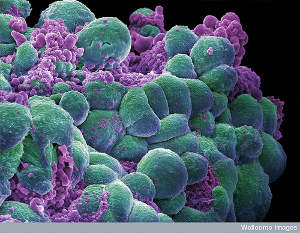
MEDIA ROOTS- Fascinating new research being done at Berkeley could completely transform the way we look at cancer from now on. Scientists are now arguing that the disease might actually be its own foreign species, instead of a creation of our own DNA. If this incredible discovery is indeed true, it could explain a lot about cancer’s resilience and the nature of the beast.

Abby

***

SALON– The science is complex, but it boils down to a shift in thinking about the way in which cancer is born. For years, scientists have believed that the disease begins when a few mutated genes give rise to renegade body cells that multiply beyond control.

But the Berkeley team, led by Dr. Peter Duesberg, argues that cancers are actually born from entire chromosomes, the long bands of genetic material that house our genes. What occurs is a process called aneuploidy, in which “disruptions” in chromosomes cause perversions of our genetic material, which can multiply during cell division. As a result, our DNA is rendered nearly unrecognizable.

According to PhysOrg.com: 

Normally this would be a death sentence for a cell, but in rare cases, [Duesberg] said, such disrupted chromosomes might be able to divide further, perpetuating and compounding the damage. Over decades, continued cell division would produce many unviable cells as well as a few still able to divide autonomously and seed cancer.

The genetic makeup of the cancerous cells, because of aneuploidy, bears strikingly little resemblance to our original DNA. However, the cancer still shows “relatively stable chromosomal patterns.” Those patterns are called karyotypes, and are a hallmark of living organisms.

[Duesberg] and his colleagues analyzed several cancers, clearly demonstrating that the karyotype is amazingly similar in all cells of a specific cancer line, yet totally different from the karyotypes of other cancers and even the same type of cancer from a different patient.

Translation: Each different case of cancer is a unique, parasitic species. And these species are flexible, adaptable, immortal and autonomous — as long as the host survives, of course.

A group of researchers at University of California at Berkeley have proposed a radical new theory that would cast most everything we know about cancer in a new light. While scientists have for years believed that the disease was the result of our own DNA run amok, the truth might be much weirder — that cancer is, maybe, its own separate species.
The science is complex, but it boils down to a shift in thinking about the way in which cancer is born. For years, scientists have believed that the disease begins when a few mutated genes give rise to renegade body cells that multiply beyond control. But the Berkeley team, led by Dr. Peter Duesberg, argues that cancers are actually born from entire chromosomes, the long bands of genetic material that house our genes. What occurs is a process called aneuploidy, in which “disruptions” in chromosomes cause perversions of our genetic material, which can multiply during cell division. As a result, our DNA is rendered nearly unrecognizable.
According to PhysOrg.com: 
Normally this would be a death sentence for a cell, but in rare cases, [Duesberg] said, such disrupted chromosomes might be able to divide further, perpetuating and compounding the damage. Over decades, continued cell division would produce many unviable cells as well as a few still able to divide autonomously and seed cancer.
The genetic makeup of the cancerous cells, because of aneuploidy, bears strikingly little resemblance to our original DNA. However, the cancer still shows “relatively stable chromosomal patterns.” Those patterns are called karyotypes, and are a hallmark of living organisms.
[Duesberg] and his colleagues analyzed several cancers, clearly demonstrating that the karyotype is amazingly similar in all cells of a specific cancer line, yet totally different from the karyotypes of other cancers and even the same type of cancer from a different patient.
Translation: Each different case of cancer is a unique, parasitic species. And these species are flexible, adaptable, immortal and autonomous — as long as the host survives, of course.
In a press release, Duesberg said:
Cancer is comparable to a bacterial level of complexity, but still autonomous, that is, it doesn’t depend on other cells for survival; it doesn’t follow orders like other cells in the body, and it can grow where, when and how it likes. That’s what species are all about … Once a cell has crossed that barrier of autonomy, it’s a new species.

Read more about A Different Beast Entirely.

© 2011 Salon

Photo by Flickr user crafty_dame

Posted in Uncategorized | 1 Reply

Two Suns Could Be Visible From Earth By 2012

MEDIA ROOTS- Humanity could be about to witness an incredible, apocalyptic spectacle– the earth could temporarily be getting a second sun, if one of the brightest night’s stars explodes and becomes super-nova, as predicted by astronomers. Huffington Post reports on the potential scenario and explores other possible outcomes.

Abby

***

THE HUFFINGTON POST– Dr. Brad Carter, Senior Lecturer of Physics at the University of Southern Queensland, outlined the scenario. Betelgeuse, one of the night sky’s brightest stars, is losing mass, indicating it is collapsing. It could run out of fuel and go super-nova at any time.

When that happens, for at least a few weeks, we’d see a second sun, Carter says. There may also be no night during that timeframe.

The Star Wars-esque scenario could happen by 2012, Carter says… or it could take longer. The explosion could also cause a neutron star or result in the formation of a black hole 1300 light years from Earth, reports news.com.au.

But doomsday sayers should be careful about speculation on this one. If the star does go super-nova, Earth will be showered with harmless particles, according to Carter. “They will flood through the Earth and bizarrely enough, even though the supernova we see visually will light up the night sky, 99 per cent of the energy in the supernova is released in these particles that will come through our bodies and through the Earth with absolutely no harm whatsoever,” he told news.com.au.

Earth could be getting a second sun, at least temporarily.
Dr. Brad Carter, Senior Lecturer of Physics at the University of Southern Queensland, outlined the scenario to news.com.au. Betelgeuse, one of the night sky’s brightest stars, is losing mass, indicating it is collapsing. It could run out of fuel and go super-nova at any time.
When that happens, for at least a few weeks, we’d see a second sun, Carter says. There may also be no night during that timeframe.
The Star Wars-esque scenario could happen by 2012, Carter says… or it could take longer. The explosion could also cause a neutron star or result in the formation of a black hole 1300 light years from Earth, reports news.com.au.
But doomsday sayers should be careful about speculation on this one. If the star does go super-nova, Earth will be showered with harmless particles, according to Carter. “They will flood through the Earth and bizarrely enough, even though the supernova we see visually will light up the night sky, 99 per cent of the energy in the supernova is released in these particles that will come through our bodies and through the Earth with absolutely no harm whatsoever,” he told news.com.au.
In fact, a neutrino shower could be beneficial to Earth. According to Carter this “star stuff” makes upthe universe. “It literally makes things like gold, silver – all the heavy elements – even things like uranium….a star like Betelgeuse is instantly forming for us all sorts of heavy elements and atoms that our own Earth and our own bodies have from long past supernovi,” said Carter.
UPDATE: To clarify, the news.com.au article does not say a neutrino shower could be beneficial to Earth, but implies a supernova could be beneficial, stating, “Far from being a sign of the apocalypse, according to Dr Carter the supernova will provide Earth with elements necessary for survival and continuity.”

Read more about Two Suns? Twin Stars Could Be Visible From Earth By 2012

© 2011 The Huffington Post

Photo by Flickr user framboise

Page 7 of 24<<...56789...>>