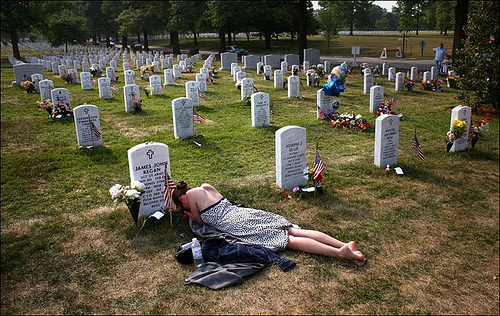
More Troops Hospitalized for Mental Health than Any Other Reason

RAW STORY– More U.S. troops were hospitalized for mental health disorders than any other reason in 2009. Mental health hospitalizations throughout the military topped injuries, battle wounds and even pregnancy and childbirth for the first time in 15 years of tracking by the Pentagon’s Medical Surveillance Monthly report.

USA Today‘s Gregg Zoroya broke the news Friday.

Mental health care accounted for almost 40% of all days spent in hospitals by servicemembers last year, the report said. Of those hospitalizations, 5% lasted longer than 33 days. For most other conditions, fewer than 5% of hospitalizations exceeded 12 days, the report said.

In 2009, there were 17,538 hospitalizations for mental health issues throughout the military, the study shows. That compares with 17,354 for pregnancy and childbirth reasons, and 11,156 for injuries and battle wounds.

Psychological issues such as post-traumatic stress disorder exact a toll in lost manpower, the study said. Four mental health issues — depression, substance abuse, anxiety and adjustment problems such as PTSD — cost the Pentagon 488 years of lost duty in 2009.

“There’s no shame in my game,” Herschel Walker told a group of soldiers from Winn Army Hospital’s Warriors in Transition Program in Georgia one day earlier.

The former NFL star overcame dissociative identity disorder at Fort Stewart’s Main Chapel and, according to Bryan County News, appealed to those who battle behavioral issues to seek help as he did.

“It’s inspiring for us to have Mr. Walker come,” Winn Army Community Hospital Commander Col. Paul R. Cordts said Thursday. “He’s of course a Heisman Trophy winner, had a huge NFL football career but he came here to speak to our soldiers about his experiences with a behavioral health diagnosis. We recognize that combat affects all soldiers. Some soldiers develop symptoms of post traumatic stress disorder. We wanted Mr. Walker to come and talk about his experience of going through treatment for his disorder as well as dispelling some of the stigma associated with having a behavioral health disorder.”

Obviously PTSD, depression, anxiety and substance abuse are not limited to American soldiers. According to a new U.K. Ministry of Defense study covered Thursday by The Guardian, troops serving in Iraq and Afghanistan have a 22% higher risk of alcohol misuse than their fellow servicemen and women.

Reservists serving in Iraq and Afghanistan were found to be three times as likely to suffer PTSD as other reservists, while regular personnel in combat roles there were found to be twice as likely to report the disorder.

Simon Wessely of the Institute of Psychiatry at King’s College London thinks alcohol abuse is even more of a concern than PTSD. “Our view is that alcohol misuse is actually a greater problem for the armed forces than PTSD,” he said.

Continue reading about Mental Health of Returning Soldiers.

© RAW STORY, 2010
US Pays Taliban Members to Switch Sides

TIMES OF INDIA– US President Barack Obama has signed a $680 billion defence appropriations bill with one provision giving commanders the ability to pay Taliban members to switch sides, but some experts feel the programme may buy only temporary loyalty.

The payments to Taliban would be made under a Taliban reintegration provision under the Commander’s Emergency Response Programme (CERP), which is now receiving $1.3 billion in the bill pay for military operations in the 2010 fiscal year, signed by Obama on Wednesday.

CERP funding is also intended for humanitarian relief and reconstruction projects at commanders’ discretion.

The buyout idea, according to Senator Carl Levin, chairman of the Senate Armed Services Committee, is to separate local Taliban from their leaders, replicating a programme used to neutralise the insurgency against Americans in Iraq.

“Afghan leaders and our military say that local Taliban fighters are motivated largely by the need for a job or loyalty to the local leader who pays them and not by ideology or religious zeal,” Levin said in a Senate floor speech Sep 11.

“They believe an effort to attract these fighters to the government’s side could succeed, if they are offered security for themselves and their families, and if there is no penalty for previous activity against us.”

The top commander in Afghanistan has backed the plan for the Taliban. “Most of the fighters we see in Afghanistan are Afghans, some with (a) foreign cadre with them,” said Gen. Stanley McChrystal in a July 28 Los Angeles Times interview.

Most are not ideologically or even politically motivated, he said in the interview.

“Most are operating for pay; some are under a commanders charismatic leadership; some are frustrated with local leaders.”

But Nicholas Schmidle, an expert on the Afghanistan-Pakistan region for the non-partisan New America Foundation, cited by CNN said that while the plan has a “reasonable chance for some success”, the old Afghan saying – “You can rent an Afghan, but you can’t buy him” – will eventually be borne out.

“So long as the Americans are keenly aware of this, you’re buying a very, very, very temporary allegiance,” he said. “If that’s the foundation for moving forward, it’s a shaky foundation.”

CNN security analyst Peter Bergen said the idea of paying off Taliban members to quit is nothing new. “There’s been an amnesty programme for low-level Taliban in place for many years now and thousands of people have taken advantage of it,” he said.

© COPYRIGHT TIMES OF INDIA, 2010

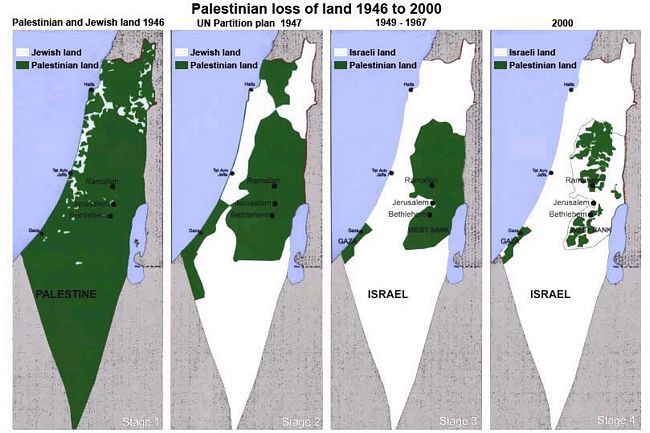
Map of Israel’s Progressive Takeover of Palestine

THE ATLANTIC– Joe Biden was kicked in the balls as he came to Israel with a simultaneous “fuck you” by the Israeli government announcing new settlements – 1600 houses – in East Jerusalem. The immediate spin was that Netanyahu was blindsided by the actions of his Interior Department and was embarrassed. But Haaretz reports today that these 1600 are just the beginning:

Some 50,000 new housing units in Jerusalem neighborhoods beyond the Green Line are in various stages of planning and approval, planning officials told Haaretz. They said Jerusalem’s construction plans for the next few years, even decades, are expected to focus on East Jerusalem.

Most of the housing units will be built in predominantly Jewish neighborhoods beyond the Green Line, while a smaller number of them will be built in Arab neighborhoods. The plans for some 20,000 of the apartments are already in advanced stages of approval and implementation, while plans for the remainder have yet to be submitted to the planning committees.

But Laura Rozen, always worth reading, sees skepticism in Israel:

Many observers were skeptical that Netanyahu was as in the dark about the plan as he claimed to Biden.

“Either one believes Netanyahu and his friends in government (saying it is all misunderstanding and bad timing),” wrote Jerusalem Post blogger Shmuel Rosner. “In such case, one should be concerned by Israel’s chaotic decision-making process on delicate matters.”

“Or, one might choose not to believe,” Rosner continued. “One might think Netanyahu isn’t telling the truth, or that [Interior Minister] Yishai is bluffing. If it’s the former, one will conclude that Netanyahu has no intention of seriously exploring the just-announced peace negotiations. If it’s the latter one will realize that Shas and Yishai are strong enough to toy with Netanyahu as much as they want – as much as embarrassing the American [Vice President]! – without paying a price. Not an encouraging thought.”

I cannot read Netanyahu’s mind. But I can observe Israel’s actions. They intend to occupy and colonize the entire West Bank forever.  They may allow some parceled enclaves for Palestinians, but they will maintain a big military presence on the Eastern border of West Bank, and they will sustain this with raw military power and force. I certainly cannot see any other rationale for their actions these past few years that makes any sense at all. Many Israeli politicians now use the term “apartheid” for this future. 

Map via Juan Cole

© THE ATLANTIC, 2010

Posted in Uncategorized | 1 Reply

In Iraq’s Bloodiest Day of 2010, Attacks Kill 100

YAHOO NEWS– A man with explosives strapped to his body blew himself up in a crowd, bombers struck a southern city and gunmen sprayed fire on security checkpoints in attacks Monday that killed at least 100 people — most of them in Shiite areas — in Iraq’s deadliest day this year.

Officials were quick to blame insurgents linked to al-Qaida in Iraq for the shootings in the capital, saying the militants were redoubling efforts to destabilize the country at a time of political uncertainty over who will control the next government.

Shiite Vice President Adel Abdul-Mahdi stressed the importance of quickly forming a government that does not exclude any major political group to try to prevent insurgents from exploiting Iraq’s fragile security.

“The terrorist gangs perpetrated new assaults today on our people and armed forces,” he said. “We call on all political blocs to work seriously for the benefit of the country and … start to form a national partnership government including all political parties without marginalizing any one.”

More than two months after the March 7 election, Iraq’s main political factions are still struggling to put together a ruling coalition. Prime Minister Nouri al-Maliki‘s Shiite bloc has tried to squeeze out election front-runner Ayad Allawi — a secular Shiite who was heavily backed by Sunnis — by forging an alliance last week with another religious Shiite coalition. The union, which is just four seats short of a majority in parliament, will likely lead to four more years of a government dominated by Shiites, much like the current one.

Sunni anger at Shiite domination of successive governments was a key reason behind the insurgency that sparked sectarian warfare in 2006 and 2007. If Allawi is perceived as not getting his fair share of power, that could in turn outrage the Sunnis who supported him and risk a resurgence of sectarian violence.

The relentless cascade of bombings and shootings — hitting at least 10 cities and towns as the day unfolded — also raised questions about whether Iraqi security forces can protect the country as the U.S. prepares to withdraw half of its remaining 92,000 troops in Iraq over the next four months.

Continue reading about Iraq’s Bloodiest Day.

Associated Press Writers Saad Abdul-Kadir and Qassim Abdul-Zahra contributed to this report.

Photo by Flickr user Peyman

© YAHOO NEWS, 2010

Page 69 of 79<<...6768697071...>>