KPFA- Mayor Gavin Newsom and other city leaders joined with the San Francisco Bicycle Coalition this afternoon to celebrate the painting of the city’s first new bike lane since the Bike Plan Injunction 4 years ago. The Injunction, lifted by the Superior Court on Friday, was the result of a lawsuit contesting the environmental review of the city’s Bike Plan adopted in 2005. Now, given the green light, the Municipal Transportation Agency is ready to stripe a record 35 bike lanes, making San Francisco one of America’s most bicycle friendly cities. Alicia Roldán files this report:
(Sound of Mayor Gavin Newsom painting the first bike lane in four years)
Mayor Newsom removed his pinstripe jacket as he joined other city leaders in pushing a paint roller over Townsend Street, striping the first of many bike lanes to be laid over the next year.
The lane laid this afternoon creates a link from the Eighth Street Station to the Embarcadero, an important connection for commuters to the Caltrain station. The Mayor said there is a full time commitment and energetic effort to complete this project that is already planned and funded.
Other lanes will be laid on key streets such as North Point St., Laguna Honda, 17th Street, Portola Dr., and Ocean Avenue.
Supervisor Ross Mirkarimi said that by doubling the number of bike lanes citywide San Francisco will keep vehicle counts down.
“Each year we are seeing an exponential increase of San Franciscans, of commuters, who want to use their bikes in this city. And that’s exactly why it is time that we design our roads to share for bikes, for pedestrians, and people who seek other modalities, other than just the private automobile.”
Bicycle ridership has increase more than 50% since 2006, despite a lack of bicycle network improvements. With the Bicycle Plan underway ridership is expected to surge. Official City counts show bicycling on average doubles after a bike lane is added.
Ian Williamson, a volunteer for the San Francisco Bicycle Coalition said the most important thing bicycle lanes do enhance the safety of cyclists.
“Just making drivers aware that cyclists have a rightful place on the road is an extremely important first step both to decrease accidents and to encourage more cyclists to get on their bikes.”
Mayor Newsom said that with mass urbanization San Francisco is competing with world class cities and that people are looking for a high quality of life. He says that a bicycle networks along side parks create this.
“Quality of life comes from a sense of place, a sense of identity, a sense of community. And community comes from not by having 25% of your land mass, which is San Francisco, just being hard surface streets but by creating a sense of place that invites people to connect and cohabitate which means softening those edges.”
When asked about the Environmental Review, Andy Thornly, program director of the SF Bicycle Coalition, said that suspension of the Bicycle Plan had been a question of process.
“One citizen was able to take a loop hole, essentially, and stop the City, based on process. The question of whether or not bikes or bicycle transportation is good for the environment has never been questioned. I think everyone gets that and we’re very confident in that.”
Supervisor Mirkarimi joined the Mayor in San Francisco’s pledge to top Portland’s ranking as the most bicycle friendly city.
“San Francisco aims to be and is serious about being very bike friendly. This is a challenge to the rest of the United States. This is an urban pledge and one that we will see no retreat to.”
Report by alicia, for Pacifica Radio, KPFA, San Francisco
Published: August 9, 2010



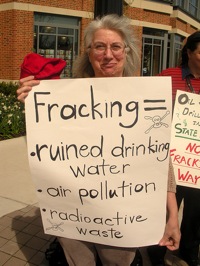 YES!– When politicians refer to natural gas as a “clean” alternative to oil and coal, they seldom mention a commonly used technique called horizontal hydraulic fracturing, also known as fracking.
 COMMON DREAMS